ORSModel
Inheritance diagram
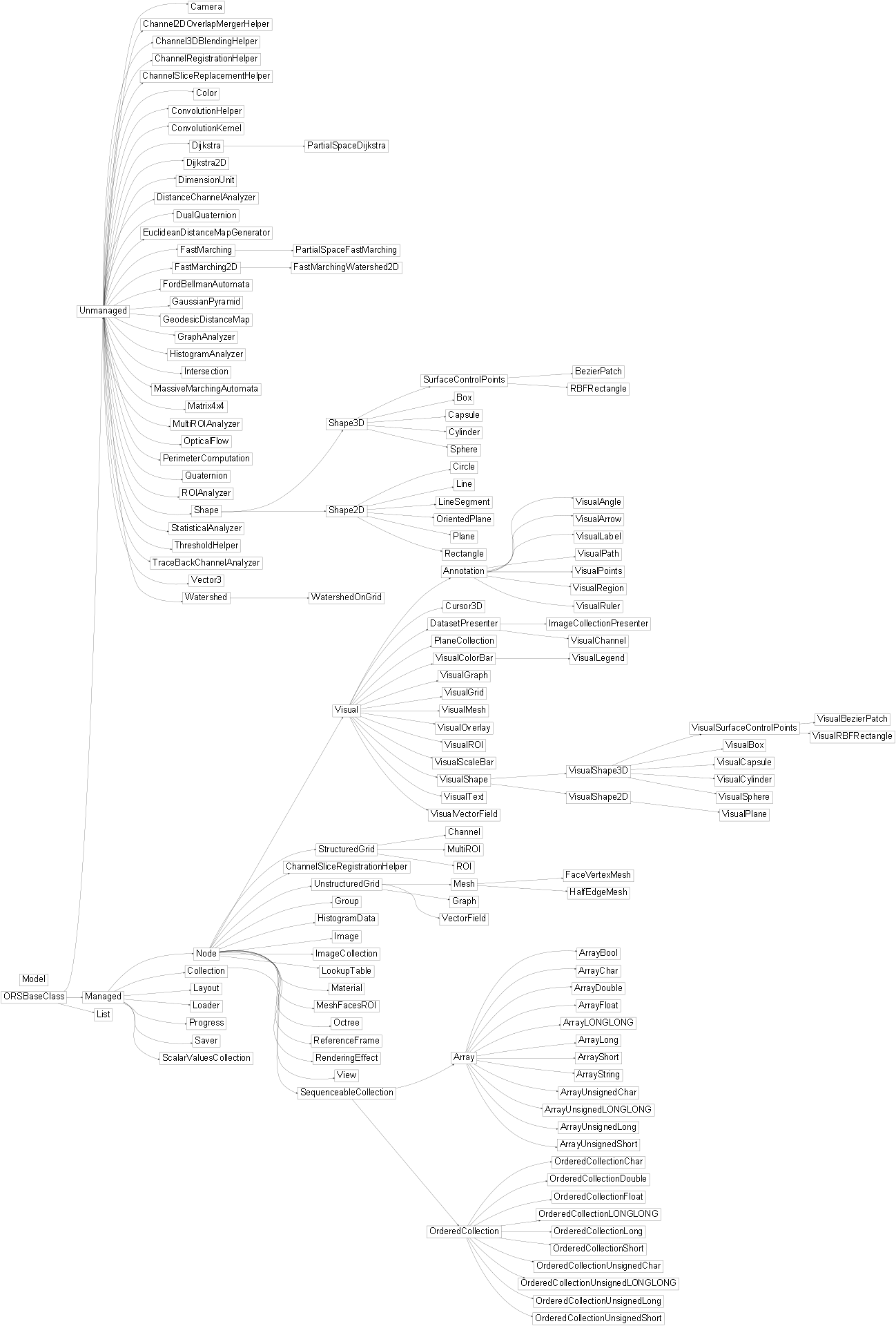
Classes
Annotation
-
class
ORSModel.ors.Annotation Bases:
ORSModel.ors.Visualbrief_description: Represents image annotations. author: Eric Fournier. All other members of ORS participated. version: 1.0 date: Aug 2006
-
addControlPoint(self, pPoint: ORSModel.ors.Vector3, iTIndex: int, aWorldTransformMatrix: ORSModel.ors.Matrix4x4) → None Adds a control point.
Note
Any change to a annotation should be followed by update() to reflect the changes visually.
Parameters: - pPoint (ORSModel.ors.Vector3) – a point (a Vector3)
- iTIndex (int) – the T index (an uint32_t)
- aWorldTransformMatrix (ORSModel.ors.Matrix4x4) – an optional transformation matrix (a Matrix4x4 or none)
-
addControlPointForAllTimeSteps(self, pPoint: ORSModel.ors.Vector3, aWorldTransformMatrix: ORSModel.ors.Matrix4x4) → None method addControlPointForAllTimeSteps
Parameters: - pPoint (ORSModel.ors.Vector3) –
- aWorldTransformMatrix (ORSModel.ors.Matrix4x4) –
-
addControlPointToHighlighted(self, controlPointIndex: int, iTIndex: int) → None Parameters: - controlPointIndex (int) –
- iTIndex (int) –
-
addControlPointToSelection(self, controlPointIndex: int, iTIndex: int) → None method addControlPointToSelection
Parameters: - controlPointIndex (int) –
- iTIndex (int) –
-
applyTransformation(self, aTransformationMatrix: ORSModel.ors.Matrix4x4, iTIndex: int) → None method applyTransformation
Parameters: - aTransformationMatrix (ORSModel.ors.Matrix4x4) –
- iTIndex (int) –
-
applyTransformationOnAllTimeStep(self, aTransformationMatrix: ORSModel.ors.Matrix4x4) → None method applyTransformationOnAllTimeStep
Parameters: aTransformationMatrix (ORSModel.ors.Matrix4x4) –
-
copyControlPointFrom(self, aControlPointCollection: ORSModel.ors.OrderedCollectionDouble, iTIndex: int) → None method copyControlPointFrom
Parameters: - aControlPointCollection (ORSModel.ors.OrderedCollectionDouble) –
- iTIndex (int) –
-
duplicateTimeStepDataAcrossAllTimeSteps(self, iTIndex: int) → None Duplicate Time Step Data Across All Time Steps.
Parameters: iTIndex (int) – the T index (an uint32_t)
-
get3DThickness(self) → float Gets the thickness of lines in 3D mode.
Returns: output (float) – the thickness, in screen proportion (a double between 0 and 1)
-
getAsROI(self, iTIndex: int, worldTransform: ORSModel.ors.Matrix4x4, pOutputROI: ORSModel.ors.ROI) → None Makes a Region of Interest from the annotation.
Parameters: - iTIndex (int) – the T index (an uint32_t)
- worldTransform (ORSModel.ors.Matrix4x4) – an optional transformation matrix (a Matrix4x4 or none())
- pOutputROI (ORSModel.ors.ROI) – the output ROI where results are to be written (a ROI)
-
getAsROIForAllTimeSteps(self, worldTransform: ORSModel.ors.Matrix4x4, pOutputROI: ORSModel.ors.ROI) → None Parameters: - worldTransform (ORSModel.ors.Matrix4x4) –
- pOutputROI (ORSModel.ors.ROI) –
-
getBackgroundBorderColor(self) → Color Returns: output (ORSModel.ors.Color) –
-
getBackgroundColor(self) → Color Returns: output (ORSModel.ors.Color) –
-
getBackgroundOpacity(self) → float Returns: output (float) –
-
getBorderPadding(self) → float Returns: output (float) –
-
getCaption(self, aView: ORSModel.ors.View, aTransformationMatrix: ORSModel.ors.Matrix4x4) → str Gets the current caption of the annotation, according to the current caption mode.
Parameters: - aView (ORSModel.ors.View) – a view (a View)
- aTransformationMatrix (ORSModel.ors.Matrix4x4) – an optional transformation matrix (a Matrix4x4 or none)
Returns: output (str) – the current caption (a string)
-
getCaptionMode(self) → int Gets the current caption mode of the annotation.
Note
See CxvAnnotationCaption_Mode in ORS_def.h for all possible caption modes.
Returns: output (int) – a caption mode (an int32_t)
-
getCaptionTextFontName(self) → str getCaptionTextFontName
Returns: output (str) –
-
getCaptionTextFontSize(self) → float Gets the font size of text captions, in screen one thousandths.
Returns: output (float) – the font size (a double between 0 and 1)
-
getCaptionTextMinimumFontSize(self) → int Gets the minimum font size of text captions, in font points.
Returns: output (int) – the font size
-
getCentroid(self, iTIndex: int, worldTransform: ORSModel.ors.Matrix4x4) → Vector3 Gets the World centroid of the annotation.
Parameters: - iTIndex (int) –
- worldTransform (ORSModel.ors.Matrix4x4) –
Returns: output (ORSModel.ors.Vector3) – The centroid vector
-
getClassNameStatic() → str getClassNameStatic
Returns: output (str) –
-
getControlPointAppearance(self) → int Gets the control point appearance.
Returns: output (int) – The appearance (an int) 0:Circle 1:Square 2:Triangle 3:+ 4:x
-
getControlPointCaptionAtIndex(self, index: int, iTIndex: int) → str Gets the text associated to a given control point.
Parameters: - index (int) – the T index (an uint32_t)
- iTIndex (int) – the control point index (an uint32_t)
Returns: output (str) – the text
-
getControlPointCount(self, iTIndex: int) → int Gets the number of control points for a given T.
Parameters: iTIndex (int) – the T index (a uint32_t) Returns: output (int) – the number of control points (an uint32_t)
-
getControlPointPositionAtIndex(self, index: int, iTIndex: int, aTransformationMatrix: ORSModel.ors.Matrix4x4) → Vector3 method getControlPointPositionAtIndex
Parameters: - index (int) –
- iTIndex (int) –
- aTransformationMatrix (ORSModel.ors.Matrix4x4) –
Returns: output (ORSModel.ors.Vector3) –
-
getControlPoints(self, iTIndex: int) → OrderedCollectionDouble getControlPoints
Parameters: iTIndex (int) – Returns: output (ORSModel.ors.OrderedCollectionDouble) –
-
getCreationOrientedPlane(self) → OrientedPlane Retrieve the oriented plane on which the annotation is created, if it was set.
Returns: output (ORSModel.ors.OrientedPlane) – an Oriented Plane (an OrientedPlane)
-
getCreationOrientedPlaneInView(self, aView: ORSModel.ors.View) → OrientedPlane getCreationOrientedPlaneInView
Parameters: aView (ORSModel.ors.View) – Returns: output (ORSModel.ors.OrientedPlane) –
-
getCustomCaption(self) → str Gets the custom caption of the annotation.
Returns: output (str) – the custom caption (a string)
-
getDefaultCaptionMode(self) → int Gets the default caption mode of the annotation.
Note
See CxvAnnotationCaption_Mode in ORS_def.h for all possible caption modes.
Returns: output (int) – a caption mode (an int32_t)
-
getDistanceFromLineSegment(self, aStartPoint: ORSModel.ors.Vector3, aEndPoint: ORSModel.ors.Vector3, iTIndex: int, aTransformationMatrix: ORSModel.ors.Matrix4x4) → float Gets the distance between this annotation and a givenLine Segment.
Parameters: - aStartPoint (ORSModel.ors.Vector3) – the start and end points (Vector3)
- aEndPoint (ORSModel.ors.Vector3) – the t index (a uint32_t)
- iTIndex (int) – a transformation matrix (a Matrix4x4)
- aTransformationMatrix (ORSModel.ors.Matrix4x4) –
Returns: output (float) – the distance (a double)
-
getDistanceFromPlane(self, aPlane: ORSModel.ors.Plane, iTIndex: int, aTransformationMatrix: ORSModel.ors.Matrix4x4) → float Gets the distance between this annotation and a givenPlane.
Parameters: - aPlane (ORSModel.ors.Plane) – the plane (a Plane)
- iTIndex (int) – the T index (an uint32_t)
- aTransformationMatrix (ORSModel.ors.Matrix4x4) – an optional transformation matrix (a Matrix4x4 or none)
Returns: output (float) – the distance (a double)
-
getDistanceFromPoint(self, aPoint: ORSModel.ors.Vector3, iTIndex: int, aTransformationMatrix: ORSModel.ors.Matrix4x4) → float Gets the distance between this annotation and a given Point.
Parameters: - aPoint (ORSModel.ors.Vector3) – a point (a Vector3)
- iTIndex (int) – the T index (a uint32_t)
- aTransformationMatrix (ORSModel.ors.Matrix4x4) – an optional transformation matrix (a Matrix4x4)
Returns: output (float) – the distance (a double)
-
getDrawDropshadow(self) → bool Returns: output (bool) –
-
getDrawTextShadow(self) → bool Gets the view text shadows status.
Returns: output (bool) – true if text shadows are visible, false otherwise
-
getEndType(self) → int Returns: output (int) –
-
getHighlightControlPointColor(self) → Color method getHighlightControlPointColor
Returns: output (ORSModel.ors.Color) –
-
getHighlightedControlPointsArray(self, iTIndex: int) → OrderedCollectionUnsignedLong Gets the list of highlighted control points.
Parameters: iTIndex (int) – the T index (a uint32_t) Returns: output (ORSModel.ors.OrderedCollectionUnsignedLong) – a collection of points (an OrderedCollectionUnsignedLong)
-
getHighlightedControlPointsCount(self, iTIndex: int) → int Gets the count of highlighted control points.
Parameters: iTIndex (int) – the T index (a uint32_t) Returns: output (int) – the count (a uint32_t)
-
getHorizontalJustify(self) → int Returns: output (int) –
-
getIsEditable(self) → bool Sees if the annotation is editable or not.
Note
Non editable annotations appear to be “locked”, i.e. they do not react to user modifications.
Returns: output (bool) – true if the annotation is editable, false otherwise
-
getIsIntersectingBox(self, box: ORSModel.ors.Box, iTIndex: int, aTransformationMatrix: ORSModel.ors.Matrix4x4) → bool Indicates if the annotation intersects with a box.
Parameters: - box (ORSModel.ors.Box) – the box (a Box)
- iTIndex (int) – the T index (an uint32_t)
- aTransformationMatrix (ORSModel.ors.Matrix4x4) – an optional transformation matrix (a Matrix4x4 or none)
Returns: output (bool) – true if the annotation intersects the box, false otherwise
-
getIsProjected(self) → bool Returns: output (bool) –
-
getLineStyle(self) → int Returns: output (int) –
-
getNormalColor(self) → Color Gets the normal color of the annotation.
Note
Because annotations can switch from normal to selected colors, you can store them within the annotation, and switch from one to the other with setToNormalColor() and setToSelectedColor().
Returns: output (ORSModel.ors.Color) – the color (a Color)
-
getProjectedNormalizedOffset(self) → float Returns: output (float) –
-
getProjectedOffset(self) → float Returns: output (float) –
-
getProjectionDirection(self) → int Returns: output (int) –
-
getProjectionIn(self, worldTransform: ORSModel.ors.Matrix4x4) → Annotation Projects the annotation in a channel’s space, returning a new annotation.
Parameters: worldTransform (ORSModel.ors.Matrix4x4) – - the channel in which to project (a Channel)
Returns: output (ORSModel.ors.Annotation) – a new annotation (an Annotation)
-
getProjectionIsHighlighted(self) → bool Returns: output (bool) –
-
getProjectionPlaneInWorldCoordinates(self) → Rectangle Returns a plane bounded to the view, in world coordinates.
Returns: output (ORSModel.ors.Rectangle) – a plane (an Rectangle)
-
getSelectedColor(self) → Color Gets the selected color of the annotation.
Note
Because annotations can switch from normal to selected colors, you can store them within the annotation, and switch from one to the other with setToNormalColor() and setToSelectedColor().
Returns: output (ORSModel.ors.Color) – the color (a Color)
-
getSelectedControlPointArray(self, iTIndex: int) → OrderedCollectionUnsignedLong method getSelectedControlPointArray
Parameters: iTIndex (int) – Returns: output (ORSModel.ors.OrderedCollectionUnsignedLong) –
-
getSelectedControlPointColor(self) → Color Gets the control point selected color of the annotation.
Returns: output (ORSModel.ors.Color) – the color (a Color)
-
getSelectedControlPointCount(self, iTIndex: int) → int Gets the count of selected control points.
Parameters: iTIndex (int) – the T index (an uint32_t) Returns: output (int) – the count (an uint32_t)
-
getShowBackground(self) → bool Returns: output (bool) –
-
getShowBorder(self) → bool Returns: output (bool) –
-
getShowCaption(self) → bool get the view status of the annotation caption.
Returns: output (bool) – true if caption are displayed, false otherwise
-
getShowControlPoints(self) → bool Sees if control points are visible.
Returns: output (bool) – true if control points are visible, false otherwise
-
getSupportsCaptionMode(self, iMode: int) → bool Gets if a caption mode is supported by the annotation.
Note
See CxvAnnotationCaption_Mode in ORS_def.h for all possible caption modes.
Parameters: iMode (int) – a caption mode (an int32_t) Returns: output (bool) –
-
getTextColor(self) → Color Gets the text color of the annotation.
Note
The text color is used for the caption.
Returns: output (ORSModel.ors.Color) – the color (a Color)
-
getTextShadowColor(self) → Color Gets the text shadow color of the annotation.
Returns: output (ORSModel.ors.Color) – the color (a Color)
-
getThickness(self) → float Gets the thickness of lines in 2D mode.
Returns: output (float) – the thickness, in screen proportion (a double between 0 and 1)
-
getVerticalJustify(self) → int Returns: output (int) –
-
getWellBehavedBoundingBox(timestep, matrix)
-
insertControlPoint(self, index: int, pPoint: ORSModel.ors.Vector3, iTIndex: int, aWorldTransformMatrix: ORSModel.ors.Matrix4x4) → None Insert a control point.
Note
Any change to a annotation should be followed by update() to reflect the changes visually.
Parameters: - index (int) – the control point insertion index (an uint32_t)
- pPoint (ORSModel.ors.Vector3) – a point (a Vector3)
- iTIndex (int) – the T index (an uint32_t)
- aWorldTransformMatrix (ORSModel.ors.Matrix4x4) – an optional transformation matrix (a Matrix4x4 or none)
-
none() → Annotation Returns a none object, equivalent to a non-existent object (or null).
Returns: output (Annotation) –
-
removeAllControlPoints(self, iTIndex: int) → None Removes all control points.
Parameters: iTIndex (int) – the T index (an uint32_t)
-
removeAllControlPointsForAllTimeSteps(self) → None Removes all control points.
-
removeControlPoint(self, index: int, iTIndex: int) → None Removes a single control point.
Note
Control point indicies are zero based.
Parameters: - index (int) – the control point index (an uint32_t)
- iTIndex (int) – the T index (an uint32_t)
-
removeControlPointForAllTimeSteps(self, index: int) → None Removes a single control point.
Parameters: index (int) – the index of the control point (an uint32_t)
-
removeControlPointFromHighlighted(self, controlPointIndex: int, iTIndex: int) → None Parameters: - controlPointIndex (int) –
- iTIndex (int) –
-
removeControlPointFromSelection(self, controlPointIndex: int, iTIndex: int) → None method removeControlPointFromSelection
Parameters: - controlPointIndex (int) –
- iTIndex (int) –
-
set3DThickness(self, value: float) → None Sets the thickness of lines in 3D mode.
Parameters: value (float) – the thickness, in pixel units (a double between 0 and 1)
-
setBackgroundBorderColor(self, IColor: ORSModel.ors.Color) → None Parameters: IColor (ORSModel.ors.Color) –
-
setBackgroundColor(self, IColor: ORSModel.ors.Color) → None Parameters: IColor (ORSModel.ors.Color) –
-
setBackgroundOpacity(self, value: float) → None Parameters: value (float) –
-
setBorderPadding(self, value: float) → None Parameters: value (float) –
-
setCaptionMode(self, iMode: int) → None Sets the current caption mode of the annotation.
Note
See CxvAnnotationCaption_Mode in ORS_def.h for all possible caption modes.
Parameters: iMode (int) – a caption mode (an int32_t)
-
setCaptionTextFontName(self, sFontName: str) → None Sets the font name of text captions.
Parameters: sFontName (str) – the font name (a string)
-
setCaptionTextFontSize(self, fontSize: float) → None Sets the font size of text captions, in screen one thousandths.
Parameters: fontSize (float) – the font size (a double between 0 and 1)
-
setCaptionTextMinimumFontSize(self, fontSize: int) → None Sets the minimum font size of text captions, in font points.
Parameters: fontSize (int) – the font size
-
setControlPointAppearance(self, nValue: int) → None Sets the control point appearance.
Parameters: nValue (int) – The appearance (an int) 0:Circle 1:Square 2:Triangle 3:+ 4:x
-
setControlPointCaptionAtIndex(self, index: int, iTIndex: int, sCaption: str) → None Sets the caption of a given control point.
Parameters: - index (int) – the control point index (an uint32_t)
- iTIndex (int) – the T index (an uint32_t)
- sCaption (str) – the caption
-
setControlPointPositionAtIndex(self, index: int, iTIndex: int, anIVector: ORSModel.ors.Vector3, aTransformationMatrix: ORSModel.ors.Matrix4x4) → None Sets the position of a given control point.
Parameters: - index (int) – the control point index (an uint32_t)
- iTIndex (int) – the T index (an uint32_t)
- anIVector (ORSModel.ors.Vector3) – the position (a Vector3)
- aTransformationMatrix (ORSModel.ors.Matrix4x4) – an optional transformation matrix (a Matrix4x4 or none)
-
setControlPointPositionAtIndexForAllTimeSteps(self, index: int, anIVector: ORSModel.ors.Vector3, aTransformationMatrix: ORSModel.ors.Matrix4x4) → None method setControlPointPositionAtIndexForAllTimeSteps
Parameters: - index (int) –
- anIVector (ORSModel.ors.Vector3) –
- aTransformationMatrix (ORSModel.ors.Matrix4x4) –
-
setCreationOrientedPlane(self, anOrientedPlane: ORSModel.ors.OrientedPlane) → None Set the oriented plane on which the annotation is created.
Parameters: anOrientedPlane (ORSModel.ors.OrientedPlane) – an Oriented Plane (an OrientedPlane)
-
setCreationOrientedPlaneFromView(self, aView: ORSModel.ors.View) → None Copies the oriented plane from the given view.
Parameters: aView (ORSModel.ors.View) – a view (a View)
-
setCustomCaption(self, text: str) → None Sets the custom caption of the annotation.
Note
This caption will be used only if the caption mode is set as CXVANNOTATIONCAPTION_MODE_CUSTOM.
Note
Any modification to annotation properties must be followed by an update() to be shown on the view.
Parameters: text (str) – a caption (a string)
-
setDrawDropshadow(self, bDraw: bool) → None Parameters: bDraw (bool) –
-
setDrawTextShadow(self, bFlag: bool) → None Toggles displaying shadows for the text.
Parameters: bFlag (bool) – true to show text shadows, false otherwise
-
setEndType(self, value: int) → None Parameters: value (int) –
-
setHighlightControlPointColor(self, IColor: ORSModel.ors.Color) → None Set the color of control points.
Parameters: IColor (ORSModel.ors.Color) – the color (a Color)
-
setHorizontalJustify(self, value: int) → None Parameters: value (int) –
-
setIsEditable(self, pFlag: bool) → None Sets the annotation to be editable or not.
Note
Non editable annotations appear to be “locked”, i.e. they do not react to user modifications.
Parameters: pFlag (bool) – true to make the annotation editable, false otherwise
-
setIsProjected(self, projected: bool) → None Parameters: projected (bool) –
-
setLineStyle(self, value: int) → None Parameters: value (int) –
-
setNormalColor(self, IColor: ORSModel.ors.Color) → None Sets the normal color of the annotation.
Note
Because annotations can switch from normal to selected colors, you can store them within the annotation, and switch from one to the other with setToNormalColor() and setToSelectedColor().
Parameters: IColor (ORSModel.ors.Color) – the color (a Color)
-
setProjectedNormalizedOffset(self, value: float) → None Parameters: value (float) –
-
setProjectedOffset(self, value: float) → None Parameters: value (float) –
-
setProjectionAtPosition(self, iTIndex: int, anIVector: ORSModel.ors.Vector3, aTransformationMatrix: ORSModel.ors.Matrix4x4) → None Parameters: - iTIndex (int) –
- anIVector (ORSModel.ors.Vector3) –
- aTransformationMatrix (ORSModel.ors.Matrix4x4) –
-
setProjectionDirection(self, value: int) → None Parameters: value (int) –
-
setSelectedColor(self, IColor: ORSModel.ors.Color) → None Sets the selected color of the annotation.
Note
Because annotations can switch from normal to selected colors, you can store them within the annotation, and switch from one to the other with setToNormalColor() and setToSelectedColor().
Parameters: IColor (ORSModel.ors.Color) – the color (a Color)
-
setSelectedControlPointColor(self, IColor: ORSModel.ors.Color) → None Sets the control point selected color of the annotation.
Parameters: IColor (ORSModel.ors.Color) – the color (a Color)
-
setShowBackground(self, showBG: bool) → None Parameters: showBG (bool) –
-
setShowBorder(self, showBorder: bool) → None Parameters: showBorder (bool) –
-
setShowCaption(self, bShow: bool) → None Toggles the displaying of the annotation caption.
Note
Any modification to annotation properties must be followed by an update() to be shown on the view.
Parameters: bShow (bool) – true to display the caption, false to hide it
-
setShowControlPoints(self, value: bool) → None Toggles the displaying of the annotation control points.
Note
Any modification to annotation properties must be followed by an update() to be shown on the view.
Parameters: value (bool) – true to display the control points, false to hide them
-
setTextColor(self, IColor: ORSModel.ors.Color) → None Sets the text color of the annotation.
Note
The text color is used for the caption.
Parameters: IColor (ORSModel.ors.Color) – the color (a Color)
-
setTextShadowColor(self, IColor: ORSModel.ors.Color) → None Sets the text shadow color of the annotation.
Parameters: IColor (ORSModel.ors.Color) – the color (a Color)
-
setThickness(self, value: float) → None Sets the thickness of lines in 2D mode.
Parameters: value (float) – the thickness, in pixel units (a double between 0 and 1)
-
setVerticalJustify(self, value: int) → None Parameters: value (int) –
-
update(self) → None Updates all visual aspects of the annotation.
-
Array
-
class
ORSModel.ors.Array Bases:
ORSModel.ors.SequenceableCollectionbrief_description: None author: Normand Mongeau. version: 1.0 Array abstraction class. Arrays can shrink and grow while preserving their contents. Resizing an array is not internally done, i.e. it’s up to the user of an array
to manage the array size. Accessing an index that’s not in the array will result in an error.-
copyFromMemory(self, pSource: int, iByteCount: int, iInsertionIndex: int) → None Copies a memory buffer in the array.
Note
The array will grow to accommodate the copied data, if required.
Parameters: - pSource (bytes) – the source (a unsigned char*)
- iByteCount (int) – the size of the source, in bytes (a uint64_t)
- iInsertionIndex (int) – the insertion index into the array (a uint64_t, zero based)
-
copyFromNumpyArray(np_array)
-
copyIntoMemory(self, pOutput: int, iStartIndex: int, iNbElementsToCopy: int) → None Copies the array to a memory buffer.
Note
The memory buffer needs to be big enough to accommodate the input.
Parameters: - pOutput (bytes) – the target memory buffer (a unsigned char*)
- iStartIndex (int) – the starting index of the source array (a uint64_t, zero based)
- iNbElementsToCopy (int) – the number of array elements to copy (a uint64_t)
-
classmethod
createArrayFromNumpyArray(np_array, packet_size=64) → ORSModel.ors.Array
-
getClassNameStatic() → str getClassNameStatic
Returns: output (str) –
-
getNDArray()
-
getNumpyArrayCopy()
-
getOffsetBitAnd(self) → int Returns: output (int) –
-
getOffsetBitShift(self) → int Returns: output (int) –
-
getPacketCount(self) → int Gets the number of packets currently in the array.
Note
Arrays are composed of packets, this method return the number of packets.
Returns: output (int) – the packet count (an uint32_t)
-
getPacketSize(self) → int Gets the packet size used by the array.
Note
Arrays are composed of packets, this method return the packet size used. The packet size represents the number of items in the packet, not the byte size.
Returns: output (int) – the packet size (an uint32_t)
-
none() → Array Returns a none object, equivalent to a non-existent object (or null).
Returns: output (Array) –
-
removeAt(self, index: int) → None Removes the element at a given index.
Parameters: index (int) – the index (a uint64_t)
-
setInitialSize(self, iPacketSize: int, initialSize: int) → None Sets the initial size of the array.
Note
This should be the first method invoked after instantiating the array. If the array has been used (items added/deleted) then this method can be costly if the array has many elements, as changing the internal storage implies that the data can co-exist momentarily.
Note
Arrays are composed of packets, this method controls the packet size used. Default values are 64 and 64.
Parameters: - iPacketSize (int) – the packet size (a uint32_t)
- initialSize (int) – the initial array size (a uint64_t)
-
ArrayBool
-
class
ORSModel.ors.ArrayBool Bases:
ORSModel.ors.Arraybrief_description: None author: Normand Mongeau. version: 1.0 Array for values of type bool.
-
at(self, index: int) → bool Retrieves a single value from the array.
Parameters: index (int) – the index of the item to retrieve (an uint64_t, zero based) Returns: output (bool) – the value (a bool)
-
atPut(self, index: int, pValue: bool) → None Puts a single value into the array.
Note
Any previous value at the given position is lost.
Parameters: - index (int) – the index of the item to modify (an uint64_t, zero based)
- pValue (bool) – the value to put (a bool)
-
copyInto(self, anArray: ORSModel.ors.ArrayBool, iInsertionIndex: int, iStartIndex: int, iEndIndex: int) → None Copies portions of the source array in another array.
Note
The destination array will grow to accommodate the copied data, if required.
Parameters: - anArray (ORSModel.ors.ArrayBool) – the destination array (an ArrayBool)
- iInsertionIndex (int) – the insertion index into the destination array (a uint64_t, zero based)
- iStartIndex (int) – the start index of the source (a uint64_t, zero based)
- iEndIndex (int) – the end index of the source (a uint64_t, zero based)
-
findFirst(self, pValue: bool) → int Searches the array for a given value, starting at index 0.
Parameters: pValue (bool) – the value to search for (a bool) Returns: output (int) – the index of the value (an uint64_t, zero based), or ULLONG_MAX if not found
-
findLast(self, pValue: bool) → int Searches the array for a given value, starting at indexgetSize() - 1 (the end of the array).
Parameters: pValue (bool) – the value to search for (a bool) Returns: output (int) – the index of the value (an uint64_t, zero based), or ULLONG_MAX if not found
-
getClassNameStatic() → str getClassNameStatic
Returns: output (str) –
-
getOccurrencesOf(self, pValue: bool) → int Parameters: pValue (bool) – Returns: output (int) –
-
includes(self, pValue: bool) → bool Return if the array includes a given value.
Parameters: pValue (bool) – the value to look for Returns: output (bool) – true or false
-
insertAt(self, index: int, pValue: bool) → None Inserts a single item into the array.
Note
All items after the insertion index are shifted down. The last element of the array is thus lost.
Parameters: - index (int) – the index of the item to insert (an uint64_t, zero based)
- pValue (bool) – the value to insert (a bool)
-
none() → ArrayBool Returns a none object, equivalent to a non-existent object (or null).
Returns: output (ArrayBool) –
-
privateGetDataPacketAtIndex(self, iIndex: int) → None Parameters: iIndex (int) –
-
remove(self, pvalue: bool) → bool Removes a value from the array.
Parameters: pvalue (bool) – the value to remove (a bool) Returns: output (bool) – true if value was removed, false otherwise
-
setAll(self, iValue: bool) → None Sets all elements of the array to the same value.
Parameters: iValue (bool) – the value to set (a bool)
-
ArrayChar
-
class
ORSModel.ors.ArrayChar Bases:
ORSModel.ors.Arraybrief_description: None author: Normand Mongeau. version: 1.0 Array for numeric values of type char (1 byte per value).
-
at(self, index: int) → int Retrieves a single value from the array.
Parameters: index (int) – the index of the item to retrieve (an uint64_t, zero based) Returns: output (int) – the value (a signed char)
-
atPut(self, index: int, pValue: int) → None Puts a single value into the array.
Note
Any previous value at the given position is lost.
Parameters: - index (int) – the index of the item to modify (an uint64_t, zero based)
- pValue (int) – the value to put (a signed char)
-
copyInto(self, anArray: ORSModel.ors.ArrayChar, iInsertionIndex: int, iStartIndex: int, iEndIndex: int) → None Copies portions of the source array in another array.
Note
The destination array will grow to accommodate the copied data, if required.
Parameters: - anArray (ORSModel.ors.ArrayChar) – the destination array (an ORSArrayCharPtr)
- iInsertionIndex (int) – the insertion index into the destination array (a uint64_t, zero based)
- iStartIndex (int) – the start index of the source (a uint64_t, zero based)
- iEndIndex (int) – the end index of the source (a uint64_t, zero based)
-
findFirst(self, pValue: int) → int Searches the array for a given value, starting at index 0.
Parameters: pValue (int) – the value to search for (a signed char) Returns: output (int) – the index of the value (an uint64_t, zero based), or ULLONG_MAX if not found
-
findLast(self, pValue: int) → int Searches the array for a given value, starting at indexgetSize() - 1 (the end of the array).
Parameters: pValue (int) – the value to search for (a signed char) Returns: output (int) – the index of the value (an uint64_t, zero based), or ULLONG_MAX if not found
-
getClassNameStatic() → str getClassNameStatic
Returns: output (str) –
-
getMax(self, startIndex: int, endIndex: int) → int Returns the max value within the array.
Parameters: - startIndex (int) – the start index where to search (a uint64_t, zero based, inclusive)
- endIndex (int) – the end index where to search (a uint64_t, zero based, inclusive)
Returns: output (int) – the largest value found (a signed short)
-
getMin(self, startIndex: int, endIndex: int) → int Returns the min value within the array.
Parameters: - startIndex (int) – the start index where to search (a uint64_t, zero based, inclusive)
- endIndex (int) – the end index where to search (a uint64_t, zero based, inclusive)
Returns: output (int) – the smallest value found (a signed short)
-
getMinMax(self, startIndex: int, endIndex: int, min: int, max: int) → None Returns the min and max values within the array.
Note
Return values are written to the supplied arguments.
Parameters: - startIndex (int) – the start index where to search (a uint64_t, zero based, inclusive)
- endIndex (int) – the end index where to search (a uint64_t, zero based, inclusive)
Returns: - min (bytes) – the smallest value found (a signed char*)
- max (bytes) – the largest value found (a signed char*)
-
getOccurrencesOf(self, pValue: int) → int Parameters: pValue (int) – Returns: output (int) –
-
includes(self, pValue: int) → bool Return if the array includes a given value.
Parameters: pValue (int) – the value to look for Returns: output (bool) – true or false
-
insertAt(self, index: int, pValue: int) → None Inserts a single item into the array.
Note
All items after the insertion index are shifted down. The last element of the array is thus lost.
Parameters: - index (int) – the index of the item to insert (an uint64_t, zero based)
- pValue (int) – the value to insert (a signed char)
-
none() → ArrayChar Returns a none object, equivalent to a non-existent object (or null).
Returns: output (ArrayChar) –
-
privateGetDataPacketAtIndex(self, iIndex: int) → None Parameters: iIndex (int) –
-
remove(self, pvalue: int) → bool Removes a value from the array.
Parameters: pvalue (int) – the value to remove (a signed char) Returns: output (bool) – true if value was removed, false otherwise
-
setAll(self, iValue: int) → None Sets all elements of the array to the same value.
Parameters: iValue (int) – the value to set (a signed char)
-
ArrayDouble
-
class
ORSModel.ors.ArrayDouble Bases:
ORSModel.ors.Arraybrief_description: None author: Normand Mongeau. version: 1.0 Array for numeric values of type double (8 bytes per value).
-
at(self, index: int) → float Retrieves a single value from the array.
Parameters: index (int) – the index of the item to retrieve (an uint64_t, zero based) Returns: output (float) – the value (a double)
-
atPut(self, index: int, pValue: float) → None Puts a single value into the array.
Note
Any previous value at the given position is lost.
Parameters: - index (int) – the index of the item to modify (an uint64_t, zero based)
- pValue (float) – the value to put (a double)
-
copyInto(self, anArray: ORSModel.ors.ArrayDouble, iInsertionIndex: int, iStartIndex: int, iEndIndex: int) → None Copies portions of the source array in another array.
Note
The destination array will grow to accommodate the copied data, if required.
Parameters: - anArray (ORSModel.ors.ArrayDouble) – the destination array (an ORSArrayDoublePtr)
- iInsertionIndex (int) – the insertion index into the destination array (a uint64_t, zero based)
- iStartIndex (int) – the start index of the source (a uint64_t, zero based)
- iEndIndex (int) – the end index of the source (a uint64_t, zero based)
-
findFirst(self, pValue: float) → int Searches the array for a given value, starting at index 0.
Parameters: pValue (float) – the value to search for (a double) Returns: output (int) – the index of the value (an uint64_t, zero based), or ULLONG_MAX if not found
-
findLast(self, pValue: float) → int Searches the array for a given value, starting at indexgetSize() - 1 (the end of the array).
Parameters: pValue (float) – the value to search for (a double) Returns: output (int) – the index of the value (an uint64_t, zero based), or ULLONG_MAX if not found
-
getClassNameStatic() → str getClassNameStatic
Returns: output (str) –
-
getMax(self, startIndex: int, endIndex: int) → float Returns the max value within the array.
Parameters: - startIndex (int) – the start index where to search (a uint64_t, zero based, inclusive)
- endIndex (int) – the end index where to search (a uint64_t, zero based, inclusive)
Returns: output (float) – the largest value found (a double)
-
getMin(self, startIndex: int, endIndex: int) → float Returns the min value within the array.
Parameters: - startIndex (int) – the start index where to search (a uint64_t, zero based, inclusive)
- endIndex (int) – the end index where to search (a uint64_t, zero based, inclusive)
Returns: output (float) – the smallest value found (a double)
-
getMinMax(self, startIndex: int, endIndex: int, min: float, max: float) → None Returns the min and max values within the array.
Note
Return values are written to the supplied arguments.
Parameters: - startIndex (int) – the start index where to search (a uint64_t, zero based, inclusive)
- endIndex (int) – the end index where to search (a uint64_t, zero based, inclusive)
Returns: - min (float) – the smallest value found (a double*)
- max (float) – the largest value found (a double*)
-
getOccurrencesOf(self, pValue: float) → int Parameters: pValue (float) – Returns: output (int) –
-
includes(self, pValue: float) → bool Return if the array includes a given value.
Parameters: pValue (float) – the value to look for Returns: output (bool) – true or false
-
insertAt(self, index: int, pValue: float) → None Inserts a single item into the array.
Note
All items after the insertion index are shifted down. The last element of the array is thus lost.
Parameters: - index (int) – the index of the item to insert (an uint64_t, zero based)
- pValue (float) – the value to insert (a double)
-
none() → ArrayDouble Returns a none object, equivalent to a non-existent object (or null).
Returns: output (ArrayDouble) –
-
privateGetDataPacketAtIndex(self, iIndex: int) → None Parameters: iIndex (int) –
-
remove(self, pvalue: float) → bool Removes a value from the array.
Parameters: pvalue (float) – the value to remove (a double) Returns: output (bool) – true if value was removed, false otherwise
-
setAll(self, iValue: float) → None Sets all elements of the array to the same value.
Parameters: iValue (float) – the value to set (a double)
-
ArrayFloat
-
class
ORSModel.ors.ArrayFloat Bases:
ORSModel.ors.Arraybrief_description: None author: Normand Mongeau. version: 1.0 Array for numeric values of type float (4 bytes per value).
-
at(self, index: int) → float Retrieves a single value from the array.
Parameters: index (int) – the index of the item to retrieve (an uint64_t, zero based) Returns: output (float) – the value (a float)
-
atPut(self, index: int, pValue: float) → None Puts a single value into the array.
Note
Any previous value at the given position is lost.
Parameters: - index (int) – the index of the item to modify (an uint64_t, zero based)
- pValue (float) – the value to put (a float)
-
copyInto(self, anArray: ORSModel.ors.ArrayFloat, iInsertionIndex: int, iStartIndex: int, iEndIndex: int) → None Copies portions of the source array in another array.
Note
The destination array will grow to accommodate the copied data, if required.
Parameters: - anArray (ORSModel.ors.ArrayFloat) – the destination array (an ORSArrayFloatPtr)
- iInsertionIndex (int) – the insertion index into the destination array (a uint64_t, zero based)
- iStartIndex (int) – the start index of the source (a uint64_t, zero based)
- iEndIndex (int) – the end index of the source (a uint64_t, zero based)
-
findFirst(self, pValue: float) → int Searches the array for a given value, starting at index 0.
Parameters: pValue (float) – the value to search for (a float) Returns: output (int) – the index of the value (an uint64_t, zero based), or ULLONG_MAX if not found
-
findLast(self, pValue: float) → int Searches the array for a given value, starting at indexgetSize() - 1 (the end of the array).
Parameters: pValue (float) – the value to search for (a float) Returns: output (int) – the index of the value (an uint64_t, zero based), or ULLONG_MAX if not found
-
getClassNameStatic() → str getClassNameStatic
Returns: output (str) –
-
getMax(self, startIndex: int, endIndex: int) → float Returns the max value within the array.
Parameters: - startIndex (int) – the start index where to search (a uint64_t, zero based, inclusive)
- endIndex (int) – the end index where to search (a uint64_t, zero based, inclusive)
Returns: output (float) – the largest value found (a float)
-
getMin(self, startIndex: int, endIndex: int) → float Returns the min value within the array.
Parameters: - startIndex (int) – the start index where to search (a uint64_t, zero based, inclusive)
- endIndex (int) – the end index where to search (a uint64_t, zero based, inclusive)
Returns: output (float) – the smallest value found (a float)
-
getMinMax(self, startIndex: int, endIndex: int, min: float, max: float) → None Returns the min and max values within the array.
Note
Return values are written to the supplied arguments.
Parameters: - startIndex (int) – the start index where to search (a uint64_t, zero based, inclusive)
- endIndex (int) – the end index where to search (a uint64_t, zero based, inclusive)
Returns: - min (float) – the smallest value found (a float*)
- max (float) – the largest value found (a float*)
-
getOccurrencesOf(self, pValue: float) → int Parameters: pValue (float) – Returns: output (int) –
-
includes(self, pValue: float) → bool Return if the array includes a given value.
Parameters: pValue (float) – the value to look for Returns: output (bool) – true or false
-
insertAt(self, index: int, pValue: float) → None Inserts a single item into the array.
Note
All items after the insertion index are shifted down. The last element of the array is thus lost.
Parameters: - index (int) – the index of the item to insert (an uint64_t, zero based)
- pValue (float) – the value to insert (a float)
-
none() → ArrayFloat Returns a none object, equivalent to a non-existent object (or null).
Returns: output (ArrayFloat) –
-
privateGetDataPacketAtIndex(self, iIndex: int) → None Parameters: iIndex (int) –
-
remove(self, pvalue: float) → bool Removes a value from the array.
Parameters: pvalue (float) – the value to remove (a float) Returns: output (bool) – true if value was removed, false otherwise
-
setAll(self, iValue: float) → None Sets all elements of the array to the same value.
Parameters: iValue (float) – the value to set (a float)
-
ArrayLONGLONG
-
class
ORSModel.ors.ArrayLONGLONG Bases:
ORSModel.ors.Arraybrief_description: None author: Normand Mongeau. version: 1.0 Array for numeric values of type int64_t (8 bytes per value).
-
at(self, index: int) → int Retrieves a single value from the array.
Parameters: index (int) – the index of the item to retrieve (an uint64_t, zero based) Returns: output (int) – the value (a int64_t)
-
atPut(self, index: int, pValue: int) → None Puts a single value into the array.
Note
Any previous value at the given position is lost.
Parameters: - index (int) – the index of the item to modify (an uint64_t, zero based)
- pValue (int) – the value to put (a int64_t)
-
copyInto(self, anArray: ORSModel.ors.ArrayLONGLONG, iInsertionIndex: int, iStartIndex: int, iEndIndex: int) → None Copies portions of the source array in another array.
Note
The destination array will grow to accommodate the copied data, if required.
Parameters: - anArray (ArrayLONGLONG) – the destination array (an ORSArrayLONGLONGPtr)
- iInsertionIndex (int) – the insertion index into the destination array (a uint64_t, zero based)
- iStartIndex (int) – the start index of the source (a uint64_t, zero based)
- iEndIndex (int) – the end index of the source (a uint64_t, zero based)
-
findFirst(self, pValue: int) → int Searches the array for a given value, starting at index 0.
Parameters: pValue (int) – the value to search for (a int64_t) Returns: output (int) – the index of the value (an uint64_t, zero based), or ULLONG_MAX if not found
-
findLast(self, pValue: int) → int Searches the array for a given value, starting at indexgetSize() - 1 (the end of the array).
Parameters: pValue (int) – the value to search for (a int64_t) Returns: output (int) – the index of the value (an uint64_t, zero based), or ULLONG_MAX if not found
-
getClassNameStatic() → str getClassNameStatic
Returns: output (str) –
-
getMax(self, startIndex: int, endIndex: int) → int Returns the max value within the array.
Parameters: - startIndex (int) – the start index where to search (a uint64_t, zero based, inclusive)
- endIndex (int) – the end index where to search (a uint64_t, zero based, inclusive)
Returns: output (int) – the largest value found (a int64_t)
-
getMin(self, startIndex: int, endIndex: int) → int Returns the min value within the array.
Parameters: - startIndex (int) – the start index where to search (a uint64_t, zero based, inclusive)
- endIndex (int) – the end index where to search (a uint64_t, zero based, inclusive)
Returns: output (int) – the smallest value found (a int64_t)
-
getMinMax(self, startIndex: int, endIndex: int, min: int, max: int) → None Returns the min and max values within the array.
Note
Return values are written to the supplied arguments.
Parameters: - startIndex (int) – the start index where to search (a uint64_t, zero based, inclusive)
- endIndex (int) – the end index where to search (a uint64_t, zero based, inclusive)
Returns: - min (int) – the smallest value found (a int64_t*)
- max (int) – the largest value found (a int64_t*)
-
getOccurrencesOf(self, pValue: int) → int Parameters: pValue (int) – Returns: output (int) –
-
includes(self, pValue: int) → bool Return if the array includes a given value.
Parameters: pValue (int) – the value to look for Returns: output (bool) – true or false
-
insertAt(self, index: int, pValue: int) → None Inserts a single item into the array.
Note
All items after the insertion index are shifted down. The last element of the array is thus lost.
Parameters: - index (int) – the index of the item to insert (an uint64_t, zero based)
- pValue (int) – the value to insert (a int64_t)
-
none() → ArrayLONGLONG Returns a none object, equivalent to a non-existent object (or null).
Returns: output (ArrayLONGLONG) –
-
privateGetDataPacketAtIndex(self, iIndex: int) → None Parameters: iIndex (int) –
-
remove(self, pvalue: int) → bool Removes a value from the array.
Parameters: pvalue (int) – the value to remove (a int64_t) Returns: output (bool) – true if value was removed, false otherwise
-
setAll(self, iValue: int) → None Sets all elements of the array to the same value.
Parameters: iValue (int) – the value to set (a int64_t)
-
ArrayLong
-
class
ORSModel.ors.ArrayLong Bases:
ORSModel.ors.Arraybrief_description: None author: Normand Mongeau. version: 1.0 Array for numeric values of type int32_t (4 bytes per value).
-
at(self, index: int) → int Retrieves a single value from the array.
Parameters: index (int) – the index of the item to retrieve (an uint64_t, zero based) Returns: output (int) – the value (a int32_t)
-
atPut(self, index: int, pValue: int) → None Puts a single value into the array.
Note
Any previous value at the given position is lost.
Parameters: - index (int) – the index of the item to modify (an uint64_t, zero based)
- pValue (int) – the value to put (a int32_t*)
-
copyInto(self, anArray: ORSModel.ors.ArrayLong, iInsertionIndex: int, iStartIndex: int, iEndIndex: int) → None Copies portions of the source array in another array.
Note
The destination array will grow to accommodate the copied data, if required.
Parameters: - anArray (ORSModel.ors.ArrayLong) – the destination array (an ORSArrayLongPtr)
- iInsertionIndex (int) – the insertion index into the destination array (a uint64_t, zero based)
- iStartIndex (int) – the start index of the source (a uint64_t, zero based)
- iEndIndex (int) – the end index of the source (a uint64_t, zero based)
-
findFirst(self, pValue: int) → int Searches the array for a given value, starting at index 0.
Parameters: pValue (int) – the value to search for (a int32_t*) Returns: output (int) – the index of the value (an uint64_t, zero based), or ULLONG_MAX if not found
-
findLast(self, pValue: int) → int Searches the array for a given value, starting at indexgetSize() - 1 (the end of the array).
Parameters: pValue (int) – the value to search for (a int32_t*) Returns: output (int) – the index of the value (an uint64_t, zero based), or ULLONG_MAX if not found
-
getClassNameStatic() → str getClassNameStatic
Returns: output (str) –
-
getMax(self, startIndex: int, endIndex: int) → int Returns the max value within the array.
Parameters: - startIndex (int) – the start index where to search (a uint64_t, zero based, inclusive)
- endIndex (int) – the end index where to search (a uint64_t, zero based, inclusive)
Returns: output (int) – the largest value found (a int32_t)
-
getMin(self, startIndex: int, endIndex: int) → int Returns the min value within the array.
Parameters: - startIndex (int) – the start index where to search (a uint64_t, zero based, inclusive)
- endIndex (int) – the end index where to search (a uint64_t, zero based, inclusive)
Returns: output (int) – the smallest value found (a int32_t)
-
getMinMax(self, startIndex: int, endIndex: int, min: int, max: int) → None Returns the min and max values within the array.
Note
Return values are written to the supplied arguments.
Parameters: - startIndex (int) – the start index where to search (a uint64_t, zero based, inclusive)
- endIndex (int) – the end index where to search (a uint64_t, zero based, inclusive)
Returns: - min (int) – the smallest value found (a int32_t*)
- max (int) – the largest value found (a int32_t*)
-
getOccurrencesOf(self, pValue: int) → int Parameters: pValue (int) – Returns: output (int) –
-
includes(self, pValue: int) → bool Return if the array includes a given value.
Parameters: pValue (int) – the value to look for Returns: output (bool) – true or false
-
insertAt(self, index: int, pValue: int) → None Inserts a single item into the array.
Note
All items after the insertion index are shifted down. The last element of the array is thus lost.
Parameters: - index (int) – the index of the item to insert (an uint64_t, zero based)
- pValue (int) – the value to insert (a int32_t)
-
none() → ArrayLong Returns a none object, equivalent to a non-existent object (or null).
Returns: output (ArrayLong) –
-
privateGetDataPacketAtIndex(self, iIndex: int) → None Parameters: iIndex (int) –
-
remove(self, pvalue: int) → bool Removes a value from the array.
Parameters: pvalue (int) – the value to remove (a int32_t) Returns: output (bool) – true if value was removed, false otherwise
-
setAll(self, iValue: int) → None Sets all elements of the array to the same value.
Parameters: iValue (int) – the value to set (a int32_t)
-
ArrayShort
-
class
ORSModel.ors.ArrayShort Bases:
ORSModel.ors.Arraybrief_description: None author: Normand Mongeau. version: 1.0 Array for numeric values of type short (2 bytes per value).
-
at(self, index: int) → int Retrieves a single value from the array.
Parameters: index (int) – the index of the item to retrieve (an uint64_t, zero based) Returns: output (int) – the value (a short)
-
atPut(self, index: int, pValue: int) → None Puts a single value into the array.
Note
Any previous value at the given position is lost.
Parameters: - index (int) – the index of the item to modify (an uint64_t, zero based)
- pValue (int) – the value to put (a short)
-
copyInto(self, anArray: ORSModel.ors.ArrayShort, iInsertionIndex: int, iStartIndex: int, iEndIndex: int) → None Copies portions of the source array in another array.
Note
The destination array will grow to accommodate the copied data, if required.
Parameters: - anArray (ORSModel.ors.ArrayShort) – the destination array (an ORSArrayShortPtr)
- iInsertionIndex (int) – the insertion index into the destination array (a uint64_t, zero based)
- iStartIndex (int) – the start index of the source (a uint64_t, zero based)
- iEndIndex (int) – the end index of the source (a uint64_t, zero based)
-
findFirst(self, pValue: int) → int Searches the array for a given value, starting at index 0.
Parameters: pValue (int) – the value to search for (a short) Returns: output (int) – the index of the value (an uint64_t, zero based), or ULLONG_MAX if not found
-
findLast(self, pValue: int) → int Searches the array for a given value, starting at indexgetSize() - 1 (the end of the array).
Parameters: pValue (int) – the value to search for (a short) Returns: output (int) – the index of the value (an uint64_t, zero based), or ULLONG_MAX if not found
-
getClassNameStatic() → str getClassNameStatic
Returns: output (str) –
-
getMax(self, startIndex: int, endIndex: int) → int Returns the max value within the array.
Parameters: - startIndex (int) – the start index where to search (a uint64_t, zero based, inclusive)
- endIndex (int) – the end index where to search (a uint64_t, zero based, inclusive)
Returns: output (int) – the largest value found (a signed short)
-
getMin(self, startIndex: int, endIndex: int) → int Returns the min value within the array.
Parameters: - startIndex (int) – the start index where to search (a uint64_t, zero based, inclusive)
- endIndex (int) – the end index where to search (a uint64_t, zero based, inclusive)
Returns: output (int) – the smallest value found (a signed short)
-
getMinMax(self, startIndex: int, endIndex: int, min: int, max: int) → None Returns the min and max values within the array.
Note
Return values are written to the supplied arguments.
Parameters: - startIndex (int) – the start index where to search (a uint64_t, zero based, inclusive)
- endIndex (int) – the end index where to search (a uint64_t, zero based, inclusive)
Returns: - min (int) – the smallest value found (a short*)
- max (int) – the largest value found (a short*)
-
getOccurrencesOf(self, pValue: int) → int Parameters: pValue (int) – Returns: output (int) –
-
includes(self, pValue: int) → bool Return if the array includes a given value.
Parameters: pValue (int) – the value to look for Returns: output (bool) – true or false
-
insertAt(self, index: int, pValue: int) → None Inserts a single item into the array.
Note
All items after the insertion index are shifted down. The last element of the array is thus lost.
Parameters: - index (int) – the index of the item to insert (an uint64_t, zero based)
- pValue (int) – the value to insert (a short)
-
none() → ArrayShort Returns a none object, equivalent to a non-existent object (or null).
Returns: output (ArrayShort) –
-
privateGetDataPacketAtIndex(self, iIndex: int) → None Parameters: iIndex (int) –
-
remove(self, pvalue: int) → bool Removes a value from the array.
Parameters: pvalue (int) – the value to remove (a short) Returns: output (bool) – true if value was removed, false otherwise
-
setAll(self, iValue: int) → None Sets all elements of the array to the same value.
Parameters: iValue (int) – the value to set (a short)
-
ArrayString
-
class
ORSModel.ors.ArrayString Bases:
ORSModel.ors.Arraybrief_description: None author: Normand Mongeau. version: 1.0 Array for values of type string.
-
at(self, index: int) → str Retrieves a single value from the array.
Parameters: index (int) – the index of the item to retrieve (an uint64_t, zero based) Returns: output (str) – the value (a wstring)
-
atPut(self, index: int, pValue: str) → None Puts a single value into the array.
Note
Any previous value at the given position is lost.
Parameters: - index (int) – the index of the item to modify (an uint64_t, zero based)
- pValue (str) – the value to put (a wstring)
-
copyInto(self, anArray: ORSModel.ors.ArrayString, iInsertionIndex: int, iStartIndex: int, iEndIndex: int) → None Copies portions of the source array in another array.
Note
The destination array will grow to accommodate the copied data, if required.
Parameters: - anArray (ORSModel.ors.ArrayString) – the destination array (an ArrayString)
- iInsertionIndex (int) – the insertion index into the destination array (a uint64_t, zero based)
- iStartIndex (int) – the start index of the source (a uint64_t, zero based)
- iEndIndex (int) – the end index of the source (a uint64_t, zero based)
-
findFirst(self, pValue: str) → int Searches the array for a given value, starting at index 0.
Parameters: pValue (str) – the value to search for (a wstring) Returns: output (int) – the index of the value (an uint64_t, zero based), or ULLONG_MAX if not found
-
findLast(self, pValue: str) → int Searches the array for a given value, starting at indexgetSize() - 1 (the end of the array).
Parameters: pValue (str) – the value to search for (a wstring) Returns: output (int) – the index of the value (an uint64_t, zero based), or ULLONG_MAX if not found
-
getClassNameStatic() → str getClassNameStatic
Returns: output (str) –
-
getOccurrencesOf(self, pValue: str) → int Parameters: pValue (str) – Returns: output (int) –
-
includes(self, pValue: str) → bool Return if the array includes a given value.
Parameters: pValue (str) – the value to look for Returns: output (bool) – true or false
-
insertAt(self, index: int, pValue: str) → None Inserts a single item into the array.
Note
All items after the insertion index are shifted down. The last element of the array is thus lost.
Parameters: - index (int) – the index of the item to insert (an uint64_t, zero based)
- pValue (str) – the value to insert (a wstring)
-
none() → ArrayString Returns a none object, equivalent to a non-existent object (or null).
Returns: output (ArrayString) –
-
privateGetDataPacketAtIndex(self, iIndex: int) → None Parameters: iIndex (int) –
-
remove(self, pvalue: str) → bool Removes a value from the array.
Parameters: pvalue (str) – the value to remove (a string) Returns: output (bool) – true if value was removed, false otherwise
-
ArrayUnsignedChar
-
class
ORSModel.ors.ArrayUnsignedChar Bases:
ORSModel.ors.Arraybrief_description: None author: Normand Mongeau. version: 1.0 Array for numeric values of type unsigned char (1 byte per value).
-
at(self, index: int) → int Retrieves a single value from the array.
Parameters: index (int) – the index of the item to retrieve (an uint64_t, zero based) Returns: output (int) – the value (an char)
-
atPut(self, index: int, pValue: int) → None Puts a single value into the array.
Note
Any previous value at the given position is lost.
Parameters: - index (int) – the index of the item to modify (an uint64_t, zero based)
- pValue (int) – the value to put (an unsigned char)
-
copyInto(self, anArray: ORSModel.ors.ArrayUnsignedChar, iInsertionIndex: int, iStartIndex: int, iEndIndex: int) → None Copies portions of the source array in another array.
Note
The destination array will grow to accommodate the copied data, if required.
Parameters: - anArray (ORSModel.ors.ArrayUnsignedChar) – the destination array (an ORSArrayUnsignedCharPtr)
- iInsertionIndex (int) – the insertion index into the destination array (a uint64_t, zero based)
- iStartIndex (int) – the start index of the source (a uint64_t, zero based)
- iEndIndex (int) – the end index of the source (a uint64_t, zero based)
-
findFirst(self, pValue: int) → int Searches the array for a given value, starting at index 0.
Parameters: pValue (int) – the value to search for (an unsigned char) Returns: output (int) – the index of the value (an uint64_t, zero based), or ULLONG_MAX if not found
-
findLast(self, pValue: int) → int Searches the array for a given value, starting at indexgetSize() - 1 (the end of the array).
Parameters: pValue (int) – the value to search for (an unsigned char) Returns: output (int) – the index of the value (an uint64_t, zero based), or ULLONG_MAX if not found
-
getClassNameStatic() → str getClassNameStatic
Returns: output (str) –
-
getMax(self, startIndex: int, endIndex: int) → int Returns the max value within the array.
Parameters: - startIndex (int) – the start index where to search (a uint64_t, zero based, inclusive)
- endIndex (int) – the end index where to search (a uint64_t, zero based, inclusive)
Returns: output (int) – the largest value found (an short)
-
getMin(self, startIndex: int, endIndex: int) → int Returns the min value within the array.
Parameters: - startIndex (int) – the start index where to search (a uint64_t, zero based, inclusive)
- endIndex (int) – the end index where to search (a uint64_t, zero based, inclusive)
Returns: output (int) – the smallest value found (an short)
-
getMinMax(self, startIndex: int, endIndex: int, min: int, max: int) → None Returns the min and max values within the array.
Note
Return values are written to the supplied arguments.
Parameters: - startIndex (int) – the start index where to search (a uint64_t, zero based, inclusive)
- endIndex (int) – the end index where to search (a uint64_t, zero based, inclusive)
Returns: - min (bytes) – the smallest value found (an unsigned char*)
- max (bytes) – the largest value found (an unsigned char*)
-
getOccurrencesOf(self, pValue: int) → int Parameters: pValue (int) – Returns: output (int) –
-
includes(self, pValue: int) → bool Return if the array includes a given value.
Parameters: pValue (int) – the value to look for Returns: output (bool) – true or false
-
insertAt(self, index: int, pValue: int) → None Inserts a single item into the array.
Note
All items after the insertion index are shifted down. The last element of the array is thus lost.
Parameters: - index (int) – the index of the item to insert (an uint64_t, zero based)
- pValue (int) – the value to insert (an unsigned char)
-
none() → ArrayUnsignedChar Returns a none object, equivalent to a non-existent object (or null).
Returns: output (ArrayUnsignedChar) –
-
privateGetDataPacketAtIndex(self, iIndex: int) → None Parameters: iIndex (int) –
-
remove(self, pvalue: int) → bool Removes a value from the array.
Parameters: pvalue (int) – the value to remove (an unsigned char) Returns: output (bool) – true if value was removed, false otherwise
-
setAll(self, iValue: int) → None Sets all elements of the array to the same value.
Parameters: iValue (int) – the value to set (an unsigned char)
-
ArrayUnsignedLONGLONG
-
class
ORSModel.ors.ArrayUnsignedLONGLONG Bases:
ORSModel.ors.Arraybrief_description: None author: Normand Mongeau. version: 1.0 Array for numeric values of type uint64_t (8 bytes per value).
-
at(self, index: int) → int Retrieves a single value from the array.
Parameters: index (int) – the index of the item to retrieve (an uint64_t, zero based) Returns: output (int) – the value (a uint64_t)
-
atPut(self, index: int, pValue: int) → None Puts a single value into the array.
Note
Any previous value at the given position is lost.
Parameters: - index (int) – the index of the item to modify (an uint64_t, zero based)
- pValue (int) – the value to put (a uint64_t)
-
copyInto(self, anArray: ORSModel.ors.ArrayUnsignedLONGLONG, iInsertionIndex: int, iStartIndex: int, iEndIndex: int) → None Copies portions of the source array in another array.
Note
The destination array will grow to accommodate the copied data, if required.
Parameters: - anArray (ArrayUnsignedLONGLONG) – the destination array (an ORSArrayUnsignedLONGLONGPtr)
- iInsertionIndex (int) – the insertion index into the destination array (a uint64_t, zero based)
- iStartIndex (int) – the start index of the source (a uint64_t, zero based)
- iEndIndex (int) – the end index of the source (a uint64_t, zero based)
-
findFirst(self, pValue: int) → int Searches the array for a given value, starting at index 0.
Parameters: pValue (int) – the value to search for (a uint64_t) Returns: output (int) – the index of the value (an uint64_t, zero based), or ULLONG_MAX if not found
-
findLast(self, pValue: int) → int Searches the array for a given value, starting at indexgetSize() - 1 (the end of the array).
Parameters: pValue (int) – the value to search for (a uint64_t) Returns: output (int) – the index of the value (an uint64_t, zero based), or ULLONG_MAX if not found
-
getClassNameStatic() → str getClassNameStatic
Returns: output (str) –
-
getMax(self, startIndex: int, endIndex: int) → int Returns the max value within the array.
Parameters: - startIndex (int) – the start index where to search (a uint64_t, zero based, inclusive)
- endIndex (int) – the end index where to search (a uint64_t, zero based, inclusive)
Returns: output (int) – the largest value found (an uint64_t)
-
getMin(self, startIndex: int, endIndex: int) → int Returns the min value within the array.
Parameters: - startIndex (int) – the start index where to search (a uint64_t, zero based, inclusive)
- endIndex (int) – the end index where to search (a uint64_t, zero based, inclusive)
Returns: output (int) – the smallest value found (an uint64_t)
-
getMinMax(self, startIndex: int, endIndex: int, min: int, max: int) → None Returns the min and max values within the array.
Note
Return values are written to the supplied arguments.
Parameters: - startIndex (int) – the start index where to search (a uint64_t, zero based, inclusive)
- endIndex (int) – the end index where to search (a uint64_t, zero based, inclusive)
Returns: - min (int) – the smallest value found (an uint64_t*)
- max (int) – the largest value found (an uint64_t*)
-
getOccurrencesOf(self, pValue: int) → int Parameters: pValue (int) – Returns: output (int) –
-
includes(self, pValue: int) → bool Return if the array includes a given value.
Parameters: pValue (int) – the value to look for Returns: output (bool) – true or false
-
insertAt(self, index: int, pValue: int) → None Inserts a single item into the array.
Note
All items after the insertion index are shifted down. The last element of the array is thus lost.
Parameters: - index (int) – the index of the item to insert (an uint64_t, zero based)
- pValue (int) – the value to insert (a uint64_t)
-
none() → ArrayUnsignedLONGLONG Returns a none object, equivalent to a non-existent object (or null).
Returns: output (ArrayUnsignedLONGLONG) –
-
privateGetDataPacketAtIndex(self, iIndex: int) → None Parameters: iIndex (int) –
-
remove(self, pvalue: int) → bool Removes a value from the array.
Parameters: pvalue (int) – the value to remove (a uint64_t) Returns: output (bool) – true if value was removed, false otherwise
-
setAll(self, iValue: int) → None Sets all elements of the array to the same value.
Parameters: iValue (int) – the value to set (an uint64_t)
-
ArrayUnsignedLong
-
class
ORSModel.ors.ArrayUnsignedLong Bases:
ORSModel.ors.Arraybrief_description: None author: Normand Mongeau. version: 1.0 Array for numeric values of type uint32_t (4 bytes per value).
-
at(self, index: int) → int Retrieves a single value from the array.
Parameters: index (int) – the index of the item to retrieve (an uint64_t, zero based) Returns: output (int) – the value (an uint32_t)
-
atPut(self, index: int, pValue: int) → None Puts a single value into the array.
Note
Any previous value at the given position is lost.
Parameters: - index (int) – the index of the item to modify (an uint64_t, zero based)
- pValue (int) – the value to put (an uint32_t)
-
copyInto(self, anArray: ORSModel.ors.ArrayUnsignedLong, iInsertionIndex: int, iStartIndex: int, iEndIndex: int) → None Copies portions of the source array in another array.
Note
The destination array will grow to accommodate the copied data, if required.
Parameters: - anArray (ORSModel.ors.ArrayUnsignedLong) – the destination array (an ORSArrayUnsignedLongPtr)
- iInsertionIndex (int) – the insertion index into the destination array (a uint64_t, zero based)
- iStartIndex (int) – the start index of the source (a uint64_t, zero based)
- iEndIndex (int) – the end index of the source (a uint64_t, zero based)
-
findFirst(self, pValue: int) → int Searches the array for a given value, starting at index 0.
Parameters: pValue (int) – the value to search for (an uint32_t) Returns: output (int) – the index of the value (an uint64_t, zero based), or ULLONG_MAX if not found
-
findLast(self, pValue: int) → int Searches the array for a given value, starting at indexgetSize() - 1 (the end of the array).
Parameters: pValue (int) – the value to search for (an uint32_t) Returns: output (int) – the index of the value (an uint64_t, zero based), or ULLONG_MAX if not found
-
getClassNameStatic() → str getClassNameStatic
Returns: output (str) –
-
getMax(self, startIndex: int, endIndex: int) → int Returns the max value within the array.
Parameters: - startIndex (int) – the start index where to search (a uint64_t, zero based, inclusive)
- endIndex (int) – the end index where to search (a uint64_t, zero based, inclusive)
Returns: output (int) – the largest value found (an uint32_t)
-
getMin(self, startIndex: int, endIndex: int) → int Returns the min value within the array.
Parameters: - startIndex (int) – the start index where to search (a uint64_t, zero based, inclusive)
- endIndex (int) – the end index where to search (a uint64_t, zero based, inclusive)
Returns: output (int) – the smallest value found (an uint32_t)
-
getMinMax(self, startIndex: int, endIndex: int, min: int, max: int) → None Returns the min and max values within the array.
Note
Return values are written to the supplied arguments.
Parameters: - startIndex (int) – the start index where to search (a uint64_t, zero based, inclusive)
- endIndex (int) – the end index where to search (a uint64_t, zero based, inclusive)
Returns: - min (int) – the smallest value found (an uint32_t*)
- max (int) – the largest value found (an uint32_t*)
-
getOccurrencesOf(self, pValue: int) → int Parameters: pValue (int) – Returns: output (int) –
-
includes(self, pValue: int) → bool Return if the array includes a given value.
Parameters: pValue (int) – the value to look for Returns: output (bool) – true or false
-
insertAt(self, index: int, pValue: int) → None Inserts a single item into the array.
Note
All items after the insertion index are shifted down. The last element of the array is thus lost.
Parameters: - index (int) – the index of the item to insert (an uint64_t, zero based)
- pValue (int) – the value to insert (an uint32_t)
-
none() → ArrayUnsignedLong Returns a none object, equivalent to a non-existent object (or null).
Returns: output (ArrayUnsignedLong) –
-
privateGetDataPacketAtIndex(self, iIndex: int) → None Parameters: iIndex (int) –
-
remove(self, pvalue: int) → bool Removes a value from the array.
Parameters: pvalue (int) – the value to remove (a uint32_t) Returns: output (bool) – true if value was removed, false otherwise
-
setAll(self, iValue: int) → None Sets all elements of the array to the same value.
Parameters: iValue (int) – the value to set (an uint32_t)
-
ArrayUnsignedShort
-
class
ORSModel.ors.ArrayUnsignedShort Bases:
ORSModel.ors.Arraybrief_description: None author: Normand Mongeau. version: 1.0 Array for numeric values of type uint16_t (2 bytes per value).
-
at(self, index: int) → int Retrieves a single value from the array.
Parameters: index (int) – the index of the item to retrieve (an uint64_t, zero based) Returns: output (int) – the value (a uint16_t)
-
atPut(self, index: int, pValue: int) → None Puts a single value into the array.
Note
Any previous value at the given position is lost.
Parameters: - index (int) – the index of the item to modify (an uint64_t, zero based)
- pValue (int) – the value to put (a uint16_t)
-
copyInto(self, anArray: ORSModel.ors.ArrayUnsignedShort, iInsertionIndex: int, iStartIndex: int, iEndIndex: int) → None Copies portions of the source array in another array.
Note
The destination array will grow to accommodate the copied data, if required.
Parameters: - anArray (ORSModel.ors.ArrayUnsignedShort) – the destination array (an ORSArrayUnsignedShortPtr)
- iInsertionIndex (int) – the insertion index into the destination array (a uint64_t, zero based)
- iStartIndex (int) – the start index of the source (a uint64_t, zero based)
- iEndIndex (int) – the end index of the source (a uint64_t, zero based)
-
findFirst(self, pValue: int) → int Searches the array for a given value, starting at index 0.
Parameters: pValue (int) – the value to search for (a uint16_t) Returns: output (int) – the index of the value (an uint64_t, zero based), or ULLONG_MAX if not found
-
findLast(self, pValue: int) → int Searches the array for a given value, starting at indexgetSize() - 1 (the end of the array).
Parameters: pValue (int) – the value to search for (a uint16_t) Returns: output (int) – the index of the value (an uint64_t, zero based), or ULLONG_MAX if not found
-
getClassNameStatic() → str getClassNameStatic
Returns: output (str) –
-
getMax(self, startIndex: int, endIndex: int) → int Returns the max value within the array.
Parameters: - startIndex (int) – the start index where to search (a uint64_t, zero based, inclusive)
- endIndex (int) – the end index where to search (a uint64_t, zero based, inclusive)
Returns: output (int) – the largest value found (a uint16_t)
-
getMin(self, startIndex: int, endIndex: int) → int Returns the min value within the array.
Parameters: - startIndex (int) – the start index where to search (a uint64_t, zero based, inclusive)
- endIndex (int) – the end index where to search (a uint64_t, zero based, inclusive)
Returns: output (int) – the smallest value found (a uint16_t)
-
getMinMax(self, startIndex: int, endIndex: int, min: int, max: int) → None Returns the min and max values within the array.
Note
Return values are written to the supplied arguments.
Parameters: - startIndex (int) – the start index where to search (a uint64_t, zero based, inclusive)
- endIndex (int) – the end index where to search (a uint64_t, zero based, inclusive)
Returns: - min (int) – the smallest value found (a uint16_t*)
- max (int) – the largest value found (a uint16_t*)
-
getOccurrencesOf(self, pValue: int) → int Parameters: pValue (int) – Returns: output (int) –
-
includes(self, pValue: int) → bool Return if the array includes a given value.
Parameters: pValue (int) – the value to look for Returns: output (bool) – true or false
-
insertAt(self, index: int, pValue: int) → None Inserts a single item into the array.
Note
All items after the insertion index are shifted down. The last element of the array is thus lost.
Parameters: - index (int) – the index of the item to insert (an uint64_t, zero based)
- pValue (int) – the value to insert (a uint16_t)
-
none() → ArrayUnsignedShort Returns a none object, equivalent to a non-existent object (or null).
Returns: output (ArrayUnsignedShort) –
-
privateGetDataPacketAtIndex(self, iIndex: int) → None Parameters: iIndex (int) –
-
remove(self, pvalue: int) → bool Removes a value from the array.
Parameters: pvalue (int) – the value to remove (a uint16_t) Returns: output (bool) – true if value was removed, false otherwise
-
setAll(self, iValue: int) → None Sets all elements of the array to the same value.
Parameters: iValue (int) – the value to set (a uint16_t)
-
BezierPatch
-
class
ORSModel.ors.BezierPatch Bases:
ORSModel.ors.SurfaceControlPointsbrief_description: None author: Nicolas Piche. All other members of ORS participated. version: 1.0 date: January 2010
-
copy(self) → BezierPatch Copies aBezierPatch.
Note
The copied BezierPatch has the same equation as the source BezierPatch.
Returns: output (ORSModel.ors.BezierPatch) – A new BezierPatch (an BezierPatch)
-
createFromPythonRepresentation(aPythonRepresentation: str) → BezierPatch Create aBezierPatch from a python representation a static method.
Parameters: aPythonRepresentation (str) – Returns: output (ORSModel.ors.BezierPatch) –
-
getClassNameStatic() → str getClassNameStatic
Returns: output (str) –
-
getIsEqualTo(self, BezierPatch: ORSModel.ors.BezierPatch) → bool Verifies equality between the receiver and a givenBezierPatch.
Parameters: BezierPatch (ORSModel.ors.BezierPatch) – Returns: output (bool) – TRUE if the argument BezierPatch is equal to the receiver, FALSE otherwise
-
none() → BezierPatch Returns: output (BezierPatch) –
-
transform(self, transformationMatrix: ORSModel.ors.Matrix4x4) → None Parameters: transformationMatrix (ORSModel.ors.Matrix4x4) –
-
Box
-
class
ORSModel.ors.Box Bases:
ORSModel.ors.Shape3Dbrief_description: None author: Nicolas Piche. All other members of ORS participated. version: 1.0 date: January 2010
-
clip(self, pBox: ORSModel.ors.Box) → None Clip the box with the given box if both box are aligned, do nothing otherwise.
Parameters: pBox (ORSModel.ors.Box) – a box (a Box)
-
createFromPythonRepresentation(aPythonRepresentation: str) → Box Create aBox object from a Python string representation a static method.
Parameters: aPythonRepresentation (str) – a Python evaluable string representation (a string) Returns: output (ORSModel.ors.Box) – a box (a Box)
-
getBoundedPlaneOfSlice(self, sliceIndex: int) → Rectangle Gets the bounded plane for a given direction2 index.
Parameters: sliceIndex (int) – the index in the direction2 of the box (an uint32_t) Returns: output (ORSModel.ors.Rectangle) – the bounded plane (a Rectangle)
-
getBoxInBoxReferential(self, inRefBox: ORSModel.ors.Box) → Box Gets a copy of the receiver in the argument referential.
Parameters: inRefBox (ORSModel.ors.Box) – a box, the destination referential (an Box) Returns: output (ORSModel.ors.Box) – a box, a copy of the receiver in the argument referential (an Box)
-
getBoxToWorld(self, intVect: ORSModel.ors.Vector3) → Vector3 Transforms the given point (which is expressed in the box referential) in the world referential.
Note
Here the spacing is not considered.
Parameters: intVect (ORSModel.ors.Vector3) – a point (an Vector3) Returns: output (ORSModel.ors.Vector3) – a point (an Vector3)
-
getCenter(self) → Vector3 Gets the geometrical middle of the box.
Returns: output (ORSModel.ors.Vector3) – a box center position (an Vector3)
-
getCenterHalfVoxel(self) → Vector3 Gets the middle of the voxel in the middle of the box.
Returns: output (ORSModel.ors.Vector3) – a box center position (an Vector3)
-
getClassNameStatic() → str getClassNameStatic
Returns: output (str) –
-
getContainsBox(self, aBox: ORSModel.ors.Box) → bool Gets if the given box is totally contained in the receiver.
Parameters: aBox (ORSModel.ors.Box) – a box (a Box) Returns: output (bool) – TRUE if the given box is totally contained in the receiver, FALSE otherwise
-
getDirection(self, index: int) → Vector3 Gets a box direction.
Note
The direction vector is normalized.
Parameters: index (int) – the side index (a uint16_t) Returns: output (ORSModel.ors.Vector3) – a vector (an Vector3)
-
getDirection0(self) → Vector3 Gets the box direction0.
Note
The direction0 vector is normalized.
Returns: output (ORSModel.ors.Vector3) – a vector (an Vector3)
-
getDirection0Size(self) → float Gets the box direction0 side length.
Note
This is the size in meters of the box side 0.
Returns: output (float) – the side 0 length (a double)
-
getDirection0SizeInVoxel(self) → int Gets the direction0 size in voxels.
Returns: output (int) – the size in voxels (an uint32_t)
-
getDirection0Spacing(self) → float Gets the box direction0 spacing.
Note
This value is used to compute transformations from world coordinate space to index space (in the channels).
Returns: output (float) – the side 0 spacing (a double)
-
getDirection1(self) → Vector3 Gets the box direction1.
Note
The direction1 vector is normalized.
Returns: output (ORSModel.ors.Vector3) – a vector (an Vector3)
-
getDirection1Size(self) → float Gets the box direction1 side length.
Note
This is the size in meters of the box side 1.
Returns: output (float) – the side 1 length (a double)
-
getDirection1SizeInVoxel(self) → int Gets the direction1 size in voxels.
Returns: output (int) – the size in voxels (an uint32_t)
-
getDirection1Spacing(self) → float Gets the box direction1 spacing.
Note
This value is used to compute transformations from world coordinate space to index space (in the channels).
Returns: output (float) – the side 1 spacing (a double)
-
getDirection2(self) → Vector3 Gets the box direction2.
Note
The direction2 vector is normalized.
Returns: output (ORSModel.ors.Vector3) – a vector (an Vector3)
-
getDirection2Size(self) → float Gets the box direction2 side length.
Note
This is the size in meters of the box side 2.
Returns: output (float) – the side 2 length (a double)
-
getDirection2SizeInVoxel(self) → int Gets the direction2 size in voxels.
Returns: output (int) – the size in voxels (an uint32_t)
-
getDirection2Spacing(self) → float Gets the box direction2 spacing.
Note
This value is used to compute transformations from world coordinate space to index space (in the channels).
Returns: output (float) – the side 2 spacing (a double)
-
getDirectionMax(self) → Vector3 Get the direction of the maximal size.
Returns: output (ORSModel.ors.Vector3) – a vector (an Vector3)
-
getDirectionMid(self) → Vector3 Get the direction of the middle size.
Returns: output (ORSModel.ors.Vector3) – a vector (an Vector3)
-
getDirectionMin(self) → Vector3 Get the direction of the minimal size.
Returns: output (ORSModel.ors.Vector3) – a vector (an Vector3)
-
getDirectionSize(self, index: int) → float Gets a box direction side length.
Note
This is the size in meters of the box side.
Parameters: index (int) – the side index (a uint16_t) Returns: output (float) – the side length (a double)
-
getDirectionSizeMax(self) → float Get the maximal direction size of the box.
Returns: output (float) – the side length (a double)
-
getDirectionSizeMid(self) → float Get the middle direction size of the box.
Returns: output (float) – the side length (a double)
-
getDirectionSizeMin(self) → float Get the minimal direction size of the box.
Returns: output (float) – the side length (a double)
-
getDirectionSizeVector(self) → Vector3 Gets the direction size as a vector.
Returns: output (ORSModel.ors.Vector3) – a vector (an Vector3)
-
getDirectionSpacing(self, index: int) → float Gets the box direction spacing.
Note
This value is used to compute transformations from world coordinate space to index space (in the channels).
Parameters: index (int) – the side index (a uint16_t) Returns: output (float) – the side spacing (a double)
-
getDirectionSpacingVector(self) → Vector3 Gets the direction spacing as a vector.
Returns: output (ORSModel.ors.Vector3) – a vector (an Vector3)
-
getEnclosingBox(self, dir0: ORSModel.ors.Vector3, dir1: ORSModel.ors.Vector3) → Box Makes the box containing the receiver, oriented with the provided directions.
Parameters: - dir0 (ORSModel.ors.Vector3) – direction0 of the new box (a Vector3)
- dir1 (ORSModel.ors.Vector3) – direction1 of the new box (a Vector3)
Returns: output (ORSModel.ors.Box) – the box containing the receiver (a Box)
-
getFace(self, faceIndex: int) → Rectangle Gets the bounded plane of a face.
Parameters: faceIndex (int) – the side index (a uint16_t) Returns: output (ORSModel.ors.Rectangle) – a bounded plane (a Rectangle)
-
getFaceOutwardNormal(self, faceIndex: int) → Rectangle Gets the bounded plane of a face with normal pointing outside of box.
Parameters: faceIndex (int) – the side index (a uint16_t) Returns: output (ORSModel.ors.Rectangle) – a bounded plane (a Rectangle)
-
getFirstIntersectingFace(self, aLine: ORSModel.ors.Line) → int Gets the face index of intersection closest to the origin of a line.
Parameters: aLine (ORSModel.ors.Line) – a line (a Line) Returns: output (int) – the side index (a short). This value is -1 if there is no intersection between the receiver and the given line.
-
getHasSameOrientation(self, pBox: ORSModel.ors.Box) → bool Gets if the receiver has the same orientation as the given box.
Parameters: pBox (ORSModel.ors.Box) – a box to compare (a Box) Returns: output (bool) – TRUE if the receiver has the same orientation, FALSE otherwise (a bool)
-
getHasSameOrthonormalBase(self, pBox: ORSModel.ors.Box) → bool Gets if the receiver has the same orthonormal base as the given box.
Parameters: pBox (ORSModel.ors.Box) – a box to compare (a Box) Returns: output (bool) – TRUE if the receiver has the same orthonormal base, FALSE otherwise (a bool)
-
getIntersectionWithLine(self, aLine: ORSModel.ors.Line) → LineSegment Gets the intersection of the receiver with the given line.
Parameters: aLine (ORSModel.ors.Line) – a line (a Line) Returns: output (ORSModel.ors.LineSegment) – the line segment at the intersection of the box with the given line (a LineSegment)
-
getIntersectionWithLineProvidingOutput(self, aLine: ORSModel.ors.Line, aLineSegmentOutput: ORSModel.ors.LineSegment) → None Parameters: - aLine (ORSModel.ors.Line) –
- aLineSegmentOutput (ORSModel.ors.LineSegment) –
-
getIntersectionWithLineSegment(self, inputLineSegment: ORSModel.ors.LineSegment) → LineSegment Gets the intersection of the receiver with the given line segment.
Parameters: inputLineSegment (ORSModel.ors.LineSegment) – a line segment (a LineSegment) Returns: output (ORSModel.ors.LineSegment) – the line segment at the intersection of the box with the given line segment (a LineSegment)
-
getIsEqualTo(self, aBox: ORSModel.ors.Box) → bool Checks for equality to another box.
Parameters: aBox (ORSModel.ors.Box) – a box (an Box) Returns: output (bool) – TRUE if the boxes are equal, FALSE otherwise
-
getIsIntersectingBox(self, aBox: ORSModel.ors.Box) → bool Gets if the receiver intersects the given box.
Parameters: aBox (ORSModel.ors.Box) – a box to intersect with the receiver (a Box) Returns: output (bool) – TRUE if the receiver intersects the box, FALSE otherwise (a bool)
-
getIsIntersectingLine(self, aLine: ORSModel.ors.Line) → bool Gets if the receiver intersects the given line.
Parameters: aLine (ORSModel.ors.Line) – a line (a Line) Returns: output (bool) – TRUE if the box intersects the line, FALSE otherwise (a bool)
-
getIsIntersectingLineSegment(self, inputLineSegment: ORSModel.ors.LineSegment) → bool Gets if the receiver intersects the given line segment.
Parameters: inputLineSegment (ORSModel.ors.LineSegment) – a line segment (a LineSegment) Returns: output (bool) – TRUE if the box intersects the line segment, FALSE otherwise (a bool)
-
getIsIntersectingPlane(self, aPlane: ORSModel.ors.Plane) → bool Gets if the receiver intersects the given plane.
Parameters: aPlane (ORSModel.ors.Plane) – a plane (a Plane) Returns: output (bool) – TRUE if the box intersects the plane, FALSE otherwise (a bool)
-
getIsIntersectingRectangle(self, aBplane: ORSModel.ors.Rectangle) → bool Gets if the receiver intersects the given bounded plane.
Parameters: aBplane (ORSModel.ors.Rectangle) – a bounded plane (a Rectangle) Returns: output (bool) – TRUE if the box intersects the bounded plane, FALSE otherwise (a bool)
-
getIsIntersectingShape(self, aShape: ORSModel.ors.Shape) → bool Gets if the receiver intersects the given shape.
Parameters: aShape (ORSModel.ors.Shape) – a shape to intersect with the receiver (a Shape) Returns: output (bool) – TRUE if the receiver intersects the shape, FALSE otherwise (a bool)
-
getIsIsotropic(self) → bool Checks is box is isotrope.
Returns: output (bool) – TRUE if the all direction spacings are equal, FALSE otherwise
-
getMostSimilarDirectionIndex(self, pVect: ORSModel.ors.Vector3) → int Gets the index of the direction vector closest to the vector given.
Parameters: pVect (ORSModel.ors.Vector3) – a direction (a Vector3) Returns: output (int) – the direction vector index (a uint16_t)
-
getNearestPointOnBoxSurfaceFromLineOnPlane(self, aPlane: ORSModel.ors.Plane, aLine: ORSModel.ors.Line, insideDeep: float) → Vector3 Gets the closest point located on the box surface to the given line on the given plane.
Parameters: - aPlane (ORSModel.ors.Plane) – a plane (a Plane)
- aLine (ORSModel.ors.Line) – a line (a Line)
- insideDeep (float) – a displacement distance to add in the direction from the point found at the surface of the box to the closest point on the line (a double)
Returns: output (ORSModel.ors.Vector3) – the point on the box (an Vector3)
-
getNearestPointOnBoxSurfaceFromPointOnPlane(self, aPlane: ORSModel.ors.Plane, aPoint: ORSModel.ors.Vector3, insideDeep: float) → Vector3 Gets the closest point located on the box surface to the given point on the given plane.
Parameters: - aPlane (ORSModel.ors.Plane) – a plane (a Plane)
- aPoint (ORSModel.ors.Vector3) – a point (a Vector3)
- insideDeep (float) – a displacement distance to add in the direction from the point found at the surface of the box to the provided point (a double)
Returns: output (ORSModel.ors.Vector3) – the point on the box (an Vector3)
-
getOrigin(self) → Vector3 Gets the box origin position.
Note
The origin is in world coordinates.
Returns: output (ORSModel.ors.Vector3) – the origin (an Vector3)
-
getOriginOpposite(self) → Vector3 Gets the position of the corner opposite to the origin.
Note
The origin opposite is in world coordinates.
Returns: output (ORSModel.ors.Vector3) – the origin opposite (an Vector3)
-
getOutwardFacePlane(self, faceIndex: int) → Plane Returns the given face index plane with outward normal.
Parameters: faceIndex (int) – the side index (a uint16_t) Returns: output (ORSModel.ors.Plane) – a plane (a Plane)
-
getPlaneInBoxReferential(self, pPlane: ORSModel.ors.Plane) → Plane Transforms the plane provided in the receiver referential.
Parameters: pPlane (ORSModel.ors.Plane) – a plane (a Plane) Returns: output (ORSModel.ors.Plane) – a plane in the box referential (a Plane)
-
getPlaneTranslatedSoThatItIntersect(self, aPlane: ORSModel.ors.Plane) → Plane Gets a translated plane intersecting the box at its closest location.
Parameters: aPlane (ORSModel.ors.Plane) – a plane (a Plane) Returns: output (ORSModel.ors.Plane) – the translated plane intersecting the box (a Plane)
-
getRectangleOfIntersection(self, cutPlane: ORSModel.ors.Plane, upVector: ORSModel.ors.Vector3) → Rectangle Computes the bounded plane (with direction 1 vector equal to the up vector provided) of the intersection of the receiver with a plane.
Note
The bounded plane will have an area of zero if the plane does not intersect the box.
Parameters: - cutPlane (ORSModel.ors.Plane) – a plane (an Plane)
- upVector (ORSModel.ors.Vector3) – an up vector (an Vector3)
Returns: output (ORSModel.ors.Rectangle) – a bounded plane (a Rectangle)
-
getRotationMatrix(self) → Matrix4x4 Get the rotation matrix define by the box.
Returns: output (ORSModel.ors.Matrix4x4) – the rotation matrix (a Matrix4x4)
-
getSpacingInDirection(self, aDirection: ORSModel.ors.Vector3) → float Gets the spacing in the specified direction.
Parameters: aDirection (ORSModel.ors.Vector3) – the direction vector (an Vector3) Returns: output (float) – the spacing (a double)
-
getSubBoxForIndex(self, minX: int, minY: int, minZ: int, maxX: int, maxY: int, maxZ: int) → Box Get a subbox for the given index.
Parameters: - minX (int) – the smallest index in direction0 (an int32_t)
- minY (int) – the smallest index in direction1 (an int32_t)
- minZ (int) – the smallest index in direction2 (an int32_t)
- maxX (int) – the biggest index in direction0 (an int32_t)
- maxY (int) – the biggest index in direction1 (an int32_t)
- maxZ (int) – the biggest index in direction2 (an int32_t)
Returns: output (ORSModel.ors.Box) – the subbox (a Box)
-
getSummit(self, maxDirection0: bool, maxDirection1: bool, maxDirection2: bool) → Vector3 Gets the position of one of the summits of the box.
Parameters: - maxDirection0 (bool) – TRUE to get maxDirection0, FALSE to get minDirection0
- maxDirection1 (bool) – TRUE to get maxDirection1, FALSE to get minDirection1
- maxDirection2 (bool) – TRUE to get maxDirection2, FALSE to get minDirection2
Returns: output (ORSModel.ors.Vector3) – a summit position (a Vector3)
-
getSummitmmm(self) → Vector3 Gets the (minDirection0, minDirection1, minDirection2) summit position.
Returns: output (ORSModel.ors.Vector3) – a summit position (a Vector3)
-
getSummitmmp(self) → Vector3 Gets the (minDirection0, minDirection1, maxDirection2) summit position.
Returns: output (ORSModel.ors.Vector3) – a summit position (a Vector3)
-
getSummitmpm(self) → Vector3 Gets the (minDirection0, maxDirection1, minDirection2) summit position.
Returns: output (ORSModel.ors.Vector3) – a summit position (a Vector3)
-
getSummitmpp(self) → Vector3 Gets the (minDirection0, maxDirection1, maxDirection2) summit position.
Returns: output (ORSModel.ors.Vector3) – a summit position (a Vector3)
-
getSummitpmm(self) → Vector3 Gets the (maxDirection0, minDirection1, minDirection2) summit position.
Returns: output (ORSModel.ors.Vector3) – a summit position (a Vector3)
-
getSummitpmp(self) → Vector3 Gets the (maxDirection0, minDirection1, maxDirection2) summit position.
Returns: output (ORSModel.ors.Vector3) – a summit position (a Vector3)
-
getSummitppm(self) → Vector3 Gets the (maxDirection0, maxDirection1, minDirection2) summit position.
Returns: output (ORSModel.ors.Vector3) – a summit position (a Vector3)
-
getSummitppp(self) → Vector3 Gets the (maxDirection0, maxDirection1, maxDirection2) summit position.
Returns: output (ORSModel.ors.Vector3) – a summit position (a Vector3)
-
getSurface(self) → float Gets the surface of the receiver.
Returns: output (float) – a surface (a double)
-
getTransformationToGoTo(self, pIBox: ORSModel.ors.Box) → Matrix4x4 Gets the 4x4 matrix transforming the receiver into the argument.
Note
The transformation can include: translation, rotation and scaling.
Parameters: pIBox (ORSModel.ors.Box) – a box (an Box) Returns: output (ORSModel.ors.Matrix4x4) – a transformation matrix (an Matrix4x4)
-
getVolume(self) → float Gets the volume of the receiver.
Returns: output (float) – a volume (a double)
-
getVoxelToWorldCoordinates(self, anIndex: ORSModel.ors.Vector3) → Vector3 Gets the position of a given voxel.
Note
Only useful if the spacing of the direction vectors have been defined.
Parameters: anIndex (ORSModel.ors.Vector3) – a voxel position (an Vector3) Returns: output (ORSModel.ors.Vector3) – the position in world coordinates (an Vector3)
-
getWorldToBox(self, inVect: ORSModel.ors.Vector3) → Vector3 Transforms the given point in the box referential.
Note
Here the spacing is not considered.
Parameters: inVect (ORSModel.ors.Vector3) – a point (an Vector3) Returns: output (ORSModel.ors.Vector3) – a point (an Vector3)
-
getWorldToVoxelCoordinates(self, pPointInWorld: ORSModel.ors.Vector3) → Vector3 Gets the position of a given world coordinate.
Note
Only useful if the spacing of the direction vectors have been defined.
Parameters: pPointInWorld (ORSModel.ors.Vector3) – a world coordinate position vector (an Vector3) Returns: output (ORSModel.ors.Vector3) – the position in local coordinates (an Vector3)
-
getWorldTranformation(self) → Matrix4x4 Gets the transformation from the unit box to the receiver.
Returns: output (ORSModel.ors.Matrix4x4) –
-
grow(self, growSize: ORSModel.ors.Vector3) → None Grows or shrinks the receiver, arount its center.
Parameters: growSize (ORSModel.ors.Vector3) – a vector with the amount of growth of each direction vector length (an Vector3)
-
growToContain(self, aShape: ORSModel.ors.Shape3D) → None Grows to include a given box.
Note
The receiver will grow to contain the provided box, but it will never shrink.
Parameters: aShape (ORSModel.ors.Shape3D) – a box (a Box)
-
growToIncludePoint(self, aPoint: ORSModel.ors.Vector3) → None Grows the receiver as to include the provided point.
Parameters: aPoint (ORSModel.ors.Vector3) – a point to be included in the box (an Vector3)
-
makeAbleToContain(self, aShape: ORSModel.ors.Shape3D) → None Makes the box able to contain a givenShape3D.
Note
The receiver will grow or shrink to fit on the provided box.
Parameters: aShape (ORSModel.ors.Shape3D) – a Shape 3d (an Shape3D)
-
moveFaceSoThatPlaneIncludesPoint(self, faceIndex: int, pVect: ORSModel.ors.Vector3) → None Moves the face at the given index so that the given point lie on the face plane.
Parameters: - faceIndex (int) – the side index (a uint16_t)
- pVect (ORSModel.ors.Vector3) – a point to be contained by the face plane (an Vector3)
-
none() → Box Returns: output (Box) –
-
orthonormalizeDirections(self) → None Orthonormalizes the directions of the box.
-
setDirection(self, index: int, pVect: ORSModel.ors.Vector3) → None Sets a box direction.
Note
The direction vector will be normalized.
Parameters: - index (int) – the side index (a uint16_t)
- pVect (ORSModel.ors.Vector3) – a vector (an Vector3)
-
setDirection0(self, pVect: ORSModel.ors.Vector3) → None Sets the box direction0.
Note
The direction0 vector will be normalized.
Parameters: pVect (ORSModel.ors.Vector3) – a vector (an Vector3)
-
setDirection0Size(self, aSize: float) → None Sets the box direction0 vector length.
Note
This is the size in meters of the box side 0.
Parameters: aSize (float) – the side 0 length (a double)
-
setDirection0Spacing(self, aSpacing: float) → None Sets the box direction0 spacing.
Note
This value is used to compute transformations from world coordinate space to index space (in the channels).
Parameters: aSpacing (float) – the side 0 spacing (a double)
-
setDirection1(self, pVect: ORSModel.ors.Vector3) → None Sets the box direction1.
Note
The direction1 vector will be normalized.
Parameters: pVect (ORSModel.ors.Vector3) – a vector (an Vector3)
-
setDirection1Size(self, aSize: float) → None Sets the box direction1 vector length.
Note
This is the size in meters of the box side 1.
Parameters: aSize (float) – the side 1 length (a double)
-
setDirection1Spacing(self, aSpacing: float) → None Sets the box direction1 spacing.
Note
This value is used to compute transformations from world coordinate space to index space (in the channels).
Parameters: aSpacing (float) – the side 1 spacing (a double)
-
setDirection2(self, pVect: ORSModel.ors.Vector3) → None Sets the box direction2.
Note
The direction2 vector will be normalized.
Parameters: pVect (ORSModel.ors.Vector3) – a vector (an Vector3)
-
setDirection2Size(self, aSize: float) → None Sets the box direction2 vector length.
Note
This is the size in meters of the box side 2.
Parameters: aSize (float) – the side 2 length (a double)
-
setDirection2Spacing(self, aSpacing: float) → None Sets the box direction2 spacing.
Note
This value is used to compute transformations from world coordinate space to index space (in the channels).
Parameters: aSpacing (float) – the side 2 spacing (a double)
-
setDirectionSize(self, index: int, aSize: float) → None Sets a box direction vector length.
Note
This is the size in meters of the box side.
Parameters: - index (int) – the side index (a uint16_t)
- aSize (float) – the side length (a double)
-
setDirectionSizeVector(self, pVect: ORSModel.ors.Vector3) → None Sets the direction size as a vector.
Parameters: pVect (ORSModel.ors.Vector3) – a vector (an Vector3)
-
setDirectionSpacing(self, index: int, aSpacing: float) → None Sets a box direction spacing.
Note
This value is used to compute transformations from world coordinate space to index space (in the channels).
Parameters: - index (int) – the side index (a uint16_t)
- aSpacing (float) – the side spacing (a double)
-
setDirectionSpacingVector(self, pVect: ORSModel.ors.Vector3) → None Sets the direction spacing as a vector.
Parameters: pVect (ORSModel.ors.Vector3) – a vector (an Vector3)
-
setOrigin(self, pVect: ORSModel.ors.Vector3) → None Sets the box origin position.
Note
The origin should be in world coordinates.
Parameters: pVect (ORSModel.ors.Vector3) – a vector (an Vector3)
-
shape
-
Camera
-
class
ORSModel.ors.Camera Bases:
ORSModel.ors.Unmanagedbrief_description: The camera object, i.e. the view point from which we look at objects. author: Nicolas Piché. All other members of ORS participated. version: 1.0 date: May 2010
-
copy(self) → Camera Gets a copy.
Returns: output (ORSModel.ors.Camera) –
-
copyFrom(self, aCamera: ORSModel.ors.Camera) → None Copy the parameters of a given camera.
Parameters: aCamera (ORSModel.ors.Camera) –
-
createFromPythonRepresentation(aPythonRepresentation: str) → Camera Create aCamera from a python representation a static method.
Parameters: aPythonRepresentation (str) – Returns: output (ORSModel.ors.Camera) –
-
getAngleOfView(self) → float Gets angle of view.
Returns: output (float) –
-
getCameraDirection(self) → Vector3 Gets the look at direction.
Returns: output (ORSModel.ors.Vector3) –
-
getCameraLeft(self) → Vector3 Gets the left direction.
Returns: output (ORSModel.ors.Vector3) –
-
getCameraPivot(self) → Vector3 Gets the pivot position.
Returns: output (ORSModel.ors.Vector3) –
-
getCameraPosition(self) → Vector3 Gets the location.
Returns: output (ORSModel.ors.Vector3) –
-
getCameraRight(self) → Vector3 Gets the right direction.
Returns: output (ORSModel.ors.Vector3) –
-
getCameraUp(self) → Vector3 Gets the up direction.
Returns: output (ORSModel.ors.Vector3) –
-
getClassNameStatic() → str getClassNameStatic
Returns: output (str) –
-
getDepthOfField(self) → float Gets depth of field.
Returns: output (float) –
-
getFarRectangle(self) → Rectangle Get camera far plane.
Returns: output (ORSModel.ors.Rectangle) – the far plane (a Rectangle)
-
getFocalLength(self) → float Gets focal length.
Returns: output (float) –
-
getIsEqualTo(self, aCamera: ORSModel.ors.Camera) → bool Tests if the cameras have the same parameters.
Parameters: aCamera (ORSModel.ors.Camera) – Returns: output (bool) –
-
getIsPointInFrontOfCamera(self, aPoint: ORSModel.ors.Vector3) → bool Use to know if a point is behind the camera.
Parameters: aPoint (ORSModel.ors.Vector3) – Returns: output (bool) –
-
getLineOfSight(self, positionOnView: ORSModel.ors.Vector3) → Line Get the line of sight of the camera from position on screen.
Note
Origin of the line of sight is the camera position.
Parameters: positionOnView (ORSModel.ors.Vector3) – Returns: output (ORSModel.ors.Line) – the line of sigth (an Line)
-
getLineOfSightOrtho(self) → Line Get the line of sight of the camera.
Note
Origin of the line of sight is the camera position.
Returns: output (ORSModel.ors.Line) – the line of sigth (an Line)
-
getNearRectangle(self) → Rectangle Get camera near plane.
Returns: output (ORSModel.ors.Rectangle) – the near plane (a Rectangle)
-
getOrthoZoomFactor(self) → float method getOrthoZoomFactor
Returns: output (float) –
-
getRectangle(self, fDistance: float) → Rectangle Get camera plane at a given distance in the frustum.
Note
The distance is clipped by [getViewPortNear(), getViewPortFar()]
Parameters: fDistance (float) – Returns: output (ORSModel.ors.Rectangle) – the plane (a Rectangle)
-
getRotatedAroundAxis(self, rotationAxis: ORSModel.ors.Vector3, rotationPivot: ORSModel.ors.Vector3, angle: float) → Camera Gets a new camera rotated around an axis around a specified location by an angle.
Parameters: - rotationAxis (ORSModel.ors.Vector3) –
- rotationPivot (ORSModel.ors.Vector3) –
- angle (float) –
Returns: output (ORSModel.ors.Camera) –
-
getSceneNormalizationMatrix(self) → Matrix4x4 Get scene normalization matrix.
Returns: output (ORSModel.ors.Matrix4x4) –
-
getSceneNormalizationRotationMatrix(self) → Matrix4x4 Get scene normalization matrix.
Returns: output (ORSModel.ors.Matrix4x4) –
-
getSceneNormalizationScaleMatrix(self) → Matrix4x4 Get scene normalization matrix.
Returns: output (ORSModel.ors.Matrix4x4) –
-
getSceneNormalizationTranslationMatrix(self) → Matrix4x4 Get scene normalization matrix.
Returns: output (ORSModel.ors.Matrix4x4) –
-
getScreenToWorldCoordinate(self, xCoordinate: float, yCoordinate: float) → Vector3 Gets screen to world coordinate.
Parameters: - xCoordinate (float) –
- yCoordinate (float) –
Returns: output (ORSModel.ors.Vector3) –
-
getScreenToWorldDirection(self, xCoordinate: float, yCoordinate: float) → Vector3 Gets screen to world direction.
Parameters: - xCoordinate (float) –
- yCoordinate (float) –
Returns: output (ORSModel.ors.Vector3) –
-
getUse3DOrthoApproximationProjection(self) → bool Gets 3D ortho approximation projection.
Returns: output (bool) –
-
getUseOrthoProjection(self) → bool Gets ortho projection.
Returns: output (bool) –
-
getViewMatrix(self) → Matrix4x4 Gets the equivalent left-handed view matrix.
Returns: output (ORSModel.ors.Matrix4x4) –
-
getViewPortFar(self) → float Gets viewport far.
Returns: output (float) –
-
getViewPortHeight(self) → int Gets viewport height.
Returns: output (int) –
-
getViewPortNear(self) → float Gets viewport near.
Returns: output (float) –
-
getViewPortTopLeftX(self) → int Gets viewport top left x.
Returns: output (int) –
-
getViewPortTopLeftY(self) → int Gets viewport top left y.
Returns: output (int) –
-
getViewPortWidth(self) → int Gets viewport width.
Returns: output (int) –
-
none() → Camera Returns: output (Camera) –
-
rotateAroundAxis(self, rotationAxis: ORSModel.ors.Vector3, rotationPivot: ORSModel.ors.Vector3, angle: float) → None Rotates the camera around an axis around a specified location by an angle.
Parameters: - rotationAxis (ORSModel.ors.Vector3) –
- rotationPivot (ORSModel.ors.Vector3) –
- angle (float) –
-
setAngleOfView(self, aValue: float) → None Sets angle of view.
Parameters: aValue (float) –
-
setCameraDirection(self, inputVector: ORSModel.ors.Vector3) → None Sets the look at direction.
Parameters: inputVector (ORSModel.ors.Vector3) –
-
setCameraPivot(self, inputVector: ORSModel.ors.Vector3) → None Sets the pivot position.
Parameters: inputVector (ORSModel.ors.Vector3) –
-
setCameraPosition(self, inputVector: ORSModel.ors.Vector3) → None Sets the location.
Parameters: inputVector (ORSModel.ors.Vector3) –
-
setCameraUp(self, inputVector: ORSModel.ors.Vector3) → None Sets the up direction.
Parameters: inputVector (ORSModel.ors.Vector3) –
-
setDepthOfField(self, aValue: float) → None Sets depth of field.
Parameters: aValue (float) –
-
setFocalLength(self, aValue: float) → None Sets focal length.
Parameters: aValue (float) –
-
setFromViewMatrix(self, aMatrix: ORSModel.ors.Matrix4x4) → None Sets the parameters from a left-handed view matrix.
Parameters: aMatrix (ORSModel.ors.Matrix4x4) –
-
setOrthoZoomFactor(self, zoomFactor: float) → None method setOrthoZoomFactor
Parameters: zoomFactor (float) –
-
setSceneNormalizationRotationMatrix(self, aMatrix: ORSModel.ors.Matrix4x4) → None Set scene normalization matrix.
Parameters: aMatrix (ORSModel.ors.Matrix4x4) –
-
setSceneNormalizationScaleMatrix(self, aMatrix: ORSModel.ors.Matrix4x4) → None Set scene normalization matrix.
Parameters: aMatrix (ORSModel.ors.Matrix4x4) –
-
setSceneNormalizationTranslationMatrix(self, aMatrix: ORSModel.ors.Matrix4x4) → None Set scene normalization matrix.
Parameters: aMatrix (ORSModel.ors.Matrix4x4) –
-
setUse3DOrthoApproximationProjection(self, aValue: bool) → None Sets 3D ortho approximationprojection.
Parameters: aValue (bool) –
-
setUseOrthoProjection(self, aValue: bool) → None Sets ortho projection.
Parameters: aValue (bool) –
-
setViewPortFar(self, aValue: float) → None Sets viewport far.
Parameters: aValue (float) –
-
setViewPortHeight(self, aValue: int) → None Sets viewport height.
Parameters: aValue (int) –
-
setViewPortNear(self, aValue: float) → None Sets viewport near.
Parameters: aValue (float) –
-
setViewPortTopLeftX(self, aValue: int) → None Sets viewport top left x.
Parameters: aValue (int) –
-
setViewPortTopLeftY(self, aValue: int) → None Sets viewport top left y.
Parameters: aValue (int) –
-
setViewPortWidth(self, aValue: int) → None Sets viewport width.
Parameters: aValue (int) –
-
Capsule
-
class
ORSModel.ors.Capsule Bases:
ORSModel.ors.Shape3Dbrief_description: None author: Nicolas Piche. All other members of ORS participated. version: 1.0 date: January 2010
-
createFromPythonRepresentation(aPythonRepresentation: str) → Capsule Create aCapsule from a python representation a static method.
Parameters: aPythonRepresentation (str) – Returns: output (ORSModel.ors.Capsule) –
-
getAxis(self) → Vector3 Returns the normal of theCapsule.
Returns: output (ORSModel.ors.Vector3) – A vector (an Vector3)
-
getCap1Center(self) → Vector3 Returns: output (ORSModel.ors.Vector3) –
-
getCap2Center(self) → Vector3 Returns: output (ORSModel.ors.Vector3) –
-
getCenter(self) → Vector3 Returns: output (ORSModel.ors.Vector3) –
-
getClassNameStatic() → str getClassNameStatic
Returns: output (str) –
-
getHeight(self) → float GetsCapsule Height.
Returns: output (float) – An Height (a double)
-
getIntersectionWithLine(self, aLine: ORSModel.ors.Line) → LineSegment Parameters: aLine (ORSModel.ors.Line) – Returns: output (ORSModel.ors.LineSegment) –
-
getIntersectionWithLineSegment(self, aLineSegment: ORSModel.ors.LineSegment) → LineSegment Return the vector representing the intersection of the provided line segment and the receiver.
Parameters: aLineSegment (ORSModel.ors.LineSegment) – Returns: output (ORSModel.ors.LineSegment) – a vector (an Vector3) or NULL if not intersection
-
getIsEqualTo(self, Capsule: ORSModel.ors.Capsule) → bool Verifies equality between the receiver and a givenCapsule.
Parameters: Capsule (ORSModel.ors.Capsule) – Returns: output (bool) – TRUE if the argument Capsule is equal to the receiver, FALSE otherwise
-
getIsIntersectingShape(self, aShape: ORSModel.ors.Shape) → bool Gets if the receiver intersects the given shape.
Parameters: aShape (ORSModel.ors.Shape) – a shape to intersect with the receiver (a Shape) Returns: output (bool) – TRUE if the receiver intersects the shape, FALSE otherwise (a bool)
-
getRadius(self) → float Returns: output (float) –
-
getSurface(self) → float GetsCapsule Surface.
Returns: output (float) – A Surface (a double)
-
getVolume(self) → float GetsCapsule Volume.
Returns: output (float) – A Volume (a double)
-
none() → Capsule Returns: output (Capsule) –
-
setCap1Center(self, aPoint: ORSModel.ors.Vector3) → None Parameters: aPoint (ORSModel.ors.Vector3) –
-
setCap2Center(self, aPoint: ORSModel.ors.Vector3) → None Parameters: aPoint (ORSModel.ors.Vector3) –
-
setCenter(self, aPoint: ORSModel.ors.Vector3) → None Parameters: aPoint (ORSModel.ors.Vector3) –
-
setRadius(self, aRadius: float) → None Parameters: aRadius (float) –
-
transform(self, transformationMatrix: ORSModel.ors.Matrix4x4) → None Applies a transformation to the receiver.
Note
The transformation can include: translation, rotation and scaling.
Parameters: transformationMatrix (Matrix4x4) – a transformation matrix (an Matrix4x4)
-
Channel
-
class
ORSModel.ors.Channel Bases:
ORSModel.ors.StructuredGridbrief_description: A container for channel data. author: Eric Fournier. All other members of ORS participated. version: 1.0 date: Jan 2005 see: CxvChannel_Description, CxvChannel_Data_Type This is used as a channel data container. Channels are used as 4D data containers, that have a depth, a description, a type, and some spacing for representation. Depth value is directly related to the channel type. To create a channel the XYZT sizes and type must be set before initializing the channel data. The channel must be initialized before the data array is set.
-
addGaussianNoise(std, mean=0) Add gaussian noise to the channel
Parameters: - std (float) – standard deviation
- mean (float) – mean of the gaussian distribution
-
addSlice(self, pSliceData: ORSModel.ors.Array) → None Adds a slice of data to the channel.
Note
The array should be of similar channel type (ArrayUnsignedChar, ArrayUnsignedShort, ArrayUnsignedInt or ArrayFloat).
Note
It is assumed that the slice added is of same shape as the existing slices within the channel.
Note
The slice data is copied to the channel. You are responsible for releasing the array.
Parameters: pSliceData (ORSModel.ors.Array) – the slice data (an Array), see note below
-
addSuggestedWindowLevelValues(self, pWidth: float, pCenter: float) → None Adds a pair of suggested window width and center values (for leveling).
Note
The window width should be >= 1.
Note
The suggested leveling values are only used to present suitable values to end users.
Parameters: - pWidth (float) – a window width (a double)
- pCenter (float) – a window center (a double)
-
apply2DAffinePixelWise(self, offsetX: float, offsetY: float, xx: float, xy: float, yx: float, yy: float, mode: int, outputChannel: ORSModel.ors.Channel) → Channel Copies a slice to another.
Note
If any index is invalid no copy occurs.
Parameters: - offsetX (float) – T source index (an uint32_t)
- offsetY (float) – Z source index (an uint32_t)
- xx (float) – T target index (an uint32_t)
- xy (float) – Z target index (an uint32_t)
- yx (float) –
- yy (float) –
- mode (int) –
- outputChannel (ORSModel.ors.Channel) –
Returns: output (ORSModel.ors.Channel) –
-
apply2DFlip(self, flipX: bool, flipY: bool, outputChannel: ORSModel.ors.Channel) → Channel Parameters: - flipX (bool) –
- flipY (bool) –
- outputChannel (ORSModel.ors.Channel) –
Returns: output (ORSModel.ors.Channel) –
-
applyLevelingAndGammaTransformationToData(self, minValue: float, maxValue: float, gamma: float) → None Parameters: - minValue (float) –
- maxValue (float) –
- gamma (float) –
-
applyLevelingTransformationToData(self, minValue: float, maxValue: float) → None Parameters: - minValue (float) –
- maxValue (float) –
-
applyLinearTransformationToData(self, slope: float, offset: float) → None Parameters: - slope (float) –
- offset (float) –
-
convertToType(self, datatype: int, bNormalize: bool, iLowNormalizationRange: float, iHighNormalizationRange: float, bFilter: bool, iLowFilterRange: float, iHighFilterRange: float, iReplacementValue: float, outputChannel: ORSModel.ors.Channel, IProgress: ORSModel.ors.Progress) → Channel Converts the data type of the receiver.
Note
The first argument should be one of CxvChannel_Data_Type (see ors_def.h for valid values).
Parameters: - datatype (int) – the target data type (a uint16_t, see note below)
- bNormalize (bool) – true to normalize the output
- iLowNormalizationRange (float) – lower bound of normalization range (a double)
- iHighNormalizationRange (float) – higher bound of normalization range (a double)
- bFilter (bool) – true to filter the output
- iLowFilterRange (float) – lower bound of filter range (a double)
- iHighFilterRange (float) – higher bound of filter range (a double)
- iReplacementValue (float) – replacement value for the filter (a double)
- outputChannel (ORSModel.ors.Channel) – optional output channel. if none, a new channel will be created (a Channel). output channel must have the number of voxels as the input channel and must have the same datatype aas the target type.
- IProgress (ORSModel.ors.Progress) – a progress object, NULL for no progress (an Progress)
Returns: output (ORSModel.ors.Channel) – a new converted channel (a Channel)
-
copyDICOMAttributesFrom(self, pInputChannel: ORSModel.ors.Channel, bCopyPrivateAttributes: bool) → None Copies the DICOM attributes from another channel.
Parameters: - pInputChannel (ORSModel.ors.Channel) – the source channel (a Channel)
- bCopyPrivateAttributes (bool) – true to copy also private attributes, false to exclude them
-
copyDICOMDatasetForSlice(self, pInputChannel: ORSModel.ors.Channel, iTSource: int, iZSource: int, iTTarget: int, iZTarget: int) → None Copies the DICOM attributes of a given slice to another channel.
Note
If any index is invalid no copy occurs.
Parameters: - pInputChannel (ORSModel.ors.Channel) – the destination channel (a Channel)
- iTSource (int) – T source index (an uint32_t)
- iZSource (int) – Z source index (an uint32_t)
- iTTarget (int) – T target index (an uint32_t)
- iZTarget (int) – Z target index (an uint32_t)
-
copyDataFromCommonRegionInto(self, pAChannel: ORSModel.ors.Channel, tOffset: int, filterMode: int, IProgress: ORSModel.ors.Progress, clearValue: bool) → None Copies the data common with another channel into that channel.
Note
This method copies the data from the receiver into a supplied channel, for the area that is common to both channels. This area is computed based on the world coordinates of both channels.
Parameters: - pAChannel (ORSModel.ors.Channel) – the companion channel (a Channel)
- tOffset (int) – the time step to use in the channel (a uint32_t)
- filterMode (int) – a CxvFiltering_Mode (a uint16_t)
- IProgress (ORSModel.ors.Progress) – a progress object (an Progress)
- clearValue (bool) – true to clear the companion channel before copying the channel (a boolean)
-
copyInto(self, aDestinationChannel: ORSModel.ors.Channel) → None Copies the receiver channel into another channel.
Parameters: aDestinationChannel (ORSModel.ors.Channel) – a destination channel (a Channel)
-
copyShapeFromChannelSubset(self, pISourceChannel: ORSModel.ors.Channel, xmin: int, ymin: int, zmin: int, tmin: int, xmax: int, ymax: int, zmax: int, tmax: int) → None Initializes the channel’s shape based on a subset of another channel.
Note
Shape includes size, spacing, type, description, position and location.
Note
This method does not handle the channel data array.
Parameters: - pISourceChannel (ORSModel.ors.Channel) – a source channel (a Channel)
- xmin (int) – the X lower range (an uint32_t)
- ymin (int) – the Y lower range (an uint32_t)
- zmin (int) – the Z lower range (an uint32_t)
- tmin (int) – the T lower range (an uint32_t)
- xmax (int) – the X upper range (an uint32_t)
- ymax (int) – the Y upper range (an uint32_t)
- zmax (int) – the Z upper range (an uint32_t)
- tmax (int) – the T upper range (an uint32_t)
-
copySliceData(self, iTSource: int, iZSource: int, iTTarget: int, iZTarget: int) → None Copies a slice to another.
Note
If any index is invalid no copy occurs.
Parameters: - iTSource (int) – T source index (an uint32_t)
- iZSource (int) – Z source index (an uint32_t)
- iTTarget (int) – T target index (an uint32_t)
- iZTarget (int) – Z target index (an uint32_t)
-
dtype
-
emptySuggestedWindowLevelValues(self) → None Cleans the suggested window leveling values.
-
classmethod
fromNDArray(data, channelGUID='', ZAxis=True, TimeAxis=False) → ORSModel.ors.Channel
-
getAllSliceIntersectionLength(self, arrayOfIntersectionLengthPerSlice: float, timeStep: int) → float Parameters: - arrayOfIntersectionLengthPerSlice (float) –
- timeStep (int) –
Returns: output (float) –
-
getAllSlicesHaveSameOrientation(self, pTIndex: int) → bool Verifies if the channel is consistent in its slice orientations.
Note
Normally a channel has consistent slice orientations, but in some poorly formed DICOM datasets it can happen that slices do not have the same orientation. Those channels become of limited use.
Parameters: pTIndex (int) – Returns: output (bool) – true if all slices have identical orientations, false otherwise
-
getAreAllZSlicesDataAvailable(self) → bool Gets the availability of all the Z slices’ data.
Note
The channel can be set to work in “lazy” mode, where slices are made available as they are read.
Note
Use this method to know if the entire data has arrived, instead of querying each slice with getIsZSliceDataAvailable().
Returns: output (bool) – true if all the Z slices’ data is available, false otherwise
-
getAsAbsoluteDifferenceChannel(self, pCompareChannel: ORSModel.ors.Channel, pOutputChannel: ORSModel.ors.Channel, IProgress: ORSModel.ors.Progress) → None Gets a channel of the same type as the receiver containing the absolute difference between the two.
Note
The provided channel serves as the reference grid and the receiver is linearly interpolated.
Parameters: - pCompareChannel (ORSModel.ors.Channel) – the channel to compare with (a Channel)
- pOutputChannel (ORSModel.ors.Channel) – the output channel (a Channel)
- IProgress (ORSModel.ors.Progress) – a progress object (an Progress)
-
getAsChannelClosedWithKernel(self, pKernel: ORSModel.ors.ConvolutionKernel, IProgress: ORSModel.ors.Progress, pOutChannel: ORSModel.ors.Channel) → Channel Creates a new channel which is the receiver dilated and afterward eroded with the provided kernel.
Parameters: - pKernel (ORSModel.ors.ConvolutionKernel) – the closing kernel made of 0 or 1 (a ConvolutionKernel)
- IProgress (ORSModel.ors.Progress) – a progress object (an Progress), or NULL for no progress
- pOutChannel (ORSModel.ors.Channel) – channel to put the result in (can be the receiver) (a Channel)
Returns: output (ORSModel.ors.Channel) – a result channel (a Channel)
-
getAsChannelCrossSection(self, path: ORSModel.ors.VisualPath, iTIndex: int, aTransformationMatrix: ORSModel.ors.Matrix4x4, x: int, y: int, pInChannel: ORSModel.ors.Channel) → Channel Samples the channel data for a given path.
Note
This method finds all the voxel data found along a path, and fills another channel with that data.
Note
The X and Y sizes define a box that will contain the data along the path.
Note
If a channel is supplied as the last argument, the results are written to it, otherwise a new channel is created.
Parameters: - path (ORSModel.ors.VisualPath) – the path to sample (an VisualPath)
- iTIndex (int) – an X size (an uint32_t), see note below
- aTransformationMatrix (ORSModel.ors.Matrix4x4) – a Y size (an uint32_t), see note below
- x (int) – The T index to be processed (an uint32_t)
- y (int) – an optional output channel (a Channel)
- pInChannel (ORSModel.ors.Channel) –
Returns: output (ORSModel.ors.Channel) – a result channel (a Channel)
-
getAsChannelCurved(self, pIInputChannel: ORSModel.ors.Channel, path: ORSModel.ors.VisualPath, aTransformationMatrix: ORSModel.ors.Matrix4x4, forTimeStep: int, xAxisDirectionX: float, xAxisDirectionY: float, xAxisDirectionZ: float, xSize: int, ySize: int, xSpacing: float, bestYSizeAndSpacing: bool, bNearest: bool) → Channel Parameters: - pIInputChannel (ORSModel.ors.Channel) –
- path (ORSModel.ors.VisualPath) –
- aTransformationMatrix (ORSModel.ors.Matrix4x4) –
- forTimeStep (int) –
- xAxisDirectionX (float) –
- xAxisDirectionY (float) –
- xAxisDirectionZ (float) –
- xSize (int) –
- ySize (int) –
- xSpacing (float) –
- bestYSizeAndSpacing (bool) –
- bNearest (bool) –
Returns: output (ORSModel.ors.Channel) –
-
getAsChannelCurvedProjected(self, pIInputChannel: ORSModel.ors.Channel, path: ORSModel.ors.VisualPath, aTransformationMatrix: ORSModel.ors.Matrix4x4, forTimeStep: int, upVect: ORSModel.ors.Vector3, rightVect: ORSModel.ors.Vector3, xSize: int, ySize: int, optimalXSizeAndSpacing: bool, optimalYSizeAndSpacing: bool, zSliceTickness: float, minProjection: bool, maxProjection: bool, averageProjection: bool, stretch: bool, bNearest: bool) → Channel Parameters: - pIInputChannel (ORSModel.ors.Channel) –
- path (ORSModel.ors.VisualPath) –
- aTransformationMatrix (ORSModel.ors.Matrix4x4) –
- forTimeStep (int) –
- upVect (ORSModel.ors.Vector3) –
- rightVect (ORSModel.ors.Vector3) –
- xSize (int) –
- ySize (int) –
- optimalXSizeAndSpacing (bool) –
- optimalYSizeAndSpacing (bool) –
- zSliceTickness (float) –
- minProjection (bool) –
- maxProjection (bool) –
- averageProjection (bool) –
- stretch (bool) –
- bNearest (bool) –
Returns: output (ORSModel.ors.Channel) –
-
getAsChannelCurvedProjectedRotational(self, pIInputChannel: ORSModel.ors.Channel, path: ORSModel.ors.VisualPath, aTransformationMatrix: ORSModel.ors.Matrix4x4, forTimeStep: int, upVect: ORSModel.ors.Vector3, rightVect: ORSModel.ors.Vector3, xSize: int, numberOfStep: int, bNearest: bool, IProgress: ORSModel.ors.Progress) → Channel Parameters: - pIInputChannel (ORSModel.ors.Channel) –
- path (ORSModel.ors.VisualPath) –
- aTransformationMatrix (ORSModel.ors.Matrix4x4) –
- forTimeStep (int) –
- upVect (ORSModel.ors.Vector3) –
- rightVect (ORSModel.ors.Vector3) –
- xSize (int) –
- numberOfStep (int) –
- bNearest (bool) –
- IProgress (ORSModel.ors.Progress) –
Returns: output (ORSModel.ors.Channel) –
-
getAsChannelCurvedRotational(self, pIInputChannel: ORSModel.ors.Channel, path: ORSModel.ors.VisualPath, aTransformationMatrix: ORSModel.ors.Matrix4x4, forTimeStep: int, normalX: float, normalY: float, normalZ: float, downX: float, downY: float, downZ: float, xSize: int, ySize: int, numberOfStep: int, xSpacing: float, bestYSizeAndSpacing: bool) → Channel Parameters: - pIInputChannel (ORSModel.ors.Channel) –
- path (ORSModel.ors.VisualPath) –
- aTransformationMatrix (ORSModel.ors.Matrix4x4) –
- forTimeStep (int) –
- normalX (float) –
- normalY (float) –
- normalZ (float) –
- downX (float) –
- downY (float) –
- downZ (float) –
- xSize (int) –
- ySize (int) –
- numberOfStep (int) –
- xSpacing (float) –
- bestYSizeAndSpacing (bool) –
Returns: output (ORSModel.ors.Channel) –
-
getAsChannelCutAlongZWithNormal(self, normal: ORSModel.ors.Vector3, timeStep: int, outXSizeInworld: float, nearest: bool, inputChannel: ORSModel.ors.Channel) → Channel Parameters: - normal (ORSModel.ors.Vector3) –
- timeStep (int) –
- outXSizeInworld (float) –
- nearest (bool) –
- inputChannel (ORSModel.ors.Channel) –
Returns: output (ORSModel.ors.Channel) –
-
getAsChannelCutAlongZWithNormalCurved(self, InputPath: ORSModel.ors.VisualPath, aTransformationMatrix: ORSModel.ors.Matrix4x4, normal: ORSModel.ors.Vector3, timeStep: int, outXSizeInworld: float, nearest: bool, inputChannel: ORSModel.ors.Channel) → Channel Parameters: - InputPath (ORSModel.ors.VisualPath) –
- aTransformationMatrix (ORSModel.ors.Matrix4x4) –
- normal (ORSModel.ors.Vector3) –
- timeStep (int) –
- outXSizeInworld (float) –
- nearest (bool) –
- inputChannel (ORSModel.ors.Channel) –
Returns: output (ORSModel.ors.Channel) –
-
getAsChannelDilatedWithKernel(self, pKernel: ORSModel.ors.ConvolutionKernel, IProgress: ORSModel.ors.Progress, pOutChannel: ORSModel.ors.Channel) → Channel Creates a new channel which is the receiver dilated with the provided kernel.
Note
the simple tone of gray dilatation is a convolution operation selecting the maximum value in the kernel
Parameters: - pKernel (ORSModel.ors.ConvolutionKernel) – the dilatation kernel made of 0 or 1 (an ConvolutionKernel)
- IProgress (ORSModel.ors.Progress) – a progress object (an Progress), or NULL for no progress
- pOutChannel (ORSModel.ors.Channel) – channel to put the result in (can be the receiver) (a Channel)
Returns: output (ORSModel.ors.Channel) – a result channel (a Channel)
-
getAsChannelDilatedWithKernelInRange(self, pKernel: ORSModel.ors.ConvolutionKernel, zmin: int, zmax: int, zOffsetInputToOutput: int, IProgress: ORSModel.ors.Progress, pOutChannel: ORSModel.ors.Channel) → Channel Computes the dilation of the input channel in a range of slices.
Note
If no channel is provided to put the result in, a new channel is created with the number of slices corresponding to the number of slices computed.
Note
When the output channel have the same characteristics as the input channel, the output channel is not re-initialized before writing in the result of the dilation of the desired slices.
Parameters: - pKernel (ORSModel.ors.ConvolutionKernel) – the dilatation kernel made of 0 or 1 (an ConvolutionKernel)
- zmin (int) – the index of the first slice to compute the dilation on
- zmax (int) – the index of the last slice to compute the dilation on
- zOffsetInputToOutput (int) – the number of slices of offset (the dilation on the slice Z of the input channel will be written at the slice “Z-offset” in the output channel)
- IProgress (ORSModel.ors.Progress) – a progress object (an Progress), or NULL for no progress
- pOutChannel (ORSModel.ors.Channel) – the channel to put the result in (cannot be the receiver) (a Channel)
Returns: output (ORSModel.ors.Channel) – a result channel (a Channel)
-
getAsChannelEmptyCrossSection(self, path: ORSModel.ors.VisualPath, aTransformationMatrix: ORSModel.ors.Matrix4x4, x: int, y: int, z: int, timeStep: int, pInChannel: ORSModel.ors.Channel) → Channel Samples the channel data for a given path.
Note
This method finds all the voxel data found along a path, and fills another channel with that data.
Note
The X and Y sizes define a box that will contain the data along the path.
Note
If a channel is supplied as the last argument, the results are written to it, otherwise a new channel is created.
Parameters: - path (ORSModel.ors.VisualPath) – the path to sample (an VisualPath)
- aTransformationMatrix (ORSModel.ors.Matrix4x4) – an X size (a uint32_t), see note below
- x (int) – a Y size (a uint32_t), see note below
- y (int) – true to have the channel contain the voxel indicies, false to contain the voxel themselves
- z (int) – an optional output channel (a Channel)
- timeStep (int) –
- pInChannel (ORSModel.ors.Channel) –
Returns: output (ORSModel.ors.Channel) – a result channel (a Channel)
-
getAsChannelErodedWithKernel(self, pKernel: ORSModel.ors.ConvolutionKernel, IProgress: ORSModel.ors.Progress, pOutChannel: ORSModel.ors.Channel) → Channel Creates a new channel which is the receiver eroded with the provided kernel.
Note
the simple tone of grey erosion is a convolution operation selecting the minimum value in the kernel
Parameters: - pKernel (ORSModel.ors.ConvolutionKernel) – the erosion kernel made of 0 or 1 (an ConvolutionKernel)
- IProgress (ORSModel.ors.Progress) – a progress object (an Progress), or none for no progress
- pOutChannel (ORSModel.ors.Channel) – channel to put the result in (can be the receiver) (a Channel)
Returns: output (ORSModel.ors.Channel) – a result channel (a Channel)
-
getAsChannelErodedWithKernelInRange(self, pKernel: ORSModel.ors.ConvolutionKernel, zmin: int, zmax: int, zOffsetInputToOutput: int, IProgress: ORSModel.ors.Progress, pOutChannel: ORSModel.ors.Channel) → Channel Computes the erosion of the input channel in a range of slices.
Note
If no channel is provided to put the result in, a new channel is created with the number of slices corresponding to the number of slices computed.
Note
When the output channel have the same characteristics as the input channel, the output channel is not re-initialized before writing in the result of the erosion of the desired slices.
Parameters: - pKernel (ORSModel.ors.ConvolutionKernel) – the erosion kernel made of 0 or 1 (an ConvolutionKernel)
- zmin (int) – the index of the first slice to compute the erosion on
- zmax (int) – the index of the last slice to compute the erosion on
- zOffsetInputToOutput (int) – the number of slices of offset (the erosion on the slice Z of the input channel will be written at the slice “Z-offset” in the output channel)
- IProgress (ORSModel.ors.Progress) – a progress object (an Progress), or NULL for no progress
- pOutChannel (ORSModel.ors.Channel) – the channel to put the result in (cannot be the receiver) (a Channel)
Returns: output (ORSModel.ors.Channel) – a result channel (a Channel)
-
getAsChannelFromMean(self, pBoxSize: int, pOutChannel: ORSModel.ors.Channel) → Channel Finds the mean in a box surrounding each voxel and writes it to the channel.
Note
The box size needs to be an odd number.
Note
If a channel is supplied as the last argument, the results are written to it, otherwise a new channel is created.
Parameters: - pBoxSize (int) – the box size (a uint16_t)
- pOutChannel (ORSModel.ors.Channel) – an optional output channel (an ORSChannelPtr)
Returns: output (ORSModel.ors.Channel) – the result channel (an ORSChannelPtr)
-
getAsChannelFromROI(self, pInputROI: ORSModel.ors.ROI, pOutChannel: ORSModel.ors.Channel) → Channel Creates a new channel from a given Region of Interest.
Note
This method extracts the channel data matching the given Region of Interest into the resulting channel.
Note
If a channel is supplied as the last argument, the results are written to it, otherwise a new channel is created.
Parameters: pInputROI (ORSModel.ors.ROI) – a region of interest (an ROI)
Returns: - output (ORSModel.ors.Channel) – a result channel (a Channel)
- pOutChannel (ORSModel.ors.Channel) – an optional output channel (a Channel)
-
getAsChannelGaussianSmoothed(self, kernelSize: int, pOutChannel: ORSModel.ors.Channel) → Channel Applies a 2 sigma gaussian convolution.
Note
If a channel is supplied as the last argument, the results are written to it, otherwise a new channel is created.
Parameters: - kernelSize (int) – the kernel size (a uint16_t, should be an odd number)
- pOutChannel (ORSModel.ors.Channel) – an optional output channel (an ORSChannelPtr)
Returns: output (ORSModel.ors.Channel) – the resulting channel (an ORSChannelPtr)
-
getAsChannelObliqueAverageFromRectangleBetweenPlanes(self, pIInputChannel: ORSModel.ors.Channel, forTimeStep: int, aBoundedPlane: ORSModel.ors.Rectangle, startPlane: ORSModel.ors.Plane, endPlane: ORSModel.ors.Plane, xSize: int, ySize: int, nbZSlice: int, zSliceThickness: float, fitOnData: bool, uniformSpacing: bool, bOptimalSizeAndSpacingInXY: bool, bOptimalSizeAndSpacingInZ: bool, nearest: bool, IProgress: ORSModel.ors.Progress) → Channel Parameters: - pIInputChannel (ORSModel.ors.Channel) –
- forTimeStep (int) –
- aBoundedPlane (ORSModel.ors.Rectangle) –
- startPlane (ORSModel.ors.Plane) –
- endPlane (ORSModel.ors.Plane) –
- xSize (int) –
- ySize (int) –
- nbZSlice (int) –
- zSliceThickness (float) –
- fitOnData (bool) –
- uniformSpacing (bool) –
- bOptimalSizeAndSpacingInXY (bool) –
- bOptimalSizeAndSpacingInZ (bool) –
- nearest (bool) –
- IProgress (ORSModel.ors.Progress) –
Returns: output (ORSModel.ors.Channel) –
-
getAsChannelObliqueFromRectangleBetweenPlanes(self, pIInputChannel: ORSModel.ors.Channel, forTimeStep: int, aBoundedPlane: ORSModel.ors.Rectangle, startPlane: ORSModel.ors.Plane, endPlane: ORSModel.ors.Plane, xSize: int, ySize: int, nbZSlice: int, fitOnData: bool, uniformSpacing: bool, bOptimalSizeAndSpacingInXY: bool, bOptimalSizeAndSpacingInZ: bool, nearest: bool, IProgress: ORSModel.ors.Progress) → Channel Parameters: - pIInputChannel (ORSModel.ors.Channel) –
- forTimeStep (int) –
- aBoundedPlane (ORSModel.ors.Rectangle) –
- startPlane (ORSModel.ors.Plane) –
- endPlane (ORSModel.ors.Plane) –
- xSize (int) –
- ySize (int) –
- nbZSlice (int) –
- fitOnData (bool) –
- uniformSpacing (bool) –
- bOptimalSizeAndSpacingInXY (bool) –
- bOptimalSizeAndSpacingInZ (bool) –
- nearest (bool) –
- IProgress (ORSModel.ors.Progress) –
Returns: output (ORSModel.ors.Channel) –
-
getAsChannelObliqueMaxIntensityProjectionFromRectangleBetweenPlanes(self, pIInputChannel: ORSModel.ors.Channel, forTimeStep: int, aBoundedPlane: ORSModel.ors.Rectangle, startPlane: ORSModel.ors.Plane, endPlane: ORSModel.ors.Plane, xSize: int, ySize: int, nbZSlice: int, zSliceThickness: float, fitOnData: bool, uniformSpacing: bool, bOptimalSizeAndSpacingInXY: bool, bOptimalSizeAndSpacingInZ: bool, nearest: bool, IProgress: ORSModel.ors.Progress) → Channel Parameters: - pIInputChannel (ORSModel.ors.Channel) –
- forTimeStep (int) –
- aBoundedPlane (ORSModel.ors.Rectangle) –
- startPlane (ORSModel.ors.Plane) –
- endPlane (ORSModel.ors.Plane) –
- xSize (int) –
- ySize (int) –
- nbZSlice (int) –
- zSliceThickness (float) –
- fitOnData (bool) –
- uniformSpacing (bool) –
- bOptimalSizeAndSpacingInXY (bool) –
- bOptimalSizeAndSpacingInZ (bool) –
- nearest (bool) –
- IProgress (ORSModel.ors.Progress) –
Returns: output (ORSModel.ors.Channel) –
-
getAsChannelObliqueMinIntensityProjectionFromRectangleBetweenPlanes(self, pIInputChannel: ORSModel.ors.Channel, forTimeStep: int, aBoundedPlane: ORSModel.ors.Rectangle, startPlane: ORSModel.ors.Plane, endPlane: ORSModel.ors.Plane, xSize: int, ySize: int, nbZSlice: int, zSliceThickness: float, fitOnData: bool, uniformSpacing: bool, bOptimalSizeAndSpacingInXY: bool, bOptimalSizeAndSpacingInZ: bool, nearest: bool, IProgress: ORSModel.ors.Progress) → Channel Parameters: - pIInputChannel (ORSModel.ors.Channel) –
- forTimeStep (int) –
- aBoundedPlane (ORSModel.ors.Rectangle) –
- startPlane (ORSModel.ors.Plane) –
- endPlane (ORSModel.ors.Plane) –
- xSize (int) –
- ySize (int) –
- nbZSlice (int) –
- zSliceThickness (float) –
- fitOnData (bool) –
- uniformSpacing (bool) –
- bOptimalSizeAndSpacingInXY (bool) –
- bOptimalSizeAndSpacingInZ (bool) –
- nearest (bool) –
- IProgress (ORSModel.ors.Progress) –
Returns: output (ORSModel.ors.Channel) –
-
getAsChannelOpenWithKernel(self, pKernel: ORSModel.ors.ConvolutionKernel, IProgress: ORSModel.ors.Progress, pOutChannel: ORSModel.ors.Channel) → Channel Creates a new channel which is the receiver eroded and afterwards dilated with the provided kernel.
Parameters: - pKernel (ORSModel.ors.ConvolutionKernel) – the opening kernel made of 0 or 1 (an ConvolutionKernel)
- IProgress (ORSModel.ors.Progress) – a progress object (an Progress), or none for no progress
- pOutChannel (ORSModel.ors.Channel) – the channel to put the result in (can be the receiver) (a Channel)
Returns: output (ORSModel.ors.Channel) – a result channel (a Channel)
-
getAsChannelPadded(self, xPadd: int, yPadd: int, zPadd: int, pValue: float, pOutChannel: ORSModel.ors.Channel) → Channel Pads the channel with a normalized value.
Note
The 3 padding values are applied to the beginning and end of each dimension.
Note
If a channel is supplied as the last argument, the results are written to it, otherwise a new channel is created.
Parameters: - xPadd (int) – the X padding in pixels (an uint32_t, see note below)
- yPadd (int) – the Y padding in pixels (an uint32_t, see note below)
- zPadd (int) – the Z padding in pixels (an uint32_t, see note below)
- pValue (float) – the padding value, normalized (a double)
- pOutChannel (ORSModel.ors.Channel) – an optional output channel (an ORSChannelPtr)
Returns: output (ORSModel.ors.Channel) – the resulting channel (an ORSChannelPtr)
-
getAsChannelSampled(self, samplingMethod: int, newXSize: int, newYSize: int, newZSize: int, IProgress: ORSModel.ors.Progress, pOutChannel: ORSModel.ors.Channel) → Channel Samples the channel according to a sampling method.
Note
This method samples the source channel and produces an output channel according to the sampling method specified.
Note
If a target channel is supplied, data is written to it and the channel is returned as a result, otherwise a new channel is created.
Note
See the ORS_def.h file for enum CxvSamplingMethod values.
Parameters: - samplingMethod (int) – a CxvSamplingMethod (a uint16_t)
- newXSize (int) – the new X size (an uint32_t)
- newYSize (int) – the new Y size (an uint32_t)
- newZSize (int) – the new Z size (an uint32_t)
- IProgress (ORSModel.ors.Progress) – progress object (NULL for no progress bar)
- pOutChannel (ORSModel.ors.Channel) – a target channel (a Channel)
Returns: output (ORSModel.ors.Channel) – the resulting channel (a Channel)
-
getAsChannelSampledConverted(self, samplingMethod: int, newXSize: int, newYSize: int, newZSize: int, datatype: int, bNormalize: bool, iLowNormalizationRange: float, iHighNormalizationRange: float, IProgress: ORSModel.ors.Progress, pOutChannel: ORSModel.ors.Channel) → Channel Samples the channel according to a sampling method, and converts its type.
Note
This method samples the source channel and produces an output channel according to the sampling method specified.
Note
If a target channel is supplied, data is written to it and the channel is returned as a result, otherwise a new channel is created.
Note
See the ORS_def.h file for enum CxvSamplingMethod values.
Parameters: - samplingMethod (int) – a CxvSamplingMethod (a uint16_t)
- newXSize (int) – the new X size (an uint32_t)
- newYSize (int) – the new Y size (an uint32_t)
- newZSize (int) – the new Z size (an uint32_t)
- datatype (int) – the target data type (a uint16_t, see note below)
- bNormalize (bool) – true to normalize the output
- iLowNormalizationRange (float) – lower bound of normalization range (a double)
- iHighNormalizationRange (float) – higher bound of normalization range (a double)
- IProgress (ORSModel.ors.Progress) – progress object (NULL for no progress bar)
- pOutChannel (ORSModel.ors.Channel) – a target channel (a Channel)
Returns: output (ORSModel.ors.Channel) – the resulting channel (a Channel)
-
getAsChannelSampledInterpolatedFromPlane(self, a: float, b: float, c: float, d: float, upX: float, upY: float, upZ: float, timeStep: int, pInChannel: ORSModel.ors.Channel) → Channel Samples the channel data for a given plane, interpolating the voxels.
Note
The general plane equation is ax + by + cz + dw = 0.
Note
If a channel is supplied as the last argument, the results are written to it, otherwise a new channel is created.
Parameters: - a (float) – The bounded plane
- b (float) – true to have the channel contain the voxel indicies, false to contain the voxel themselves
- c (float) – an optional output channel (a Channel)
- d (float) –
- upX (float) –
- upY (float) –
- upZ (float) –
- timeStep (int) –
- pInChannel (ORSModel.ors.Channel) –
Returns: output (ORSModel.ors.Channel) – a result channel (a Channel)
-
getAsChannelSampledInterpolatedFromPlane2(self, aBoundedPlane: ORSModel.ors.Rectangle, nearest: bool, timeStep: int, pInChannel: ORSModel.ors.Channel) → Channel Samples the channel data for a given plane, interpolating the voxels.
Note
The general plane equation is ax + by + cz + dw = 0.
Note
If a channel is supplied as the last argument, the results are written to it, otherwise a new channel is created.
Parameters: - aBoundedPlane (ORSModel.ors.Rectangle) – The bounded plane
- nearest (bool) – true to have the channel contain the voxel indicies, false to contain the voxel themselves
- timeStep (int) – an optional output channel (a Channel)
- pInChannel (ORSModel.ors.Channel) –
Returns: output (ORSModel.ors.Channel) – a result channel (a Channel)
-
getAsChannelSampledViaSpacing(self, samplingMethod: int, newXSpacing: float, newYSpacing: float, newZSpacing: float, IProgress: ORSModel.ors.Progress, pOutChannel: ORSModel.ors.Channel) → Channel Samples the channel according to a sampling method.
Note
This method samples the source channel and produces an output channel according to the sampling method specified.
Note
If a target channel is supplied, data is written to it and the channel is returned as a result, otherwise a new channel is created.
Note
See the ORS_def.h file for enum CxvSamplingMethod values.
Parameters: - samplingMethod (int) – a CxvSamplingMethod (a uint16_t)
- newXSpacing (float) – the new X spacing (a double)
- newYSpacing (float) – the new Y spacing (a double)
- newZSpacing (float) – the new Z spacing (a double)
- IProgress (ORSModel.ors.Progress) – progress object (None() for no progress bar)
- pOutChannel (ORSModel.ors.Channel) – a target channel (a Channel)
Returns: output (ORSModel.ors.Channel) – the resulting channel (a Channel)
-
getAsChannelWithEqualizedHistogram(self, anHistogram: ORSModel.ors.HistogramData, normalizeData: bool, zmin: int, zmax: int, zOffsetInputToOutput: int, pIOutputChannel: ORSModel.ors.Channel) → Channel Creates a new channel with the data of the receiver transformed to equalize its histogram.
Note
algorithm to be descibed later
Parameters: - anHistogram (ORSModel.ors.HistogramData) – histogram to be used for the equalization (OPTIONAL)
- normalizeData (bool) – true if the output has to be normalized to the total spread of the data type (unsigned char [0,255] unsigned short [0,65535] float[0,1])
- zmin (int) – the channel to be filled with the result (can be the receiver ) (a Channel)
- zmax (int) –
- zOffsetInputToOutput (int) –
- pIOutputChannel (ORSModel.ors.Channel) –
Returns: output (ORSModel.ors.Channel) – a result channel (a Channel)
-
getAsChannelWithinRange(self, minValue: float, maxValue: float, lowerReplacementValue: float, upReplacementValue: float, pIInputChannel: ORSModel.ors.Channel) → Channel Creates a new channel within a given range.
Note
This method creates a new channel having the same shape (characteristics) as the receiver. It extracts the channel data that falls within the given range of data into the resulting channel. The lower and upper replacement values define what value gets written to the resulting channel for the data falling outside the given range.
Note
If a channel is supplied as the last argument, the results are written to it, otherwise a new channel is created.
Parameters: - minValue (float) – the lower boundary of the range (a double)
- maxValue (float) – the upper boundary of the range (a double)
- lowerReplacementValue (float) – the lower replacement value (a double, see note)
- upReplacementValue (float) – the upper replacement value (a double, see note)
Returns: - output (ORSModel.ors.Channel) – a result channel (a Channel)
- pIInputChannel (ORSModel.ors.Channel) – an optional output channel (a Channel)
-
getAsMarchingCubeMesh(self, isovalue: float, bSnapToContour: bool, flipNormal: bool, timeStep: int, xSample: int, ySample: int, zSample: int, pNearest: bool, pWorld: bool, pProgress: ORSModel.ors.Progress, pMesh: ORSModel.ors.Mesh) → Mesh Creates a marching cube from the channel.
Note
The isovalue is used as a threshold, any value below it (inclusive) is not considered.
Note
The channel needs to have a minimum size of 3 in its X, Y and Z axis.
Note
If a mesh model is supplied as the last argument, the results are written to it, otherwise a new mesh model is created.
Note
If a progress object is supplied, a cancellable progress bar will be displayed, otherwise no progression is shown.
Parameters: - isovalue (float) – an isovalue (a double)
- bSnapToContour (bool) – true to snap vertices to contour, false to interpolate
- flipNormal (bool) – true flips normals, false doesn’t
- timeStep (int) – the time step to use in the channel (an uint32_t)
- xSample (int) – the X sampling (a uint16_t, 1 means no sampling)
- ySample (int) – the Y sampling (a uint16_t, 1 means no sampling)
- zSample (int) – the Z sampling (a uint16_t, 1 means no sampling)
- pNearest (bool) – true to sample to nearest value, false to sample linearly (if sampling is 1 this flag is ignored)
- pWorld (bool) – true to have the resulting mesh in world coordinates, false in local
- pProgress (ORSModel.ors.Progress) – a progress object (an ORSProgressPtr) to show a progress bar, NULL doesn’t show one
Returns: - output (ORSModel.ors.Mesh) – the resulting mesh model (an ORSMeshPtr)
- pMesh (ORSModel.ors.Mesh) – an optional output mesh model (an ORSMeshPtr)
-
getAsMultiROIInArea(self, minX: int, minY: int, minZ: int, maxX: int, maxY: int, maxZ: int, IProgress: ORSModel.ors.Progress, pInputMultiROI: ORSModel.ors.MultiROI) → MultiROI Creates a labeled region of interest (MultiROI) from a specified channel area, within supplied ranges.
Note
If a target MultiROI is supplied, data is written to it and returned, otherwise a new MultiROI is created.
Note
The area is expressed in X, Y and Z min/max pairs.
Parameters: - minX (int) – an X minimum coordinate, in pixel size (an uint32_t)
- minY (int) – a Y minimum coordinate, in pixel size (an uint32_t)
- minZ (int) – a Z minimum coordinate, in pixel size (an uint32_t)
- maxX (int) – an X maximum coordinate, in pixel size (an uint32_t)
- maxY (int) – a Y maximum coordinate, in pixel size (an uint32_t)
- maxZ (int) – a Z maximum coordinate, in pixel size (an uint32_t)
- IProgress (ORSModel.ors.Progress) – a progress object (an Progress) or NULL for no progress
- pInputMultiROI (ORSModel.ors.MultiROI) – a target ROI (an ROI)
Returns: output (ORSModel.ors.MultiROI) – the resulting ROI (an ROI)
-
getAsROIWithinRange(self, minValue: float, maxValue: float, IProgress: ORSModel.ors.Progress, pInputROI: ORSModel.ors.ROI) → ROI Creates a region of interest (ROI) from all the channel data within a given range.
Note
The range must be supplied in a normalized fashion, no matter the data type of the channel.
Note
If a target ROI is supplied, data is written to it and returned, otherwise a new ROI is created.
Parameters: - minValue (float) – the lower range, a normalized value (a double)
- maxValue (float) – the upper range, a normalized value (a double)
- IProgress (ORSModel.ors.Progress) – a progress object (an Progress) or NULL for no progress
- pInputROI (ORSModel.ors.ROI) – a target ROI (an ROI)
Returns: output (ORSModel.ors.ROI) – the resulting ROI (an ROI)
-
getAsROIWithinRangeInArea(self, minValue: float, maxValue: float, minX: int, minY: int, minZ: int, maxX: int, maxY: int, maxZ: int, IProgress: ORSModel.ors.Progress, pOutputROI: ORSModel.ors.ROI) → ROI Creates a region of interest (ROI) from a specified channel area, within a range.
Note
The range must be supplied in a normalized fashion, no matter the data type of the channel.
Note
If a target ROI is supplied, data is written to it and returned, otherwise a new ROI is created.
Note
The area is expressed in X, Y and Z min/max pairs.
Parameters: - minValue (float) – the lower range, a normalized value (a double)
- maxValue (float) – the upper range, a normalized value (a double)
- minX (int) – an X minimum coordinate, in pixel size (an uint32_t)
- minY (int) – a Y minimum coordinate, in pixel size (an uint32_t)
- minZ (int) – a Z minimum coordinate, in pixel size (an uint32_t)
- maxX (int) – an X maximum coordinate, in pixel size (an uint32_t)
- maxY (int) – a Y maximum coordinate, in pixel size (an uint32_t)
- maxZ (int) – a Z maximum coordinate, in pixel size (an uint32_t)
- IProgress (ORSModel.ors.Progress) – a progress object (an Progress) or NULL for no progress
- pOutputROI (ORSModel.ors.ROI) – a target ROI (an ROI)
Returns: output (ORSModel.ors.ROI) – the resulting ROI (an ROI)
-
getAsROIWithinRangeInterpolated(self, minValue: float, maxValue: float, IProgress: ORSModel.ors.Progress, pInputROI: ORSModel.ors.ROI, cubic: bool) → ROI Creates a region of interest (ROI) from all the channel data within a given range.
Note
The range must be supplied in a normalized fashion, no matter the data type of the channel.
Note
If a target ROI is supplied, data is written to it and returned, otherwise a new ROI is created.
Parameters: - minValue (float) – the lower range, a normalized value (a double)
- maxValue (float) – the upper range, a normalized value (a double)
- IProgress (ORSModel.ors.Progress) – a progress object (an Progress) or NULL for no progress
- pInputROI (ORSModel.ors.ROI) – a target ROI (an ROI)
- cubic (bool) –
Returns: output (ORSModel.ors.ROI) – the resulting ROI (an ROI)
-
getAsROIWithinRanges(self, rangeDuplets: float, nbRangeDuplets: int, IProgress: ORSModel.ors.Progress, pInputROI: ORSModel.ors.ROI) → ROI Creates a region of interest (ROI) from all the channel data within the given ranges.
Note
The ranges must be supplied in a normalized fashion, no matter the data type of the channel.
Note
If a target ROI is supplied, data is written to it and returned, otherwise a new ROI is created.
Parameters: - rangeDuplets (float) – the pairs of ranges (a double*)
- nbRangeDuplets (int) – number of pairs (a uint16_t), so rangeDuplet size should be nbRangeDuplet*2
- IProgress (ORSModel.ors.Progress) – a target ROI (an ROI)
- pInputROI (ORSModel.ors.ROI) – a progress object (an Progress) or NULL for no progress
Returns: output (ORSModel.ors.ROI) – the resulting ROI (an ROI)
-
getAsROIWithinRangesInArea(self, rangeDuplet: float, nbRangeDuplet: int, minX: int, minY: int, minZ: int, maxX: int, maxY: int, maxZ: int, IProgress: ORSModel.ors.Progress, pInputROI: ORSModel.ors.ROI) → ROI Creates a region of interest (ROI) from a specified channel area, within supplied ranges.
Note
The ranges must be supplied in a normalized fashion, no matter the data type of the channel.
Note
If a target ROI is supplied, data is written to it and returned, otherwise a new ROI is created.
Note
The area is expressed in X, Y and Z min/max pairs.
Parameters: - rangeDuplet (float) – the pairs of ranges (a double*)
- nbRangeDuplet (int) – number of pairs (a uint16_t), so rangeDuplet size should be nbRangeDuplet*2
- minX (int) – an X minimum coordinate, in pixel size (an uint32_t)
- minY (int) – a Y minimum coordinate, in pixel size (an uint32_t)
- minZ (int) – a Z minimum coordinate, in pixel size (an uint32_t)
- maxX (int) – an X maximum coordinate, in pixel size (an uint32_t)
- maxY (int) – a Y maximum coordinate, in pixel size (an uint32_t)
- maxZ (int) – a Z maximum coordinate, in pixel size (an uint32_t)
- IProgress (ORSModel.ors.Progress) – a progress object (an Progress) or NULL for no progress
- pInputROI (ORSModel.ors.ROI) – a target ROI (an ROI)
Returns: output (ORSModel.ors.ROI) – the resulting ROI (an ROI)
-
getAttenuationOnLine(self, aLine: ORSModel.ors.Line, attenuationFactor: float, timeStep: int, spacing: float, bNormalize: bool, bConvertToPhysicalUnits: bool) → float Calculates the attenuation on the line.
Parameters: - aLine (ORSModel.ors.Line) – a line
- attenuationFactor (float) – the timestep
- timeStep (int) – the number of samples required (an int)
- spacing (float) – true normalizes the results, false doesn’t
- bNormalize (bool) – true returns the values in physical units, false doesn’t
- bConvertToPhysicalUnits (bool) –
Returns: output (float) –
-
getBitCount(self) → int Gets the number of bits used to represent one pixel.
Note
It can be 8, 16 or 32.
Returns: output (int) – the bit count (a uint16_t)
-
getByteCountPerSample(self) → int Returns: output (int) –
-
getChannelLocalMaxAsROI(self, pKernel: ORSModel.ors.ConvolutionKernel, fMinValue: float, fMaxValue: float, pOutROI: ORSModel.ors.ROI) → ROI Find the local maximum of a dataset and returns it into a volumeROI.
Parameters: - pKernel (ORSModel.ors.ConvolutionKernel) – the computation kernel made of 0 or 1 (an ConvolutionKernel)
- fMinValue (float) – a minimum thresholdValue under which the localMax found are ignored (double)
- fMaxValue (float) – a maximum thresholdValue over which the localMax found are ignored (double)
- pOutROI (ORSModel.ors.ROI) – an output ROI
Returns: output (ORSModel.ors.ROI) –
-
getChannelLocalMinAsROI(self, pKernel: ORSModel.ors.ConvolutionKernel, fMinValue: float, fMaxValue: float, pOutROI: ORSModel.ors.ROI) → ROI Find the local minimum of a dataset and returns it into a volumeROI.
Parameters: - pKernel (ORSModel.ors.ConvolutionKernel) – the computation kernel made of 0 or 1 (an ConvolutionKernel)
- fMinValue (float) – a minimum thresholdValue under which the localMin found are ignored (double)
- fMaxValue (float) – a maximum thresholdValue over which the localMin found are ignored (double)
- pOutROI (ORSModel.ors.ROI) – an output ROI
Returns: output (ORSModel.ors.ROI) –
-
classmethod
getClassDenomination()
-
getClassNameStatic() → str getClassNameStatic
Returns: output (str) –
-
getClassicalStandardDeviation(self) → float Computes the standard deviation.
Returns: output (float) – the standard deviation (a float)
-
getClipBox(timestep=0, display=None) Gets the clip box of the channel
Parameters: - timestep (int) – the time index
- display (ORSModel.ors.View) – a view
Returns: aClipBox (ORSModel.ors.Box) – the clip box
-
getClipping(timestep=0, display=None) Gets the origin and the opposite summit of the clip box of the channel
Parameters: - timestep (int) – the time index
- display (ORSModel.ors.View) – a view
Returns: - clipOriginSummit (ORSModel.ors.Vector3) – the origin summit of the clip box
- clipOppositeSummit (ORSModel.ors.Vector3) – the origin opposite summit of the clip box
-
getDICOMAttribute(self, iTIndex: int, iZIndex: int, pGroup: int, pElement: int, bSearchSubs: bool) → str Parameters: - iTIndex (int) –
- iZIndex (int) –
- pGroup (int) –
- pElement (int) –
- bSearchSubs (bool) –
Returns: output (str) –
-
getDICOMAttributeAsDouble(self, iTIndex: int, iZIndex: int, iGroup: int, iElement: int, iIndex: int, bSearchSubs: bool) → float Retrieves a DICOM attribute as a double.
Note
Applicable to the following VRs: DS, FD.
Note
To distinguish between a return value of 0 because the attribute is absent, check for the presence of the attribute with hasDICOMAttribute().
Parameters: - iTIndex (int) – the T index (an uint32_t)
- iZIndex (int) – the slice index (an uint32_t)
- iGroup (int) – the group number (a uint16_t)
- iElement (int) – the element number (a uint16_t)
- iIndex (int) – index of the item in case of multi-valued elements (0..vm-1)
- bSearchSubs (bool) – true to search sequences, false otherwise
Returns: output (float) – the value (a double)
-
getDICOMAttributeAsFloat(self, iTIndex: int, iZIndex: int, iGroup: int, iElement: int, iIndex: int, bSearchSubs: bool) → float Retrieves a DICOM attribute as a float.
Note
Applicable to the following VRs: FL, OF.
Note
To distinguish between a return value of 0 because the attribute is absent, check for the presence of the attribute with hasDICOMAttribute().
Parameters: - iTIndex (int) – the T index (an uint32_t)
- iZIndex (int) – the slice index (an uint32_t)
- iGroup (int) – the group number (a uint16_t)
- iElement (int) – the element number (a uint16_t)
- iIndex (int) – index of the item in case of multi-valued elements (0..vm-1)
- bSearchSubs (bool) – true to search sequences, false otherwise
Returns: output (float) – the value (a float)
-
getDICOMAttributeAsInt(self, iTIndex: int, iZIndex: int, iGroup: int, iElement: int, iIndex: int, bSearchSubs: bool) → int Retrieves a DICOM attribute as a signed 32 bit number.
Note
Applicable to the following VRs: IS, SL, SS, UL, US.
Note
To distinguish between a return value of 0 because the attribute is absent, check for the presence of the attribute with hasDICOMAttribute().
Parameters: - iTIndex (int) – the T index (an uint32_t)
- iZIndex (int) – the slice index (an uint32_t)
- iGroup (int) – the group number (a uint16_t)
- iElement (int) – the element number (a uint16_t)
- iIndex (int) – index of the item in case of multi-valued elements (0..vm-1)
- bSearchSubs (bool) – true to search sequences, false otherwise
Returns: output (int) – the value (an int)
-
getDICOMAttributeAsShort(self, iTIndex: int, iZIndex: int, iGroup: int, iElement: int, iIndex: int, bSearchSubs: bool) → int Retrieves a DICOM attribute as a signed 16 bit number.
Note
Applicable to the following VRs: SS.
Note
To distinguish between a return value of 0 because the attribute is absent, check for the presence of the attribute with hasDICOMAttribute().
Parameters: - iTIndex (int) – the T index (an uint32_t)
- iZIndex (int) – the slice index (an uint32_t)
- iGroup (int) – the group number (a uint16_t)
- iElement (int) – the element number (a uint16_t)
- iIndex (int) – index of the item in case of multi-valued elements (0..vm-1)
- bSearchSubs (bool) – true to search sequences, false otherwise
Returns: output (int) – the value (a short)
-
getDICOMAttributeAsUnsignedInt(self, iTIndex: int, iZIndex: int, iGroup: int, iElement: int, iIndex: int, bSearchSubs: bool) → int Retrieves a DICOM attribute as an unsigned 32 bit number.
Note
Applicable to the following VRs: UL.
Note
The success is indicated in the seventh argument. If you’re not interested in the success, you can use NULL.
Parameters: - iTIndex (int) – the T index (an uint32_t)
- iZIndex (int) – the slice index (an uint32_t)
- iGroup (int) – the group number (a uint16_t)
- iElement (int) – the element number (a uint16_t)
- iIndex (int) – index of the item in case of multi-valued elements (0..vm-1)
- bSearchSubs (bool) – true to search sequences, false otherwise
Returns: output (int) – the value (a uint32_t)
-
getDICOMAttributeAsUnsignedShort(self, iTIndex: int, iZIndex: int, iGroup: int, iElement: int, iIndex: int, bSearchSubs: bool) → int Retrieves a DICOM attribute as an unsigned 16 bit number.
Note
Applicable to the following VRs: OW, US.
Note
To distinguish between a return value of 0 because the attribute is absent, check for the presence of the attribute with hasDICOMAttribute().
Parameters: - iTIndex (int) – the T index (an uint32_t)
- iZIndex (int) – the slice index (an uint32_t)
- iGroup (int) – the group number (a uint16_t)
- iElement (int) – the element number (a uint16_t)
- iIndex (int) – index of the item in case of multi-valued elements (0..vm-1)
- bSearchSubs (bool) – true to search sequences, false otherwise
Returns: output (int) – the value (a uint16_t)
-
getDICOMAttributeFromSequence(self, iTIndex: int, iZIndex: int, iGroup: int, iElement: int, iItemNo: int, iElementGroup: int, iElementElement: int) → str Parameters: - iTIndex (int) –
- iZIndex (int) –
- iGroup (int) –
- iElement (int) –
- iItemNo (int) –
- iElementGroup (int) –
- iElementElement (int) –
Returns: output (str) –
-
getDICOMContainer(self, iTIndex: int, iZIndex: int) → str Parameters: - iTIndex (int) –
- iZIndex (int) –
Returns: output (str) –
-
getDataDescription(self) → int Gets the channel description.
Note
enum CxvChannel_Description (in ORS_def.h) is used to categorize channels.
Returns: output (int) – a description index (a int32_t)
-
getDataRange(self) → float Gets the size of the spread of data.
Note
Unless a value was supplied via setDataRange(), the value returned by this method is assumed to cover the spread of the data type (i.e. for unsigned short it will return 2^16). Float channels are an exception, where the true data range will be computed from the smallest and largest value found in the channel (because the computed spread is too large).
Returns: output (float) – a value (a double)
-
getDataType(self) → int Gets the channel data type.
Note
See CxvChannel_Data_Type (in ORS_def.h) for supported types.
Returns: output (int) – a type (a int32_t)
-
getDataUnit(self) → str Returns: output (str) –
-
getDimensionUnit(self) → DimensionUnit Gets the channel’s dimension unit.
Returns: output (ORSModel.ors.DimensionUnit) –
-
getHasDICOMAttributes(self) → bool Checks to see if the channel has DICOM attributes.
Returns: output (bool) – true if DICOM attributes exist, false otherwise
-
getHasSliceOrientationAndPosition(self) → bool Queries the channel to know if it has slice orientation and position.
Note
All channels have a zero origin orientation and position, but some channels have a greater level of detail, where each slice has orientation and position data.
Returns: output (bool) – true if it does, false otherwise
-
getInitialWindowLevelCenter(self) → float Returns: output (float) –
-
getInitialWindowLevelWidth(self) → float Returns: output (float) –
-
getInterpolatedLineSegment(self, pLineSegment: ORSModel.ors.LineSegment, nTIndex: int, fSpacing: float, nInterpolationMethod: int, values: ORSModel.ors.Array) → Array Parameters: - pLineSegment (ORSModel.ors.LineSegment) –
- nTIndex (int) –
- fSpacing (float) –
- nInterpolationMethod (int) –
- values (ORSModel.ors.Array) –
Returns: output (ORSModel.ors.Array) –
-
getInterpolatedPositionOnSlice(self, pTIndex: int, pZSlice: float, xPos: float, yPos: float) → Vector3 Gets the interpolated position of a point on a given slice.
Note
The X and Y positions can be outside the channel.
Parameters: - pTIndex (int) – the T index (an uint32_t)
- pZSlice (float) – the Z slice index (a double)
- xPos (float) – the X voxel position (a double)
- yPos (float) – the Y voxel position (a double)
Returns: output (ORSModel.ors.Vector3) – a vector (a Vector3)
-
getInterpolatedValuesAtPositions(self, aWorldCoordinate: ORSModel.ors.ArrayDouble, tIndex: int, nInterpolationMethod: int, bConvertToPhysicalUnits: bool, values: ORSModel.ors.ArrayDouble) → ArrayDouble Parameters: - aWorldCoordinate (ORSModel.ors.ArrayDouble) –
- tIndex (int) –
- nInterpolationMethod (int) –
- bConvertToPhysicalUnits (bool) –
- values (ORSModel.ors.ArrayDouble) –
Returns: output (ORSModel.ors.ArrayDouble) –
-
getIsClipped(timestep=0, display=None) Gets to know if there is a clip box attached to the channel
Parameters: - timestep (int) – the time index
- display (ORSModel.ors.View) – a view
Returns: isClipped (bool) – if True, the clip box of the channel is visible; False otherwise.
-
getIsData3D(self) → bool Verifies if the channel holds 3D data or not.
Note
Normally channels hold 3D data, but there are cases where it is known that the data is not 3D (for example, stacks of screenshots). In those cases channels need to be told that they do not hold 3D data.
Returns: output (bool) – true if data is 3D, false otherwise
-
getIsDataInitialized(self) → bool Checks if the internal data is initialized.
Note
The channel must be initialized before you start using the channel.
Returns: output (bool) – true if initialized correctly, false otherwise
-
getIsDataTypeFloat(self) → bool Returns: output (bool) –
-
getIsDataTypeUnsignedBYTE(self) → bool Returns: output (bool) –
-
getIsDataTypeUnsignedInt(self) → bool Returns: output (bool) –
-
getIsDataTypeUnsignedShort(self) → bool Returns: output (bool) –
-
getIsLossy(self) → bool Verifies if the channel is lossy or not.
Note
A channel can be lossy for two different reasons:
Returns: output (bool) – true if data is lossy, false otherwise
-
getIsMarkedSlice(self, pTIndex: int, pZSlice: int) → bool Checks to see if a slice is marked or not.
Parameters: - pTIndex (int) – the T index (an uint32_t)
- pZSlice (int) – the Z slice index (an uint32_t)
Returns: output (bool) – true if the slice’s marker is on, false otherwise
-
getIsZSliceDataAvailable(self, pTIndex: int, pZSlice: int) → bool Gets the availability of a Z slice’s data.
Note
The channel can be set to work in “lazy” mode, where slices are made available as they are read.
Note
If you want to know if the entire data has arrived, use getAreAllZSlicesDataAvailable().
Parameters: - pTIndex (int) – the T index (an uint32_t)
- pZSlice (int) – the Z slice index (an uint32_t)
Returns: output (bool) – true if the Z slice’s data is available, false otherwise
-
getLabelization(self, minX: int, minY: int, minZ: int, maxX: int, maxY: int, maxZ: int, iTIndex: int, min: float, max: float, considerDiagonal: bool, IProgress: ORSModel.ors.Progress, pInVolumeROI: ORSModel.ors.ROI, pOutData: ORSModel.ors.MultiROI) → MultiROI Labels the channel data.
Note
This method labels areas of the channel by finding adjacent voxels and labelling them with sequential numbering.
Note
If a multi ROI object is supplied as the last argument, the results are written to it, otherwise a new one is created.
Parameters: - minX (int) – the minimum X range (an uint32_t)
- minY (int) – the minimum Y range (an uint32_t)
- minZ (int) – the minimum Z range (an uint32_t)
- maxX (int) – the maximum X range (an uint32_t)
- maxY (int) – the maximum Y range (an uint32_t)
- maxZ (int) – the maximum Z range (an uint32_t)
- iTIndex (int) – the T index (an uint32_t)
- min (float) – the minimum data range (a double)
- max (float) – the maximum data range (a double)
- considerDiagonal (bool) – true to consider diagonals, false otherwise
- IProgress (ORSModel.ors.Progress) – a progress object (an Progress), or NULL for no progress
- pInVolumeROI (ORSModel.ors.ROI) – an optional input mask (an ROI)
- pOutData (ORSModel.ors.MultiROI) – an optional output object (an MultiROI)
Returns: output (ORSModel.ors.MultiROI) – the resulting object (an MultiROI)
-
getLineBoundedDoublePlane(self, pT: int, iZSlice: int, iYLine: int) → Rectangle Parameters: - pT (int) –
- iZSlice (int) –
- iYLine (int) –
Returns: output (ORSModel.ors.Rectangle) –
-
getMarkedSlicesCount(self) → int Gets the count of marked slices.
Note
Gets the total marked slices count, across all T dimensions.
Returns: output (int) – the count of marked slices (a uint32_t)
-
getMaximumValue(self) → float Gets the maximum value found in the data array, always returned as a double.
Note
Min, max and mean are kept statically and are recomputed when the channel data changes.
Returns: output (float) – the maximum value (a double)
-
getMaximumValueInPhysicalUnits(self) → float Gets the maximum value found in the data array in physical units, always returned as a double.
Note
Min, max and mean are kept statically and are recomputed when the channel data changes.
Returns: output (float) – the maximum value (a double)
-
getMeanValue(self) → float Gets the mean value computed with the data array, always returned as a double.
Note
Min, Max and Mean are kept statically and are recomputed when the channel data changes.
Returns: output (float) – the mean value (a double)
-
getMinMaxSubsetAsVector(self, xmin: int, ymin: int, zmin: int, tmin: int, xmax: int, ymax: int, zmax: int, tmax: int) → Vector3 Parameters: - xmin (int) –
- ymin (int) –
- zmin (int) –
- tmin (int) –
- xmax (int) –
- ymax (int) –
- zmax (int) –
- tmax (int) –
Returns: output (ORSModel.ors.Vector3) –
-
getMinimumValue(self) → float Gets the minimum value found in the channel, always returned as a double.
Note
Min, max and mean are kept statically and are recomputed when the channel data changes.
Returns: output (float) – the minimum value (a double)
-
getMinimumValueInPhysicalUnits(self) → float Gets the minimum value found in the channel in physical unit, always returned as a double.
Note
Min, max and mean are kept statically and are recomputed when the channel data changes.
Returns: output (float) – the minimum value (a double)
-
getNDArray(timestep=0)
-
getNormalizedMaxPossibleValue(self) → float Gets the normalized maximum possible value, according to the channel’s data type.
Returns: output (float) – max value (a double)
-
getNormalizedMinPossibleValue(self) → float Gets the normalized minimum possible value, according to the channel’s data type.
Returns: output (float) – min value (a double)
-
getNormalizedValueAt(self, x: int, y: int, z: int, t: int) → float Gets the normalized data value at the specified coordinate.
Note
For an 8 bit channel, return value is normalized on 256.
Note
For a 16 bit channel, return value is normalized on 65536.
Note
For a 32 bit channel, return value is normalized on the spread found in the channel.
Parameters: - x (int) – X coordinate (an uint32_t)
- y (int) – Y coordinate (an uint32_t)
- z (int) – Z coordinate (an uint32_t)
- t (int) – T coordinate (an uint32_t)
Returns: output (float) – value (a double)
-
getNumberOfSuggestedWindowLevelValues(self) → int Returns the number of known pairs of suggested window width and center values (for leveling).
Returns: output (int) – the number of pairs (a uint16_t)
-
getOffset(self) → float Gets the channel offset.
Returns: output (float) – the offset (a double)
-
getOrientationComparisonPrecision(self) → float Gets the channel’s orientation comparison precision.
Note
To deem if a channel is well behaved or not in terms of its orientations, one can compare all the channel slices’ orientations. This method returns the precision to use to determine if orientations are close enough.
Returns: output (float) – a double (see note)
-
getOtsu(timestep=0, bins=256) Get the Otsu Threshold
Parameters: - timestep (int) – timestep to analyse
- bins (int) – bin count for the calculation
-
getPhysicalMax(self) → float Gets the maximum value found in the data array, always returned as a double.
Note
Min and max are kept statically and are recomputed when the channel data changes.
Note
The return value is not normalized, but it is always typecast to a double.
Returns: output (float) – the maximum value (a float)
-
getPhysicalMin(self) → float Gets the minimum value found in the data array, always returned as a float.
Note
Min and max are kept statically and are recomputed when the channel data changes.
Note
The return value is not normalized, but it is always typecast to a float.
Returns: output (float) – the minimum value (a float)
-
getPositionOnLine(self, pT: int, iZSlice: int, iYLine: int, xIndex: float) → Vector3 Parameters: - pT (int) –
- iZSlice (int) –
- iYLine (int) –
- xIndex (float) –
Returns: output (ORSModel.ors.Vector3) –
-
getPositionOnSlice(self, pTIndex: int, pZSlice: int, xPos: int, yPos: int) → Vector3 Gets the position of a point on a given slice.
Note
The X and Y positions can be outside the channel.
Parameters: - pTIndex (int) – the T index (an uint32_t)
- pZSlice (int) – the Z slice index (an uint32_t)
- xPos (int) – the X voxel position (an uint32_t)
- yPos (int) – the Y voxel position (an uint32_t)
Returns: output (ORSModel.ors.Vector3) – a position (an Vector3)
-
getRawDataChunk(self, iLevel1: int, iLevel2: int) → None Gets a portion of the channel’s data.
Note
The received array is not a copy, do not release it. It will be released by the interface.
Note
Use with caution, as this method gives you direct access to the channel data. ORS encourages use of the CxvChannelData class wrapper instead of direct access.
Parameters: - iLevel1 (int) – the T index (an uint32_t)
- iLevel2 (int) – the Z index (an uint32_t)
-
getSampledLine(self, pPoint1: ORSModel.ors.Vector3, pPoint2: ORSModel.ors.Vector3, timeStep: int) → ArrayDouble Samples the channel data between two points.
Note
This method finds all the voxel data placed on an imaginary line drawn between the two given points, and returns the data in a normalized fashion.
Parameters: - pPoint1 (ORSModel.ors.Vector3) – a starting coordinate (an ORSVector3Ptr)
- pPoint2 (ORSModel.ors.Vector3) – an ending coordinate (an ORSVector3Ptr)
- timeStep (int) – the T index (an uint32_t)
Returns: output (ORSModel.ors.ArrayDouble) – an array of double values (an ArrayDouble)
-
getSampledLineOfNPoints(self, pPoint1: ORSModel.ors.Vector3, pPoint2: ORSModel.ors.Vector3, timeStep: int, nbOutputPoint: int, bNormalize: bool, bConvertToPhysicalUnits: bool) → ArrayDouble Samples the channel data between two points.
Note
This method finds all the voxel data placed on an imaginary line drawn between the two given points.
Parameters: - pPoint1 (ORSModel.ors.Vector3) – a starting coordinate (an ORSVector3Ptr)
- pPoint2 (ORSModel.ors.Vector3) – an ending coordinate (an ORSVector3Ptr)
- timeStep (int) – the timestep (an uint32_t)
- nbOutputPoint (int) – the number of points required (a uint32_t)
- bNormalize (bool) – true normalizes the results, false doesn’t
- bConvertToPhysicalUnits (bool) – true returns the values in physical units, false doesn’t
Returns: output (ORSModel.ors.ArrayDouble) – an array containing the results (an ArrayDouble)
-
getSavePixelDataWhileSavingNode(self) → int Gets if and how the channel should save its pixel data to XML.
Note
The save mode has these meanings:
Returns: output (int) – the current save mode (a short between 0 and 2, see below)
-
getSerieHasBeenModified(self) → bool Returns: output (bool) –
-
getSliceDirection0Size(self, timeStep: int, sliceIndex: int) → float Parameters: - timeStep (int) –
- sliceIndex (int) –
Returns: output (float) –
-
getSliceDirection0Spacing(self, timeStep: int, sliceIndex: int) → float Parameters: - timeStep (int) –
- sliceIndex (int) –
Returns: output (float) –
-
getSliceDirection1Size(self, timeStep: int, sliceIndex: int) → float Parameters: - timeStep (int) –
- sliceIndex (int) –
Returns: output (float) –
-
getSliceDirection1Spacing(self, timeStep: int, sliceIndex: int) → float Parameters: - timeStep (int) –
- sliceIndex (int) –
Returns: output (float) –
-
getSliceIntersectionLength(self, timeStep: int, sliceIndex: int) → float Parameters: - timeStep (int) –
- sliceIndex (int) –
Returns: output (float) –
-
getSliceOrientation(self, pTIndex: int, pZSlice: int, index: int) → float Gets the orientation of a given slice.
Note
First three indicies indicate X orientation, next three indicate Y orientation and last three are for Z.
Parameters: - pTIndex (int) – the T index (an uint32_t)
- pZSlice (int) – the Z slice index (an uint32_t)
- index (int) – an index (from 0 to 9)
Returns: output (float) – the orientation value (a double)
-
getSlicePosition(self, pTIndex: int, pZSlice: int) → Vector3 Gets the position of a given slice.
Parameters: - pTIndex (int) – the T index (an uint32_t)
- pZSlice (int) – the Z slice index (an uint32_t)
Returns: output (ORSModel.ors.Vector3) – the position (an Vector3)
-
getSliceRectangle(self, timeStep: int, sliceIndex: int) → Rectangle Parameters: - timeStep (int) –
- sliceIndex (int) –
Returns: output (ORSModel.ors.Rectangle) –
-
getSlope(self) → float Gets the channel slope.
Returns: output (float) – the slope (a double)
-
getSpacingXValidity(self) → bool Checks if X spacing is valid.
Returns: output (bool) – true if X spacing is valid, false otherwise
-
getSpacingYValidity(self) → bool Checks if Y spacing is valid.
Returns: output (bool) – true if Y spacing is valid, false otherwise
-
getSpacingZValidity(self) → bool Checks if Z spacing is valid.
Returns: output (bool) – true if Z spacing is valid, false otherwise
-
getSuggestedWindowLevelCenterAt(self, pIndex: int) → float Gets the Nth suggested window venter value (for leveling).
Note
The suggested leveling values are only used to present suitable values to end users.
Parameters: pIndex (int) – the index (a uint16_t) Returns: output (float) – the window center (a double)
-
getSuggestedWindowLevelWidthAt(self, pIndex: int) → float Gets the Nth suggested window width value (for leveling).
Note
The suggested leveling values are only used to present suitable values to end users.
Parameters: pIndex (int) – the index (a uint32_t) Returns: output (float) – the window width (a double)
-
getTRawDataChunk(self, iLevel1: int) → int Gets a T portion of the channel’s data.
Note
The received array is not a copy, do not release it. It will be released by the interface.
Note
Use with caution, as this method gives you direct access to the channel data. ORS encourages use of the CxvChannelData class wrapper instead of direct access.
Parameters: iLevel1 (int) – the T index (an uint32_t) Returns: output (int) – an array of array of bytes (char)
-
getTimeFrame(self, pTimeStep: int, pYear: int, pMonth: int, pDay: int, pHour: int, pMinutes: int, pSeconds: int, pMicroSeconds: int) → None Gets the value of a time frame.
Note
Time frames represent the exact time at each T increment.
Note
-1 is returned if no time frames are defined or if the T index argument is invalid.
Parameters: pTimeStep (int) – the T index (an uint32_t)
Returns: - pYear (int) – the year (a uint16_t*)
- pMonth (int) – the month (a uint16_t*)
- pDay (int) – the day (a uint16_t*)
- pHour (int) – the hour (a uint16_t*)
- pMinutes (int) – the minutes (a uint16_t*)
- pSeconds (int) – the seconds (a uint16_t*)
- pMicroSeconds (int) – the microseconds (a uint32_t*)
-
getTotalByteCount(self) → int Gets the total number of bytes in the internal data.
Note
The size in bytes is represented by the formula: X size * Y size * Z size * T size * bit depth.
Returns: output (int) – number of bytes (a uint64_t)
-
getTotalSliceIntersectionLength(self, timeStep: int) → float Parameters: timeStep (int) – Returns: output (float) –
-
getTransformationToGoTo(self, pInChannel: ORSModel.ors.Channel) → Matrix4x4 Parameters: pInChannel (ORSModel.ors.Channel) – Returns: output (ORSModel.ors.Matrix4x4) –
-
getTypeDescription(self) → str Returns: output (str) –
-
getValueAsDoubleAtIndex(self, xIndex: int, yIndex: int, zIndex: int, tIndex: int) → float Parameters: - xIndex (int) –
- yIndex (int) –
- zIndex (int) –
- tIndex (int) –
Returns: output (float) –
-
getValueAsDoubleAtWorldCoordinateNearest(self, aWorldCoordinate: ORSModel.ors.Vector3, tIndex: int) → float Parameters: - aWorldCoordinate (ORSModel.ors.Vector3) –
- tIndex (int) –
Returns: output (float) –
-
getValueConvertedFromPhysicalUnits(self, pInput: float) → float Converts a value from physical units to channel units.
Note
Slope and offset are applied to convert from physical units.
Parameters: pInput (float) – the value to convert (a double) Returns: output (float) – the result (a double)
-
getValueConvertedToPhysicalUnits(self, pInput: float) → float Converts a value from channel units to physical units.
Note
Slope and offset are applied to convert to physical units.
Parameters: pInput (float) – the value to convert (a double) Returns: output (float) – the result (a double)
-
hasDICOMAttribute(self, iTIndex: int, iZIndex: int, iGroup: int, iElement: int, bSearchSubs: bool) → bool Verifies the existence of a DICOM attribute.
Parameters: - iTIndex (int) – the T index (an uint32_t)
- iZIndex (int) – the slice index (an uint32_t)
- iGroup (int) – the group number (a uint16_t)
- iElement (int) – the element number (a uint16_t)
- bSearchSubs (bool) – true to search sequences, false otherwise
Returns: output (bool) – true if item was found, false otherwise
-
classmethod
imread(files) Loads a Channel from file(s)
Parameters: files (file or str) – fully qualified file name list or fully qualified file name Returns: outChannel (ORSModel.ors.Channel) – the resulting Channel
-
classmethod
imreadDICOM(files) Loads a Channel from files or folder contaning DICOM
Parameters: files (file) [count=[0, None]] – fully qualified file name list Returns: outChannel (ORSModel.ors.Channel) – the resulting Channel
-
classmethod
imreadDICOMFolder(folder) Loads a Channel from folder of DICOM files
Parameters: folder (folder) – fully qualified folder Returns: outChannel (ORSModel.ors.Channel) – the resulting Channel
-
classmethod
imreadFolder(folder) Loads a Channel from folder
Parameters: folder (folder) – fully qualified folder Returns: outChannel (ORSModel.ors.Channel) – the resulting Channel
-
imsave(fileName, extension='tif') Save a Channel to file in the type specified by the extension
Parameters: - fileName (file saving) – fully qualified file name
- extension (str) – image file format extension
Return: True or False
Rtype: bool
-
imwrite(fileName, extension='tif') Save a Channel to file in the type specified by the extension
Parameters: - fileName (file saving) – fully qualified file name
- extension (str) – image file format extension
Return: True or False
Rtype: bool
-
initializeData(self) → bool Initializes the channel’s internal data.
Note
The memory required by the internal data is represented by the formula: X size * Y size * Z size * T size * bitSize.
Note
The channel must be initialized before you start using the channel.
Note
The XYZT sizes, and the data type must be set prior to initializing the channel.
Note
A false result means that a memory allocation error occurred.
Returns: output (bool) – true if initialization was successful, false otherwise
-
initializeDataForFLOAT(self) → bool Initializes the channel data array for 32 bit float data.
Note
The size in bytes of the data array is represented by the formula: X * Y * Z * T * 4.
Note
The channel must be initialized before you set the channel data array.
Note
The XYZT sizes must be set prior to initializing the channel.
Note
A false result means that a memory allocation error occurred.
Returns: output (bool) – true if initialization was successful, false otherwise
-
initializeDataForUCHAR(self) → bool Initializes the channel data array for 8 bit unsigned data.
Note
The size in bytes of the data array is represented by the formula: X * Y * Z * T.
Note
The channel must be initialized before you set the channel data array.
Note
The XYZT sizes must be set prior to initializing the channel.
Note
A false result means that a memory allocation error occurred.
Returns: output (bool) – true if initialization was successful, false otherwise
-
initializeDataForUINT(self) → bool Initializes the channel data array for 32 bit unsigned int data.
Note
The size in bytes of the data array is represented by the formula: X * Y * Z * T * 4.
Note
The channel must be initialized before you set the channel data array.
Note
The XYZT sizes must be set prior to initializing the channel.
Note
A false result means that a memory allocation error occurred.
Returns: output (bool) – true if initialization was successful, false otherwise
-
initializeDataForUSHORT(self) → bool Initializes the channel data array for 16 bit unsigned integer data.
Note
The size in bytes of the data array is represented by the formula: X * Y * Z * T * 2.
Note
The channel must be initialized before you set the channel data array.
Note
The XYZT sizes must be set prior to initializing the channel.
Note
A false result means that a memory allocation error occurred.
Returns: output (bool) – true if initialization was successful, false otherwise
-
invert(self, invertX: bool, invertY: bool, invertZ: bool, invertData: bool, axisTransformation: int, IProgress: ORSModel.ors.Progress, IOutputChannel: ORSModel.ors.Channel) → Channel Inverts the receiver.
Note
The axis transformation code allows to transpose the axis according to this grid: 0 -> XYZ (no transformation) 1 -> XZY 2 -> YXZ 3 -> YZX 4 -> ZXY 5 -> ZYX
Note
If a channel is supplied as the last argument, the results are written to it, otherwise a new channel is created.
Parameters: - invertX (bool) – true to invert the X axis
- invertY (bool) – true to invert the Y axis
- invertZ (bool) – true to invert the Z axis
- invertData (bool) – true to invert the data
- axisTransformation (int) – an axis transformation code (a uint16_t), between 0 and 5 (see note)
- IProgress (ORSModel.ors.Progress) – a progress object, NULL for no progress (an Progress)
- IOutputChannel (ORSModel.ors.Channel) – an optional output channel (a Channel)
Returns: output (ORSModel.ors.Channel) – the inverted channel (a Channel)
-
iterateDICOMAttributes(self, iTIndex: int, iZIndex: int, callbackFunction: int, userdata: int) → None Iterates through the DICOM attributes, calling a callback function.
Note
The callback function is called with the group and element numbers, the attribute as a string, and any user data supplied to this method. Note that PixelData and OverlayData attributes are excluded from the enumeration. The callback function should return true to continue iterating, but can return false to interrupt the iterating.
Parameters: - iTIndex (int) – the T index (an uint32_t)
- iZIndex (int) – the slice index (an uint32_t)
- callbackFunction (int) – a callback function (the address of a ORSCHANNELDICOMATTRIBUTESITERATOR function)
- userdata (bytes) – any user data to be supplied to the callback function
-
logOOMError(log)
-
mergeWithBAndProjectInC(self, channelB: ORSModel.ors.Channel, channelC: ORSModel.ors.Channel, IProgress: ORSModel.ors.Progress) → None Merges the channel with another channel, feeding a third channel.
Note
Merging respects both channels’ orientation, size, spacing, etc.
Parameters: - channelB (ORSModel.ors.Channel) – a source channel (a Channel)
- channelC (ORSModel.ors.Channel) – a target channel (a Channel)
- IProgress (ORSModel.ors.Progress) – a progress object (an Progress)
-
moveChannelDataInto(self, otherChannel: ORSModel.ors.Channel) → bool move the data from the left channel to the right channel
Parameters: otherChannel (ORSModel.ors.Channel) – the other channel to move data into Returns: output (bool) –
-
moveSlicedata(self, zIndex: int, timeStep: int, xTranslation: int, yTranslation: int) → None Parameters: - zIndex (int) –
- timeStep (int) –
- xTranslation (int) –
- yTranslation (int) –
-
none() → Channel Returns a none object, equivalent to a non-existent object (or null).
Returns: output (Channel) –
-
ones(aShape, dtype=<class 'numpy.uint8'>)
-
overwriteRangeWithValue(self, minValue: float, maxValue: float, replacementValue: float) → None Overwrites data within a range with a given value.
Note
All three arguments are supplied in double for convenience only, and are converted into the native type of the channel. For each pixel of the channel, if its value is > minimum range and < maximum range, then its pixel is replaced with the replacement value.
Parameters: - minValue (float) – the minimum range value (a double, see note below), non-inclusive
- maxValue (float) – the maximum range value (a double, see note below), non-inclusive
- replacementValue (float) – the replacement value (a double, see note below)
-
overwriteValueAtIndicies(self, indices: int, indicesSize: int, repValue: float) → None Overwrites the channel data at the specified indicies with a supplied (normalized) value.
Note
The replacement value must be supplied in double format, no matter the data type of the channel.
Note
The sender is responsible for releasing the array of indices.
Parameters: - indices (int) – an array of data indicies (an array of int64_t)
- indicesSize (int) – the array element count (an uint32_t)
- repValue (float) – the replacement value (a double)
-
overwriteValueAtWorldCoordinates(self, positionTriplets: float, nbTriplet: int, tIndex: int, replacementValue: float) → None Overwrites the values at positions specified by world triplets and time T.
Note
The replacement value must be supplied in normalized format, no matter the data type of the channel.
Parameters: - positionTriplets (float) – An array of world coordinates triplets (a double*)
- nbTriplet (int) – The number of triplets in the above array (an uint32_t)
- tIndex (int) – The T index to be processed (an uint32_t)
- replacementValue (float) – The replacement value (a double)
-
overwriteValueWithMultiROI(self, aMultiROI: ORSModel.ors.MultiROI, labelOffset: int) → None Overwrites the channel data at a givenMultiROI.
Note
The channel and multiROI doesn’t need to have the same shape
Note
This method overwrites the channel data according to a MultiROI.
Note
The new value needs to be a normalized value, and will be converted to the native channel type.
Parameters: - aMultiROI (ORSModel.ors.MultiROI) – a MultiROI (an MultiROI)
- labelOffset (int) – the label offset (an uint32_t)
-
overwriteValueWithMultiROIConsideringOpacity(self, aMultiROI: ORSModel.ors.MultiROI, labelOffset: int, fHightlightOpacity: float, fHightlightOpacityOutRange: float, fROIOpacity: float, fROIOpacityOutRange: float) → None Overwrites the channel data at a givenMultiROI.
Note
The channel and multiROI doesn’t need to have the same shape
Note
This method overwrites the channel data according to a MultiROI.
Note
The new value needs to be a normalized value, and will be converted to the native channel type.
Parameters: - aMultiROI (ORSModel.ors.MultiROI) – a MultiROI (an MultiROI)
- labelOffset (int) – the label offset (an uint32_t)
- fHightlightOpacity (float) –
- fHightlightOpacityOutRange (float) –
- fROIOpacity (float) –
- fROIOpacityOutRange (float) –
-
overwriteValueWithMultiROIOnSubBox(self, aVolumeROI: ORSModel.ors.MultiROI, labelOffset: int, subBox: ORSModel.ors.Box, iTIndex: int) → None Overwrites the channel data at a givenMultiROI included in the given box.
Note
The channel and multiROI doesn’t need to have the same shape
Note
The box must have orthonormal base with the channel box.
Note
This method overwrites the channel data according to a MultiROI.
Note
The new value needs to be a normalized value, and will be converted to the native channel type.
Parameters: - aVolumeROI (ORSModel.ors.MultiROI) – a MultiROI (an MultiROI)
- labelOffset (int) – the label offset (an uint32_t)
- subBox (ORSModel.ors.Box) – the box (a Box)
- iTIndex (int) – the time step index (uint32_t)
-
overwriteValueWithMultiROIOnSubBoxConsideringOpacity(self, aVolumeROI: ORSModel.ors.MultiROI, labelOffset: int, subBox: ORSModel.ors.Box, fHightlightOpacity: float, fHightlightOpacityOutRange: float, fROIOpacity: float, fROIOpacityOutRange: float, iTIndex: int) → None Overwrites the channel data at a givenMultiROI included in the given box.
Note
The channel and multiROI doesn’t need to have the same shape
Note
The box must have orthonormal base with the channel box.
Note
This method overwrites the channel data according to a MultiROI.
Note
The new value needs to be a normalized value, and will be converted to the native channel type.
Parameters: - aVolumeROI (ORSModel.ors.MultiROI) – a MultiROI (an MultiROI)
- labelOffset (int) – the label offset (an uint32_t)
- subBox (ORSModel.ors.Box) – the box (a Box)
- fHightlightOpacity (float) – the time step index (uint32_t)
- fHightlightOpacityOutRange (float) –
- fROIOpacity (float) –
- fROIOpacityOutRange (float) –
- iTIndex (int) –
-
overwriteValueWithROI(self, aVolumeROI: ORSModel.ors.ROI, pReplacementValue: float) → None Overwrites the channel data at a given Region of Interest.
Note
The channel and ROI doesn’t need to have the same shape
Note
This method overwrites the channel data according to a Region of Interest.
Note
The new value needs to be a normalized value, and will be converted to the native channel type.
Parameters: - aVolumeROI (ORSModel.ors.ROI) – a ROI (an ROI)
- pReplacementValue (float) – the new value (a double)
-
overwriteValueWithROIOnSubBox(self, aROI: ORSModel.ors.ROI, pReplacementValue: float, subBox: ORSModel.ors.Box, iTIndex: int) → None Overwrites the channel data at a given Region of Interest included in the given box.
Note
The channel and ROI doesn’t need to have the same shape
Note
The box must have orthonormal base with the channel box.
Note
This method overwrites the channel data according to a Region of Interest.
Note
The new value needs to be a normalized value, and will be converted to the native channel type.
Parameters: - aROI (ORSModel.ors.ROI) – a ROI (an ROI)
- pReplacementValue (float) – the new value (a double)
- subBox (ORSModel.ors.Box) – the box (a Box)
- iTIndex (int) – the time step index (uint32_t)
-
prepareForObliqueExtractionFromRectangleBetweenPlanes(self, aBoundedPlane: ORSModel.ors.Rectangle, startPlane: ORSModel.ors.Plane, endPlane: ORSModel.ors.Plane, xSize: int, ySize: int, nbZSlice: int, fitOnData: bool, uniformSpacing: bool, bOptimalSizeAndSpacingInXY: bool, bOptimalSizeAndSpacingInZ: bool, IOutChannel: ORSModel.ors.Channel) → Channel Parameters: - aBoundedPlane (ORSModel.ors.Rectangle) –
- startPlane (ORSModel.ors.Plane) –
- endPlane (ORSModel.ors.Plane) –
- xSize (int) –
- ySize (int) –
- nbZSlice (int) –
- fitOnData (bool) –
- uniformSpacing (bool) –
- bOptimalSizeAndSpacingInXY (bool) –
- bOptimalSizeAndSpacingInZ (bool) –
- IOutChannel (ORSModel.ors.Channel) –
Returns: output (ORSModel.ors.Channel) –
-
projectInShape(self, aShape: ORSModel.ors.Shape3D, sourceTime: int, channelFilteringMode: int, outputChannel: ORSModel.ors.Channel, outputChannelMask: ORSModel.ors.Channel, destinationTime: int) → Channel Parameters: - aShape (ORSModel.ors.Shape3D) –
- sourceTime (int) –
- channelFilteringMode (int) –
- outputChannel (ORSModel.ors.Channel) –
- outputChannelMask (ORSModel.ors.Channel) –
- destinationTime (int) –
Returns: output (ORSModel.ors.Channel) –
-
removeAllPrivateDICOMAttributes(self) → None Removes all private DICOM attributes.
-
removeSlice(self, pSliceIndex: int) → None Removes a slice of data from the channel.
Note
Note that the same slice index will be removed in all T dimensions of the channel.
Parameters: pSliceIndex (int) – the slice number (an uint32_t, 0 based)
-
resize(shape, dtype=<class 'numpy.uint8'>)
-
setAllData(self, aValue: float) → None Sets the entire channel data to a single value.
Note
The new value needs to be a normalized value, and will be converted to the native channel type.
Parameters: aValue (float) – the new value (a double)
-
setAllDataOnSubBox(self, aValue: float, subBox: ORSModel.ors.Box, iTIndex: int) → None Sets the channel data included in a box to a single value.
Note
The box must have orthonormal base with the channel box.
Note
The new value needs to be a normalized value, and will be converted to the native channel type.
Parameters: - aValue (float) – the new value (a double)
- subBox (ORSModel.ors.Box) – the subBox (a Box)
- iTIndex (int) – the T index (an uint32_t)
-
setAllMarkedSlices(self, pValue: bool) → None Sets the boolean marker of all slices.
Note
Each slice has a BOOLEAN marker associated to it.
Parameters: pValue (bool) – true to set the entire slices’ marker on, false otherwise
-
setAreAllZSlicesDataAvailable(self, pValue: bool) → None Sets the availability of all Z slices’ data.
Note
The channel can be set to work in “lazy” mode, where slices are made available as they are read.
Parameters: pValue (bool) – true to set the entire Z slices’ data as available, false otherwise
-
setDICOMAttribute(self, sValue: str, iTIndex: int, iZIndex: int, pGroup: int, pElement: int, bReplaceExisting: bool) → bool Sets a string DICOM attribute.
Note
To apply to all slices, set the T and Z index to -1. The T and Z values’ true type is uint32_t.
Note
Applicable to the following VRs: AE, AS, AT, CS, DA, DS, DT, FL, FD, IS, LO, LT, OB, OF, OW, PN, SH, SL, SS, ST, TM, UI, UL, US, UT.
Parameters: - sValue (str) – the string value (a string)
- iTIndex (int) – the T index (an int64_t, see note)
- iZIndex (int) – the slice index (an int64_t, see note)
- pGroup (int) – the group number (a uint16_t)
- pElement (int) – the element number (a uint16_t)
- bReplaceExisting (bool) – true to replace an existing value, false otherwise
Returns: output (bool) – true if successful, false otherwise
-
setDICOMAttributeDouble(self, iValue: float, iTIndex: int, iZIndex: int, iGroup: int, iElement: int, iIndex: int, bReplaceExisting: bool) → bool Sets a double DICOM attribute.
Note
Applicable to the following VRs: DS, FD.
Note
To apply to all slices, set the T and Z index to -1. The T and Z values’ true type is uint32_t.
Parameters: - iValue (float) – the value (a double)
- iTIndex (int) – the T index (an int64_t, see note)
- iZIndex (int) – the slice index (an int64_t, see note)
- iGroup (int) – the group number (a uint16_t)
- iElement (int) – the element number (a uint16_t)
- iIndex (int) – index of the item in case of multi-valued elements (0..vm-1)
- bReplaceExisting (bool) – true to replace an existing value, false otherwise
Returns: output (bool) – true if successful, false otherwise
-
setDICOMAttributeFloat(self, iValue: float, iTIndex: int, iZIndex: int, iGroup: int, iElement: int, iIndex: int, bReplaceExisting: bool) → bool Sets a float DICOM attribute.
Note
Applicable to the following VRs: FL, OF.
Note
To apply to all slices, set the T and Z index to -1. The T and Z values’ true type is uint16_t.
Parameters: - iValue (float) – the value (a float)
- iTIndex (int) – the T index (an int64_t, see note)
- iZIndex (int) – the slice index (an int64_t, see note)
- iGroup (int) – the group number (a uint16_t)
- iElement (int) – the element number (a uint16_t)
- iIndex (int) – index of the item in case of multi-valued elements (0..vm-1)
- bReplaceExisting (bool) – true to replace an existing value, false otherwise
Returns: output (bool) – true if successful, false otherwise
-
setDICOMAttributeInt(self, iValue: int, iTIndex: int, iZIndex: int, iGroup: int, iElement: int, iIndex: int, bReplaceExisting: bool) → bool Sets a signed 32 bit DICOM attribute.
Note
Applicable to the following VRs: IS, SL, SS, UL, US.
Note
To apply to all slices, set the T and Z index to -1. The T and Z values’ true type is uint32_t.
Parameters: - iValue (int) – the value (an int)
- iTIndex (int) – the T index (an int64_t, see note)
- iZIndex (int) – the slice index (an int64_t, see note)
- iGroup (int) – the group number (a uint16_t)
- iElement (int) – the element number (a uint16_t)
- iIndex (int) – index of the item in case of multi-valued elements (0..vm-1)
- bReplaceExisting (bool) – true to replace an existing value, false otherwise
Returns: output (bool) – true if successful, false otherwise
-
setDICOMAttributeShort(self, iValue: int, iTIndex: int, iZIndex: int, iGroup: int, iElement: int, iIndex: int, bReplaceExisting: bool) → bool Sets a signed 16 bit DICOM attribute.
Note
Applicable to the following VRs: SS.
Note
To apply to all slices, set the T and Z index to -1. The T and Z values’ true type is uint32_t.
Parameters: - iValue (int) – the value (a short)
- iTIndex (int) – the T index (an int64_t, see note)
- iZIndex (int) – the slice index (an int64_t, see note)
- iGroup (int) – the group number (a uint16_t)
- iElement (int) – the element number (a uint16_t)
- iIndex (int) – index of the item in case of multi-valued elements (0..vm-1)
- bReplaceExisting (bool) – true to replace an existing value, false otherwise
Returns: output (bool) – true if successful, false otherwise
-
setDICOMAttributeUnsignedChar(self, iValue: int, iTIndex: int, iZIndex: int, pGroup: int, pElement: int, iIndex: int, bReplaceExisting: bool) → bool Sets an unsigned 8 bit DICOM attribute.
Note
Applicable to the following VRs: OB.
Note
To apply to all slices, set the T and Z index to -1. The T and Z values’ true type is uint32_t.
Parameters: - iValue (int) – the value (an short char)
- iTIndex (int) – the T index (an int64_t, see note)
- iZIndex (int) – the slice index (an int64_t, see note)
- pGroup (int) – the group number (a uint16_t)
- pElement (int) – the element number (a uint16_t)
- iIndex (int) – index of the item in case of multi-valued elements (0..vm-1)
- bReplaceExisting (bool) – true to replace an existing value, false otherwise
Returns: output (bool) – true if successful, false otherwise
-
setDICOMAttributeUnsignedInt(self, iValue: int, iTIndex: int, iZIndex: int, iGroup: int, iElement: int, iIndex: int, bReplaceExisting: bool) → bool Sets an unsigned 32 bit DICOM attribute.
Note
Applicable to the following VRs: UL.
Note
To apply to all slices, set the T and Z index to -1. The T and Z values’ true type is uint32_t.
Parameters: - iValue (int) – the value (a uint32_t)
- iTIndex (int) – the T index (an int64_t, see note)
- iZIndex (int) – the slice index (an int64_t, see note)
- iGroup (int) – the group number (a uint16_t)
- iElement (int) – the element number (a uint16_t)
- iIndex (int) – index of the item in case of multi-valued elements (0..vm-1)
- bReplaceExisting (bool) – true to replace an existing value, false otherwise
Returns: output (bool) – true if successful, false otherwise
-
setDICOMAttributeUnsignedShort(self, iValue: int, iTIndex: int, iZIndex: int, iGroup: int, iElement: int, iIndex: int, bReplaceExisting: bool) → bool Sets an unsigned 16 bit DICOM attribute.
Note
Applicable to the following VRs: OW, US.
Note
To apply to all slices, set the T and Z index to -1. The T and Z values’ true type is uint32_t.
Parameters: - iValue (int) – the value (a uint16_t)
- iTIndex (int) – the T index (an int64_t, see note)
- iZIndex (int) – the slice index (an int64_t, see note)
- iGroup (int) – the group number (a uint16_t)
- iElement (int) – the element number (a uint16_t)
- iIndex (int) – index of the item in case of multi-valued elements (0..vm-1)
- bReplaceExisting (bool) – true to replace an existing value, false otherwise
Returns: output (bool) – true if successful, false otherwise
-
setDICOMContainer(self, iTIndex: int, iZIndex: int, sData: int) → None Private.
Parameters: - iTIndex (int) –
- iZIndex (int) –
- sData (bytes) –
-
setDataDescription(self, pChannelDescriptionEnumValue: int) → None Sets the channel description.
Note
Channel description is used to categorize channels.
Note
See the constants defined in ORS_def.h, enum CxvChannel_Description, for valid values.
Parameters: pChannelDescriptionEnumValue (int) – a description index (a int32_t*)
-
setDataRange(self, pValue: float) → None Sets the size of the spread of data.
Note
Normally the channel knows its data spread, for example the spread of an 8 bit channel is 256 (from 0 to 255). This method becomes useful when it is known that the pixel data is smaller that the data type. For example, it is common for DICOM data to have its pixel data represented in 12 bits, but the data is stored in 16 bits.
Parameters: pValue (float) – a value (a double)
-
setDataType(self, pDataType: int) → None Sets the channel data type.
Note
See CxvChannel_Data_Type (in ORS_def.h) for supported data types.
Parameters: pDataType (int) –
-
setDataUnit(self, bDimensionalUnit: str) → None Sets the channel data unit description.
Parameters: bDimensionalUnit (str) – a string
-
setDimensionUnit(self, dimUnit: ORSModel.ors.DimensionUnit) → None Sets the channel’s dimension unit.
Parameters: dimUnit (ORSModel.ors.DimensionUnit) –
-
setInitialWindowLevelValues(self, pWidth: float, pCenter: float) → None Sets the initial window leveling value.
Note
This leveling will only be applied when the channel is first shown in a volume.
Note
Two special values are accepted: -1 means to normalize from the channel data spread, and 0 means to use no leveling at all.
Parameters: - pWidth (float) – the window width (a double)
- pCenter (float) – the window center (a double)
-
setIsData3D(self, pValue: bool) → None Sets the channel to be true 3D data or not.
Note
Normally channels hold 3D data, but there are cases where it is known that the data is not 3D (for example, stacks of screenshots). In those cases channels need to be told that they do not hold 3D data.
Parameters: pValue (bool) – true if data is 3D, false otherwise
-
setIsLossy(self, pValue: bool) → None Sets the channel to be lossy or not.
Note
A channel can be lossy for two different reasons:
Parameters: pValue (bool) – true if data is lossy, false otherwise
-
setIsMarkedSlice(self, pTIndex: int, pZSlice: int, pValue: bool) → None Sets a slice to be marked or not.
Note
Each slice has a BOOLEAN marker associated to it.
Parameters: - pTIndex (int) – the T index (an uint32_t)
- pZSlice (int) – the Z slice index (an uint32_t)
- pValue (bool) – true to set the slice to be marked, false otherwise
-
setIsZSliceDataAvailable(self, pTIndex: int, pZSlice: int, pValue: bool) → None Sets the availability of a Z slice’s data.
Note
The channel can be set to work in “lazy” mode, where slices are made available as they are read.
Parameters: - pTIndex (int) – the T index (a uint32_t)
- pZSlice (int) – the Z slice index (a uint32_t)
- pValue (bool) – true to set the Z slice’s data available, false otherwise
-
setOffset(self, pOffset: float) → None Sets the channel offset.
Parameters: pOffset (float) – the offset (a double)
-
setSavePixelDataWhileSavingNode(self, pFlag: int) → None Controls if and how the channel should save its pixel data to XML.
Note
The save mode has these meanings:
Parameters: pFlag (int) – the save mode (a short between 0 and 2, see below)
-
setSerieHasBeenModified(self, seriesHasBeenChangedFlag: bool) → None Parameters: seriesHasBeenChangedFlag (bool) –
-
setSliceDirection0Size(self, timeStep: int, sliceIndex: int, direction0Size: float) → None Parameters: - timeStep (int) –
- sliceIndex (int) –
- direction0Size (float) –
-
setSliceDirection0Spacing(self, timeStep: int, sliceIndex: int, direction0Spacing: float) → None Parameters: - timeStep (int) –
- sliceIndex (int) –
- direction0Spacing (float) –
-
setSliceDirection1Size(self, timeStep: int, sliceIndex: int, direction1Size: float) → None Parameters: - timeStep (int) –
- sliceIndex (int) –
- direction1Size (float) –
-
setSliceDirection1Spacing(self, timeStep: int, sliceIndex: int, direction1Spacing: float) → None Parameters: - timeStep (int) –
- sliceIndex (int) –
- direction1Spacing (float) –
-
setSliceOrientation(self, pTIndex: int, pZSlice: int, index: int, value: float) → None Sets the orientation of a given slice.
Note
First three indicies indicate X orientation, next three indicate Y orientation and last three are for Z.
Parameters: - pTIndex (int) – the T index (an uint32_t)
- pZSlice (int) – the Z slice index (an uint32_t)
- index (int) – an index (from 0 to 9)
- value (float) – the orientation value (a double)
-
setSlicePosition(self, pTIndex: int, pZSlice: int, pPosition: ORSModel.ors.Vector3) → None Sets the position of a given slice.
Parameters: - pTIndex (int) – the T index (an uint32_t)
- pZSlice (int) – the Z slice index (an uint32_t
- pPosition (ORSModel.ors.Vector3) – a position (an Vector3)
-
setSliceRectangle(self, timeStep: int, sliceIndex: int, pBoundedPlane: ORSModel.ors.Rectangle) → None Parameters: - timeStep (int) –
- sliceIndex (int) –
- pBoundedPlane (ORSModel.ors.Rectangle) –
-
setSlope(self, pSlope: float) → None Sets the channel slope.
Parameters: pSlope (float) – the slope (a double)
-
setSpacingValidity(self, bXSpacing: bool, bYSpacing: bool, bZSpacing: bool) → None Sets if the channel has valid spacing.
Parameters: - bXSpacing (bool) – validity of X spacing
- bYSpacing (bool) – validity of Y spacing
- bZSpacing (bool) – validity of Z spacing
-
setSubset(self, pSourceChannel: ORSModel.ors.Channel, xMinSource: int, yMinSource: int, zMinSource: int, tMinSource: int, xSize: int, ySize: int, zSize: int, tSize: int, xMinDestination: int, yMinDestination: int, zMinDestination: int, tMinDestination: int) → None Writes a channel subset into the current channel data.
Parameters: - pSourceChannel (ORSModel.ors.Channel) – the channel to read the data from (the “source”)
- xMinSource (int) – the first index in X to copy from the source channel (a uint32_t)
- yMinSource (int) – the first index in Y to copy from the source channel (a uint32_t)
- zMinSource (int) – the first index in Z to copy from the source channel (a uint32_t)
- tMinSource (int) – the first index in T to copy from the source channel (a uint32_t)
- xSize (int) – the number of pixels in X to copy from the source channel (a uint32_t)
- ySize (int) – the number of pixels in Y to copy from the source channel (a uint32_t)
- zSize (int) – the number of pixels in Z to copy from the source channel (a uint32_t)
- tSize (int) – the number of pixels in T to copy from the source channel (a uint32_t)
- xMinDestination (int) – the index in X of the first pixel to copy into the current channel (a uint32_t)
- yMinDestination (int) – the index in Y of the first pixel to copy into the current channel (a uint32_t)
- zMinDestination (int) – the index in Z of the first pixel to copy into the current channel (a uint32_t)
- tMinDestination (int) – the index in T of the first pixel to copy into the current channel (a uint32_t)
-
setTimeFrame(self, pTimeStep: int, pYear: int, pMonth: int, pDay: int, pHour: int, pMinutes: int, pSeconds: int, pMicroSeconds: int) → None Sets the value of a time frame.
Note
Time frames represent the exact time at each T increment.
Parameters: - pTimeStep (int) – the T index (a uint32_t)
- pYear (int) – the year (a uint16_t)
- pMonth (int) – the month (a uint16_t)
- pDay (int) – the day (a uint16_t)
- pHour (int) – the hour (a uint16_t)
- pMinutes (int) – the minutes (a uint16_t)
- pSeconds (int) – the seconds (a uint16_t)
- pMicroSeconds (int) – the microseconds (a uint32_t)
-
shape
-
swapSliceData(self, iTSource: int, iZSource: int, iTTarget: int, iZTarget: int) → None Swap two slices.
Note
If any index is invalid no swap occurs.
Parameters: - iTSource (int) – T source index (an uint32_t)
- iZSource (int) – Z source index (an uint32_t)
- iTTarget (int) – T target index (an uint32_t)
- iZTarget (int) – Z target index (an uint32_t)
-
transform(self, transformationMatrix: ORSModel.ors.Matrix4x4) → None Parameters: transformationMatrix (ORSModel.ors.Matrix4x4) –
-
updateCrossSection(self, path: ORSModel.ors.VisualPath, aTransformationMatrix: ORSModel.ors.Matrix4x4, timeStep: int, pInChannel: ORSModel.ors.Channel) → None Parameters: - path (ORSModel.ors.VisualPath) –
- aTransformationMatrix (ORSModel.ors.Matrix4x4) –
- timeStep (int) –
- pInChannel (ORSModel.ors.Channel) –
-
updateSliceMatricesWithGlobalMatrixValue(self) → None
-
zeros(shape, dtype=<class 'numpy.uint8'>)
-
Channel2DOverlapMergerHelper
-
class
ORSModel.ors.Channel2DOverlapMergerHelper Bases:
ORSModel.ors.Unmanaged-
getClassNameStatic() → str getClassNameStatic
Returns: output (str) –
-
getOverLap(self, outputChannel: ORSModel.ors.Channel, listOfChannelsToMerge: ORSModel.ors.List, z: int, t: int, method: int, onlyOverlap: bool) → Channel Parameters: - outputChannel (ORSModel.ors.Channel) –
- listOfChannelsToMerge (ORSModel.ors.List) –
- z (int) –
- t (int) –
- method (int) –
- onlyOverlap (bool) –
Returns: output (ORSModel.ors.Channel) –
-
none() → Channel2DOverlapMergerHelper Returns: output (Channel2DOverlapMergerHelper) –
-
updateOverlapAtPos(self, outputChannel: ORSModel.ors.Channel, listOfChannelsToMerge: ORSModel.ors.List, oldXMin: int, oldXMax: int, oldYMin: int, oldYMax: int, newXmin: int, newXMax: int, newYMin: int, newYMax: int) → None Parameters: - outputChannel (ORSModel.ors.Channel) –
- listOfChannelsToMerge (ORSModel.ors.List) –
- oldXMin (int) –
- oldXMax (int) –
- oldYMin (int) –
- oldYMax (int) –
- newXmin (int) –
- newXMax (int) –
- newYMin (int) –
- newYMax (int) –
-
Channel3DBlendingHelper
-
class
ORSModel.ors.Channel3DBlendingHelper Bases:
ORSModel.ors.Unmanaged-
blend(self, outputChannel: ORSModel.ors.Channel, listOfChannelsToMerge: ORSModel.ors.List, t: int, method: int, interpolation: int, progress: ORSModel.ors.Progress) → Channel Parameters: - outputChannel (ORSModel.ors.Channel) –
- listOfChannelsToMerge (ORSModel.ors.List) –
- t (int) –
- method (int) –
- interpolation (int) –
- progress (ORSModel.ors.Progress) –
Returns: output (ORSModel.ors.Channel) –
-
getClassNameStatic() → str getClassNameStatic
Returns: output (str) –
-
none() → Channel3DBlendingHelper Returns: output (Channel3DBlendingHelper) –
-
ChannelRegistrationHelper
-
class
ORSModel.ors.ChannelRegistrationHelper Bases:
ORSModel.ors.Unmanaged-
applyTransformationDegreeOfFreedomOnChannel(self, kindOfDegreeOfFreedom: int, numeroDirection: int, backward: bool) → None Parameters: - kindOfDegreeOfFreedom (int) –
- numeroDirection (int) –
- backward (bool) –
-
getChannelA(self) → Channel Returns: output (ORSModel.ors.Channel) –
-
getChannelB(self) → Channel Returns: output (ORSModel.ors.Channel) –
-
getClassNameStatic() → str getClassNameStatic
Returns: output (str) –
-
getCurrentSimilarity(self) → float Returns: output (float) –
-
getEpsilonRotation(self) → Vector3 Returns: output (ORSModel.ors.Vector3) –
-
getEpsilonScaleFactor(self) → Vector3 Returns: output (ORSModel.ors.Vector3) –
-
getEpsilonTranslation(self) → Vector3 Returns: output (ORSModel.ors.Vector3) –
-
getFactorOfCompressionHistogramA(self) → int Returns: output (int) –
-
getFactorOfCompressionHistogramB(self) → int Returns: output (int) –
-
getHistogramASize(self) → int Returns: output (int) –
-
getHistogramBSize(self) → int Returns: output (int) –
-
getMaxSimilarityMetric(self) → float Returns: output (float) –
-
getMutualInformationFor(self, p_entropyA: float, p_entropyB: float, p_entropyAB: float, histoASize: int, histoBSize: int, fractionOfChannelConsidered: float) → float Parameters: - p_entropyA (float) –
- p_entropyB (float) –
- p_entropyAB (float) –
- histoASize (int) –
- histoBSize (int) –
- fractionOfChannelConsidered (float) –
Returns: output (float) –
-
getNearestInterpolation(self) → bool Returns: output (bool) –
-
getRegistration3DTransformation(self, bApplyTransformation: bool, IProgress: ORSModel.ors.Progress) → Matrix4x4 Parameters: - bApplyTransformation (bool) –
- IProgress (ORSModel.ors.Progress) –
Returns: output (ORSModel.ors.Matrix4x4) –
-
getRotationScaleCenter(self) → Vector3 Returns: output (ORSModel.ors.Vector3) –
-
getRotationScaleCenterAlwaysAtCenter(self) → bool Returns: output (bool) –
-
getSearchDeltaRotation(self) → Vector3 Returns: output (ORSModel.ors.Vector3) –
-
getSearchDeltaScaleFactor(self) → Vector3 Returns: output (ORSModel.ors.Vector3) –
-
getSearchDeltaTranslation(self) → Vector3 Returns: output (ORSModel.ors.Vector3) –
-
getSuggestedHistogramSizesSturgesRule(self, pIChannelA: ORSModel.ors.Channel, pIChannelB: ORSModel.ors.Channel) → int Parameters: - pIChannelA (ORSModel.ors.Channel) –
- pIChannelB (ORSModel.ors.Channel) –
Returns: output (int) –
-
getTimeA(self) → int Returns: output (int) –
-
getTimeB(self) → int Returns: output (int) –
-
getUseMultiScale(self) → bool Returns: output (bool) –
-
getUseMutualInfo(self) → bool Returns: output (bool) –
-
getXSampling(self) → int Returns: output (int) –
-
getYSampling(self) → int Returns: output (int) –
-
getZSampling(self) → int Returns: output (int) –
-
none() → ChannelRegistrationHelper Returns: output (ChannelRegistrationHelper) –
-
resetRotationScaleCenter(self) → None
-
setChannelA(self, pIChannel: ORSModel.ors.Channel) → None Parameters: pIChannel (ORSModel.ors.Channel) –
-
setChannelAB(self, pIChannelA: ORSModel.ors.Channel, pIChannelB: ORSModel.ors.Channel) → None Parameters: - pIChannelA (ORSModel.ors.Channel) –
- pIChannelB (ORSModel.ors.Channel) –
-
setChannelB(self, pIChannel: ORSModel.ors.Channel) → None Parameters: pIChannel (ORSModel.ors.Channel) –
-
setEpsilonRotation(self, pVector: ORSModel.ors.Vector3) → None Parameters: pVector (ORSModel.ors.Vector3) –
-
setEpsilonScaleFactor(self, pVector: ORSModel.ors.Vector3) → None Parameters: pVector (ORSModel.ors.Vector3) –
-
setEpsilonTranslation(self, pVector: ORSModel.ors.Vector3) → None Parameters: pVector (ORSModel.ors.Vector3) –
-
setFactorOfCompressionHistogramA(self, factor: int) → None Parameters: factor (int) –
-
setFactorOfCompressionHistogramB(self, factor: int) → None Parameters: factor (int) –
-
setHistogramASize(self, value: int) → None Parameters: value (int) –
-
setHistogramBSize(self, value: int) → None Parameters: value (int) –
-
setMask(self, pROiMask: ORSModel.ors.ROI) → None Parameters: pROiMask (ORSModel.ors.ROI) –
-
setNearestInterpolation(self, aFlag: bool) → None Parameters: aFlag (bool) –
-
setRotationScaleCenter(self, pVect: ORSModel.ors.Vector3) → None Parameters: pVect (ORSModel.ors.Vector3) –
-
setRotationScaleCenterAlwaysAtCenter(self, aFlag: bool) → None Parameters: aFlag (bool) –
-
setSearchDeltaEpsilonRotation(self, pIInputChannel: ORSModel.ors.Channel, searchDelta: float, epsilon: float) → None Parameters: - pIInputChannel (ORSModel.ors.Channel) –
- searchDelta (float) –
- epsilon (float) –
-
setSearchDeltaEpsilonScaleFactor(self, pIInputChannel: ORSModel.ors.Channel, searchDelta: float, epsilon: float) → None Parameters: - pIInputChannel (ORSModel.ors.Channel) –
- searchDelta (float) –
- epsilon (float) –
-
setSearchDeltaEpsilonTranslation(self, pIInputChannel: ORSModel.ors.Channel, searchDelta: float, epsilon: float) → None Parameters: - pIInputChannel (ORSModel.ors.Channel) –
- searchDelta (float) –
- epsilon (float) –
-
setSearchDeltaRotation(self, pVector: ORSModel.ors.Vector3) → None Parameters: pVector (ORSModel.ors.Vector3) –
-
setSearchDeltaScaleFactor(self, pVector: ORSModel.ors.Vector3) → None Parameters: pVector (ORSModel.ors.Vector3) –
-
setSearchDeltaTranslation(self, pVector: ORSModel.ors.Vector3) → None Parameters: pVector (ORSModel.ors.Vector3) –
-
setSearchDirectionBox(self, pIChannelBox: ORSModel.ors.Box) → None Parameters: pIChannelBox (ORSModel.ors.Box) –
-
setSearchDirectionChannel(self, pIChannel: ORSModel.ors.Channel) → None Parameters: pIChannel (ORSModel.ors.Channel) –
-
setTimeA(self, time: int) → None Parameters: time (int) –
-
setTimeB(self, time: int) → None Parameters: time (int) –
-
setUseMultiScale(self, aFlag: bool) → None Parameters: aFlag (bool) –
-
setUseMutualInfo(self, aFlag: bool) → None Parameters: aFlag (bool) –
-
setXSampling(self, aSampling: int) → None Parameters: aSampling (int) –
-
setYSampling(self, aSampling: int) → None Parameters: aSampling (int) –
-
setZSampling(self, aSampling: int) → None Parameters: aSampling (int) –
-
ChannelSliceRegistrationHelper
-
class
ORSModel.ors.ChannelSliceRegistrationHelper Bases:
ORSModel.ors.Node-
addTranslation(self, zIndex: int, tIndex: int, aVect: ORSModel.ors.Vector3) → None Parameters: - zIndex (int) –
- tIndex (int) –
- aVect (ORSModel.ors.Vector3) –
-
applySliceRegistrationToChannel(self, pInputChannel: ORSModel.ors.Channel, iTIndex: int, IProgress: ORSModel.ors.Progress, pOutputChannel: ORSModel.ors.Channel) → Channel Parameters: - pInputChannel (ORSModel.ors.Channel) –
- iTIndex (int) –
- IProgress (ORSModel.ors.Progress) –
- pOutputChannel (ORSModel.ors.Channel) –
Returns: output (ORSModel.ors.Channel) –
-
composeMatrix(self, zIndex: int, tIndex: int, aMatrix: ORSModel.ors.Matrix4x4) → None Compose the transformation matrix from slice (zIndex-1) registered position to slice zIndex registered position with thw given matrix.
Parameters: - zIndex (int) –
- tIndex (int) –
- aMatrix (ORSModel.ors.Matrix4x4) –
-
copyInto(self, aDestinationRegistration: ORSModel.ors.ChannelSliceRegistrationHelper) → None Parameters: aDestinationRegistration (ORSModel.ors.ChannelSliceRegistrationHelper) –
-
copyShapeFromChannel(self, aChannel: ORSModel.ors.Channel) → None Parameters: aChannel (ORSModel.ors.Channel) –
-
extractSliceChannel(self, pInputChannel: ORSModel.ors.Channel, aCutPlane: ORSModel.ors.Plane, IOutputSliceChannel: ORSModel.ors.Channel, timeStep: int, IProgress: ORSModel.ors.Progress) → Channel Parameters: - pInputChannel (ORSModel.ors.Channel) –
- aCutPlane (ORSModel.ors.Plane) –
- IOutputSliceChannel (ORSModel.ors.Channel) –
- timeStep (int) –
- IProgress (ORSModel.ors.Progress) –
Returns: output (ORSModel.ors.Channel) –
-
extractZSliceChannel(self, pInputChannel: ORSModel.ors.Channel, aCutPlane: ORSModel.ors.Plane, IOutputSliceChannel: ORSModel.ors.Channel, timeStep: int, IProgress: ORSModel.ors.Progress) → Channel Parameters: - pInputChannel (ORSModel.ors.Channel) –
- aCutPlane (ORSModel.ors.Plane) –
- IOutputSliceChannel (ORSModel.ors.Channel) –
- timeStep (int) –
- IProgress (ORSModel.ors.Progress) –
Returns: output (ORSModel.ors.Channel) –
-
getApplicableChannelList(self) → List Returns: output (ORSModel.ors.List) –
-
getClassNameStatic() → str getClassNameStatic
Returns: output (str) –
-
getComposeMatrixFromSliceIToJ(self, zIndexI: int, zIndexJ: int, tIndex: int) → Matrix4x4 Parameters: - zIndexI (int) –
- zIndexJ (int) –
- tIndex (int) –
Returns: output (ORSModel.ors.Matrix4x4) –
-
getGlobalMatrix(self, zIndex: int, tIndex: int) → Matrix4x4 Returns the transformation matrix from channel original position to slice zIndex registered position.
Parameters: - zIndex (int) –
- tIndex (int) –
Returns: output (ORSModel.ors.Matrix4x4) –
-
getIsSliceUnmovable(self, zIndex: int, tIndex: int) → bool Parameters: - zIndex (int) –
- tIndex (int) –
Returns: output (bool) –
-
getMatrix(self, zIndex: int, tIndex: int) → Matrix4x4 Returns the transformation matrix from slice (zIndex-1) registered position to slice zIndex registered position.
Parameters: - zIndex (int) –
- tIndex (int) –
Returns: output (ORSModel.ors.Matrix4x4) –
-
getMaxTranslation(self, tIndex: int) → Vector3 Parameters: tIndex (int) – Returns: output (ORSModel.ors.Vector3) –
-
getMaximumXOffsetBetweenSlice(self) → int Returns: output (int) –
-
getMaximumYOffsetBetweenSlice(self) → int Returns: output (int) –
-
getMinTranslation(self, tIndex: int) → Vector3 Parameters: tIndex (int) – Returns: output (ORSModel.ors.Vector3) –
-
getOpticalFluxMaximalLevelGaussianPyramid(self, aChannel: ORSModel.ors.Channel, nZIndex: int, nTIndex: int, pIBoundingBoxSearchArea: ORSModel.ors.Box) → int Parameters: - aChannel (ORSModel.ors.Channel) –
- nZIndex (int) –
- nTIndex (int) –
- pIBoundingBoxSearchArea (ORSModel.ors.Box) –
Returns: output (int) –
-
getRegisteredChannelBox(self, aChannel: ORSModel.ors.Channel) → Box Parameters: aChannel (ORSModel.ors.Channel) – Returns: output (ORSModel.ors.Box) –
-
getSimilarityXSampling(self) → int Returns: output (int) –
-
getSimilarityYSampling(self) → int Returns: output (int) –
-
getTSize(self) → int Returns: output (int) –
-
getTranslation(self, zIndex: int, tIndex: int) → Vector3 Parameters: - zIndex (int) –
- tIndex (int) –
Returns: output (ORSModel.ors.Vector3) –
-
getZSize(self) → int Returns: output (int) –
-
mergeSliceRegistrationHelper(self, pInputRegistrationHelper: ORSModel.ors.ChannelSliceRegistrationHelper, startZ: int, endZ: int, startT: int, endT: int, pOutputRegistrationHelper: ORSModel.ors.ChannelSliceRegistrationHelper) → ChannelSliceRegistrationHelper Parameters: - pInputRegistrationHelper (ORSModel.ors.ChannelSliceRegistrationHelper) –
- startZ (int) –
- endZ (int) –
- startT (int) –
- endT (int) –
- pOutputRegistrationHelper (ORSModel.ors.ChannelSliceRegistrationHelper) –
Returns: output (ORSModel.ors.ChannelSliceRegistrationHelper) –
-
none() → ChannelSliceRegistrationHelper Returns a none object, equivalent to a non-existent object (or null).
Returns: output (ChannelSliceRegistrationHelper) –
-
registerSliceMutualInfo(self, aChannel: ORSModel.ors.Channel, startZ: int, endZ: int, tIndex: int, nbIteration: int, bResetRegistration: bool, IProgress: ORSModel.ors.Progress) → None Voxel based slice registration using Mutual info algorithm.
Note
Set the parameter with setSimilarityXSampling(), setSimilarityYSampling(), setMaximumXOffsetBetweenSlice(), setMaximumYOffsetBetweenSlice()
Parameters: - aChannel (ORSModel.ors.Channel) – the channel to register (a Channel)
- startZ (int) – the slice start index (a uint32_t)
- endZ (int) – the slice end index (a uint32_t)
- tIndex (int) – the channel T index (a uint32_t)
- nbIteration (int) – the maximum number of iteration(an unsigned short)
- bResetRegistration (bool) – the progress bar (an Progress)
- IProgress (ORSModel.ors.Progress) –
-
registerSliceMutualInfoSubVoxel(self, aChannel: ORSModel.ors.Channel, startZ: int, endZ: int, tIndex: int, fDeltaTranslationX: float, fDeltaTranslationY: float, fEpsilonTranslationX: float, fEpsilonTranslationY: float, fDeltaRotation: float, fEpsilonRotation: float, bResetRegistration: bool, bUseFixReferenceSlice: bool, nFixReferenceSliceIdx: int, IProgress: ORSModel.ors.Progress) → None Sub-Voxel based slice registration using Mutual info algorithm.
Parameters: - aChannel (ORSModel.ors.Channel) – the channel to register (a Channel)
- startZ (int) – the slice start index (a uint32_t)
- endZ (int) – the slice end index (a uint32_t)
- tIndex (int) – the channel T index (a uint32_t)
- fDeltaTranslationX (float) – the initial step on X axis is the first translation that will be applied and tested by the algorithm
- fDeltaTranslationY (float) – the initial step on Y axis is the first translation that will be applied and tested by the algorithm
- fEpsilonTranslationX (float) – the smallest step on X axis is the minimum distance that could be tested by the algorithm
- fEpsilonTranslationY (float) – the smallest step on Y axis is the minimum distance that could be tested by the algorithm
- fDeltaRotation (float) – the initial step is the first rotation that will be applied and tested by the algorithm
- fEpsilonRotation (float) – the smallest step is the is minimum rotation that could be tested by the algorithm
- bResetRegistration (bool) – indicate if the registration matrix should be reseted (a bool)
- bUseFixReferenceSlice (bool) – indicate if we register on a fixed slice (a bool)
- nFixReferenceSliceIdx (int) – indicate the fixed slice index (if we register on a fixed slice) (a uint32_t)
- IProgress (ORSModel.ors.Progress) – the progress bar (an Progress)
-
registerSliceOpticalFlow(self, aChannel: ORSModel.ors.Channel, startZ: int, endZ: int, tIndex: int, bUseTranslation: bool, fMinimalDistanceToStop: float, bUseRotation: bool, fMinimalRotationToStop: float, nMaxIteration: int, nGaussianPyramid: int, bUseLinearFactor: bool, bUseConstantFactor: bool, bUseMIRegistration: bool, IInterestBox: ORSModel.ors.Box, ISearchBox: ORSModel.ors.Box, bResetRegistration: bool, IProgress: ORSModel.ors.Progress) → None Sub - Voxel based slice registration using Optical Flow algorithm.
Note
Determining Optical Flow, Berthold K.P. Horn and Brian G. Schunck. MIT, Artificial Intelligence Laboratory, April 1980.
Note
Relaxing the Brightness Constancy Assumption in Computing Optical Flow, Michael A. Gennert and Shahriar Negahdaripour. MIT, Artificial Intelligence Laboratory, June 1987.
Note
On Variable Brightness Optical Flow for Tagged MRI, Sandeep N. Gupta and Jerry L. Prince. Information Processing in Medical Imaging, 1995.
Parameters: - aChannel (ORSModel.ors.Channel) – the channel to register(a Channel)
- startZ (int) – the slice start index(a uint32_t)
- endZ (int) – the slice end index(a uint32_t)
- tIndex (int) – the channel T index(a uint32_t)
- bUseTranslation (bool) – indicate that the algorithm should use translation(a bool)
- fMinimalDistanceToStop (float) – the smallest distance in translation(from the last iteration) that should be reached to stop the iterative process(a double)
- bUseRotation (bool) – indicate that the algorithm should use rotation(a bool)
- fMinimalRotationToStop (float) – smallest rotation (in radians) (from the last iteration) that should be reached to stop the iterative process(a double)
- nMaxIteration (int) – maximal number of iterations(an unsigned short)
- nGaussianPyramid (int) – the minimal level (highest resolution) of the Gaussian pyramid to use to evaluate the transformation.A value of 0 is the resolution of the input image(and is usually a source of instability); each increment of 1 of this value reduces the resolution by half and would usually increase the stability of the result and reduce the computation time. (an int)
- bUseLinearFactor (bool) – indicate if the linear factor of brightness correction(for stabilization) should be used(a bool)
- bUseConstantFactor (bool) – indicate if the constant factor of brightness correction(for stabilization) should be used.This value will be considered only if the linear factor is used. (a bool)
- bUseMIRegistration (bool) – indicate if a pass of registration by mutual information should be performed after the pass of optical flow(a bool)
- IInterestBox (ORSModel.ors.Box) – the section of the image of reference to be detected in the other image(an Box)
- ISearchBox (ORSModel.ors.Box) – the area where the section of the image of reference should be found in the other image(an Box)
- bResetRegistration (bool) – indicate if the registration matrix should be reset(a bool)
- IProgress (ORSModel.ors.Progress) – the progress bar(an Progress)
-
registerSliceSSD(self, aChannel: ORSModel.ors.Channel, startZ: int, endZ: int, tIndex: int, nbIteration: int, bResetRegistration: bool, IProgress: ORSModel.ors.Progress) → None Voxel based slice registration using SSD algorithm.
Note
Set the parameter with setSimilarityXSampling(), setSimilarityYSampling(), setMaximumXOffsetBetweenSlice(), setMaximumYOffsetBetweenSlice()
Parameters: - aChannel (ORSModel.ors.Channel) – the channel to register (a Channel)
- startZ (int) – the slice start index (a uint32_t)
- endZ (int) – the slice end index (a uint32_t)
- tIndex (int) – the channel T index (a uint32_t)
- nbIteration (int) – the maximum number of iteration(an unsigned short)
- bResetRegistration (bool) – the progress bar (an Progress)
- IProgress (ORSModel.ors.Progress) –
-
registerSliceSSDSubVoxel(self, aChannel: ORSModel.ors.Channel, startZ: int, endZ: int, tIndex: int, fDeltaTranslationX: float, fDeltaTranslationY: float, fEpsilonTranslationX: float, fEpsilonTranslationY: float, fDeltaRotation: float, fEpsilonRotation: float, bResetRegistration: bool, bUseFixReferenceSlice: bool, nFixReferenceSliceIdx: int, IProgress: ORSModel.ors.Progress) → None Sub-Voxel based slice registration using SSD algorithm.
Parameters: - aChannel (ORSModel.ors.Channel) – the channel to register (a Channel)
- startZ (int) – the slice start index (a uint32_t)
- endZ (int) – the slice end index (a uint32_t)
- tIndex (int) – the channel T index (a uint32_t)
- fDeltaTranslationX (float) – the initial step on X axis is the first translation that will be applied and tested by the algorithm
- fDeltaTranslationY (float) – the initial step on Y axis is the first translation that will be applied and tested by the algorithm
- fEpsilonTranslationX (float) – the smallest step on X axis is the minimum distance that could be tested by the algorithm
- fEpsilonTranslationY (float) – the smallest step on Y axis is the minimum distance that could be tested by the algorithm
- fDeltaRotation (float) – the initial step is the first rotation that will be applied and tested by the algorithm
- fEpsilonRotation (float) – the smallest step is the is minimum rotation that could be tested by the algorithm
- bResetRegistration (bool) – indicate if the registration matrix should be reseted (a bool)
- bUseFixReferenceSlice (bool) – indicate if we register on a fixed slice (a bool)
- nFixReferenceSliceIdx (int) – indicate the fixed slice index (if we register on a fixed slice) (a uint32_t)
- IProgress (ORSModel.ors.Progress) – the progress bar (an Progress)
-
resetRegistration(self) → None
-
setEndOfInterestZone(self, xEnd: int, yEnd: int) → None Parameters: - xEnd (int) –
- yEnd (int) –
-
setIsSliceUnmovable(self, zIndex: int, tIndex: int, bUnmovable: bool) → None Parameters: - zIndex (int) –
- tIndex (int) –
- bUnmovable (bool) –
-
setMatrix(self, zIndex: int, tIndex: int, aMatrix: ORSModel.ors.Matrix4x4) → None Set the transformation matrix from slice (zIndex-1) registered position to slice zIndex registered position.
Parameters: - zIndex (int) –
- tIndex (int) –
- aMatrix (ORSModel.ors.Matrix4x4) –
-
setMaximumXOffsetBetweenSlice(self, maxOffset: int) → None Parameters: maxOffset (int) –
-
setMaximumYOffsetBetweenSlice(self, maxOffset: int) → None Parameters: maxOffset (int) –
-
setSimilarityXSampling(self, sampling: int) → None Parameters: sampling (int) –
-
setSimilarityYSampling(self, sampling: int) → None Parameters: sampling (int) –
-
setStartOfInterestZone(self, xStart: int, yStart: int) → None Parameters: - xStart (int) –
- yStart (int) –
-
setTSize(self, tSize: int) → None Parameters: tSize (int) –
-
setTranslation(self, zIndex: int, tIndex: int, aVect: ORSModel.ors.Vector3) → None Parameters: - zIndex (int) –
- tIndex (int) –
- aVect (ORSModel.ors.Vector3) –
-
setZSize(self, zSize: int) → None Parameters: zSize (int) –
-
ChannelSliceReplacementHelper
-
class
ORSModel.ors.ChannelSliceReplacementHelper Bases:
ORSModel.ors.Unmanaged-
analyzeAndReplaceMarkedSlices(self) → None
-
canSliceReplacementBePerformed(self) → bool Returns: output (bool) –
-
getClassNameStatic() → str getClassNameStatic
Returns: output (str) –
-
none() → ChannelSliceReplacementHelper Returns: output (ChannelSliceReplacementHelper) –
-
setChannel(self, pIInputChannel: ORSModel.ors.Channel) → None Parameters: pIInputChannel (ORSModel.ors.Channel) –
-
setTime(self, value: int) → None Parameters: value (int) –
-
Circle
-
class
ORSModel.ors.Circle Bases:
ORSModel.ors.Shape2Dbrief_description: None author: Nicolas Piche. All other members of ORS participated. version: 1.0 date: January 2010
-
copy(self) → Circle Copies aCircle.
Note
The copied Circle has the same equation as the source Circle.
Returns: output (ORSModel.ors.Circle) – A new Circle (an Circle)
-
createFromPythonRepresentation(aPythonRepresentation: str) → Circle Create aCircle from a python representation a static method.
Parameters: aPythonRepresentation (str) – Returns: output (ORSModel.ors.Circle) –
-
from3Points(self, point0: ORSModel.ors.Vector3, point1: ORSModel.ors.Vector3, point2: ORSModel.ors.Vector3) → None Initializes theCircle from 3 points.
Parameters: - point0 (ORSModel.ors.Vector3) – The first point (an Vector3)
- point1 (ORSModel.ors.Vector3) – The second point (an Vector3)
- point2 (ORSModel.ors.Vector3) – The third point (an Vector3)
-
getArea(self) → float Returns: output (float) –
-
getCenter(self) → Vector3 Returns the normal of theCircle.
Returns: output (ORSModel.ors.Vector3) – A vector (an Vector3)
-
getClassNameStatic() → str getClassNameStatic
Returns: output (str) –
-
getIntersectionWithLine(self, aLine: ORSModel.ors.Line) → Vector3 Return the vector representing the intersection of the provided line and the receiver.
Parameters: aLine (ORSModel.ors.Line) – Returns: output (ORSModel.ors.Vector3) – a vector (an Vector3) or NULL if not intersection
-
getIntersectionWithLineSegment(self, aLineSegment: ORSModel.ors.LineSegment) → Vector3 Return the vector representing the intersection of the provided line and the receiver.
Parameters: aLineSegment (ORSModel.ors.LineSegment) – Returns: output (ORSModel.ors.Vector3) – a vector (an Vector3) or NULL if not intersection
-
getIntersectionWithPlane(self, aPlane: ORSModel.ors.Plane) → LineSegment Return the vector representing the intersection of the provided line and the receiver.
Parameters: aPlane (ORSModel.ors.Plane) – Returns: output (ORSModel.ors.LineSegment) – a vector (an Vector3) or NULL if not intersection
-
getIsEqualTo(self, Circle: ORSModel.ors.Circle) → bool Parameters: Circle (ORSModel.ors.Circle) – Returns: output (bool) –
-
getIsIntersectingShape(self, aShape: ORSModel.ors.Shape) → bool Gets if the receiver intersects the given shape.
Parameters: aShape (ORSModel.ors.Shape) – a shape to intersect with the receiver (a Shape) Returns: output (bool) – TRUE if the receiver intersects the shape, FALSE otherwise (a bool)
-
getNormal(self) → Vector3 Returns the normal of theCircle.
Returns: output (ORSModel.ors.Vector3) – A vector (an Vector3)
-
getPlane(self) → Plane Returns: output (ORSModel.ors.Plane) –
-
getRadius(self) → float Returns: output (float) –
-
getRotated(self, axisOfRotation: ORSModel.ors.Vector3, rotationCenter: ORSModel.ors.Vector3, angle: float) → Circle Parameters: - axisOfRotation (ORSModel.ors.Vector3) –
- rotationCenter (ORSModel.ors.Vector3) –
- angle (float) –
Returns: output (ORSModel.ors.Circle) –
-
none() → Circle Returns: output (Circle) –
-
rotate(self, axisOfRotation: ORSModel.ors.Vector3, rotationCenter: ORSModel.ors.Vector3, angle: float) → None Applies a rotation to the receiver.
Note
The box is a right handed bounded referential.
Parameters: - axisInWorld (ORSModel.ors.Vector3) – a rotation axis (an Vector3)
- aroundPointInWorld (ORSModel.ors.Vector3) – a center of rotation (an Vector3)
- angleInRadian (float) – an angle in radian (a double)
-
setCenter(self, aCenter: ORSModel.ors.Vector3) → None Parameters: aCenter (ORSModel.ors.Vector3) –
-
setNormal(self, aNormal: ORSModel.ors.Vector3) → None Returns the normal of theCircle.
Parameters: aNormal (ORSModel.ors.Vector3) –
-
setRadius(self, aRadius: float) → None Parameters: aRadius (float) –
-
Collection
-
class
ORSModel.ors.Collection Bases:
ORSModel.ors.Managedbrief_description: Abstraction class for collections. author: Normand Mongeau. version: 1.0 Abstraction class for collections. The main difference between collections and arrays is that with collections, you do not need to worry about the capacity, you can just add elements; while for arrays you need to manage the size yourself.
-
applyLinearTransformation(self, slope: float, offset: float) → None Parameters: - slope (float) –
- offset (float) –
-
getClassNameStatic() → str getClassNameStatic
Returns: output (str) –
-
getSize(self) → int Returns: output (int) –
-
none() → Collection Returns a none object, equivalent to a non-existent object (or null).
Returns: output (Collection) –
-
Color
-
class
ORSModel.ors.Color Bases:
ORSModel.ors.Unmanagedbrief_description: Wraps and defines colors. author: N Mongeau All other members of ORS participated. version: 1.0 date: December 2015 Defines a color. Colors are composed of components, each stored in the form of a double between 0 and 1. Colors can have as many components as wanted, but slots 0 to 3 are reserved for red, green, blue and alpha. Any additional component should thus be stored starting at index 4.
-
class
OPACITY_FLAG Bases:
enum.IntEnumAn enumeration.
-
HIDDEN_OPACITY= 0
-
IN_RANGE_OPACITY= -1
-
OUT_RANGE_OPACITY= 2
-
-
createFromPythonRepresentation(aPythonRepresentation: str) → Color Create an OrientedPlane from a python representation a static method.
Parameters: aPythonRepresentation (str) – Returns: output (ORSModel.ors.Color) –
-
fromQColor(qColor)
-
getAlpha(self) → float Gets the alpha component of the color.
Note
Color components are expressed as values between 0 and 1.
Returns: output (float) – the alpha value (a double)
-
getAsQColor()
-
getBlue(self) → float Gets the blue component of the color.
Note
Color components are expressed as values between 0 and 1.
Returns: output (float) – the blue value (a double)
-
getClassNameStatic() → str getClassNameStatic
Returns: output (str) –
-
getComponentAtIndex(self, index: int) → float Gets a component of the color.
Note
Color components are expressed as values between 0 and 1.
Note
Color components indexes are zero-based.
Parameters: index (int) – the component index (a uint16_t) Returns: output (float) – a double value
-
getComponentCount(self) → int Gets the number of component of the color.
Returns: output (int) – the component count (a uint16_t)
-
getComponents(self) → ArrayDouble Gets all the components of the color.
Note
Color components are expressed as values between 0 and 1.
Returns: output (ORSModel.ors.ArrayDouble) – a double array (an ArrayDouble)
-
getGreen(self) → float Gets the green component of the color.
Note
Color components are expressed as values between 0 and 1.
Returns: output (float) – the green value (a double)
-
getIsEqualTo(self, aColor: ORSModel.ors.Color) → bool Checks for equality to another color.
Parameters: aColor (ORSModel.ors.Color) – a color (a Color) Returns: output (bool) – true if the colors are equal, false otherwise
-
getRed(self) → float Gets the red component of the color.
Note
Color components are expressed as values between 0 and 1.
Returns: output (float) – the red value (a double)
-
none() → Color Returns: output (Color) –
-
setAlpha(self, alpha: float) → None Sets the alpha component of the color.
Note
Color components are expressed as values between 0 and 1.
Parameters: alpha (float) – the alpha value (a double)
-
setBlue(self, blue: float) → None Sets the blue component of the color.
Note
Color components are expressed as values between 0 and 1.
Parameters: blue (float) – the blue value (a double)
-
setComponentAtIndex(self, index: int, component: float) → None Sets a component of the color.
Note
Color components are expressed as values between 0 and 1.
Note
Color components indexes are zero-based.
Parameters: - index (int) – the component index (a uint16_t)
- component (float) – a double value
-
setComponents(self, components: ORSModel.ors.ArrayDouble) → None Sets all the components of the color.
Note
Color components are expressed as values between 0 and 1.
Parameters: components (ORSModel.ors.ArrayDouble) – a double array (an ArrayDouble)
-
setGreen(self, green: float) → None Sets the green component of the color.
Note
Color components are expressed as values between 0 and 1.
Parameters: green (float) – the green value (a double)
-
setRed(self, red: float) → None Sets the red component of the color.
Note
Color components are expressed as values between 0 and 1.
Parameters: red (float) – the red value (a double)
-
class
ConvolutionHelper
-
class
ORSModel.ors.ConvolutionHelper Bases:
ORSModel.ors.Unmanaged-
fastGaussian2D(self, pInputChannel: ORSModel.ors.Channel, nMinZ: int, nMaxZ: int, nMinT: int, nMaxT: int, pKernelSize: int, standarDeviation: float, nBorderHandling: int, IProgress: ORSModel.ors.Progress, pOutChannel: ORSModel.ors.Channel) → Channel Parameters: - pInputChannel (ORSModel.ors.Channel) –
- nMinZ (int) –
- nMaxZ (int) –
- nMinT (int) –
- nMaxT (int) –
- pKernelSize (int) –
- standarDeviation (float) –
- nBorderHandling (int) –
- IProgress (ORSModel.ors.Progress) –
- pOutChannel (ORSModel.ors.Channel) –
Returns: output (ORSModel.ors.Channel) –
-
get1DConvolution(self, inputValues: ORSModel.ors.Array, pKernel: ORSModel.ors.ConvolutionKernel, nBorderHandling: int, values: ORSModel.ors.Array) → Array Convolutes a given 1D kernel through a Float array.
Note
The convolution’s size needs to be an odd number.
Note
The kernel is a one dimension array where the dimension is of equal size to the convolution.
Note
If a Float array is supplied as the last argument, the results are written to it, otherwise a new array is created.
Parameters: - inputValues (ORSModel.ors.Array) – the input array (an Array)
- pKernel (ORSModel.ors.ConvolutionKernel) – the kernel (a ConvolutionKernel, see note below)
- nBorderHandling (int) – The border handling algorithm to use(an int). One of: CXV_CONVOLUTION_BORDER_HANDLING_VALID: Use only the valid portion of the convolution. CXV_CONVOLUTION_BORDER_HANDLING_PADDED_SURROUND The image is padded at the borders with extra pixels with a value given by m_fPaddedValue. CXV_CONVOLUTION_BORDER_HANDLING_NEAREST_NEIGHBOR The nearest known pixel value is substituted for the unknown one. CXV_CONVOLUTION_BORDER_HANDLING_CYCLIC Consider the extended image to be a tiled version of the original, and then convolve the central image using portions of the adjacent tiles at the borders. CXV_CONVOLUTION_BORDER_HANDLING_MIRRORING A mirror image of the known image is created with the border for a mirroring axis. CXV_CONVOLUTION_BORDER_HANDLING_INTERPOLATION Unknown values are estimated by polynomial interpolation.
- values (ORSModel.ors.Array) – an optional output array to fill (an Array)
Returns: output (ORSModel.ors.Array) – the resulting output array (an Array)
-
get1DMedian(self, inputValues: ORSModel.ors.Array, kernelSize: int, nBorderHandling: int, values: ORSModel.ors.Array) → Array Parameters: - inputValues (ORSModel.ors.Array) –
- kernelSize (int) –
- nBorderHandling (int) –
- values (ORSModel.ors.Array) –
Returns: output (ORSModel.ors.Array) –
-
getClassNameStatic() → str getClassNameStatic
Returns: output (str) –
-
getConvolution(self, pInputChannel: ORSModel.ors.Channel, nMinZ: int, nMaxZ: int, nMinT: int, nMaxT: int, pKernel: ORSModel.ors.ConvolutionKernel, nBorderHandling: int, nOutputChannelDatatype: int, bLeaveDataOfOutChannelOutsizeZRangeUnaffected: bool, IProgress: ORSModel.ors.Progress, pOutChannel: ORSModel.ors.Channel) → Channel Convolutes a given 2D kernel through the channel’s data.
Note
The convolution’s size needs to be an odd number.
Note
The kernel is a two dimensional array where each dimension is of equal size to the convolution. Thus a convolution size of 5 needs a kernel of 5 x 5. It should be arranged in [y][x] order.
Note
If a channel is supplied as the last argument, the results are written to it, otherwise a new channel is created of the size of the input channel.
Parameters: - pInputChannel (ORSModel.ors.Channel) – the input channel (an Channel)
- nMinZ (int) – the minimal z slice index (an int)
- nMaxZ (int) – the maximal z slice index (an int)
- nMinT (int) – the kernel (a double**, see note below)
- nMaxT (int) – the convolution’s size (a short)
- pKernel (ORSModel.ors.ConvolutionKernel) – The border handling algorithm to use(an int). One of: CXV_CONVOLUTION_BORDER_HANDLING_VALID: Use only the valid portion of the convolution. CXV_CONVOLUTION_BORDER_HANDLING_PADDED_SURROUND The image is padded at the borders with extra pixels with a value given by m_fPaddedValue. CXV_CONVOLUTION_BORDER_HANDLING_NEAREST_NEIGHBOR The nearest known pixel value is substituted for the unknown one. CXV_CONVOLUTION_BORDER_HANDLING_CYCLIC Consider the extended image to be a tiled version of the original, and then convolve the central image using portions of the adjacent tiles at the borders. CXV_CONVOLUTION_BORDER_HANDLING_MIRRORING A mirror image of the known image is created with the border for a mirroring axis. CXV_CONVOLUTION_BORDER_HANDLING_INTERPOLATION Unknown values are estimated by polynomial interpolation.
- nBorderHandling (int) – a progress object (an Progress)
- nOutputChannelDatatype (int) – an optional output channel to fill(an Channel)
- bLeaveDataOfOutChannelOutsizeZRangeUnaffected (bool) –
- IProgress (ORSModel.ors.Progress) –
- pOutChannel (ORSModel.ors.Channel) –
Returns: output (ORSModel.ors.Channel) – the resulting channel (an Channel)
-
getConvolutionSubsetOnOther(self, pInputChannel: ORSModel.ors.Channel, xMinInput: int, yMinInput: int, zMinInput: int, tMinInput: int, xSize: int, ySize: int, zSize: int, tSize: int, xMinOutput: int, yMinOutput: int, zMinOutput: int, tMinOutput: int, pKernel: ORSModel.ors.ConvolutionKernel, nBorderHandling: int, nOutputChannelDatatypeIfOutputChannelIsNull: int, IProgress: ORSModel.ors.Progress, pOutChannel: ORSModel.ors.Channel) → Channel Convolutes a given 1D, 2D or 3D kernel through the channel’s data.
Note
If a channel is supplied as the last argument, the results are written to it, otherwise a new channel is created of the minimal size needed to agree with the indexes of output specified.
Parameters: - pInputChannel (ORSModel.ors.Channel) – the input channel (an Channel)
- xMinInput (int) – the minimal x index of the input channel to compute the convolution on (an unsigned int)
- yMinInput (int) – the minimal y index of the input channel to compute the convolution on (an unsigned int)
- zMinInput (int) – the minimal z (slice) index of the input channel to compute the convolution on (an unsigned int)
- tMinInput (int) – the minimal t (time) index of the input channel to compute the convolution on (an unsigned int)
- xSize (int) – the number of pixels to compute in x (an unsigned int)
- ySize (int) – the number of pixels to compute in y (an unsigned int)
- zSize (int) – the number of pixels to compute in z (an unsigned int)
- tSize (int) – the number of time steps to compute (an unsigned int)
- xMinOutput (int) – the minimal x index of the output channel to write the result in (an unsigned int)
- yMinOutput (int) – the minimal y index of the output channel to write the result in (an unsigned int)
- zMinOutput (int) – the minimal z index of the output channel to write the result in (an unsigned int)
- tMinOutput (int) – the minimal t index of the output channel to write the result in (an unsigned int)
- pKernel (ORSModel.ors.ConvolutionKernel) – the kernel
- nBorderHandling (int) – The border handling algorithm to use(an int). One of: CXV_CONVOLUTION_BORDER_HANDLING_VALID: Use only the valid portion of the convolution. CXV_CONVOLUTION_BORDER_HANDLING_PADDED_SURROUND The image is padded at the borders with extra pixels with a value given by m_fPaddedValue. CXV_CONVOLUTION_BORDER_HANDLING_NEAREST_NEIGHBOR The nearest known pixel value is substituted for the unknown one. CXV_CONVOLUTION_BORDER_HANDLING_CYCLIC Consider the extended image to be a tiled version of the original, and then convolve the central image using portions of the adjacent tiles at the borders. CXV_CONVOLUTION_BORDER_HANDLING_MIRRORING A mirror image of the known image is created with the border for a mirroring axis. CXV_CONVOLUTION_BORDER_HANDLING_INTERPOLATION Unknown values are estimated by polynomial interpolation.
- nOutputChannelDatatypeIfOutputChannelIsNull (int) – the data type of the output channel, if the output channel is not given
- IProgress (ORSModel.ors.Progress) – a progress object (an Progress)
- pOutChannel (ORSModel.ors.Channel) – an optional output channel to fill(an Channel)
Returns: output (ORSModel.ors.Channel) – the resulting channel (an Channel)
-
getConvolutionSubsetOnSelf(self, pInputChannel: ORSModel.ors.Channel, xMinInput: int, yMinInput: int, zMinInput: int, tMinInput: int, xSize: int, ySize: int, zSize: int, tSize: int, pKernel: ORSModel.ors.ConvolutionKernel, nBorderHandling: int, IProgress: ORSModel.ors.Progress) → None Convolutes a given 1D, 2D or 3D kernel through the channel’s data.
Parameters: - pInputChannel (ORSModel.ors.Channel) – the input channel (an Channel), in which the result is written
- xMinInput (int) – the minimal x index of the input channel to compute the convolution on (an unsigned int)
- yMinInput (int) – the minimal y index of the input channel to compute the convolution on (an unsigned int)
- zMinInput (int) – the minimal z (slice) index of the input channel to compute the convolution on (an unsigned int)
- tMinInput (int) – the minimal t (time) index of the input channel to compute the convolution on (an unsigned int)
- xSize (int) – the number of pixels to compute in x (an unsigned int)
- ySize (int) – the number of pixels to compute in y (an unsigned int)
- zSize (int) – the number of pixels to compute in z (an unsigned int)
- tSize (int) – the number of time steps to compute (an unsigned int)
- pKernel (ORSModel.ors.ConvolutionKernel) – the kernel
- nBorderHandling (int) – The border handling algorithm to use(an int). One of: CXV_CONVOLUTION_BORDER_HANDLING_VALID: Use only the valid portion of the convolution. CXV_CONVOLUTION_BORDER_HANDLING_PADDED_SURROUND The image is padded at the borders with extra pixels with a value given by m_fPaddedValue. CXV_CONVOLUTION_BORDER_HANDLING_NEAREST_NEIGHBOR The nearest known pixel value is substituted for the unknown one. CXV_CONVOLUTION_BORDER_HANDLING_CYCLIC Consider the extended image to be a tiled version of the original, and then convolve the central image using portions of the adjacent tiles at the borders. CXV_CONVOLUTION_BORDER_HANDLING_MIRRORING A mirror image of the known image is created with the border for a mirroring axis. CXV_CONVOLUTION_BORDER_HANDLING_INTERPOLATION Unknown values are estimated by polynomial interpolation.
- IProgress (ORSModel.ors.Progress) – a progress object (an Progress)
-
getMaximumSubsetOnOther(self, pInputChannel: ORSModel.ors.Channel, xMinInput: int, yMinInput: int, zMinInput: int, tMinInput: int, xSize: int, ySize: int, zSize: int, tSize: int, xMinOutput: int, yMinOutput: int, zMinOutput: int, tMinOutput: int, pKernel: ORSModel.ors.ConvolutionKernel, nBorderHandling: int, IProgress: ORSModel.ors.Progress, pOutChannel: ORSModel.ors.Channel) → Channel Gets the maximum value over a given 1D, 2D or 3D kernel through the channel’s data.
Note
If a channel is supplied as the last argument, the results are written to it, otherwise a new channel is created of the minimal size needed to agree with the indexes of output specified.
Parameters: - pInputChannel (ORSModel.ors.Channel) – the input channel (a Channel)
- xMinInput (int) – the minimal x index of the input channel to evaluate the maximum value on (a uint32_t)
- yMinInput (int) – the minimal y index of the input channel to evaluate the maximum value on (a uint32_t)
- zMinInput (int) – the minimal z (slice) index of the input channel to evaluate the maximum value on (a uint32_t)
- tMinInput (int) – the minimal t (time) index of the input channel to evaluate the maximum value on (a uint32_t)
- xSize (int) – the number of pixels to evaluate in x (a uint32_t)
- ySize (int) – the number of pixels to evaluate in y (a uint32_t)
- zSize (int) – the number of pixels to evaluate in z (a uint32_t)
- tSize (int) – the number of time steps to evaluate (a uint32_t)
- xMinOutput (int) – the minimal x index of the output channel to write the result in (a uint32_t)
- yMinOutput (int) – the minimal y index of the output channel to write the result in (a uint32_t)
- zMinOutput (int) – the minimal z index of the output channel to write the result in (a uint32_t)
- tMinOutput (int) – the minimal t index of the output channel to write the result in (a uint32_t)
- pKernel (ORSModel.ors.ConvolutionKernel) – the kernel
- nBorderHandling (int) – The border handling algorithm to use(a uint16_t). One of: CXV_CONVOLUTION_BORDER_HANDLING_VALID: Use only the valid portion of the data. CXV_CONVOLUTION_BORDER_HANDLING_PADDED_SURROUND The image is padded at the borders with extra pixels with a value given by m_fPaddedValue. CXV_CONVOLUTION_BORDER_HANDLING_NEAREST_NEIGHBOR The nearest known pixel value is substituted for the unknown one. CXV_CONVOLUTION_BORDER_HANDLING_CYCLIC Consider the extended image to be a tiled version of the original, and then evalutes the central image using portions of the adjacent tiles at the borders. CXV_CONVOLUTION_BORDER_HANDLING_MIRRORING A mirror image of the known image is created with the border for a mirroring axis. CXV_CONVOLUTION_BORDER_HANDLING_INTERPOLATION Unknown values are estimated by polynomial interpolation.
- IProgress (ORSModel.ors.Progress) – a progress object (a Progress)
- pOutChannel (ORSModel.ors.Channel) – an optional output channel to fill (a Channel)
Returns: output (ORSModel.ors.Channel) – the resulting channel (a Channel)
-
getMedian(self, pInputChannel: ORSModel.ors.Channel, nMinZ: int, nMaxZ: int, nMinT: int, nMaxT: int, pKernel: ORSModel.ors.ConvolutionKernel, nBorderHandling: int, nOutputChannelDatatype: int, bLeaveDataOfOutChannelOutsizeZRangeUnaffected: bool, IProgress: ORSModel.ors.Progress, pOutChannel: ORSModel.ors.Channel) → Channel Parameters: - pInputChannel (ORSModel.ors.Channel) –
- nMinZ (int) –
- nMaxZ (int) –
- nMinT (int) –
- nMaxT (int) –
- pKernel (ORSModel.ors.ConvolutionKernel) –
- nBorderHandling (int) –
- nOutputChannelDatatype (int) –
- bLeaveDataOfOutChannelOutsizeZRangeUnaffected (bool) –
- IProgress (ORSModel.ors.Progress) –
- pOutChannel (ORSModel.ors.Channel) –
Returns: output (ORSModel.ors.Channel) –
-
getMinimumSubsetOnOther(self, pInputChannel: ORSModel.ors.Channel, xMinInput: int, yMinInput: int, zMinInput: int, tMinInput: int, xSize: int, ySize: int, zSize: int, tSize: int, xMinOutput: int, yMinOutput: int, zMinOutput: int, tMinOutput: int, pKernel: ORSModel.ors.ConvolutionKernel, nBorderHandling: int, IProgress: ORSModel.ors.Progress, pOutChannel: ORSModel.ors.Channel) → Channel Gets the minimum value over a given 1D, 2D or 3D kernel through the channel’s data.
Note
If a channel is supplied as the last argument, the results are written to it, otherwise a new channel is created of the minimal size needed to agree with the indexes of output specified.
Parameters: - pInputChannel (ORSModel.ors.Channel) – the input channel (a Channel)
- xMinInput (int) – the minimal x index of the input channel to evaluate the minimum value on (a uint32_t)
- yMinInput (int) – the minimal y index of the input channel to evaluate the minimum value on (a uint32_t)
- zMinInput (int) – the minimal z (slice) index of the input channel to evaluate the minimum value on (a uint32_t)
- tMinInput (int) – the minimal t (time) index of the input channel to evaluate the minimum value on (a uint32_t)
- xSize (int) – the number of pixels to evaluate in x (a uint32_t)
- ySize (int) – the number of pixels to evaluate in y (a uint32_t)
- zSize (int) – the number of pixels to evaluate in z (a uint32_t)
- tSize (int) – the number of time steps to evaluate (a uint32_t)
- xMinOutput (int) – the minimal x index of the output channel to write the result in (a uint32_t)
- yMinOutput (int) – the minimal y index of the output channel to write the result in (a uint32_t)
- zMinOutput (int) – the minimal z index of the output channel to write the result in (a uint32_t)
- tMinOutput (int) – the minimal t index of the output channel to write the result in (a uint32_t)
- pKernel (ORSModel.ors.ConvolutionKernel) – the kernel
- nBorderHandling (int) – The border handling algorithm to use(a uint16_t). One of: CXV_CONVOLUTION_BORDER_HANDLING_VALID: Use only the valid portion of the data. CXV_CONVOLUTION_BORDER_HANDLING_PADDED_SURROUND The image is padded at the borders with extra pixels with a value given by m_fPaddedValue. CXV_CONVOLUTION_BORDER_HANDLING_NEAREST_NEIGHBOR The nearest known pixel value is substituted for the unknown one. CXV_CONVOLUTION_BORDER_HANDLING_CYCLIC Consider the extended image to be a tiled version of the original, and then evalutes the central image using portions of the adjacent tiles at the borders. CXV_CONVOLUTION_BORDER_HANDLING_MIRRORING A mirror image of the known image is created with the border for a mirroring axis. CXV_CONVOLUTION_BORDER_HANDLING_INTERPOLATION Unknown values are estimated by polynomial interpolation.
- IProgress (ORSModel.ors.Progress) – a progress object (a Progress)
- pOutChannel (ORSModel.ors.Channel) – an optional output channel to fill (a Channel)
Returns: output (ORSModel.ors.Channel) – the resulting channel (a Channel)
-
getPaddingValue(self) → float Returns: output (float) –
-
getZOffsetInputToOutputWithOutsideZRangeUnaffected(self) → int Returns: output (int) –
-
none() → ConvolutionHelper Returns: output (ConvolutionHelper) –
-
setPaddingValue(self, aValue: float) → None Parameters: aValue (float) –
-
setZOffsetInputToOutputWithOutsideZRangeUnaffected(self, aValue: int) → None Parameters: aValue (int) –
-
ConvolutionKernel
-
class
ORSModel.ors.ConvolutionKernel Bases:
ORSModel.ors.Unmanaged-
createFromPythonRepresentation(aPythonRepresentation: str) → ConvolutionKernel Create aConvolutionKernel from a python representation a static method.
Parameters: aPythonRepresentation (str) – Returns: output (ORSModel.ors.ConvolutionKernel) –
-
getClassNameStatic() → str getClassNameStatic
Returns: output (str) –
-
getElementSummation(self) → float Returns: output (float) –
-
getIs1DKernel(self) → bool Returns: output (bool) –
-
getIs2DKernel(self) → bool Returns: output (bool) –
-
getIs3DKernel(self) → bool Returns: output (bool) –
-
getIsEqualTo(self, aConvolutionKernel: ORSModel.ors.ConvolutionKernel) → bool Checks for equality to another kernel.
Parameters: aConvolutionKernel (ORSModel.ors.ConvolutionKernel) – a kernel (a ConvolutionKernel) Returns: output (bool) – TRUE if the kernels are equal, FALSE otherwise
-
getKernelStarPoint(self, pIndexX: int, pIndexY: int, pIndexZ: int) → None Parameters: - pIndexX (int) –
- pIndexY (int) –
- pIndexZ (int) –
-
getKernelXSize(self) → int Returns: output (int) –
-
getKernelYSize(self) → int Returns: output (int) –
-
getKernelZSize(self) → int Returns: output (int) –
-
getValueAt(self, indexX: int, indexY: int, indexZ: int) → float Parameters: - indexX (int) –
- indexY (int) –
- indexZ (int) –
Returns: output (float) –
-
initializeAs1DKernel(self, indexX: int) → None Parameters: indexX (int) –
-
initializeAs2DKernel(self, indexX: int, indexY: int) → None Parameters: - indexX (int) –
- indexY (int) –
-
initializeAs3DKernel(self, indexX: int, indexY: int, indexZ: int) → None Parameters: - indexX (int) –
- indexY (int) –
- indexZ (int) –
-
multiplyAllElementBy(self, aValue: float) → None Parameters: aValue (float) –
-
none() → ConvolutionKernel Returns: output (ConvolutionKernel) –
-
setAsGaussianWithMinimumUnnormalizedSmallestValue(self, aValue: float) → None Parameters: aValue (float) –
-
setAsGaussianWithStandarDeviation(self, sigma: float) → None Parameters: sigma (float) –
-
setKernelStarPoint(self, indexX: int, indexY: int, indexZ: int) → None Parameters: - indexX (int) –
- indexY (int) –
- indexZ (int) –
-
setValueAt(self, indexX: int, indexY: int, indexZ: int, aValue: float) → None Parameters: - indexX (int) –
- indexY (int) –
- indexZ (int) –
- aValue (float) –
-
Cursor3D
-
class
ORSModel.ors.Cursor3D Bases:
ORSModel.ors.Visualbrief_description: A visual artifact used to illustrate a position in a 3D referential. author: Eric Fournier. All other members of ORS participated. version: 1.0 date: Jan 2005
-
getActivePlaneColor(self) → Color Gets the active plane color of the 3D cursor.
Note
The color is expressed in RGB fashion.
Returns: output (ORSModel.ors.Color) – a color (an Color)
-
getAllHighlightedViewAnchorsInView(self, pCurrentDisplay: ORSModel.ors.View) → List Parameters: pCurrentDisplay (ORSModel.ors.View) – Returns: output (ORSModel.ors.List) –
-
getAllHighlightedViewLineInView(self, pCurrentDisplay: ORSModel.ors.View) → List Parameters: pCurrentDisplay (ORSModel.ors.View) – Returns: output (ORSModel.ors.List) –
-
getAllHighlightedViewMIPLineInView(self, pCurrentDisplay: ORSModel.ors.View) → List Parameters: pCurrentDisplay (ORSModel.ors.View) – Returns: output (ORSModel.ors.List) –
-
getAllParentViewsExcludingCurrent(self, pCurrentDisplay: ORSModel.ors.View) → List Parameters: pCurrentDisplay (ORSModel.ors.View) – Returns: output (ORSModel.ors.List) –
-
getAllParentViewsExcludingCurrentCount(self, pCurrentDisplay: ORSModel.ors.View) → int Parameters: pCurrentDisplay (ORSModel.ors.View) – Returns: output (int) –
-
getAllShownViewAnchorsInView(self, pCurrentDisplay: ORSModel.ors.View) → List Parameters: pCurrentDisplay (ORSModel.ors.View) – Returns: output (ORSModel.ors.List) –
-
getAllShownViewMIPLineInView(self, pCurrentDisplay: ORSModel.ors.View) → List Parameters: pCurrentDisplay (ORSModel.ors.View) – Returns: output (ORSModel.ors.List) –
-
getAnyHighlightedViewLineInView(self, pCurrentDisplay: ORSModel.ors.View) → bool Parameters: pCurrentDisplay (ORSModel.ors.View) – Returns: output (bool) –
-
getClassNameStatic() → str getClassNameStatic
Returns: output (str) –
-
getColor(self) → Color Gets the color of the 3D cursor.
Note
The color is expressed in RGB fashion.
Returns: output (ORSModel.ors.Color) – a color (an Color)
-
getCrossHairMode(self) → int Gets the crosshair mode of the 3D cursor.
Note
See the Cxv3DCursor_Crosshair enum in the ORS_def.h header file for valid crosshair modes.
Returns: output (int) – a crosshair mode (a int32_t)
-
getCrossHairWidth(self) → float Returns: output (float) –
-
getCursorIn3DThickness(self) → float Returns: output (float) –
-
getFontName(self) → str Returns: output (str) –
-
getFontSize(self) → float Returns: output (float) –
-
getHighlightedCircleInView(self, pCurrentDisplay: ORSModel.ors.View) → bool Parameters: pCurrentDisplay (ORSModel.ors.View) – Returns: output (bool) –
-
getHighlightedObliqueSliderInView(self, pCurrentDisplay: ORSModel.ors.View) → bool Parameters: pCurrentDisplay (ORSModel.ors.View) – Returns: output (bool) –
-
getIsHighlightedViewAnchorsInView(self, pCurrentDisplay: ORSModel.ors.View, anotherDisplay: ORSModel.ors.View) → bool Parameters: - pCurrentDisplay (ORSModel.ors.View) –
- anotherDisplay (ORSModel.ors.View) –
Returns: output (bool) –
-
getIsHighlightedViewLineInView(self, pCurrentDisplay: ORSModel.ors.View, anotherDisplay: ORSModel.ors.View) → bool Parameters: - pCurrentDisplay (ORSModel.ors.View) –
- anotherDisplay (ORSModel.ors.View) –
Returns: output (bool) –
-
getIsHighlightedViewMIPLineInView(self, pCurrentDisplay: ORSModel.ors.View, anotherDisplay: ORSModel.ors.View) → bool Parameters: - pCurrentDisplay (ORSModel.ors.View) –
- anotherDisplay (ORSModel.ors.View) –
Returns: output (bool) –
-
getIsShowViewAnchorsInView(self, pCurrentDisplay: ORSModel.ors.View, anotherDisplay: ORSModel.ors.View) → bool Parameters: - pCurrentDisplay (ORSModel.ors.View) –
- anotherDisplay (ORSModel.ors.View) –
Returns: output (bool) –
-
getIsShowViewMIPLineInView(self, pCurrentDisplay: ORSModel.ors.View, anotherDisplay: ORSModel.ors.View) → bool Parameters: - pCurrentDisplay (ORSModel.ors.View) –
- anotherDisplay (ORSModel.ors.View) –
Returns: output (bool) –
-
getLineThickness(self) → float Gets the line thickness (in screen one thousandths)
Returns: output (float) –
-
getMiddleHoleSize(self) → float Gets the size of the blank hole in the middle of the 3D cursor (in screen one thousandths)
Returns: output (float) –
-
getMinimumFontSize(self) → int Returns: output (int) –
-
getPickAnchor(self, pDisplay: ORSModel.ors.View, pixelXPositionInDisplay: int, pixelYPositionInDisplay: int) → View Picks for an anchor in the given display.
Parameters: - pDisplay (ORSModel.ors.View) – a display (an View)
- pixelXPositionInDisplay (int) –
- pixelYPositionInDisplay (int) –
Returns: output (ORSModel.ors.View) – aView
-
getPickMIPAnchor(self, pDisplay: ORSModel.ors.View, pixelXPositionInDisplay: int, pixelYPositionInDisplay: int) → View Parameters: - pDisplay (ORSModel.ors.View) –
- pixelXPositionInDisplay (int) –
- pixelYPositionInDisplay (int) –
Returns: output (ORSModel.ors.View) –
-
getPickMPRAnchor(self, pDisplay: ORSModel.ors.View, pixelXPositionInDisplay: int, pixelYPositionInDisplay: int) → View Parameters: - pDisplay (ORSModel.ors.View) –
- pixelXPositionInDisplay (int) –
- pixelYPositionInDisplay (int) –
Returns: output (ORSModel.ors.View) –
-
getPickObliqueCircleAnchor(self, pDisplay: ORSModel.ors.View, pixelXPositionInDisplay: int, pixelYPositionInDisplay: int) → bool Parameters: - pDisplay (ORSModel.ors.View) –
- pixelXPositionInDisplay (int) –
- pixelYPositionInDisplay (int) –
Returns: output (bool) –
-
getPickObliqueSliderAnchor(self, pDisplay: ORSModel.ors.View, pixelXPositionInDisplay: int, pixelYPositionInDisplay: int) → int Parameters: - pDisplay (ORSModel.ors.View) –
- pixelXPositionInDisplay (int) –
- pixelYPositionInDisplay (int) –
Returns: output (int) –
-
getPosition(self) → Vector3 Returns: output (ORSModel.ors.Vector3) –
-
getRenderCurrentViewPlane(self) → bool Returns: output (bool) –
-
getRenderViewPlaneOpacity(self) → float Returns: output (float) –
-
getShowCircleForView(self, pCurrentDisplay: ORSModel.ors.View) → bool Parameters: pCurrentDisplay (ORSModel.ors.View) – Returns: output (bool) –
-
getShowObliqueSliderForView(self, pCurrentDisplay: ORSModel.ors.View) → bool Parameters: pCurrentDisplay (ORSModel.ors.View) – Returns: output (bool) –
-
getViewsDefineAValidCursorPosition(self, pCurrentDisplay: ORSModel.ors.View) → bool Parameters: pCurrentDisplay (ORSModel.ors.View) – Returns: output (bool) –
-
hideAllCircle(self) → None
-
hideAllMIPLine(self) → None
-
hideAllObliqueSlider(self) → None
-
hideAllViewAnchors(self) → None
-
none() → Cursor3D Returns a none object, equivalent to a non-existent object (or null).
Returns: output (Cursor3D) –
-
resetRenderCurrentViewPlane(self, pCurrentDisplay: ORSModel.ors.View) → None Parameters: pCurrentDisplay (ORSModel.ors.View) –
-
setActivePlaneColor(self, IColor: ORSModel.ors.Color) → None Sets the active plane color of the 3D cursor.
Note
The color is expressed in RGB fashion.
Parameters: IColor (ORSModel.ors.Color) – a color (an Color)
-
setColor(self, IColor: ORSModel.ors.Color) → None Sets the color of the 3D cursor.
Note
The color is expressed in RGB fashion.
Parameters: IColor (ORSModel.ors.Color) – a color (an Color)
-
setCrossHairMode(self, iMode: int) → None Sets the crosshair mode of the 3D cursor.
Note
See the Cxv3DCursor_Crosshair enum in the ORS_def.h header file for valid crosshair modes.
Parameters: iMode (int) – a crosshair mode (a int32_t*)
-
setCrossHairWidth(self, value: float) → None Parameters: value (float) –
-
setCursorIn3DThickness(self, pThickness: float) → None Parameters: pThickness (float) –
-
setCursorPositionFromParentView(self, pDisplay: ORSModel.ors.View) → bool Parameters: pDisplay (ORSModel.ors.View) – Returns: output (bool) –
-
setFontName(self, sFontName: str) → None Parameters: sFontName (str) –
-
setFontSize(self, pSize: float) → None Parameters: pSize (float) –
-
setHighlightedCircleInView(self, pCurrentDisplay: ORSModel.ors.View, highlight: bool) → None Parameters: - pCurrentDisplay (ORSModel.ors.View) –
- highlight (bool) –
-
setHighlightedObliqueSliderInView(self, pCurrentDisplay: ORSModel.ors.View, highlight: bool) → None Parameters: - pCurrentDisplay (ORSModel.ors.View) –
- highlight (bool) –
-
setHighlightedViewAnchorsInView(self, pCurrentDisplay: ORSModel.ors.View, anotherDisplay: ORSModel.ors.View, highlight: bool) → None Parameters: - pCurrentDisplay (ORSModel.ors.View) –
- anotherDisplay (ORSModel.ors.View) –
- highlight (bool) –
-
setHighlightedViewLineInView(self, pCurrentDisplay: ORSModel.ors.View, anotherDisplay: ORSModel.ors.View, highlight: bool) → None Parameters: - pCurrentDisplay (ORSModel.ors.View) –
- anotherDisplay (ORSModel.ors.View) –
- highlight (bool) –
-
setHighlightedViewMIPLineInView(self, pCurrentDisplay: ORSModel.ors.View, anotherDisplay: ORSModel.ors.View, highlight: bool) → None Parameters: - pCurrentDisplay (ORSModel.ors.View) –
- anotherDisplay (ORSModel.ors.View) –
- highlight (bool) –
-
setLineThickness(self, value: float) → None Sets the line thickness (in screen one thousandths)
Parameters: value (float) –
-
setMiddleHoleSize(self, value: float) → None Sets the size of the blank hole in the middle of the 3D cursor (in screen one thousandths)
Parameters: value (float) –
-
setMinimumFontSize(self, pSize: int) → None Parameters: pSize (int) –
-
setPosition(self, pPosition: ORSModel.ors.Vector3) → None Sets the position of the 3D cursor.
Parameters: pPosition (ORSModel.ors.Vector3) – a screen position (an Vector3)
-
setRenderCurrentViewPlane(self, bRender: bool) → None Parameters: bRender (bool) –
-
setRenderViewPlaneOpacity(self, pOpacity: float) → None Parameters: pOpacity (float) –
-
setShowCircleInView(self, pCurrentDisplay: ORSModel.ors.View, showC: bool) → None Parameters: - pCurrentDisplay (ORSModel.ors.View) –
- showC (bool) –
-
setShowObliqueSliderInView(self, pCurrentDisplay: ORSModel.ors.View, showO: bool) → None Parameters: - pCurrentDisplay (ORSModel.ors.View) –
- showO (bool) –
-
setShowViewAnchorsInView(self, pCurrentDisplay: ORSModel.ors.View, anotherDisplay: ORSModel.ors.View, showA: bool) → None Parameters: - pCurrentDisplay (ORSModel.ors.View) –
- anotherDisplay (ORSModel.ors.View) –
- showA (bool) –
-
setShowViewMIPLineInView(self, pCurrentDisplay: ORSModel.ors.View, anotherDisplay: ORSModel.ors.View, showA: bool) → None Parameters: - pCurrentDisplay (ORSModel.ors.View) –
- anotherDisplay (ORSModel.ors.View) –
- showA (bool) –
-
unHighlightedAllCircle(self) → None
-
unHighlightedAllMIPLine(self) → None
-
unHighlightedAllObliqueSlider(self) → None
-
unHighlightedAllViewAnchors(self) → None
-
unHighlightedAllViewLine(self) → None
-
Cylinder
-
class
ORSModel.ors.Cylinder Bases:
ORSModel.ors.Shape3Dbrief_description: None author: Nicolas Piche. All other members of ORS participated. version: 1.0 date: January 2010
-
copy(self) → Cylinder Copies aCylinder.
Note
The copied Cylinder has the same equation as the source Cylinder.
Returns: output (ORSModel.ors.Cylinder) – A new Cylinder (an Cylinder)
-
createFromPythonRepresentation(aPythonRepresentation: str) → Cylinder Create aCylinder from a python representation a static method.
Parameters: aPythonRepresentation (str) – Returns: output (ORSModel.ors.Cylinder) –
-
fromNPointsLeastMeanSquares(self, aPointCollection: ORSModel.ors.SequenceableCollection) → None Sets the cylinder minimizing the sum of the squares distances from a set of (at leats 6) points.
Parameters: aPointCollection (ORSModel.ors.SequenceableCollection) –
-
getAxis(self) → Vector3 Returns the normal of theCylinder.
Returns: output (ORSModel.ors.Vector3) – A vector (an Vector3)
-
getCap1Center(self) → Vector3 Returns: output (ORSModel.ors.Vector3) –
-
getCap2Center(self) → Vector3 Returns: output (ORSModel.ors.Vector3) –
-
getCenter(self) → Vector3 Returns: output (ORSModel.ors.Vector3) –
-
getClassNameStatic() → str getClassNameStatic
Returns: output (str) –
-
getHeight(self) → float GetsCylinder Height.
Returns: output (float) – An Height (a double)
-
getIntersectionWithLine(self, aLine: ORSModel.ors.Line) → LineSegment Return the vector representing the intersection of the provided line segment and the receiver.
Parameters: aLine (ORSModel.ors.Line) – Returns: output (ORSModel.ors.LineSegment) – a vector (an Vector3) or NULL if not intersection
-
getIntersectionWithLineSegment(self, aLineSegment: ORSModel.ors.LineSegment) → LineSegment Return the vector representing the intersection of the provided line segment and the receiver.
Parameters: aLineSegment (ORSModel.ors.LineSegment) – Returns: output (ORSModel.ors.LineSegment) – a vector (an Vector3) or NULL if not intersection
-
getIsEqualTo(self, Cylinder: ORSModel.ors.Cylinder) → bool Verifies equality between the receiver and a givenCylinder.
Parameters: Cylinder (ORSModel.ors.Cylinder) – Returns: output (bool) – TRUE if the argument Cylinder is equal to the receiver, FALSE otherwise
-
getIsIntersectingShape(self, aShape: ORSModel.ors.Shape) → bool Gets if the receiver intersects the given shape.
Parameters: aShape (ORSModel.ors.Shape) – a shape to intersect with the receiver (a Shape) Returns: output (bool) – TRUE if the receiver intersects the shape, FALSE otherwise (a bool)
-
getRadius(self) → float Returns: output (float) –
-
getRotated(self, axisOfRotation: ORSModel.ors.Vector3, rotationCenter: ORSModel.ors.Vector3, angle: float) → Cylinder Parameters: - axisOfRotation (ORSModel.ors.Vector3) –
- rotationCenter (ORSModel.ors.Vector3) –
- angle (float) –
Returns: output (ORSModel.ors.Cylinder) –
-
getSurface(self) → float GetsCylinder Surface.
Returns: output (float) – A Surface (a double)
-
getThetaOffset(self) → float Returns: output (float) –
-
getVolume(self) → float GetsCylinder Volume.
Returns: output (float) – A Volume (a double)
-
none() → Cylinder Returns: output (Cylinder) –
-
rotate(self, axisOfRotation: ORSModel.ors.Vector3, rotationCenter: ORSModel.ors.Vector3, angle: float) → None Applies a rotation to the receiver.
Note
The box is a right handed bounded referential.
Parameters: - axisInWorld (ORSModel.ors.Vector3) – a rotation axis (an Vector3)
- aroundPointInWorld (ORSModel.ors.Vector3) – a center of rotation (an Vector3)
- angleInRadian (float) – an angle in radian (a double)
-
setCap1Center(self, aPoint: ORSModel.ors.Vector3) → None Parameters: aPoint (ORSModel.ors.Vector3) –
-
setCap2Center(self, aPoint: ORSModel.ors.Vector3) → None Parameters: aPoint (ORSModel.ors.Vector3) –
-
setCenter(self, aPoint: ORSModel.ors.Vector3) → None Parameters: aPoint (ORSModel.ors.Vector3) –
-
setRadius(self, aRadius: float) → None Parameters: aRadius (float) –
-
setThetaOffset(self, anOffset: float) → None Parameters: anOffset (float) –
-
transform(self, transformationMatrix: ORSModel.ors.Matrix4x4) → None Parameters: transformationMatrix (ORSModel.ors.Matrix4x4) –
-
DatasetPresenter
-
class
ORSModel.ors.DatasetPresenter Bases:
ORSModel.ors.Visual-
get2DWindowLevel2CenterForAllViews(self) → float Returns: output (float) –
-
get2DWindowLevel2CenterForView(self, pDisplay: ORSModel.ors.View) → float Parameters: pDisplay (ORSModel.ors.View) – Returns: output (float) –
-
get2DWindowLevel2MaxForAllViews(self) → float Returns: output (float) –
-
get2DWindowLevel2MaxForView(self, pDisplay: ORSModel.ors.View) → float Parameters: pDisplay (ORSModel.ors.View) – Returns: output (float) –
-
get2DWindowLevel2MinForAllViews(self) → float Returns: output (float) –
-
get2DWindowLevel2MinForView(self, pDisplay: ORSModel.ors.View) → float Parameters: pDisplay (ORSModel.ors.View) – Returns: output (float) –
-
get2DWindowLevel2OpacityForAllViews(self) → float Returns: output (float) –
-
get2DWindowLevel2OpacityForView(self, pDisplay: ORSModel.ors.View) → float Parameters: pDisplay (ORSModel.ors.View) – Returns: output (float) –
-
get2DWindowLevel2RangeForAllViews(self, fMin: float, fMax: float) → None Gets the current second level 2D window level values range.
Note
Volumes support two leveling modes, one for 3D displays and the other for 2D displays.
Note
The values are expressed in physical units.
Note
The level width and center can be derived from the min/max.
Note
Return values are written to the supplied arguments.
Returns: - fMin (float) – The lower range value (a double)
- fMax (float) – The upper range value (a double)
-
get2DWindowLevel2RangeForView(self, pDisplay: ORSModel.ors.View, pMin: float, pMax: float) → None Parameters: - pDisplay (ORSModel.ors.View) –
- pMin (float) –
- pMax (float) –
-
get2DWindowLevel2ValuesForAllViews(self, pWindowWidth: float, pWindowCenter: float) → None Gets the second 2D window level values for the double leveling mode.
Note
Volumes support two leveling modes, one for 3D displays and the other for 2D displays.
Note
The values are expressed in physical units.
Note
Return values are written to the supplied arguments.
Parameters: - pWindowWidth (float) –
- pWindowCenter (float) –
-
get2DWindowLevel2ValuesForView(self, pDisplay: ORSModel.ors.View, pWindowWidth: float, pWindowCenter: float) → None Parameters: - pDisplay (ORSModel.ors.View) –
- pWindowWidth (float) –
- pWindowCenter (float) –
-
get2DWindowLevel2WidthForAllViews(self) → float Returns: output (float) –
-
get2DWindowLevel2WidthForView(self, pDisplay: ORSModel.ors.View) → float Parameters: pDisplay (ORSModel.ors.View) – Returns: output (float) –
-
get2DWindowLevelCenterForAllViews(self) → float Returns: output (float) –
-
get2DWindowLevelCenterForView(self, pDisplay: ORSModel.ors.View) → float Parameters: pDisplay (ORSModel.ors.View) – Returns: output (float) –
-
get2DWindowLevelMaxForAllViews(self) → float Returns: output (float) –
-
get2DWindowLevelMaxForView(self, pDisplay: ORSModel.ors.View) → float Parameters: pDisplay (ORSModel.ors.View) – Returns: output (float) –
-
get2DWindowLevelMinForAllViews(self) → float Returns: output (float) –
-
get2DWindowLevelMinForView(self, pDisplay: ORSModel.ors.View) → float Parameters: pDisplay (ORSModel.ors.View) – Returns: output (float) –
-
get2DWindowLevelRangeForAllViews(self, pMin: float, pMax: float) → None Gets the current 2D window level range values, for all displays.
Note
Volumes support two leveling modes, one for 3D displays and the other for 2D displays.
Note
The values are expressed in physical units.
Note
The level width and center can be derived from the min/max.
Note
Return values are written to the supplied arguments.
Returns: - pMin (float) – The current 2D window level range lower value (a double)
- pMax (float) – The current 2D window level range supper value (a double)
-
get2DWindowLevelRangeForView(self, pDisplay: ORSModel.ors.View, pMin: float, pMax: float) → None Gets the current 2D window level range values.
Note
Volumes support two leveling modes, one for 3D displays and the other for 2D displays.
Note
The values are expressed in physical units.
Note
The level width and center can be derived from the min/max.
Note
Return values are written to the supplied arguments.
Parameters: pMax (float) –
Returns: - pDisplay (ORSModel.ors.View) – The current 2D window level range lower value (a double)
- pMin (float) – The current 2D window level range supper value (a double)
-
get2DWindowLevelValuesForAllViews(self, pWindowWidth: float, pWindowCenter: float) → None Gets the current 3D window level values (width and center) for all displays.
Note
Volumes support two leveling modes, one for 3D displays and the other for 2D displays.
Note
The values are expressed in physical units.
Note
Return values are written to the supplied arguments.
Returns: - pWindowWidth (float) – the window level width (a double*)
- pWindowCenter (float) – the window level center (a double*)
-
get2DWindowLevelValuesForView(self, pDisplay: ORSModel.ors.View, pWindowWidth: float, pWindowCenter: float) → None Gets the current 2D window level values (width and center) for a given display.
Note
Volumes support two leveling modes, one for 3D displays and the other for 2D displays.
Note
The values are expressed in physical units.
Note
Return values are written to the supplied arguments.
Parameters: pDisplay (ORSModel.ors.View) – the display (an View)
Returns: - pWindowWidth (float) – the window level width (a double*)
- pWindowCenter (float) – the window level center (a double*)
-
get2DWindowLevelWidthForAllViews(self) → float Returns: output (float) –
-
get2DWindowLevelWidthForView(self, pDisplay: ORSModel.ors.View) → float Parameters: pDisplay (ORSModel.ors.View) – Returns: output (float) –
-
get3DWindowLevelCenterForAllViews(self) → float Returns: output (float) –
-
get3DWindowLevelCenterForView(self, pDisplay: ORSModel.ors.View) → float Parameters: pDisplay (ORSModel.ors.View) – Returns: output (float) –
-
get3DWindowLevelMaxForAllViews(self) → float Returns: output (float) –
-
get3DWindowLevelMaxForView(self, pDisplay: ORSModel.ors.View) → float Parameters: pDisplay (ORSModel.ors.View) – Returns: output (float) –
-
get3DWindowLevelMinForAllViews(self) → float Returns: output (float) –
-
get3DWindowLevelMinForView(self, pDisplay: ORSModel.ors.View) → float Parameters: pDisplay (ORSModel.ors.View) – Returns: output (float) –
-
get3DWindowLevelRangeForAllViews(self, pMin: float, pMax: float) → None Gets the current 2D window level range values, for all displays.
Note
Volumes support two leveling modes, one for 3D displays and the other for 2D displays.
Note
The values are expressed in physical units.
Note
The level width and center can be derived from the min/max.
Note
Return values are written to the supplied arguments.
Returns: - pMin (float) – The current 2D window level range lower value (a double)
- pMax (float) – The current 2D window level range supper value (a double)
-
get3DWindowLevelRangeForView(self, IDisplay: ORSModel.ors.View, pMin: float, pMax: float) → None Gets the current 2D window level range values.
Note
Volumes support two leveling modes, one for 3D displays and the other for 2D displays.
Note
The values are expressed in physical units.
Note
The level width and center can be derived from the min/max.
Note
Return values are written to the supplied arguments.
Parameters: pMax (float) –
Returns: - IDisplay (ORSModel.ors.View) – The current 2D window level range lower value (a double)
- pMin (float) – The current 2D window level range supper value (a double)
-
get3DWindowLevelValuesForAllViews(self, pWindowWidth: float, pWindowCenter: float) → None Gets the current 3D window level values (width and center) for all views.
Note
Volumes support two leveling modes, one for 3D displays and the other for 2D views.
Note
The values are expressed in physical units.
Note
Return values are written to the supplied arguments.
Returns: - pWindowWidth (float) – the window level width (a double*)
- pWindowCenter (float) – the window level center (a double*)
-
get3DWindowLevelValuesForView(self, pDisplay: ORSModel.ors.View, pWindowWidth: float, pWindowCenter: float) → None Gets the current 2D window level values (width and center) for a given display.
Note
Volumes support two leveling modes, one for 3D displays and the other for 2D displays.
Note
The values are expressed in physical units.
Note
Return values are written to the supplied arguments.
Parameters: pDisplay (ORSModel.ors.View) – the display (an View)
Returns: - pWindowWidth (float) – the window level width (a double*)
- pWindowCenter (float) – the window level center (a double*)
-
get3DWindowLevelWidthForAllViews(self) → float Returns: output (float) –
-
get3DWindowLevelWidthForView(self, pDisplay: ORSModel.ors.View) → float Parameters: pDisplay (ORSModel.ors.View) – Returns: output (float) –
-
getClassNameStatic() → str getClassNameStatic
Returns: output (str) –
-
getRangeSelectionColor(self) → Color Returns: output (ORSModel.ors.Color) –
-
getRangeSelectionEnabledForAllViews(self) → bool Returns: output (bool) –
-
getRangeSelectionEnabledForView(self, pDisplay: ORSModel.ors.View) → bool Parameters: pDisplay (ORSModel.ors.View) – Returns: output (bool) –
-
none() → DatasetPresenter Returns a none object, equivalent to a non-existent object (or null).
Returns: output (DatasetPresenter) –
-
set2DWindowLevel2OpacityForAllViews(self, aValue: float) → None Parameters: aValue (float) –
-
set2DWindowLevel2OpacityForView(self, pDisplay: ORSModel.ors.View, aValue: float) → None Parameters: - pDisplay (ORSModel.ors.View) –
- aValue (float) –
-
set2DWindowLevel2RangeForAllViews(self, fMin: float, fMax: float) → None Sets the current second level 2D window level values range.
Note
Volumes support two leveling modes, one for 3D displays and the other for 2D displays.
Note
The values are expressed in physical units.
Note
The level width and center can be derived from the min/max.
Parameters: - fMin (float) – The lower range value (a double)
- fMax (float) – The upper range value (a double)
-
set2DWindowLevel2RangeForView(self, pDisplay: ORSModel.ors.View, iMin: float, iMax: float) → None Parameters: - pDisplay (ORSModel.ors.View) –
- iMin (float) –
- iMax (float) –
-
set2DWindowLevel2ValuesForAllViews(self, pWindowWidth: float, pWindowCenter: float) → None Sets the second 2D window level values for the double leveling mode.
Note
Volumes support two leveling modes, one for 3D displays and the other for 2D displays.
Note
The values should be expressed in physical units.
Parameters: - pWindowWidth (float) – the window width (a double)
- pWindowCenter (float) – the window center (a double)
-
set2DWindowLevel2ValuesForView(self, pDisplay: ORSModel.ors.View, iWindowWidth: float, iWindowCenter: float) → None Parameters: - pDisplay (ORSModel.ors.View) –
- iWindowWidth (float) –
- iWindowCenter (float) –
-
set2DWindowLevelRangeForAllViews(self, iMin: float, iMax: float) → None Sets the current 2D window level values via a range, for all displays.
Note
Volumes support two leveling modes, one for 3D displays and the other for 2D displays.
Note
The values are expressed in physical units.
Note
The level width and center can be derived from the min/max.
Parameters: - iMin (float) – The lower range value (a double)
- iMax (float) – The upper range value (a double)
-
set2DWindowLevelRangeForView(self, pDisplay: ORSModel.ors.View, iMin: float, iMax: float) → None Sets the current 2D window level values via a range, for a given display.
Note
Volumes support two leveling modes, one for 3D displays and the other for 2D displays.
Note
The values are expressed in physical units.
Note
The level width and center can be derived from the min/max.
Parameters: - pDisplay (ORSModel.ors.View) – The lower range value (a double)
- iMin (float) – The upper range value (a double)
- iMax (float) –
-
set2DWindowLevelValuesForAllViews(self, iWindowWidth: float, iWindowCenter: float) → None Sets the current 2D window level values (width and center) for all displays.
Note
Volumes support two leveling modes, one for 3D displays and the other for 2D displays.
Note
The values should be expressed in physical units.
Parameters: - iWindowWidth (float) – the window width (a double)
- iWindowCenter (float) – the window center (a double)
-
set2DWindowLevelValuesForView(self, pDisplay: ORSModel.ors.View, iWindowWidth: float, iWindowCenter: float) → None Sets the current 3D window level values (width and center).
Note
Volumes support two leveling modes, one for 3D displays and the other for 2D displays.
Note
The values should be expressed in physical units.
Parameters: - pDisplay (ORSModel.ors.View) – the display (an View)
- iWindowWidth (float) – the window level width (a double)
- iWindowCenter (float) – the window level center (a double)
-
set3DWindowLevelRangeForAllViews(self, iMin: float, iMax: float) → None Sets the current 2D window level values via a range, for all displays.
Note
Volumes support two leveling modes, one for 3D displays and the other for 2D displays.
Note
The values are expressed in physical units.
Note
The level width and center can be derived from the min/max.
Parameters: - iMin (float) – The lower range value (a double)
- iMax (float) – The upper range value (a double)
-
set3DWindowLevelRangeForView(self, IDisplay: ORSModel.ors.View, iMin: float, iMax: float) → None Sets the current 2D window level values via a range, for a given display.
Note
Volumes support two leveling modes, one for 3D displays and the other for 2D displays.
Note
The values are expressed in physical units.
Note
The level width and center can be derived from the min/max.
Parameters: - IDisplay (ORSModel.ors.View) – The lower range value (a double)
- iMin (float) – The upper range value (a double)
- iMax (float) –
-
set3DWindowLevelValuesForAllViews(self, iWindowWidth: float, iWindowCenter: float) → None Sets the current 2D window level values (width and center) for all displays.
Note
Volumes support two leveling modes, one for 3D displays and the other for 2D displays.
Note
The values should be expressed in physical units.
Parameters: - iWindowWidth (float) – the window width (a double)
- iWindowCenter (float) – the window center (a double)
-
set3DWindowLevelValuesForView(self, pDisplay: ORSModel.ors.View, iWindowWidth: float, iWindowCenter: float) → None Sets the current 3D window level values (width and center).
Note
Volumes support two leveling modes, one for 3D displays and the other for 2D displays.
Note
The values should be expressed in physical units.
Parameters: - pDisplay (ORSModel.ors.View) – the display (an View)
- iWindowWidth (float) – the window level width (a double)
- iWindowCenter (float) – the window level center (a double)
-
setRangeSelectionColor(self, IColor: ORSModel.ors.Color) → None Parameters: IColor (ORSModel.ors.Color) –
-
setRangeSelectionEnabledForAllViews(self, aFlag: bool) → None Parameters: aFlag (bool) –
-
setRangeSelectionEnabledForView(self, pDisplay: ORSModel.ors.View, aFlag: bool) → None Ask the dataset presenter to use the range selector.
Parameters: - pDisplay (ORSModel.ors.View) –
- aFlag (bool) –
-
Dijkstra
-
class
ORSModel.ors.Dijkstra Bases:
ORSModel.ors.Unmanaged-
cleanDistanceMapChannel(self, outputChannel: ORSModel.ors.Channel) → None Removes boundaries or non reached value from a distance map channel.
Parameters: outputChannel (ORSModel.ors.Channel) – a distance map channel (an Channel)
-
createDistanceMap(self, lOutputChannelDistanceMap: ORSModel.ors.Channel, lOutputChannelTraceBack: ORSModel.ors.Channel, lOutputChannelLabel: ORSModel.ors.Channel) → None Creates a distance map starting from all the providedROI sources.
Parameters: - lOutputChannelDistanceMap (ORSModel.ors.Channel) – the distance map generated by the Dijkstra algorithm (an Channel)
- lOutputChannelTraceBack (ORSModel.ors.Channel) – a traceback channel, can be NULL (an Channel)
- lOutputChannelLabel (ORSModel.ors.Channel) – a label channel, can be NULL (an Channel)
-
createDistanceMapForMaxDistance(self, lOutputChannelDistanceMap: ORSModel.ors.Channel, maxDistance: float, lOutputChannelTraceBack: ORSModel.ors.Channel, lOutputChannelLabel: ORSModel.ors.Channel, continueDijkstra: bool) → None Creates a distance map until a providedDijkstra distance is reached, starting from all the provided ROI sources.
Parameters: - lOutputChannelDistanceMap (ORSModel.ors.Channel) – the distance map generated by the Dijkstra algorithm (an Channel)
- maxDistance (float) – the Dijkstra distance to reach before stopping to process new voxels (a double)
- lOutputChannelTraceBack (ORSModel.ors.Channel) – a traceback channel, can be NULL (an Channel)
- lOutputChannelLabel (ORSModel.ors.Channel) – a label channel, can be NULL (an Channel)
- continueDijkstra (bool) – TRUE if it is not the first time this call is done on this instance of Dijkstra with the same distance map and that the algorithm must continue, FALSE to start over
-
createDistanceMapForNBIteration(self, lOutputChannelDistanceMap: ORSModel.ors.Channel, forNbIteration: int, lOutputChannelTraceBack: ORSModel.ors.Channel, lOutputChannelLabel: ORSModel.ors.Channel, autoUpdateROI: bool, continueDijkstra: bool) → None Creates a distance map for a given number of voxels, starting from all the providedROI sources.
Parameters: - lOutputChannelDistanceMap (ORSModel.ors.Channel) – the distance map generated by the Dijkstra algorithm (an Channel)
- forNbIteration (int) – the number of voxels to be processed by the Dijkstra algorithm (an unsigned int)
- lOutputChannelTraceBack (ORSModel.ors.Channel) – a traceback channel, can be NULL (an Channel)
- lOutputChannelLabel (ORSModel.ors.Channel) – a label channel, can be NULL (an Channel)
- autoUpdateROI (bool) – TRUE if the source ROIs should be updated with their diffusion result, FALSE otherwise
- continueDijkstra (bool) – TRUE if it is not the first time this call is done on this instance of Dijkstra with the same distance map and that the algorithm must continue, FALSE to start over
-
createDistanceMapUntilAnyPointInTargetRoiIsReached(self, lOutputChannelDistanceMap: ORSModel.ors.Channel, aTargetVolumeROI: ORSModel.ors.ROI, lOutputChannelTraceBack: ORSModel.ors.Channel, continueDijkstra: bool) → None Creates a distance map until any stop point provided in aROI are reached, starting from all the provided ROI sources.
Parameters: - lOutputChannelDistanceMap (ORSModel.ors.Channel) – the distance map generated by the Dijkstra algorithm (an Channel)
- aTargetVolumeROI (ORSModel.ors.ROI) – TODO DOCUMENT_ME
- lOutputChannelTraceBack (ORSModel.ors.Channel) – a traceback channel, can be None (a Channel)
- continueDijkstra (bool) – a label channel, can be None (a Channel)
-
createDistanceMapUntilPointInWorldCoordinatesIsReached(self, lOutputChannelDistanceMap: ORSModel.ors.Channel, xStopPointInWorld: float, yStopPointInWorld: float, zStopPointInWorld: float, lOutputChannelTraceBack: ORSModel.ors.Channel, lOutputChannelLabel: ORSModel.ors.Channel, continueDijkstra: bool) → None Parameters: - lOutputChannelDistanceMap (ORSModel.ors.Channel) – Z position of a world coordinate
- xStopPointInWorld (float) – the number of voxels to be processed after the stop condition is matched (an uint32_t)
- yStopPointInWorld (float) – a traceback channel, can be NULL (an Channel)
- zStopPointInWorld (float) – a label channel, can be NULL (an Channel)
- lOutputChannelTraceBack (ORSModel.ors.Channel) – TRUE if it is not the first time this call is done on this instance of Dijkstra with the same distance map and that the algorithm must continue, FALSE to start over
- lOutputChannelLabel (ORSModel.ors.Channel) –
- continueDijkstra (bool) –
-
createDistanceMapUntilPointsAreReached(self, lOutputChannelDistanceMap: ORSModel.ors.Channel, positionTripleInSourceRef: int, nbPosition: int, waitForNIndex: int, lOutputChannelTraceBack: ORSModel.ors.Channel, lOutputChannelLabel: ORSModel.ors.Channel, breakForAny: bool, continueDijkstra: bool) → None Creates a distance map until any or all stop points provided are reached, starting from all the providedROI sources.
Parameters: - lOutputChannelDistanceMap (ORSModel.ors.Channel) – the distance map generated by the Dijkstra algorithm (an Channel)
- positionTripleInSourceRef (int) – a collection of x,y,z triplets stop points in input channel referential (an uint32_t*)
- nbPosition (int) – the number of triplets present in the collection of triplets stop points (an uint32_t)
- waitForNIndex (int) – the number of voxels to be processed after the stop condition is matched (an uint32_t)
- lOutputChannelTraceBack (ORSModel.ors.Channel) – a traceback channel, can be NULL (an Channel)
- lOutputChannelLabel (ORSModel.ors.Channel) – a label channel, can be NULL (an Channel)
- breakForAny (bool) – TRUE if the algorithm has to stop for any points, FALSE if all the points have to be reached to stop
- continueDijkstra (bool) – TRUE if it is not the first time this call is done on this instance of Dijkstra with the same distance map and that the algorithm must continue, FALSE to start over
-
getAlphaParameter(self) → float Gets the alpha parameter for the metric == 1.
Note
Only useful when metric is set to 1.
Returns: output (float) – the alpha parameter (a double)
-
getClassNameStatic() → str getClassNameStatic
Returns: output (str) –
-
getEuclideanBias(self) → float Gets the Euclidean bias that will be the minimumDijkstra distance between voxels.
Note
Neighbors of distance 1 will have a bias of spacialTerm
Note
Neighbors of distance sqrt(2) will have a bias of sqrt(2)*spacialTerm
Note
Neighbors of distance sqrt(3) will have a bias of sqrt(3)*spacialTerm
Returns: output (float) – the minimum distance between voxels (a double)
-
getGaussianPeakCenterValue(self) → float Sets the peak position of the gaussian used if the metric == 1.
Note
Only useful when metric is set to 1.
Returns: output (float) – peak center of the gaussian (a double)
-
getIndexOfStopPointReach(self) → int Retrieve the index reached by theDijkstra algorithm.
Note
Only useful when distance map was generated using methods createDistanceMapUntilAnyPointInTargetRoiIsReached, createDistanceMapUntilPointInWorldCoordinatesIsReached or createDistanceMapUntilPointsAreReached.
Returns: output (int) – index in the input channel (a int64_t)
-
getKappa(self) → float Gets the kappa parameter for the metric == 1.
Note
Only useful when metric is set to 1.
Returns: output (float) – the kappa parameter (a double)
-
getMetric(self) → int Gets the metric used by theDijkstra algorithm.
Note
If the metric chosen is 0, the metric function will be: DijkstraDistanceBetween(a,b) = (Ia-Ib)^2 + EuclideanBias*EuclideanDistance(a,b);
Note
If the metric chosen is 1, the metric function will be: DijkstraDistanceBetween(a,b) = (Ia-Ib)^2 + EuclideanBias*EuclideanDistance(a,b) + alpha(1.0 - exp(-(b-gaussianPeakCenterValue)^2/kappa*sigmaPow2)); where a and b are Neighbor, Ia and Ib are intensity at a and b
Returns: output (int) – 0 or 1
-
getNeighborCount(self) → int Gets the number of neighbors used by theDijkstra algorithm (the connectivity).
Note
Can be 6, 18 or 26
Returns: output (int) – the number of neighbors (an char)
-
getROI(self, index: int) → ROI Retrieves a particularROI from the index specified slot.
Note
A maximum of 10 ROIs can be provided. The ROIs provided must be of the same shape as the input channel.
Parameters: index (int) – the slot index (an unsigned char) Returns: output (ORSModel.ors.ROI) – the ROI associated with this slot index (an ROI), or NULL if no ROI is at that slot
-
getROICount(self) → int Returns the number of ROIs that have been set as sources.
Note
A maximum of 10 ROI can be provided.
Returns: output (int) – the number of ROIs that have been provided (an char)
-
getSigmaPow2(self) → float Gets the variance used by the gaussian used if the metric == 1.
Note
Only useful when metric is set to 1.
Returns: output (float) – variance of the gaussian (a double)
-
none() → Dijkstra Returns: output (Dijkstra) –
-
resetROIs(self) → None Empties all the sourceROI slots.
-
setAlphaParameter(self, alpha: float) → None Sets the alpha parameter for the metric == 1.
Note
Only useful when metric is set to 1.
Parameters: alpha (float) – the alpha parameter (a double)
-
setEuclideanBias(self, EuclideanBias: float) → None Provides an Euclidean bias that will be the minimumDijkstra distance between voxels.
Note
Neighbors of distance 1 will have a bias of spacialTerm.
Note
Neighbors of distance sqrt(2) will have a bias of sqrt(2)*spacialTerm.
Note
Neighbors of distance sqrt(3) will have a bias of sqrt(3)*spacialTerm.
Parameters: EuclideanBias (float) – the minimum distance between voxels (a double)
-
setGaussianPeakCenterValue(self, aPeakCenter: float) → None Sets the peak position of the gaussian used if the metric == 1.
Note
Only useful when metric is set to 1.
Parameters: aPeakCenter (float) – peak center of the gaussian (a double)
-
setInputChannelAndWorkingArea(self, inputChannel: ORSModel.ors.Channel, minX: int, minY: int, minZ: int, maxX: int, maxY: int, maxZ: int, currentT: int) → None Sets the channel that will be used by theDijkstra algorithm to calculate distance.
Note
The min and max boundaries must not describe a space bigger than the input channel.
Parameters: - inputChannel (ORSModel.ors.Channel) – the input channel (an Channel)
- minX (int) – the minimum X index in the input channel (an unsigned short)
- minY (int) – the minimum Y index in the input channel (an unsigned short)
- minZ (int) – the minimum Z index in the input channel (an unsigned short)
- maxX (int) – the maximum X index in the input channel (an unsigned short)
- maxY (int) – the maximum Y index in the input channel (an unsigned short)
- maxZ (int) – the maximum Z index in the input channel (an unsigned short)
- currentT (int) –
-
setInputLabelsChannel(self, aInputLabelsChannel: ORSModel.ors.Channel) → None Parameters: aInputLabelsChannel (ORSModel.ors.Channel) –
-
setInputMultiROI(self, aInputMultiROI: ORSModel.ors.MultiROI) → None Parameters: aInputMultiROI (ORSModel.ors.MultiROI) –
-
setKappa(self, kappa: float) → None Sets the kappa parameter for the metric == 1.
Note
Only useful when metric is set to 1.
Parameters: kappa (float) – the kappa parameter (a double)
-
setMaskROI(self, IMaskROI: ORSModel.ors.ROI) → None Parameters: IMaskROI (ORSModel.ors.ROI) –
-
setMetric(self, metricType: int) → None Selects the metric to be used by theDijkstra algorithm.
Note
If the metric chosen is 0, the metric function will be: DijkstraDistanceBetween(a,b) = (Ia-Ib)^2 + EuclideanBias*EuclideanDistance(a,b);
Note
If the metric chosen is 1, the metric function will be: DijkstraDistanceBetween(a,b) = (Ia-Ib)^2 + EuclideanBias*EuclideanDistance(a,b) + alpha(1.0 - exp(-(b-gaussianPeakCenterValue)^2/kappa*sigmaPow2)); where a and b are Neighbors, Ia and Ib are intensity at a and b
Parameters: metricType (int) – 0 or 1
-
setNeighborCountTo18(self) → None Sets the number of neighbors used by theDijkstra algorithm to 6 ( Neighbor distance == 1).
-
setNeighborCountTo26(self) → None Sets the number of neighbors used by theDijkstra algorithm to 6 ( Neighbor distance == 1).
-
setNeighborCountTo6(self) → None Sets the number of neighbors used by theDijkstra algorithm to 6 ( Neighbor distance == 1).
-
setProgressObject(self, IProgress: ORSModel.ors.Progress) → None Parameters: IProgress (ORSModel.ors.Progress) –
-
setROI(self, index: int, aVolROI: ORSModel.ors.ROI) → None Fills a particularROI slot to be used as a source for the Dijkstra algorithm.
Note
A maximum of 10 ROIs can be provided. The ROIs provided must be of the same shape as the input channel.
Parameters: - index (int) – the slot index (an unsigned char)
- aVolROI (ORSModel.ors.ROI) – the ROI associated with this slot index (an ROI)
-
setSigmaPow2(self, aLimit: float) → None Sets the variance used by the gaussian used if the metric == 1.
Note
Only useful when metric is set to 1.
Parameters: aLimit (float) – variance of the gaussian (a double)
-
tracebackCPU(self, aROI: ORSModel.ors.ROI, linputChannelTraceBack: ORSModel.ors.Channel, aPath: ORSModel.ors.VisualPath) → None Uses a traceback channel to fill a path from aROI to the nearest source ROI.
Parameters: - aROI (ORSModel.ors.ROI) – a trace back start (an ROI)
- linputChannelTraceBack (ORSModel.ors.Channel) – a trace back channel (an ROI)
- aPath (ORSModel.ors.VisualPath) –
-
updateDistanceMapForMaxDistance(self, lOutputChannelDistanceMap: ORSModel.ors.Channel, maxDistance: float, lOutputChannelTraceBack: ORSModel.ors.Channel, lOutputChannelLabel: ORSModel.ors.Channel) → None Parameters: - lOutputChannelDistanceMap (ORSModel.ors.Channel) –
- maxDistance (float) –
- lOutputChannelTraceBack (ORSModel.ors.Channel) –
- lOutputChannelLabel (ORSModel.ors.Channel) –
-
Dijkstra2D
-
class
ORSModel.ors.Dijkstra2D Bases:
ORSModel.ors.Unmanaged-
cleanDistanceMapChannel(self, outputChannel: ORSModel.ors.Channel) → None Removes boundaries or non reached value from a distance map channel.
Parameters: outputChannel (ORSModel.ors.Channel) – a distance map channel (an Channel)
-
createDistanceMap(self, lOutputChannelDistanceMap: ORSModel.ors.Channel, lOutputChannelLabel: ORSModel.ors.Channel) → None Parameters: - lOutputChannelDistanceMap (ORSModel.ors.Channel) –
- lOutputChannelLabel (ORSModel.ors.Channel) –
-
createDistanceMapWithTraceBack(self, lOutputChannelDistanceMap: ORSModel.ors.Channel, lOutputChannelLabel: ORSModel.ors.Channel, traceBackChannel: ORSModel.ors.Channel) → None Parameters: - lOutputChannelDistanceMap (ORSModel.ors.Channel) –
- lOutputChannelLabel (ORSModel.ors.Channel) –
- traceBackChannel (ORSModel.ors.Channel) –
-
getClassNameStatic() → str getClassNameStatic
Returns: output (str) –
-
getEuclideanBias(self) → float Get the Euclidean bias that will be the minimumDijkstra distance between voxels.
Note
Neighbors of distance 1 will have a bias of spacialTerm.
Note
Neighbors of distance sqrt(2) will have a bias of sqrt(2)*spacialTerm.
Note
Neighbors of distance sqrt(3) will have a bias of sqrt(3)*spacialTerm.
Returns: output (float) – the minimum distance between voxel (a double)
-
getNeighborCount(self) → int Returns: output (int) –
-
getROICount(self) → int Returns the number of ROIs that have been set as sources.
Note
A maximum of 10 ROI can be provided.
Returns: output (int) – the number of ROIs that have been provided (an char)
-
getVolumeROI(self, index: int) → ROI Retrieves a particularROI from the index specified slot.
Note
A maximum of 10 ROIs can be provided. The ROIs provided must be of the same shape as the input channel.
Parameters: index (int) – the slot index (an unsigned char) Returns: output (ORSModel.ors.ROI) – the ROI associated with this slot index (an ROI), or NULL if no ROI is at that slot
-
none() → Dijkstra2D Returns: output (Dijkstra2D) –
-
resetVolumeROIs(self) → None Empties all the sourceROI slots.
-
setEuclideanBias(self, EuclideanBias: float) → None Provides an Euclidean bias that will be the minimumDijkstra distance between voxels.
Note
Neighbors of distance 1 will have a bias of spacialTerm.
Note
Neighbors of distance sqrt(2) will have a bias of sqrt(2)*spacialTerm.
Note
Neighbors of distance sqrt(3) will have a bias of sqrt(3)*spacialTerm.
Parameters: EuclideanBias (float) – the minimum distance between voxels (a double)
-
setInputChannelAndWorkingArea(self, inputChannel: ORSModel.ors.Channel, minX: int, minY: int, maxX: int, maxY: int, currentT: int) → None Sets the channel that will be used by the 2DDijkstra algorithm to calculate distance.
Note
The min and max boundaries must not describe a space bigger than the input channel.
Parameters: - inputChannel (ORSModel.ors.Channel) – the input channel (an Channel)
- minX (int) – the minimum X index in the input channel (an integer)
- minY (int) – the minimum Y index in the input channel (an integer) TODO DOCUMENT_ME: Should this be removed?
- maxX (int) – the minimum Z index in the input channel (an unsigned short)
- maxY (int) – the maximum X index in the input channel (an integer)
- currentT (int) – the maximum Y index in the input channel (an integer) TODO DOCUMENT_ME
-
setNeighborCountTo4(self) → None Sets the number of neighbors used by the 2DDijkstra algorithm to 4.
-
setNeighborCountTo8(self) → None Sets the number of neighbors used by the 2DDijkstra algorithm to 8.
-
setVolumeROI(self, index: int, aVolROI: ORSModel.ors.ROI) → None Fills a particularROI slot to be used as a source for the Dijkstra algorithm.
Note
A maximum of 10 ROIs can be provided. The ROIs provided must be of the same shape as the input channel.
Parameters: - index (int) – the slot index (an unsigned char)
- aVolROI (ORSModel.ors.ROI) – the ROI associated with this slot index (an ROI)
-
traceback(self, traceBackChannel: ORSModel.ors.Channel, worldPosition: ORSModel.ors.Vector3, outArray: ORSModel.ors.Array) → Array Parameters: - traceBackChannel (ORSModel.ors.Channel) –
- worldPosition (ORSModel.ors.Vector3) –
- outArray (ORSModel.ors.Array) –
Returns: output (ORSModel.ors.Array) –
-
DimensionUnit
-
class
ORSModel.ors.DimensionUnit Bases:
ORSModel.ors.Unmanagedbrief_description: An entity describing a unit of measure used by author: Eric Fournier. All other members of ORS participated. version: 1.0 date: august 2005 An entity describing a unit of measure used by the SDK.
-
convertToUnit(self, aVolume: float, aDimensionUnit: ORSModel.ors.DimensionUnit) → float Converts from a unit to another unit.
Note
Conversion can be applied only between units of the same type.
Parameters: - aVolume (float) –
- aDimensionUnit (ORSModel.ors.DimensionUnit) –
Returns: output (float) –
-
createFromPythonRepresentation(aPythonRepresentation: str) → DimensionUnit Create aDimensionUnit from a python representation a static method.
Parameters: aPythonRepresentation (str) – Returns: output (ORSModel.ors.DimensionUnit) –
-
getAllCalibrationKeys(self) → ArrayString Gets all the existing calibration keys of the dictionary of calibration values.
Note
it is the responsibility of the caller to delete the returned array
Returns: output (ORSModel.ors.ArrayString) – array of the calibration keys (an ArrayString)
-
getAllRegistrationKeys() → ArrayString Gets all the existing registration keys of the dictionary of registered DimensionUnits.
Note
it is the responsibility of the caller to delete the returned array
Returns: output (ORSModel.ors.ArrayString) – array of the registration keys (an ArrayString)
-
getCalibrationValue(self, sCalibrationKey: str) → float Gets a calibration value from the dictionary of calibration values.
Parameters: sCalibrationKey (str) – calibration key (a string) Returns: output (float) – calibration value (a double)
-
getClassNameStatic() → str getClassNameStatic
Returns: output (str) –
-
getDefault(dimensionType: int) → DimensionUnit Gets the default system unit.
Note
See the CxvUniverse_Dimension_Type enum in ORS_def.h to know the supported values.
Parameters: dimensionType (int) – a dimension type (an int) Returns: output (ORSModel.ors.DimensionUnit) – a DimensionUnit
-
getDimensionType(self) → int Returns a CxvUniverse_Dimension_Type describing the dimensionality of the dimension unit.
Note
See the CxvUniverse_Dimension_Type enum in ORS_def.h to know the supported values.
Returns: output (int) – a CxvUniverse_Dimension_Type describing the dimensionality of the dimension unit (an int)
-
getFilenameCustomDimensionUnits() → str Gets the filename of the custom dimension units.
Returns: output (str) – filename of the custom dimension units (a string)
-
getIsEqualTo(self, aDimensionUnit: ORSModel.ors.DimensionUnit) → bool Checks for equality to anotherDimensionUnit.
Parameters: aDimensionUnit (ORSModel.ors.DimensionUnit) – a DimensionUnit (a DimensionUnit) Returns: output (bool) – true if the DimensionUnits are equal, false otherwise
-
getIsImperialUnit(self) → bool Gets if the dimension unit corresponds to an imperial system of measurement.
Returns: output (bool) – true if the dimension unit is an imperial unit (inches, feet, …), false otherwise (a bool)
-
getReferenceUnitConvertedToUnit(self, aVolume: float) → float Converts from MKS to another unit.
Parameters: aVolume (float) – Returns: output (float) –
-
getReferenceUnitToUnitFactor(self) → float Gets the unit factor.
Note
All factors are expressed in relation to the base unit (1 meter, 1 square meter, 1 radian, …).
Returns: output (float) – a multiplying factor (a double)
-
getRegisteredUnit(registrationKey: str) → DimensionUnit Gets theDimensionUnit associated to a registration key.
Parameters: registrationKey (str) – registration key (a string) Returns: output (ORSModel.ors.DimensionUnit) – a DimensionUnit (a DimensionUnit)
-
getRegistrationKey(self) → str Gets the unit registration key.
Returns: output (str) – the unit registration key (a string)
-
getRegistrationKeyFromCxvDimensionUniverse(pDimension: int) → str Gets the registration key of a dimension unit associated to the legacy CxvUniverse_Dimension enum.
Note
See the CxvUniverse_Dimension enum in ORS_def.h to know the supported values.
Parameters: pDimension (int) – a dimension index (an int) Returns: output (str) – registration key (a string)
-
getRegistrationKeysSpecificDimensionUnitType(dimensionType: int) → ArrayString Gets the existing registration keys of the dictionary of registered DimensionUnits of the DimensionUnits of the provided type.
Note
See the CxvUniverse_Dimension_Type enum in ORS_def.h to know the supported values.
Note
it is the responsibility of the caller to delete the returned array
Parameters: dimensionType (int) – a dimension type (an int) Returns: output (ORSModel.ors.ArrayString) – array of the registration keys (an ArrayString)
-
getSupportsConversion(self) → bool Gets if the unit supports conversion to another unit.
Note
Generic units don’t support conversion.
Returns: output (bool) – true if the unit can be converted to another unit, false otherwise (a bool)
-
getSupportsConversionToUnit(self, aDimensionUnit: ORSModel.ors.DimensionUnit) → bool Gets if the unit can be converted in the other unit.
Note
Generic units don’t support conversion.
Note
Conversion can be applied only between units of the same type.
Parameters: aDimensionUnit (ORSModel.ors.DimensionUnit) – Returns: output (bool) – true if the unit can be converted to another unit, false otherwise (a bool)
-
getTypeForID(pDimension: int) → int Returns a CxvUniverse_Dimension_Type describing the dimensionality of the dimension type.
Deprecated since version (unknown): use getDimensionType instead
Note
See the CxvUniverse_Dimension_Type enum in ORS_def.h to know the supported values.
Parameters: pDimension (int) – a dimension index (an int) Returns: output (int) – a CxvUniverse_Dimension_Type describing the dimensionality of the dimension unit (an int)
-
getUnitAbbreviation(self) → str Gets the unit abbreviation.
Returns: output (str) – the unit abbreviation (a string)
-
getUnitConvertedToReferenceUnit(self, aVolume: float) → float Converts to MKS from another unit.
Parameters: aVolume (float) – Returns: output (float) –
-
getUnitForID(pDimension: int) → DimensionUnit Gets the unit for the specified index.
Deprecated since version (unknown): use getRegisteredUnit instead
Note
See the CxvUniverse_Dimension enum in ORS_def.h to know the supported values.
Parameters: pDimension (int) – a dimension index (an int) Returns: output (ORSModel.ors.DimensionUnit) – a DimensionUnit
-
getUnitName(self) → str Gets the unit name.
Returns: output (str) – the unit name (a string)
-
getUnitWithAbbreviation(sAbbreviation: str) → DimensionUnit Gets the unit that has the specified abbreviation.
Parameters: sAbbreviation (str) – a text abbreviation (a string) Returns: output (ORSModel.ors.DimensionUnit) – a DimensionUnit or none
-
getUnitWithName(sUnitName: str) → DimensionUnit Gets the unit that has the specified name.
Parameters: sUnitName (str) – a text name (a string) Returns: output (ORSModel.ors.DimensionUnit) – a DimensionUnit or none
-
none() → DimensionUnit Returns: output (DimensionUnit) –
-
removeFromRegisteredDimensionUnits(registrationKey: str) → bool Removes aDimensionUnit from the dictionary of registered DimensionUnits, using the registration key.
Parameters: registrationKey (str) – registration key (a string) Returns: output (bool) – true if the removal from the dictionary is successful, false otherwise (a bool)
-
setFilenameCustomDimensionUnits(filenameCustomDimensionUnits: str) → bool Sets the filename of the custom dimension units.
Note
the file should be accessible with reading and writing permissions
Parameters: filenameCustomDimensionUnits (str) – filename of the custom dimension units (a string) Returns: output (bool) – true if the file can be used, false otherwise (a bool)
-
DistanceChannelAnalyzer
-
class
ORSModel.ors.DistanceChannelAnalyzer Bases:
ORSModel.ors.Unmanaged-
climbFromROI(self, lDistanceChannel: ORSModel.ors.Channel, inputROI: ORSModel.ors.ROI, outputROI: ORSModel.ors.ROI) → ROI Parameters: - lDistanceChannel (ORSModel.ors.Channel) –
- inputROI (ORSModel.ors.ROI) –
- outputROI (ORSModel.ors.ROI) –
Returns: output (ORSModel.ors.ROI) –
-
descentPathTowardMinimum(self, lDistanceChannel: ORSModel.ors.Channel, inputROI: ORSModel.ors.ROI, InputPath: ORSModel.ors.VisualPath) → VisualPath Parameters: - lDistanceChannel (ORSModel.ors.Channel) –
- inputROI (ORSModel.ors.ROI) –
- InputPath (ORSModel.ors.VisualPath) –
Returns: output (ORSModel.ors.VisualPath) –
-
descentTowardMinimum(self, lDistanceChannel: ORSModel.ors.Channel, inputROI: ORSModel.ors.ROI, outputROI: ORSModel.ors.ROI) → ROI Parameters: - lDistanceChannel (ORSModel.ors.Channel) –
- inputROI (ORSModel.ors.ROI) –
- outputROI (ORSModel.ors.ROI) –
Returns: output (ORSModel.ors.ROI) –
-
getClassNameStatic() → str getClassNameStatic
Returns: output (str) –
-
none() → DistanceChannelAnalyzer Returns: output (DistanceChannelAnalyzer) –
-
DualQuaternion
-
class
ORSModel.ors.DualQuaternion Bases:
ORSModel.ors.Unmanagedbrief_description: A wrapper to a author: Nicolas Piche. All other members of ORS participated. version: 1.0 date: august 2018
-
add(self, aVector: ORSModel.ors.DualQuaternion) → None Adds a vector to the receiver.
Parameters: aVector (ORSModel.ors.DualQuaternion) – a vector (an Vector3)
-
copy(self) → DualQuaternion Returns a new vector identical to the receiver (a copy).
Returns: output (ORSModel.ors.DualQuaternion) –
-
createFromPythonRepresentation(aPythonRepresentation: str) → DualQuaternion Create aUnmanaged Object from a python representation a static method.
Parameters: aPythonRepresentation (str) – Returns: output (ORSModel.ors.DualQuaternion) –
-
getAdditionWith(self, aVector: ORSModel.ors.DualQuaternion) → DualQuaternion Gets the result of adding a vector to the receiver.
Note
The receiver is not modified.
Parameters: aVector (ORSModel.ors.DualQuaternion) – a vector (an Vector3) Returns: output (ORSModel.ors.DualQuaternion) – the resulting vector (an Vector3)
-
getClassNameStatic() → str getClassNameStatic
Returns: output (str) –
-
getIsEqualTo(self, aVector: ORSModel.ors.DualQuaternion) → bool Parameters: aVector (ORSModel.ors.DualQuaternion) – Returns: output (bool) –
-
getLinearInterpolationWith(self, point1: ORSModel.ors.DualQuaternion, normalizePosition: float) → DualQuaternion Computes the lerp with another vector.
Parameters: - point1 (ORSModel.ors.DualQuaternion) – a vector (an Vector3)
- normalizePosition (float) – a interpolation factor [0,1](a double)
Returns: output (ORSModel.ors.DualQuaternion) – the lerp vector (an Vector3)
-
getNegated(self) → DualQuaternion Gets the receiver negated in a new vector.
Note
The receiver is not modified.
Returns: output (ORSModel.ors.DualQuaternion) – the resulting vector (an Vector3)
-
getNormalized(self) → DualQuaternion Returns: output (ORSModel.ors.DualQuaternion) –
-
getScaledBy(self, scaleFactor: float) → DualQuaternion Gets the result of sacling a vector to the receiver.
Note
The receiver is not modified.
Parameters: scaleFactor (float) – a scale a double Returns: output (ORSModel.ors.DualQuaternion) – the resulting vector (an Vector3)
-
getSphericalInterpolationWith(self, point1: ORSModel.ors.DualQuaternion, normalizePosition: float) → DualQuaternion Computes the lerp with another vector.
Parameters: - point1 (ORSModel.ors.DualQuaternion) – a vector (an Vector3)
- normalizePosition (float) – a interpolation factor [0,1](a double)
Returns: output (ORSModel.ors.DualQuaternion) – the lerp vector (an Vector3)
-
getSubtractionFrom(self, aVector: ORSModel.ors.DualQuaternion) → DualQuaternion Gets the result of subtracting a vector from the receiver.
Note
The receiver is not modified.
Parameters: aVector (ORSModel.ors.DualQuaternion) – a vector (an Vector3) Returns: output (ORSModel.ors.DualQuaternion) – the resulting vector (an Vector3)
-
negate(self) → None Negates the vector.
-
none() → DualQuaternion Returns: output (DualQuaternion) –
-
normalize(self) → None Normalizes the vector.
Note
A normalized vector has norm (length) 1.
-
scale(self, scaleFactor: float) → None Scales the vector.
Parameters: scaleFactor (float) – a scale factor (a double)
-
subtract(self, aVector: ORSModel.ors.DualQuaternion) → None Subtracts a vector from the receiver.
Parameters: aVector (ORSModel.ors.DualQuaternion) – a vector (an Vector3)
-
EuclideanDistanceMapGenerator
-
class
ORSModel.ors.EuclideanDistanceMapGenerator Bases:
ORSModel.ors.Unmanagedbrief_description: Exact euclidean distance map generator. author: N Piche All other members of ORS participated. version: 1.0 date: December 2015 Object used to generate euclidean distance map
-
createDistanceMap(self, seedChannel: ORSModel.ors.Channel, outputChannel: ORSModel.ors.Channel, timeStep: int, IProgress: ORSModel.ors.Progress, bShowProgress: bool) → Channel Parameters: - seedChannel (ORSModel.ors.Channel) –
- outputChannel (ORSModel.ors.Channel) –
- timeStep (int) –
- IProgress (ORSModel.ors.Progress) –
- bShowProgress (bool) –
Returns: output (ORSModel.ors.Channel) –
-
createDistanceMapFromROI(self, seedVolumeROI: ORSModel.ors.ROI, outputChannel: ORSModel.ors.Channel, timeStep: int, IProgress: ORSModel.ors.Progress, bShowProgress: bool) → Channel Parameters: - seedVolumeROI (ORSModel.ors.ROI) –
- outputChannel (ORSModel.ors.Channel) –
- timeStep (int) –
- IProgress (ORSModel.ors.Progress) –
- bShowProgress (bool) –
Returns: output (ORSModel.ors.Channel) –
-
createFLOATDistanceMap(self, seedVolumeROI: ORSModel.ors.ROI, outputChannel: ORSModel.ors.Channel, timeStep: int, IProgress: ORSModel.ors.Progress, bShowProgress: bool) → Channel Parameters: - seedVolumeROI (ORSModel.ors.ROI) –
- outputChannel (ORSModel.ors.Channel) –
- timeStep (int) –
- IProgress (ORSModel.ors.Progress) –
- bShowProgress (bool) –
Returns: output (ORSModel.ors.Channel) –
-
createFLOATDistanceMapFromROI(self, seedVolumeROI: ORSModel.ors.ROI, outputChannel: ORSModel.ors.Channel, timeStep: int, IProgress: ORSModel.ors.Progress, bShowProgress: bool) → Channel Parameters: - seedVolumeROI (ORSModel.ors.ROI) –
- outputChannel (ORSModel.ors.Channel) –
- timeStep (int) –
- IProgress (ORSModel.ors.Progress) –
- bShowProgress (bool) –
Returns: output (ORSModel.ors.Channel) –
-
createUBYTEDistanceMap(self, seedVolumeROI: ORSModel.ors.ROI, outputChannel: ORSModel.ors.Channel, timeStep: int, IProgress: ORSModel.ors.Progress, bShowProgress: bool) → Channel Parameters: - seedVolumeROI (ORSModel.ors.ROI) –
- outputChannel (ORSModel.ors.Channel) –
- timeStep (int) –
- IProgress (ORSModel.ors.Progress) –
- bShowProgress (bool) –
Returns: output (ORSModel.ors.Channel) –
-
createUBYTEDistanceMapFromROI(self, seedVolumeROI: ORSModel.ors.ROI, outputChannel: ORSModel.ors.Channel, timeStep: int, IProgress: ORSModel.ors.Progress, bShowProgress: bool) → Channel Parameters: - seedVolumeROI (ORSModel.ors.ROI) –
- outputChannel (ORSModel.ors.Channel) –
- timeStep (int) –
- IProgress (ORSModel.ors.Progress) –
- bShowProgress (bool) –
Returns: output (ORSModel.ors.Channel) –
-
createUSHORTDistanceMap(self, seedVolumeROI: ORSModel.ors.ROI, outputChannel: ORSModel.ors.Channel, timeStep: int, IProgress: ORSModel.ors.Progress, bShowProgress: bool) → Channel Parameters: - seedVolumeROI (ORSModel.ors.ROI) –
- outputChannel (ORSModel.ors.Channel) –
- timeStep (int) –
- IProgress (ORSModel.ors.Progress) –
- bShowProgress (bool) –
Returns: output (ORSModel.ors.Channel) –
-
createUSHORTDistanceMapFromROI(self, seedVolumeROI: ORSModel.ors.ROI, outputChannel: ORSModel.ors.Channel, timeStep: int, IProgress: ORSModel.ors.Progress, bShowProgress: bool) → Channel Parameters: - seedVolumeROI (ORSModel.ors.ROI) –
- outputChannel (ORSModel.ors.Channel) –
- timeStep (int) –
- IProgress (ORSModel.ors.Progress) –
- bShowProgress (bool) –
Returns: output (ORSModel.ors.Channel) –
-
getClassNameStatic() → str getClassNameStatic
Returns: output (str) –
-
none() → EuclideanDistanceMapGenerator Returns: output (EuclideanDistanceMapGenerator) –
-
FaceVertexMesh
-
class
ORSModel.ors.FaceVertexMesh Bases:
ORSModel.ors.Mesh-
copyInto(self, aDestinationUnstructuredGrid: ORSModel.ors.UnstructuredGrid) → None Copies the receiver unstructured grid into another unstructured grid.
Parameters: aDestinationUnstructuredGrid (ORSModel.ors.UnstructuredGrid) – a destination unstructured grid
-
getAsHalfEdgeModelCopy(self, pInOutMeshModel: ORSModel.ors.HalfEdgeMesh) → HalfEdgeMesh Parameters: pInOutMeshModel (ORSModel.ors.HalfEdgeMesh) – Returns: output (ORSModel.ors.HalfEdgeMesh) –
-
getClassNameStatic() → str getClassNameStatic
Returns: output (str) –
-
getTotalByteCount(self) → int Gets the total byte count in memory of the mesh.
Returns: output (int) –
-
none() → FaceVertexMesh Returns a none object, equivalent to a non-existent object (or null).
Returns: output (FaceVertexMesh) –
-
FastMarching
-
class
ORSModel.ors.FastMarching Bases:
ORSModel.ors.Unmanaged-
cleanSpeedMapChannel(self, outputChannel: ORSModel.ors.Channel) → None Remove boundary or non reached value from a speed mapChannel.
Parameters: outputChannel (ORSModel.ors.Channel) – a distance map Channel (an Channel)
-
continueDistanceMapForNBIteration(self, lOutputChannelSpeedMap: ORSModel.ors.Channel, forNbIteration: int, autoUpdateROI: bool) → None Parameters: - lOutputChannelSpeedMap (ORSModel.ors.Channel) –
- forNbIteration (int) –
- autoUpdateROI (bool) –
-
createDistanceMap(self, inChannelDistanceMap: ORSModel.ors.Channel, positionTripleInSourceRef: int, nbPosition: int, lMaskChannel: ORSModel.ors.Channel, traceBackChannel: ORSModel.ors.Channel) → Channel Parameters: - inChannelDistanceMap (ORSModel.ors.Channel) –
- positionTripleInSourceRef (int) –
- nbPosition (int) –
- lMaskChannel (ORSModel.ors.Channel) –
- traceBackChannel (ORSModel.ors.Channel) –
Returns: output (ORSModel.ors.Channel) –
-
createDistanceMapForNBIteration(self, lOutputChannelSpeedMap: ORSModel.ors.Channel, forNbIteration: int, autoUpdateROI: bool, lMaskChannel: ORSModel.ors.Channel) → None Parameters: - lOutputChannelSpeedMap (ORSModel.ors.Channel) –
- forNbIteration (int) –
- autoUpdateROI (bool) –
- lMaskChannel (ORSModel.ors.Channel) –
-
createDistanceMapWithMask(self, inChannelDistanceMap: ORSModel.ors.Channel, lMaskChannel: ORSModel.ors.Channel) → Channel Parameters: - inChannelDistanceMap (ORSModel.ors.Channel) –
- lMaskChannel (ORSModel.ors.Channel) –
Returns: output (ORSModel.ors.Channel) –
-
getClassNameStatic() → str getClassNameStatic
Returns: output (str) –
-
getEuclideanBias(self) → float get the Euclidean bias that will be the minimumDijkstra distance between voxels
Note
Neighbor of distance 1 will have a bias of spacialTerm
Note
Neighbor of distance sqrt(2) will have a bias of sqrt(2)*spacialTerm
Note
Neighbor of distance sqrt(3) will have a bias of sqrt(3)*spacialTerm
Returns: output (float) – the minimum distance between voxel (a double)
-
getForcedMeanValue(self) → float Returns: output (float) –
-
getIndexOfStopPointReach(self) → int Returns: output (int) –
-
getMaxValueToConsider(self) → float Returns: output (float) –
-
getMinValueToConsider(self) → float Returns: output (float) –
-
getROI(self, index: int) → ROI Retrieves a particularROI from the index specified slot.
Note
A maximum of 10 ROIs can be provided. The ROIs provided must be of the same shape as the input channel.
Parameters: index (int) – the slot index (an unsigned char) Returns: output (ORSModel.ors.ROI) – the ROI associated with this slot index (an ROI), or NULL if no ROI is at that slot
-
getROICount(self) → int Returns the number of ROIs that have been set as sources.
Note
A maximum of 10 ROI can be provided.
Returns: output (int) – the number of ROIs that have been provided (an char)
-
getStopValue(self) → float Returns: output (float) –
-
getStopWhenValueIsEncountered(self) → bool Returns: output (bool) –
-
getUsedForcedMean(self) → bool Returns: output (bool) –
-
none() → FastMarching Returns: output (FastMarching) –
-
recomputeValueWindow(self, aVolumeROI: ORSModel.ors.ROI) → None Parameters: aVolumeROI (ORSModel.ors.ROI) –
-
resetROIs(self) → None Empties all the sourceROI slots.
-
setEuclideanBias(self, EuclideanBias: float) → None Provides an Euclidean bias that will be the minimumDijkstra distance between voxels.
Note
Neighbors of distance 1 will have a bias of spacialTerm.
Note
Neighbors of distance sqrt(2) will have a bias of sqrt(2)*spacialTerm.
Note
Neighbors of distance sqrt(3) will have a bias of sqrt(3)*spacialTerm.
Parameters: EuclideanBias (float) – the minimum distance between voxels (a double)
-
setForcedMeanValue(self, aVal: float) → None Parameters: aVal (float) –
-
setInputChannelAndWorkingArea(self, inputChannel: ORSModel.ors.Channel, minX: int, minY: int, minZ: int, maxX: int, maxY: int, maxZ: int, currentT: int) → None Sets the channel that will be used by theFastMarching algorithm to calculate distance.
Note
The min and max boundaries must not describe a space bigger than the input channel.
Parameters: - inputChannel (ORSModel.ors.Channel) – the input channel (an Channel)
- minX (int) – the minimum X index in the input channel (an integer)
- minY (int) – the minimum Y index in the input channel (an integer) TODO DOCUMENT_ME: Should this be removed?
- minZ (int) – the minimum Z index in the input channel (an unsigned short)
- maxX (int) – the maximum X index in the input channel (an integer)
- maxY (int) – the maximum Y index in the input channel (an integer) TODO DOCUMENT_ME
- maxZ (int) – the maximum Z index in the input channel (an unsigned short)
- currentT (int) – the current time point (an unsigned short)
-
setMaxValueToConsider(self, maxValue: float) → None Parameters: maxValue (float) –
-
setMinValueToConsider(self, minValue: float) → None Parameters: minValue (float) –
-
setROI(self, index: int, aVolROI: ORSModel.ors.ROI) → None Fills a particularROI slot to be used as a source for the Dijkstra algorithm.
Note
A maximum of 10 ROIs can be provided. The ROIs provided must be of the same shape as the input channel.
Parameters: - index (int) – the slot index (an unsigned char)
- aVolROI (ORSModel.ors.ROI) – the ROI associated with this slot index (an ROI)
-
setStopPosition(self, xP: int, yP: int, zP: int) → None Parameters: - xP (int) –
- yP (int) –
- zP (int) –
-
setStopValue(self, stopValue: float) → None Parameters: stopValue (float) –
-
setStopWhenValueIsEncountered(self, aF: bool) → None Parameters: aF (bool) –
-
setUseValueWindow(self, aF: bool) → None Parameters: aF (bool) –
-
setUsedForcedMean(self, aF: bool) → None Parameters: aF (bool) –
-
useDijkstraMetric(self, aF: bool) → None Parameters: aF (bool) –
-
FastMarching2D
-
class
ORSModel.ors.FastMarching2D Bases:
ORSModel.ors.Unmanagedbrief_description: None author: Benjamin Provencher. All other members of ORS participated. version: 1.0 date: June 2010
-
cleanSpeedMapChannel(self, outputChannel: ORSModel.ors.Channel) → None Removes boundaries or non reached values from a speed map channel.
Parameters: outputChannel (ORSModel.ors.Channel) – a distance map channel (an Channel)
-
createDistanceMap(self, lOutputChannelDistanceMap: ORSModel.ors.Channel, lMaskChannel: ORSModel.ors.Channel) → None Parameters: - lOutputChannelDistanceMap (ORSModel.ors.Channel) –
- lMaskChannel (ORSModel.ors.Channel) –
-
createDistanceMapForNBIteration(self, lOutputChannelSpeedMap: ORSModel.ors.Channel, forNbIteration: int, autoUpdateROI: bool, lMaskChannel: ORSModel.ors.Channel) → None Parameters: - lOutputChannelSpeedMap (ORSModel.ors.Channel) –
- forNbIteration (int) –
- autoUpdateROI (bool) –
- lMaskChannel (ORSModel.ors.Channel) –
-
getClassNameStatic() → str getClassNameStatic
Returns: output (str) –
-
getMeanValue(self) → float get the mean value used in the setian metric
Returns: output (float) – float a normalized value
-
getROICount(self) → int Returns the number of ROIs that have been set as sources.
Note
A maximum of 10 ROI can be provided.
Returns: output (int) – the number of ROIs that have been provided (an char)
-
getVolumeROI(self, index: int) → ROI Retrieves a particularROI from the index specified slot.
Note
A maximum of 10 ROIs can be provided. The ROIs provided must be of the same shape as the input channel.
Parameters: index (int) – the slot index (an unsigned char) Returns: output (ORSModel.ors.ROI) – the ROI associated with this slot index (an ROI), or NULL if no ROI is at that slot
-
none() → FastMarching2D Returns: output (FastMarching2D) –
-
resetVolumeROIs(self) → None Empties all the sourceROI slots.
-
setEuclideanBias(self, EuclideanBias: float) → None Provides an Euclidean bias that will be the minimumDijkstra distance between voxels.
Note
Neighbors of distance 1 will have a bias of spacialTerm.
Note
Neighbors of distance sqrt(2) will have a bias of sqrt(2)*spacialTerm.
Note
Neighbors of distance sqrt(3) will have a bias of sqrt(3)*spacialTerm.
Parameters: EuclideanBias (float) – the minimum distance between voxels (a float)
-
setInputChannelAndWorkingArea(self, inputChannel: ORSModel.ors.Channel, minX: int, minY: int, maxX: int, maxY: int, currentT: int) → None Sets the channel that will be used by the 2DFastMarching algorithm to calculate distance.
Note
The min and max boundaries must not describe a space bigger than the input channel.
Parameters: - inputChannel (ORSModel.ors.Channel) – the input channel (an Channel)
- minX (int) – the minimum X index in the input channel (an unsigned short)
- minY (int) – the minimum Y index in the input channel (an unsigned short)
- maxX (int) – the minimum Z index in the input channel (an unsigned short)
- maxY (int) – the maximum X index in the input channel (an unsigned short)
- currentT (int) – the maximum Y index in the input channel (an unsigned short)
-
setMeanValue(self, mean: float) → None Set the mean value used in the setian metric.
Parameters: mean (float) – float a normalized value
-
setVolumeROI(self, index: int, aVolROI: ORSModel.ors.ROI) → None Fills a particularROI slot to be used as a source for the Dijkstra algorithm.
Note
A maximum of 10 ROIs can be provided. The ROIs provided must be of the same shape as the input channel.
Parameters: - index (int) – the slot index (an unsigned char)
- aVolROI (ORSModel.ors.ROI) – the ROI associated with this slot index (an ROI)
-
useDijkstraMetric(self, pFlag: bool) → None Parameters: pFlag (bool) –
-
FastMarchingWatershed2D
-
class
ORSModel.ors.FastMarchingWatershed2D Bases:
ORSModel.ors.FastMarching2Dbrief_description: None author: Nicolas Piché. All other members of ORS participated. version: 1.0 date: July 2010
-
getClassNameStatic() → str getClassNameStatic
Returns: output (str) –
-
getGradMinimumSearchRange(self) → int Returns: output (int) –
-
none() → FastMarchingWatershed2D Returns: output (FastMarchingWatershed2D) –
-
setGradChannel(self, gradChannel: ORSModel.ors.Channel) → None Parameters: gradChannel (ORSModel.ors.Channel) –
-
setGradMinimumSearchRange(self, range: int) → None Parameters: range (int) –
-
setLabelChannel(self, labelChannel: ORSModel.ors.Channel) → None Parameters: labelChannel (ORSModel.ors.Channel) –
-
FordBellmanAutomata
-
class
ORSModel.ors.FordBellmanAutomata Bases:
ORSModel.ors.Unmanaged-
cleanDistanceMapChannel(self, outputChannel: ORSModel.ors.Channel) → None Remove boundary or non reached value from a distance mapChannel.
Parameters: outputChannel (ORSModel.ors.Channel) – a distance map Channel (an Channel)
-
createDistanceMap(self, lOutputChannelDistanceMap: ORSModel.ors.Channel, lOutputChannelTraceBack: ORSModel.ors.Channel, lOutputChannelLabel: ORSModel.ors.Channel, nbIteration: int) → None Parameters: - lOutputChannelDistanceMap (ORSModel.ors.Channel) –
- lOutputChannelTraceBack (ORSModel.ors.Channel) –
- lOutputChannelLabel (ORSModel.ors.Channel) –
- nbIteration (int) –
-
getClassNameStatic() → str getClassNameStatic
Returns: output (str) –
-
getEuclideanBias(self) → float get the Euclidean bias that will be the minimumDijkstra distance between voxels
Note
Neighbor of distance 1 will have a bias of spacialTerm
Note
Neighbor of distance sqrt(2) will have a bias of sqrt(2)*spacialTerm
Note
Neighbor of distance sqrt(3) will have a bias of sqrt(3)*spacialTerm
Returns: output (float) – the minimum distance between voxel (an float)
-
getMetric(self) → int Returns: output (int) –
-
getNeighborCount(self) → int Returns: output (int) –
-
getROI(self, index: int) → ROI Retrieves a particularROI from the index specified slot.
Note
A maximum of 10 ROIs can be provided. The ROIs provided must be of the same shape as the input channel.
Parameters: index (int) – the slot index (an unsigned char) Returns: output (ORSModel.ors.ROI) – the ROI associated with this slot index (an ROI), or NULL if no ROI is at that slot
-
getROICount(self) → int Returns the number of ROIs that have been set as sources.
Note
A maximum of 10 ROI can be provided.
Returns: output (int) – the number of ROIs that have been provided (an char)
-
none() → FordBellmanAutomata Returns: output (FordBellmanAutomata) –
-
resetVolumeROIs(self) → None Empties all the sourceROI slots.
-
setEuclideanBias(self, EuclideanBias: float) → None Provides an Euclidean bias that will be the minimumDijkstra distance between voxels.
Note
Neighbors of distance 1 will have a bias of spacialTerm.
Note
Neighbors of distance sqrt(2) will have a bias of sqrt(2)*spacialTerm.
Note
Neighbors of distance sqrt(3) will have a bias of sqrt(3)*spacialTerm.
Parameters: EuclideanBias (float) – the minimum distance between voxels (a float)
-
setInputChannelAndWorkingArea(self, inputChannel: ORSModel.ors.Channel, minX: int, minY: int, minZ: int, maxX: int, maxY: int, maxZ: int, currentT: int) → None Sets the channel that will be used by the FordBellman algorithm to calculate distance.
Note
The min and max boundaries must not describe a space bigger than the input channel.
Parameters: - inputChannel (ORSModel.ors.Channel) – the input channel (an Channel)
- minX (int) – the minimum X index in the input channel (an unsigned short)
- minY (int) – the minimum Y index in the input channel (an unsigned short)
- minZ (int) – the minimum Z index in the input channel (an unsigned short)
- maxX (int) – the maximum X index in the input channel (an unsigned short)
- maxY (int) – the maximum Y index in the input channel (an unsigned short)
- maxZ (int) – the maximum Z index in the input channel (an unsigned short)
- currentT (int) –
-
setMetric(self, metricType: int) → None Parameters: metricType (int) –
-
setNeighborCountTo18(self) → None
-
setNeighborCountTo26(self) → None
-
setNeighborCountTo6(self) → None
-
setVolumeROI(self, index: int, aVolROI: ORSModel.ors.ROI) → None Fills a particularROI slot to be used as a source for the Dijkstra algorithm.
Note
A maximum of 10 ROIs can be provided. The ROIs provided must be of the same shape as the input channel.
Parameters: - index (int) – the slot index (an int)
- aVolROI (ORSModel.ors.ROI) – the ROI associated with this slot index (an ROI)
-
GaussianPyramid
-
class
ORSModel.ors.GaussianPyramid Bases:
ORSModel.ors.Unmanaged-
createGaussianPyramid(self, pIOutChannelsGaussianPyramid: ORSModel.ors.Channel, pNumberOfLevels: int) → None Parameters: - pIOutChannelsGaussianPyramid (ORSModel.ors.Channel) –
- pNumberOfLevels (int) –
-
getChannelBase(self) → Channel Returns: output (ORSModel.ors.Channel) –
-
getClassNameStatic() → str getClassNameStatic
Returns: output (str) –
-
getGaussianPyramid(self, firstLevelChannel: ORSModel.ors.Channel, secondLevelChannel: ORSModel.ors.Channel, thirdLevelChannel: ORSModel.ors.Channel, fourthLevelChannel: ORSModel.ors.Channel) → None Parameters: - firstLevelChannel (ORSModel.ors.Channel) –
- secondLevelChannel (ORSModel.ors.Channel) –
- thirdLevelChannel (ORSModel.ors.Channel) –
- fourthLevelChannel (ORSModel.ors.Channel) –
-
getHalfsizeKernel(self, x: int, y: int, z: int) → None Parameters: - x (int) –
- y (int) –
- z (int) –
-
getMaxLevelGaussianPyramid(self) → int Returns: output (int) –
-
getMinLevelGaussianPyramid(self) → int Returns: output (int) –
-
getOriginSubsetPixels(self, x: int, y: int, z: int, t: int) → None Parameters: - x (int) –
- y (int) –
- z (int) –
- t (int) –
-
getPerformZReduction(self) → bool Returns: output (bool) –
-
getSigma(self) → float Returns: output (float) –
-
getSizeSubsetPixels(self, x: int, y: int, z: int, t: int) → None Parameters: - x (int) –
- y (int) –
- z (int) –
- t (int) –
-
none() → GaussianPyramid Returns: output (GaussianPyramid) –
-
setChannelBase(self, pIInputChannel: ORSModel.ors.Channel) → None Parameters: pIInputChannel (ORSModel.ors.Channel) –
-
setHalfsizeKernel(self, x: int, y: int, z: int) → None Parameters: - x (int) –
- y (int) –
- z (int) –
-
setLevelsGaussianPyramid(self, minLevel: int, maxLevel: int) → None Parameters: - minLevel (int) –
- maxLevel (int) –
-
setOriginSubsetPixels(self, x: int, y: int, z: int, t: int) → None Parameters: - x (int) –
- y (int) –
- z (int) –
- t (int) –
-
setPerformZReduction(self, bValue: bool) → None Parameters: bValue (bool) –
-
setSigma(self, value: float) → None Parameters: value (float) –
-
setSizeSubsetPixels(self, x: int, y: int, z: int, t: int) → None Parameters: - x (int) –
- y (int) –
- z (int) –
- t (int) –
-
GeodesicDistanceMap
-
class
ORSModel.ors.GeodesicDistanceMap Bases:
ORSModel.ors.Unmanaged-
createDistanceMap(maskROI: ORSModel.ors.ROI, seedROI: ORSModel.ors.ROI) → Channel Parameters: - maskROI (ORSModel.ors.ROI) –
- seedROI (ORSModel.ors.ROI) –
Returns: output (ORSModel.ors.Channel) –
-
Graph
-
class
ORSModel.ors.Graph Bases:
ORSModel.ors.UnstructuredGrid-
addUpdateEdgeScalar(scalarCollection, scalarName, unit=None, timestep=0)
-
attachVertexToVertices(self, vertexIndex: int, arrayOfVertices: ORSModel.ors.ArrayUnsignedLong, iTIndex: int) → None creates an edge between vertex index and every vertex in array
Parameters: - vertexIndex (int) – vertex index (a uint64_t)
- arrayOfVertices (ORSModel.ors.ArrayUnsignedLong) – array of vertices to connect (an ArrayUnsignedLong)
- iTIndex (int) – the time step (a uint32_t)
-
computeDijkstraDistancesAndPredecessorMap(self, iTIndex: int, sourceVertexIndex: int, arrayOfDijkstraDistances: ORSModel.ors.ArrayDouble, arrayOfSourcesAndTargetsFromDijkstra: ORSModel.ors.ArrayUnsignedLong, weights: ORSModel.ors.SequenceableCollection) → None Parameters: - iTIndex (int) – the time step (a uint32_t)
- sourceVertexIndex (int) – the index of the vertex that dijkstra starts calculating from (a uint64_t)
- arrayOfDijkstraDistances (ORSModel.ors.ArrayDouble) – the distances of the vertices from source vertex from distance map (an ArrayDouble)
- arrayOfSourcesAndTargetsFromDijkstra (ORSModel.ors.ArrayUnsignedLong) – the indices of the vertices of predecessors (an ArrayUnsignedLong)
- weights (ORSModel.ors.SequenceableCollection) – the weights to associate de edges (a SequenceableCollection)
-
findNeighbours(self, iTIndex: int) → ArrayUnsignedLong Parameters: iTIndex (int) – Returns: output (ORSModel.ors.ArrayUnsignedLong) –
-
getAnglesCount(self, iTIndex: int) → int Parameters: iTIndex (int) – Returns: output (int) –
-
getAnglesForNodeType(self, iTIndex: int, NumOutEdges: int, arrayAngles: ORSModel.ors.ArrayDouble, arrayFirstEdgeOfAngles: ORSModel.ors.ArrayUnsignedLong, arraySecondEdgeOfAngles: ORSModel.ors.ArrayUnsignedLong, arrayVertexOfAngles: ORSModel.ors.ArrayUnsignedLong) → None Parameters: - iTIndex (int) – the time step (a uint32_t)
- NumOutEdges (int) – the number of out edges for a node which defines the required node type (a uint32_t)
- arrayAngles (ORSModel.ors.ArrayDouble) – the angles associated with the specified node type (an ArrayDouble)
- arrayFirstEdgeOfAngles (ORSModel.ors.ArrayUnsignedLong) – the index of the first edge of each angle (an ArrayUnsignedLong)
- arraySecondEdgeOfAngles (ORSModel.ors.ArrayUnsignedLong) – the index of the second edge of each angle (an ArrayUnsignedLong)
- arrayVertexOfAngles (ORSModel.ors.ArrayUnsignedLong) – the angles associated with the specified node type (an ArrayUnsignedLong)
-
getAsROI(self, iTIndex: int, worldTransform: ORSModel.ors.Matrix4x4, pOutputROI: ORSModel.ors.ROI, progress: ORSModel.ors.Progress) → bool Makes a Region of Interest from the mesh.
Parameters: - iTIndex (int) – the time step (a uint32_t)
- worldTransform (ORSModel.ors.Matrix4x4) – a transformation matrix (a Matrix4x4)
- pOutputROI (ORSModel.ors.ROI) – a region of interest (a ROI)
- progress (ORSModel.ors.Progress) – a progress object (an Progress) or NULL for no progress
Returns: output (bool) –
-
getClassNameStatic() → str getClassNameStatic
Returns: output (str) –
-
getCurrentEdgeScalarValuesSlot(self) → int gets the current edge scalar.
Note
The scalar index is zero-based, and thus should be less than getEdgeScalarValuesSlotCount().
Note
Use -1 to indicate no current scalar
Returns: output (int) – the scalar slot index (an int32_t)
-
getDefaultEdgeAlphaColor(self) → float Queries the Edge to get its default alpha color.
Returns: output (float) – Default alpha color used for the edge (a double)
-
getDefaultEdgeColor(self) → Color Gets the edge default color.
Note
Each color value goes between 0 (none) and 1 (full).
Returns: output (ORSModel.ors.Color) – a color (an Color)
-
getEdgeCount(self, iTIndex: int) → int Returns the number of edges.
Parameters: iTIndex (int) – the the time step (a uint32_t) Returns: output (int) – a uint64_t
-
getEdgeScalarSlotIndexForDescription(self, sValue: str, iTIndex: int) → int Gets the scalar slot index from an edge scalar description.
Parameters: - sValue (str) – the slot description (an std::wstring)
- iTIndex (int) – the time step (a uint32_t)
Returns: output (int) – the index or -1 if not found
-
getEdgeScalarValue(self, nScalarValueSlotIndex: int, scalarValueEdgeIndex: int, iTIndex: int) → float Gets the value of an edge scalar.
Parameters: - nScalarValueSlotIndex (int) – the scalar slot index (a uint16_t)
- scalarValueEdgeIndex (int) – the edge index (a uint16_t)
- iTIndex (int) – the time step (a uint32_t)
Returns: output (float) – the value of a edge scalar (a double)
-
getEdgeScalarValueDescription(self, nScalarValueSlotIndex: int, iTIndex: int) → str Gets an edge scalar description.
Parameters: - nScalarValueSlotIndex (int) – the scalar slot index (a uint16_t)
- iTIndex (int) – the time step (a uint32_t)
Returns: output (str) – the description (a std::wstring)
-
getEdgeScalarValueDimensionUnit(self, nScalarValueSlotIndex: int, iTIndex: int) → DimensionUnit Gets the dimension unit of an edge scalar.
Parameters: - nScalarValueSlotIndex (int) – the scalar slot index (a uint16_t)
- iTIndex (int) – the time step (a uint32_t)
Returns: output (ORSModel.ors.DimensionUnit) – the dimension unit (a DimensionUnit)
-
getEdgeScalarValueMax(self, nScalarValueSlotIndex: int, iTIndex: int) → float method getEdgeScalarValueMax
Deprecated since version (unknown): use getEdgeScalarValuesWindowMax instead
Parameters: - nScalarValueSlotIndex (int) –
- iTIndex (int) –
Returns: output (float) –
-
getEdgeScalarValueMaxs(self, iTIndex: int) → ArrayDouble method getEdgeScalarValueMaxs
Deprecated since version (unknown): use getEdgeScalarValuesWindowMaxs instead
Parameters: iTIndex (int) – Returns: output (ORSModel.ors.ArrayDouble) –
-
getEdgeScalarValueMin(self, nScalarValueSlotIndex: int, iTIndex: int) → float Gets an edge scalar min value.
Deprecated since version (unknown): use getEdgeScalarValuesWindowMin instead
Parameters: - nScalarValueSlotIndex (int) – the scalar slot index (a uint16_t)
- iTIndex (int) – the time step (a uint32_t)
Returns: output (float) – a double
-
getEdgeScalarValueMins(self, iTIndex: int) → ArrayDouble method getEdgeScalarValueMins
Deprecated since version (unknown): use getEdgeScalarValuesWindowMins instead
Parameters: iTIndex (int) – Returns: output (ORSModel.ors.ArrayDouble) –
-
getEdgeScalarValueOffset(self, nScalarValueSlotIndex: int, iTIndex: int) → float Gets an edge scalar offset value.
Parameters: - nScalarValueSlotIndex (int) – the scalar slot index (a uint16_t)
- iTIndex (int) – the time step (a uint32_t)
Returns: output (float) – the scalar offset value (a double)
-
getEdgeScalarValueOffsets(self, iTIndex: int) → ArrayDouble Get the edge scalar offset values.
Parameters: iTIndex (int) – the time step (a uint32_t) Returns: output (ORSModel.ors.ArrayDouble) – the scalar offset values (an ArrayDouble)
-
getEdgeScalarValueSlope(self, scalarValueSlotIndex: int, iTIndex: int) → float Gets an edge scalar slope value.
Parameters: - scalarValueSlotIndex (int) – the scalar slot index (a uint16_t)
- iTIndex (int) – the time step (a uint32_t)
Returns: output (float) – the scalar slope value (a double)
-
getEdgeScalarValueSlopes(self, iTIndex: int) → ArrayDouble Get the edge scalar slope values.
Parameters: iTIndex (int) – the time step (a uint32_t) Returns: output (ORSModel.ors.ArrayDouble) – the scalar slope values (an ArrayDouble)
-
getEdgeScalarValueSlotLookUpTable(self, nScalarValueSlotIndex: int, iTIndex: int) → dict Parameters: - nScalarValueSlotIndex (int) –
- iTIndex (int) –
Returns: output (dict) –
-
getEdgeScalarValues(self, nScalarValueSlotIndex: int, iTIndex: int) → Array Gets the values of an edge scalar.
Note
The array of values is of length getEdgeCount() * getEdgeScalarValuesSlotCount().
Note
The scalar value in the slot s of the edge v is located at the index (getEdgeScalarValuesSlotCount() * v) + s of the array.
Parameters: - nScalarValueSlotIndex (int) – the edge scalar value slot index (a uint16_t)
- iTIndex (int) – the time step (a uint32_t)
Returns: output (ORSModel.ors.Array) – an array of values (an ArrayFloat)
-
getEdgeScalarValuesCollection(self) → ScalarValuesCollection Queries the scalar values collection of the edges.
Returns: output (ORSModel.ors.ScalarValuesCollection) – the ScalarValuesCollection of the edges.
-
getEdgeScalarValuesDatatype(self, nScalarValueSlotIndex: int) → int Parameters: nScalarValueSlotIndex (int) – Returns: output (int) –
-
getEdgeScalarValuesId(self, nScalarValueSlotIndex: int, iTIndex: int) → str Parameters: - nScalarValueSlotIndex (int) –
- iTIndex (int) –
Returns: output (str) –
-
getEdgeScalarValuesRangeBoundaryMax(self, nScalarValueSlotIndex: int, iTIndex: int) → float Get an edge scalar range max boundary value.
Parameters: - nScalarValueSlotIndex (int) – the scalar slot index (a uint16_t)
- iTIndex (int) – the time step (a uint32_t)
Returns: output (float) – a double
-
getEdgeScalarValuesRangeBoundaryMin(self, nScalarValueSlotIndex: int, iTIndex: int) → float Get an edge scalar range min boundary value.
Parameters: - nScalarValueSlotIndex (int) – the scalar slot index (a uint16_t)
- iTIndex (int) – the time step (a uint32_t)
Returns: output (float) – a double
-
getEdgeScalarValuesRangeMax(self, nScalarValueSlotIndex: int, iTIndex: int) → float Get an edge scalar range max value.
Parameters: - nScalarValueSlotIndex (int) – the scalar slot index (a uint16_t)
- iTIndex (int) – the time step (a uint32_t)
Returns: output (float) – a double
-
getEdgeScalarValuesRangeMin(self, nScalarValueSlotIndex: int, iTIndex: int) → float Get an edge scalar range min value.
Parameters: - nScalarValueSlotIndex (int) – the scalar slot index (a uint16_t)
- iTIndex (int) – the time step (a uint32_t)
Returns: output (float) – a double
-
getEdgeScalarValuesSlotCount(self) → int Gets the number of slots for edge scalar values.
Returns: output (int) – the number of slots (a uint16_t)
-
getEdgeScalarValuesWindowMax(self, nScalarValueSlotIndex: int, iTIndex: int) → float Parameters: - nScalarValueSlotIndex (int) –
- iTIndex (int) –
Returns: output (float) –
-
getEdgeScalarValuesWindowMaxs(self, iTIndex: int) → ArrayDouble Parameters: iTIndex (int) – Returns: output (ORSModel.ors.ArrayDouble) –
-
getEdgeScalarValuesWindowMin(self, nScalarValueSlotIndex: int, iTIndex: int) → float Gets an edge scalar window min value.
Parameters: - nScalarValueSlotIndex (int) – the scalar slot index (a uint16_t)
- iTIndex (int) – the time step (a uint32_t)
Returns: output (float) – a double
-
getEdgeScalarValuesWindowMins(self, iTIndex: int) → ArrayDouble Parameters: iTIndex (int) – Returns: output (ORSModel.ors.ArrayDouble) –
-
getEdges(self, iTIndex: int) → ArrayUnsignedLong Get the edge array.
Parameters: iTIndex (int) – the time step (a uint32_t) Returns: output (ORSModel.ors.ArrayUnsignedLong) – an array of int32_t (an ArrayLong)
-
getEdgesConnectedComponent(self, iTIndex: int) → ArrayUnsignedLong Get the edges connected componenent number.
Parameters: iTIndex (int) – the time step (a uint32_t) Returns: output (ORSModel.ors.ArrayUnsignedLong) – an ArrayUnsignedLong
-
getEdgesLength(self, worldMatrix: ORSModel.ors.Matrix4x4, iTIndex: int) → ArrayDouble Parameters: - worldMatrix (Matrix4x4) – the world matrix (a Matrix 4x4)
- iTIndex (int) – the time step (a uint32_t)
Returns: output (ORSModel.ors.ArrayDouble) –
-
getEdgesTotalLength(self, worldMatrix: ORSModel.ors.Matrix4x4, iTIndex: int) → float Gets the total length of the edges.
Parameters: - worldMatrix (ORSModel.ors.Matrix4x4) – a transformation matrix (an Matrix4x4)
- iTIndex (int) – the time step (a uint32_t)
Returns: output (float) –
-
getHideOutOfRangeEdgeScalarValues(self) → bool Indicate if out of range values should be hidden.
Returns: output (bool) – (a bool)
-
getMinMaxEdgeScalarValue(self, nScalarValueSlotIndex: int, iTIndex: int, fMinValue: float, fMaxValue: float) → None Parameters: - nScalarValueSlotIndex (int) –
- iTIndex (int) –
- fMinValue (float) –
- fMaxValue (float) –
-
getNumVertices(self, iTIndex: int) → int Parameters: iTIndex (int) – Returns: output (int) –
-
getOrderedEdgesArray(self, iTIndex: int) → ArrayUnsignedLong Parameters: iTIndex (int) – Returns: output (ORSModel.ors.ArrayUnsignedLong) –
-
getTotalByteCount(self) → int Gets the total byte count in memory of the graph.
Returns: output (int) –
-
getUnstructuredGridHelperClass()
-
getUseDefaultEdgeAlphaColor(self) → bool Queries the edge to see if it uses its default alpha color.
Returns: output (bool) – true if a default alpha color is used for the edge, false otherwise
-
getUseDefaultEdgeColor(self) → bool Queries the edge to see if it uses its default color.
Returns: output (bool) – true if the edge uses its default color, false otherwise
-
getUseEdgeScalarValues(self) → bool Sets the edge to have edge scalar values or not.
Returns: output (bool) – true to use scalar values, false otherwise
-
getVerticeConnectivityCount(self, iTIndex: int) → ArrayUnsignedLong Get the vertices connectivity count.
Parameters: iTIndex (int) – the time step (a uint32_t) Returns: output (ORSModel.ors.ArrayUnsignedLong) – an ArrayUnsignedLong
-
getVerticesConnectedComponent(self, iTIndex: int) → ArrayUnsignedLong Get the vertices connected componenent number.
Parameters: iTIndex (int) – the time step (a uint32_t) Returns: output (ORSModel.ors.ArrayUnsignedLong) – an ArrayUnsignedLong
-
getVerticesPredecessorAndSuccessor(self, iTIndex: int) → ArrayLong Parameters: iTIndex (int) – Returns: output (ORSModel.ors.ArrayLong) –
-
getVerticesWithConnectivity(self, iTIndex: int, NumOfNeighbours: int) → ArrayUnsignedLong Parameters: - iTIndex (int) –
- NumOfNeighbours (int) –
Returns: output (ORSModel.ors.ArrayUnsignedLong) –
-
getVerticesWithIntersectionOutsideOfArray(self, indexOfVerticesInBox: ORSModel.ors.ArrayUnsignedLong, iTIndex: int) → ArrayUnsignedLong Parameters: - indexOfVerticesInBox (ORSModel.ors.ArrayUnsignedLong) – the indices of the vertices (an ArrayUnsignedLong)
- iTIndex (int) – the time step (a uint32_t)
Returns: output (ORSModel.ors.ArrayUnsignedLong) –
-
graphStats(self, iTIndex: int) → None Parameters: iTIndex (int) –
-
makeSourceIndexSmallerThanTargetIndex(self, iTIndex: int) → None Parameters: iTIndex (int) –
-
mapEdgeScalarValuesFromChannel(self, aReferenceChannel: ORSModel.ors.Channel, sourceScalarValuesSlotIndex: int, channelTimeStep: int, sourceTIndex: int, percentageAwayFromSourceVertex: float) → None Parameters: - aReferenceChannel (ORSModel.ors.Channel) – the channel to take values at position (a Channel)
- sourceScalarValuesSlotIndex (int) – scalar slot index (a uint16_t)
- channelTimeStep (int) – the time step (a uint16_t)
- sourceTIndex (int) – iTindex (a uint32_t)
- percentageAwayFromSourceVertex (float) – fraction away from source vertex of the edge ex. 0,5 for mid edge (a double)
-
nodeTypeCount(self, iTIndex: int, nodeTypeArray: ORSModel.ors.ArrayDouble) → ArrayDouble Parameters: - iTIndex (int) –
- nodeTypeArray (ORSModel.ors.ArrayDouble) –
Returns: output (ORSModel.ors.ArrayDouble) –
-
nodeTypePercentage(self, iTIndex: int, nodeTypeArray: ORSModel.ors.ArrayDouble) → ArrayDouble Parameters: - iTIndex (int) –
- nodeTypeArray (ORSModel.ors.ArrayDouble) –
Returns: output (ORSModel.ors.ArrayDouble) –
-
none() → Graph Returns a none object, equivalent to a non-existent object (or null).
Returns: output (Graph) –
-
removeAnEdgeScalarValuesSlot(self, nScalarValueSlotIndex: int) → None Remove an edge scalar slot.
Parameters: nScalarValueSlotIndex (int) – the index of the slot to be removed (a uint16_t)
-
removeDuplicateEdges(self, iTIndex: int, aProgress: ORSModel.ors.Progress) → None Removes duplicate edges.
Parameters: - iTIndex (int) – the time step (a uint32_t)
- aProgress (ORSModel.ors.Progress) – a progress object (an Progress) or NULL for no progress
-
removeEdge(self, indiceOfEdge: int, iTInex: int) → None removes edge
Parameters: - indiceOfEdge (int) – index of edge to remove (a uint32_t)
- iTInex (int) – the time step (a uint32_t)
-
removeEdgesAttachedToVertices(self, arrayOfVertices: ORSModel.ors.ArrayUnsignedLong, iTIndex: int) → None isolates vertices in given array by removing all its connected edges
Parameters: - arrayOfVertices (ORSModel.ors.ArrayUnsignedLong) – array of vertices to isolate (an ArrayUnsignedLong)
- iTIndex (int) – the time step (a uint32_t)
-
removeIsolatedEdges(self, iTIndex: int) → None Parameters: iTIndex (int) –
-
removeIsolatedVertices(self, iTIndex: int) → None Parameters: iTIndex (int) –
-
removeSelfLoopEdges(self, iTIndex: int) → None Parameters: iTIndex (int) –
-
setCurrentEdgeScalarValuesSlot(self, slotIndex: int) → None Sets the current edge scalar.
Note
The scalar index is zero-based, and thus should be less than getEdgeScalarValuesSlotCount().
Note
Use -1 to indicate no current scalar
Parameters: slotIndex (int) – the current scalar slot index (an int32_t)
-
setDefaultEdgeAlphaColor(self, value: float) → None Sets the edge its default alpha color.
Parameters: value (float) – Alpha color (double)
-
setDefaultEdgeColor(self, IColor: ORSModel.ors.Color) → None Sets the edge default color.
Note
Each color value goes between 0 (none) and 1 (full).
Note
You need to call setUseDefaultColor(true) for the default color to be used.
Note
You need to call initializeVisual after color changes for them to be visible on the screen.
Parameters: IColor (ORSModel.ors.Color) – a color (an Color)
-
setEdgeScalarValue(self, nScalarValueSlotIndex: int, scalarValueEdgeIndex: int, aValue: float, iTIndex: int) → None Sets the value of an edge scalar.
Parameters: - nScalarValueSlotIndex (int) – the scalar slot index (a uint16_t)
- scalarValueEdgeIndex (int) – the edge index (a uint32_t)
- aValue (float) – the value of a edge scalar to set (a double)
- iTIndex (int) – the time step (a uint32_t)
-
setEdgeScalarValueDescription(self, nScalarValueSlotIndex: int, value: str, iTIndex: int) → None Parameters: - nScalarValueSlotIndex (int) –
- value (str) –
- iTIndex (int) –
-
setEdgeScalarValueDimensionUnit(self, nScalarValueSlotIndex: int, pDimensionUnit: ORSModel.ors.DimensionUnit, iTIndex: int) → None Sets the dimension unit of an edge scalar.
Parameters: - nScalarValueSlotIndex (int) – the scalar slot index (a uint16_t)
- pDimensionUnit (ORSModel.ors.DimensionUnit) – the dimension unit (a DimensionUnit)
- iTIndex (int) – the time step (a uint32_t)
-
setEdgeScalarValueMax(self, nScalarValueSlotIndex: int, value: float, iTIndex: int) → None Sets an edge scalar max value.
Deprecated since version (unknown): use setEdgeScalarValuesWindowMax instead
Parameters: - nScalarValueSlotIndex (int) – scalar slot index (a uint16_t)
- value (float) – scalar max value (a double)
- iTIndex (int) – time step (a uint32_t)
-
setEdgeScalarValueMaxs(self, pScalarValues: ORSModel.ors.ArrayDouble, iTIndex: int) → None method setEdgeScalarValueMaxs
Deprecated since version (unknown): use setEdgeScalarValuesWindowMaxs instead
Parameters: - pScalarValues (ORSModel.ors.ArrayDouble) –
- iTIndex (int) –
-
setEdgeScalarValueMin(self, nScalarValueSlotIndex: int, value: float, iTIndex: int) → None method setEdgeScalarValueMin
Deprecated since version (unknown): use setEdgeScalarValuesWindowMin instead
Parameters: - nScalarValueSlotIndex (int) – the slot index (a uint16_t)
- value (float) – the value (a double)
- iTIndex (int) – the time step (a uint32_t)
-
setEdgeScalarValueMins(self, pScalarValues: ORSModel.ors.ArrayDouble, iTIndex: int) → None method setEdgeScalarValueMins
Deprecated since version (unknown): use setEdgeScalarValuesWindowMins instead
Parameters: - pScalarValues (ORSModel.ors.ArrayDouble) –
- iTIndex (int) –
-
setEdgeScalarValueOffset(self, nScalarValueSlotIndex: int, value: float, iTIndex: int) → None Sets an edge scalar offset value.
Parameters: - nScalarValueSlotIndex (int) – the scalar slot index (a uint16_t)
- value (float) – the scalar offset value (a double)
- iTIndex (int) – the time step (a uint32_t)
-
setEdgeScalarValueOffsets(self, pScalarValues: ORSModel.ors.ArrayDouble, iTIndex: int) → None Set the edge scalar offset values.
Parameters: - pScalarValues (ORSModel.ors.ArrayDouble) – scalar offset values (an ArrayDouble)
- iTIndex (int) – time step (a uint32_t)
-
setEdgeScalarValueSlope(self, nScalarValueSlotIndex: int, value: float, iTIndex: int) → None Gets a edge scalar slope value.
Parameters: - nScalarValueSlotIndex (int) – scalar slot index (a uint16_t)
- value (float) – scalar slope value (a double)
- iTIndex (int) – time step (a uint32_t)
-
setEdgeScalarValueSlopes(self, pScalarValues: ORSModel.ors.ArrayDouble, iTIndex: int) → None Set the edge scalar slope values.
Parameters: - pScalarValues (ORSModel.ors.ArrayDouble) – scalar slope values (an ArrayDouble)
- iTIndex (int) – time step (a uint32_t)
-
setEdgeScalarValueSlotLookUpTable(self, lookUpTable: dict, nScalarValueSlotIndex: int, iTIndex: int) → None Parameters: - lookUpTable (dict) –
- nScalarValueSlotIndex (int) –
- iTIndex (int) –
-
setEdgeScalarValueUnit(self, nScalarValueSlotIndex: int, value: int, iTIndex: int) → None method setEdgeScalarValueUnit
Deprecated since version (unknown): use setEdgeScalarValueDimensionUnit instead
Parameters: - nScalarValueSlotIndex (int) –
- value (int) –
- iTIndex (int) –
-
setEdgeScalarValues(self, pScalarValues: ORSModel.ors.Array, nScalarValueSlotIndex: int, iTIndex: int) → None Sets the values of an edge scalar.
Note
The array of values is of length getEdgeCount() * getEdgeScalarValuesSlotCount().
Note
The scalar value in the slot s of the edge v is located at the index (getEdgeScalarValuesSlotCount() * v) + s of the array.
Parameters: - pScalarValues (ORSModel.ors.Array) – an array of values (an ArrayFloat)
- nScalarValueSlotIndex (int) – the scalar slot index (a uint16_t)
- iTIndex (int) – the time step (a uint32_t)
-
setEdgeScalarValuesDatatype(self, iSlotIndex: int, nEdgeScalarValuesDatatype: int) → None Parameters: - iSlotIndex (int) –
- nEdgeScalarValuesDatatype (int) –
-
setEdgeScalarValuesRangeBoundaryMax(self, nScalarValueSlotIndex: int, value: float, iTIndex: int) → None Set an edge scalar range max boundary value.
Parameters: - nScalarValueSlotIndex (int) – the slot index (a uint16_t)
- value (float) – the value (a double)
- iTIndex (int) – the time step (a uint32_t)
-
setEdgeScalarValuesRangeBoundaryMin(self, nScalarValueSlotIndex: int, value: float, iTIndex: int) → None Set an edge scalar range min boundary value.
Parameters: - nScalarValueSlotIndex (int) – the scalar slot index (a uint16_t)
- value (float) – the value (a double)
- iTIndex (int) – the time step (a uint32_t)
-
setEdgeScalarValuesRangeMax(self, nScalarValueSlotIndex: int, value: float, iTIndex: int) → None Set an edge scalar range max value.
Parameters: - nScalarValueSlotIndex (int) – the slot index (a uint16_t)
- value (float) – the value (a double)
- iTIndex (int) – the time step (a uint32_t)
-
setEdgeScalarValuesRangeMin(self, nScalarValueSlotIndex: int, value: float, iTIndex: int) → None Set an edge scalar range min value.
Parameters: - nScalarValueSlotIndex (int) – the scalar slot index (a uint16_t)
- value (float) – the value (a double)
- iTIndex (int) – the time step (a uint32_t)
-
setEdgeScalarValuesSlotCount(self, value: int) → None Sets the number of slots for edge scalar values.
Parameters: value (int) – the number of slots (a uint16_t)
-
setEdgeScalarValuesWindowMax(self, nScalarValueSlotIndex: int, value: float, iTIndex: int) → None Sets an edge scalar max value.
Parameters: - nScalarValueSlotIndex (int) – scalar slot index (a uint16_t)
- value (float) – scalar max value (a double)
- iTIndex (int) – time step (a uint32_t)
-
setEdgeScalarValuesWindowMaxs(self, pScalarValues: ORSModel.ors.ArrayDouble, iTIndex: int) → None Parameters: - pScalarValues (ORSModel.ors.ArrayDouble) –
- iTIndex (int) –
-
setEdgeScalarValuesWindowMin(self, nScalarValueSlotIndex: int, value: float, iTIndex: int) → None method setEdgeScalarValuesWindowMin
Parameters: - nScalarValueSlotIndex (int) – the slot index (a uint16_t)
- value (float) – the value (a double)
- iTIndex (int) – the time step (a uint32_t)
-
setEdgeScalarValuesWindowMins(self, pScalarValues: ORSModel.ors.ArrayDouble, iTIndex: int) → None Parameters: - pScalarValues (ORSModel.ors.ArrayDouble) –
- iTIndex (int) –
-
setEdges(self, pEdges: ORSModel.ors.ArrayUnsignedLong, iTIndex: int) → None Sets the edges.
Parameters: - pEdges (ORSModel.ors.ArrayUnsignedLong) – the edges(an ArrayUnsignedLong)
- iTIndex (int) – the time step (a uint32_t)
-
setHideOutOfRangeEdgeScalarValues(self, value: bool) → None Indicate if out of range values should be hidden.
Parameters: value (bool) – (a bool)
-
setUseDefaultEdgeAlphaColor(self, value: bool) → None Sets the edge to use its default alpha color.
Parameters: value (bool) – true for using a default alpha color for the edge, false otherwise (bool)
-
setUseDefaultEdgeColor(self, value: bool) → None Sets the edge to use its default color.
Parameters: value (bool) – true to use the edge default color, false otherwise
-
setUseEdgeScalarValues(self, value: bool) → None Gets the status of edge scalar values usage.
Parameters: value (bool) –
-
GraphAnalyzer
-
class
ORSModel.ors.GraphAnalyzer Bases:
ORSModel.ors.Unmanaged-
computeStatisticsFor(self, denseGraph: ORSModel.ors.Graph, aTimeStep: int, edgeSlotIndex: int, pProgress: ORSModel.ors.Progress, sourceIndex: int) → bool Parameters: - denseGraph (ORSModel.ors.Graph) –
- aTimeStep (int) –
- edgeSlotIndex (int) –
- pProgress (ORSModel.ors.Progress) –
- sourceIndex (int) –
Returns: output (bool) –
-
getClassNameStatic() → str getClassNameStatic
Returns: output (str) –
-
getDijkstraDistanceMap(self) → ArrayDouble Returns: output (ORSModel.ors.ArrayDouble) –
-
getDijkstraPredecessorMap(self) → ArrayUnsignedLong Returns: output (ORSModel.ors.ArrayUnsignedLong) –
-
getDistancesBasedOnPredecessorMapForEdgeSlotIndex(self, anEdgeSlotIndex: int, destinationVerticesz: ORSModel.ors.ArrayUnsignedLong) → ArrayDouble Parameters: - anEdgeSlotIndex (int) –
- destinationVerticesz (ORSModel.ors.ArrayUnsignedLong) –
Returns: output (ORSModel.ors.ArrayDouble) –
-
getEdgesOfPath(self, anEdgeSlotIndex: int, lastIndexInPath: int) → ArrayDouble Parameters: - anEdgeSlotIndex (int) –
- lastIndexInPath (int) –
Returns: output (ORSModel.ors.ArrayDouble) –
-
getFirstAndLastVertexIndicesOfPathFromPredecessorMap(self, firstAndLastVertexIndicesInPath: ORSModel.ors.ArrayUnsignedLong) → ArrayUnsignedLong Parameters: firstAndLastVertexIndicesInPath (ORSModel.ors.ArrayUnsignedLong) – Returns: output (ORSModel.ors.ArrayUnsignedLong) –
-
getTimeStep(self) → int Returns: output (int) –
-
initializeFor(self, denseGraph: ORSModel.ors.Graph) → None Parameters: denseGraph (ORSModel.ors.Graph) –
-
none() → GraphAnalyzer Returns: output (GraphAnalyzer) –
-
Group
-
class
ORSModel.ors.Group Bases:
ORSModel.ors.Nodebrief_description: A container object for managed objects. author: ORS. All other members of ORS participated. version: 2.0 date: January 2020 A container object for managed objects. Groups can contain any Managed objects. This container has two methods of storing objects internally:
- as a set
- as a dictionary
Thus objects can be added as is or with a key. Objects are stored as sets, be it at keys or without keys.
-
add(self, pObject: ORSModel.ors.Managed) → None Adds an object to the group.
Note
This container behaves like a set, i.e. objects can only appear once.
Parameters: pObject (ORSModel.ors.Managed) – object to add (a Managed)
-
addAtKey(self, sKey: str, pObject: ORSModel.ors.Managed) → None Adds an object to the group, at a specific key.
Note
This container behaves like a set, i.e. objects can only appear once.
Parameters: - sKey (str) – a key (a string)
- pObject (ORSModel.ors.Managed) – object to add (a Managed)
-
addGroup(self, IInputGroup: ORSModel.ors.Group) → None Appends the objects found in the supplied group to the group.
Note
This container behaves like a set, i.e. objects can only appear once.
Parameters: IInputGroup (ORSModel.ors.Group) – another group (a Group)
-
empty(self) → None Empties the group.
-
getAllContainedInstancesOf(self, pProgId: str) → List Returns all the objects of the supplied class found in the group.
Parameters: pProgId (str) – a class name (a string) Returns: output (ORSModel.ors.List) – a list of objects (a List)
-
getAllContainedObjects(self) → List Returns all the objects found in the group.
Returns: output (ORSModel.ors.List) – a list of objects (a List)
-
getAllContainedObjectsOfClassAndPrivateTitle(self, pProgId: str, pPrivateTitle: str) → List Returns all the objects of the supplied class and private title found in the group.
Parameters: - pProgId (str) – a class name (a string)
- pPrivateTitle (str) – a private title (a string)
Returns: output (ORSModel.ors.List) – a list of objects (a List)
-
getClassNameStatic() → str getClassNameStatic
Returns: output (str) –
-
getCount(self) → int Returns the count of objects in the group.
Returns: output (int) – object count (a uint32_t)
-
getIncludes(self, pObject: ORSModel.ors.Managed) → bool Checks to see if an object is in the group.
Parameters: pObject (ORSModel.ors.Managed) – object to check (a Managed) Returns: output (bool) – true if object is in the group, false otherwise
-
getIncludesGUID(self, sGUID: str) → bool Checks to see if an object is in the group, via its GUID.
Parameters: sGUID (str) – guid to check (a string) Returns: output (bool) – true if guid is in the group, false otherwise
-
getIndexOf(self, pObject: ORSModel.ors.Managed) → int Returns the index of the supplied object in the group.
Parameters: pObject (ORSModel.ors.Managed) – an object (a Managed) Returns: output (int) – an index (an int), or -1 if the object is not in the group
-
getIntersectionWith(self, IInputGroup: ORSModel.ors.Group, IInOutGroup: ORSModel.ors.Group) → Group Intersects the group with another group.
Note
If a target group is supplied, data is written to it and returned, otherwise a new group is created.
Note
The output group can be the same as the receiver group (i.e. can intersect another group into itself) or the same as the intersection group (i.e. can intersect another group into the intersection group).
Note
The output group is initialized as the set of objects of the receiver with their original keys, then all the objects absent from the intersection group are removed (independently of their associated keys).
Parameters: - IInputGroup (ORSModel.ors.Group) – the group to intersect with (a Group)
- IInOutGroup (ORSModel.ors.Group) – the output group (a Group), see note below
Returns: output (ORSModel.ors.Group) – the intersected group
-
getIsModifiedAnyAspect()
-
getKeysOfObject(self, pObject: ORSModel.ors.Managed) → typing.List[str] Returns the keys associated to an object in the group.
Parameters: pObject (ORSModel.ors.Managed) – an object (a Managed) Returns: output (typing.List[str]) – a list of keys (a list of strings)
-
getObjectAt(self, pos: int) → Managed Returns the Nth object in the group.
Parameters: pos (int) – an index (a uint32_t) Returns: output (ORSModel.ors.Managed) – an object (a Managed)
-
getObjectsAtKey(self, sKey: str) → List Returns the objects found at the given key.
Parameters: sKey (str) – a key (a string) Returns: output (ORSModel.ors.List) – a list of objects (a List)
-
getSubtractionFrom(self, IInputGroup: ORSModel.ors.Group, IInOutGroup: ORSModel.ors.Group) → Group Subtracts another group from the group.
Note
If a target group is supplied, data is written to it and returned, otherwise a new group is created.
Note
The output group can be the same as the receiver group (i.e. can subtract another group into itself) or the same as the subtraction group (i.e. can subtract another group into the subtraction group).
Note
The output group is initialized as the set of objects of the receiver with their original keys, then all the objects present from the subtraction group are removed (independently of their associated keys).
Parameters: - IInputGroup (ORSModel.ors.Group) – the group to subtract (a Group)
- IInOutGroup (ORSModel.ors.Group) – the output group (a Group), see note below
Returns: output (ORSModel.ors.Group) – the subtracted group
-
getUnionWith(self, IInputGroup: ORSModel.ors.Group, IInOutGroup: ORSModel.ors.Group) → Group Merges the group with another group.
Note
This container behaves like a set, i.e. objects can only appear once.
Note
If a target group is supplied, data is written to it and returned, otherwise a new group is created.
Note
The output group can be the same as the receiver group (i.e. can merge with another group into itself) or the same as the union group (i.e. can merge another group in the union group).
Note
The output group is initialized as the set of objects of the receiver with their original keys, then all the objects present in the union group are added with their associated keys.
Parameters: - IInputGroup (ORSModel.ors.Group) – the group to merge with (a Group)
- IInOutGroup (ORSModel.ors.Group) – the output group (a Group), see note below
Returns: output (ORSModel.ors.Group) – the merged group
-
none() → Group Returns a none object, equivalent to a non-existent object (or null).
Returns: output (Group) –
-
remove(self, pObject: ORSModel.ors.Managed) → None Removes an object from the group.
Parameters: pObject (ORSModel.ors.Managed) – object to remove (a Managed)
-
removeAtKey(self, sKey: str, pObject: ORSModel.ors.Managed) → None Removes an object from the group, at a specific key.
Note
This container behaves like a set, i.e. objects can only appear once.
Parameters: - sKey (str) – a key (a string)
- pObject (ORSModel.ors.Managed) – object to remove (a Managed)
-
removeGroup(self, IInputGroup: ORSModel.ors.Group) → None Removes all the objects found in the supplied group from the group.
Note
This container behaves like a set, i.e. objects can only appear once.
Parameters: IInputGroup (ORSModel.ors.Group) – another group (a Group)
HalfEdgeMesh
-
class
ORSModel.ors.HalfEdgeMesh Bases:
ORSModel.ors.Mesh-
copyInto(self, aDestinationUnstructuredGrid: ORSModel.ors.Node) → None Copies the receiver unstructured grid into another unstructured grid.
Parameters: aDestinationUnstructuredGrid (ORSModel.ors.Node) – a destination unstructured grid
-
getAsFaceVertexModelCopy(self, pInOutMeshModel: ORSModel.ors.FaceVertexMesh) → FaceVertexMesh Parameters: pInOutMeshModel (ORSModel.ors.FaceVertexMesh) – Returns: output (ORSModel.ors.FaceVertexMesh) –
-
getClassNameStatic() → str getClassNameStatic
Returns: output (str) –
-
getEdgesInFaceVertexTopology(self, iTIndex: int) → ArrayUnsignedLong Parameters: iTIndex (int) – Returns: output (ORSModel.ors.ArrayUnsignedLong) –
-
getFacesAdjacencyArray(self, iTIndex: int) → ArrayUnsignedLong Get the Faces Adjacent EdgeArray, containning, for each face f, the index e of an adjacent edge (i.e. pFaceAdjacentEdges->at(faceIdx) == edgeIdx)
Parameters: iTIndex (int) – the time step (a uint32_t) Returns: output (ORSModel.ors.ArrayUnsignedLong) – an array of int32_t (an ArrayLong)
-
getTotalByteCount(self) → int Gets the total byte count in memory of the mesh.
Returns: output (int) –
-
getVerticesAdjacencyArray(self, iTIndex: int) → ArrayUnsignedLong Get the Vertices Outgoing EdgeArray, containning, for each vertex v, the index e of a edge outgoing from v (i.e. pVerticesOutgoingEdges->at(vertexIdx) == outgoingEdgeIdx)
Parameters: iTIndex (int) – the time step (a uint32_t) Returns: output (ORSModel.ors.ArrayUnsignedLong) – an array of int32_t (an ArrayLong)
-
none() → HalfEdgeMesh Returns a none object, equivalent to a non-existent object (or null).
Returns: output (HalfEdgeMesh) –
-
setEdgesInFaceVertexTopology(self, pEdges: ORSModel.ors.ArrayUnsignedLong, iTIndex: int) → None Parameters: - pEdges (ORSModel.ors.ArrayUnsignedLong) –
- iTIndex (int) –
-
HistogramAnalyzer
-
class
ORSModel.ors.HistogramAnalyzer Bases:
ORSModel.ors.Unmanaged-
fillHistogram1DFromChannel(self, IHistogramData: ORSModel.ors.HistogramData, IChannel1: ORSModel.ors.Channel, tChannel: int, IROI: ORSModel.ors.ROI, tROI: int) → None Fill a 1D histogram from the channel values, over the voxels specified by theROI.
Parameters: - IHistogramData (ORSModel.ors.HistogramData) – the 1D histogram to fill (an HistogramData)
- IChannel1 (ORSModel.ors.Channel) – the channel (an Channel)
- tChannel (int) – the t index of the channel (an unsigned int)
- IROI (ORSModel.ors.ROI) – the ROI specifying what channel voxels to include (an ROI). If this parameter is given as nullptr, all channel voxels will be used.
- tROI (int) – the t index of the ROI (an unsigned int)
-
fillHistogram1DFromChannelSubset(self, IHistogramData: ORSModel.ors.HistogramData, IChannel1: ORSModel.ors.Channel, tChannel: int, xmin: int, ymin: int, zmin: int, xmax: int, ymax: int, zmax: int) → None Fill a 1D histogram from the channel values, over a subset of the volume.
Parameters: - IHistogramData (ORSModel.ors.HistogramData) – the 1D histogram to fill (an HistogramData)
- IChannel1 (ORSModel.ors.Channel) – the channel (an Channel)
- tChannel (int) – the t index of the channel (an unsigned int)
- xmin (int) – the minimal x index of the channel to use (an unsigned int)
- ymin (int) – the minimal y index of the channel to use (an unsigned int)
- zmin (int) – the minimal z index of the channel to use (an unsigned int)
- xmax (int) – the maximal x index of the channel to use (an unsigned int)
- ymax (int) – the maximal y index of the channel to use (an unsigned int)
- zmax (int) – the maximal z index of the channel to use (an unsigned int)
-
fillHistogram1DFromCollection(self, IHistogramData: ORSModel.ors.HistogramData, ICollection1: ORSModel.ors.SequenceableCollection, IFilterCollection: ORSModel.ors.SequenceableCollection, IArrayBinIndexes: ORSModel.ors.ArrayUnsignedLONGLONG) → None Fill a 1D histogram from the collection values, over the elements specified by the filter collection.
Parameters: - IHistogramData (ORSModel.ors.HistogramData) – the 1D histogram to fill (an HistogramData)
- ICollection1 (ORSModel.ors.SequenceableCollection) – the collection values (a SequenceableCollection)
- IFilterCollection (ORSModel.ors.SequenceableCollection) – the filter collection (a SequenceableCollection). If this parameter is given as nullptr, all elements of the collection values will be used.
- IArrayBinIndexes (ArrayUnsignedLONGLONG) – an array filled with the bin index of each element. If this parameter is given as nullptr, these indexes won’t be returned.
-
fillHistogram1DFromCollectionSubset(self, IHistogramData: ORSModel.ors.HistogramData, ICollection1: ORSModel.ors.SequenceableCollection, indexStart: int, indexEnd: int) → None Fill a 1D histogram from the collection values, over a subset of the collection.
Parameters: - IHistogramData (ORSModel.ors.HistogramData) – the 1D histogram to fill (an HistogramData)
- ICollection1 (ORSModel.ors.SequenceableCollection) – the collection (a SequenceableCollection)
- indexStart (int) – the first index of the collection to use (an uint64_t)
- indexEnd (int) – the last index of the collection to use (an uint64_t)
-
fillHistogram2DFromChannels(self, IHistogramData: ORSModel.ors.HistogramData, IChannel1: ORSModel.ors.Channel, IChannel2: ORSModel.ors.Channel, tChannel1: int, tChannel2: int, IROI: ORSModel.ors.ROI, tROI: int, IProgress: ORSModel.ors.Progress) → None Fill a 2D histogram from the channels values, over the voxels specified by theROI.
Parameters: - IHistogramData (ORSModel.ors.HistogramData) – the 2D histogram to fill (an HistogramData)
- IChannel1 (ORSModel.ors.Channel) – the channel of the first dimension (an Channel)
- IChannel2 (ORSModel.ors.Channel) – the channel of the second dimension (an Channel)
- tChannel1 (int) – the t index of the channel of the first dimension (an unsigned int)
- tChannel2 (int) – the t index of the channel of the second dimension (an unsigned int)
- IROI (ORSModel.ors.ROI) – the ROI specifying what channel voxels to include (an ROI). If this parameter is given as nullptr, all channel voxels will be used.
- tROI (int) – the t index of the ROI (an unsigned int)
- IProgress (ORSModel.ors.Progress) –
-
fillHistogram2DFromChannelsSubset(self, IHistogramData: ORSModel.ors.HistogramData, IChannel1: ORSModel.ors.Channel, IChannel2: ORSModel.ors.Channel, tChannel: int, xmin: int, ymin: int, zmin: int, xmax: int, ymax: int, zmax: int) → None Fill a 2D histogram from the channels values, over a subset of the volume.
Parameters: - IHistogramData (ORSModel.ors.HistogramData) – the 2D histogram to fill (an HistogramData)
- IChannel1 (ORSModel.ors.Channel) – the channel of the first dimension (an Channel)
- IChannel2 (ORSModel.ors.Channel) – the channel of the second dimension (an Channel)
- tChannel (int) – the t index of the channels (an unsigned int)
- xmin (int) – the minimal x index of the channels to use (an unsigned int)
- ymin (int) – the minimal y index of the channels to use (an unsigned int)
- zmin (int) – the minimal z index of the channels to use (an unsigned int)
- xmax (int) – the maximal x index of the channels to use (an unsigned int)
- ymax (int) – the maximal y index of the channels to use (an unsigned int)
- zmax (int) – the maximal z index of the channels to use (an unsigned int)
-
fillHistogram2DFromCollections(self, IHistogramData: ORSModel.ors.HistogramData, ICollection1: ORSModel.ors.SequenceableCollection, ICollection2: ORSModel.ors.SequenceableCollection, IFilterCollection: ORSModel.ors.SequenceableCollection, IArrayBinIndexes: ORSModel.ors.ArrayUnsignedLONGLONG) → None Fill a 2D histogram from the collections values, over the elements specified by the filter collection.
Parameters: - IHistogramData (ORSModel.ors.HistogramData) – the 2D histogram to fill (an HistogramData)
- ICollection1 (ORSModel.ors.SequenceableCollection) – the collection values of the first dimension (a SequenceableCollection)
- ICollection2 (ORSModel.ors.SequenceableCollection) – the collection values of the second dimension (a SequenceableCollection)
- IFilterCollection (ORSModel.ors.SequenceableCollection) – the filter collection (a SequenceableCollection). If this parameter is given as nullptr, all elements of the collections values will be used.
- IArrayBinIndexes (ArrayUnsignedLONGLONG) – an array filled with the linear bin index of each element. If this parameter is given as nullptr, these indexes won’t be returned.
-
fillHistogram2DFromCollectionsSubset(self, IHistogramData: ORSModel.ors.HistogramData, ICollection1: ORSModel.ors.SequenceableCollection, ICollection2: ORSModel.ors.SequenceableCollection, indexStart: int, indexEnd: int) → None Fill a 2D histogram from the collections values, over a subset of the collection.
Parameters: - IHistogramData (ORSModel.ors.HistogramData) – the 2D histogram to fill (an HistogramData)
- ICollection1 (ORSModel.ors.SequenceableCollection) – the collection of the first dimension (a SequenceableCollection)
- ICollection2 (ORSModel.ors.SequenceableCollection) – the collection of the second dimension (a SequenceableCollection)
- indexStart (int) – the first index of the collections to use (an uint64_t)
- indexEnd (int) – the last index of the collections to use (an uint64_t)
-
getClassNameStatic() → str getClassNameStatic
Returns: output (str) –
-
getOtsuThreshold(self, IHistogramData: ORSModel.ors.HistogramData, dimension: int) → float Computes the Otsu threshold value along a dimension.
Parameters: - IHistogramData (ORSModel.ors.HistogramData) – the ND histogram (an HistogramData)
- dimension (int) – the dimension along which the threshold is computed (an unsigned int)
Returns: output (float) –
-
mapHistogram2DLabels(self, IHistogramData: ORSModel.ors.HistogramData, ILMRHistogramLabels: ORSModel.ors.MultiROI, IChannel1: ORSModel.ors.Channel, IChannel2: ORSModel.ors.Channel, tChannel1: int, tChannel2: int, IROI: ORSModel.ors.ROI, tROI: int, ILMROutput: ORSModel.ors.MultiROI, tLMR: int) → None Map labels of a LMR having the same shape as the 2D histogram into a LMR using the channels values.
Parameters: - IHistogramData (ORSModel.ors.HistogramData) – the 2D histogram (an HistogramData)
- ILMRHistogramLabels (ORSModel.ors.MultiROI) – the LMR of labels (histogram classification) (an MultiROI)
- IChannel1 (ORSModel.ors.Channel) – the channel of the first dimension (an Channel)
- IChannel2 (ORSModel.ors.Channel) – the channel of the second dimension (an Channel)
- tChannel1 (int) – the t index of the channel of the first dimension (an unsigned int)
- tChannel2 (int) – the t index of the channel of the second dimension (an unsigned int)
- IROI (ORSModel.ors.ROI) – the ROI specifying what channel voxels to include (an ROI). If this parameter is given as nullptr, all channel voxels will be used.
- tROI (int) – the t index of the ROI (an unsigned int)
- ILMROutput (ORSModel.ors.MultiROI) – the LMR receiving the labels (volume segmentation) (an MultiROI)
- tLMR (int) – the t index of the LMR (an unsigned int)
-
none() → HistogramAnalyzer Returns: output (HistogramAnalyzer) –
-
HistogramData
-
class
ORSModel.ors.HistogramData Bases:
ORSModel.ors.Nodebrief_description: An object that contains histogram data. author: Thierry Côté. All other members of ORS participated. version: 1.0 date: August 2005 An object that contains histogram data. Histograms can contain multiple dimensions (ex: one dimension for each color in a multicolor volume, and another for all of them). And, it can be in 1D or 2D, based on intensity for the 1D, and on both intensity and gradient in 2D. Size of bins stays constant across dimensions, but it is possible to choose different bin sizes for 1D and 2D.
-
addCountAtIndex1D(self, iIndex: int, countToAdd: int) → None Add a number of counts at the given indexes.
Parameters: - iIndex (int) – bin index of the dimension 0
- countToAdd (int) – number of counts to add
-
addCountAtIndex2D(self, iIndex0: int, iIndex1: int, countToAdd: int) → None Add a number of counts at the given indexes.
Parameters: - iIndex0 (int) – bin index of the dimension 0
- iIndex1 (int) – bin index of the dimension 1
- countToAdd (int) – number of counts to add
-
addCountAtValue1D(self, dValue: float, countToAdd: int, pBinIndex: int) → None Add a number of counts for the given values.
Parameters: - dValue (float) – value in dimension 0
- countToAdd (int) – number of counts to add
- pBinIndex (int) – returned value of the linear bin index where the count is added
-
addCountAtValue2D(self, dValue0: float, dValue1: float, countToAdd: int, pLinearBinIndex: int) → None Add a number of counts for the given values.
Parameters: - dValue0 (float) – value in dimension 0
- dValue1 (float) – value in dimension 1
- countToAdd (int) – number of counts to add
- pLinearBinIndex (int) – returned value of the linear bin index where the count is added
-
copyInto(self, destination: ORSModel.ors.HistogramData) → None Copies the current histogram data in to the destination.
Parameters: destination (HistogramData) – destination Histogram
-
downSample(self, dimension: int, dStart: float, dEnd: float, nBins: int) → HistogramData Returns a downsampled histogram.
Parameters: - dimension (int) – index of the dimension (starting at 0)
- dStart (float) – start of the bin edge
- dEnd (float) – end of the bin edge
- nBins (int) – number of bins for the new histogram
Returns: output (ORSModel.ors.HistogramData) – HistogramData
HistogramData.downSample(self, dimension: int, nBins: int) -> HistogramData
Returns a downsampled histogram.
Parameters: - dimension (int) – index of the dimension (starting at 0)
- nBins (int) – number of bins for the new histogram
Returns: output (ORSModel.ors.HistogramData) – HistogramData
-
getBinCount(self, dimension: int) → int Get the number of bins in a given dimension.
Parameters: dimension (int) – index of the dimension (starting at 0) Returns: output (int) – The number of bins
-
getBinCounts(self) → ArrayUnsignedLong Get the number of bins in each dimension.
Returns: output (ORSModel.ors.ArrayUnsignedLong) – An array with the number of bins in each dimension (an ArrayUnsignedLong)
-
getBinEdges(self, dimension: int) → ArrayDouble Get the bin edges of the range in a given dimension.
Parameters: dimension (int) – index of the dimension (starting at 0) Returns: output (ORSModel.ors.ArrayDouble) – An array with the bin edges (the number of edges is 1 more than the number of bins)
-
getBinEdgesEnd(self, dimension: int) → float Get the ending value of the range in a given dimension.
Parameters: dimension (int) – index of the dimension (starting at 0) Returns: output (float) – The ending value of the range
-
getBinEdgesStart(self, dimension: int) → float Get the starting value of the range in a given dimension.
Parameters: dimension (int) – index of the dimension (starting at 0) Returns: output (float) – The starting value of the range
-
getClassNameStatic() → str getClassNameStatic
Returns: output (str) –
-
getCountAtIndex1D(self, iIndex: int) → int Get the number of counts at the given index.
Parameters: iIndex (int) – bin index Returns: output (int) – Number of counts
-
getCountAtIndex2D(self, iIndex0: int, iIndex1: int) → int Get the number of counts at the given index.
Parameters: - iIndex0 (int) – bin index
- iIndex1 (int) –
Returns: output (int) – Number of counts
-
getCumulativeDistribution(self, dimension: int) → HistogramData Computes the cumulative distribution along one dimension.
Parameters: dimension (int) – dimension along which the cumulation is made Returns: output (ORSModel.ors.HistogramData) – New histogramData
-
getData(self) → ArrayUnsignedLONGLONG Returns: output (ArrayUnsignedLONGLONG) –
-
getDimensionCount(self) → int Get the number of dimensions.
Returns: output (int) – The number of dimensions (a uint32_t)
-
getIndexAtValue1D(self, dValue: float) → int Determines the bin index for a given value.
Parameters: dValue (float) – value Returns: output (int) – bin index
-
getIndexAtValueForDimension(self, dimension: int, dValue: float) → int Determines the bin index for a given value in a given dimension.
Parameters: - dimension (int) – index of the dimension (starting at 0)
- dValue (float) – value
Returns: output (int) – bin index
-
getIsDataInitialized(self) → bool Get the status of the data.
Returns: output (bool) – TRUE if the data is initialized, FALSE otherwise
-
getIsHistogramDegenerated(self) → bool Get the degenerated state of the histogram.
Returns: output (bool) – TRUE if the histogram is degenerated, FALSE otherwise
-
getIsSparse(self) → bool Get the sparse representation state.
Returns: output (bool) – true if using a sparse representation, false if using a dense representation
-
initializeData(self) → bool Initialize the memory to contain the histogram data. If the data is already initialized, all values of the data are set to 0.
Returns: output (bool) – TRUE if successful, FALSE otherwise
-
isValueInsideRangeLimits(self, dimension: int, dValue: float) → bool Determines if the given value is in the range.
Parameters: - dimension (int) – index of the dimension (starting at 0)
- dValue (float) – value to test
Returns: output (bool) – TRUE if the value is inside the range, FALSE otherwise
-
none() → HistogramData Returns a none object, equivalent to a non-existent object (or null).
Returns: output (HistogramData) –
-
setBinEdgesFromArray(self, dimension: int, dValues: ORSModel.ors.ArrayDouble) → None Set the range for a given dimension, with bin edges specified individually.
Parameters: - dimension (int) – array of bin edges (the number of bins is 1 less than the number of edges specified)
- dValues (ORSModel.ors.ArrayDouble) –
-
setBinEdgesFromRange(self, dimension: int, dStart: float, dEnd: float, nbBins: int) → None Set the range for a given dimension, for equally spaced bins, using the starting value, the end value and the number of bins.
Parameters: - dimension (int) – index of the dimension (starting at 0)
- dStart (float) – range start
- dEnd (float) – range end
- nbBins (int) – number of bins
-
setBinEdgesFromWidth(self, dimension: int, dStart: float, dWidth: float, nbBins: int) → None Set the range for a given dimension, for equally spaced bins, using the starting value, the bin width and the number of bins.
Parameters: - dimension (int) – index of the dimension (starting at 0)
- dStart (float) – range start
- dWidth (float) – bin width
- nbBins (int) – number of bins
-
setCountAtIndex1D(self, iIndex: int, countToSet: int) → None Set the number of counts at the given index.
Parameters: - iIndex (int) – bin index in which the count should be set (a uint32_t)
- countToSet (int) – number of counts to set
-
setCountAtIndex2D(self, iIndex0: int, iIndex1: int, countToSet: int) → None Set the number of counts at the given index.
Parameters: - iIndex0 (int) – bin index in which the count should be set
- iIndex1 (int) – number of counts to set
- countToSet (int) –
-
setDimensionCount(self, nbDimensions: int) → None Sets the number of dimensions.
Parameters: nbDimensions (int) – number of dimensions (a uint32_t)
-
setUseSparse(self, bUseSparse: bool) → None Specifies if a sparse representation should be used internally.
Parameters: bUseSparse (bool) – true to use a sparse representation, false to use a dense representation
-
sumAlongDimension(self, dimension: int) → HistogramData Sum the counts along one dimension.
Parameters: dimension (int) – dimension along which the sum is made Returns: output (ORSModel.ors.HistogramData) – New histogramData
-
Image
-
class
ORSModel.ors.Image Bases:
ORSModel.ors.Node-
copyDataFromChannel(self, aChannel: ORSModel.ors.Channel, timeStep: int) → None Parameters: - aChannel (ORSModel.ors.Channel) –
- timeStep (int) –
-
copyDataFromChannelWithLookupTable(self, aChannel: ORSModel.ors.Channel, timeStep: int, levelingMinValue: float, levelingMaxValue: float, slabThickness: float, aLUT: ORSModel.ors.LookupTable, alpha: float, gamma: float) → None Parameters: - aChannel (ORSModel.ors.Channel) –
- timeStep (int) –
- levelingMinValue (float) –
- levelingMaxValue (float) –
- slabThickness (float) –
- aLUT (ORSModel.ors.LookupTable) –
- alpha (float) –
- gamma (float) –
-
dtype
-
exportToFile(filename) Exports an image to a file
Parameters: filename (file saving) – fully qualified file name Returns: exportSuccess (bool) – True if succeeded, False otherwise
-
flipImageDataHorizontally(self) → None
-
flipImageDataVertically(self) → None
-
getAllocatedSize(self) → int Returns: output (int) –
-
getBoundedPlane(self) → Rectangle Returns: output (ORSModel.ors.Rectangle) –
-
getClassNameStatic() → str getClassNameStatic
Returns: output (str) –
-
getComponent(index)
-
getComponentCountPerPixel(self) → int Gets the number of components per pixel.
Returns: output (int) – a count (an short)
-
getComponents()
-
getDataOffsetForPixelComponent(self, componentIndex: int) → float Parameters: componentIndex (int) – Returns: output (float) –
-
getDataSlopeForPixelComponent(self, componentIndex: int) → float Parameters: componentIndex (int) – Returns: output (float) –
-
getDataType(self) → int Gets the image data type.
Note
See CxvChannel_Data_Type (in ORS_def.h) for supported types.
Returns: output (int) – a type (a int32_t)
-
getIsDataInitialized(self) → bool Checks if the internal data is initialized.
Note
The channel must be initialized before you start using the channel.
Returns: output (bool) – true if initialized correctly, false otherwise
-
getMaxU(self) → float Returns: output (float) –
-
getMaxV(self) → float Returns: output (float) –
-
getMinU(self) → float Returns: output (float) –
-
getMinV(self) → float Returns: output (float) –
-
getNDArray()
-
getRawImageData(self) → None
-
getXSize(self) → int Gets the X size of the image.
Returns: output (int) – the X size (a uint32_t)
-
getYSize(self) → int Gets the Y size of the image.
Returns: output (int) – the Y size (a uint32_t)
-
initialize(self, aDataType: int, componentPerPixelCount: int, aBoundedPlane: ORSModel.ors.Rectangle) → bool Initializes the image.
Note
See CxvChannel_Data_Type (in ORS_def.h) for supported data types.
Parameters: - aDataType (int) – the datatype (a int32_t*, see note below)
- componentPerPixelCount (int) – the number of components per pixel (an unsigned short)
- aBoundedPlane (ORSModel.ors.Rectangle) – the image size (a Rectangle)
Returns: output (bool) – TRUE if successful, FALSE otherwise
-
loadFromFile(filename) Loads an image from a file
Parameters: filename (file) – fully qualified file name Returns: exportSuccess (bool) – True if succeeded, False otherwise
-
none() → Image Returns a none object, equivalent to a non-existent object (or null).
Returns: output (Image) –
-
setBoundedPlane(self, aBoundedPlane: ORSModel.ors.Rectangle) → None Parameters: aBoundedPlane (ORSModel.ors.Rectangle) –
-
setDataOffsetForPixelComponent(self, offset: float, componentIndex: int) → None Parameters: - offset (float) –
- componentIndex (int) –
-
setDataSlopeForPixelComponent(self, slope: float, componentIndex: int) → None Parameters: - slope (float) –
- componentIndex (int) –
-
setDirections(self, direction0: ORSModel.ors.Vector3, direction1: ORSModel.ors.Vector3) → None Parameters: - direction0 (ORSModel.ors.Vector3) –
- direction1 (ORSModel.ors.Vector3) –
-
setMaxU(self, aValue: float) → None Parameters: aValue (float) –
-
setMaxV(self, aValue: float) → None Parameters: aValue (float) –
-
setMinU(self, aValue: float) → None Parameters: aValue (float) –
-
setMinV(self, aValue: float) → None Parameters: aValue (float) –
-
setOrigin(self, origin: ORSModel.ors.Vector3) → None Parameters: origin (ORSModel.ors.Vector3) –
-
setSpacings(self, xSpacing: float, ySpacing: float) → None Parameters: - xSpacing (float) –
- ySpacing (float) –
-
shape
-
transform(self, aTransformationMatrix: ORSModel.ors.Matrix4x4) → None Parameters: aTransformationMatrix (ORSModel.ors.Matrix4x4) –
-
ImageCollection
-
class
ORSModel.ors.ImageCollection Bases:
ORSModel.ors.Node-
deleteAllImages(self) → None Deletes all images.
-
getClassNameStatic() → str getClassNameStatic
Returns: output (str) –
-
getImageAtIndex(self, imageIndex: int) → Image Gets the image at an index position.
Parameters: imageIndex (int) – the image index (an uint32_t) Returns: output (ORSModel.ors.Image) – an image (an Image or NULL if index is invalid)
-
getImageCount(self) → int Gets the image count.
Returns: output (int) – the count of images (an uint32_t)
-
getIndexOfImage(self, anImage: ORSModel.ors.Image) → int Gets the index position of an image.
Note
Returns -1 if image is not present.
Parameters: anImage (ORSModel.ors.Image) – an image (an Image) Returns: output (int) – the image index (an int)
-
insertImageAtIndex(self, imageIndex: int, anImage: ORSModel.ors.Image) → None Inserts an image at a given index.
Parameters: - imageIndex (int) – the image index (an uint32_t)
- anImage (ORSModel.ors.Image) – an image (an Image)
-
insertImageFirst(self, anImage: ORSModel.ors.Image) → None Inserts an image at start of list.
Parameters: anImage (ORSModel.ors.Image) – an image (an Image)
-
insertImageLast(self, anImage: ORSModel.ors.Image) → None Inserts an image at end of list.
Parameters: anImage (ORSModel.ors.Image) – an image (an Image)
-
none() → ImageCollection Returns a none object, equivalent to a non-existent object (or null).
Returns: output (ImageCollection) –
-
removeAllImages(self) → None Removes all images.
-
removeImage(self, anImage: ORSModel.ors.Image) → None Removes an image.
Parameters: anImage (ORSModel.ors.Image) – an image (an Image)
-
removeImageAtIndex(self, imageIndex: int) → None Removes the image at given index.
Parameters: imageIndex (int) – the image index (an uint32_t)
-
ImageCollectionPresenter
-
class
ORSModel.ors.ImageCollectionPresenter Bases:
ORSModel.ors.DatasetPresenter-
getClassNameStatic() → str getClassNameStatic
Returns: output (str) –
-
getImageIndexForView(self, aView: ORSModel.ors.View) → int Parameters: aView (ORSModel.ors.View) – Returns: output (int) –
-
getNodeVisibleForAllImage(self, aNode: ORSModel.ors.Node) → bool Parameters: aNode (ORSModel.ors.Node) – Returns: output (bool) –
-
getNodeVisibleForImage(self, aNode: ORSModel.ors.Node, anImage: ORSModel.ors.Image) → bool Parameters: - aNode (ORSModel.ors.Node) –
- anImage (ORSModel.ors.Image) –
Returns: output (bool) –
-
getPresentationBoundedPlane(self) → Rectangle Returns: output (ORSModel.ors.Rectangle) –
-
none() → ImageCollectionPresenter Returns a none object, equivalent to a non-existent object (or null).
Returns: output (ImageCollectionPresenter) –
-
setImageIndexForView(self, aView: ORSModel.ors.View, imageIndex: int) → None Parameters: - aView (ORSModel.ors.View) –
- imageIndex (int) –
-
setNodeNotVisibleForAllImage(self, aNode: ORSModel.ors.Node) → None Parameters: aNode (ORSModel.ors.Node) –
-
setNodeNotVisibleForImage(self, aNode: ORSModel.ors.Node, anImage: ORSModel.ors.Image) → None Parameters: - aNode (ORSModel.ors.Node) –
- anImage (ORSModel.ors.Image) –
-
setNodeVisibleForAllImage(self, aNode: ORSModel.ors.Node) → None Parameters: aNode (ORSModel.ors.Node) –
-
setNodeVisibleForImage(self, aNode: ORSModel.ors.Node, anImage: ORSModel.ors.Image) → None Parameters: - aNode (ORSModel.ors.Node) –
- anImage (ORSModel.ors.Image) –
-
setPresentationBoundedPlane(self, aBoudedPlane: ORSModel.ors.Rectangle) → None Parameters: aBoudedPlane (ORSModel.ors.Rectangle) –
-
Intersection
-
class
ORSModel.ors.Intersection Bases:
ORSModel.ors.Unmanagedbrief_description: Represents a ray pick result. author: Eric Fournier. All other members of ORS participated. version: 1.0 date: Jan 2005 see: View::pick(), Node::pick()
-
getClassNameStatic() → str getClassNameStatic
Returns: output (str) –
-
getClosestVisual(self) → Visual Returns the picked visual object closest to the pick point.
Note
Since more than one visual can be found by the pick ray, either because visuals are superimposed or because they are found within the pick tolerance, this method returns the closest visual to the pick point.
Returns: output (ORSModel.ors.Visual) – a visual (an Visual), or NULL if no visual was picked
-
getClosestVisualOfClass(self, pProgId: str) → Visual Returns the visual object of a given class closest to the pick point.
Note
Since more than one visual can be found by the pick ray, either because visuals are superimposed or because they are found within the pick tolerance, this method returns the closest visual to the pick point.
Parameters: pProgId (str) – Returns: output (ORSModel.ors.Visual) – a visual (a Visual), or NULL if no visual was picked
-
getColor(self) → Color Returns the color value of the intersection.
Returns: output (ORSModel.ors.Color) – a color (a Color)
-
getColorInPhysicalUnits(self) → Color Gets the color value, adjusted to physical units (slope and offset).
Returns: output (ORSModel.ors.Color) – the color (a Color)
-
getControlPointIndexHit(self) → int Returns: output (int) –
-
getDataUnit(self) → str Returns: output (str) –
-
getDistance(self) → float Returns the distance from the ray pick origin to the intersection.
Note
Distances are calculated in pixels.
Returns: output (float) – a double
-
getFarthestVisual(self) → Visual Returns the picked visual object farthest from the pick point.
Note
Since more than one visual can be found by the pick ray, either because visuals are superimposed or because they are found within the pick tolerance, this method returns the farthest visual from the pick point.
Returns: output (ORSModel.ors.Visual) – a visual (a Visual), or NULL if no visual was picked
-
getFarthestVisualOfClass(self, pProgId: str) → Visual Returns the visual object of a given class farthest from the pick point.
Note
Since more than one visual can be found by the pick ray, either because visuals are superimposed or because they are found within the pick tolerance, this method returns the farthest visual from the pick point.
Parameters: pProgId (str) – Returns: output (ORSModel.ors.Visual) – a visual (a Visual), or NULL if no visual was picked
-
getHit(self) → bool Checks if the ray pick intersects something.
Returns: output (bool) – true if the intersection is valid, false otherwise
-
getHitCount(self) → int Returns: output (int) –
-
getMeshFace(self) → int When picking a mesh, returns the face index of the triangle being picked.
Returns: output (int) – a face index in the mesh (a int32_t)
-
getMeshFaceBary1(self) → float Returns the barycentric coordinate 1.
Returns: output (float) – a double between 0 and 1
-
getMeshFaceBary2(self) → float Returns the barycentric coordinate 1.
Returns: output (float) – a double between 0 and 1
-
getMeshVertexIndex0(self) → int When picking a mesh, returns the index 1 of the vertex being picked.
Returns: output (int) – a vertex index 1 (a int32_t)
-
getMeshVertexIndex1(self) → int When picking a mesh, returns the index 1 of the vertex being picked.
Returns: output (int) – a vertex index 1 (a int32_t)
-
getMeshVertexIndex2(self) → int When picking a mesh, returns the index 1 of the vertex being picked.
Returns: output (int) – a vertex index 1 (a int32_t)
-
getNearestMeshVertexIndex(self) → int When picking a mesh, returns the vertex index nearest to the point being picked.
Returns: output (int) – a vertex index in the mesh (a int32_t)
-
getNthDistance(self, nth: int) → float Parameters: nth (int) – Returns: output (float) –
-
getNthLabel(self, nth: int) → int Parameters: nth (int) – Returns: output (int) –
-
getNthMeshFace(self, nth: int) → int Parameters: nth (int) – Returns: output (int) –
-
getNthMeshFaceBary1(self, nth: int) → float Parameters: nth (int) – Returns: output (float) –
-
getNthMeshFaceBary2(self, nth: int) → float Parameters: nth (int) – Returns: output (float) –
-
getNthMeshVertexIndex0(self, nth: int) → int Parameters: nth (int) – Returns: output (int) –
-
getNthMeshVertexIndex1(self, nth: int) → int Parameters: nth (int) – Returns: output (int) –
-
getNthMeshVertexIndex2(self, nth: int) → int Parameters: nth (int) – Returns: output (int) –
-
getNthNearestMeshVertexIndex(self, nth: int) → int Parameters: nth (int) – Returns: output (int) –
-
getNthPositionInLocalCoordinates(self, nth: int) → Vector3 Parameters: nth (int) – Returns: output (ORSModel.ors.Vector3) –
-
getNthPositionInWorldCoordinates(self, nth: int) → Vector3 Parameters: nth (int) – Returns: output (ORSModel.ors.Vector3) –
-
getNthScalarValue(self, nth: int) → float Parameters: nth (int) – Returns: output (float) –
-
getOffset(self) → float Gets the intersection offset, which is the offset of the channel being picked.
Returns: output (float) – the offset (a double)
-
getPickDirection(self) → Vector3 Returns: output (ORSModel.ors.Vector3) –
-
getPickOrigin(self) → Vector3 Returns: output (ORSModel.ors.Vector3) –
-
getPixelPositionInView(self) → Vector3 Returns the position of the intersection in screen coordinates.
Returns: output (ORSModel.ors.Vector3) – a point (an Vector3)
-
getPositionInLocalCoordinates(self) → Vector3 Returns the position of the intersection in local coordinates.
Returns: output (ORSModel.ors.Vector3) – a point (a Vector3)
-
getPositionInVoxelIndex(self) → Vector3 Returns the position of the intersection as X/Y/Z indicies.
Note
The point vector will contain X/Y/Z indicies.
Returns: output (ORSModel.ors.Vector3) – a point (an Vector3)
-
getPositionInWorldCoordinates(self) → Vector3 Returns the position of the intersection in world coordinates.
Returns: output (ORSModel.ors.Vector3) – a point (an Vector3)
-
getScalarValue(self) → float Returns the scalar value of the picked triangle.
Returns: output (float) – the scalar value (a double)
-
getSlope(self) → float Gets the intersection slope, which is the slope of the channel being picked.
Returns: output (float) – the slope (a double)
-
getStructuredGridAtIndex(self, iIndex: int) → StructuredGrid Returns the Nth picked structured grid object.
Note
Since more than one visual can be found by the pick ray, either because visuals are superimposed or because they are found within the pick tolerance, this method returns the Nth visual.
Parameters: iIndex (int) – the structured grid index (an unsigned short, zero based) Returns: output (ORSModel.ors.StructuredGrid) – a structured grid (a StructuredGrid), or NULL if the index given is invalid
-
getStructuredGridCount(self) → int Returns: output (int) –
-
getTimeStep(self) → int Returns the T value of the intersection.
Returns: output (int) – a uint32_t
-
getVisualAtIndex(self, iIndex: int) → Visual Returns the Nth picked visual object.
Note
Since more than one visual can be found by the pick ray, either because visuals are superimposed or because they are found within the pick tolerance, this method returns the Nth visual.
Parameters: iIndex (int) – the visual index (an unsigned short, zero based) Returns: output (ORSModel.ors.Visual) – a visual (a Visual), or NULL if the index given is invalid
-
getVisualCount(self) → int Returns the number of visual objects that were intersected by the ray pick.
Note
Since more than one visual can be found at any given point, this method returns how many visual objects were touched by the ray pick.
Returns: output (int) – a visual object count (an short)
-
getVoxelIndex(self) → int Returns the index of the voxel being picked.
Note
The index is computed as follows: (T value * zSize * ySize * xSize) + (Z value * xSize * ySize) + (Y value * xSize) + (X value)
Returns: output (int) – an index (a int64_t)
-
getWindowLeveledNormalizedValue(self) → float Returns the value with window leveling applied, normalized between 0 and 1.
Returns: output (float) – a double between 0 and 1
-
getXIndexInCurvedChannel(self) → float Returns: output (float) –
-
getYIndexInCurvedChannel(self) → float Returns: output (float) –
-
none() → Intersection Returns: output (Intersection) –
-
Layout
-
class
ORSModel.ors.Layout Bases:
ORSModel.ors.Managedbrief_description: object used to describe a view layout author: N Piche All other members of ORS participated. version: 1.0 date: December 2015 Object that represent a layout of views
-
addFirst(self, aLayout: ORSModel.ors.Layout) → None Parameters: aLayout (ORSModel.ors.Layout) –
-
addLast(self, aLayout: ORSModel.ors.Layout) → None Parameters: aLayout (ORSModel.ors.Layout) –
-
getAllChildLayout(self) → List Returns: output (ORSModel.ors.List) –
-
getAllChildViews(self) → List Returns: output (ORSModel.ors.List) –
-
getAllLeaves(self) → List Returns: output (ORSModel.ors.List) –
-
getBottomRight(self) → Vector3 Returns: output (ORSModel.ors.Vector3) –
-
getBottomRightPositionOfChildren(self, aLayout: ORSModel.ors.Layout) → Vector3 Parameters: aLayout (ORSModel.ors.Layout) – Returns: output (ORSModel.ors.Vector3) –
-
getChildWithPrivateTitle(self, privateTitle: str) → Layout Parameters: privateTitle (str) – Returns: output (ORSModel.ors.Layout) –
-
getChildren(self) → List Returns: output (ORSModel.ors.List) –
-
getChildrenAtIndex(self, index: int) → Layout Parameters: index (int) – Returns: output (ORSModel.ors.Layout) –
-
getChildrenCount(self) → int Returns: output (int) –
-
getClassNameStatic() → str getClassNameStatic
Returns: output (str) –
-
getContext()
-
getEnabled(self) → bool Returns: output (bool) –
-
getEnabledChildrenCount(self) → int Returns: output (int) –
-
getGenealogicalName(self) → str Returns: output (str) –
-
getHasChildren(self) → bool Returns: output (bool) –
-
getIsLayoutMyDescendent(self, aLayout: ORSModel.ors.Layout) → bool Parameters: aLayout (ORSModel.ors.Layout) – Returns: output (bool) –
-
getIsLinear(self) → bool Returns: output (bool) –
-
getIsMyChildren(self, aLayout: ORSModel.ors.Layout) → bool Parameters: aLayout (ORSModel.ors.Layout) – Returns: output (bool) –
-
getIsVertical(self) → bool Returns: output (bool) –
-
getLayoutClass(self) → str Returns: output (str) –
-
getLeaveEmpty(self) → bool Returns: output (bool) –
-
getParent(self) → Layout Returns: output (ORSModel.ors.Layout) –
-
getTopLeft(self) → Vector3 Returns: output (ORSModel.ors.Vector3) –
-
getTopLeftPositionOfChildren(self, aLayout: ORSModel.ors.Layout) → Vector3 Parameters: aLayout (ORSModel.ors.Layout) – Returns: output (ORSModel.ors.Vector3) –
-
getViewGUID(self) → str Returns: output (str) –
-
getWeight(self) → float Returns: output (float) –
-
none() → Layout Returns a none object, equivalent to a non-existent object (or null).
Returns: output (Layout) –
-
normalizeChildrenWeights(self) → None
-
propagateLayoutUpdated(self) → bool Returns: output (bool) –
-
removeAllChildren(self) → None
-
removeChildren(self, aLayout: ORSModel.ors.Layout) → None Parameters: aLayout (ORSModel.ors.Layout) –
-
replaceChildren(self, aLayoutToBeReplace: ORSModel.ors.Layout, aLayoutReplacement: ORSModel.ors.Layout) → bool Parameters: - aLayoutToBeReplace (ORSModel.ors.Layout) –
- aLayoutReplacement (ORSModel.ors.Layout) –
Returns: output (bool) –
-
setBottomRight(self, aVector: ORSModel.ors.Vector3) → None Parameters: aVector (ORSModel.ors.Vector3) –
-
setEnabled(self, bEnabled: bool) → None Parameters: bEnabled (bool) –
-
setIsLinear(self, aValue: bool) → None Parameters: aValue (bool) –
-
setIsVertical(self, aValue: bool) → None Parameters: aValue (bool) –
-
setLayoutClass(self, aClass: str) → None Parameters: aClass (str) –
-
setLeaveEmpty(self, aValue: bool) → None Parameters: aValue (bool) –
-
setTopLeft(self, aVector: ORSModel.ors.Vector3) → None Parameters: aVector (ORSModel.ors.Vector3) –
-
setViewGUID(self, aGUID: str) → None Parameters: aGUID (str) –
-
setWeight(self, aValue: float) → None Parameters: aValue (float) –
-
Line
-
class
ORSModel.ors.Line Bases:
ORSModel.ors.Shape2Dbrief_description: None author: Nicolas Piche. All other members of ORS participated. version: 1.0 date: January 2010
-
copy(self) → Line Gets a copy of the receiver.
Returns: output (ORSModel.ors.Line) – a line (an Line)
-
createFromPythonRepresentation(aPythonRepresentation: str) → Line Create aUnmanaged Object from a python representation a static method.
Parameters: aPythonRepresentation (str) – Returns: output (ORSModel.ors.Line) –
-
fromOriginAndOrientation(self, origin: ORSModel.ors.Vector3, orientation: ORSModel.ors.Vector3) → None Sets the the origin and orientation of the line.
Note
The orientation vector will be normalized.
Parameters: - origin (ORSModel.ors.Vector3) – a point (an Vector3)
- orientation (ORSModel.ors.Vector3) – an orientation (an Vector3)
-
fromTwoPoints(self, point0: ORSModel.ors.Vector3, point1: ORSModel.ors.Vector3) → None Sets the the origin and orientation of the line based on the two provided points.
Parameters: - point0 (ORSModel.ors.Vector3) – a point (an Vector3)
- point1 (ORSModel.ors.Vector3) – a point (an Vector3)
-
getClassNameStatic() → str getClassNameStatic
Returns: output (str) –
-
getClosestPointOnLineFromPoint(self, aPoint: ORSModel.ors.Vector3) → Vector3 Parameters: aPoint (ORSModel.ors.Vector3) – Returns: output (ORSModel.ors.Vector3) –
-
getDistanceFromLine(self, aLine: ORSModel.ors.Line) → float Parameters: aLine (ORSModel.ors.Line) – Returns: output (float) –
-
getDistanceFromPoint(self, pVect: ORSModel.ors.Vector3) → float Gets the distance from the receiver to the provided point.
Parameters: pVect (ORSModel.ors.Vector3) – a point (an Vector3) Returns: output (float) – the distance (a double)
-
getIsEqualTo(self, aLine: ORSModel.ors.Line) → bool Parameters: aLine (ORSModel.ors.Line) – Returns: output (bool) –
-
getIsIntersectingShape(self, aShape: ORSModel.ors.Shape) → bool Gets if the receiver intersects the given shape.
Parameters: aShape (ORSModel.ors.Shape) – a shape to intersect with the receiver (a Shape) Returns: output (bool) – TRUE if the receiver intersects the shape, FALSE otherwise (a bool)
-
getOrientation(self) → Vector3 Gets the receiver orientation.
Note
The orientation vector is normalized.
Returns: output (ORSModel.ors.Vector3) – a vector (an Vector3)
-
getOrigin(self) → Vector3 Gets the receiver origin position.
Note
The origin is in world coordinates.
Returns: output (ORSModel.ors.Vector3) – the origin (an Vector3)
-
none() → Line Returns: output (Line) –
-
setOrientation(self, pVect: ORSModel.ors.Vector3) → None Sets the receiver orientation.
Note
The orientation vector will be normalized.
Parameters: pVect (ORSModel.ors.Vector3) – a vector (an Vector3)
-
setOrigin(self, pVect: ORSModel.ors.Vector3) → None Sets the receiver origin position.
Note
The origin should be in world coordinates.
Parameters: pVect (ORSModel.ors.Vector3) – a poing (an Vector3)
-
LineSegment
-
class
ORSModel.ors.LineSegment Bases:
ORSModel.ors.Shape2Dbrief_description: None author: Nicolas Piche. All other members of ORS participated. version: 1.0 date: January 2010
-
copy(self) → LineSegment Gets a copy of the receiver.
Returns: output (ORSModel.ors.LineSegment) – a box (an LineSegment)
-
createFromPythonRepresentation(aPythonRepresentation: str) → LineSegment Create aUnmanaged Object from a python representation a static method.
Parameters: aPythonRepresentation (str) – Returns: output (ORSModel.ors.LineSegment) –
-
fromOriginAndDirectionAndLength(self, origin: ORSModel.ors.Vector3, direction: ORSModel.ors.Vector3, length: float) → None Parameters: - origin (ORSModel.ors.Vector3) –
- direction (ORSModel.ors.Vector3) –
- length (float) –
-
getClassNameStatic() → str getClassNameStatic
Returns: output (str) –
-
getDistanceFromPoint(self, pVect: ORSModel.ors.Vector3) → float Gets the distance from the receiver to the provided point,.
Parameters: pVect (ORSModel.ors.Vector3) – a point (an Vector3) Returns: output (float) – the distance (a double)
-
getEnd(self) → Vector3 Gets the receiver end point.
Returns: output (ORSModel.ors.Vector3) – a point (an Vector3)
-
getEndProvidingOutput(self, pVect: ORSModel.ors.Vector3) → None Parameters: pVect (ORSModel.ors.Vector3) –
-
getIsEqualTo(self, aLineSegment: ORSModel.ors.LineSegment) → bool Parameters: aLineSegment (ORSModel.ors.LineSegment) – Returns: output (bool) –
-
getIsIntersectingShape(self, aShape: ORSModel.ors.Shape) → bool Gets if the receiver intersects the given shape.
Parameters: aShape (ORSModel.ors.Shape) – a shape to intersect with the receiver (a Shape) Returns: output (bool) – TRUE if the receiver intersects the shape, FALSE otherwise (a bool)
-
getLength(self) → float Gets the receiver length.
Returns: output (float) – a length (a double)
-
getPointInBetween(self, aRatio: float) → Vector3 Parameters: aRatio (float) – Returns: output (ORSModel.ors.Vector3) –
-
getStart(self) → Vector3 Gets the receiver start point.
Returns: output (ORSModel.ors.Vector3) – a point (an Vector3)
-
getStartProvidingOutput(self, pVect: ORSModel.ors.Vector3) → None Parameters: pVect (ORSModel.ors.Vector3) –
-
none() → LineSegment Returns: output (LineSegment) –
-
setEnd(self, pVect: ORSModel.ors.Vector3) → None Sets the receiver end point.
Parameters: pVect (ORSModel.ors.Vector3) – a point (an Vector3)
-
setStart(self, pVect: ORSModel.ors.Vector3) → None Set the receiver start point.
Parameters: pVect (ORSModel.ors.Vector3) – a point (an Vector3)
-
List
-
class
ORSModel.ors.List Bases:
ORSModel.ors.ORSBaseClassbrief_description: A list of author: Eric Fournier. All other members of ORS participated. version: 1.0 date: Jan 2005 see: Managed, Node A list of Managed instances. Several methods in the SDK return lists of objects. Some typecasts are necessary to convert Object instances to their correct type because all services of List take or return only Managed instances.
-
add(self, pObject: ORSModel.ors.Managed) → None Adds an object to the list.
Parameters: pObject (ORSModel.ors.Managed) – an object (an Object)
-
appendAllObjects(self, pList: ORSModel.ors.List) → None Appends a list to the list.
Note
All objects are taken from the appended list, whether or not they are already in the receiver list.
Parameters: pList (ORSModel.ors.List) – a list (a List)
-
appendNonPresentObjects(self, pList: ORSModel.ors.List) → None Appends a list to the list, taking only the objects not present in the receiver.
Note
Only the objects not already in the receiver are taken from the appended list.
Parameters: pList (ORSModel.ors.List) – a list (a List)
-
extend(iterable)
-
getAllElementsOfClass(self, sClassname: str) → List Gets all the elements that belong to a given class.
Parameters: sClassname (str) – the class name of the class to test against (a string) Returns: output (ORSModel.ors.List) – a list (a List)
-
getClassNameStatic() → str Returns: output (str) –
-
getCount(self) → int Returns the count of objects in the list.
Returns: output (int) – object count (an uint32_t)
-
getIncludes(self, pObject: ORSModel.ors.Managed) → bool Verifies if an object is present in the list.
Parameters: pObject (ORSModel.ors.Managed) – an object (an Object) Returns: output (bool) – true if object is in the list, false otherwise
-
getIndexOf(self, pObject: ORSModel.ors.Managed) → int Returns the index of an object in the list or -1 if not found.
Parameters: pObject (ORSModel.ors.Managed) – Returns: output (int) –
-
getIntersectionWith(self, pList: ORSModel.ors.List) → List Returns the intersection of the list with another list.
Note
Objects duplicated in both lists only appear once in the intersected list.
Parameters: pList (ORSModel.ors.List) – a list (a List) Returns: output (ORSModel.ors.List) – a new list (a List)
-
getObjectAt(self, pos: int) → Managed Gets an object from the list at the specified index.
Note
Index starts at zero (zero-based).
Note
When the type of the object is known, you can pre-type it as it will automatically typecast to the correct type, for example: Channel IChan = someList->getObjectAt(0). If the object at index 0 is not a channel, IChan will be none.
Parameters: pos (int) – an index (an uint32_t) Returns: output (ORSModel.ors.Managed) – an object (a Managed)
-
getPythonRepresentation(self) → str Returns the python representation of the list.
Returns: output (str) – str
-
getSubtractionFrom(self, pList: ORSModel.ors.List) → List Returns the subtraction of another list from the list.
Note
The subtraction results in a list of objects only in the receiver (union of both lists is removed from the list, or A - (A U B)).
Parameters: pList (ORSModel.ors.List) – a list (a List) Returns: output (ORSModel.ors.List) – a new list (a List)
-
getUnionWith(self, pList: ORSModel.ors.List) → List Returns the union of the list with another list.
Note
Objects duplicated in both lists only appear once in the unionized list.
Parameters: pList (ORSModel.ors.List) – a list (a List) Returns: output (ORSModel.ors.List) – a new list (a List)
-
index(item)
-
isNone(self) → bool Checks if the object is none.
Returns: output (bool) –
-
isNotNone(self) → bool Checks if the object is not none.
Returns: output (bool) –
-
loadEmptyObjectsFromFile(self, sFilename: str) → None Create empty objects from all the objects found within the file and adds them to the list.
Note
This is meant to quickly analyze an object or session file to know what types of objects are within. An empty object of the correct class will be created for every object defined in the file.
Parameters: sFilename (str) – an input filename (a string)
-
loadFromFile(self, sFilename: str, preserveIdentity: bool, progress: ORSModel.ors.Progress) → None Loads all the objects found within the file and adds them to the list.
Note
This illustrates the meaning of the “preserve identity” argument, if you load a file that has the same object twice in a row, if you preserve identity you’ll obtain 1 object, if you don’t preserve identity you’ll obtain 2 objects (both having the same internal state).
Parameters: - sFilename (str) – an input filename (a string)
- preserveIdentity (bool) – true to preserve identity, false otherwise (see note)
- progress (ORSModel.ors.Progress) – a progress object
-
loadFromFileFiltered(self, sFilename: str, preserveIdentity: bool, classNames: ORSModel.ors.typing.List[str], progress: ORSModel.ors.Progress) → None Loads all the objects found within the file and adds them to the list, keeping only specified classes.
Note
This illustrates the meaning of the “preserve identity” argument, if you load a file that has the same object twice in a row, if you preserve identity you’ll obtain 1 object, if you don’t preserve identity you’ll obtain 2 objects (both having the same internal state).
Note
The filter list should be a list of class names to filter on, for example, to load only ROI and MultiROI objects, one would specify ROI.getClassNameStatic() and MultiROI.getClassNameStatic().
Parameters: - sFilename (str) – an input filename (a string)
- preserveIdentity (bool) – true to preserve identity, false otherwise (see note)
- classNames (typing.List[str]) – list of class names (see note)
- progress (ORSModel.ors.Progress) – a progress object
-
loadSpecificObjectsFromFile(self, sFilename: str, preserveIdentity: bool, guids: ORSModel.ors.typing.List[str], progress: ORSModel.ors.Progress) → None Loads a specific set of objects found within the file and adds them to the list, based on GUIDs.
Note
This illustrates the meaning of the “preserve identity” argument, if you load a file that has the same object twice in a row, if you preserve identity you’ll obtain 1 object, if you don’t preserve identity you’ll obtain 2 objects (both having the same internal state).
Parameters: - sFilename (str) – an input filename (a string)
- preserveIdentity (bool) – true to preserve identity, false otherwise (see note)
- guids (typing.List[str]) – list of GUIDs to load
- progress (ORSModel.ors.Progress) – a progress object
-
none() → List Returns: output (List) –
-
remove(self, pObject: ORSModel.ors.Managed) → bool Removes an object from the list.
Parameters: pObject (ORSModel.ors.Managed) – an object (an Object) Returns: output (bool) – true if object was removed, false otherwise (it wasn’t in the list)
-
removeDuplicates(self) → None
-
saveToFile(self, sFilename: str) → int Saves all the objects in the list to a file.
Parameters: sFilename (str) – an output filename (a string) Returns: output (int) – a result (an int, 0 for no error, otherwise an error code)
-
Loader
-
class
ORSModel.ors.Loader Bases:
ORSModel.ors.Managedbrief_description: Allows to load previously saved author: Eric Fournier. All other members of ORS participated. version: 1.0 date: Jan 2005 see: Saver Allows to load previously saved ORS objects. ORS objects are saved in XML format, so this loader uses internally the msxml framework (hence the frequent mention of DOM). Can be used to load and parse any XML (i.e. not only to load objects).
-
getClassNameStatic() → str getClassNameStatic
Returns: output (str) –
-
getCurrentNodeAttributeValue(self, attributeName: str) → str Parameters: attributeName (str) – Returns: output (str) –
-
getCurrentNodeBoolAttributeValue(self, sAttributeName: str) → bool Gets a boolean attribute from the current node in an XML tree being parsed.
Note
Return is false if attribute name is not found.
Parameters: sAttributeName (str) – the attribute name (a string) Returns: output (bool) – the value (a bool)
-
getCurrentNodeBoolValue(self) → bool Gets the current node boolean value in an XML tree being parsed.
Returns: output (bool) – the node value (a bool)
-
getCurrentNodeCompletePath(self) → str Gets the current node’s complete path from the document root.
Returns: output (str) – the path (a string)
-
getCurrentNodeDoubleAttributeValue(self, sAttributeName: str) → float Gets a double attribute from the current node in an XML tree being parsed.
Note
Return is 0.0 if attribute name is not found.
Parameters: sAttributeName (str) – the attribute name (a string) Returns: output (float) – the value (a double)
-
getCurrentNodeDoubleValue(self) → float Gets the current node double value in an XML tree being parsed.
Returns: output (float) – the node value (a double)
-
getCurrentNodeFloatAttributeValue(self, sAttributeName: str) → float Gets a float attribute from the current node in an XML tree being parsed.
Note
Return is 0.0f if attribute name is not found.
Parameters: sAttributeName (str) – the attribute name (a string) Returns: output (float) – the value (a float)
-
getCurrentNodeFloatValue(self) → float Gets the current node float value in an XML tree being parsed.
Returns: output (float) – the node value (a float)
-
getCurrentNodeIntAttributeValue(self, sAttributeName: str) → int Gets an int attribute from the current node in an XML tree being parsed.
Note
Return is 0 if attribute name is not found.
Parameters: sAttributeName (str) – the attribute name (a string) Returns: output (int) – the value (an int)
-
getCurrentNodeIntValue(self) → int Gets the current node int value in an XML tree being parsed.
Returns: output (int) – the node value (an int)
-
getCurrentNodeLONGLONGValue(self) → int Gets the current node int64_t value in an XML tree being parsed.
Returns: output (int) – the node value (a int64_t)
-
getCurrentNodeName(self) → str Gets the current node’s name.
Returns: output (str) – the name (a string)
-
getCurrentNodeShortAttributeValue(self, sAttributeName: str) → int Gets a short attribute from the current node in an XML tree being parsed.
Note
Return is 0 if attribute name is not found.
Parameters: sAttributeName (str) – the attribute name (a string) Returns: output (int) – the value (a short)
-
getCurrentNodeShortValue(self) → int Gets the current node short value in an XML tree being parsed.
Returns: output (int) – the node value (a short)
-
getCurrentNodeULONGLONGValue(self) → int Gets the current node uint64_t value in an XML tree being parsed.
Returns: output (int) – the node value (an uint64_t)
-
getCurrentNodeUnsignedIntAttributeValue(self, sAttributeName: str) → int Gets an unsigned int attribute from the current node in an XML tree being parsed.
Note
Return is 0 if attribute name is not found.
Parameters: sAttributeName (str) – the attribute name (a string) Returns: output (int) – the value (an int)
-
getCurrentNodeUnsignedIntValue(self) → int Gets the current node unsigned int value in an XML tree being parsed.
Returns: output (int) – the node value (an int)
-
getCurrentNodeUnsignedShortAttributeValue(self, sAttributeName: str) → int Gets an unsigned short attribute from the current node in an XML tree being parsed.
Note
Return is 0 if attribute name is not found.
Parameters: sAttributeName (str) – the attribute name (a string) Returns: output (int) – the value (an short)
-
getCurrentNodeUnsignedShortValue(self) → int Gets the current node unsigned short value in an XML tree being parsed.
Returns: output (int) – the node value (an short)
-
getCurrentNodeValue(self) → str Returns: output (str) –
-
getNodeBoolValueFromCurrentNode(self, sElementName: str) → bool Gets a boolean element from the current node in an XML tree being parsed.
Note
Return is false if element name is not valid nor found.
Parameters: sElementName (str) – the element name (a string) Returns: output (bool) – the value (a bool)
-
getNodeCount(self, pXpath: str) → int Returns the nodes count according to an XPATH.
Parameters: pXpath (str) – the XPATH to search for (a string) Returns: output (int) – the number of nodes found (an int)
-
getNodeDoubleValueFromCurrentNode(self, sElementName: str) → float Gets a double element from the current node in an XML tree being parsed.
Note
Return is 0.0 if element name is not valid nor found.
Parameters: sElementName (str) – the element name (a string) Returns: output (float) – the value (a double)
-
getNodeFloatValueFromCurrentNode(self, sElementName: str) → float Gets a float element from the current node in an XML tree being parsed.
Note
Return is 0.0f if element name is not valid nor found.
Parameters: sElementName (str) – the element name (a string) Returns: output (float) – the value (a float)
-
getNodeIntValueFromCurrentNode(self, sElementName: str) → int Gets an int element from the current node in an XML tree being parsed.
Note
Return is 0 if element name is not valid nor found.
Parameters: sElementName (str) – the element name (a string) Returns: output (int) – the value (an int)
-
getNodeLONGLONGValueFromCurrentNode(self, sElementName: str) → int Gets a int64_t element from the current node in an XML tree being parsed.
Note
Return is 0 if element name is not valid nor found.
Parameters: sElementName (str) – the element name (a string) Returns: output (int) – the value (a int64_t)
-
getNodeShortValueFromCurrentNode(self, sElementName: str) → int Gets a short element from the current node in an XML tree being parsed.
Note
Return is 0 if element name is not valid nor found.
Parameters: sElementName (str) – the element name (a string) Returns: output (int) – the value (a short)
-
getNodeULONGLONGValueFromCurrentNode(self, sElementName: str) → int Gets a uint64_t element from the current node in an XML tree being parsed.
Note
Return is 0 if element name is not valid nor found.
Parameters: sElementName (str) – the element name (a string) Returns: output (int) – the value (an uint64_t)
-
getNodeUnsignedIntValueFromCurrentNode(self, sElementName: str) → int Gets an unsigned int element from the current node in an XML tree being parsed.
Note
Return is 0 if element name is not valid nor found.
Parameters: sElementName (str) – the element name (a string) Returns: output (int) – the value (an int)
-
getNodeUnsignedShortValueFromCurrentNode(self, sElementName: str) → int Gets an unsigned short element from the current node in an XML tree being parsed.
Note
Return is 0 if element name is not valid nor found.
Parameters: sElementName (str) – the element name (a string) Returns: output (int) – the value (an short)
-
getNodeValueFromCurrentNode(self, pXpath: str) → str Parameters: pXpath (str) – Returns: output (str) –
-
getVersionFromFile(self, filename: str) → str Returns the version number stored in a session file.
Parameters: filename (str) – the file name (a string) Returns: output (str) – the version number (a string)
-
loadObjectsFromFile(self, filename: str) → None Loads objects from a file.
Note
All ORS objects can save themselves to file, in an XML format.
Parameters: filename (str) – the file name (a string)
-
loadObjectsFromXML(self, anXML: str) → None Loads objects from an XML string.
Note
All ORS objects can save themselves in an XML format.
Parameters: anXML (str) – the XML (a string)
-
none() → Loader Returns a none object, equivalent to a non-existent object (or null).
Returns: output (Loader) –
-
pop(self) → None Goes up one level in an XML tree being parsed.
-
setCurrentNode(self, pXpath: str) → bool Selects a node in an XML tree being parsed.
Parameters: pXpath (str) – an XPath (a string) Returns: output (bool) – true if successful, false otherwise
-
setCurrentNodeFromCurrentNode(self, pXpath: str) → bool Selects a node in an XML tree, under the current node.
Note
The node is only searched under the current node of the tree.
Parameters: pXpath (str) – the node name (a string) Returns: output (bool) – true if successful, false otherwise
-
setCurrentNodeToCurrentNodeNextSibling(self) → bool Moves to the next node equivalent to the current node, in an XML tree being parsed.
Returns: output (bool) – true if successful, false otherwise
-
setXMLString(self, aXMLString: str) → bool Gives an XML string to the loader and DOMifies it.
Parameters: aXMLString (str) – an XML string (a string) Returns: output (bool) – true if the XML is valid, false otherwise
-
setXMLStringFromFilename(self, filename: str) → bool Gives an XML string from a file to the loader and DOMifies it.
Parameters: filename (str) – a filename containing the XML string (a string) Returns: output (bool) – true if the XML is valid, false otherwise
-
LookupTable
-
class
ORSModel.ors.LookupTable Bases:
ORSModel.ors.Nodebrief_description: A Lookup Table that can adopt predefined and/or custom looks. author: Eric Fournier. All other members of ORS participated. version: 1.0 date: August 2005 see: VisualMesh::setLookupTable(), Vector3::setLookupTable()
A Lookup Table that can adopt predefined and/or custom looks.It contains the ambiant, power, diffuse, emissive and specular properties.
-
appendColor(self, IColor: ORSModel.ors.Color) → None Add a color at the end of the table.
Parameters: IColor (ORSModel.ors.Color) –
-
build(self) → None Builds the LUT according to its settings.
-
buildDiscreteLUT(self) → None Build Discrete lut color and alpha control point arrays from color table.
Note
User-defined LUTs use color and alpha control points.
-
copyColorSettingsFrom(self, ILookupTable: ORSModel.ors.LookupTable) → None Copy color settings from the given lookup table.
Note
Copies only the color settings, leaving the object attributes unchanged.
Parameters: ILookupTable (ORSModel.ors.LookupTable) –
-
copyFrom(self, ILookupTable: ORSModel.ors.LookupTable) → None Copy internal parameters from the given lookup table.
Note
Copies everything (color settings and object attributes).
Parameters: ILookupTable (ORSModel.ors.LookupTable) –
-
fillColorFromMultiROI(self, aMultiROI: ORSModel.ors.MultiROI) → None Fill a LUT fromMultiROI label Color.
Parameters: aMultiROI (ORSModel.ors.MultiROI) – a MultiROI (a MultiROI)
-
fillRGBAColorArray(self, startIndex: int, endIndex: int, colorsArray: int, subtractFactors: int) → None Dump the lut in arrays.
Parameters: - startIndex (int) – startIndex
- endIndex (int) – endIndex
- colorsArray (bytes) – colorsArray an unsigned char* array of size 4*getTableSize()
- subtractFactors (bytes) – subtractFactors an unsigned char* array of size getTableSize()
-
findAlphaControlPointIndexForPosition(self, pX: float) → int Searches for an alpha control point according to its position.
Note
The returned value is the index of the first alpha control point having a higher position than the provided position, or the index of the last alpha control point plus 1 if the provided position is greater than or equal to the position of the last alpha control point.
Note
The returned value may be used to determine the insertion index of a new control point at a given position.
Parameters: pX (float) – the X coordinate of the alpha control point (a double) Returns: output (int) – the index alpha control point (a uint32_t).
-
findColorControlPointIndexForPosition(self, pX: float) → int Searches for a color control point according to its position.
Note
The returned value is the index of the first color control point having a higher position than the provided position, or the index of the last color control point plus 1 if the provided position is greater than or equal to the position of the last color control point.
Note
The returned value may be used to determine the insertion index of a new control point at a given position.
Parameters: pX (float) – the X coordinate of the color control point (a double) Returns: output (int) – the index color control point (a uint32_t).
-
getAlphaControlPointAlphaValueHigh(self, index: int) → float Retrieves the alpha value (higher portion) of an alpha control point. This alpha value is used only when the alpha control point is split.
Parameters: index (int) – the alpha control point index (a uint32_t) Returns: output (float) – the alpha value (a double)
-
getAlphaControlPointAlphaValueLow(self, index: int) → float Retrieves the alpha value (lower portion) of an alpha control point. This is the alpha value used also in the higher portion when the alpha control point is not split.
Parameters: index (int) – the alpha control point index (a uint32_t) Returns: output (float) – the alpha value (a double)
-
getAlphaControlPointCount(self) → int Retrieves the total number of alpha control points in the LUT.
Returns: output (int) – the number of alpha control points (a uint32_t)
-
getAlphaControlPointIsSplit(self, index: int) → bool Retrieves if the alpha control point is split.
Parameters: index (int) – the alpha control point index (a uint32_t) Returns: output (bool) – the split value (a bool)
-
getAlphaControlPointPositionX(self, index: int) → float Retrieves the X coordinate of an alpha control point.
Parameters: index (int) – the alpha control point index (a uint32_t) Returns: output (float) – the X coordinate of the alpha control point (a double)
-
getClassNameStatic() → str getClassNameStatic
Returns: output (str) –
-
getColorAtIndex(self, inValue: int) → Color Get color at a given index.
Parameters: inValue (int) – the color index (in range [0, getTableSize()-1] ) (a uint32_t) Returns: output (ORSModel.ors.Color) –
-
getColorAtPosition(self, position: float) → Color Gets the color at a given position.
Note
This method returns a color at a position normalized between 0 and 1. If the position does not exactly match an existing color control point, the returned color will be an interpolation of the two closest colors.
Parameters: position (float) – the position (a double, see note) Returns: output (ORSModel.ors.Color) – the color (a Color)
-
getColorControlPointColorHigh(self, index: int) → Color Retrieves the color (higher portion) of a color control point. This color is used only when the color control point is split.
Parameters: index (int) – the color control point index (a uint32_t) Returns: output (ORSModel.ors.Color) – the color (an Color)
-
getColorControlPointColorLow(self, index: int) → Color Retrieves the color (lower portion) of a color control point. This is the color used also in the higher portion when the color control point is not split.
Parameters: index (int) – the color control point index (a uint32_t) Returns: output (ORSModel.ors.Color) – the color (an Color)
-
getColorControlPointCount(self) → int Retrieves the total number of color control points in the LUT.
Returns: output (int) – the number of color control points (a uint32_t)
-
getColorControlPointIsSplit(self, index: int) → bool Retrieves if the color control point is split.
Parameters: index (int) – the color control point index (a uint32_t) Returns: output (bool) – the split value (a bool)
-
getColorControlPointPositionX(self, index: int) → float Retrieves the X coordinate of a color control point.
Parameters: index (int) – the color control point index (a uint32_t) Returns: output (float) – the X coordinate of the color control point (a double)
-
getColorFromPosition(self, position: float, aColor: ORSModel.ors.Color) → None Gets the color at a given position.
Note
This method returns the color at a position normalized between 0 and 1. If the position does not exactly match an existing color control point, the returned color will be an interpolation of the two closest colors.
Parameters: - position (float) – the position (a double, see note)
- aColor (ORSModel.ors.Color) – a Color object
-
getIsDiscrete(self) → bool Gets if the lookup table is discrete.
Returns: output (bool) –
-
getQtLinearGradientFromORSLut(rangeInPixelMin, rangeInPixelMax, isXGradient=True, useAlphaValue=True) Creates and return a QtGui.QLinearGradient object from the current lookupTable
Parameters: - rangeInPixelMin (float) – starting value (pixel value) of the interpolation area
- rangeInPixelMax (float) – final value (pixel value) of the interpolation area
- isXGradient (bool) – if True, the linear the gradient will be along x direction, False for y. X gradient by default
- useAlphaValue (bool) – if True, alpha value will be considered, false to not playing with the opacity.
-
getRampUsesControlPoints(self) → bool Gets if the LUT is using control points to build his ramp.
Returns: output (bool) – true if the LUTs uses color and alpha control points, false otherwise (a bool)
-
getTableSize(self) → int Get the table size.
Returns: output (int) – the table size (a uint32_t)
-
insertAlphaControlPointAt(self, index: int, x: float, alphaValueL: float, alphaValueH: float, bIsSplit: bool) → None Inserts an alpha control point.
Parameters: - index (int) – the alpha control point index (a uint32_t)
- x (float) – the X coordinate of the alpha control point (a double)
- alphaValueL (float) – the alpha value of the lower portion (a double)
- alphaValueH (float) – the alpha value of the higher portion (a double). This alpha value will be considered only if this alpha control point is split.
- bIsSplit (bool) – the split value (a bool)
-
insertColorControlPointAt(self, index: int, x: float, IColorLow: ORSModel.ors.Color, IColorHigh: ORSModel.ors.Color, bIsSplit: bool) → None Inserts a color control point.
Parameters: - index (int) – the color control point index (a uint32_t)
- x (float) – the X coordinate of the color control point (a double)
- IColorLow (ORSModel.ors.Color) – the color of the lower portion (a Color)
- IColorHigh (ORSModel.ors.Color) – the color of the higher portion (a Color). This color will be considered only if this color control point is split.
- bIsSplit (bool) – the split value (a bool)
-
none() → LookupTable Returns a none object, equivalent to a non-existent object (or null).
Returns: output (LookupTable) –
-
removeAllAlphaControlPoints(self) → None Removes all LUT alpha control points.
-
removeAllColorControlPoints(self) → None Removes all LUT color control points.
-
removeAllControlPoints(self) → None Removes all LUT control points (color and alpha).
-
removeAlphaControlPointAt(self, index: int) → None Removes an alpha control point.
Parameters: index (int) – the alpha control point index (a uint32_t)
-
removeColorAtIndex(self, nIndex: int) → bool Removes the color at the given index.
Parameters: nIndex (int) – Returns: output (bool) –
-
removeColorControlPointAt(self, index: int) → None Removes a color control point.
Parameters: index (int) – the color control point index (a uint32_t)
-
setAlphaControlPointAlphaValueHigh(self, index: int, alphaValue: float) → None Changes the alpha value of an alpha control point (higher portion).
Parameters: - index (int) – the alpha control point index (a uint32_t)
- alphaValue (float) – the alpha value (a double). Should be in the range [0, 1].
-
setAlphaControlPointAlphaValueLow(self, index: int, alphaValue: float) → None Changes the alpha value of an alpha control point (lower portion).
Parameters: - index (int) – the alpha control point index (a uint32_t)
- alphaValue (float) – the alpha value (a double). Should be in the range [0, 1].
-
setAlphaControlPointIsSplit(self, index: int, bIsSplit: bool) → None Specifies if the alpha control point is splitted. If false, only the alpha value of the lower portion will be considered.
Parameters: - index (int) – the alpha control point index (a uint32_t)
- bIsSplit (bool) – the split value (a bool)
-
setAlphaControlPointPosition(self, index: int, pX: float) → None Changes the position of an alpha control point.
Parameters: - index (int) – the alpha control point index (a uint32_t)
- pX (float) – the new X coordinate of the alpha control point (a double)
-
setColorAtIndex(self, nIndex: int, IColor: ORSModel.ors.Color) → None Sets the color at the given index.
Parameters: - nIndex (int) –
- IColor (ORSModel.ors.Color) –
-
setColorAtPosition(self, position: float, IColor: ORSModel.ors.Color) → None Sets the color at a given position.
Note
The position is normalized between 0 and 1. The color that will be changed will be the closest color control point color.
Parameters: - position (float) – the position (a double, see note)
- IColor (ORSModel.ors.Color) –
-
setColorControlPointColorHigh(self, index: int, IColor: ORSModel.ors.Color) → None Changes the color of a color control point (higher portion).
Parameters: - index (int) – the color control point index (a uint32_t)
- IColor (ORSModel.ors.Color) – the color (a Color)
-
setColorControlPointColorLow(self, index: int, IColor: ORSModel.ors.Color) → None Changes the color of a color control point (lower portion).
Parameters: - index (int) – the color control point index (a uint32_t)
- IColor (ORSModel.ors.Color) – the color (a Color)
-
setColorControlPointIsSplit(self, index: int, bIsSplit: bool) → None Specifies if the color control point is splitted. If false, only the color of the lower portion will be considered.
Parameters: - index (int) – the color control point index (a uint32_t)
- bIsSplit (bool) – the split value (a bool)
-
setColorControlPointPosition(self, index: int, pX: float) → None Changes the position of a color control point.
Parameters: - index (int) – the color control point index (a uint32_t)
- pX (float) – the new X coordinate of the color control point (a double)
-
setColorForIndexRange(self, nStartIndex: int, nEndIndex: int, IColor: ORSModel.ors.Color) → None Set color at a given index range.
Parameters: - nStartIndex (int) – the color start index (in range [0, getTableSize()-1] ) (a uint32_t)
- nEndIndex (int) – the color end index (in range [0, getTableSize()-1] ) (a uint32_t)
- IColor (ORSModel.ors.Color) – the color (a Color)
-
setIsDiscrete(self, bDiscrete: bool) → None Sets the lookup table as discrete.
Parameters: bDiscrete (bool) –
-
setRampBMPFile(self, filepath: str) → None Sets the LUT to BMP file.
Parameters: filepath (str) –
-
setRampGrayScale(self) → None Sets the LUT to be gray scale.
Note
Gray scale LUTs divide the color range in 256 gray tones.
-
setRampRainbow(self) → None Sets the LUT to be rainbow.
Note
Rainbow LUTs divide the color range in 4 sections.
-
setRampUserDefined(self) → None Sets the LUT to be user-defined.
Note
User-defined LUTs use color and alpha control points.
-
setTableSize(self, size: int) → None Sets the table size.
Parameters: size (int) –
-
Managed
-
class
ORSModel.ors.Managed Bases:
ORSModel.ors.ORSBaseClassbrief_description: An abstract class that implements all the default behavior of managed objects. author: Eric Fournier. All other members of ORS participated. version: 1.0 date: Jan 2005
-
addCallbackToEvent(self, anEventName: str, sCallbackName: str, callbackData: int) → bool Adds a callback subscription to an event.
Note
The callback name for a given event needs to be unique for that event, i.e. no two callbacks for a given event can have the same name.
Parameters: - anEventName (str) – name of the event to subscribe to (a string)
- sCallbackName (str) – callback name (a string)
- callbackData (int) – a pointer to a ORS_EVENT_CALLBACK_INFO structure
Returns: output (bool) – true if subscription succeeded, false otherwise
-
addToDeleteSet(self, anIObject: ORSModel.ors.Managed) → None Add an object to the delete set.
Note
All objects have a delete set, which designates those objects that should also be deleted when the receiver gets deleted.
Parameters: anIObject (ORSModel.ors.Managed) – an object (a Managed)
-
addToSelection(contextInstance) Adds the instance to the selection of a context
Parameters: contextInstance (plugin instance) – context instance Note
Only representable object can be selected
-
applyPreferences() Helper for setting the attribute of the object following the preferences
-
atomicLoad(sFilename: str, bPreserveIdentity: bool) → Managed Creates an object from a file where an object was save.
Parameters: - sFilename (str) – path of the file to load
- bPreserveIdentity (bool) – if true, preserves the identity of the object, false otherwise
Returns: output (Managed) – a managed object, or none() if the load fails
-
atomicLoadFrom(self, anXML: str) → None Loads an object from an XML string.
Parameters: anXML (str) – Managed.atomicLoadFrom(self, buffer: int, nBytes: int) -> None
Loads an object from a buffer. Used for python pickling.
Parameters: - buffer (bytes) – the buffer
- nBytes (int) – the number of bytes in the buffer (a 64 bit unsigned int)
-
atomicLoadSpecificNode(self, aFilename: str, aXPathOfTheNodeToLoad: str) → bool Loads an object from a file containing several objects.
Parameters: - aFilename (str) –
- aXPathOfTheNodeToLoad (str) –
Returns: output (bool) –
-
atomicSave(self, aFilename: str, isTemporary: bool) → int Saves the object to a file.
Parameters: - aFilename (str) – path of the file to save
- isTemporary (bool) – if true, try to keep file in memory
Returns: output (int) – 0 if successful, otherwise an error code
-
copy(self) → Managed Returns a copy of the managed.
Note
Only the immediate attributes of the managed are copied. The graph surrounding the new managed is the same one as the source managed.
Note
You can type the return value of this method to any subclass of Managed, if you know the class of the object being retrieved. If its class doesn’t match the type specified the return will be NULL.
Returns: output (ORSModel.ors.Managed) – a new managed (a Managed)
-
createScalarValuesCollection(self) → None
-
deleteObject(self) → None Explicitly deletes the core object wrapped by this Interface object.
-
deleteObjectAndAllItsChildren(self) → None Explicitly deletes the core object wrapped by this Interface object, along with all its children.
-
getAllGroupsContaining(self, anIObject: ORSModel.ors.Managed) → List Gets all the groups that contain the given object.
Parameters: anIObject (ORSModel.ors.Managed) – Returns: output (ORSModel.ors.List) –
-
classmethod
getAllInstances()
-
getAllInstancesOf(pProgId: str) → List Gathers all existing objects of the specified class.
Parameters: pProgId (str) – Returns: output (ORSModel.ors.List) –
-
classmethod
getAllObjectsOfClass(cls_name)
-
getAllObjectsOfClassAndPrivateTitle(pProgId: str, pPrivateTitle: str) → List Gathers all existing objects of the specified class, that have a matching private title.
Parameters: - pProgId (str) – name of the class (a string)
- pPrivateTitle (str) – private title to search for (a string)
Returns: output (ORSModel.ors.List) – all the objects that match the search criteria (a List)
-
getAllObjectsOfClassAndTitle(pProgId: str, pTitle: str) → List Gathers all existing objects of the specified class, that have a matching title.
Parameters: - pProgId (str) – name of the class (a string)
- pTitle (str) – title to search for (a string)
Returns: output (ORSModel.ors.List) – all the objects that match the search criteria (a List)
-
getAllObjectsOfClassAndUserData(pProgId: str, userDataKey: str, userDataValue: str) → List Gathers all existing objects of the specified class, that have a matching user data.
Parameters: - pProgId (str) – name of the class (a string)
- userDataKey (str) – key of the user data (a string)
- userDataValue (str) – value to look for (a string)
Returns: output (ORSModel.ors.List) – all the objects that match the search criteria (a List)
-
classmethod
getAllRepresentableInstances()
-
getAllRepresentableInstancesOf(pProgId: str) → List Gathers all existing objects of the specified class that are representable.
Parameters: pProgId (str) – Returns: output (ORSModel.ors.List) –
-
getAllRepresentableObjects(self) → List Gets all the representable objects of the world.
Returns: output (ORSModel.ors.List) – a list containing all the representable objects
-
classmethod
getAllSubclasses(outputCollection=None)
-
getAtomicTextRepresentation(self, bSelfContained: bool) → str Retrieves the object’s atomic text representation.
Parameters: bSelfContained (bool) – Returns: output (str) –
-
getBinaryUserInfo(self, pTag: str) → None Retrieves a user defined binary value. Typed as void* for sip, but it’s in reality an unsigned char*.
Note
If the key doesn’t exist, nullptr is returned
Parameters: pTag (str) – key of the data (a string)
-
getBinaryUserInfoAsBytes(name)
-
getBinaryUserInfoSize(self, pTag: str) → int Retrieves the size of a user defined binary value.
Note
If the key doesn’t exist, 0 is returned
Parameters: pTag (str) – key of the data (a string) Returns: output (int) – the size of the data (a uint32_t)
-
getCallbacksEnabled(self) → bool Queries the object to know if its callbacks are enabled or disabled.
Returns: output (bool) – true if callbacks are enabled, false otherwise
-
getChildrenNodesOrganizationDirtySignature() Gets the current dirty signature for the flag OrsChildrenNodesOrganizationDirty
Returns: childrenNodesOrganizationDirtySignature (int) – the dirty signature
-
classmethod
getClassDenomination()
-
static
getClassFromProgId(progId)
-
getClassName(self) → str Retrieves the class name of the core object wrapped by this Interface object.
Returns: output (str) – the class name (a string)
-
getClassNameStatic() → str getClassNameStatic
Returns: output (str) –
-
getCreationTime(self) → int Returns the time Number of seconds since Jan 1 2000 of creation of this object.
Returns: output (int) – a uint32_t
-
getDataChecksum(self) → str Returns: output (str) –
-
getDataDirtySignature() Gets the current dirty signature for the flag OrsDataDirty
Returns: dataDirtySignature (int) – the dirty signature
-
getDirtySignature(self, dirtyFlag: str) → int Gets the current dirty signature.
Note
Objects can be dirty for several aspects, see the ors_def.h file for the different dirty aspects.
Parameters: dirtyFlag (str) – dirty flag name (a string, see note below) Returns: output (int) – dirty signature (a uint64_t)
-
getEntireDirtySignature(self) → int Gets the current dirty signature for all aspects, added up.
Note
Objects can be dirty for several aspects, see the ors_def.h file for the different dirty aspects.
Returns: output (int) – entire dirty signature (a uint64_t)
-
getEventCallbackEnabled(self, sEventName: str, sCallbackName: str) → bool Gets the enabled state of a callback subscription to an event.
Parameters: - sEventName (str) – event name (a string)
- sCallbackName (str) – callback name (a string)
Returns: output (bool) – true if callback is enabled, false if disabled or if the callback subscription did not exist
-
getGUID(self) → str Retrieves the GUID of the core object.
Note
The GUID is the unique identifier of the object. No two objects can have the same GUID. Once you have an object’s GUID, at any time you can obtain a reference to that object via its GUID, given that the object is still alive.
Returns: output (str) –
-
getGeometryDirtySignature() Gets the current dirty signature for the flag OrsGeometryDirty
Returns: geometryDirtySignature (int) – the dirty signature
-
getHasCallbacksForEvent(self, anEventName: str) → bool Checks if the receiver has any callbacks for an event.
Parameters: anEventName (str) – name of the event (a string) Returns: output (bool) –
-
getHighlightDirtySignature() Gets the current dirty signature for the flag OrsHighlightDirty
Returns: highlightDirtySignature (int) – the dirty signature
-
getIsAllowedToBeDeletedInContext(pluginInstance=None)
-
getIsAvailableInContext(pluginInstance=None)
-
getIsDirty(self, dirtyFlag: str) → bool Gets if the object is dirty for a specific dirty flag.
Parameters: dirtyFlag (str) – dirty flag name (a string, see note below) Returns: output (bool) – true if object is dirty, false otherwise
-
getIsDirtyAnyDirtyFlag(self) → bool Gets if the object is dirty for any of the dirty flags.
Returns: output (bool) – true if object is dirty, false otherwise
-
getIsEqualTo(self, aManaged: ORSModel.ors.Managed) → bool Checks if the two objects are equal.
Parameters: aManaged (ORSModel.ors.Managed) – an object to compare with (a Managed) Returns: output (bool) – true if the receiver and the argument are equal (class dependent), false otherwise
-
getIsExclusiveToContext(pluginInstance=None)
-
getIsIdentityPreservedForPickling(self) → bool Returns True if the GUID is preserved when pickling and unpickling an object.
Returns: output (bool) – Returns True if the GUID is preserved when pickling and unpickling an object
-
getIsInDeleteSet(self, anIObject: ORSModel.ors.Managed) → bool Gets if an object is included in the receiver delete set.
Note
The delete set is a list of objects that are to be deleted when the receiver is deleted.
Parameters: anIObject (ORSModel.ors.Managed) – object to look for in the receiver delete set (a Managed) Returns: output (bool) – true if the object is in the delete set of the receiver, false otherwise
-
getIsInstanceOf(self, pProgId: str) → bool Queries the object to know if it is an instance of a certain class.
Parameters: pProgId (str) – Returns: output (bool) –
-
getIsInstanceOfAtLeastOneClasses(progIdList)
-
getIsModifiedAnyAspect()
-
getIsPrivateInContext(pluginInstance=None)
-
getIsPublicInAllContexts()
-
getIsRepresentable(self) → bool Queries the object to know if it is representable.
Returns: output (bool) –
-
getIsSameObjectAs(self, anObject: ORSModel.ors.Managed) → bool Checks to see if the receiver wraps the same underlying object as the supplied argument.
Parameters: anObject (ORSModel.ors.Managed) – an object to compare with (a Managed) Returns: output (bool) – true if underlying object is the same for both the receiver and the argument, false otherwise
-
classmethod
getIsSubclassOf(parentClass)
-
getIsToBeKeptAliveUntilExit(self) → bool Queries the object to know if it is permanent for the life of the application.
Note
Permanent objects survive a new session, i.e. they live until the application is terminated.
Returns: output (bool) – true if object is permanent, false otherwise
-
getIsToBeSaved(self) → bool Queries the object to know if it should be saved in a session file.
Returns: output (bool) – true if object should be saved, false otherwise
-
getMetadataChecksum(self) → str Returns: output (str) –
-
getObjectWithGUID(guid: str) → Managed Retrieves an object from its GUID.
Parameters: guid (str) – a GUID (a string) Returns: output (ORSModel.ors.Managed) – An object or none if object is not found
-
getPrivateTitle(self) → str Gets the private title of the object.
Note
The private title is never shown in the application, but is a means by which an object can be found (getAllObjectsOfClassAndPrivateTitle for example).
Returns: output (str) – private title of the object (a string)
-
getPropertyDirtySignature() Gets the current dirty signature for the flag OrsPropertyDirty
Returns: propertyDirtySignature (int) – the dirty signature
-
getPythonRepresentation(self) → str Gets a Python evaluable string representation.
Returns: output (str) – The object’s representation (a string)
-
getReferenceCount(self) → int Returns the count of references to the object.
Returns: output (int) – the count of references (an int)
-
getScalarValuesCollection(self) → ScalarValuesCollection Returns: output (ORSModel.ors.ScalarValuesCollection) –
-
getTitle(self) → str Gets the title of the object.
Returns: output (str) – the title (a string)
-
getUserInfo(self, pTag: str) → str Retrieves a user defined value.
Note
If the key doesn’t exist an empty string is returned.
Parameters: pTag (str) – key of the data (a string) Returns: output (str) – the data (a string)
-
getUserInfoAsArray(self) → ArrayString Retrieves the user info as a string array.
Note
The user info data is flattened into an array of string pairs, for the key and the value.
Returns: output (ORSModel.ors.ArrayString) – the data (an ArrayString, see note below)
-
getUserInfoPickledObject(name)
-
getVisibilityDirtySignature() Gets the current dirty signature for the flag OrsVisibilityDirty
Returns: visibilityDirtySignature (int) – the dirty signature
-
isManaged(self) → bool Returns: output (bool) –
-
isNone(self) → bool check if the object is none
Returns: output (bool) –
-
isNotNone(self) → bool check if the object is Not none
Returns: output (bool) –
-
none() → Managed Returns a none object, equivalent to a non-existent object (or null).
Returns: output (Managed) –
-
publish() Sets an object as representable and notifies the Dragonfly UI of a new available object
-
removeBinaryUserInfo(self, pTag: str) → None Removes a user defined binary value.
Parameters: pTag (str) – key name of the binary value (a string)
-
removeCallbackFromEvent(guid: str, sEventName: str, sCallbackName: str, bRemoveInDeletedObject: bool) → bool Removes a callback subscription to an event.
Parameters: - guid (str) – object GUID (a string)
- sEventName (str) – name of the callback event (a string)
- sCallbackName (str) – name of the callback (a string)
- bRemoveInDeletedObject (bool) – if true, the callback will be removed from the object even if that object is in the process of being deleted (a boolean)
Returns: output (bool) – true callback existed, false otherwise
-
removeFromDeleteSet(self, anIObject: ORSModel.ors.Managed) → None Remove an object from the delete set.
Note
The delete set is a list of objects that are to be deleted when the receiver is deleted.
Parameters: anIObject (ORSModel.ors.Managed) – object to be removed from the delete set (a Managed)
-
removeUserInfo(self, pTag: str) → None Removes a user defined value.
Parameters: pTag (str) – key of the data (a string)
-
selectExclusively(contextInstance) Selects only the current instance for a context
Parameters: contextInstance (plugin instance) – context instance Note
Only representable object can be selected
-
setAsTemporaryObject(isTemporaryObject=True) Helper for setting useful properties when marking an object as a (non-)temporary object.
Parameters: isTemporaryObject (bool) – if True, the object will be set as temporary (not representable, not to be saved, callbacks disabled). Otherwise, these properties are set as the opposite.
-
setBinaryUserInfo(self, pTag: str, pValue: int, iDataSize: int) → None Sets a user defined binary value.
Note
Objects can carry user defined data in the form of strings or binary data.
Parameters: - pTag (str) – key of the data (a string)
- pValue (bytes) – the data (an unsigned char* buffer)
- iDataSize (int) – the size of the data (a uint32_t)
-
setCallbacksEnabled(self, enabled: bool) → None Sets the object’s callbacks to be enabled or not.
Note
When an object’s callbacks are disabled, absolutely no callbacks are triggered from the receiver.
Parameters: enabled (bool) – true to enable callbacks, false otherwise
-
setChildrenNodesOrganizationDirty() Calls for a setDirty with the flag OrsChildrenNodesOrganizationDirty
-
setDataDirty() Calls for a setDirty with the flag OrsDataDirty
-
setDirty(self, dirtyFlag: str) → None Sets the object as being dirty for a given aspect.
Note
A dirty object is an object that has changed, giving its observers a chance to refresh their view on the object. Several aspects of an object can be dirty, see ORS_def.h for dirty signature flags.
Parameters: dirtyFlag (str) – dirty flag name (a string)
-
setEventCallbackEnabled(self, sEventName: str, sCallbackName: str, bValue: bool) → bool Enables/disables a callback subscription to an event.
Note
Works for all callback types (object, class and global)
Parameters: - sEventName (str) – event name (a string)
- sCallbackName (str) – callback name (a string)
- bValue (bool) – true to enable the callback, false to disable it
Returns: output (bool) – true if callback subscription existed, false otherwise
-
setExclusiveToContext(pluginInstance=None)
-
setGeometryDirty() Calls for a setDirty with the flag OrsGeometryDirty
-
setHighlightDirty() Calls for a setDirty with the flag OrsHighlightDirty
-
setIdentityIsPreservedForPickling(self, value: bool) → None Set to True if the GUID is to be preserved when pickling and unpickling an object.
Parameters: value (bool) –
-
setIsNotDirty(self) → None Sets the object as not being dirty for all dirty flags.
-
setIsRepresentable(self, isRepresentable: bool) → None Sets the object to be representable or not.
Note
Non representable objects don’t appear in lists and such, the implicit meaning is that these objects are transient and temporary.
Parameters: isRepresentable (bool) – true to make the object representable, false otherwise
-
setIsToBeKeptAliveUntilExit(self, pFlag: bool) → None Sets the object to be permanent for the life of the application.
Note
Permanent objects survive a new session, i.e. they live until the application is terminated.
Parameters: pFlag (bool) – true to make the object permanent, false otherwise
-
setIsToBeSaved(self, pIsToBeSaved: bool) → None Sets the object to be saved to session files or not.
Parameters: pIsToBeSaved (bool) – true to cause the object to be saved to session files, false otherwise
-
setPrivateTitle(self, newPrivateTitle: str) → None Sets the private title of the object.
Note
The private title can later be used to find a reference to that object, given that it’s still alive.
Parameters: newPrivateTitle (str) – a title (a string)
-
setPropertyDirty() Calls for a setDirty with the flag OrsPropertyDirty
-
setPublicInAllContexts()
-
setTitle(self, newVal: str) → None Sets the title of the object.
Parameters: newVal (str) –
-
setUserInfo(self, pTag: str, pValue: str) → None Sets a user defined value.
Note
Stores the key/value pair in an internal dictionary. If the key already exists its previous value is overwritten.
Parameters: - pTag (str) – a key name (a string)
- pValue (str) – a value (a string)
-
setUserInfoPickledObject(name: str, picklable_object)
-
setVisibilityDirty() Calls for a setDirty with the flag OrsVisibilityDirty
-
switchAvailabilityToContext(oldContextID, newContextID) Switches the availability of the object from an old context to a new context. This will be done only if the old context ID is found in the set of available contexts and the new context ID is not already in the set of available contexts. The availability for all other contexts remains unchanged.
The arguments oldContextID and newContextID are used as strings instead of plugin instances to support the situation where the old or new context is not existing (for example, to perform a copy of the objects).
Parameters: - oldContextID (str) – old context ID
- newContextID (str) – new context ID
-
triggerClassEvent(self, sEventName: str) → bool Triggers a class event.
Parameters: sEventName (str) – Returns: output (bool) –
-
unpublish() Sets an object as non-representable and notifies the Dragonfly UI of a loss of the availability of the object.
-
unselect(contextInstance) Unselects the instance for a context
Parameters: contextInstance (plugin instance) – context instance
-
MassiveMarchingAutomata
-
class
ORSModel.ors.MassiveMarchingAutomata Bases:
ORSModel.ors.Unmanaged-
cleanSpeedMapChannel(self, outputChannel: ORSModel.ors.Channel) → None Removes boundaries or non reached value from a Speed map channel.
Parameters: outputChannel (ORSModel.ors.Channel) – a distance map channel (an Channel)
-
createDistanceMap(self, lOutputChannelDistanceMap: ORSModel.ors.Channel, lOutputChannelTraceBack: ORSModel.ors.Channel, lOutputChannelLabel: ORSModel.ors.Channel, nbIteration: int) → None Parameters: - lOutputChannelDistanceMap (ORSModel.ors.Channel) –
- lOutputChannelTraceBack (ORSModel.ors.Channel) –
- lOutputChannelLabel (ORSModel.ors.Channel) –
- nbIteration (int) –
-
getClassNameStatic() → str getClassNameStatic
Returns: output (str) –
-
getEuclideanBias(self) → float Gets the Euclidean bias that will be the minimumDijkstra distance between voxels.
Note
Neighbors of distance 1 will have a bias of spacialTerm
Note
Neighbors of distance sqrt(2) will have a bias of sqrt(2)*spacialTerm
Note
Neighbors of distance sqrt(3) will have a bias of sqrt(3)*spacialTerm
Returns: output (float) – the minimum distance between voxels (a double)
-
getNeighborCount(self) → int Returns: output (int) –
-
getROICount(self) → int Returns the number of ROIs that have been set as sources.
Note
A maximum of 10 ROI can be provided.
Returns: output (int) – the number of ROIs that have been provided (an char)
-
getVolumeROI(self, index: int) → ROI Retrieves a particularROI from the index specified slot.
Note
A maximum of 10 ROIs can be provided. The ROIs provided must be of the same shape as the input channel.
Parameters: index (int) – the slot index (an unsigned char) Returns: output (ORSModel.ors.ROI) – the ROI associated with this slot index (an ROI), or NULL if no ROI is at that slot
-
none() → MassiveMarchingAutomata Returns: output (MassiveMarchingAutomata) –
-
resetVolumeROIs(self) → None Empties all the sourceROI slots.
-
setEuclideanBias(self, EuclideanBias: float) → None Provides an Euclidean bias that will be the minimumDijkstra distance between voxels.
Note
Neighbors of distance 1 will have a bias of spacialTerm.
Note
Neighbors of distance sqrt(2) will have a bias of sqrt(2)*spacialTerm.
Note
Neighbor of distance sqrt(3) will have a bias of sqrt(3)*spacialTerm.
Parameters: EuclideanBias (float) – the minimum distance between voxels (a double)
-
setInputChannelAndWorkingArea(self, inputChannel: ORSModel.ors.Channel, minX: int, minY: int, minZ: int, maxX: int, maxY: int, maxZ: int, currentT: int) → None Sets the channel that will be used by the MassiveMarching algorithm to calculate distance.
Note
The min and max boundaries must not describe a space bigger than the input channel.
Parameters: - inputChannel (ORSModel.ors.Channel) – the input channel (an Channel)
- minX (int) – the minimum X index in the input channel (a uint32_t)
- minY (int) – the minimum Y index in the input channel (a uint32_t)
- minZ (int) – the minimum Z index in the input channel (a uint32_t)
- maxX (int) – the maximum X index in the input channel (a uint32_t)
- maxY (int) – the maximum Y index in the input channel (a uint32_t)
- maxZ (int) – the maximum Z index in the input channel (a uint32_t)
- currentT (int) – the T index (a uint32_t)
-
setNeighborCountTo18(self) → None
-
setNeighborCountTo26(self) → None
-
setNeighborCountTo6(self) → None
-
setVolumeROI(self, index: int, aVolROI: ORSModel.ors.ROI) → None Fills a particularROI slot to be used as a source for the Dijkstra algorithm.
Note
A maximum of 10 ROIs can be provided. The ROIs provided must be of the same shape as the input channel.
Parameters: - index (int) – the slot index (an unsigned char)
- aVolROI (ORSModel.ors.ROI) – the ROI associated with this slot index (an ROI)
-
Material
-
class
ORSModel.ors.Material Bases:
ORSModel.ors.Nodebrief_description: Represents the material of a visual ( author: Eric Fournier. All other members of ORS participated. version: 1.0 date: Jan 2005 see: Visual::setMaterial(), Visual::getMaterial()
Represents a material that can be used with any Visual object.It contains the ambiant, power, diffuse, emissive and specular properties.
-
getAmbiant(self) → Color Gets the ambiant color of the material.
Returns: output (ORSModel.ors.Color) – ambiant (a Color)
-
getClassNameStatic() → str getClassNameStatic
Returns: output (str) –
-
getDiffuse(self) → Color Gets the diffuse color of the material.
Returns: output (ORSModel.ors.Color) – diffuse (a Color)
-
getEmissive(self) → Color Gets the emissive color of the material.
Returns: output (ORSModel.ors.Color) – an emissive (a Color)
-
getPower(self) → float Gets the power property of the material.
Returns: output (float) – power value (a float)
-
getShadowIntensity(self) → float Gets the shadow intensity.
Note
Should be between 0.0 and 1.0.
Returns: output (float) – an intensity factor (a float)
-
getSpecular(self) → Color Gets the specular color of the material.
Returns: output (ORSModel.ors.Color) – specular (a Color)
-
getTexture(self, stage: int) → str Parameters: stage (int) – Returns: output (str) –
-
getTextureScale(self) → float Gets the texture scale factor.
Returns: output (float) – the scale factor (a float)
-
none() → Material Returns a none object, equivalent to a non-existent object (or null).
Returns: output (Material) –
-
setAmbiant(self, IColor: ORSModel.ors.Color) → None Sets the ambiant color, in Red-Green-Blue.
Note
Each color value goes between 0 (none) and 1 (full).
Parameters: IColor (ORSModel.ors.Color) – a color object (a Color)
-
setDiffuse(self, IColor: ORSModel.ors.Color) → None Sets the diffuse color, in Red-Green-Blue.
Note
Each color value goes between 0 (none) and 1 (full).
Parameters: IColor (ORSModel.ors.Color) – a color object (a Color)
-
setEmissive(self, IColor: ORSModel.ors.Color) → None Sets the emissive color, in Red-Green-Blue.
Note
Each color value goes between 0 (none) and 1 (full).
Parameters: IColor (ORSModel.ors.Color) – a color object (a Color)
-
setPower(self, value: float) → None Sets the power property of the material.
Parameters: value (float) – a power value (a float)
-
setShadowIntensity(self, value: float) → None Sets the shadow intensity.
Note
Should be between 0.0 and 1.0.
Parameters: value (float) – an intensity factor (a float)
-
setSpecular(self, IColor: ORSModel.ors.Color) → None Sets the specular color, in Red-Green-Blue.
Note
Each color value goes between 0 (none) and 1 (full).
Parameters: IColor (ORSModel.ors.Color) – a color object (a Color)
-
setTexture(self, filename: str, stage: int) → None Sets the texture from a texture file.
Note
Stages are valued between 0 and 7.
Parameters: - filename (str) – a file name (a string)
- stage (int) – a stage (a LONG)
-
setTextureScale(self, value: float) → None Sets the texture scale factor.
Parameters: value (float) – a scale factor (a float)
-
Matrix4x4
-
class
ORSModel.ors.Matrix4x4 Bases:
ORSModel.ors.Unmanagedbrief_description: A wrapper to a 3D matrix. author: Eric Fournier. All other members of ORS participated. version: 1.0 date: Jan 2005
-
asRotationMatrix(self, inputVector: ORSModel.ors.Vector3) → None As rotation matrix from quaternion.
Parameters: inputVector (ORSModel.ors.Vector3) –
-
copy(self) → Matrix4x4 Gets a copy.
Returns: output (ORSModel.ors.Matrix4x4) –
-
createFromPythonRepresentation(aPythonRepresentation: str) → Matrix4x4 Create a Matrix from a python representation static method.
Parameters: aPythonRepresentation (str) – aPythonRepresentation (an wstring) Returns: output (ORSModel.ors.Matrix4x4) – a Matrix4x4 (Matrix4x4)
-
getClassNameStatic() → str getClassNameStatic
Returns: output (str) –
-
getInverted(self) → Matrix4x4 Gets an inverted matrix.
Note
The receiver is not affected.
Returns: output (ORSModel.ors.Matrix4x4) – an inverted matrix (an Matrix4x4)
-
getIsEqualTo(self, aMatrix4x4: ORSModel.ors.Matrix4x4) → bool Checks for equality to another matrix.
Parameters: aMatrix4x4 (ORSModel.ors.Matrix4x4) – a matrix (a Matrix4x4) Returns: output (bool) – TRUE if the matrices are equal, FALSE otherwise
-
getIsIdentity(self) → bool Tests for identity.
Returns: output (bool) –
-
getMultiply(self, IMatrix: ORSModel.ors.Matrix4x4) → Matrix4x4 Matrix4x4 product.
Parameters: IMatrix (ORSModel.ors.Matrix4x4) – Returns: output (ORSModel.ors.Matrix4x4) –
-
getScale(self) → Vector3 Returns: output (ORSModel.ors.Vector3) –
-
getTransformedBoundedPlane(self, inputBoundedPlane: ORSModel.ors.Rectangle) → Rectangle Applies a matrix transformation to a bounded plane.
Parameters: inputBoundedPlane (ORSModel.ors.Rectangle) – Returns: output (ORSModel.ors.Rectangle) –
-
getTransformedBox(self, inputBox: ORSModel.ors.Box) → Box Applies a matrix transformation to a box.
Parameters: inputBox (ORSModel.ors.Box) – Returns: output (ORSModel.ors.Box) –
-
getTransformedCoordinate(self, inputCoordinate: ORSModel.ors.Vector3) → Vector3 Applies a matrix transformation to an augmented vector ([x, y, z, 1]).
Parameters: inputCoordinate (ORSModel.ors.Vector3) – Returns: output (ORSModel.ors.Vector3) –
-
getTransformedLine(self, inputLine: ORSModel.ors.Line) → Line Applies a matrix transformation to a line.
Parameters: inputLine (ORSModel.ors.Line) – Returns: output (ORSModel.ors.Line) –
-
getTransformedLineSegment(self, inputLineSegment: ORSModel.ors.LineSegment) → LineSegment Applies a matrix transformation to a line segment.
Parameters: inputLineSegment (ORSModel.ors.LineSegment) – Returns: output (ORSModel.ors.LineSegment) –
-
getTransformedOrientedPlane(self, inputOrientedPlane: ORSModel.ors.OrientedPlane) → OrientedPlane Applies a matrix transformation to an oriented plane.
Parameters: inputOrientedPlane (ORSModel.ors.OrientedPlane) – Returns: output (ORSModel.ors.OrientedPlane) –
-
getTransformedPlane(self, inputPlane: ORSModel.ors.Plane) → Plane Applies a matrix transformation to a plane.
Parameters: inputPlane (ORSModel.ors.Plane) – Returns: output (ORSModel.ors.Plane) –
-
getTransformedVector(self, inputVector: ORSModel.ors.Vector3) → Vector3 Applies a matrix transformation to an augmented vector ([x, y, z, 0]).
Parameters: inputVector (ORSModel.ors.Vector3) – Returns: output (ORSModel.ors.Vector3) –
-
getTranslation(self) → Vector3 Gets the translation vector.
Returns: output (ORSModel.ors.Vector3) –
-
getTransposed(self) → Matrix4x4 Gets the transpose of the matrix.
Returns: output (ORSModel.ors.Matrix4x4) –
-
getValue(self, row: int, column: int) → float Gets a value from the matrix.
Note
Row and column are both between 0 and 3.
Parameters: - row (int) – row (an int)
- column (int) – column (an int)
Returns: output (float) – a double
-
multiply(self, IMatrix: ORSModel.ors.Matrix4x4) → None Multiplies the matrix by another matrix.
Note
The receiver is modified.
Parameters: IMatrix (ORSModel.ors.Matrix4x4) – a matrix to multiply with (an Matrix4x4)
-
none() → Matrix4x4 Returns: output (Matrix4x4) –
-
setAsRotation(self, axisOfRotation: ORSModel.ors.Vector3, angleInRadian: float) → None As rotation matrix from rotation axis and angle.
Parameters: - axisOfRotation (ORSModel.ors.Vector3) –
- angleInRadian (float) –
-
setScale(self, scaleVector: ORSModel.ors.Vector3) → None Sets the scale vector.
Parameters: scaleVector (ORSModel.ors.Vector3) –
-
setTranslation(self, translation: ORSModel.ors.Vector3) → None Sets the translation vector.
Parameters: translation (ORSModel.ors.Vector3) –
-
setValue(self, row: int, column: int, value: float) → None Sets a value in the matrix.
Note
Row and column are both between 0 and 3.
Parameters: - row (int) – row (an int)
- column (int) – column (an int)
- value (float) – a double value
-
setValues(self, values: float) → None Sets the matrix values from an array of doubles.
Note
The array of doubles should contain 16 double (4 rows X 4 colums).
Parameters: values (float) – an array of 16 float values (a doublePtr)
-
setupAsIdentity(self) → None Initializes the matrix.
-
Mesh
-
class
ORSModel.ors.Mesh Bases:
ORSModel.ors.UnstructuredGridbrief_description: A visual that represents a author: Eric Fournier. All other members of ORS participated. version: 1.0 date: Jan 2005 A visual that represents a VisualMesh.
-
addUpdateEdgeScalar(scalarCollection, scalarName, unit=None, timestep=0)
-
cleanMeshWinding(iTIndex) all cell of the mesh generated by the scipy spatial convexhull does not have the same winding so make sure they are all in same order. vtkPolyDataNormals filter is used here to clean the mesh.
return true if the clean up was well done.
-
computeAnisotropyMappingFromSurfaceNormals(self, iTIndex: int, channelToFill: ORSModel.ors.Channel, vectorFieldEigenvectorMax: ORSModel.ors.VectorField, channelToFillNormOfGradient: ORSModel.ors.Channel, channelToFillDivergence: ORSModel.ors.Channel, vectorFielCurl: ORSModel.ors.VectorField, channelToFillNormOfCurl: ORSModel.ors.Channel, radiusOfInfluence: float, useProjectionBasedAnisotropy: bool, IProgress: ORSModel.ors.Progress) → bool Computes the anisotropy mapping of a mesh at the specified locations, using the surface normals.
Note
The vector field object will be cleared before being filled with the current information.
Parameters: - iTIndex (int) – the T index (a uint32_t)
- channelToFill (ORSModel.ors.Channel) – the channel (anisotropy) to fill at each voxel location (a Channel)
- vectorFieldEigenvectorMax (ORSModel.ors.VectorField) – the vector field (eigenvector associated to the highest eigenvalue) to fill at each voxel location of the given channel (a VectorField)
- channelToFillNormOfGradient (ORSModel.ors.Channel) – the channel (norm of the gradient of the orientation) to fill at each voxel location (a Channel)
- channelToFillDivergence (ORSModel.ors.Channel) – the channel (divergence of the orientation) to fill at each voxel location (a Channel)
- vectorFielCurl (ORSModel.ors.VectorField) – the vector field (curl of the orientation) to fill at each voxel location of the given channel (a VectorField)
- channelToFillNormOfCurl (ORSModel.ors.Channel) – the channel (norm of the curl of the orientation) to fill at each voxel location (a Channel)
- radiusOfInfluence (float) – distance from the analysis point to the last considered anisotropy element (a double)
- useProjectionBasedAnisotropy (bool) – anisotropy computation method. If true, the projection based method is used; if false, the eigenvalues from the tensor of inertia are taken (a bool)
- IProgress (ORSModel.ors.Progress) – an optional progress object (a Progress)
Returns: output (bool) – true if the computation was completed successfully, false otherwise
-
convertToVTKPolyData(currentTimeStep, includeScalar=False, vertexXScaleFactor=1.0, vertexYScaleFactor=1.0, vertexZScaleFactor=1.0, progress=None)
-
static
createFromVTKPolyData(vtkPolyData, currentTimeStep=0, includeScalar=False, generatedMeshisFaceVertex=True, progress=None)
-
findMeshContourPointsAndConnectionOnAPlane(self, cuttingPlane: ORSModel.ors.Plane, anOctreeBox: ORSModel.ors.Octree, iTIndex: int, oPoints: ORSModel.ors.ArrayDouble, oPointsConnection: ORSModel.ors.ArrayUnsignedLONGLONG, outNbOfPts: int, outNbOfConnection: int) → None Find points of the mesh on a plane and all connection between those points.
Parameters: - cuttingPlane (ORSModel.ors.Plane) – a cutting plane (Plane)
- anOctreeBox (ORSModel.ors.Octree) – an octree, if the octree is none a default one will be created (Octree)
- iTIndex (int) – the time step (a uint32_t)
- oPoints (ORSModel.ors.ArrayDouble) – output points collection (ArrayDouble)
- oPointsConnection (ORSModel.ors.ArrayUnsignedLONGLONG) – output points connection (edges with size = 2) collection (ArrayUnsignedLongLong)
- outNbOfPts (int) – number of point that make the contour on plane (int)
- outNbOfConnection (int) – number of edges that make the contour on plane (int)
-
fromVTKPolyData(vtkPolyData, currentTimeStep=0, includeScalar=False, progress=None)
-
getArea(self, iTIndex: int, aWorldTransformMatrix: ORSModel.ors.Matrix4x4, IProgress: ORSModel.ors.Progress) → float Gets the one sided area from closed mesh.
Note
Result for an open mesh is undefined.
Parameters: - iTIndex (int) – the T index to compute (a uint32_t)
- aWorldTransformMatrix (ORSModel.ors.Matrix4x4) – a transformation matrix (an Matrix4x4)
- IProgress (ORSModel.ors.Progress) – a progress object (an Progress) or NULL for no progress
Returns: output (float) – the area (a double)
-
getAsMeshProjectedOnPlane(self, aPlane: ORSModel.ors.Plane, iTIndex: int, aWorldTransformMatrix: ORSModel.ors.Matrix4x4, inMesh: ORSModel.ors.Mesh) → Mesh Parameters: - aPlane (ORSModel.ors.Plane) –
- iTIndex (int) –
- aWorldTransformMatrix (ORSModel.ors.Matrix4x4) –
- inMesh (ORSModel.ors.Mesh) –
Returns: output (ORSModel.ors.Mesh) –
-
getAsMeshWithEdgesDecimatedSmallerThan(self, value: float, IProgress: ORSModel.ors.Progress, worldTransform: ORSModel.ors.Matrix4x4, inoutMesh: ORSModel.ors.Mesh) → Mesh Decimates all edges with a length smaller than a threshold value.
Note
This method is recursive and will decimate edges until all edges length are greater than the supplied threshold value.
Parameters: - value (float) – the threshold value (a double)
- IProgress (ORSModel.ors.Progress) –
- worldTransform (ORSModel.ors.Matrix4x4) –
- inoutMesh (ORSModel.ors.Mesh) –
Returns: output (ORSModel.ors.Mesh) –
-
getAsROI(self, iTIndex: int, worldTransform: ORSModel.ors.Matrix4x4, pOutputROI: ORSModel.ors.ROI, progress: ORSModel.ors.Progress) → None Parameters: - iTIndex (int) –
- worldTransform (ORSModel.ors.Matrix4x4) –
- pOutputROI (ORSModel.ors.ROI) –
- progress (ORSModel.ors.Progress) –
-
getClassNameStatic() → str getClassNameStatic
Returns: output (str) –
-
getContourAreaForPlane(self, nax: float, nby: float, ncz: float, nd: float, iTIndex: int) → float Gets area of contours of mesh for plane.
Note
Results for an open contour is undefined.
Note
Only works for triangular primitive type mesh.
Note
The algorithm uses winding to find the inside part of faces. Thus the result for meshes with wrong winding is undefined.
Parameters: - nax (float) – the a value of the plane (a float)
- nby (float) – the b value of the plane (a float)
- ncz (float) – the c value of the plane (a float)
- nd (float) – the d value of the plane (a float)
- iTIndex (int) –
Returns: output (float) – the area (a float)
-
getContourMeshForPlane(self, nax: float, nby: float, ncz: float, nd: float, iTIndex: int, inoutMesh: ORSModel.ors.Mesh) → Mesh Returns a mesh representing the contour of the mesh intersecting the specifed plane.
Note
If a target mesh is supplied, data is written to it and returned, otherwise a new mesh is created.
Note
The general plane equation is ax + by + cz + dw = 0.
Parameters: - nax (float) – The a coefficient of the plane (a float)
- nby (float) – The b coefficient of the plane (a float)
- ncz (float) – The c coefficient of the plane (a float)
- nd (float) – The d coefficient of the plane (a float)
- iTIndex (int) – the target mesh (a Mesh, see note below)
- inoutMesh (ORSModel.ors.Mesh) –
Returns: output (ORSModel.ors.Mesh) – the resulting mesh (an VisualMesh)
-
getCurrentFaceScalarValuesSlot(self) → int gets the current face scalar.
Note
The scalar index is zero-based, and thus should be less than getFaceScalarValuesSlotCount().
Note
Use -1 to indicate no current scalar
Returns: output (int) – the scalar slot index (a int32_t, see not)
-
getDefaultColor(self) → Color Gets the mesh default color.
Note
Each color value goes between 0 (none) and 1 (full).
Returns: output (ORSModel.ors.Color) – a color (an Color)
-
getDefaultMeshAlphaColor(self) → float Queries the mesh to get its default alpha color.
Deprecated since version (unknown): Use
Returns: output (float) – Default alpha color used for the mesh (a double)
-
getDistanceFromRays(self, aLineSegment: ORSModel.ors.LineSegment, rotationAxis: ORSModel.ors.Vector3, rayCount: int, timeStep: int, octree: ORSModel.ors.Octree, outputArray: ORSModel.ors.ArrayDouble) → ArrayDouble Get the unsigned distance between theLineSegment, rotated around rotationAxis arayCount number of times, a and the surface of the mesh. If the ray does not collide a triangle (for instance the start member of the line segmenet is out of the mesh) return 0.
Parameters: - aLineSegment (ORSModel.ors.LineSegment) – the line segment (LineSegment )
- rotationAxis (ORSModel.ors.Vector3) – rotation Axis (Vector3)
- rayCount (int) – ray Count arount the axis (a uint32_t)
- timeStep (int) – timeStep of the receiving Mesh to considered (a uint32_t)
- octree (ORSModel.ors.Octree) – the octree (optional), useful when calling more than once on the same mesh(octree)
- outputArray (ORSModel.ors.ArrayDouble) –
Returns: output (ORSModel.ors.ArrayDouble) – the Output Array Double (ArrayDouble)
-
getDistanceFromRaysWithFibonaciDistristributionOnSphere(self, centerOfTheSphere: ORSModel.ors.Vector3, rayCount: int, timeStep: int, octree: ORSModel.ors.Octree, outputArray: ORSModel.ors.ArrayDouble) → ArrayDouble Get the distance then center of the provided sphere and rayCount points on it surface. The points are distributed using the Fibonacci algorithm (http://extremelearning.com.au/evenly-distributing-points-on-a-sphere/)
Parameters: - centerOfTheSphere (ORSModel.ors.Vector3) – the center of the sphere (Vector3 )
- rayCount (int) – number of point on the surface (Vector3)
- timeStep (int) – ray Count arount the axis (a uint32_t)
- octree (ORSModel.ors.Octree) – timeStep of the receiving Mesh to considered (a uint32_t)
- outputArray (ORSModel.ors.ArrayDouble) – the octree (optional), useful when calling more than once on the same mesh(octree)
Returns: output (ORSModel.ors.ArrayDouble) – the Output Array Double (ArrayDouble)
-
getEdgeCount(self, iTIndex: int) → int Returns the number of edges.
Parameters: iTIndex (int) – the the time step (a uint32_t) Returns: output (int) – an uint64_t
-
getEdgeCountPerFace(self) → int Returns: output (int) –
-
getEdges(self, iTIndex: int) → ArrayUnsignedLong Get the edge array.
Parameters: iTIndex (int) – the time step (a uint32_t) Returns: output (ORSModel.ors.ArrayUnsignedLong) – an array of int32_t (an ArrayLong)
-
getEulerCharacteristicNumber(self, iTIndex: int) → int Get euler characteristic number to describe shape of mesh.
Parameters: iTIndex (int) – the time step (a uint32_t) Returns: output (int) – a int64_t
-
getExtractedSubMesh(self, IMeshROI: ORSModel.ors.MeshFacesROI, IOutputMesh: ORSModel.ors.Mesh, bExtractSubMeshROI: bool) → Mesh Parameters: - IMeshROI (ORSModel.ors.MeshFacesROI) –
- IOutputMesh (ORSModel.ors.Mesh) –
- bExtractSubMeshROI (bool) –
Returns: output (ORSModel.ors.Mesh) –
-
getFaceCount(self, iTIndex: int) → int Gets the number of faces.
Parameters: iTIndex (int) – the time step (a uint32_t) Returns: output (int) – an uint64_t
-
getFaceScalarSlotIndexForDescription(self, sValue: str, iTIndex: int) → int Gets the scalar slot index from a face scalar description.
Parameters: - sValue (str) – the slot description (an std::wstring)
- iTIndex (int) – the time step (a uint32_t)
Returns: output (int) – the index or -1 if not found
-
getFaceScalarValue(self, nScalarValueSlotIndex: int, scalarValueFaceIndex: int, iTIndex: int) → float Gets the value of a face scalar.
Parameters: - nScalarValueSlotIndex (int) – the scalar slot index (a uint16_t)
- scalarValueFaceIndex (int) – the face index (a uint16_t)
- iTIndex (int) – the time step (a uint32_t)
Returns: output (float) – the value of a face scalar (a double)
-
getFaceScalarValueDescription(self, nScalarValueSlotIndex: int, iTIndex: int) → str Gets a face scalar description.
Parameters: - nScalarValueSlotIndex (int) – the scalar slot index (a uint16_t)
- iTIndex (int) – the time step (a uint32_t)
Returns: output (str) – the description (a std::wstring)
-
getFaceScalarValueDimensionUnit(self, nScalarValueSlotIndex: int, iTIndex: int) → DimensionUnit Gets the dimension unit of a face scalar.
Parameters: - nScalarValueSlotIndex (int) – the scalar slot index (a uint16_t)
- iTIndex (int) – the time step (a uint32_t)
Returns: output (ORSModel.ors.DimensionUnit) – the dimension unit (a DimensionUnit)
-
getFaceScalarValueMax(self, nScalarValueSlotIndex: int, iTIndex: int) → float method getFaceScalarValueMax
Deprecated since version (unknown): use getFaceScalarValuesWindowMax instead
Parameters: - nScalarValueSlotIndex (int) –
- iTIndex (int) –
Returns: output (float) –
-
getFaceScalarValueMaxs(self, iTIndex: int) → ArrayDouble method getFaceScalarValueMaxs
Deprecated since version (unknown): use getFaceScalarValuesWindowMaxs instead
Parameters: iTIndex (int) – Returns: output (ORSModel.ors.ArrayDouble) –
-
getFaceScalarValueMin(self, nScalarValueSlotIndex: int, iTIndex: int) → float Gets a face scalar min value.
Deprecated since version (unknown): use getFaceScalarValuesWindowMin instead
Parameters: - nScalarValueSlotIndex (int) – the scalar slot index (a uint16_t)
- iTIndex (int) – the time step (a uint32_t)
Returns: output (float) – a double
-
getFaceScalarValueMins(self, iTIndex: int) → ArrayDouble method getFaceScalarValueMins
Deprecated since version (unknown): use getFaceScalarValuesWindowMins instead
Parameters: iTIndex (int) – Returns: output (ORSModel.ors.ArrayDouble) –
-
getFaceScalarValueOffset(self, nScalarValueSlotIndex: int, iTIndex: int) → float Gets a face scalar offset value.
Parameters: - nScalarValueSlotIndex (int) – the scalar slot index (a uint16_t)
- iTIndex (int) – the time step (a uint32_t)
Returns: output (float) – the scalar offset value (a double)
-
getFaceScalarValueOffsets(self, iTIndex: int) → ArrayDouble Get the face scalar offset values.
Parameters: iTIndex (int) – the time step (a uint32_t) Returns: output (ORSModel.ors.ArrayDouble) – the scalar offset values (an ArrayDouble)
-
getFaceScalarValueSlope(self, scalarValueSlotIndex: int, iTIndex: int) → float Gets a face scalar slope value.
Parameters: - scalarValueSlotIndex (int) – the scalar slot index (a uint16_t)
- iTIndex (int) – the time step (a uint32_t)
Returns: output (float) – the scalar slope value (a double)
-
getFaceScalarValueSlopes(self, iTIndex: int) → ArrayDouble Get the face scalar slope values.
Parameters: iTIndex (int) – the time step (a uint32_t) Returns: output (ORSModel.ors.ArrayDouble) – the scalar slope values (an ArrayDouble)
-
getFaceScalarValueSlotLookUpTable(self, nScalarValueSlotIndex: int, iTIndex: int) → dict Parameters: - nScalarValueSlotIndex (int) –
- iTIndex (int) –
Returns: output (dict) –
-
getFaceScalarValues(self, nScalarValueSlotIndex: int, iTIndex: int) → Array Gets the values of a face scalar.
Note
The array of values is of length getFaceCount() * getFaceScalarValuesSlotCount().
Note
The scalar value in the slot s of the face v is located at the index (getFaceScalarValuesSlotCount() * v) + s of the array.
Parameters: - nScalarValueSlotIndex (int) – the face scalar value slot index (a uint16_t)
- iTIndex (int) – the time step (a uint32_t)
Returns: output (ORSModel.ors.Array) – an array of values (an ArrayFloat)
-
getFaceScalarValuesAsPandaDataFrame()
-
getFaceScalarValuesCollection(self) → ScalarValuesCollection Queries the scalar values collection of the faces.
Returns: output (ORSModel.ors.ScalarValuesCollection) – the ScalarValuesCollection of the faces.
-
getFaceScalarValuesDatatype(self, nScalarValueSlotIndex: int) → int Parameters: nScalarValueSlotIndex (int) – Returns: output (int) –
-
getFaceScalarValuesId(self, nScalarValueSlotIndex: int, iTIndex: int) → str Gets the scalar slot id from a face scalar values slot.
Parameters: - nScalarValueSlotIndex (int) – the index of the slot (a uint16_t)
- iTIndex (int) – the time step (a uint32_t)
Returns: output (str) –
-
getFaceScalarValuesRangeBoundaryMax(self, nScalarValueSlotIndex: int, iTIndex: int) → float Get a face scalar range max boundary value.
Parameters: - nScalarValueSlotIndex (int) – the scalar slot index (a uint16_t)
- iTIndex (int) – the time step (a uint32_t)
Returns: output (float) – a double
-
getFaceScalarValuesRangeBoundaryMin(self, nScalarValueSlotIndex: int, iTIndex: int) → float Get a face scalar range min boundary value.
Parameters: - nScalarValueSlotIndex (int) – the scalar slot index (a uint16_t)
- iTIndex (int) – the time step (a uint32_t)
Returns: output (float) – a double
-
getFaceScalarValuesRangeMax(self, nScalarValueSlotIndex: int, iTIndex: int) → float Get a face scalar range max value.
Parameters: - nScalarValueSlotIndex (int) – the scalar slot index (a uint16_t)
- iTIndex (int) – the time step (a uint32_t)
Returns: output (float) – a double
-
getFaceScalarValuesRangeMin(self, nScalarValueSlotIndex: int, iTIndex: int) → float Get a face scalar range min value.
Parameters: - nScalarValueSlotIndex (int) – the scalar slot index (a uint16_t)
- iTIndex (int) – the time step (a uint32_t)
Returns: output (float) – a double
-
getFaceScalarValuesSlotCount(self) → int Gets the number of slots for face scalar values.
Returns: output (int) – the number of slots (a uint16_t)
-
getFaceScalarValuesWindowMax(self, nScalarValueSlotIndex: int, iTIndex: int) → float Parameters: - nScalarValueSlotIndex (int) –
- iTIndex (int) –
Returns: output (float) –
-
getFaceScalarValuesWindowMaxs(self, iTIndex: int) → ArrayDouble Parameters: iTIndex (int) – Returns: output (ORSModel.ors.ArrayDouble) –
-
getFaceScalarValuesWindowMin(self, nScalarValueSlotIndex: int, iTIndex: int) → float Gets a face scalar window min value.
Parameters: - nScalarValueSlotIndex (int) – the scalar slot index (a uint16_t)
- iTIndex (int) – the time step (a uint32_t)
Returns: output (float) – a double
-
getFaceScalarValuesWindowMins(self, iTIndex: int) → ArrayDouble Parameters: iTIndex (int) – Returns: output (ORSModel.ors.ArrayDouble) –
-
getHideOutOfRangeFaceScalarValues(self) → bool Indicate if out of range values should be hiden.
Returns: output (bool) – (a bool)
-
getMeshContourOnPlane(self, aPlane: ORSModel.ors.Plane, iTIndex: int, pResultEdgesMap: ORSModel.ors.ArrayUnsignedLong) → ArrayDouble Parameters: - aPlane (ORSModel.ors.Plane) –
- iTIndex (int) –
- pResultEdgesMap (ORSModel.ors.ArrayUnsignedLong) –
Returns: output (ORSModel.ors.ArrayDouble) –
-
getMinMaxFaceScalarValue(self, nScalarValueSlotIndex: int, iTIndex: int, fMinValue: float, fMaxValue: float) → None Parameters: - nScalarValueSlotIndex (int) –
- iTIndex (int) –
- fMinValue (float) –
- fMaxValue (float) –
-
getMinimumAndMaximumDistanceOnPlaneFromCenterOf(self, anOrientedPlane: ORSModel.ors.OrientedPlane, iTIndex: int, minValue: float, maxValue: float) → None Parameters: - anOrientedPlane (ORSModel.ors.OrientedPlane) –
- iTIndex (int) –
- minValue (float) –
- maxValue (float) –
-
getNormalsMomentOfInertia(self, iTIndex: int, aWorldTransform: ORSModel.ors.Matrix4x4) → Matrix4x4 Parameters: - iTIndex (int) –
- aWorldTransform (ORSModel.ors.Matrix4x4) –
Returns: output (ORSModel.ors.Matrix4x4) –
-
getSignedVerticesDistance(self, target: ORSModel.ors.Mesh, targetOctree: ORSModel.ors.Octree, iTIndex: int, pProgress: ORSModel.ors.Progress) → ArrayFloat Get signed distance between vertices of two meshes.
Parameters: - target (ORSModel.ors.Mesh) – mesh target (Mesh )
- targetOctree (ORSModel.ors.Octree) – targetOctree(Octree)
- iTIndex (int) – iTIndex (a uint32_t)
- pProgress (ORSModel.ors.Progress) – pProgress (Progress)
Returns: output (ORSModel.ors.ArrayFloat) –
-
getSphericalEquiRectangularHeightProjection(self, aSphere: ORSModel.ors.Sphere, xSize: int, ySize: int, timeStep: int, aChannel: ORSModel.ors.Channel) → Channel Get the signed distance between the sphere and the surface of the mesh, in a Equirectangular projection.
Parameters: - aSphere (ORSModel.ors.Sphere) – aSphere target (Sphere )
- xSize (int) – xSize of the output Channel (a uint32_t)
- ySize (int) – ySize of the output Channel (a uint32_t)
- timeStep (int) – timeStep of the receiving Mesh to considered (a uint32_t)
- aChannel (ORSModel.ors.Channel) – output Channel, can be None (Channel)
Returns: output (ORSModel.ors.Channel) – the Output Channel (Channel)
-
getTransformed(self, aTransformationMatrix: ORSModel.ors.Matrix4x4, pInOutMesh: ORSModel.ors.Mesh) → Mesh Parameters: - aTransformationMatrix (ORSModel.ors.Matrix4x4) –
- pInOutMesh (ORSModel.ors.Mesh) –
Returns: output (ORSModel.ors.Mesh) –
-
getUVs(self, iTIndex: int) → ArrayFloat Gets the UV values.
Parameters: iTIndex (int) – the time step (a uint32_t) Returns: output (ORSModel.ors.ArrayFloat) – an array of float (an ArrayFloat)
-
getUnstructuredGridHelperClass()
-
getUseDefaultMeshAlphaColor(self) → bool Queries the mesh to see if it uses its default alpha color.
Deprecated since version (unknown): use getUseDefaultVertexAlphaColor instead
Returns: output (bool) – true if a default alpha color is used for the mesh, false otherwise
-
getUseDefaultMeshColor(self) → bool Queries the mesh to see if it uses its default color.
Deprecated since version (unknown): use getUseDefaultVertexColor instead
Returns: output (bool) – true if the mesh uses its default color, false otherwise
-
getUseFaceScalarValues(self) → bool Sets the mesh to have face scalar values or not.
Returns: output (bool) – TRUE to use scalar values, FALSE otherwise
-
getVertexScalarValuesAsPandaDataFrame()
-
getVerticesClosestFacesId(self, target: ORSModel.ors.Mesh, targetOctree: ORSModel.ors.Octree, iTIndex: int, pProgress: ORSModel.ors.Progress, oMapping: ORSModel.ors.ArrayLong, oCollisionPoints: ORSModel.ors.ArrayDouble) → None Get for each vertex of a mesh the closest faces id of an other mesh.
Parameters: - target (ORSModel.ors.Mesh) – mesh target (Mesh )
- targetOctree (ORSModel.ors.Octree) – targetOctree(Octree)
- iTIndex (int) – iTIndex (a uint32_t)
- pProgress (ORSModel.ors.Progress) – pProgress (Progress)
- oMapping (ORSModel.ors.ArrayLong) – pProgress (ArrayLong)
- oCollisionPoints (ORSModel.ors.ArrayDouble) – pProgress (ArrayDouble)
-
getVerticesDistance(self, target: ORSModel.ors.Mesh, targetOctree: ORSModel.ors.Octree, iTIndex: int, pProgress: ORSModel.ors.Progress) → ArrayFloat Get absolute distance between vertices of two meshes.
Parameters: - target (ORSModel.ors.Mesh) – mesh target (Mesh )
- targetOctree (ORSModel.ors.Octree) – targetOctree(Octree)
- iTIndex (int) – iTIndex (a uint32_t)
- pProgress (ORSModel.ors.Progress) – pProgress (Progress)
Returns: output (ORSModel.ors.ArrayFloat) –
-
getVerticesNormals(self, iTIndex: int) → ArrayFloat Gets the normals.
Parameters: iTIndex (int) – the time step (a uint32_t) Returns: output (ORSModel.ors.ArrayFloat) – the normals data (an ArrayFloat)
-
getVolume(self, aPlane: ORSModel.ors.Plane, timeStep: int, aWorldTransformMatrix: ORSModel.ors.Matrix4x4, IProgress: ORSModel.ors.Progress) → float Gets the volume from closed mesh.
Note
Result for an open mesh is undefined.
Note
Only works for triangular primitive type mesh.
Note
The algorithm uses winding to find the inside part of faces. Thus the result for meshes with wrong winding is undefined.
Parameters: - aPlane (ORSModel.ors.Plane) – a progress object (an Progress) or NULL for no progress
- timeStep (int) –
- aWorldTransformMatrix (ORSModel.ors.Matrix4x4) –
- IProgress (ORSModel.ors.Progress) –
Returns: output (float) – the volume (a double)
-
getWorldTransform(timestep=0) Get the Matrix4x4 for transforming from local to world coordinates
Parameters: timestep (int) – Return: Rtype: ORSModel.ors.Matrix4x4
-
isWindingSoThatFaceNormalAreOutside(self, iTIndex: int, progress: ORSModel.ors.Progress) → bool Check if face vertex normal direction point outside of the mesh.
Parameters: - iTIndex (int) – the time step (a uint32_t)
- progress (ORSModel.ors.Progress) – a progress object (a Progress) or none for no progress
Returns: output (bool) –
-
labelizeMesh(self, nScalarValueSlotIndex: int, iTIndex: int) → int Labelizes mesh vertices based on connectivity.
Note
The scalar for the specified index should be already initialized.
Parameters: - nScalarValueSlotIndex (int) – the scalar index where to place labels (a uint16_t)
- iTIndex (int) –
Returns: output (int) – the number of labels found (an uint32_t)
-
laplacianSmooth(self, nNbIterations: int, iTIndex: int, relaxationFactor: float) → None Smooth the mesh using Laplacien algorithm.
Parameters: - nNbIterations (int) – number of smooth iteration (uint16_t)
- iTIndex (int) – time step to smooth (uint32_t)
- relaxationFactor (float) – relaxation factor (double) , must be between 0 and 1
-
mapScalarValuesFromAnOtherMesh(self, referenceMesh: ORSModel.ors.Mesh, mapping: ORSModel.ors.ArrayLong, collisionPoints: ORSModel.ors.ArrayDouble, referenceSlotIndex: int, sourceSlotIndex: int, referenceTIndex: int, sourceTIndex: int, defaultScalarValue: float) → None Maps vertices scalar values of a reference mesh to a source mesh.
Parameters: - referenceMesh (ORSModel.ors.Mesh) – the reference mesh (a Mesh)
- mapping (ORSModel.ors.ArrayLong) – an array that give which face ID of the reference mesh match with the source mesh (an ArrayLong)
- collisionPoints (ORSModel.ors.ArrayDouble) – an array that give the collision point on the reference mesh (an ArrayDouble)
- referenceSlotIndex (int) – the slot of the reference mesh to map (a uint32_t)
- sourceSlotIndex (int) – the slot destination of the source mesh (a uint32_t)
- referenceTIndex (int) – the time step of the reference mesh (a uint32_t)
- sourceTIndex (int) – the time step of the soruce mesh (a uint32_t)
- defaultScalarValue (float) – a default value in case that no match is found between a vertexe and a face (double)
-
none() → Mesh Returns a none object, equivalent to a non-existent object (or null).
Returns: output (Mesh) –
-
removeDuplicateVertices(self, fEpsilon: float, iTIndex: int, pInOutMesh: ORSModel.ors.Mesh) → Mesh Removes duplicate vertices of the mesh.
Note
If a target mesh is supplied, data is written to it and returned, otherwise a new mesh is created.
Parameters: - fEpsilon (float) – an epsilon value (a float)
- iTIndex (int) – the time step (a uint32_t)
- pInOutMesh (ORSModel.ors.Mesh) – the output mesh (a Mesh)
Returns: output (ORSModel.ors.Mesh) – the result mesh (a Mesh)
-
setCurrentFaceScalarValuesSlot(self, slotIndex: int) → None Sets the current face scalar.
Note
The scalar index is zero-based, and thus should be less than getFaceScalarValuesSlotCount().
Note
Use -1 to indicate no current scalar
Parameters: slotIndex (int) – the current scalar slot index (an int32_t)
-
setDefaultColor(self, IColor: ORSModel.ors.Color) → None Sets the mesh default color.
Note
Each color value goes between 0 (none) and 1 (full).
Note
You need to call setUseDefaultColor(TRUE) for the default color to be used.
Note
You need to call initializeVisual after color changes for them to be visible on the screen.
Parameters: IColor (ORSModel.ors.Color) – a color (an Color)
-
setDefaultMeshAlphaColor(self, value: float) → None Sets the mesh its default alpha color.
Deprecated since version (unknown): use
Parameters: value (float) – Alpha color (double)
-
setEdgeCountPerFace(self, value: int) → None Parameters: value (int) –
-
setFaceScalarValue(self, nScalarValueSlotIndex: int, scalarValueFaceIndex: int, aValue: float, iTIndex: int) → None Sets the value of a face scalar.
Parameters: - nScalarValueSlotIndex (int) – the scalar slot index (a uint16_t)
- scalarValueFaceIndex (int) – the face index (an uint32_t)
- aValue (float) – the value of a face scalar to set (a double)
- iTIndex (int) – the time step (a uint32_t)
-
setFaceScalarValueDescription(self, nScalarValueSlotIndex: int, value: str, iTIndex: int) → None Parameters: - nScalarValueSlotIndex (int) –
- value (str) –
- iTIndex (int) –
-
setFaceScalarValueDimensionUnit(self, nScalarValueSlotIndex: int, pDimensionUnit: ORSModel.ors.DimensionUnit, iTIndex: int) → None Sets the dimension unit of a face scalar.
Parameters: - nScalarValueSlotIndex (int) – the scalar slot index (a uint16_t)
- pDimensionUnit (ORSModel.ors.DimensionUnit) – the dimension unit (a DimensionUnit)
- iTIndex (int) – the time step (a uint32_t)
-
setFaceScalarValueMax(self, nScalarValueSlotIndex: int, value: float, iTIndex: int) → None Sets a face scalar max value.
Deprecated since version (unknown): use setFaceScalarValuesWindowMax instead
Parameters: - nScalarValueSlotIndex (int) – scalar slot index (a uint16_t)
- value (float) – scalar max value (a double)
- iTIndex (int) – time step (a uint32_t)
-
setFaceScalarValueMaxs(self, pScalarValues: ORSModel.ors.ArrayDouble, iTIndex: int) → None method setFaceScalarValueMaxs
Deprecated since version (unknown): use setFaceScalarValuesWindowMaxs instead
Parameters: - pScalarValues (ORSModel.ors.ArrayDouble) –
- iTIndex (int) –
-
setFaceScalarValueMin(self, nScalarValueSlotIndex: int, value: float, iTIndex: int) → None method setFaceScalarValueMin
Deprecated since version (unknown): use setFaceScalarValuesWindowMin instead
Parameters: - nScalarValueSlotIndex (int) – the slot index (a uint16_t)
- value (float) – the value (a double)
- iTIndex (int) – the time step (a uint32_t)
-
setFaceScalarValueMins(self, pScalarValues: ORSModel.ors.ArrayDouble, iTIndex: int) → None method setFaceScalarValueMins
Deprecated since version (unknown): use setFaceScalarValuesWindowMins instead
Parameters: - pScalarValues (ORSModel.ors.ArrayDouble) –
- iTIndex (int) –
-
setFaceScalarValueOffset(self, nScalarValueSlotIndex: int, value: float, iTIndex: int) → None Sets a face scalar offset value.
Parameters: - nScalarValueSlotIndex (int) – the scalar slot index (a uint16_t)
- value (float) – the scalar offset value (a double)
- iTIndex (int) – the time step (a uint32_t)
-
setFaceScalarValueOffsets(self, pScalarValues: ORSModel.ors.ArrayDouble, iTIndex: int) → None Set the face scalar offset values.
Parameters: - pScalarValues (ORSModel.ors.ArrayDouble) – scalar offset values (an ArrayDouble)
- iTIndex (int) – time step (a uint32_t)
-
setFaceScalarValueSlope(self, nScalarValueSlotIndex: int, value: float, iTIndex: int) → None Gets a face scalar slope value.
Parameters: - nScalarValueSlotIndex (int) – scalar slot index (a uint16_t)
- value (float) – scalar slope value (a double)
- iTIndex (int) – time step (a uint32_t)
-
setFaceScalarValueSlopes(self, pScalarValues: ORSModel.ors.ArrayDouble, iTIndex: int) → None Set the face scalar slope values.
Parameters: - pScalarValues (ORSModel.ors.ArrayDouble) – scalar slope values (an ArrayDouble)
- iTIndex (int) – time step (a uint32_t)
-
setFaceScalarValueSlotLookUpTable(self, lookUpTable: dict, nScalarValueSlotIndex: int, iTIndex: int) → None Parameters: - lookUpTable (dict) –
- nScalarValueSlotIndex (int) –
- iTIndex (int) –
-
setFaceScalarValueUnit(self, nScalarValueSlotIndex: int, value: int, iTIndex: int) → None method setFaceScalarValueUnit
Deprecated since version (unknown): use setFaceScalarValueDimensionUnit instead
Parameters: - nScalarValueSlotIndex (int) –
- value (int) –
- iTIndex (int) –
-
setFaceScalarValues(self, pScalarValues: ORSModel.ors.Array, nScalarValueSlotIndex: int, iTIndex: int) → None Sets the values of a face scalar.
Note
The array of values is of length getFaceCount() * getFaceScalarValuesSlotCount().
Note
The scalar value in the slot s of the face v is located at the index (getFaceScalarValuesSlotCount() * v) + s of the array.
Parameters: - pScalarValues (ORSModel.ors.Array) – an array of values (an ArrayFloat)
- nScalarValueSlotIndex (int) – the scalar slot index (a uint16_t)
- iTIndex (int) – the time step (a uint32_t)
-
setFaceScalarValuesDatatype(self, iSlotIndex: int, nFaceScalarValuesDatatype: int) → None Parameters: - iSlotIndex (int) –
- nFaceScalarValuesDatatype (int) –
-
setFaceScalarValuesFromPandaDataFrame(dataFrame, iTIndex=0)
-
setFaceScalarValuesRangeBoundaryMax(self, nScalarValueSlotIndex: int, value: float, iTIndex: int) → None Set a face scalar range max boundary value.
Parameters: - nScalarValueSlotIndex (int) – the slot index (a uint16_t)
- value (float) – the value (a double)
- iTIndex (int) – the time step (a uint32_t)
-
setFaceScalarValuesRangeBoundaryMin(self, nScalarValueSlotIndex: int, value: float, iTIndex: int) → None Set a face scalar range min boundary value.
Parameters: - nScalarValueSlotIndex (int) – the scalar slot index (a uint16_t)
- value (float) – the value (a double)
- iTIndex (int) – the time step (a uint32_t)
-
setFaceScalarValuesRangeMax(self, nScalarValueSlotIndex: int, value: float, iTIndex: int) → None Set a face scalar range max value.
Parameters: - nScalarValueSlotIndex (int) – the slot index (a uint16_t)
- value (float) – the value (a double)
- iTIndex (int) – the time step (a uint32_t)
-
setFaceScalarValuesRangeMin(self, nScalarValueSlotIndex: int, value: float, iTIndex: int) → None Set a face scalar range min value.
Parameters: - nScalarValueSlotIndex (int) – the scalar slot index (a uint16_t)
- value (float) – the value (a double)
- iTIndex (int) – the time step (a uint32_t)
-
setFaceScalarValuesSlotCount(self, value: int) → None Sets the number of slots for face scalar values.
Parameters: value (int) – the number of slots (a uint16_t)
-
setFaceScalarValuesWindowMax(self, nScalarValueSlotIndex: int, value: float, iTIndex: int) → None Sets a face scalar max value.
Parameters: - nScalarValueSlotIndex (int) – scalar slot index (a uint16_t)
- value (float) – scalar max value (a double)
- iTIndex (int) – time step (a uint32_t)
-
setFaceScalarValuesWindowMaxs(self, pScalarValues: ORSModel.ors.ArrayDouble, iTIndex: int) → None Parameters: - pScalarValues (ORSModel.ors.ArrayDouble) –
- iTIndex (int) –
-
setFaceScalarValuesWindowMin(self, nScalarValueSlotIndex: int, value: float, iTIndex: int) → None method setFaceScalarValuesWindowMin
Parameters: - nScalarValueSlotIndex (int) – the slot index (a uint16_t)
- value (float) – the value (a double)
- iTIndex (int) – the time step (a uint32_t)
-
setFaceScalarValuesWindowMins(self, pScalarValues: ORSModel.ors.ArrayDouble, iTIndex: int) → None Parameters: - pScalarValues (ORSModel.ors.ArrayDouble) –
- iTIndex (int) –
-
setHideOutOfRangeFaceScalarValues(self, value: bool) → None Indicate if out of range values should be hiden.
Parameters: value (bool) –
-
setUseDefaultMeshAlphaColor(self, value: bool) → None Sets the mesh to use its default alpha color.
Deprecated since version (unknown): Use
Parameters: value (bool) – TRUE for using a default alpha color for the mesh, FALSE otherwise (bool)
-
setUseDefaultMeshColor(self, value: bool) → None Sets the mesh to use its default color.
Deprecated since version (unknown): use setUseDefaultVertexColor instead
Parameters: value (bool) – TRUE to use the mesh default color, FALSE otherwise
-
setUseFaceScalarValues(self, value: bool) → None Gets the status of face scalar values usage.
Parameters: value (bool) –
-
setVertexScalarValuesFromPandaDataFrame(dataFrame, iTIndex=0)
-
updateVerticesNormal(self, iTIndex: int) → None Parameters: iTIndex (int) –
-
MeshFacesROI
-
class
ORSModel.ors.MeshFacesROI Bases:
ORSModel.ors.Nodebrief_description: Represents a region of interest for a mesh ( author: Eric Fournier. All other members of ORS participated. version: 1.0 date: Jan 2005 warning: Not currently supported. see: ROI Represents a region of interest for a Mesh.
-
addFaceIndex(self, nFaceIndex: int, nTIndex: int) → None Parameters: - nFaceIndex (int) –
- nTIndex (int) –
-
addFacesIndexes(self, indexes: ORSModel.ors.ArrayUnsignedLong, nNbIndex: int, nTIndex: int) → None Parameters: - indexes (ORSModel.ors.ArrayUnsignedLong) –
- nNbIndex (int) –
- nTIndex (int) –
-
getClassNameStatic() → str getClassNameStatic
Returns: output (str) –
-
getFaceIndexAtPosition(self, pos: int, nTIndex: int) → int Parameters: - pos (int) –
- nTIndex (int) –
Returns: output (int) –
-
getFaceIndexes(self, nTimeStep: int, IInputFaceIndexes: ORSModel.ors.ArrayUnsignedLong) → ArrayUnsignedLong Parameters: - nTimeStep (int) –
- IInputFaceIndexes (ORSModel.ors.ArrayUnsignedLong) –
Returns: output (ORSModel.ors.ArrayUnsignedLong) –
-
getFaceIndexesCount(self, nTIndex: int) → int Parameters: nTIndex (int) – Returns: output (int) –
-
getHasFaceIndex(self, nFaceIndex: int, nTIndex: int) → bool Parameters: - nFaceIndex (int) –
- nTIndex (int) –
Returns: output (bool) –
-
getIntersectionWithMeshFacesROI(self, IInputMeshROI: ORSModel.ors.MeshFacesROI, nTimeStep: int, IOutputMeshROI: ORSModel.ors.MeshFacesROI) → MeshFacesROI Parameters: - IInputMeshROI (ORSModel.ors.MeshFacesROI) –
- nTimeStep (int) –
- IOutputMeshROI (ORSModel.ors.MeshFacesROI) –
Returns: output (ORSModel.ors.MeshFacesROI) –
-
getInverseMeshFacesROI(self, nTimeStep: int, IOutputMeshROI: ORSModel.ors.MeshFacesROI) → MeshFacesROI Parameters: - nTimeStep (int) –
- IOutputMeshROI (ORSModel.ors.MeshFacesROI) –
Returns: output (ORSModel.ors.MeshFacesROI) –
-
getIsVisibleForAllDisplays(self) → bool Gets the visibility of the receiver in all displays.
Returns: output (bool) – true if the receiver is visible is all displays, false otherwise
-
getIsVisibleForDisplay(self, IDisplay: ORSModel.ors.View) → bool Gets the visibility of the receiver in a given display.
Parameters: IDisplay (ORSModel.ors.View) – the display (an View) Returns: output (bool) – true if the receiver is visible, false otherwise
-
getSubtractionFromMeshFacesROI(self, IInputMeshROI: ORSModel.ors.MeshFacesROI, nTimeStep: int, IOutputMeshROI: ORSModel.ors.MeshFacesROI) → MeshFacesROI Parameters: - IInputMeshROI (ORSModel.ors.MeshFacesROI) –
- nTimeStep (int) –
- IOutputMeshROI (ORSModel.ors.MeshFacesROI) –
Returns: output (ORSModel.ors.MeshFacesROI) –
-
getUnionWithMeshFacesROI(self, IInputMeshROI: ORSModel.ors.MeshFacesROI, nTimeStep: int, IOutputMeshROI: ORSModel.ors.MeshFacesROI) → MeshFacesROI Parameters: - IInputMeshROI (ORSModel.ors.MeshFacesROI) –
- nTimeStep (int) –
- IOutputMeshROI (ORSModel.ors.MeshFacesROI) –
Returns: output (ORSModel.ors.MeshFacesROI) –
-
none() → MeshFacesROI Returns a none object, equivalent to a non-existent object (or null).
Returns: output (MeshFacesROI) –
-
removeAllFaceIndexes(self, nTIndex: int) → None Parameters: nTIndex (int) –
-
removeFaceIndex(self, nFaceIndex: int, nTIndex: int) → None Parameters: - nFaceIndex (int) –
- nTIndex (int) –
-
removeFaceIndexAtPosition(self, pos: int, nTimeStep: int) → int Parameters: - pos (int) –
- nTimeStep (int) –
Returns: output (int) –
-
setColor(self, aColor: ORSModel.ors.Color) → None Parameters: aColor (ORSModel.ors.Color) –
-
setIsVisibleForAllDisplays(self, bValue: bool) → None Sets the visibility of the receiver in all displays.
Note
This API overrides all prior calls to setIsVisibleForDisplay(), or in other words, any display specific setting is erased.
Parameters: bValue (bool) – true to make the receiver visible in all displays, false to hide it
-
setIsVisibleForDisplay(self, IDisplay: ORSModel.ors.View, bValue: bool) → None Sets the visibility of the receiver in a given display.
Note
This API overrides a prior call to setIsVisibleForAllDisplays(), for a given display.
Parameters: - IDisplay (ORSModel.ors.View) – the display (an View)
- bValue (bool) – true to make the receiver visible, false to hide it
-
Model
-
class
ORSModel.ors.Model brief_description: Main gateway into the author: Normand Mongeau. All other members of ORS participated. version: 1.2 date: September 2006 Main gateway into the ORS Core library. Used for general functionality of the ORS Core library.
-
static
addAListOfObjectsToSelection(aListOfObjects, contextInstance) Adds a list of objects to selection for a given context.
Parameters: - aListOfObjects (ORSModel.ors.Managed) – list of objects to add (list)
- contextInstance (plugin instance) – context instance
Count aListOfObjects: [0, None]
Note
Only representable object can be un selected
-
addCallbackToClassEvent(aClassName: str, anEventName: str, sCallbackName: str, callbackInfo: int, permanent: bool) → bool Adds a callback subscription to a class event.
Parameters: - aClassName (str) – the class name (a string)
- anEventName (str) – the event name (a string)
- sCallbackName (str) – the callback name (a string)
- callbackInfo (bytes) – a pointer to a ORS_EVENT_CALLBACK_INFO struct
- permanent (bool) – true to make the callback permanent (will survive a new session), false for a normal callback
Returns: output (bool) – true if operation was successful, false otherwise (the callback already existed)
-
addCallbackToGlobalEvent(anEventName: str, sCallbackName: str, callbackInfo: int, permanent: bool) → bool Adds a callback subscription to a global event.
Parameters: - anEventName (str) – the event name (a string)
- sCallbackName (str) – the callback name (a string)
- callbackInfo (bytes) – a pointer to a ORS_EVENT_CALLBACK_INFO struct
- permanent (bool) – true to make the callback permanent (will survive a new session), false for a normal callback
Returns: output (bool) – true if operation was successful, false otherwise (the callback already existed)
-
deleteAllObjects(pFinalExit: bool) → None Deletes every core object.
Parameters: pFinalExit (bool) –
-
downgrade() → None
-
getActiveWorkerThreadsCount() → int Returns the number of active worker threads.
Returns: output (int) – a count of active worker threads (a uint32_t)
-
static
getAllSelectedObjectsOfClass(pProgId, contextInstance) Returns a flattened list of all representable selected object of the given class and context.
Parameters: - pProgId (str) – the ProgId of the class to test against
- contextInstance (plugin instance) – context instance
Return: a list of all selected objects
Rtype: ORSModel.ors.Managed
Rcount: [0, None]
-
getAvailableCPUCount() → int Returns how many CPUs are available.
Note
In order to prepare some computations to be multi-threaded, this method returns how many CPUs are available.
Returns: output (int) – a CPU count (a uint16_t)
-
getBuildNumber() → str Returns the Core library internal build number.
Returns: output (str) – a build number text (a string)
-
getClassEventCallbackEnabled(aClassName: str, sEventName: str, sCallbackName: str) → bool Gets the enabled state of a callback subscription to a class event.
Parameters: - aClassName (str) – the event name (a string)
- sEventName (str) – the callback name (a string)
- sCallbackName (str) –
Returns: output (bool) – true if the callback is enabled, false if the callback is disabled or if the callback was not found
-
getCredentialsFilePath() → str Returns: output (str) –
-
getCurrentActivationFor(product: int) → str Parameters: product (int) – Returns: output (str) –
-
classmethod
getCurrentAvailableGPUMemoryNVIDIADisplay() Returns available GPU memory (in kb) on current NVIDIA display.
Note
This function should not be called in a run in back ground function. Also application should be running so that the OpenGL context is started.
-
getCurrentLicenseInformationFor(product: int) → str Parameters: product (int) – Returns: output (str) –
-
getDLLFilename() → str Returns the Core library file name.
Returns: output (str) – a fully qualified file path (a string)
-
getDLLVersion() → str Returns the Core library internal version.
Returns: output (str) – a version text (a string)
-
getDebugMode() → bool Checks if the Core library is in debug mode.
Returns: output (bool) – true if in debug mode, false otherwise
-
getEpsilon() → float Returns: output (float) –
-
getFontNames() → str Gets the available font names.
Returns: output (str) –
-
getGlobalEventCallbackEnabled(sEventName: str, sCallbackName: str) → bool Gets the enabled state of a callback subscription to a global event.
Parameters: - sEventName (str) – the event name (a string)
- sCallbackName (str) – the callback name (a string)
Returns: output (bool) – true if the callback is enabled, false if the callback is disabled or if the callback was not found
-
getIsRunningInReleaseMode() → bool Checks if the Core library is running in release mode.
Returns: output (bool) – true if in release mode, false otherwise
-
getLicenseExpiry() → int Returns: output (int) –
-
getMajorVersion() → str Returns the Core library internal major version.
Returns: output (str) – a version text (a string)
-
getMaximumViewportHeight() → int Returns: output (int) –
-
getMaximumViewportWidth() → int Returns: output (int) –
-
getModelObjectsCount() → int Returns the count of currently live objects.
Returns: output (int) –
-
getPresetFileExtension() → str Gets the extension of preset files.
Returns: output (str) –
-
getStartupResultCode() → int Returns: output (int) –
-
classmethod
getTotalGPUMemoryNVIDIADisplay() Returns the total GPU memory (in kb) on current NVIDIA display.
Note
This function should not be called in a run in back ground function. Also application should be running so that the OpenGL context is started.
-
getWasLicenseDowngraded() → bool Returns: output (bool) –
-
hasFeature(iFeature: int, iMode: int) → bool Parameters: - iFeature (int) –
- iMode (int) –
Returns: output (bool) –
-
initializeUIDeleteFramework() → None Starts the UI delete framework. The UI is then responsible for periodically invokingprocessUIDelete() from the UI thread.
-
isAMD() → bool Checks if an AMD dedicated GPU is present.
Returns: output (bool) – true if an AMD GPU was detected, false otherwise
-
isAWS() → bool Returns: output (bool) –
-
isNVidia() → bool Checks if an Nvidia dedicated GPU is present.
Returns: output (bool) – true if an Nvidia GPU was detected, false otherwise
-
isNotNone(self) → bool Returns: output (bool) –
-
loadSessionFromFile(aFilename: str) → bool Loads a session file.
Parameters: aFilename (str) – a fully qualified file path (a string) Returns: output (bool) – true if operation was successful, false otherwise
-
processUIDelete() → None Gives the UI delete sub-system some processing time. Must be invoked from the UI thread.
-
removeCallbackFromClassEvent(aClassName: str, sEventName: str, sCallbackName: str) → bool Removes a callback subscription to a class event.
Parameters: - aClassName (str) – the class name (a string)
- sEventName (str) – the event name (a string)
- sCallbackName (str) – the callback name (a string)
Returns: output (bool) – true if operation was successful, false otherwise (the callback was not found)
-
removeCallbackFromGlobalEvent(sEventName: str, sCallbackName: str) → bool Removes a callback subscription to a global event.
Parameters: - sEventName (str) – the event name (a string)
- sCallbackName (str) – the callback name (a string)
Returns: output (bool) – true if removal was successful, false otherwise (the callback did not exist)
-
saveSessionToFile(pSessionName: str, aFilename: str, progress: ORSModel.ors.Progress) → int Saves the current session to a file.
Parameters: - pSessionName (str) – a session name (a string)
- aFilename (str) – a fully qualified file path (a string)
- progress (ORSModel.ors.Progress) – a progress object or none (a Progress)
Returns: output (int) – 0 if operation was successful, otherwise an error code
-
static
selectExclusivelyAListOfObjects(aListOfObjects, contextInstance) Selects only the given objects for the context.
Parameters: - aListOfObjects (ORSModel.ors.Managed) – list of objects to be selected exclusively (list)
- contextInstance (plugin instance) – context instance
Count aListOfObjects: [0, None]
Note
Only representable object can be un selected
-
setAvailableCPUCount(pNbCPUs: int) → None Tells the Core library to limit the number of CPUs it should use.
Note
Many algorithms are multi-threaded, use this method if you want to limit the number of CPUs used internally, to allow other applications to be responsive for example.
Note
Setting this value to 0 means to use all CPUs.
Parameters: pNbCPUs (int) – a count (a uint16_t)
-
setClassEventCallbackEnabled(aClassName: str, sEventName: str, sCallbackName: str, bValue: bool) → bool Enables/disables a callback subscription to a class event.
Parameters: - aClassName (str) – the event name (a string)
- sEventName (str) – the callback name (a string)
- sCallbackName (str) – true to enable the callback, false to disable it
- bValue (bool) –
Returns: output (bool) – true if operation was successful, false otherwise (the callback was not found)
-
setDebugMode(pState: bool) → None Sets the COM’s debug mode on or off.
Parameters: pState (bool) –
-
setEpsilon(anEpsilon: float) → None Parameters: anEpsilon (float) –
-
setGlobalEventCallbackEnabled(sEventName: str, sCallbackName: str, bValue: bool) → bool Enables/disables a callback subscription to a global event.
Parameters: - sEventName (str) – the event name (a string)
- sCallbackName (str) – the callback name (a string)
- bValue (bool) – true to enable the callback, false to disable it
Returns: output (bool) – true if operation was successful, false otherwise (the callback was not found)
-
setPrecision(iPrecision: int) → None Sets the precision of computations when displayed.
Parameters: iPrecision (int) –
-
startWorkersFor(pWorkData: int) → None Parameters: pWorkData (bytes) –
-
stopWorkersWithID(id: int) → None Parameters: id (int) –
-
triggerGlobalEvent(anEventName: str, sData: str) → bool Triggers a global event.
Parameters: - anEventName (str) – the event name (a string)
- sData (str) – an event specific string
Returns: output (bool) – true if event was triggered, false otherwise
-
static
unselectAListOfObjects(aListOfObjects, contextInstance) Removes a list of objects to selection for a given context.
Parameters: - aListOfObjects (ORSModel.ors.Managed) – list of objects to remove (list)
- contextInstance (plugin instance) – context instance
Count aListOfObjects: [0, None]
-
static
unselectAllObjects(contextInstance) Removes all selected object of selection for the given context.
Parameters: contextInstance (plugin instance) – context instance
-
yieldUIWorker() → None Gives the UI worker control to process any pending tasks that it holds.
-
static
MultiROI
-
class
ORSModel.ors.MultiROI Bases:
ORSModel.ors.StructuredGridbrief_description: Container for multiple ROIs. author: Normand Mongeau. All other members of ORS participated. version: 1.0 date: February 2010
-
class
COLOR_SLOT Bases:
enum.IntEnumAn enumeration.
-
LABEL_COLOR= 1
-
SCALAR_COLOR= 6
-
-
addAllUnlabeledVoxelsToLabel(self, label: int) → None Adds all unlabeled voxels, giving them a specific label.
Parameters: label (int) – the label (a uint32_t)
-
addToVolumeROI(self, pOutputROI: ORSModel.ors.ROI, pLabel: int) → None Adds all the voxels associated to a label to a VolumeROI.
Note
The ROI is not cleared prior to adding.
Parameters: - pOutputROI (ORSModel.ors.ROI) – the output Volume ROI (a ROI)
- pLabel (int) – the label to extract (a uint32_t)
-
addToVolumeROILabelAtIndex(self, pOutputROI: ORSModel.ors.ROI, pIndex: int) → None Finds the label at a given index, then extracts the label data and adds it to a VolumeROI.
Parameters: - pOutputROI (ORSModel.ors.ROI) – the output Volume ROI (an ROI)
- pIndex (int) – the index (an int64_t)
-
addToVolumeROILabelAtPosition(self, pOutputROI: ORSModel.ors.ROI, tIndex: int, pVector: ORSModel.ors.Vector3) → None Finds the label at a given position, then extracts the label data and adds it to a VolumeROI.
Parameters: - pOutputROI (ORSModel.ors.ROI) – the output Volume ROI (an ROI)
- tIndex (int) – the T value (a uint32_t)
- pVector (ORSModel.ors.Vector3) – the position (an Vector3)
-
addVolumeROIToLabel(self, aLabel: int, pROI: ORSModel.ors.ROI) → bool Parameters: - aLabel (int) –
- pROI (ORSModel.ors.ROI) –
Returns: output (bool) –
-
addVolumeROIToLabelConstrained(self, aLabel: int, pROI: ORSModel.ors.ROI, sourceLabels: ORSModel.ors.ArrayUnsignedLong) → bool Parameters: - aLabel (int) –
- pROI (ORSModel.ors.ROI) –
- sourceLabels (ORSModel.ors.ArrayUnsignedLong) –
Returns: output (bool) –
-
appendMultiROI(self, pLabeledMultiROI: ORSModel.ors.MultiROI, pLabelArray: ORSModel.ors.ArrayUnsignedLong) → None Parameters: - pLabeledMultiROI (ORSModel.ors.MultiROI) –
- pLabelArray (ORSModel.ors.ArrayUnsignedLong) –
-
assignDefaultColors() Helper to assign default color to an instance of a MultiROI
-
clear(self) → None Clears the entire data.
Note
All label information is lost (scalars, colors, names, etc).
-
clearAllLabels(self) → None Clears (empties) all labels for all Ts.
Note
All label information is preserved (scalars, colors, names, etc).
-
clearAllLabelsForTIndex(self, tIndex: int) → None Clears (empties) all labels for a specific T index.
Note
All label information is preserved (scalars, colors, names, etc).
Parameters: tIndex (int) –
-
clearLabel(self, pLabel: int) → None Clears a label.
Parameters: pLabel (int) – the label to clear (a uint32_t)
-
clearLabels(self, pLabelArray: ORSModel.ors.ArrayUnsignedLong) → None Clears a set of labels.
Parameters: pLabelArray (ORSModel.ors.ArrayUnsignedLong) – an array of labels to clear (an ArrayUnsignedLong)
-
copyInto(self, aMultiROI: ORSModel.ors.MultiROI) → None Copies the receiver into anotherROI.
Parameters: aMultiROI (ORSModel.ors.MultiROI) – a destination multiROI (an MultiROI)
-
copyLabelAndScalarInformationInto(self, pDestinationMultiROI: ORSModel.ors.MultiROI) → None Copy scalars, labels color, opacity and title into pDestinationMultiROI.
Parameters: pDestinationMultiROI (ORSModel.ors.MultiROI) –
-
copyLabelInformationInto(self, pDestinationMultiROI: ORSModel.ors.MultiROI) → None Copy labels color, opacity and title into pDestinationMultiROI.
Parameters: pDestinationMultiROI (ORSModel.ors.MultiROI) –
-
copyScalarInformationInto(self, pDestinationMultiROI: ORSModel.ors.MultiROI) → None Copy scalars into pDestinationMultiROI.
Parameters: pDestinationMultiROI (ORSModel.ors.MultiROI) –
-
fillAllInnerHoles2DAlongXAxis(self, labels: ORSModel.ors.ArrayUnsignedLong, iTIndex: int, considerDiagonal: bool) → None Fills all X slices’ inner holes (see note below).
Note
This method fills the interior of a MultiROI for each 2D slice along the X axis.
Note
Only those labels specified are filled, in the order they are supplied in.
Note
This method fills a MultiROI’s interior by looking for escape openings. Using 26 neighbors enforces more rigidity in the algorithm to determine if a neighboring voxel is an opening or not.
Parameters: - labels (ORSModel.ors.ArrayUnsignedLong) – an array of labels to fill (an ArrayUnsignedLong)
- iTIndex (int) – the T index (a uint32_t)
- considerDiagonal (bool) – true to use 26 neighbors, false to use 6 neighbors (see note below)
-
fillAllInnerHoles2DAlongYAxis(self, labels: ORSModel.ors.ArrayUnsignedLong, iTIndex: int, considerDiagonal: bool) → None Fills all Y slices’ inner holes (see note below).
Note
This method fills the interior of a MultiROI for each 2D slice along the Y axis.
Note
Only those labels specified are filled, in the order they are supplied in.
Note
This method fills a MultiROI’s interior by looking for escape openings. Using 26 neighbors enforces more rigidity in the algorithm to determine if a neighboring voxel is an opening or not.
Parameters: - labels (ORSModel.ors.ArrayUnsignedLong) – an array of labels to fill (an ArrayUnsignedLong)
- iTIndex (int) – the T index (a uint32_t)
- considerDiagonal (bool) – true to use 26 neighbors, false to use 6 neighbors (see note below)
-
fillAllInnerHoles2DAlongZAxis(self, labels: ORSModel.ors.ArrayUnsignedLong, iTIndex: int, considerDiagonal: bool) → None Fills all Z slices’ inner holes (see note below).
Note
This method fills the interior of a MultiROI for each 2D slice along the Z axis.
Note
Only those labels specified are filled, in the order they are supplied in.
Note
This method fills a MultiROI’s interior by looking for escape openings. Using 26 neighbors enforces more rigidity in the algorithm to determine if a neighboring voxel is an opening or not.
Parameters: - labels (ORSModel.ors.ArrayUnsignedLong) – an array of labels to fill (an ArrayUnsignedLong)
- iTIndex (int) – the T index (a uint32_t)
- considerDiagonal (bool) – true to use 26 neighbors, false to use 6 neighbors (see note below)
-
fillInnerHoles(self, labels: ORSModel.ors.ArrayUnsignedLong, iTIndex: int, considerDiagonal: bool) → None Fills theMultiROI’s interior (see note below).
Note
This method fills a MultiROI’s interior by looking for escape openings. Using 26 neighbors enforces more rigidity in the algorithm to determine if a neighboring voxel is an opening or not.
Note
Only those labels specified are filled, in the order they are supplied in.
Note
When trying to close a 2D MultiROI (for example a circle), you need to work with a 2D MultiROI (i.e. Z size = 1).
Parameters: - labels (ORSModel.ors.ArrayUnsignedLong) – an array of labels to fill (an ArrayUnsignedLong)
- iTIndex (int) – the T index (a uint32_t)
- considerDiagonal (bool) – true to use 26 neighbors, false to use 6 neighbors (see note below)
-
fromChannel(self, pChan: ORSModel.ors.Channel) → None Parameters: pChan (ORSModel.ors.Channel) –
-
generateAnalyzer(self, inputChannel: ORSModel.ors.Channel, pROI: ORSModel.ors.ROI, aTimeStep: int, pStats: int, pCompute2DStats: bool, IProgress: ORSModel.ors.Progress) → MultiROIAnalyzer Parameters: - inputChannel (ORSModel.ors.Channel) –
- pROI (ORSModel.ors.ROI) –
- aTimeStep (int) –
- pStats (int) –
- pCompute2DStats (bool) –
- IProgress (ORSModel.ors.Progress) –
Returns: output (ORSModel.ors.MultiROIAnalyzer) –
-
getAsArray(self, tIndex: int, pOutputArray: ORSModel.ors.ArrayUnsignedLong) → ArrayUnsignedLong Extracts the labels and adds them all to anArray.
Note
If an output Array is supplied, data is written to it and returned, otherwise a new Array is created.
Note
The Array is cleared prior to adding.
Parameters: - tIndex (int) – time index (a uint32_t)
- pOutputArray (ORSModel.ors.ArrayUnsignedLong) – an optional output Array (an ArrayUnsignedLong)
Returns: output (ORSModel.ors.ArrayUnsignedLong) – the resulting Array (an ArrayUnsignedLong)
-
getAsChannelWithLabelOffset(self, labelOffset: int, pOutputChannel: ORSModel.ors.Channel) → Channel Extracts the labels and adds them all to a channel.
Note
If an output channel is supplied, data is written to it and returned, otherwise a new channel is created.
Note
The channel’s data type is determined by the total number of labels within:
Parameters: - labelOffset (int) – a label offset to add to output channel values (a uint32_t)
- pOutputChannel (ORSModel.ors.Channel) – an optional output channel (an Channel)
Returns: output (ORSModel.ors.Channel) – the resulting channel (an Channel)
-
getAsCubicMesh(self, bWorld: bool, IProgress: ORSModel.ors.Progress, IInMesh: ORSModel.ors.Mesh) → Mesh Parameters: - bWorld (bool) –
- IProgress (ORSModel.ors.Progress) –
- IInMesh (ORSModel.ors.Mesh) –
Returns: output (ORSModel.ors.Mesh) –
-
getAsCubicMeshForTIndex(self, bWorld: bool, timeStep: int, IProgress: ORSModel.ors.Progress, IInMesh: ORSModel.ors.Mesh) → Mesh Generates a cubic mesh model from the receiver.
Note
If a target Mesh is supplied, data is written to it and returned, otherwise a new Mesh is created.
Parameters: - bWorld (bool) – true to have the resulting mesh model in world coordinates, false in local
- timeStep (int) – the time step to extract from the receiver (a uint32_t)
- IProgress (ORSModel.ors.Progress) – a progress object to show no progress (an Progress)
- IInMesh (ORSModel.ors.Mesh) – an optional target mesh model (a Mesh)
Returns: output (ORSModel.ors.Mesh) – the resulting mesh model (an Mesh)
-
getAsCubicMeshSubset(self, IEnabledLabel: ORSModel.ors.ArrayChar, bWorld: bool, IProgress: ORSModel.ors.Progress, IInMesh: ORSModel.ors.Mesh) → Mesh Parameters: - IEnabledLabel (ORSModel.ors.ArrayChar) –
- bWorld (bool) –
- IProgress (ORSModel.ors.Progress) –
- IInMesh (ORSModel.ors.Mesh) –
Returns: output (ORSModel.ors.Mesh) –
-
getAsGraph(self, optionalInputGraph: ORSModel.ors.Graph, IProgress: ORSModel.ors.Progress) → Graph Computes the graph of theMultiROI’s connectivity.
Parameters: - optionalInputGraph (ORSModel.ors.Graph) – an optional input graph to modify (a Graph)
- IProgress (ORSModel.ors.Progress) – a progress object (a Progress)
Returns: output (ORSModel.ors.Graph) – graph of the MultiROI’s connectivity
-
getAsNDArray(timestep=0) Get a numpy nd array representation
Parameters: timestep (int) – timestep to analyse
-
getBoundingBoxOfLabel(self, pTIndex: int, iLabel: int) → Box Parameters: - pTIndex (int) –
- iLabel (int) –
Returns: output (ORSModel.ors.Box) –
-
getClassNameStatic() → str getClassNameStatic
Returns: output (str) –
-
getClipBox(timestep=0, display=None) Gets the clip box of the ROI or of the MultiROI
Parameters: - timestep (int) – the time index
- display (ORSModel.ors.View) – a view
Returns: aClipBox (ORSModel.ors.Box) – the clip box
-
getClipping(timestep=0, display=None) Gets the origin and the opposite summit of the clip box of the ROI or MultiROI
Parameters: - timestep (int) – the time index
- display (ORSModel.ors.View) – a view
Returns: - clipOriginSummit (ORSModel.ors.Vector3) – the origin summit of the clip box
- clipOppositeSummit (ORSModel.ors.Vector3) – the origin opposite summit of the clip box
-
getClosedWithKernel(self, pKernel: ORSModel.ors.ConvolutionKernel, labels: ORSModel.ors.ArrayUnsignedLong, pTimeStep: int, pOutMultiROI: ORSModel.ors.MultiROI) → MultiROI Closes theMultiROI (see note below) according to a supplied 3D kernel.
Note
Only those labels specified are closed, in the order they are supplied in.
Note
The 3D kernel needs not be symmetric, but each dimension must be odd, for the center always represents the current voxel.
Note
If a target MultiROI is supplied, data is written to it and returned, otherwise a new MultiROI is created.
Parameters: - pKernel (ORSModel.ors.ConvolutionKernel) – the kernel (a ConvolutionKernel)
- labels (ORSModel.ors.ArrayUnsignedLong) – an array of labels to close (an ArrayUnsignedLong)
- pTimeStep (int) – the time step (a uint32_t)
- pOutMultiROI (ORSModel.ors.MultiROI) – an optional output MultiROI (a MultiROI)
Returns: output (ORSModel.ors.MultiROI) – the resulting MultiROI (a MultiROI)
-
getClosedWithKernelOnSpecificSlices(self, pKernel: ORSModel.ors.ConvolutionKernel, labels: ORSModel.ors.ArrayUnsignedLong, pTimeStep: int, axis: int, indices: ORSModel.ors.SequenceableCollection, pOutMultiROI: ORSModel.ors.MultiROI) → MultiROI Closes theMultiROI (see note below) according to a supplied 3D kernel.
Note
Only those labels specified are closed, in the order they are supplied in.
Note
The 3D kernel needs not be symmetric, but each dimension must be odd, for the center always represents the current voxel.
Note
If a target MultiROI is supplied, data is written to it and returned, otherwise a new MultiROI is created.
Parameters: - pKernel (ORSModel.ors.ConvolutionKernel) – the kernel (a ConvolutionKernel)
- labels (ORSModel.ors.ArrayUnsignedLong) – an array of labels to close (an ArrayUnsignedLong)
- pTimeStep (int) – the time step (a uint32_t)
- axis (int) – the axis of the specified slices (x=0,y=1,z=2) (a uint8_t)
- indices (ORSModel.ors.SequenceableCollection) – the slices to work on (an SequenceableCollection)
- pOutMultiROI (ORSModel.ors.MultiROI) – an optional output MultiROI (a MultiROI)
Returns: output (ORSModel.ors.MultiROI) – the resulting MultiROI (a MultiROI)
-
getColorSlot()
-
getConvexHullAsAFilledMultiROI(binning=1) Return the convex hull of a MultiROI as a filled MultiROI
Parameters: binning (int) – the binning of the operation Returns: newMultiROI (ORSModel.ors.MultiROI) – the created MultiROI
-
getConvexHullMeshSurfaces(tIndex, progress=None, binning=1) Creates a new Array Double of surface from convexHull of labels
Parameters: - self (ORSModel.ors.MultiROI) – the source MultiROI
- tIndex (int) – the time index of intersest
- progress (ORSModel.ors.Progress) – a progress object
- binning (int) – the binning of the operation
Returns: newArrayDouble (ORSModel.ors.ArrayDouble) – the created ArrayDouble
-
getCorrelatedWithKernel(self, pKernel: ORSModel.ors.ConvolutionKernel, labels: ORSModel.ors.ArrayUnsignedLong, threshold: float, pTimeStep: int, pROIMask: ORSModel.ors.ROI, progress: ORSModel.ors.Progress, pOutput: ORSModel.ors.MultiROI) → MultiROI Correlates theMultiROI (see note below) with a supplied 3D kernel.
Note
This method can be used to smooth the MultiROI by providing a smoothing kernel (e.g. with a gaussian distribution).
Note
Only those labels specified are correlated, in the order they are supplied in.
Note
If a mask is provided, its T size should be 1.
Note
All voxels (partipating in the labels specified) of the input MultiROI not in the mask are copied into the output MultiROI.
Note
If a target MultiROI is supplied, data is written to it and returned, otherwise a new MultiROI is created.
Parameters: - pKernel (ORSModel.ors.ConvolutionKernel) – the kernel (an ConvolutionKernel)
- labels (ORSModel.ors.ArrayUnsignedLong) – an array of labels to correlate (an ArrayUnsignedLong)
- threshold (float) – the threshold value (a double). The output MultiROI will contain this voxel if the result of the correlation at that voxel is greater than or equal to this threshold value.
- pTimeStep (int) – the time step of the receiver MultiROI to smooth (a uint32_t)
- pROIMask (ORSModel.ors.ROI) – an optional mask (a ROI)
- progress (ORSModel.ors.Progress) – an optional progress object (a Progress)
- pOutput (ORSModel.ors.MultiROI) – an optional output MultiROI (a MultiROI)
Returns: output (ORSModel.ors.MultiROI) – the resulting MultiROI (a MultiROI)
-
getCurrentScalarValuesSlot(self) → int gets the current scalar value slot index.
Note
The scalar index is zero-based, and thus should be less than getScalarValuesSlotCount().
Note
Returns -1 to indicate no current scalar
Returns: output (int) – the scalar slot index (a int32_t)
-
getDilatedWithKernel(self, pKernel: ORSModel.ors.ConvolutionKernel, labels: ORSModel.ors.ArrayUnsignedLong, pTimeStep: int, progress: ORSModel.ors.Progress, pOutMultiROI: ORSModel.ors.MultiROI) → MultiROI Dilates (grows) theMultiROI (see note below) according to a supplied 3D kernel.
Note
Only those labels specified are dilated, in the order they are supplied in.
Note
The 3D kernel needs not be symmetric, but each dimension must be odd, for the center always represents the current voxel.
Note
If a target MultiROI is supplied, data is written to it and returned, otherwise a new MultiROI is created.
Parameters: - pKernel (ORSModel.ors.ConvolutionKernel) – the kernel (a ConvolutionKernel)
- labels (ORSModel.ors.ArrayUnsignedLong) – an array of labels to dilate (an ArrayUnsignedLong)
- pTimeStep (int) – the time step (a uint32_t)
- progress (ORSModel.ors.Progress) – an optional progress object (a Progress)
- pOutMultiROI (ORSModel.ors.MultiROI) – an optional output MultiROI (a MultiROI)
Returns: output (ORSModel.ors.MultiROI) – the resulting MultiROI (a MultiROI)
-
getDilatedWithKernelOnSpecificSlices(self, pKernel: ORSModel.ors.ConvolutionKernel, labels: ORSModel.ors.ArrayUnsignedLong, pTimeStep: int, axis: int, indices: ORSModel.ors.SequenceableCollection, progress: ORSModel.ors.Progress, pOutMultiROI: ORSModel.ors.MultiROI) → MultiROI Dilates (grows) theMultiROI (see note below) according to a supplied 3D kernel.
Note
Only those labels specified are dilated, in the order they are supplied in.
Note
The 3D kernel needs not be symmetric, but each dimension must be odd, for the center always represents the current voxel.
Note
If a target MultiROI is supplied, data is written to it and returned, otherwise a new MultiROI is created.
Parameters: - pKernel (ORSModel.ors.ConvolutionKernel) – the kernel (a ConvolutionKernel)
- labels (ORSModel.ors.ArrayUnsignedLong) – an array of labels to dilate (an ArrayUnsignedLong)
- pTimeStep (int) – the time step (a uint32_t)
- axis (int) – the axis of the specified slices (x=0,y=1,z=2) (a uint8_t)
- indices (ORSModel.ors.SequenceableCollection) – the slices to work on (an SequenceableCollection)
- progress (ORSModel.ors.Progress) – an optional progress object (a Progress)
- pOutMultiROI (ORSModel.ors.MultiROI) – an optional output MultiROI (a MultiROI)
Returns: output (ORSModel.ors.MultiROI) – the resulting MultiROI (a MultiROI)
-
getErodedWithKernel(self, pKernel: ORSModel.ors.ConvolutionKernel, labels: ORSModel.ors.ArrayUnsignedLong, pTimeStep: int, progress: ORSModel.ors.Progress, pOutMultiROI: ORSModel.ors.MultiROI) → MultiROI Erodes (shrinks) theMultiROI (see note below) according to a supplied 3D kernel.
Note
Only those labels specified are eroded, in the order they are supplied in.
Note
The 3D kernel needs not be symmetric, but each dimension must be odd, for the center always represents the current voxel.
Note
If a target MultiROI is supplied, data is written to it and returned, otherwise a new MultiROI is created.
Parameters: - pKernel (ORSModel.ors.ConvolutionKernel) – the kernel (a ConvolutionKernel)
- labels (ORSModel.ors.ArrayUnsignedLong) – an array of labels to erode (an ArrayUnsignedLong)
- pTimeStep (int) – the time step (a uint32_t)
- progress (ORSModel.ors.Progress) – an optional progress object (a Progress)
- pOutMultiROI (ORSModel.ors.MultiROI) – an optional output MultiROI (a MultiROI)
Returns: output (ORSModel.ors.MultiROI) – the resulting MultiROI (a MultiROI)
-
getErodedWithKernelOnSpecificSlices(self, pKernel: ORSModel.ors.ConvolutionKernel, labels: ORSModel.ors.ArrayUnsignedLong, pTimeStep: int, axis: int, indices: ORSModel.ors.SequenceableCollection, progress: ORSModel.ors.Progress, pOutMultiROI: ORSModel.ors.MultiROI) → MultiROI Erodes (shrinks) theMultiROI (see note below) according to a supplied 3D kernel.
Note
Only those labels specified are eroded, in the order they are supplied in.
Note
The 3D kernel needs not be symmetric, but each dimension must be odd, for the center always represents the current voxel.
Note
If a target MultiROI is supplied, data is written to it and returned, otherwise a new MultiROI is created.
Parameters: - pKernel (ORSModel.ors.ConvolutionKernel) – the kernel (a ConvolutionKernel)
- labels (ORSModel.ors.ArrayUnsignedLong) – an array of labels to erode (an ArrayUnsignedLong)
- pTimeStep (int) – the time step (a uint32_t)
- axis (int) – the axis of the specified slices (x=0,y=1,z=2) (a uint8_t)
- indices (ORSModel.ors.SequenceableCollection) – the slices to work on (an SequenceableCollection)
- progress (ORSModel.ors.Progress) – an optional progress object (a Progress)
- pOutMultiROI (ORSModel.ors.MultiROI) – an optional output MultiROI (a MultiROI)
Returns: output (ORSModel.ors.MultiROI) – the resulting MultiROI (a MultiROI)
-
getFeretBox(iTIndex, iAngleSampling=5) Gets Feret box of a MultiROI
Note
Default value for angle sampling is 5
Parameters: - iTIndex (int) – the T index
- iAngleSampling (int) – the angle sampling, steps between each angle iteration
Returns: output (ORSModel.ors.Box) – Feret box
-
getHideOutOfRangeScalarValues(self) → bool Indicate if out of range values should be hidden.
Returns: output (bool) – (a bool)
-
getIntersectionWithLabeledMultiROI(self, pInputLabeledMultiROI: ORSModel.ors.MultiROI, anOutputLabeledMultiROI: ORSModel.ors.MultiROI) → MultiROI Intersects theMultiROI with another MultiROI.
Note
If a target MultiROI is supplied, data is written to it and returned, otherwise a new MultiROI is created.
Parameters: - pInputLabeledMultiROI (ORSModel.ors.MultiROI) – the MultiROI to intersect with (a MultiROI)
- anOutputLabeledMultiROI (ORSModel.ors.MultiROI) – the output MultiROI (a MultiROI), see note below
Returns: output (ORSModel.ors.MultiROI) – the intersection result
-
getIntersectionWithROI(self, aROI: ORSModel.ors.ROI, anOutputMultiROI: ORSModel.ors.MultiROI) → MultiROI Intersects theMultiROI with a ROI.
Note
If a target MultiROI is supplied, data is written to it and returned, otherwise a new MultiROI is created.
Parameters: - aROI (ORSModel.ors.ROI) – the ROI to intersect with (an ROI)
- anOutputMultiROI (ORSModel.ors.MultiROI) – the output MultiROI (a MultiROI), see note below
Returns: output (ORSModel.ors.MultiROI) – the intersection result
-
getIsClipped(timestep=0, display=None) Gets to know if there is a clip box attached to the ROI or MultiROI
Parameters: - timestep (int) – the time index
- display (ORSModel.ors.View) – a view
Returns: isClipped (bool) – if True, the clip box of the ROI or MultiROI is visible; False otherwise.
-
getIsEmpty(self) → bool Verifies to see if all labels are empty or not.
Returns: output (bool) – true if no labels within, false otherwise
-
getLabelAtIndex(self, pIndex: int) → int Gets the label value at a given index.
Note
If no label exists at the given index 0 is returned.
Parameters: pIndex (int) – the index (a int64_t) Returns: output (int) – the resulting label (a uint32_t)
-
getLabelAtPosition(self, tIndex: int, pVector: ORSModel.ors.Vector3) → int Gets the label value at a given World position.
Note
If no label exists at the given position, 0 is returned.
Parameters: - tIndex (int) – the T value (a uint32_t)
- pVector (ORSModel.ors.Vector3) – the position (an Vector3)
Returns: output (int) – the resulting label (a uint32_t)
-
getLabelColor(self, label: int) → Color Gets the label color (See note below)
Note
Labels have two colors: the label color and the color of the current scalar.
Parameters: label (int) – The label (a uint32_t) Returns: output (ORSModel.ors.Color) – a color (an Color)
-
getLabelColorsExternal(self) → bool Were the label colors set from the outside?
Returns: output (bool) – true if label colors were set from external sources, true if label colors were set internally
-
getLabelCount(self) → int Gets the number of distinct labels within.
Returns: output (int) – the number of labels (a uint32_t)
-
getLabelName(self, label: int) → str Gets the name associated to a label.
Parameters: label (int) – the label (a uint32_t) Returns: output (str) – the name (a std::wstring)
-
getLabelNames(self) → ArrayString Gets the name associated to all labels.
Returns: output (ORSModel.ors.ArrayString) – all label names (an ArrayString)
-
getLabelOpacity(self, label: int) → float Gets the opacity of a label.
Parameters: label (int) – the label (a uint32_t) Returns: output (float) – the opacity (a double)
-
getLabelScalarValuesCollection(self) → ScalarValuesCollection Queries the scalar values collection of the labels.
Returns: output (ORSModel.ors.ScalarValuesCollection) – the ScalarValuesCollection of the labels.
-
getLabelSize(self, pLabel: int) → int Gets the size of a given label.
Parameters: pLabel (int) – the label value (a uint32_t) Returns: output (int) – the size of the label (an int64_t)
-
getLabelUseGlobalOpacity(self, aLabel: int) → bool Query if the label use global opacity.
Parameters: aLabel (int) – the label (a uint32_t) Returns: output (bool) – true if the label use global opacity(a bool)
-
getLabelVisibility(self, label: int) → bool Gets a label’s visibility.
Parameters: label (int) – the label (a uint32_t) Returns: output (bool) – true if label is visible, false otherwise
-
getMergedLabelsIntersectingMultiROI(self, pInputMROI: ORSModel.ors.MultiROI) → MultiROI Parameters: pInputMROI (ORSModel.ors.MultiROI) – Returns: output (ORSModel.ors.MultiROI) –
-
getMergedLabelsIntersectingROI(self, inputROI: ORSModel.ors.ROI) → MultiROI Parameters: inputROI (ORSModel.ors.ROI) – Returns: output (ORSModel.ors.MultiROI) –
-
getMergedWith(self, otherMultiROI: ORSModel.ors.MultiROI, outputMultiROI: ORSModel.ors.MultiROI) → MultiROI Merges with the suppliedMultiROI.
Note
All the labels from the merge MultiROI are added to the receiver. If a label exists in the receiver then the two labels are merged, if not then the label is added.
Parameters: - otherMultiROI (ORSModel.ors.MultiROI) – the multiROI to merge with (a MultiROI)
- outputMultiROI (ORSModel.ors.MultiROI) – an output multiROI (a MultiROI)
Returns: output (ORSModel.ors.MultiROI) –
-
getMinimalBox(self, iTIndex: int) → Box Get miminal box (also know as Oriented BoundingBox in litterature)
Parameters: iTIndex (int) – the T index (a uint32_t) Returns: output (Box) –
-
getNDArray(timestep=0) Get a numpy nd array representation
Parameters: timestep (int) – timestep to analyse Deprecated since version 2021.1: use getAsNDArray instead
-
getNonEmptyLabelCount(self) → int Gets the number of distinct labels within.
Returns: output (int) – the number of non empty labels (a uint32_t)
-
getNonEmptyLabels(self, pOutputArray: ORSModel.ors.ArrayUnsignedLong) → ArrayUnsignedLong Returns an array of all non empty labels.
Note
If an output array is supplied, data is written to it and returned, otherwise a new array is created.
Note
The array is cleared prior to adding.
Parameters: pOutputArray (ORSModel.ors.ArrayUnsignedLong) – an optional output array (an ArrayUnsignedLong) Returns: output (ORSModel.ors.ArrayUnsignedLong) – the resulting array (an ArrayUnsignedLong)
-
getOpenWithKernel(self, pKernel: ORSModel.ors.ConvolutionKernel, labels: ORSModel.ors.ArrayUnsignedLong, pTimeStep: int, pOutMultiROI: ORSModel.ors.MultiROI) → MultiROI Opens theMultiROI (see note below) according to a supplied 3D kernel.
Note
Only those labels specified are open, in the order they are supplied in.
Note
The 3D kernel needs not be symmetric, but each dimension must be odd, for the center always represents the current voxel.
Note
If a target MultiROI is supplied, data is written to it and returned, otherwise a new MultiROI is created.
Parameters: - pKernel (ORSModel.ors.ConvolutionKernel) – the kernel (a ConvolutionKernel)
- labels (ORSModel.ors.ArrayUnsignedLong) – an array of labels to open (an ArrayUnsignedLong)
- pTimeStep (int) – the time step (a uint32_t)
- pOutMultiROI (ORSModel.ors.MultiROI) – an optional output MultiROI (a MultiROI)
Returns: output (ORSModel.ors.MultiROI) – the resulting MultiROI (a MultiROI)
-
getOpenWithKernelOnSpecificSlices(self, pKernel: ORSModel.ors.ConvolutionKernel, labels: ORSModel.ors.ArrayUnsignedLong, pTimeStep: int, axis: int, indices: ORSModel.ors.SequenceableCollection, pOutMultiROI: ORSModel.ors.MultiROI) → MultiROI Opens theMultiROI (see note below) according to a supplied 3D kernel.
Note
Only those labels specified are open, in the order they are supplied in.
Note
The 3D kernel needs not be symmetric, but each dimension must be odd, for the center always represents the current voxel.
Note
If a target MultiROI is supplied, data is written to it and returned, otherwise a new MultiROI is created.
Parameters: - pKernel (ORSModel.ors.ConvolutionKernel) – the kernel (a ConvolutionKernel)
- labels (ORSModel.ors.ArrayUnsignedLong) – an array of labels to open (an ArrayUnsignedLong)
- pTimeStep (int) – the time step (a uint32_t)
- axis (int) – the axis of the specified slices (x=0,y=1,z=2) (a uint8_t)
- indices (ORSModel.ors.SequenceableCollection) – the slices to work on (an SequenceableCollection)
- pOutMultiROI (ORSModel.ors.MultiROI) – an optional output MultiROI (a MultiROI)
Returns: output (ORSModel.ors.MultiROI) – the resulting MultiROI (a MultiROI)
-
getProjectionIn(self, aLabeledMultiROI: ORSModel.ors.MultiROI, sourceTimeOffset: int, pProgress: ORSModel.ors.Progress) → MultiROI Parameters: - aLabeledMultiROI (ORSModel.ors.MultiROI) –
- sourceTimeOffset (int) –
- pProgress (ORSModel.ors.Progress) –
Returns: output (ORSModel.ors.MultiROI) –
-
getScalarSlotAsChannel(self, scalarSlot: int) → Channel Extracts the labels and adds them all to a channel.
Note
If an output channel is supplied, data is written to it and returned, otherwise a new channel is created.
Parameters: scalarSlot (int) – a scalar slot (a uint32_t) Returns: output (ORSModel.ors.Channel) – the resulting channel (an Channel)
-
getScalarSlotIndexForDescription(self, sValue: str, iTIndex: int) → int Gets the scalar slot index from scalar description.
Parameters: - sValue (str) – the slot description (an std::wstring)
- iTIndex (int) – the time step (a uint32_t)
Returns: output (int) – the index or -1 if not found
-
getScalarValue(self, nScalarValueSlotIndex: int, nValueIndex: int, iTIndex: int) → float Gets the value of a label.
Parameters: - nScalarValueSlotIndex (int) – the scalar slot index (an uint16_t)
- nValueIndex (int) – the label index (an uint64_t)
- iTIndex (int) – the time step (a uint32_t)
Returns: output (float) –
-
getScalarValueDescription(self, nScalarValueSlotIndex: int, iTIndex: int) → str Gets a scalar description value.
Parameters: - nScalarValueSlotIndex (int) – the scalar slot index (a uint16_t)
- iTIndex (int) – the time step (a uint32_t)
Returns: output (str) – the scalar description value (a std::wstring)
-
getScalarValueDimensionUnit(self, nScalarValueSlotIndex: int, iTIndex: int) → DimensionUnit Gets the dimension unit of a scalar value.
Parameters: - nScalarValueSlotIndex (int) – the scalar slot index (a uint16_t)
- iTIndex (int) – the time step (a uint32_t)
Returns: output (ORSModel.ors.DimensionUnit) – the dimension unit (a DimensionUnit)
-
getScalarValueId(self, nScalarValueSlotIndex: int, iTIndex: int) → str Gets a scalar id value.
Parameters: - nScalarValueSlotIndex (int) – the scalar slot index (a uint16_t)
- iTIndex (int) – the time step (a uint32_t)
Returns: output (str) – the scalar id value (a std::wstring)
-
getScalarValueMax(self, nScalarValueSlotIndex: int, iTIndex: int) → float Gets a scalar max value.
Deprecated since version (unknown): use getScalarValuesWindowMax instead
Parameters: - nScalarValueSlotIndex (int) – the scalar slot index (a uint16_t)
- iTIndex (int) – the time step (a uint32_t)
Returns: output (float) – the scalar max value (a double)
-
getScalarValueMin(self, nScalarValueSlotIndex: int, iTIndex: int) → float Gets a scalar min value.
Deprecated since version (unknown): use getScalarValuesWindowMin instead
Parameters: - nScalarValueSlotIndex (int) – the scalar slot index (a uint16_t)
- iTIndex (int) – the time step (a uint32_t)
Returns: output (float) – the scalar min value (a double)
-
getScalarValueOffset(self, nScalarValueSlotIndex: int, iTIndex: int) → float Gets a scalar offset value.
Parameters: - nScalarValueSlotIndex (int) – the scalar slot index (a uint16_t)
- iTIndex (int) – the time step (a uint32_t)
Returns: output (float) – the scalar offset value (a double)
-
getScalarValueSlope(self, nScalarValueSlotIndex: int, iTIndex: int) → float Get a scalar slope value.
Parameters: - nScalarValueSlotIndex (int) – the scalar slot index (a uint16_t)
- iTIndex (int) – the time step (a uint32_t)
Returns: output (float) – the scalar slope value (a double)
-
getScalarValueSlotLookUpTable(self, nScalarValueSlotIndex: int, iTIndex: int) → dict Parameters: - nScalarValueSlotIndex (int) –
- iTIndex (int) –
Returns: output (dict) –
-
getScalarValues(self, nScalarValueSlotIndex: int, iTIndex: int) → Array Gets the values of a scalar.
Note
The scalar value in the slot s of the v is located at the index (getScalarValuesSlotCount() * v) + s of the array.
Parameters: - nScalarValueSlotIndex (int) – the time step (a uint32_t)
- iTIndex (int) –
Returns: output (ORSModel.ors.Array) – an array of values (an Array)
-
getScalarValuesAsPandaDataFrame(iTIndex=0)
-
getScalarValuesDatatype(self, nScalarValueSlotIndex: int) → int Parameters: nScalarValueSlotIndex (int) – Returns: output (int) –
-
getScalarValuesId(self, nScalarValueSlotIndex: int, iTIndex: int) → str Gets the scalar slot id from a scalar values slot.
Parameters: - nScalarValueSlotIndex (int) – the index of the slot (a uint16_t)
- iTIndex (int) – the time step (a uint32_t)
Returns: output (str) –
-
getScalarValuesRangeBoundaryMax(self, nScalarValueSlotIndex: int, iTIndex: int) → float Get a scalar range max boundary value.
Parameters: - nScalarValueSlotIndex (int) – the scalar slot index (a uint16_t)
- iTIndex (int) – the time step (a uint32_t)
Returns: output (float) – a double
-
getScalarValuesRangeBoundaryMin(self, nScalarValueSlotIndex: int, iTIndex: int) → float Get a scalar range min boundary value.
Parameters: - nScalarValueSlotIndex (int) – the scalar slot index (a uint16_t)
- iTIndex (int) – the time step (a uint32_t)
Returns: output (float) – a double
-
getScalarValuesRangeMax(self, nScalarValueSlotIndex: int, iTIndex: int) → float Get a scalar range max value.
Parameters: - nScalarValueSlotIndex (int) – the scalar slot indexuint16_t(a uint16_t)
- iTIndex (int) – the time step (a uint32_t)
Returns: output (float) – a double
-
getScalarValuesRangeMin(self, nScalarValueSlotIndex: int, iTIndex: int) → float Get a scalar range min value.
Parameters: - nScalarValueSlotIndex (int) – the scalar slot index (a uint16_t)
- iTIndex (int) – the time step (a uint32_t)
Returns: output (float) – a double
-
getScalarValuesSlotCount(self) → int Gets the number of slots for scalar values.
Returns: output (int) – the number of slots (a uint16_t)
-
getScalarValuesWindowMax(self, nScalarValueSlotIndex: int, iTIndex: int) → float Gets a scalar window max value.
Parameters: - nScalarValueSlotIndex (int) – the scalar slot index (a uint16_t)
- iTIndex (int) – the time step (a uint32_t)
Returns: output (float) – the scalar max value (a double)
-
getScalarValuesWindowMin(self, nScalarValueSlotIndex: int, iTIndex: int) → float Gets a scalar window min value.
Parameters: - nScalarValueSlotIndex (int) – the scalar slot index (a uint16_t)
- iTIndex (int) – the time step (a uint32_t)
Returns: output (float) – the scalar min value (a double)
-
getSelectedLabels(self, iTIndex: int) → ArrayUnsignedLong Returns the selected Labels.
Parameters: iTIndex (int) – the time step (a uint32_t) Returns: output (ORSModel.ors.ArrayUnsignedLong) – An array of labels
-
getSelectedLabelsCount(self, iTIndex: int) → int Returns the count of selected Labels.
Parameters: iTIndex (int) – the time step (a uint32_t) Returns: output (int) – the count of selected labels (a uint32_t)
-
getTotalVoxelCount(self) → int Gets the total size of all labels.
Returns: output (int) – the total size (a uint64_t)
-
getUndoROI()
-
getUnlabeledVoxelCount(self) → int Gets the count of unlabeled voxels.
Note
This number is the total size of the receiver (X*Y*Z*T) less the total size of all labeled voxels.
Returns: output (int) – the count of unlabeled voxels (a uint64_t)
-
getUseScalarValues(self) → bool Returns: output (bool) –
-
getVoxelCount(self, iTIndex: int) → int Gets the size of all labels for a given T value.
Parameters: iTIndex (int) – Returns: output (int) – the number of voxels in the MultiROI (an uint64_t)
-
grid(self, celXSize: int, celYSize: int, celZSize: int, minT: int, maxT: int) → None Parameters: - celXSize (int) –
- celYSize (int) –
- celZSize (int) –
- minT (int) –
- maxT (int) –
-
classmethod
imread(files) Loads a MultiROI from files
Parameters: files (file) [count=[0, None]] – fully qualified file name list Returns: outMultiROI (ORSModel.ors.MultiROI) – the resulting MultiROI
-
classmethod
imreadDICOM(files) Loads a MultiROI from files or folder contaning DICOM
Parameters: files (file) [count=[0, None]] – fully qualified file name list Returns: outMultiROI (ORSModel.ors.MultiROI) – the resulting MultiROI
-
classmethod
imreadDICOMFolder(folder) Loads a MultiROI from folder of DICOM files
Parameters: folder (folder) – fully qualified folder Returns: outMultiROI (ORSModel.ors.MultiROI) – the resulting MultiROI
-
classmethod
imreadFolder(folder) Loads a MultiROI from folder
Parameters: folder (folder) – fully qualified folder Returns: outMultiROI (ORSModel.ors.MultiROI) – the resulting MultiROI
-
imsave(fileName) Save a MultiROI to file in the type specified by the extension
Parameters: fileName (file saving) – fully qualified file name Return: True or False Rtype: bool
-
imwrite(fileName) Save a MultiROI to file in the type specified by the extension
Parameters: fileName (file saving) – fully qualified file name Return: True or False Rtype: bool
-
insertLabeledMultiROI(self, pLabeledMultiROI: ORSModel.ors.MultiROI, insertionLabel: int) → bool Insert all the labels of aMultiROI starting at an insertion label.
Parameters: - pLabeledMultiROI (ORSModel.ors.MultiROI) – the MultiROI to insert (a MultiROI)
- insertionLabel (int) – the label at which the insertion begins (a uint32_t)
Returns: output (bool) – true if the operation succeeded, false otherwise
-
mapLabelsToColors(self, anILUT: ORSModel.ors.LookupTable) → None Parameters: anILUT (ORSModel.ors.LookupTable) –
-
mapLabelsToDiscreteColors(self, anILUT: ORSModel.ors.LookupTable) → None mapLabelsToDiscreteColors
Parameters: anILUT (ORSModel.ors.LookupTable) – the LookUpTable (a LookupTable))
-
mapScalarValuesToColors(self, pData: ORSModel.ors.Array, pHightlightOpacityValue: ORSModel.ors.ArrayFloat, pLMROpacityValue: ORSModel.ors.ArrayFloat, fMinDisplayableValue: float, fMaxDisplayableValue: float, anILUT: ORSModel.ors.LookupTable) → None mapScalarValuesToColors
Parameters: - pData (ORSModel.ors.Array) – The scalar array (an Array)
- pHightlightOpacityValue (ORSModel.ors.ArrayFloat) – The optional highlight opacity array (an ArrayFloat)
- pLMROpacityValue (ORSModel.ors.ArrayFloat) – The optional MultiROI opacity array (an ArrayFloat)
- fMinDisplayableValue (float) – The minimum displayable value (windowMin) (a double)
- fMaxDisplayableValue (float) – The maximum displayable value (windowMax) (a double)
- anILUT (ORSModel.ors.LookupTable) – the LookUpTable (a LookupTable))
-
mapScalarValuesToColorsWithRange(self, pData: ORSModel.ors.Array, fMinDisplayableValue: float, fMaxDisplayableValue: float, fMinSelectionRangeValue: float, fMaxSelectionRangeValue: float, hideOutOfRangeValues: bool, anILUT: ORSModel.ors.LookupTable) → None ComputeMultiROI color table using scalar value.
Parameters: - pData (ORSModel.ors.Array) – the scalar value to use (an Array)
- fMinDisplayableValue (float) – the minimum value used for the LUT range (a double)
- fMaxDisplayableValue (float) – the maximum value used for the LUT range (a double)
- fMinSelectionRangeValue (float) – the minimum range value (a double)
- fMaxSelectionRangeValue (float) – the maximum range value (a double)
- hideOutOfRangeValues (bool) – indicate if the out of range value should be displayed (a bool)
- anILUT (ORSModel.ors.LookupTable) – the LookUpTable (a LookupTable)
-
mapScalarValuesToDiscreteColors(self, pData: ORSModel.ors.Array, pHightlightOpacityValue: ORSModel.ors.ArrayFloat, pLMROpacityValue: ORSModel.ors.ArrayFloat, nMinDisplayableValue: float, nMaxDisplayableValue: float, anILUT: ORSModel.ors.LookupTable) → None mapScalarValuesToDiscreteColors
Parameters: - pData (ORSModel.ors.Array) – The scalar array (an Array)
- pHightlightOpacityValue (ORSModel.ors.ArrayFloat) – The optional highlight opacity array (an ArrayFloat)
- pLMROpacityValue (ORSModel.ors.ArrayFloat) – The optional MultiROI opacity array (an ArrayFloat)
- nMinDisplayableValue (float) – The minimum displayable value (windowMin) (a double)
- nMaxDisplayableValue (float) – The maximum displayable value (windowMax) (a double)
- anILUT (ORSModel.ors.LookupTable) – the LookUpTable (a LookupTable))
-
mergeLabels(self, targetLabel: int, sourceLabel: int) → bool Merge a label into another one.
Parameters: - targetLabel (int) – the receiving label (a uint32_t)
- sourceLabel (int) – the source label (a uint32_t)
Returns: output (bool) – true if the operation succeeded, false otherwise
-
mergeLabelsIntersectingMultiROI(self, pInputMROI: ORSModel.ors.MultiROI) → bool assign the label of all intersecting labels to the smallest label intersecting, per label
Parameters: pInputMROI (ORSModel.ors.MultiROI) – Returns: output (bool) – return true if labels where collapse
-
mergeLabelsIntersectingROI(self, pInputROI: ORSModel.ors.ROI) → bool assign the label of all intersecting labels to the smallest label intersecting
Parameters: pInputROI (ORSModel.ors.ROI) – Returns: output (bool) – return true if labels where collapse
-
none() → MultiROI Returns a none object, equivalent to a non-existent object (or null).
Returns: output (MultiROI) –
-
paintBoxConstrained(self, pBox: ORSModel.ors.Box, destinationLabel: float, sourceLabels: ORSModel.ors.ArrayUnsignedLong, tStep: int) → None Parameters: - pBox (ORSModel.ors.Box) –
- destinationLabel (float) –
- sourceLabels (ORSModel.ors.ArrayUnsignedLong) –
- tStep (int) –
-
paintBoxConstrainedIfInRange(self, pBox: ORSModel.ors.Box, destinationLabel: float, sourceLabels: ORSModel.ors.ArrayUnsignedLong, tStep: int, fMinValue: float, fMaxValue: float, pRangeChannel: ORSModel.ors.StructuredGrid) → None Parameters: - pBox (ORSModel.ors.Box) –
- destinationLabel (float) –
- sourceLabels (ORSModel.ors.ArrayUnsignedLong) –
- tStep (int) –
- fMinValue (float) –
- fMaxValue (float) –
- pRangeChannel (ORSModel.ors.StructuredGrid) –
-
paintCircleConstrainedOnPlane(self, pPlane: ORSModel.ors.Rectangle, worldPos: ORSModel.ors.Vector3, radius: float, destinationLabel: float, sourceLabels: ORSModel.ors.ArrayUnsignedLong, timeIndex: int, worldPositionArray: ORSModel.ors.ArrayDouble) → None Parameters: - pPlane (ORSModel.ors.Rectangle) –
- worldPos (ORSModel.ors.Vector3) –
- radius (float) –
- destinationLabel (float) –
- sourceLabels (ORSModel.ors.ArrayUnsignedLong) –
- timeIndex (int) –
- worldPositionArray (ORSModel.ors.ArrayDouble) –
-
paintCircleConstrainedOnPlaneIfInRange(self, pPlane: ORSModel.ors.Rectangle, worldPos: ORSModel.ors.Vector3, radius: float, destinationLabel: float, sourceLabels: ORSModel.ors.ArrayUnsignedLong, timeIndex: int, fMinValue: float, fMaxValue: float, pRangeChannel: ORSModel.ors.StructuredGrid, worldPositionArray: ORSModel.ors.ArrayDouble) → None Parameters: - pPlane (ORSModel.ors.Rectangle) –
- worldPos (ORSModel.ors.Vector3) –
- radius (float) –
- destinationLabel (float) –
- sourceLabels (ORSModel.ors.ArrayUnsignedLong) –
- timeIndex (int) –
- fMinValue (float) –
- fMaxValue (float) –
- pRangeChannel (ORSModel.ors.StructuredGrid) –
- worldPositionArray (ORSModel.ors.ArrayDouble) –
-
paintRemoveBox(self, pBox: ORSModel.ors.Box, label: float, addLabel: float, tStep: int) → None Removes a box (3D object) from the receiver.
Parameters: - pBox (ORSModel.ors.Box) – The box (a Box)
- label (float) – The label to remove from (or 0 to remove from any label)
- addLabel (float) – The label to add removed voxels to (or 0 to just remove voxels and not add them to any label)
- tStep (int) – The T index (a uint32_t)
-
paintRemoveBoxIfInRange(self, pBox: ORSModel.ors.Box, eraseLabel: float, addLabel: float, tStep: int, fMinValue: float, fMaxValue: float, pRangeChannel: ORSModel.ors.StructuredGrid) → None Removes a box (3D object) from the receiver if the data within the box is in the supplied range.
Parameters: - pBox (ORSModel.ors.Box) – The box (a Box)
- eraseLabel (float) – The label to remove from (or 0 to remove from any label)
- addLabel (float) – The label to add removed voxels to (or 0 to just remove voxels and not add them to any label)
- tStep (int) – The T index (a uint32_t)
- fMinValue (float) – The range lower bound (a double)
- fMaxValue (float) – The range upper bound (a double)
- pRangeChannel (ORSModel.ors.StructuredGrid) – The dataset where to check (a StructuredGrid)
-
paintRemoveBoxIntersectingChannel(self, pBox: ORSModel.ors.Box, eraseLabel: float, addLabel: float, tStep: int, intersectingChannel: ORSModel.ors.Channel, levelingMinRange: float, levelingMaxRange: float, pLUT: ORSModel.ors.LookupTable, intersectingChannelClipBox: ORSModel.ors.Box) → None Removes a box (3D object) from the receiver if the box intersects with the supplied channel.
Parameters: - pBox (ORSModel.ors.Box) – The brush box (a Box)
- eraseLabel (float) – The label to remove from (or 0 to remove from any label)
- addLabel (float) – The label where the removed voxels should be written (a double, see note)
- tStep (int) – The T index (a uint32_t)
- intersectingChannel (ORSModel.ors.Channel) – The intersecting channel (a Channel)
- levelingMinRange (float) – The window leveling lower bound (a double)
- levelingMaxRange (float) – The window leveling upper bound(a double)
- pLUT (ORSModel.ors.LookupTable) – The look up table (a LUT)
- intersectingChannelClipBox (ORSModel.ors.Box) – The channel box (a Box)
-
paintRemoveBoxIntersectingMultiROI(self, pBox: ORSModel.ors.Box, eraseLabel: float, addLabel: float, tStep: int, intersectingMultiROI: ORSModel.ors.MultiROI, fHightlightOpacity: float, fHightlightOpacityOutRange: float, intersectingMultiROIClipBox: ORSModel.ors.Box) → None Removes a box (3D object) from the receiver if the sphere intersects with the suppliedMultiROI.
Parameters: - pBox (ORSModel.ors.Box) – The brush box (a Box)
- eraseLabel (float) – The label to remove from (or 0 to remove from any label)
- addLabel (float) – The label where the removed voxels should be written (a double, see note)
- tStep (int) – The T index (a uint32_t)
- intersectingMultiROI (ORSModel.ors.MultiROI) – The intersecting MultiROI (a MultiROI)
- fHightlightOpacity (float) – The highlight opacity (a double)
- fHightlightOpacityOutRange (float) – The highlight opacity range (a double)
- intersectingMultiROIClipBox (ORSModel.ors.Box) – The MultiROI clip box (a Box)
-
paintRemoveBoxIntersectingROI(self, pBox: ORSModel.ors.Box, eraseLabel: float, addLabel: float, tStep: int, intersectingROI: ORSModel.ors.ROI, intersectingROIClipBox: ORSModel.ors.Box) → None Removes a box (3D object) from the receiver if the sphere intersects with the suppliedROI.
Parameters: - pBox (ORSModel.ors.Box) – The brush box (a Box)
- eraseLabel (float) – The label to remove from (or 0 to remove from any label)
- addLabel (float) – The label where the removed voxels should be written (a double, see note)
- tStep (int) – The T index (a uint32_t)
- intersectingROI (ORSModel.ors.ROI) – The intersecting ROI (a ROI)
- intersectingROIClipBox (ORSModel.ors.Box) – The ROI clip box (a Box)
-
paintRemoveCircleOnPlane(self, pPlane: ORSModel.ors.Rectangle, worldPos: ORSModel.ors.Vector3, radius: float, label: float, addLabel: float, timeIndex: int, worldPositionArray: ORSModel.ors.ArrayDouble) → None Removes a circle (2D object) from the receiver.
Parameters: - pPlane (ORSModel.ors.Rectangle) – The plane of the circle (a Rectangle)
- worldPos (ORSModel.ors.Vector3) – The center of the circle (a Vector3)
- radius (float) – The radius circle (a double)
- label (float) – The label to remove from (or 0 to remove from any label)
- addLabel (float) – The label where the removed voxels should be written (a double, see note)
- timeIndex (int) – The T index (a uint32_t)
- worldPositionArray (ORSModel.ors.ArrayDouble) – None
-
paintRemoveCircleOnPlaneIfInRange(self, pPlane: ORSModel.ors.Rectangle, worldPos: ORSModel.ors.Vector3, radius: float, eraselabel: float, addLabel: float, timeIndex: int, lowerThreshold: float, upperThreshold: float, pRangeChannel: ORSModel.ors.StructuredGrid, worldPositionArray: ORSModel.ors.ArrayDouble) → None Removes a circle (2D object) from the receiver if the data within the circle is in the supplied range.
Parameters: - pPlane (ORSModel.ors.Rectangle) – The plane of the circle (a Rectangle)
- worldPos (ORSModel.ors.Vector3) – The center of the circle (a Vector3)
- radius (float) – The radius circle (a double)
- eraselabel (float) – The label to remove from (or 0 to remove from any label)
- addLabel (float) – The label where the removed voxels should be written (a double, see note)
- timeIndex (int) – The T index (a uint32_t)
- lowerThreshold (float) – The range lower bound (a double)
- upperThreshold (float) – The range upper bound (a double)
- pRangeChannel (ORSModel.ors.StructuredGrid) – The dataset where to check (a StructuredGrid)
- worldPositionArray (ORSModel.ors.ArrayDouble) – None
-
paintRemoveSphere(self, worldPos: ORSModel.ors.Vector3, fRadius: float, label: float, addLabel: float, tStep: int) → None Removes a sphere (3D object) from the receiver.
Parameters: - worldPos (ORSModel.ors.Vector3) – The center of the sphere (a Vector3)
- fRadius (float) – The sphere radius (a double)
- label (float) – The label to remove from (or 0 to remove from any label)
- addLabel (float) – The label to add removed voxels to (or 0 to just remove voxels and not add them to any label)
- tStep (int) – The T index (a uint32_t)
-
paintRemoveSphereIfInRange(self, worldPos: ORSModel.ors.Vector3, fRadius: float, eraseLabel: float, addLabel: float, tStep: int, fMinValue: float, fMaxValue: float, pRangeChannel: ORSModel.ors.StructuredGrid) → None Removes a sphere (3D object) from the receiver if the data within the sphere is in the supplied range.
Parameters: - worldPos (ORSModel.ors.Vector3) – The center of the sphere (a Vector3)
- fRadius (float) – The sphere radius (a double)
- eraseLabel (float) – The label to remove from (or 0 to remove from any label)
- addLabel (float) – The label where the removed voxels should be written (a double, see note)
- tStep (int) – The T index (a uint32_t)
- fMinValue (float) – The range lower bound (a double)
- fMaxValue (float) – The range upper bound (a double)
- pRangeChannel (ORSModel.ors.StructuredGrid) – The dataset where to check (a StructuredGrid)
-
paintRemoveSphereIntersectingChannel(self, worldPos: ORSModel.ors.Vector3, fRadius: float, eraseLabel: float, addLabel: float, tStep: int, intersectingChannel: ORSModel.ors.Channel, levelingMinRange: float, levelingMaxRange: float, ILUT: ORSModel.ors.LookupTable, intersectingChannelClipBox: ORSModel.ors.Box) → None Removes a sphere (3D object) from the receiver if the sphere intersects with the supplied channel.
Parameters: - worldPos (ORSModel.ors.Vector3) – The center of the sphere (a Vector3)
- fRadius (float) – The sphere radius (a double)
- eraseLabel (float) – The label to remove from (or 0 to remove from any label)
- addLabel (float) – The label where the removed voxels should be written (a double, see note)
- tStep (int) – The T index (a uint32_t)
- intersectingChannel (ORSModel.ors.Channel) – The intersecting channel (a Channel)
- levelingMinRange (float) – The window leveling lower bound (a double)
- levelingMaxRange (float) – The window leveling upper bound(a double)
- ILUT (ORSModel.ors.LookupTable) – The look up table (a LUT)
- intersectingChannelClipBox (ORSModel.ors.Box) – The channel box (a Box)
-
paintRemoveSphereIntersectingMultiROI(self, worldPos: ORSModel.ors.Vector3, radius: float, eraseLabel: float, addLabel: float, tStep: int, intersectingMultiROI: ORSModel.ors.MultiROI, fHightlightOpacity: float, fHightlightOpacityOutRange: float, intersectingMultiROIClipBox: ORSModel.ors.Box) → None Removes a sphere (3D object) from the receiver if the sphere intersects with the suppliedMultiROI.
Parameters: - worldPos (ORSModel.ors.Vector3) – The center of the sphere (a Vector3)
- radius (float) – The sphere radius (a double)
- eraseLabel (float) – The label to remove from (or 0 to remove from any label)
- addLabel (float) – The label where the removed voxels should be written (a double, see note)
- tStep (int) – The T index (a uint32_t)
- intersectingMultiROI (ORSModel.ors.MultiROI) – The intersecting MultiROI (a MultiROI)
- fHightlightOpacity (float) – The highlight opacity (a double)
- fHightlightOpacityOutRange (float) – The highlight opacity range (a double)
- intersectingMultiROIClipBox (ORSModel.ors.Box) – The MultiROI clip box (a Box)
-
paintRemoveSphereIntersectingROI(self, worldPos: ORSModel.ors.Vector3, fRadius: float, eraseLabel: float, label: float, tStep: int, intersectingROI: ORSModel.ors.ROI, intersectingROIClipBox: ORSModel.ors.Box) → None Removes a sphere (3D object) from the receiver if the sphere intersects with the suppliedROI.
Parameters: - worldPos (ORSModel.ors.Vector3) – The center of the sphere (a Vector3)
- fRadius (float) – The sphere radius (a double)
- eraseLabel (float) – The label to remove from (or 0 to remove from any label)
- label (float) – The label where the removed voxels should be written (a double, see note)
- tStep (int) – The T index (a uint32_t)
- intersectingROI (ORSModel.ors.ROI) – The intersecting ROI (a ROI)
- intersectingROIClipBox (ORSModel.ors.Box) – The ROI clip box (a Box)
-
paintRemoveSquareOnPlane(self, pPlane: ORSModel.ors.Rectangle, worldPos: ORSModel.ors.Vector3, radius: float, label: float, addLabel: float, timeIndex: int, worldPositionArray: ORSModel.ors.ArrayDouble) → None Removes a square (2D object) from the receiver.
Parameters: - pPlane (ORSModel.ors.Rectangle) – The plane of the square (a Rectangle)
- worldPos (ORSModel.ors.Vector3) – The center of the square (a Vector3)
- radius (float) – The radius (a double)
- label (float) – The label affected (a double)
- addLabel (float) – The label where the removed voxels should be written (a double, see note)
- timeIndex (int) – The T index (a uint32_t)
- worldPositionArray (ORSModel.ors.ArrayDouble) – None
-
paintRemoveSquareOnPlaneIfInRange(self, pPlane: ORSModel.ors.Rectangle, worldPos: ORSModel.ors.Vector3, width: float, eraselabel: float, addLabel: float, timeIndex: int, lowerThreshold: float, upperThreshold: float, pRangeChannel: ORSModel.ors.StructuredGrid, worldPositionArray: ORSModel.ors.ArrayDouble) → None Removes a square (2D object) from the receiver if the data within the square is in the supplied range.
Parameters: - pPlane (ORSModel.ors.Rectangle) – The plane of the square (a Rectangle)
- worldPos (ORSModel.ors.Vector3) – The center of the square (a Vector3)
- width (float) – The square width (a double)
- eraselabel (float) – The label to remove from (or 0 to remove from any label)
- addLabel (float) – The label where the removed voxels should be written (a double, see note)
- timeIndex (int) – The T index (a uint32_t)
- lowerThreshold (float) – The range lower bound (a double)
- upperThreshold (float) – The range upper bound (a double)
- pRangeChannel (ORSModel.ors.StructuredGrid) – The dataset where to check (a StructuredGrid)
- worldPositionArray (ORSModel.ors.ArrayDouble) – None
-
paintSphereConstrained(self, worldPos: ORSModel.ors.Vector3, fRadius: float, destinationLabel: float, sourceLabels: ORSModel.ors.ArrayUnsignedLong, tStep: int) → None Parameters: - worldPos (ORSModel.ors.Vector3) –
- fRadius (float) –
- destinationLabel (float) –
- sourceLabels (ORSModel.ors.ArrayUnsignedLong) –
- tStep (int) –
-
paintSphereConstrainedIfInRange(self, worldPos: ORSModel.ors.Vector3, fRadius: float, destinationLabel: float, sourceLabels: ORSModel.ors.ArrayUnsignedLong, tStep: int, fMinValue: float, fMaxValue: float, pRangeChannel: ORSModel.ors.StructuredGrid) → None Parameters: - worldPos (ORSModel.ors.Vector3) –
- fRadius (float) –
- destinationLabel (float) –
- sourceLabels (ORSModel.ors.ArrayUnsignedLong) –
- tStep (int) –
- fMinValue (float) –
- fMaxValue (float) –
- pRangeChannel (ORSModel.ors.StructuredGrid) –
-
paintSquareConstrainedOnPlane(self, pPlane: ORSModel.ors.Rectangle, worldPos: ORSModel.ors.Vector3, width: float, destinationLabel: float, sourceLabels: ORSModel.ors.ArrayUnsignedLong, timeIndex: int, worldPositionArray: ORSModel.ors.ArrayDouble) → None Parameters: - pPlane (ORSModel.ors.Rectangle) –
- worldPos (ORSModel.ors.Vector3) –
- width (float) –
- destinationLabel (float) –
- sourceLabels (ORSModel.ors.ArrayUnsignedLong) –
- timeIndex (int) –
- worldPositionArray (ORSModel.ors.ArrayDouble) –
-
paintSquareConstrainedOnPlaneIfInRange(self, pPlane: ORSModel.ors.Rectangle, worldPos: ORSModel.ors.Vector3, width: float, destinationLabel: float, sourceLabels: ORSModel.ors.ArrayUnsignedLong, timeIndex: int, fMinValue: float, fMaxValue: float, pRangeChannel: ORSModel.ors.StructuredGrid, worldPositionArray: ORSModel.ors.ArrayDouble) → None Parameters: - pPlane (ORSModel.ors.Rectangle) –
- worldPos (ORSModel.ors.Vector3) –
- width (float) –
- destinationLabel (float) –
- sourceLabels (ORSModel.ors.ArrayUnsignedLong) –
- timeIndex (int) –
- fMinValue (float) –
- fMaxValue (float) –
- pRangeChannel (ORSModel.ors.StructuredGrid) –
- worldPositionArray (ORSModel.ors.ArrayDouble) –
-
projectInShape(self, aShape: ORSModel.ors.Shape3D, sourceTime: int, destinationMROI: ORSModel.ors.MultiROI, destinationTime: int) → MultiROI Parameters: - aShape (ORSModel.ors.Shape3D) –
- sourceTime (int) –
- destinationMROI (ORSModel.ors.MultiROI) –
- destinationTime (int) –
Returns: output (ORSModel.ors.MultiROI) –
-
removeAScalarValuesSlot(self, nScalarValueSlotIndex: int) → None Remove a scalar values slot from aMultiROI.
Parameters: nScalarValueSlotIndex (int) – the scalar slot index (a uint16_t)
-
removeEmptyLabelsAndRenumber(self) → None Removes all empty labels and renumber the remaining labels in the same order.
-
removeFromVolumeROI(self, pOutputROI: ORSModel.ors.ROI, pLabel: int) → None Remove all the voxels associated to a label from a VolumeROI.
Parameters: - pOutputROI (ORSModel.ors.ROI) – the output Volume ROI (an ROI)
- pLabel (int) – the label to extract (a uint32_t)
-
removeLabelAndRenumber(self, pLabel: int) → None Removes the specified label and renumber the remaining labels in the same order.
Parameters: pLabel (int) – the label to remove (a uint32_t)
-
removeLabelIntersectingROI(self, pInputROI: ORSModel.ors.ROI) → bool Remove label that are intersecting the givenROI.
Parameters: pInputROI (ORSModel.ors.ROI) – Returns: output (bool) – return true if label where removed (a bool)
-
removeLabelNotIntersectingROI(self, pInputROI: ORSModel.ors.ROI) → bool Remove label that are not intersecting the givenROI.
Parameters: pInputROI (ORSModel.ors.ROI) – Returns: output (bool) – return true if label where removed (a bool)
-
removeLabeledMultiROI(self, pInputLabeledMultiROI: ORSModel.ors.MultiROI) → None Removes aMultiROI.
Parameters: pInputLabeledMultiROI (ORSModel.ors.MultiROI) – the MultiROI to remove (a MultiROI)
-
removeLabelsAndRenumber(self, pLabelArray: ORSModel.ors.ArrayUnsignedLong) → None Removes the specified labels and renumber the remaining labels in the same order.
Parameters: pLabelArray (ORSModel.ors.ArrayUnsignedLong) – an array of labels to remove (an ArrayUnsignedLong)
-
removeROI(self, pInputROI: ORSModel.ors.ROI) → None Removes a VolumeROI.
Parameters: pInputROI (ORSModel.ors.ROI) – the Volume ROI to remove (an ROI)
-
removeShape3DIntersectingLabels(self, aShape: ORSModel.ors.Shape3D, labels: ORSModel.ors.ArrayUnsignedLong, destinationLabel: int, timestep: int) → None Removes the intersection of the supplied shape and the list of labels.
Parameters: - aShape (ORSModel.ors.Shape3D) – a shape (a Shape3D)
- labels (ORSModel.ors.ArrayUnsignedLong) – an array of labels
- destinationLabel (int) – the destination label of removed voxels (0 to just remove them) (a uint32_t)
- timestep (int) – the time step (a uint32_t)
-
removeVolumeROI(self, pInputROI: ORSModel.ors.ROI) → None Removes a VolumeROI.
Parameters: pInputROI (ORSModel.ors.ROI) – the Volume ROI to remove (an ROI)
-
removeVolumeROIFromLabel(self, aLabel: int, pROI: ORSModel.ors.ROI) → bool Parameters: - aLabel (int) –
- pROI (ORSModel.ors.ROI) –
Returns: output (bool) –
-
setAllLabelsVisibility(self, bVisible: bool) → None Sets the visibility of all labels.
Parameters: bVisible (bool) – true to make all the labels visible, false otherwise
-
setAllSelectedLabels(self, iTIndex: int, selected: bool) → None Selects all the labels.
Parameters: - iTIndex (int) – the time step (a uint32_t)
- selected (bool) – true to select, false to unselect
-
setColorSlot(colorSlot)
-
setCurrentScalarValuesSlot(self, nScalarValueSlotIndex: int) → None Sets the current scalar.
Note
The scalar index is zero-based, and thus should be less than getScalarValuesSlotCount().
Note
Use -1 to indicate no current scalar
Parameters: nScalarValueSlotIndex (int) – the scalar slot index (an int32_t, see note)
-
setHideOutOfRangeScalarValues(self, value: bool) → None Indicate if out of range values should be hidden.
Parameters: value (bool) –
-
setLabelColor(self, label: int, IColor: ORSModel.ors.Color) → None Parameters: - label (int) –
- IColor (ORSModel.ors.Color) –
-
setLabelCount(self, aCount: int) → None Sets the label count.
Parameters: aCount (int) – the label count to set (a uint32_t)
-
setLabelName(self, label: int, name: str) → None Sets the name of a label.
Parameters: - label (int) – the label (a uint32_t)
- name (str) – the name (a std::wstring)
-
setLabelOpacity(self, label: int, opacity: float) → None Sets the opacity of a label.
Parameters: - label (int) – the label (a uint32_t)
- opacity (float) – the opacity (a double)
-
setLabelUseGlobalOpacity(self, aLabel: int) → None Make the label use the global opacity.
Parameters: aLabel (int) – the label (a uint32_t)
-
setLabelVisibility(self, label: int, bVisible: bool) → None Sets the visibility of a label.
Parameters: - label (int) – the label (a uint32_t)
- bVisible (bool) – true to make the label visible, false otherwise
-
setScalarValue(self, nScalarValueSlotIndex: int, nValueIndex: int, fValue: float, iTIndex: int) → None Sets the value of a label.
Parameters: - nScalarValueSlotIndex (int) – the scalar slot index (an uint16_t)
- nValueIndex (int) – the label index (an uint64_t)
- fValue (float) – the value of a scalar to set (a double)
- iTIndex (int) – the time step (a uint32_t)
-
setScalarValueDescription(self, nScalarValueSlotIndex: int, sDesc: str, iTIndex: int) → None Sets a face scalar description value.
Parameters: - nScalarValueSlotIndex (int) – scalar slot index (a uint16_t)
- sDesc (str) – scalar description value (a std::wstring)
- iTIndex (int) – time step (a uint32_t)
-
setScalarValueDimensionUnit(self, nScalarValueSlotIndex: int, pDimensionUnit: ORSModel.ors.DimensionUnit, iTIndex: int) → None Sets the dimension unit of a scalar value.
Parameters: - nScalarValueSlotIndex (int) – the scalar slot index (a uint16_t)
- pDimensionUnit (ORSModel.ors.DimensionUnit) – the dimension unit (a DimensionUnit)
- iTIndex (int) – the time step (a uint32_t)
-
setScalarValueMax(self, nScalarValueSlotIndex: int, value: float, iTIndex: int) → None Sets a scalar max value.
Deprecated since version (unknown): use setScalarValuesWindowMax instead
Parameters: - nScalarValueSlotIndex (int) – the scalar slot index (a uint16_t)
- value (float) – the scalar max value (a double)
- iTIndex (int) – the time step (a uint32_t)
-
setScalarValueMin(self, nScalarValueSlotIndex: int, value: float, iTIndex: int) → None Sets a scalar min value.
Deprecated since version (unknown): use setScalarValuesWindowMin instead
Parameters: - nScalarValueSlotIndex (int) – the scalar slot index (a uint16_t)
- value (float) – the scalar min value (a double)
- iTIndex (int) – the time step (a uint32_t)
-
setScalarValueOffset(self, nScalarValueSlotIndex: int, value: float, iTIndex: int) → None Sets a scalar offset value.
Parameters: - nScalarValueSlotIndex (int) – the scalar slot index (a uint16_t)
- value (float) – the scalar offset value (a double)
- iTIndex (int) – the time step (a uint32_t)
-
setScalarValueSlope(self, nScalarValueSlotIndex: int, value: float, iTIndex: int) → None Set a scalar slope value.
Parameters: - nScalarValueSlotIndex (int) – scalar slot index (a uint16_t)
- value (float) – scalar slope value (a double)
- iTIndex (int) – time step (a uint32_t)
-
setScalarValueSlotLookUpTable(self, lookUpTable: dict, nScalarValueSlotIndex: int, iTIndex: int) → None Parameters: - lookUpTable (dict) –
- nScalarValueSlotIndex (int) –
- iTIndex (int) –
-
setScalarValueUnit(self, nScalarValueSlotIndex: int, iUnit: int, iTIndex: int) → None Sets a scalar unit value.
Deprecated since version (unknown): use setScalarValueDimensionUnit instead
Parameters: - nScalarValueSlotIndex (int) – scalar slot index (a uint16_t)
- iUnit (int) – iUnit (a uint16_t)
- iTIndex (int) – time step (a uint32_t)
-
setScalarValues(self, pScalarValues: ORSModel.ors.Array, nScalarValueSlotIndex: int, iTIndex: int) → None Sets the values of a scalar.
Parameters: - pScalarValues (ORSModel.ors.Array) – an array of values (example an ArrayFloat)
- nScalarValueSlotIndex (int) – the scalar slot index (a uint16_t)
- iTIndex (int) – the the time step (a uint32_t)
-
setScalarValuesDatatype(self, iSlotIndex: int, nFaceScalarValuesDatatype: int) → None Parameters: - iSlotIndex (int) –
- nFaceScalarValuesDatatype (int) –
-
setScalarValuesFromPandaDataFrame(dataFrame, iTIndex=0)
-
setScalarValuesRangeBoundaryMax(self, nScalarValueSlotIndex: int, value: float, iTIndex: int) → None Set a scalar range max boundary value.
Parameters: - nScalarValueSlotIndex (int) – the slot index (a uint16_t)
- value (float) – the value (a double)
- iTIndex (int) – the time step(a uint32_t)
-
setScalarValuesRangeBoundaryMin(self, nScalarValueSlotIndex: int, value: float, iTIndex: int) → None Set a scalar range min boundary value.
Parameters: - nScalarValueSlotIndex (int) – the scalar slot index (a uint16_t)
- value (float) – the value (a double)
- iTIndex (int) – the time step (a uint32_t)
-
setScalarValuesRangeMax(self, nScalarValueSlotIndex: int, value: float, iTIndex: int) → None Set a scalar range max value.
Parameters: - nScalarValueSlotIndex (int) – the slot index (a uint16_t)
- value (float) – the value (a double)
- iTIndex (int) – the time step(a uint32_t)
-
setScalarValuesRangeMin(self, nScalarValueSlotIndex: int, value: float, iTIndex: int) → None Set a scalar range min value.
Parameters: - nScalarValueSlotIndex (int) – the scalar slot index (auint16_t)
- value (float) – the value (a double)
- iTIndex (int) – the time step (a uint32_t)
-
setScalarValuesSlotCount(self, nScalarValueSlotCount: int) → None Sets the number of slots for scalar values.
Parameters: nScalarValueSlotCount (int) – the number of slots (a uint16_t)
-
setScalarValuesWindowMax(self, nScalarValueSlotIndex: int, value: float, iTIndex: int) → None Sets a scalar window max value.
Parameters: - nScalarValueSlotIndex (int) – the scalar slot index (a uint16_t)
- value (float) – the scalar max value (a double)
- iTIndex (int) – the time step (a uint32_t)
-
setScalarValuesWindowMin(self, nScalarValueSlotIndex: int, value: float, iTIndex: int) → None Sets a scalar window min value.
Parameters: - nScalarValueSlotIndex (int) – the scalar slot index (a uint16_t)
- value (float) – the scalar min value (a double)
- iTIndex (int) – the time step (a uint32_t)
-
setSelectedLabels(self, iTIndex: int, labels: ORSModel.ors.ArrayUnsignedLong, selected: bool) → None Selects or unselects 1 or more Labels.
Parameters: - iTIndex (int) – the time step (a uint32_t)
- labels (ORSModel.ors.ArrayUnsignedLong) – An array of labels
- selected (bool) – true to select, false to unselect
-
setUseScalarValues(self, value: bool) → None Parameters: value (bool) –
-
sortAndRenumberLabelsOnSize(self, bAscending: bool, bRemoveEmptyLabels: bool) → None Sorts and renumbers the labels based on their sizes (number of labels).
Parameters: - bAscending (bool) – true to sort in ascending order, false to sort in descending order
- bRemoveEmptyLabels (bool) – true to remove empty labels, false to keep them
-
swapLabels(self, label1: int, label2: int) → None Swaps two labels.
Parameters: - label1 (int) – the first label (a uint32_t)
- label2 (int) – the second label (a uint32_t)
-
updateUndo()
-
class
MultiROIAnalyzer
-
class
ORSModel.ors.MultiROIAnalyzer Bases:
ORSModel.ors.Unmanagedbrief_description: Analyzer for multi-ROIs. author: Nicolas Piché. All other members of ORS participated. version: 1.0 date: May 2010
-
computeStatisticsFor(self, IChannel: ORSModel.ors.Channel, pTimeStep: int, IROI: ORSModel.ors.ROI, IProgress: ORSModel.ors.Progress) → None Parameters: - IChannel (ORSModel.ors.Channel) –
- pTimeStep (int) –
- IROI (ORSModel.ors.ROI) –
- IProgress (ORSModel.ors.Progress) –
-
getCenterOfMassMinMax(self, pXMin: float, pYMin: float, pZMin: float, pXMax: float, pYMax: float, pZMax: float) → None Parameters: - pXMin (float) –
- pYMin (float) –
- pZMin (float) –
- pXMax (float) –
- pYMax (float) –
- pZMax (float) –
-
getClassNameStatic() → str getClassNameStatic
Returns: output (str) –
-
getDataHistogramInRangeForLabels(self, IChannel: ORSModel.ors.Channel, IMultiROI: ORSModel.ors.MultiROI, IListOfLabels: ORSModel.ors.ArrayUnsignedLong, tChannel: int, tLMR: int, bins: int, pMinRange: float, pMaxRange: float) → ArrayUnsignedLONGLONG Parameters: - IChannel (ORSModel.ors.Channel) –
- IMultiROI (ORSModel.ors.MultiROI) –
- IListOfLabels (ORSModel.ors.ArrayUnsignedLong) –
- tChannel (int) –
- tLMR (int) –
- bins (int) –
- pMinRange (float) –
- pMaxRange (float) –
Returns: output (ORSModel.ors.ArrayUnsignedLONGLONG) –
-
getEquivalentRadiusMinMax(self, pMin: float, pMax: float) → None Parameters: - pMin (float) –
- pMax (float) –
-
getFeretLengthMax(self) → ArrayDouble Gets maximum feret size.
Returns: output (ORSModel.ors.ArrayDouble) – feret maximum size (an ArrayDouble)
-
getFeretLengthMean(self) → ArrayDouble Gets medium feret size.
Returns: output (ORSModel.ors.ArrayDouble) – feret medium size (an ArrayDouble)
-
getFeretLengthMin(self) → ArrayDouble Gets minimum feret size.
Returns: output (ORSModel.ors.ArrayDouble) – feret minimum size (an ArrayDouble)
-
getFeretLengthMinOrtho(self) → ArrayDouble Gets minimum orthogonal feret diameter.
Returns: output (ORSModel.ors.ArrayDouble) – feret minimum orthogonal (an ArrayDouble)
-
getIndiciesCountInLabels(self) → ArrayLONGLONG Returns: output (ORSModel.ors.ArrayLONGLONG) –
-
getLabelAspectRatio(self, pLabel: int) → float Parameters: pLabel (int) – Returns: output (float) –
-
getLabelCenterOfMass(self, pLabel: int) → Vector3 Parameters: pLabel (int) – Returns: output (ORSModel.ors.Vector3) –
-
getLabelEntropy(self, pLabel: int) → float Parameters: pLabel (int) – Returns: output (float) –
-
getLabelEquivalentRadius(self, pLabel: int) → float Parameters: pLabel (int) – Returns: output (float) –
-
getLabelInertiaEigenValue(self, pLabel: int, vectorIndex: int) → float Gets the eigenvalue of the inertia tensor for the specified label and eigenvalue index.
Parameters: - pLabel (int) – label (a uint32_t)
- vectorIndex (int) – eigenvalue index (0: minimum eigenvalue; 1: medium eigenvalue; 2: maximum eigenvalue) (a uint16_t)
Returns: output (float) – the eigenvalue (a double)
-
getLabelInertiaEigenValueMax(self, pLabel: int) → float Gets the maximum eigenvalue of the inertia tensor for the specified label.
Parameters: pLabel (int) – label (a uint32_t) Returns: output (float) – the eigenvalue (a double)
-
getLabelInertiaEigenValueMed(self, pLabel: int) → float Gets the medium eigenvalue of the inertia tensor for the specified label.
Parameters: pLabel (int) – label (a uint32_t) Returns: output (float) – the eigenvalue (a double)
-
getLabelInertiaEigenValueMin(self, pLabel: int) → float Gets the minimum eigenvalue of the inertia tensor for the specified label.
Parameters: pLabel (int) – label (a uint32_t) Returns: output (float) – the eigenvalue (a double)
-
getLabelInertiaEigenVector(self, pLabel: int, vectorIndex: int) → Vector3 Gets the eigenvector associated to an eigenvalue index of the inertia tensor for the specified label.
Parameters: - pLabel (int) – label (a uint32_t)
- vectorIndex (int) – eigenvalue index (0: minimum eigenvalue; 1: medium eigenvalue; 2: maximum eigenvalue) (a uint16_t)
Returns: output (ORSModel.ors.Vector3) – the eigenvector (a Vector3)
-
getLabelInertiaEigenVectorWithMaxEigenValue(self, pLabel: int) → Vector3 Gets the eigenvector associated to the maximum eigenvalue of the inertia tensor for the specified label.
Parameters: pLabel (int) – label (a uint32_t) Returns: output (ORSModel.ors.Vector3) – the eigenvector (a Vector3)
-
getLabelInertiaEigenVectorWithMedEigenValue(self, pLabel: int) → Vector3 Gets the eigenvector associated to the medium eigenvalue of the inertia tensor for the specified label.
Parameters: pLabel (int) – label (a uint32_t) Returns: output (ORSModel.ors.Vector3) – the eigenvector (a Vector3)
-
getLabelInertiaEigenVectorWithMinEigenValue(self, pLabel: int) → Vector3 Gets the eigenvector associated to the minimum eigenvalue of the inertia tensor for the specified label.
Parameters: pLabel (int) – label (a uint32_t) Returns: output (ORSModel.ors.Vector3) – the eigenvector (a Vector3)
-
getLabelInertiaEigenVectorWithMinEigenValuePhiAngle(self, pLabel: int) → float Gets the phi angle for the eigenvector associated to the minimum eigenvalue of the inertia tensor for the specified label. It is the angle from the X axis of the projection on the XZ plane of that orientation.
Parameters: pLabel (int) – label (a uint32_t) Returns: output (float) – the phi angle in radian (a double)
-
getLabelInertiaEigenVectorWithMinEigenValueThetaAngle(self, pLabel: int) → float Gets the theta angle for the eigenvector associated to the minimum eigenvalue of the inertia tensor for the specified label. It is the angle from the X axis of the projection on the XY plane of that orientation.
Parameters: pLabel (int) – label (a uint32_t) Returns: output (float) – the theta angle in radian (a double)
-
getLabelMaximumVoxel(self, pLabel: int) → float Parameters: pLabel (int) – Returns: output (float) –
-
getLabelMeanVoxel(self, pLabel: int) → float Parameters: pLabel (int) – Returns: output (float) –
-
getLabelMinimumVoxel(self, pLabel: int) → float Parameters: pLabel (int) – Returns: output (float) –
-
getLabelSizeMinMax(self, pMin: int, pMax: int) → None Parameters: - pMin (int) –
- pMax (int) –
-
getLabelSphericity(self, pLabel: int) → float Parameters: pLabel (int) – Returns: output (float) –
-
getLabelStandardDeviationVoxel(self, pLabel: int) → float Parameters: pLabel (int) – Returns: output (float) –
-
getLabelSurfaceArea(self, pLabel: int) → float Parameters: pLabel (int) – Returns: output (float) –
-
getLabelSurfaceXArea(self, pLabel: int) → float Parameters: pLabel (int) – Returns: output (float) –
-
getLabelSurfaceYArea(self, pLabel: int) → float Parameters: pLabel (int) – Returns: output (float) –
-
getLabelSurfaceZArea(self, pLabel: int) → float Parameters: pLabel (int) – Returns: output (float) –
-
getLabelVarianceVoxel(self, pLabel: int) → float Parameters: pLabel (int) – Returns: output (float) –
-
getLabelWeightedCenterOfMass(self, pLabel: int) → Vector3 Parameters: pLabel (int) – Returns: output (ORSModel.ors.Vector3) –
-
getLabelsAspectRatio(self) → ArrayDouble Returns: output (ORSModel.ors.ArrayDouble) –
-
getLabelsCenterOfMassX(self) → ArrayDouble Returns: output (ORSModel.ors.ArrayDouble) –
-
getLabelsCenterOfMassY(self) → ArrayDouble Returns: output (ORSModel.ors.ArrayDouble) –
-
getLabelsCenterOfMassZ(self) → ArrayDouble Returns: output (ORSModel.ors.ArrayDouble) –
-
getLabelsContinueSurfaceArea(self) → ArrayDouble Returns: output (ORSModel.ors.ArrayDouble) –
-
getLabelsEntropy(self) → ArrayDouble Returns: output (ORSModel.ors.ArrayDouble) –
-
getLabelsEquivalentRadius(self) → ArrayDouble Returns: output (ORSModel.ors.ArrayDouble) –
-
getLabelsInertiaEigenValueMax(self) → ArrayDouble Gets the maximum eigenvalues of the inertia tensor.
Returns: output (ORSModel.ors.ArrayDouble) – the eigenvalues (an ArrayDouble)
-
getLabelsInertiaEigenValueMed(self) → ArrayDouble Gets the medium eigenvalues of the inertia tensor.
Returns: output (ORSModel.ors.ArrayDouble) – the eigenvalues (an ArrayDouble)
-
getLabelsInertiaEigenValueMin(self) → ArrayDouble Gets the minimum eigenvalues of the inertia tensor.
Returns: output (ORSModel.ors.ArrayDouble) – the eigenvalues (an ArrayDouble)
-
getLabelsInertiaEigenVectorWithMinEigenValuePhiAngle(self) → ArrayDouble Gets the phi angle for the eigenvector associated to the minimum eigenvalue of the inertia tensor for each label.
Returns: output (ORSModel.ors.ArrayDouble) – the phi angles in radian (an ArrayDouble)
-
getLabelsInertiaEigenVectorWithMinEigenValueThetaAngle(self) → ArrayDouble Gets the theta angle for the eigenvector associated to the minimum eigenvalue of the inertia tensor for each label.
Returns: output (ORSModel.ors.ArrayDouble) – the theta angles in radian (an ArrayDouble)
-
getLabelsMaxLocationX(self) → ArrayDouble Returns: output (ORSModel.ors.ArrayDouble) –
-
getLabelsMaxLocationY(self) → ArrayDouble Returns: output (ORSModel.ors.ArrayDouble) –
-
getLabelsMaxLocationZ(self) → ArrayDouble Returns: output (ORSModel.ors.ArrayDouble) –
-
getLabelsMaximumVoxel(self) → ArrayDouble Returns: output (ORSModel.ors.ArrayDouble) –
-
getLabelsMeanVoxel(self) → ArrayDouble Returns: output (ORSModel.ors.ArrayDouble) –
-
getLabelsMinLocationX(self) → ArrayDouble Returns: output (ORSModel.ors.ArrayDouble) –
-
getLabelsMinLocationY(self) → ArrayDouble Returns: output (ORSModel.ors.ArrayDouble) –
-
getLabelsMinLocationZ(self) → ArrayDouble Returns: output (ORSModel.ors.ArrayDouble) –
-
getLabelsMinimumVoxel(self) → ArrayDouble Returns: output (ORSModel.ors.ArrayDouble) –
-
getLabelsSphericity(self) → ArrayDouble Returns: output (ORSModel.ors.ArrayDouble) –
-
getLabelsStandardDeviationVoxel(self) → ArrayDouble Returns: output (ORSModel.ors.ArrayDouble) –
-
getLabelsSurfaceArea(self) → ArrayDouble Returns: output (ORSModel.ors.ArrayDouble) –
-
getLabelsSurfaceXArea(self) → ArrayDouble Returns: output (ORSModel.ors.ArrayDouble) –
-
getLabelsSurfaceYArea(self) → ArrayDouble Returns: output (ORSModel.ors.ArrayDouble) –
-
getLabelsSurfaceZArea(self) → ArrayDouble Returns: output (ORSModel.ors.ArrayDouble) –
-
getLabelsVarianceVoxel(self) → ArrayDouble Returns: output (ORSModel.ors.ArrayDouble) –
-
getLabelsWeightedCenterOfMassX(self) → ArrayDouble Returns: output (ORSModel.ors.ArrayDouble) –
-
getLabelsWeightedCenterOfMassY(self) → ArrayDouble Returns: output (ORSModel.ors.ArrayDouble) –
-
getLabelsWeightedCenterOfMassZ(self) → ArrayDouble Returns: output (ORSModel.ors.ArrayDouble) –
-
getMaximumVoxelMinMax(self, pMin: float, pMax: float) → None Parameters: - pMin (float) –
- pMax (float) –
-
getMeanVoxelMinMax(self, pMin: float, pMax: float) → None Parameters: - pMin (float) –
- pMax (float) –
-
getMinimumVoxelMinMax(self, pMin: float, pMax: float) → None Parameters: - pMin (float) –
- pMax (float) –
-
getNumberOfROIIndiciesInLabel(self, pLabel: int) → int Parameters: pLabel (int) – Returns: output (int) –
-
getNumberOfROIIndiciesInLabelsMinMax(self, pMin: int, pMax: int) → None Parameters: - pMin (int) –
- pMax (int) –
-
getSphericityMinMax(self, pMin: float, pMax: float) → None Parameters: - pMin (float) –
- pMax (float) –
-
getStandardDeviationVoxelMinMax(self, pMin: float, pMax: float) → None Parameters: - pMin (float) –
- pMax (float) –
-
getSurfaceAreaFromMarchingCube(self) → ArrayDouble Get the surfaces of labels computed from the marching cube algorithm.
Returns: output (ORSModel.ors.ArrayDouble) – surface from marching cube (an ArrayDouble)
-
getSurfaceAreaMax(self) → float Returns: output (float) –
-
getSurfaceAreaMin(self) → float Returns: output (float) –
-
getSurfaceAreaMinMax(self, pMin: float, pMax: float) → None Parameters: - pMin (float) –
- pMax (float) –
-
getSurfaceXAreaMax(self) → float Returns: output (float) –
-
getSurfaceXAreaMin(self) → float Returns: output (float) –
-
getSurfaceYAreaMax(self) → float Returns: output (float) –
-
getSurfaceYAreaMin(self) → float Returns: output (float) –
-
getSurfaceZAreaMax(self) → float Returns: output (float) –
-
getSurfaceZAreaMin(self) → float Returns: output (float) –
-
getTotalRoughnessFromSurfaceDistancesMax(self) → ArrayDouble Gets the total roughness max distance based on the surface distance from the center of mass of label.
Returns: output (ORSModel.ors.ArrayDouble) – total roughness range (an ArrayDouble)
-
getTotalRoughnessFromSurfaceDistancesMean(self) → ArrayDouble Gets the total roughness mean distance based on the surface distance from the center of mass of label.
Returns: output (ORSModel.ors.ArrayDouble) – total roughness range (an ArrayDouble)
-
getTotalRoughnessFromSurfaceDistancesMin(self) → ArrayDouble Gets the total roughness min distance based on the surface distance from the center of mass of label.
Returns: output (ORSModel.ors.ArrayDouble) – total roughness range (an ArrayDouble)
-
getTotalRoughnessFromSurfaceDistancesRange(self) → ArrayDouble Gets the total roughness range based on the surface distance from the center of mass of label.
Returns: output (ORSModel.ors.ArrayDouble) – total roughness range (an ArrayDouble)
-
getTotalRoughnessFromSurfaceDistancesSTD(self) → ArrayDouble Gets the total roughness standart deviation based on the surface distance from the center of mass of label.
Returns: output (ORSModel.ors.ArrayDouble) – total roughness range (an ArrayDouble)
-
getTotalRoughnessProxyXY(self) → ArrayDouble Gets the total roughness of the on the XY plane from the center of mass of label.
Returns: output (ORSModel.ors.ArrayDouble) – total roughness on the XY plane (an ArrayDouble)
-
getTotalRoughnessProxyXYZ(self) → ArrayDouble Gets the total roughness of the on the XY,YZ, XZ plane from center of mass of label.
Returns: output (ORSModel.ors.ArrayDouble) – total roughness on the XY,YZ, XZ plane (an ArrayDouble)
-
getTotalRoughnessProxyXZ(self) → ArrayDouble Gets the total roughness of the on the XY plane from center of mass of label.
Returns: output (ORSModel.ors.ArrayDouble) – total roughness on the XZ plane (an ArrayDouble)
-
getTotalRoughnessProxyYZ(self) → ArrayDouble Gets the total roughness of the on the YZ plane from center of mass of label.
Returns: output (ORSModel.ors.ArrayDouble) – total roughness on the YZ plane (an ArrayDouble)
-
getVarianceVoxelMinMax(self, pMin: float, pMax: float) → None Parameters: - pMin (float) –
- pMax (float) –
-
getWeightedCenterOfMassMinMax(self, pXMin: float, pYMin: float, pZMin: float, pXMax: float, pYMax: float, pZMax: float) → None Parameters: - pXMin (float) –
- pYMin (float) –
- pZMin (float) –
- pXMax (float) –
- pYMax (float) –
- pZMax (float) –
-
initializeFor(self, IMultiROI: ORSModel.ors.MultiROI, pStats: int, pCompute2DStats: bool) → None Parameters: - IMultiROI (ORSModel.ors.MultiROI) –
- pStats (int) –
- pCompute2DStats (bool) –
-
none() → MultiROIAnalyzer Returns: output (MultiROIAnalyzer) –
-
class
stats Bases:
enum.IntEnumAn enumeration.
-
basic= 1
-
center_of_mass= 32
-
continue_surface_area= 512
-
entropy= 128
-
equivalent_radius= 4
-
feret_length= 1024
-
min_max_location= 64
-
sphericity= 2
-
surface_area= 8
-
surface_from_marching_cube= 8192
-
tensor_inertia= 16
-
total_roughness_from_surface_distances= 4096
-
total_roughness_proxy= 2048
-
-
Node
-
class
ORSModel.ors.Node Bases:
ORSModel.ors.Managedbrief_description: An abstract class for any object that can be a node in the visualization flow. author: Eric Fournier. All other members of ORS participated. version: 1.0 date: Jan 2005
-
addTransformationToStack(matrix, registrationMethod=None)
-
attachChild(self, anINode: ORSModel.ors.Node) → bool Attaches a child node.
Note
Certain parent-child relationships are forbidden, hence the need to verify the result.
Note
Calling this method several times will still result in the child node only appearing once in its parent.
Parameters: anINode (ORSModel.ors.Node) – the node to attach (a Node) Returns: output (bool) – true if child was attached, false otherwise
-
attachChildAtIndex(self, anINode: ORSModel.ors.Node, index: int) → bool Attaches a child node at a given index.
Note
Certain parent-child relationships are forbidden, hence the need to verify the result.
Note
Calling this method several times will still result in the child node only appearing once in its parent.
Parameters: - anINode (ORSModel.ors.Node) – the node to attach (a Node)
- index (int) – the index (a uint32_t)
Returns: output (bool) – true if child was attached, false otherwise
-
copyGraph(self) → Node Returns a copy of the node, including its graph.
Note
You can type the return value of this method to any subclass of ORSNode, if you know the class of the object being retrieved. If its class doesn’t match the type specified the return will be none().
Returns: output (ORSModel.ors.Node) – a new node (a Node)
-
detachChild(self, anINode: ORSModel.ors.Node) → bool Detaches a child node.
Parameters: anINode (ORSModel.ors.Node) – the node to detach (a Node) Returns: output (bool) – true if child was detached, false otherwise
-
getAllChildrenNodes(self) → List Returns a flattened list of the child hierarchy of the node.
Note
The child hierarchy is flattened.
Note
Expect no particular ordering of the nodes.
Returns: output (ORSModel.ors.List) – a list of all nodes below the node (a List)
-
getAllChildrenOfClass(self, pProgId: str) → List Returns all the nodes of the specified class found in the child hierarchy.
Note
Result will be an empty list if no match is found.
Note
The search is done breadth-first.
Note
Use constants defined in ORS_def.h for ProgIds (ex: ORSFrameProgId).
Parameters: pProgId (str) – the ProgId of the class to test against (a string) Returns: output (ORSModel.ors.List) – a list of nodes (a List)
-
getAllChildrenOfClassReachableByRenderer(self, pProgId: str) → List Returns a flattened list of all the child nodes, of the given class, that are renderable.
Note
The list contains only Managed objects (they will need to be typecast to the appropriate class).
Parameters: pProgId (str) – the ProgId of the class to test against (a string) Returns: output (ORSModel.ors.List) – a list of all child nodes that can be rendered (an List)
-
getAllParentNodes(self) → List Returns a flattened list of the parent hierarchy of the node.
Note
The parent hierarchy is flattened.
Note
Expect no particular ordering of the nodes.
Returns: output (ORSModel.ors.List) – a list of all nodes above the node (an List)
-
getAllParentsOfClass(self, pProgId: str) → List Returns all the nodes of the specified class found in the parent hierarchy.
Note
Result will be an empty list if no match is found.
Note
The search is done breadth-first.
Note
Use constants defined in ORS_def.h for ProgIds (ex: ORSFrameProgId).
Parameters: pProgId (str) – the ProgId of the class to test against (a string) Returns: output (ORSModel.ors.List) – a list of nodes (an List)
-
getChildWithGUID(self, aGUID: str) → Node Gets an immediate child node with the given GUID.
Note
Only immediate children are searched.
Note
You can type the return value of this method to any subclass of ORSNode, if you know the class of the object being retrieved. If its class doesn’t match the type specified the return will be none().
Parameters: aGUID (str) – a GUID (a string) Returns: output (ORSModel.ors.Node) – a child node if found (a Node), none() otherwise
-
getChildWithTitle(self, aTitle: str) → Node Gets an immediate child node with the given title.
Note
Only immediate children are searched.
Note
You can type the return value of this method to any subclass of ORSNode, if you know the class of the object being retrieved. If its class doesn’t match the type specified the return will be none().
Parameters: aTitle (str) – a string (a string) Returns: output (ORSModel.ors.Node) – a child node if found (a Node), none() otherwise
-
getChildrenNodes(self) → List Returns the list of immediate child nodes.
Returns: output (ORSModel.ors.List) – a list of nodes (an List)
-
getChildrenOfClass(self, pProgId: str) → List Returns the nodes of the specified class found in the immediate children.
Note
Result will be an empty list if no match is found.
Note
Use constants defined in ORS_def.h for ProgIds (ex: ORSFrameProgId).
Parameters: pProgId (str) – the ProgId of the class to test against (a string) Returns: output (ORSModel.ors.List) – a list of nodes (an List)
-
getClassNameStatic() → str getClassNameStatic
Returns: output (str) –
-
getFirstChildOfClass(self, pProgId: str) → Node Returns the first object of the specified class found in the child hierarchy.
Note
The search is done breadth-first.
Note
You can type the return value of this method to any subclass of ORSNode, if you know the class of the object being retrieved. If its class doesn’t match the type specified the return will be none().
Note
Use constants defined in ORS_def.h for ProgIds (ex: ORSFrameProgId).
Parameters: pProgId (str) – the ProgId of the class to test against (a string) Returns: output (ORSModel.ors.Node) – a node if one exists (a Node), none() otherwise
-
getFirstChildOfClassAndPrivateTitle(self, pProgId: str, privateTitle: str) → Node Searches the hierarchy for a child node with the specified class and private title.
Note
You can type the return value of this method to any subclass of ORSNode, if you know the class of the object being retrieved. If its class doesn’t match the type specified the return will be none().
Note
Use constants defined in ORS_def.h for ProgIds (ex: ORSFrameProgId).
Parameters: - pProgId (str) – the ProgId of the class to test against (a string)
- privateTitle (str) – some text (a string)
Returns: output (ORSModel.ors.Node) – a node if it exists (a Node), none() otherwise
-
getFirstFrameTowardsNode(self, anINode: ORSModel.ors.Node) → ReferenceFrame Gets the first frame found going up the hierarchy towards a given object.
Parameters: anINode (ORSModel.ors.Node) – the target node (an Node) Returns: output (ORSModel.ors.ReferenceFrame) – a frame (an ReferenceFrame) or none if no frame is found
-
getFirstNodeWithClassNameTowardsNode(self, pProgId: str, anINode: ORSModel.ors.Node) → Node Searches the hierarchy for a parent node with the specified class toward a specific parent nopde.
Note
You can type the return value of this method to any subclass of ORSNode, if you know the class of the object being retrieved. If its class doesn’t match the type specified the return will be none().
Note
Use constants defined in ORS_def.h for ProgIds (ex: ORSFrameProgId).
Parameters: - pProgId (str) – the ProgId of the class to test against (a string)
- anINode (ORSModel.ors.Node) – a target node
Returns: output (ORSModel.ors.Node) – a node if it exists (a Node), none() otherwise
-
getFirstParentOfClass(self, pProgId: str) → Node Returns the first object of the specified class found in the parent hierarchy.
Note
The search is done breadth-first.
Note
You can type the return value of this method to any subclass of ORSNode, if you know the class of the object being retrieved. If its class doesn’t match the type specified the return will be none().
Note
Use constants defined in ORS_def.h for ProgIds (ex: ORSFrameProgId).
Parameters: pProgId (str) – the ProgId of the class to test against (a string) Returns: output (ORSModel.ors.Node) – a node if one exists (a Node), none() otherwise
-
getFirstParentOfClassAndPrivateTitle(self, pProgId: str, privateTitle: str) → Node Searches the hierarchy for a parent node with the specified class and private title.
Note
You can type the return value of this method to any subclass of ORSNode, if you know the class of the object being retrieved. If its class doesn’t match the type specified the return will be none().
Note
Use constants defined in ORS_def.h for ProgIds (ex: ORSFrameProgId).
Parameters: - pProgId (str) – the ProgId of the class to test against (a string)
- privateTitle (str) – some text (a string)
Returns: output (ORSModel.ors.Node) – a node if it exists (a Node), none() otherwise
-
getFrameTransformationFromNode(self, towardNode: ORSModel.ors.Node, pTimeStep: int) → Matrix4x4 Parameters: - towardNode (ORSModel.ors.Node) –
- pTimeStep (int) –
Returns: output (ORSModel.ors.Matrix4x4) –
-
getImmediateChildOfClass(self, pProgId: str) → Node Searches for a child node with the specified class.
Note
Only the immediate children are searched, not the hierarchy.
Note
You can type the return value of this method to any subclass of ORSNode, if you know the class of the object being retrieved. If its class doesn’t match the type specified the return will be none().
Note
Use constants defined in ORS_def.h for ProgIds (ex: ORSFrameProgId).
Parameters: pProgId (str) – the ProgId of the class to test against (a string) Returns: output (ORSModel.ors.Node) – a node if it exists (a Node), none() otherwise
-
getImmediateParentOfClass(self, pProgId: str) → Node Searches for a parent node with the specified class.
Note
Only the immediate parents are searched, not the hierarchy.
Note
You can type the return value of this method to any subclass of ORSNode, if you know the class of the object being retrieved. If its class doesn’t match the type specified the return will be none().
Note
Use constants defined in ORS_def.h for ProgIds (ex: ORSFrameProgId).
Parameters: pProgId (str) – the ProgId of the class to test against (a string) Returns: output (ORSModel.ors.Node) – a node if it exists (a Node), none() otherwise
-
getImmediateParentWithGUID(self, pGUID: str) → Node Gets a parent node with the given GUID.
Note
Only immediate parents are searched.
Note
You can type the return value of this method to any subclass of ORSNode, if you know the class of the object being retrieved. If its class doesn’t match the type specified the return will be none().
Parameters: pGUID (str) – a GUID (a string) Returns: output (ORSModel.ors.Node) – a parent node if found (a Node), none() otherwise
-
getIsNodeOneOfMyAscendants(self, anINode: ORSModel.ors.Node) → bool Checks to see if a specified node is in the parent hierarchy of the node.
Note
The parent hierarchy is searched in its entirety for the specified node.
Note
The search is conducted depth-first.
Parameters: anINode (ORSModel.ors.Node) – Returns: output (bool) – true if the specified node in the parent hierarchy, false otherwise
-
getIsNodeOneOfMyDescendants(self, anINode: ORSModel.ors.Node) → bool Checks to see if a specified node is in the child hierarchy of the node.
Note
The child hierarchy is searched in its entirety for the specified node.
Note
The search is conducted depth-first.
Parameters: anINode (ORSModel.ors.Node) – Returns: output (bool) – true if the specified node in the child hierarchy, false otherwise
-
getMaxTSizeOfChilden(self) → int Get Maximum T Size of all children node of this node.
Returns: output (int) –
-
getParentNodes(self) → List Gets the immediate parent nodes.
Returns: output (ORSModel.ors.List) – a list of nodes (a List)
-
getParentWithGUID(self, pGUID: str) → Node Gets a parent node (from the hierarchy) with the given GUID.
Note
The whole parent hierarchy is searched.
Note
The search is done breadth-first.
Note
You can type the return value of this method to any subclass of ORSNode, if you know the class of the object being retrieved. If its class doesn’t match the type specified the return will be none().
Parameters: pGUID (str) – a GUID (a string) Returns: output (ORSModel.ors.Node) – a parent node if found (a Node), none() otherwise
-
getParentsOfClass(self, pProgId: str) → List Returns the nodes of the specified class found in the immediate parents.
Note
Result will be an empty list if no match is found.
Note
Use constants defined in ORS_def.h for ProgIds (ex: ORSFrameProgId).
Parameters: pProgId (str) – the ProgId of the class to test against (a string) Returns: output (ORSModel.ors.List) – a list of nodes (a List)
-
getVisual(self) → Visual Gets the visual of a model. Some models have a visual, e.g.Channel has VisualChannel as Visual.
Returns: output (ORSModel.ors.Visual) – the visual of a model (a Visual)
-
none() → Node Returns a none object, equivalent to a non-existent object (or null).
Returns: output (Node) –
-
propagateChildrenNodesOrganizationDirty(includeSelf=False) Calls for a propagateDirty with the flag OrsChildrenNodesOrganizationDirty
Parameters: includeSelf (bool) – True includes the receiver in the propagation, False doesn’t
-
propagateDataDirty(includeSelf=False) Calls for a propagateDirty with the flag OrsDataDirty
Parameters: includeSelf (bool) – True includes the receiver in the propagation, False doesn’t
-
propagateDirty(self, dirtyFlag: str, includeSelf: bool) → None Causes a dirty message to be sent to all children nodes.
Note
See ORS_def.h for default dirty flag (ex: ORSDataDirty).
Note
A dirty message has different results for different objects, but generally causes a refresh on the data.
Note
Message propagation is done depth-first.
Parameters: - dirtyFlag (str) – a string dirty flag (a string)
- includeSelf (bool) – should set this dirty (a bool)
-
propagateGeometryDirty(includeSelf=False) Calls for a propagateDirty with the flag OrsGeometryDirty
Parameters: includeSelf (bool) – True includes the receiver in the propagation, False doesn’t
-
propagateHighlightDirty(includeSelf=False) Calls for a propagateDirty with the flag OrsHighlightDirty
Parameters: includeSelf (bool) – True includes the receiver in the propagation, False doesn’t
-
propagatePropertyDirty(includeSelf=False) Calls for a propagateDirty with the flag OrsPropertyDirty
Parameters: includeSelf (bool) – True includes the receiver in the propagation, False doesn’t
-
propagateVisibilityDirty(includeSelf=False) Calls for a propagateDirty with the flag OrsVisibilityDirty
Parameters: includeSelf (bool) – True includes the receiver in the propagation, False doesn’t
-
refresh() Refreshes the views related to the current object
-
refreshAll2DParentViews(self) → None Causes all 3D views in the parent hierarchy of the node to be refreshed.
-
refreshAll2DParentViewsIfVisible(self) → None Causes all 2D views in the parent hierarchy of the node to be refreshed if it is a model and it visuals are visible in the views.
-
refreshAll3DParentViews(self) → None Causes all 3D views in the parent hierarchy of the node to be refreshed.
-
refreshAll3DParentViewsIfVisible(self) → None Causes all 3D views in the parent hierarchy of the node to be refreshed if it is a model and it visuals are visible in the views.
-
refreshAllParentViews(self) → None Causes all views in the parent hierarchy of the node to be refreshed.
-
refreshAllParentViewsIfVisible(self) → None Causes all views in the parent hierarchy of the node to be refreshed if it is a model and it visuals are visible in the views.
-
setAllowRenderingInAllParentViews(self, bValue: bool) → None Allows or prevents rendering in the views affected by a node.
Parameters: bValue (bool) – true to allow rendering, false to disallow it.
-
switchOrderOfPrecedenceOfChildrenNodes(self, anINode1: ORSModel.ors.Node, anINode2: ORSModel.ors.Node) → bool Rearranges the order of child nodes.
Note
When child nodes are not in the desired order, they can be switched with this method (for example, the order in which they are rendered can be undesired).
Note
Both nodes are swapped in the list of nodes. For example, if nodes are A B C D and this call is made switchOrderOfPrecedenceOfChildrenNodes(A, C), the nodes are then in this order: C B A D.
Note
This method dives down in the child hierarchy until it finds a node where both arguments appear, then performs the switch at that level.
Parameters: - anINode1 (ORSModel.ors.Node) – a child node (a Node)
- anINode2 (ORSModel.ors.Node) – a child node (a Node)
Returns: output (bool) – true if successful, false otherwise
-
switchOrderOfPrecedenceOfParentNodes(self, anINode1: ORSModel.ors.Node, anINode2: ORSModel.ors.Node) → bool Rearranges the ordering of immediate parent nodes.
Note
When parent nodes are not in the desired order, they can be switched with this method.
Note
Both nodes are swapped in the list of nodes. For example, if nodes are A B C D and this call is made switchOrderOfPrecedenceOfParentNodes(A, C), the nodes are then in this order: C B A D.
Note
This method acts only on immediate parent nodes, not the entire parent hierarchy.
Parameters: - anINode1 (ORSModel.ors.Node) – a parent node (a Node)
- anINode2 (ORSModel.ors.Node) – a parent node (a Node)
Returns: output (bool) – true if successful, false otherwise
-
ORSBaseClass
-
class
ORSModel.ors.ORSBaseClass brief_description: An abstract class from which all objects issued from the author: Eric Fournier. All other members of ORS participated. version: 1.0 date: Jan 2005
-
getPythonTraceBack() → typing.List[str] Set the python traceback for a call from python.
Returns: output (typing.List[str]) –
-
isManaged(self) → bool Returns: output (bool) –
-
isNone(self) → bool Returns: output (bool) –
-
setPythonTraceBack(tb: ORSModel.ors.typing.List[str]) → None Set the python traceback for a call from python.
Parameters: tb (typing.List[str]) –
-
Octree
-
class
ORSModel.ors.Octree Bases:
ORSModel.ors.Node-
buildOctreeBox(self, pGrid: ORSModel.ors.UnstructuredGrid, iTIndex: int, bAppend: bool) → None Parameters: - pGrid (ORSModel.ors.UnstructuredGrid) –
- iTIndex (int) –
- bAppend (bool) –
-
buildOctreeBoxMultiThread(self, pGrid: ORSModel.ors.UnstructuredGrid, iTIndex: int, bAppend: bool) → None Parameters: - pGrid (ORSModel.ors.UnstructuredGrid) –
- iTIndex (int) –
- bAppend (bool) –
-
buildSpheresOctreeBox(self, pCollection: ORSModel.ors.SequenceableCollection, boxThatContainTheSpheres: ORSModel.ors.Box, iTIndex: int, bAppend: bool, aProgress: ORSModel.ors.Progress) → None Parameters: - pCollection (ORSModel.ors.SequenceableCollection) –
- boxThatContainTheSpheres (ORSModel.ors.Box) –
- iTIndex (int) –
- bAppend (bool) –
- aProgress (ORSModel.ors.Progress) –
-
getAtomsForPoint(self, x: float, y: float, z: float, iTIndex: int) → ArrayUnsignedLong Parameters: - x (float) –
- y (float) –
- z (float) –
- iTIndex (int) –
Returns: output (ORSModel.ors.ArrayUnsignedLong) –
-
getAtomsIntersectingBoundedPlane(self, aBoundedPlane: ORSModel.ors.Rectangle, iTIndex: int) → List Parameters: - aBoundedPlane (ORSModel.ors.Rectangle) –
- iTIndex (int) –
Returns: output (ORSModel.ors.List) –
-
getAtomsIntersectingBox(self, aBox: ORSModel.ors.Box, iTIndex: int) → List Parameters: - aBox (ORSModel.ors.Box) –
- iTIndex (int) –
Returns: output (ORSModel.ors.List) –
-
getAtomsIntersectingLine(self, aLine: ORSModel.ors.Line, iTIndex: int) → List Parameters: - aLine (ORSModel.ors.Line) –
- iTIndex (int) –
Returns: output (ORSModel.ors.List) –
-
getAtomsIntersectingPlane(self, a: float, b: float, c: float, d: float, iTIndex: int) → List Parameters: - a (float) –
- b (float) –
- c (float) –
- d (float) –
- iTIndex (int) –
Returns: output (ORSModel.ors.List) –
-
getClassNameStatic() → str getClassNameStatic
Returns: output (str) –
-
isEqualTo(self, anOctree: ORSModel.ors.Octree, iTIndex: int) → bool Parameters: - anOctree (ORSModel.ors.Octree) –
- iTIndex (int) –
Returns: output (bool) –
-
none() → Octree Returns a none object, equivalent to a non-existent object (or null).
Returns: output (Octree) –
-
OpticalFlow
-
class
ORSModel.ors.OpticalFlow Bases:
ORSModel.ors.Unmanaged-
computeAverageSpeedAndRotation(self, bUsePonderationByIntensityIm1: bool, pAverageSpeedX: float, pAverageSpeedY: float, pAverageSpeedZ: float, pAverageRotationAroundZ: float, pBarycenterX: float, pBarycenterY: float) → None Parameters: - bUsePonderationByIntensityIm1 (bool) –
- pAverageSpeedX (float) –
- pAverageSpeedY (float) –
- pAverageSpeedZ (float) –
- pAverageRotationAroundZ (float) –
- pBarycenterX (float) –
- pBarycenterY (float) –
-
computeOpticalFlow(self) → None
-
createGaussianPyramid(self, pIOutChannelsGaussianPyramidIm1: ORSModel.ors.Channel, pIOutChannelsGaussianPyramidIm2: ORSModel.ors.Channel, pNumberOfLevels: int) → None Parameters: - pIOutChannelsGaussianPyramidIm1 (ORSModel.ors.Channel) –
- pIOutChannelsGaussianPyramidIm2 (ORSModel.ors.Channel) –
- pNumberOfLevels (int) –
-
findMaximalLevelGaussianPyramid(self) → int Returns: output (int) –
-
findMaximalLevelGaussianPyramidChannelAWithChannelB(self, pIBoundingBoxSearchArea: ORSModel.ors.Box) → int Parameters: pIBoundingBoxSearchArea (ORSModel.ors.Box) – Returns: output (int) –
-
findMaximalLevelGaussianPyramidForThisImageSize(self, sizeX: int, sizeY: int, sizeZ: int, bPerformZReduction: bool) → int Parameters: - sizeX (int) –
- sizeY (int) –
- sizeZ (int) –
- bPerformZReduction (bool) –
Returns: output (int) –
-
findMinimalLevelGaussianPyramidForGivenPrecision(self, pIBoundingBoxReferenceIm1: ORSModel.ors.Box, pIBoundingBoxSearchArea: ORSModel.ors.Box, minimalDistanceToStopOpticalFlow: float, minimalRotationToStopOpticalFlow: float, maximalNumberOfIterationsOpticalFlow: int, acceptableRelativeError: float) → int Parameters: - pIBoundingBoxReferenceIm1 (ORSModel.ors.Box) –
- pIBoundingBoxSearchArea (ORSModel.ors.Box) –
- minimalDistanceToStopOpticalFlow (float) –
- minimalRotationToStopOpticalFlow (float) –
- maximalNumberOfIterationsOpticalFlow (int) –
- acceptableRelativeError (float) –
Returns: output (int) –
-
getChannelIm1(self) → Channel Returns: output (ORSModel.ors.Channel) –
-
getChannelIm2(self) → Channel Returns: output (ORSModel.ors.Channel) –
-
getClassNameStatic() → str getClassNameStatic
Returns: output (str) –
-
getFactorRegularizationSpeedCorrection(self) → float Returns: output (float) –
-
getLastDisplacementRegistration2DTransformation(self, pAverageSpeedX: float, pAverageSpeedY: float, pAverageRotationAroundZ: float, pBarycenterX: float, pBarycenterY: float) → None Parameters: - pAverageSpeedX (float) –
- pAverageSpeedY (float) –
- pAverageRotationAroundZ (float) –
- pBarycenterX (float) –
- pBarycenterY (float) –
-
getMaxLevelGaussianPyramid(self) → int Returns: output (int) –
-
getMaximalConditionValueRegularizedAtransposeA(self) → float Returns: output (float) –
-
getMinLevelGaussianPyramid(self) → int Returns: output (int) –
-
getOriginPixelsAverageSpeedIm1(self, x: int, y: int, z: int) → None Parameters: - x (int) –
- y (int) –
- z (int) –
-
getOriginPixelsIm1(self, x: int, y: int, z: int, t: int) → None Parameters: - x (int) –
- y (int) –
- z (int) –
- t (int) –
-
getOriginPixelsIm2(self, x: int, y: int, z: int, t: int) → None Parameters: - x (int) –
- y (int) –
- z (int) –
- t (int) –
-
getPatchWindowHalfsize(self, x: int, y: int, z: int) → None Parameters: - x (int) –
- y (int) –
- z (int) –
-
getPerformZReduction(self) → bool Returns: output (bool) –
-
getSizeImagesPixels(self, x: int, y: int, z: int) → None Parameters: - x (int) –
- y (int) –
- z (int) –
-
getSizePixelsAverageSpeed(self, x: int, y: int, z: int) → None Parameters: - x (int) –
- y (int) –
- z (int) –
-
getUpsampleSpeedToSameSizeAsBaseChannel(self) → bool Returns: output (bool) –
-
getUseBrightnessCorrectionFactors(self, pValueLinearFactor: bool, pValueConstantFactor: bool) → None Parameters: - pValueLinearFactor (bool) –
- pValueConstantFactor (bool) –
-
getUseRotationAroundZ(self) → bool Returns: output (bool) –
-
getUseTranslationX(self) → bool Returns: output (bool) –
-
getUseTranslationY(self) → bool Returns: output (bool) –
-
getXSpeed(self) → Channel Returns: output (ORSModel.ors.Channel) –
-
getYSpeed(self) → Channel Returns: output (ORSModel.ors.Channel) –
-
getZSpeed(self) → Channel Returns: output (ORSModel.ors.Channel) –
-
none() → OpticalFlow Returns: output (OpticalFlow) –
-
registration2DTransformation(self, pIBoundingBoxReferenceIm1: ORSModel.ors.Box, pIBoundingBoxSearchArea: ORSModel.ors.Box, minimalDistanceToStopOpticalFlow: float, minimalRotationToStopOpticalFlow: float, maximalNumberOfIterationsOpticalFlow: int, bApplyTransformation: bool, IProgress: ORSModel.ors.Progress) → Matrix4x4 Parameters: - pIBoundingBoxReferenceIm1 (ORSModel.ors.Box) –
- pIBoundingBoxSearchArea (ORSModel.ors.Box) –
- minimalDistanceToStopOpticalFlow (float) –
- minimalRotationToStopOpticalFlow (float) –
- maximalNumberOfIterationsOpticalFlow (int) –
- bApplyTransformation (bool) –
- IProgress (ORSModel.ors.Progress) –
Returns: output (ORSModel.ors.Matrix4x4) –
-
setChannelIm1(self, pIInputChannel: ORSModel.ors.Channel) → None Parameters: pIInputChannel (ORSModel.ors.Channel) –
-
setChannelIm2(self, pIInputChannel: ORSModel.ors.Channel) → None Parameters: pIInputChannel (ORSModel.ors.Channel) –
-
setFactorRegularizationSpeedCorrection(self, value: float) → None Parameters: value (float) –
-
setLevelsGaussianPyramid(self, minLevel: int, maxLevel: int) → None Parameters: - minLevel (int) –
- maxLevel (int) –
-
setMaximalConditionValueRegularizedAtransposeA(self, value: float) → None Parameters: value (float) –
-
setOriginPixelsAverageSpeedIm1(self, x: int, y: int, z: int) → None Parameters: - x (int) –
- y (int) –
- z (int) –
-
setOriginPixelsIm1(self, x: int, y: int, z: int, t: int) → None Parameters: - x (int) –
- y (int) –
- z (int) –
- t (int) –
-
setOriginPixelsIm2(self, x: int, y: int, z: int, t: int) → None Parameters: - x (int) –
- y (int) –
- z (int) –
- t (int) –
-
setPatchWindowHalfsize(self, x: int, y: int, z: int) → None Parameters: - x (int) –
- y (int) –
- z (int) –
-
setPerformZReduction(self, bValue: bool) → None Parameters: bValue (bool) –
-
setSizeImagesPixels(self, x: int, y: int, z: int) → None Parameters: - x (int) –
- y (int) –
- z (int) –
-
setSizePixelsAverageSpeed(self, x: int, y: int, z: int) → None Parameters: - x (int) –
- y (int) –
- z (int) –
-
setUpsampleSpeedToSameSizeAsBaseChannel(self, bValue: bool) → None Parameters: bValue (bool) –
-
setUseBrightnessCorrectionFactors(self, bValueLinearFactor: bool, bValueConstantFactor: bool) → None Parameters: - bValueLinearFactor (bool) –
- bValueConstantFactor (bool) –
-
setUseRotationAroundZ(self, bValue: bool) → None Parameters: bValue (bool) –
-
setUseTranslationX(self, bValue: bool) → None Parameters: bValue (bool) –
-
setUseTranslationY(self, bValue: bool) → None Parameters: bValue (bool) –
-
OrderedCollection
-
class
ORSModel.ors.OrderedCollection Bases:
ORSModel.ors.SequenceableCollectionbrief_description: Abstraction class for ordered collections. author: Normand Mongeau. version: 1.0 Abstraction class for ordered collections. OCs keep the items added in their natural order, i.e. the order they were added in. OCs grow dynamically.
-
addAll(self, aSequenceableCollection: ORSModel.ors.SequenceableCollection) → None Parameters: aSequenceableCollection (ORSModel.ors.SequenceableCollection) –
-
addAllFirst(self, aSequenceableCollection: ORSModel.ors.SequenceableCollection) → None Parameters: aSequenceableCollection (ORSModel.ors.SequenceableCollection) –
-
getClassNameStatic() → str getClassNameStatic
Returns: output (str) –
-
none() → OrderedCollection Returns a none object, equivalent to a non-existent object (or null).
Returns: output (OrderedCollection) –
-
OrderedCollectionChar
-
class
ORSModel.ors.OrderedCollectionChar Bases:
ORSModel.ors.OrderedCollection-
add(self, pValue: int) → None Parameters: pValue (int) –
-
addBeforeIndex(self, index: int, pValue: int) → None Parameters: - index (int) –
- pValue (int) –
-
addFirst(self, pValue: int) → None Parameters: pValue (int) –
-
at(self, index: int) → int Parameters: index (int) – Returns: output (int) –
-
atPut(self, index: int, pValue: int) → None Parameters: - index (int) –
- pValue (int) –
-
getClassNameStatic() → str getClassNameStatic
Returns: output (str) –
-
getFirst(self) → int Returns: output (int) –
-
getLast(self) → int Returns: output (int) –
-
getOccurrencesOf(self, pValue: int) → int Parameters: pValue (int) – Returns: output (int) –
-
includes(self, pValue: int) → bool Return if the array includes a given value.
Parameters: pValue (int) – the value to look for Returns: output (bool) – true or false
-
insertAt(self, index: int, pValue: int) → None Parameters: - index (int) –
- pValue (int) –
-
none() → OrderedCollectionChar Returns a none object, equivalent to a non-existent object (or null).
Returns: output (OrderedCollectionChar) –
-
removeAllOccurrencesOf(self, pValue: int) → None Parameters: pValue (int) –
-
OrderedCollectionDouble
-
class
ORSModel.ors.OrderedCollectionDouble Bases:
ORSModel.ors.OrderedCollection-
add(self, pValue: float) → None Parameters: pValue (float) –
-
addBeforeIndex(self, index: int, pValue: float) → None Parameters: - index (int) –
- pValue (float) –
-
addFirst(self, pValue: float) → None Parameters: pValue (float) –
-
at(self, index: int) → float Parameters: index (int) – Returns: output (float) –
-
atPut(self, index: int, pValue: float) → None Parameters: - index (int) –
- pValue (float) –
-
getClassNameStatic() → str getClassNameStatic
Returns: output (str) –
-
getFirst(self) → float Returns: output (float) –
-
getLast(self) → float Returns: output (float) –
-
getOccurrencesOf(self, pValue: float) → int Parameters: pValue (float) – Returns: output (int) –
-
includes(self, pValue: float) → bool Return if the array includes a given value.
Parameters: pValue (float) – the value to look for Returns: output (bool) – true or false
-
insertAt(self, index: int, pValue: float) → None Parameters: - index (int) –
- pValue (float) –
-
none() → OrderedCollectionDouble Returns a none object, equivalent to a non-existent object (or null).
Returns: output (OrderedCollectionDouble) –
-
removeAllOccurrencesOf(self, pValue: float) → None Parameters: pValue (float) –
-
OrderedCollectionFloat
-
class
ORSModel.ors.OrderedCollectionFloat Bases:
ORSModel.ors.OrderedCollection-
add(self, pValue: float) → None Parameters: pValue (float) –
-
addBeforeIndex(self, index: int, pValue: float) → None Parameters: - index (int) –
- pValue (float) –
-
addFirst(self, pValue: float) → None Parameters: pValue (float) –
-
at(self, index: int) → float Parameters: index (int) – Returns: output (float) –
-
atPut(self, index: int, pValue: float) → None Parameters: - index (int) –
- pValue (float) –
-
getClassNameStatic() → str getClassNameStatic
Returns: output (str) –
-
getFirst(self) → float Returns: output (float) –
-
getLast(self) → float Returns: output (float) –
-
getOccurrencesOf(self, pValue: float) → int Parameters: pValue (float) – Returns: output (int) –
-
includes(self, pValue: float) → bool Return if the array includes a given value.
Parameters: pValue (float) – the value to look for Returns: output (bool) – true or false
-
insertAt(self, index: int, pValue: float) → None Parameters: - index (int) –
- pValue (float) –
-
none() → OrderedCollectionFloat Returns a none object, equivalent to a non-existent object (or null).
Returns: output (OrderedCollectionFloat) –
-
removeAllOccurrencesOf(self, pValue: float) → None Parameters: pValue (float) –
-
OrderedCollectionLONGLONG
-
class
ORSModel.ors.OrderedCollectionLONGLONG Bases:
ORSModel.ors.OrderedCollection-
add(self, pValue: int) → None Parameters: pValue (int) –
-
addBeforeIndex(self, index: int, pValue: int) → None Parameters: - index (int) –
- pValue (int) –
-
addFirst(self, pValue: int) → None Parameters: pValue (int) –
-
at(self, index: int) → int Parameters: index (int) – Returns: output (int) –
-
atPut(self, index: int, pValue: int) → None Parameters: - index (int) –
- pValue (int) –
-
getClassNameStatic() → str getClassNameStatic
Returns: output (str) –
-
getFirst(self) → int Returns: output (int) –
-
getLast(self) → int Returns: output (int) –
-
getOccurrencesOf(self, pValue: int) → int Parameters: pValue (int) – Returns: output (int) –
-
includes(self, pValue: int) → bool Return if the array includes a given value.
Parameters: pValue (int) – the value to look for Returns: output (bool) – true or false
-
insertAt(self, index: int, pValue: int) → None Parameters: - index (int) –
- pValue (int) –
-
none() → OrderedCollectionLONGLONG Returns a none object, equivalent to a non-existent object (or null).
Returns: output (OrderedCollectionLONGLONG) –
-
removeAllOccurrencesOf(self, pValue: int) → None Parameters: pValue (int) –
-
OrderedCollectionLong
-
class
ORSModel.ors.OrderedCollectionLong Bases:
ORSModel.ors.OrderedCollection-
add(self, pValue: int) → None Parameters: pValue (int) –
-
addBeforeIndex(self, index: int, pValue: int) → None Parameters: - index (int) –
- pValue (int) –
-
addFirst(self, pValue: int) → None Parameters: pValue (int) –
-
at(self, index: int) → int Parameters: index (int) – Returns: output (int) –
-
atPut(self, index: int, pValue: int) → None Parameters: - index (int) –
- pValue (int) –
-
getClassNameStatic() → str getClassNameStatic
Returns: output (str) –
-
getFirst(self) → int Returns: output (int) –
-
getLast(self) → int Returns: output (int) –
-
getOccurrencesOf(self, pValue: int) → int Parameters: pValue (int) – Returns: output (int) –
-
includes(self, pValue: int) → bool Return if the array includes a given value.
Parameters: pValue (int) – the value to look for Returns: output (bool) – true or false
-
insertAt(self, index: int, pValue: int) → None Parameters: - index (int) –
- pValue (int) –
-
none() → OrderedCollectionLong Returns a none object, equivalent to a non-existent object (or null).
Returns: output (OrderedCollectionLong) –
-
removeAllOccurrencesOf(self, pValue: int) → None Parameters: pValue (int) –
-
OrderedCollectionShort
-
class
ORSModel.ors.OrderedCollectionShort Bases:
ORSModel.ors.OrderedCollection-
add(self, pValue: int) → None Parameters: pValue (int) –
-
addBeforeIndex(self, index: int, pValue: int) → None Parameters: - index (int) –
- pValue (int) –
-
addFirst(self, pValue: int) → None Parameters: pValue (int) –
-
at(self, index: int) → int Parameters: index (int) – Returns: output (int) –
-
atPut(self, index: int, pValue: int) → None Parameters: - index (int) –
- pValue (int) –
-
getClassNameStatic() → str getClassNameStatic
Returns: output (str) –
-
getFirst(self) → int Returns: output (int) –
-
getLast(self) → int Returns: output (int) –
-
getOccurrencesOf(self, pValue: int) → int Parameters: pValue (int) – Returns: output (int) –
-
includes(self, pValue: int) → bool Return if the array includes a given value.
Parameters: pValue (int) – the value to look for Returns: output (bool) – true or false
-
insertAt(self, index: int, pValue: int) → None Parameters: - index (int) –
- pValue (int) –
-
none() → OrderedCollectionShort Returns a none object, equivalent to a non-existent object (or null).
Returns: output (OrderedCollectionShort) –
-
removeAllOccurrencesOf(self, pValue: int) → None Parameters: pValue (int) –
-
OrderedCollectionUnsignedChar
-
class
ORSModel.ors.OrderedCollectionUnsignedChar Bases:
ORSModel.ors.OrderedCollection-
add(self, pValue: int) → None Parameters: pValue (int) –
-
addBeforeIndex(self, index: int, pValue: int) → None Parameters: - index (int) –
- pValue (int) –
-
addFirst(self, pValue: int) → None Parameters: pValue (int) –
-
at(self, index: int) → int Parameters: index (int) – Returns: output (int) –
-
atPut(self, index: int, pValue: int) → None Parameters: - index (int) –
- pValue (int) –
-
getClassNameStatic() → str getClassNameStatic
Returns: output (str) –
-
getFirst(self) → int Returns: output (int) –
-
getLast(self) → int Returns: output (int) –
-
getOccurrencesOf(self, pValue: int) → int Parameters: pValue (int) – Returns: output (int) –
-
includes(self, pValue: int) → bool Return if the array includes a given value.
Parameters: pValue (int) – the value to look for Returns: output (bool) – true or false
-
insertAt(self, index: int, pValue: int) → None Parameters: - index (int) –
- pValue (int) –
-
none() → OrderedCollectionUnsignedChar Returns a none object, equivalent to a non-existent object (or null).
Returns: output (OrderedCollectionUnsignedChar) –
-
removeAllOccurrencesOf(self, pValue: int) → None Parameters: pValue (int) –
-
OrderedCollectionUnsignedLONGLONG
-
class
ORSModel.ors.OrderedCollectionUnsignedLONGLONG Bases:
ORSModel.ors.OrderedCollection-
add(self, pValue: int) → None Parameters: pValue (int) –
-
addBeforeIndex(self, index: int, pValue: int) → None Parameters: - index (int) –
- pValue (int) –
-
addFirst(self, pValue: int) → None Parameters: pValue (int) –
-
at(self, index: int) → int Parameters: index (int) – Returns: output (int) –
-
atPut(self, index: int, pValue: int) → None Parameters: - index (int) –
- pValue (int) –
-
getClassNameStatic() → str getClassNameStatic
Returns: output (str) –
-
getFirst(self) → int Returns: output (int) –
-
getLast(self) → int Returns: output (int) –
-
getOccurrencesOf(self, pValue: int) → int Parameters: pValue (int) – Returns: output (int) –
-
includes(self, pValue: int) → bool Return if the array includes a given value.
Parameters: pValue (int) – the value to look for Returns: output (bool) – true or false
-
insertAt(self, index: int, pValue: int) → None Parameters: - index (int) –
- pValue (int) –
-
none() → OrderedCollectionUnsignedLONGLONG Returns a none object, equivalent to a non-existent object (or null).
Returns: output (OrderedCollectionUnsignedLONGLONG) –
-
removeAllOccurrencesOf(self, pValue: int) → None Parameters: pValue (int) –
-
OrderedCollectionUnsignedLong
-
class
ORSModel.ors.OrderedCollectionUnsignedLong Bases:
ORSModel.ors.OrderedCollection-
add(self, pValue: int) → None Parameters: pValue (int) –
-
addBeforeIndex(self, index: int, pValue: int) → None Parameters: - index (int) –
- pValue (int) –
-
addFirst(self, pValue: int) → None Parameters: pValue (int) –
-
at(self, index: int) → int Parameters: index (int) – Returns: output (int) –
-
atPut(self, index: int, pValue: int) → None Parameters: - index (int) –
- pValue (int) –
-
getClassNameStatic() → str getClassNameStatic
Returns: output (str) –
-
getFirst(self) → int Returns: output (int) –
-
getLast(self) → int Returns: output (int) –
-
getOccurrencesOf(self, pValue: int) → int Parameters: pValue (int) – Returns: output (int) –
-
includes(self, pValue: int) → bool Return if the array includes a given value.
Parameters: pValue (int) – the value to look for Returns: output (bool) – true or false
-
insertAt(self, index: int, pValue: int) → None Parameters: - index (int) –
- pValue (int) –
-
none() → OrderedCollectionUnsignedLong Returns a none object, equivalent to a non-existent object (or null).
Returns: output (OrderedCollectionUnsignedLong) –
-
removeAllOccurrencesOf(self, pValue: int) → None Parameters: pValue (int) –
-
OrderedCollectionUnsignedShort
-
class
ORSModel.ors.OrderedCollectionUnsignedShort Bases:
ORSModel.ors.OrderedCollection-
add(self, pValue: int) → None Parameters: pValue (int) –
-
addBeforeIndex(self, index: int, pValue: int) → None Parameters: - index (int) –
- pValue (int) –
-
addFirst(self, pValue: int) → None Parameters: pValue (int) –
-
at(self, index: int) → int Parameters: index (int) – Returns: output (int) –
-
atPut(self, index: int, pValue: int) → None Parameters: - index (int) –
- pValue (int) –
-
getClassNameStatic() → str getClassNameStatic
Returns: output (str) –
-
getFirst(self) → int Returns: output (int) –
-
getLast(self) → int Returns: output (int) –
-
getOccurrencesOf(self, pValue: int) → int Parameters: pValue (int) – Returns: output (int) –
-
includes(self, pValue: int) → bool Return if the array includes a given value.
Parameters: pValue (int) – the value to look for Returns: output (bool) – true or false
-
insertAt(self, index: int, pValue: int) → None Parameters: - index (int) –
- pValue (int) –
-
none() → OrderedCollectionUnsignedShort Returns a none object, equivalent to a non-existent object (or null).
Returns: output (OrderedCollectionUnsignedShort) –
-
removeAllOccurrencesOf(self, pValue: int) → None Parameters: pValue (int) –
-
OrientedPlane
-
class
ORSModel.ors.OrientedPlane Bases:
ORSModel.ors.Shape2Dbrief_description: Oriented plane manipulation services. author: Nicolas Piche. All other members of ORS participated. version: 1.0 date: May 2010
-
copy(self) → OrientedPlane Gets a copy of the receiver.
Returns: output (ORSModel.ors.OrientedPlane) – an oriented plane (an OrientedPlane)
-
createFromPythonRepresentation(aPythonRepresentation: str) → OrientedPlane Create aUnmanaged Object from a python representation a static method.
Parameters: aPythonRepresentation (str) – Returns: output (ORSModel.ors.OrientedPlane) –
-
from3PointsAndUp(self, point0: ORSModel.ors.Vector3, point1: ORSModel.ors.Vector3, point2: ORSModel.ors.Vector3, up: ORSModel.ors.Vector3) → None Initializes the plane from 3 points and an up vector.
Note
The up vector must be perpendicular to the normal vector.
Parameters: - point0 (ORSModel.ors.Vector3) – The first point (an Vector3)
- point1 (ORSModel.ors.Vector3) – The second point (an Vector3)
- point2 (ORSModel.ors.Vector3) – The third point (an Vector3)
- up (ORSModel.ors.Vector3) – The up vector (an Vector3)
-
fromPointAndNormalAndUp(self, point: ORSModel.ors.Vector3, normal: ORSModel.ors.Vector3, up: ORSModel.ors.Vector3) → None Initializes the receiver from an origin point, a normal vector and an up vector.
Note
The up vector must be perpendicular to the normal vector.
Parameters: - point (ORSModel.ors.Vector3) – The point of origin (an Vector3)
- normal (ORSModel.ors.Vector3) – The normal vector (an Vector3)
- up (ORSModel.ors.Vector3) – The up vector (an Vector3)
-
getA(self) → float Gets the A plane value.
Returns: output (float) – the A value (a double)
-
getB(self) → float Gets the B plane value.
Returns: output (float) – the B value (a double)
-
getC(self) → float Gets the C plane value.
Returns: output (float) – the C value (a double)
-
getCenter(self) → Vector3 Gets the center position.
Returns: output (ORSModel.ors.Vector3) – the center position (an Vector3)
-
getClassNameStatic() → str getClassNameStatic
Returns: output (str) –
-
getD(self) → float Gets the D plane value.
Returns: output (float) – the D value (a double)
-
getDirection0(self) → Vector3 Gets the orientedPlane right direction.
Note
The direction0 vector is normalized.
Returns: output (ORSModel.ors.Vector3) – a vector (an Vector3)
-
getDirection1(self) → Vector3 Gets the orientedPlane up direction.
Note
The direction0 vector is normalized.
Returns: output (ORSModel.ors.Vector3) – a vector (an Vector3)
-
getDirection2(self) → Vector3 Gets the orientedPlane normal direction.
Note
The direction0 vector is normalized.
Returns: output (ORSModel.ors.Vector3) – a vector (an Vector3)
-
getDistanceFromOrientedPlane(self, orientedPlane: ORSModel.ors.OrientedPlane) → float Gets the distance from the provided plane to the receiver.
Parameters: orientedPlane (ORSModel.ors.OrientedPlane) – Returns: output (float) – a distance (a double)
-
getDistanceFromPlane(self, plane: ORSModel.ors.Plane) → float Returns the distance from the receiver to the provided plane.
Note
Returns 0 if the receiver is parallel with the provided plane.
Parameters: plane (ORSModel.ors.Plane) – the plane (an Plane) Returns: output (float) – a distance (a double)
-
getDistanceFromPoint(self, point: ORSModel.ors.Vector3) → float Returns the distance from the receiver to the provided point.
Parameters: point (ORSModel.ors.Vector3) – the point (an Vector3) Returns: output (float) – a distance (a double)
-
getEulerAngles(self, yaw: float, pitch: float, roll: float) → None Returns the yaw, pitch, roll of the plane.
Returns: - yaw (float) – yaw (a double)
- pitch (float) – pitch (a double)
- roll (float) – roll (a double)
-
getIntersectionWithLine(self, aLine: ORSModel.ors.Line) → Vector3 Returns the vector representing the intersection with the provided line.
Parameters: aLine (ORSModel.ors.Line) – Returns: output (ORSModel.ors.Vector3) – a vector (an Vector3) or NULL if no intersection
-
getIntersectionWithLineSegment(self, aLineSegment: ORSModel.ors.LineSegment) → Vector3 Returns the vector representing the intersection with the provided line segment.
Parameters: aLineSegment (ORSModel.ors.LineSegment) – Returns: output (ORSModel.ors.Vector3) – a vector (an Vector3) or NULL if no intersection
-
getIntersectionWithPlanes(self, plane1: ORSModel.ors.Plane, plane2: ORSModel.ors.Plane) → Vector3 Returns the point of the intersection with the provided planes.
Parameters: - plane1 (ORSModel.ors.Plane) –
- plane2 (ORSModel.ors.Plane) –
Returns: output (ORSModel.ors.Vector3) – a vector (an Vector3) or NULL if no intersection
-
getIsEqualTo(self, anOrientedPlane: ORSModel.ors.OrientedPlane) → bool Parameters: anOrientedPlane (ORSModel.ors.OrientedPlane) – Returns: output (bool) –
-
getIsIntersectingShape(self, aShape: ORSModel.ors.Shape) → bool Gets if the receiver intersects the given shape.
Parameters: aShape (ORSModel.ors.Shape) – a shape to intersect with the receiver (a Shape) Returns: output (bool) – TRUE if the receiver intersects the shape, FALSE otherwise (a bool)
-
getIsParallelWithOrientedPlane(self, orientedPlane: ORSModel.ors.OrientedPlane) → bool Checks if the receiver is parallel with the provided oriented plane.
Parameters: orientedPlane (ORSModel.ors.OrientedPlane) – Returns: output (bool) – TRUE if parallel, FALSE otherwise
-
getIsParallelWithPlane(self, plane: ORSModel.ors.Plane) → bool Checks if the receiver is parallel with the provided plane.
Parameters: plane (ORSModel.ors.Plane) – the plane (an Plane) Returns: output (bool) – TRUE if parallel, FALSE otherwise
-
getNormal(self) → Vector3 Returns the normal of the plane.
Returns: output (ORSModel.ors.Vector3) – A vector (an Vector3)
-
getPlane(self) → Plane Gets the plane represented by the receiver.
Returns: output (ORSModel.ors.Plane) – a plane (an Plane)
-
getPointOnOrientedPlaneClosestToOrigin(self) → Vector3 Returns the point on the receiver that is closest to the origin (0, 0, 0)
Returns: output (ORSModel.ors.Vector3) – a vector (an Vector3)
-
getProjectionOnPlane(self, point: ORSModel.ors.Vector3) → Vector3 Returns the point provided projected on the receiver.
Parameters: point (ORSModel.ors.Vector3) – the point (an Vector3) Returns: output (ORSModel.ors.Vector3) – the projected point (an Vector3)
-
getRight(self) → Vector3 Gets the cross product of the normal and up vectors.
Returns: output (ORSModel.ors.Vector3) – a vector (an Vector3)
-
getRotated(self, axisOfRotation: ORSModel.ors.Vector3, rotationCenter: ORSModel.ors.Vector3, angle: float) → OrientedPlane Parameters: - axisOfRotation (ORSModel.ors.Vector3) –
- rotationCenter (ORSModel.ors.Vector3) –
- angle (float) –
Returns: output (ORSModel.ors.OrientedPlane) –
-
getTransformed(self, aTransformationMatrix: ORSModel.ors.Matrix4x4) → OrientedPlane Parameters: aTransformationMatrix (ORSModel.ors.Matrix4x4) – Returns: output (ORSModel.ors.OrientedPlane) –
-
getTranslatedToIncludePoint(self, point: ORSModel.ors.Vector3) → OrientedPlane Parameters: point (ORSModel.ors.Vector3) – Returns: output (ORSModel.ors.OrientedPlane) –
-
getUp(self) → Vector3 Gets the up vector.
Returns: output (ORSModel.ors.Vector3) – a vector (an Vector3)
-
none() → OrientedPlane Returns: output (OrientedPlane) –
-
rotate(self, axisOfRotation: ORSModel.ors.Vector3, rotationCenter: ORSModel.ors.Vector3, angle: float) → None Applies a rotation to the receiver.
Note
The box is a right handed bounded referential.
Parameters: - axisInWorld (ORSModel.ors.Vector3) – a rotation axis (an Vector3)
- aroundPointInWorld (ORSModel.ors.Vector3) – a center of rotation (an Vector3)
- angleInRadian (float) – an angle in radian (a double)
-
setA(self, a: float) → None Sets the A plane value.
Parameters: a (float) – the A value (a double)
-
setB(self, b: float) → None Sets the B plane value.
Parameters: b (float) – the B value (a double)
-
setC(self, c: float) → None Sets the C plane value.
Parameters: c (float) – the C value (a double)
-
setCenter(self, pCenterVector: ORSModel.ors.Vector3) → None Sets the center position.
Parameters: pCenterVector (ORSModel.ors.Vector3) – a vector (an Vector3)
-
setD(self, d: float) → None Sets the D plane value.
Parameters: d (float) – the D value (a double)
-
setOrientedPlaneValue(self, a: float, b: float, c: float, d: float, upX: float, upY: float, upZ: float, centerX: float, centerY: float, centerZ: float) → None Sets all the receiver value components.
Parameters: - a (float) – the A parameter (a double)
- b (float) – the B parameter (a double)
- c (float) – the C parameter (a double)
- d (float) – the D parameter (a double)
- upX (float) – the up X component (a double)
- upY (float) – the up Y component (a double)
- upZ (float) – the up Z component (a double)
- centerX (float) – the center position X component (a double)
- centerY (float) – the center position Y component (a double)
- centerZ (float) – the center position Z component (a double)
-
setUp(self, upVector: ORSModel.ors.Vector3) → None Sets the up vector.
Parameters: upVector (ORSModel.ors.Vector3) – a vector (an Vector3)
-
translateToIncludePoint(self, point: ORSModel.ors.Vector3) → None Parameters: point (ORSModel.ors.Vector3) –
-
PartialSpaceDijkstra
-
class
ORSModel.ors.PartialSpaceDijkstra Bases:
ORSModel.ors.Dijkstra-
extractBoundaryFromROI(self, aVolROI: ORSModel.ors.ROI) → None Parameters: aVolROI (ORSModel.ors.ROI) –
-
getClassNameStatic() → str getClassNameStatic
Returns: output (str) –
-
none() → PartialSpaceDijkstra Returns: output (PartialSpaceDijkstra) –
-
setRadiusOfInterest(self, radius: int) → None Parameters: radius (int) –
-
PartialSpaceFastMarching
-
class
ORSModel.ors.PartialSpaceFastMarching Bases:
ORSModel.ors.FastMarching-
extractBoundaryFromROI(self, aVolROI: ORSModel.ors.ROI) → None Parameters: aVolROI (ORSModel.ors.ROI) –
-
getClassNameStatic() → str getClassNameStatic
Returns: output (str) –
-
none() → PartialSpaceFastMarching Returns: output (PartialSpaceFastMarching) –
-
setRadiusOfInterest(self, radius: int) → None Parameters: radius (int) –
-
PerimeterComputation
-
class
ORSModel.ors.PerimeterComputation Bases:
ORSModel.ors.Unmanaged-
computeTotalPerimeterFromOneSliceDataArray(self, sliceData: ORSModel.ors.ArrayUnsignedChar, iSizeX: int, iSizeY: int, dSpacingX: float, dSpacingY: float, occupiedvalue: int) → float Parameters: - sliceData (ArrayUnsignedChar) –
- iSizeX (int) –
- iSizeY (int) –
- dSpacingX (float) –
- dSpacingY (float) –
- occupiedvalue (int) –
Returns: output (float) –
-
computeTotalROIPerimeterOnAPlane(self, plane: ORSModel.ors.Plane, iTIndex: int) → float Parameters: - plane (Plane) –
- iTIndex (int) –
Returns: output (float) –
-
getClassNameStatic() → str getClassNameStatic
Returns: output (str) –
-
setROI(self, roi: ORSModel.ors.ROI) → None Parameters: roi (ROI) –
-
Plane
-
class
ORSModel.ors.Plane Bases:
ORSModel.ors.Shape2Dbrief_description: None author: Nicolas Piche. All other members of ORS participated. version: 1.0 date: January 2010
-
copy(self) → Plane Copies a plane.
Note
The copied plane has the same equation as the source plane.
Returns: output (ORSModel.ors.Plane) – A new plane (an Plane)
-
createFromPythonRepresentation(aPythonRepresentation: str) → Plane Create aPlane from a python representation a static method.
Parameters: aPythonRepresentation (str) – Returns: output (ORSModel.ors.Plane) –
-
from3Points(self, point0: ORSModel.ors.Vector3, point1: ORSModel.ors.Vector3, point2: ORSModel.ors.Vector3) → None Initializes the plane from 3 points.
Parameters: - point0 (ORSModel.ors.Vector3) – The first point (an Vector3)
- point1 (ORSModel.ors.Vector3) – The second point (an Vector3)
- point2 (ORSModel.ors.Vector3) – The third point (an Vector3)
-
fromNPointsLeastMeanSquares(self, aPointCollection: ORSModel.ors.SequenceableCollection) → None Gets the plane minimizing the sum of the squares distances from a set of (at least 3) points.
Parameters: aPointCollection (ORSModel.ors.SequenceableCollection) – A sequence of points coordinates.
-
fromPointAndNormal(self, point: ORSModel.ors.Vector3, normal: ORSModel.ors.Vector3) → None Initializes the plane from an origin point and a normal vector.
Parameters: - point (ORSModel.ors.Vector3) – The point of origin (an Vector3)
- normal (ORSModel.ors.Vector3) – The normal vector (an Vector3)
-
getA(self) → float Gets the a coefficient of the plane.
Note
The general plane equation is ax + by + cz + dw = 0.
Returns: output (float) – The a coefficient of the plane (a double)
-
getB(self) → float Gets the b coefficient of the plane.
Note
The general plane equation is ax + by + cz + dw = 0.
Returns: output (float) – The b coefficient of the plane (a double)
-
getC(self) → float Gets the c coefficient of the plane.
Note
The general plane equation is ax + by + cz + dw = 0.
Returns: output (float) – The c coefficient of the plane (a double)
-
getClassNameStatic() → str getClassNameStatic
Returns: output (str) –
-
getD(self) → float Gets the d coefficient of the plane.
Note
The general plane equation is ax + by + cz + dw = 0.
Returns: output (float) – The d coefficient of the plane (a double)
-
getDistanceFromPlane(self, plane: ORSModel.ors.Plane) → float Computes the distance from another plane.
Parameters: plane (ORSModel.ors.Plane) – A plane (an Plane) Returns: output (float) – the distance (a double)
-
getDistanceFromPoint(self, point: ORSModel.ors.Vector3) → float Computes the distance from a point.
Parameters: point (ORSModel.ors.Vector3) – A point (an Vector3) Returns: output (float) – the distance (a double)
-
getIntersectionWithLine(self, aLine: ORSModel.ors.Line) → Vector3 Return the vector representing the intersection of the provided line and the receiver.
Parameters: aLine (ORSModel.ors.Line) – a line (a Line) Returns: output (ORSModel.ors.Vector3) – a vector (a Vector3) or NULL if not intersection
-
getIntersectionWithLineProvidingOutput(self, aLine: ORSModel.ors.Line, aVector3Output: ORSModel.ors.Vector3) → None Return the vector representing the intersection of the provided line and the receiver.
Parameters: - aLine (ORSModel.ors.Line) – a line (a Line)
- aVector3Output (ORSModel.ors.Vector3) – a vector (a Vector3) to fill
-
getIntersectionWithLineSegment(self, aLineSegment: ORSModel.ors.LineSegment) → Vector3 Return the vector representing the intersection of the provided line segment and the receiver.
Parameters: aLineSegment (ORSModel.ors.LineSegment) – Returns: output (ORSModel.ors.Vector3) – a vector (an Vector3) or NULL if not intersection
-
getIntersectionWithPlane(self, plane: ORSModel.ors.Plane) → Line Parameters: plane (ORSModel.ors.Plane) – Returns: output (ORSModel.ors.Line) –
-
getIntersectionWithPlanes(self, plane1: ORSModel.ors.Plane, plane2: ORSModel.ors.Plane) → Vector3 Return the point of the intersection of the provided planes and the receiver.
Parameters: - plane1 (ORSModel.ors.Plane) –
- plane2 (ORSModel.ors.Plane) –
Returns: output (ORSModel.ors.Vector3) – a vector (an Vector3) or NULL if not intersection
-
getIsEqualTo(self, plane: ORSModel.ors.Plane) → bool Verifies equality between the receiver and a given plane.
Parameters: plane (ORSModel.ors.Plane) – Returns: output (bool) – TRUE if the argument plane is equal to the receiver, FALSE otherwise
-
getIsIntersectingLine(self, aLine: ORSModel.ors.Line) → bool Gets if the receiver intersects the given line.
Parameters: aLine (ORSModel.ors.Line) – a line (a Line) Returns: output (bool) – TRUE if the plane intersects the line, FALSE otherwise (a bool)
-
getIsIntersectingShape(self, aShape: ORSModel.ors.Shape) → bool Gets if the receiver intersects the given shape.
Parameters: aShape (ORSModel.ors.Shape) – a shape to intersect with the receiver (a Shape) Returns: output (bool) – TRUE if the receiver intersects the shape, FALSE otherwise (a bool)
-
getIsParallelWithPlane(self, plane: ORSModel.ors.Plane) → bool Checks to see if a given plane is parallel to the received plane.
Parameters: plane (ORSModel.ors.Plane) – A plane (an Plnae) Returns: output (bool) – TRUE if both planes are parallel, FALSE otherwise
-
getNormal(self) → Vector3 Returns the normal of the plane.
Returns: output (ORSModel.ors.Vector3) – A vector (an Vector3)
-
getPointOnPlaneClosestToOrigin(self) → Vector3 Returns the closest point to the origin of the plane.
Returns: output (ORSModel.ors.Vector3) – A point (an Vector3)
-
getProjectionOnPlane(self, point: ORSModel.ors.Vector3) → Vector3 Parameters: point (ORSModel.ors.Vector3) – Returns: output (ORSModel.ors.Vector3) –
-
getRotated(self, axisOfRotation: ORSModel.ors.Vector3, rotationCenter: ORSModel.ors.Vector3, angle: float) → Plane Parameters: - axisOfRotation (ORSModel.ors.Vector3) –
- rotationCenter (ORSModel.ors.Vector3) –
- angle (float) –
Returns: output (ORSModel.ors.Plane) –
-
getTranslatedToIncludePoint(self, point: ORSModel.ors.Vector3) → Plane Parameters: point (ORSModel.ors.Vector3) – Returns: output (ORSModel.ors.Plane) –
-
none() → Plane Returns: output (Plane) –
-
rotate(self, axisOfRotation: ORSModel.ors.Vector3, rotationCenter: ORSModel.ors.Vector3, angle: float) → None Applies a rotation to the receiver.
Note
The box is a right handed bounded referential.
Parameters: - axisInWorld (ORSModel.ors.Vector3) – a rotation axis (an Vector3)
- aroundPointInWorld (ORSModel.ors.Vector3) – a center of rotation (an Vector3)
- angleInRadian (float) – an angle in radian (a double)
-
setA(self, a: float) → None Sets the a coefficient of the plane.
Note
The general plane equation is ax + by + cz + dw = 0.
Parameters: a (float) – The a coefficient of the plane (a double)
-
setB(self, b: float) → None Sets the b coefficient of the plane.
Note
The general plane equation is ax + by + cz + dw = 0.
Parameters: b (float) – The b coefficient of the plane (a double)
-
setC(self, c: float) → None Sets the c coefficient of the plane.
Note
The general plane equation is ax + by + cz + dw = 0.
Parameters: c (float) – The c coefficient of the plane (a double)
-
setD(self, d: float) → None Sets the d coefficient of the plane.
Note
The general plane equation is ax + by + cz + dw = 0.
Parameters: d (float) – The d coefficient of the plane (a double)
-
translateToIncludePoint(self, point: ORSModel.ors.Vector3) → None Parameters: point (ORSModel.ors.Vector3) –
-
PlaneCollection
-
class
ORSModel.ors.PlaneCollection Bases:
ORSModel.ors.Visualbrief_description: Represents a collection of planes in the view. author: Nicolas Piche. All other members of ORS participated. version: 1.0 date: Mai 2015 Represents a collection of planes in the view.
-
addPlane(self, aPlane: ORSModel.ors.Plane, tIndex: int) → None Parameters: - aPlane (ORSModel.ors.Plane) –
- tIndex (int) –
-
getClassNameStatic() → str getClassNameStatic
Returns: output (str) –
-
getColor(self) → Color Returns: output (ORSModel.ors.Color) –
-
getHighlightedPlaneCollection(self, tIndex: int) → OrderedCollectionUnsignedChar Parameters: tIndex (int) – Returns: output (ORSModel.ors.OrderedCollectionUnsignedChar) –
-
getHighlightedPlaneCount(self, tIndex: int) → int Parameters: tIndex (int) – Returns: output (int) –
-
getPlane(self, planeIndex: int, tIndex: int) → Plane Parameters: - planeIndex (int) –
- tIndex (int) –
Returns: output (ORSModel.ors.Plane) –
-
getPlaneCount(self, tIndex: int) → int Parameters: tIndex (int) – Returns: output (int) –
-
getSelectedColor(self) → Color Returns: output (ORSModel.ors.Color) –
-
getSelectedPlaneCollection(self, tIndex: int) → OrderedCollectionUnsignedChar Parameters: tIndex (int) – Returns: output (ORSModel.ors.OrderedCollectionUnsignedChar) –
-
getSelectedPlaneCount(self, tIndex: int) → int Parameters: tIndex (int) – Returns: output (int) –
-
getThicknessIn2DView(self) → int Returns: output (int) –
-
none() → PlaneCollection Returns a none object, equivalent to a non-existent object (or null).
Returns: output (PlaneCollection) –
-
removePlane(self, planeIndex: int, tIndex: int) → None Parameters: - planeIndex (int) –
- tIndex (int) –
-
setColor(self, color: ORSModel.ors.Color) → None Parameters: color (ORSModel.ors.Color) –
-
setPlane(self, aPlane: ORSModel.ors.Plane, planeIndex: int, tIndex: int) → None Parameters: - aPlane (ORSModel.ors.Plane) –
- planeIndex (int) –
- tIndex (int) –
-
setSelectedColor(self, color: ORSModel.ors.Color) → None Parameters: color (ORSModel.ors.Color) –
-
setThicknessIn2DView(self, tickness: int) → None Parameters: tickness (int) –
-
Progress
-
class
ORSModel.ors.Progress Bases:
ORSModel.ors.Managedbrief_description: An entity to control progress of lengthy processes. author: Normand All other members of ORS participated. version: 1.0 date: August 2014 An entity describing a progress controller.
-
closeProgress(self) → None Closes the progress bar.
Note
This protocol is also called automatically when the interface gets deleted, so it is not necessary to call it.
-
decrementRangeBy(self, iVal: int) → None Decrements the progress range.
Note
This protocol is only relevant when the progress is not a working progress.
Parameters: iVal (int) –
-
getCaption(self) → str Gets the caption.
Returns: output (str) –
-
getClassNameStatic() → str getClassNameStatic
Returns: output (str) –
-
getCurrentProgress(self) → int Gets the current progress position.
Note
This protocol should not be used with working progress bars, as they do not have a position.
Returns: output (int) – the current progress bar position (an uint32_t)
-
getExtraText(self) → str Gets the extra text.
Returns: output (str) –
-
getID(self) → int Gets the ID.
Note
This protocol is only relevant when the progress is started from an ID, not from a string caption.
Returns: output (int) – the progress ID (an short)
-
getIsCancellable(self) → bool Gets if the progress is cancellable.
Returns: output (bool) – true if progress is cancellable, false otherwise
-
getIsCancelled(self) → bool Checks if the progress was cancelled by the user.
Note
This protocol is only relevant when the progress is a cancellable progress.
Returns: output (bool) – true if progress was cancelled, false otherwise
-
getIsVisible(self) → bool Gets if the progress is visible.
Returns: output (bool) – true if progress is visible, false otherwise
-
getIsWorkingBar(self) → bool Gets if the progress is a working progress or not.
Returns: output (bool) – true if progress is a working progress, false otherwise
-
getRange(self) → int Gets the progress range.
Note
This protocol is only relevant when the progress is not a working progress.
Returns: output (int) – the range (an uint32_t)
-
incrementProgress(self, iIncrement: int) → None Updates the progress bar by adding an increment to its position.
Note
This protocol should not be used with working progress bars, as they do not have a position.
Parameters: iIncrement (int) – an increment (an uint32_t)
-
incrementRangeBy(self, iVal: int) → None Increments the progress range.
Note
This protocol is only relevant when the progress is not a working progress.
Parameters: iVal (int) –
-
none() → Progress Returns a none object, equivalent to a non-existent object (or null).
Returns: output (Progress) –
-
reset(self) → None Reset the progress.
-
resetCancelledState(self) → None Resets the cancelled state.
-
setCancelButtonText(self, sText: str) → None Sets the text of the cancel button.
Parameters: sText (str) –
-
setExtraText(self, text: str) → None Sets the extra text.
Note
The extra text is displayed in the progress dialog.
Parameters: text (str) – some text (a string)
-
setIsCancellable(self, pValue: bool) → None Sets if the progress is cancellable.
Parameters: pValue (bool) – true to make the progress cancellable, false otherwise
-
setIsCancelled(self, pValue: bool) → None Sets the progress to be cancelled or not.
Note
This protocol is only relevant when the progress is a cancellable progress.
Parameters: pValue (bool) – true to cancel, false otherwise
-
setIsVisible(self, bVisible: bool) → None Sets if the progress is visible.
Parameters: bVisible (bool) –
-
startProgressWithCaption(self, sCaption: str, iRange: int, bCancellable: bool) → None Starts a normal progress bar.
Parameters: - sCaption (str) – the progress caption (a string)
- iRange (int) – the range (an uint32_t)
- bCancellable (bool) – true if the progress bar is to be cancellable, false otherwise
-
startProgressWithID(self, iID: int, iRange: int, bCancellable: bool) → None Starts a normal progress bar.
Parameters: - iID (int) – the progress id (an unsigned short, see ORSProgressBars.h for supported IDs)
- iRange (int) – the range (an uint32_t)
- bCancellable (bool) – true if the progress bar is to be cancellable, false otherwise
-
startWorkingProgressWithCaption(self, sCaption: str, bCancellable: bool) → None Starts a working progress bar.
Parameters: - sCaption (str) – the progress caption (a string)
- bCancellable (bool) – true if the working bar is to be cancellable, false otherwise
-
startWorkingProgressWithID(self, iID: int, bCancellable: bool) → None Starts a working progress bar.
Parameters: - iID (int) – the progress id (an unsigned short, see ORSProgressBars.h for supported IDs)
- bCancellable (bool) – true if the working bar is to be cancellable, false otherwise
-
updateProgress(self, iPosition: int) → None Updates the progress bar.
Note
This protocol should not be used with working progress bars, as they do not have a position.
Parameters: iPosition (int) – the new progress bar position (an uint32_t)
-
Quaternion
-
class
ORSModel.ors.Quaternion Bases:
ORSModel.ors.Unmanagedbrief_description: A wrapper to a 3D vector. author: Nicolas Piche. All other members of ORS participated. version: 1.0 date: august 2018
-
add(self, aVector: ORSModel.ors.Quaternion) → None Adds a vector to the receiver.
Parameters: aVector (ORSModel.ors.Quaternion) – a vector (an Vector3)
-
copy(self) → Quaternion Returns a new vector identical to the receiver (a copy).
Returns: output (ORSModel.ors.Quaternion) –
-
createFromPythonRepresentation(aPythonRepresentation: str) → Quaternion Create aUnmanaged Object from a python representation a static method.
Parameters: aPythonRepresentation (str) – Returns: output (ORSModel.ors.Quaternion) –
-
fromAxisAndAngle(self, axis: ORSModel.ors.Vector3, angle: float) → None Parameters: - axis (ORSModel.ors.Vector3) –
- angle (float) –
-
fromRotationMatrix(self, aRotationMatrix: ORSModel.ors.Matrix4x4) → None Parameters: aRotationMatrix (ORSModel.ors.Matrix4x4) –
-
getAdditionWith(self, aVector: ORSModel.ors.Quaternion) → Quaternion Gets the result of adding a vector to the receiver.
Note
The receiver is not modified.
Parameters: aVector (ORSModel.ors.Quaternion) – a vector (an Vector3) Returns: output (ORSModel.ors.Quaternion) – the resulting vector (an Vector3)
-
getAngle(self) → float Returns: output (float) –
-
getAsRotationMatrix(self) → Matrix4x4 Returns: output (ORSModel.ors.Matrix4x4) –
-
getAxis(self) → Vector3 Returns: output (ORSModel.ors.Vector3) –
-
getClassNameStatic() → str getClassNameStatic
Returns: output (str) –
-
getConjugate(self) → Quaternion Returns: output (ORSModel.ors.Quaternion) –
-
getDirection(self) → Vector3 get direction of theQuaternion
Returns: output (ORSModel.ors.Vector3) – Vector3
-
getDotProductWith(self, aQuaternion: ORSModel.ors.Quaternion) → float Parameters: aQuaternion (ORSModel.ors.Quaternion) – Returns: output (float) –
-
getIsEqualTo(self, aVector: ORSModel.ors.Quaternion) → bool Parameters: aVector (ORSModel.ors.Quaternion) – Returns: output (bool) –
-
getLength(self) → float Gets the vector’s length.
Returns: output (float) – the length (a double)
-
getLinearInterpolationWith(self, point1: ORSModel.ors.Quaternion, normalizePosition: float) → Quaternion Computes the lerp with another vector.
Parameters: - point1 (ORSModel.ors.Quaternion) – a vector (an Vector3)
- normalizePosition (float) – a interpolation factor [0,1](a double)
Returns: output (ORSModel.ors.Quaternion) – the lerp vector (an Vector3)
-
getMultiply(self, aQuaternion: ORSModel.ors.Quaternion) → Quaternion multyply the receiver with the givenQuaternion.
Parameters: aQuaternion (ORSModel.ors.Quaternion) – a double value Returns: output (ORSModel.ors.Quaternion) –
-
getNegated(self) → Quaternion Gets the receiver negated in a new vector.
Note
The receiver is not modified.
Returns: output (ORSModel.ors.Quaternion) – the resulting vector (an Vector3)
-
getNormalized(self) → Quaternion Returns: output (ORSModel.ors.Quaternion) –
-
getScaledBy(self, scaleFactor: float) → Quaternion Gets the result of sacling a vector to the receiver.
Note
The receiver is not modified.
Parameters: scaleFactor (float) – a scale a double Returns: output (ORSModel.ors.Quaternion) – the resulting vector (an Vector3)
-
getSphericalInterpolationWith(self, point1: ORSModel.ors.Quaternion, normalizePosition: float) → Quaternion Computes the slerp with another vector.
Parameters: - point1 (ORSModel.ors.Quaternion) – a vector (an Vector3)
- normalizePosition (float) – a interpolation factor [0,1](a double)
Returns: output (ORSModel.ors.Quaternion) – the lerp vector (an Vector3)
-
getSubtractionFrom(self, aVector: ORSModel.ors.Quaternion) → Quaternion Gets the result of subtracting a vector from the receiver.
Note
The receiver is not modified.
Parameters: aVector (ORSModel.ors.Quaternion) – a vector (an Vector3) Returns: output (ORSModel.ors.Quaternion) – the resulting vector (an Vector3)
-
getUp(self) → Vector3 get direction of theQuaternion
Returns: output (ORSModel.ors.Vector3) – Vectoupr3
-
getW(self) → float Gets the W value from the vector.
Returns: output (float) – a double
-
getX(self) → float Gets the X value from the vector.
Returns: output (float) – a double
-
getY(self) → float Gets the Y value from the vector.
Returns: output (float) – a double
-
getZ(self) → float Gets the Z value from the vector.
Returns: output (float) – a double
-
multiply(self, aQuaternion: ORSModel.ors.Quaternion) → None multyply the receiver with the givenQuaternion.
Parameters: aQuaternion (ORSModel.ors.Quaternion) – a double value
-
none() → Quaternion Returns: output (Quaternion) –
-
normalize(self) → None Normalizes the vector.
Note
A normalized vector has norm (length) 1.
-
scale(self, scaleFactor: float) → None Scales the vector.
Parameters: scaleFactor (float) – a scale factor (a double)
-
setW(self, value: float) → None Sets the Y value of the vector.
Parameters: value (float) – a double value
-
setX(self, value: float) → None Sets the X value of the vector.
Parameters: value (float) – a double value
-
setXYZ(self, x: float, y: float, z: float) → None Sets the 3 vector component.
Note
W is set to zero
Parameters: - x (float) – the X component (a double)
- y (float) – the Y component (a double)
- z (float) – the Z component (a double)
-
setY(self, value: float) → None Sets the Y value of the vector.
Parameters: value (float) – a double value
-
setZ(self, value: float) → None Sets the Z value of the vector.
Parameters: value (float) – a double value
-
subtract(self, aVector: ORSModel.ors.Quaternion) → None Subtracts a vector from the receiver.
Parameters: aVector (ORSModel.ors.Quaternion) – a vector (an Vector3)
-
RBFRectangle
-
class
ORSModel.ors.RBFRectangle Bases:
ORSModel.ors.SurfaceControlPointsbrief_description: None author: Nicolas Piche. All other members of ORS participated. version: 1.0 date: January 2010
-
copy(self) → RBFRectangle Copies aRBFRectangle.
Note
The copied RBFRectangle has the same equation as the source RBFRectangle.
Returns: output (ORSModel.ors.RBFRectangle) – A new RBFRectangle (an RBFRectangle)
-
createFromPythonRepresentation(aPythonRepresentation: str) → RBFRectangle Create aRBFRectangle from a python representation a static method.
Parameters: aPythonRepresentation (str) – Returns: output (ORSModel.ors.RBFRectangle) –
-
getClassNameStatic() → str getClassNameStatic
Returns: output (str) –
-
getIsEqualTo(self, RBFRectangle: ORSModel.ors.RBFRectangle) → bool Verifies equality between the receiver and a givenRBFRectangle.
Parameters: RBFRectangle (ORSModel.ors.RBFRectangle) – Returns: output (bool) – TRUE if the argument RBFRectangle is equal to the receiver, FALSE otherwise
-
getRectangle(self) → Rectangle Returns: output (ORSModel.ors.Rectangle) –
-
none() → RBFRectangle Returns: output (RBFRectangle) –
-
setRectangle(self, aRectangle: ORSModel.ors.Rectangle) → None Parameters: aRectangle (ORSModel.ors.Rectangle) –
-
transform(self, transformationMatrix: ORSModel.ors.Matrix4x4) → None Parameters: transformationMatrix (ORSModel.ors.Matrix4x4) –
-
ROI
-
class
ORSModel.ors.ROI Bases:
ORSModel.ors.StructuredGridbrief_description: Represents a region of interest for a dataset. author: Eric Fournier. All other members of ORS participated. version: 1.0 date: Jan 2005 see: VisualChannel, MeshFacesROI Represents a VisualRegion of Interest (ROI) for a dataset. Can be used to highlight, subtract, extract, etc, portions of a dataset. Each ROI has its own color, opacity, visual state, etc. Only a limited amount of ROIs (255) can be visible simultaneously.
-
adaptToChannel(self, pChannel: ORSModel.ors.Channel, x: int, y: int, z: int, pTSourceOffset: int, pTRange: int) → None Adapts aROI to a channel, according to the channel’s coordinates.
Note
The supplied X/Y/Z offset is the offset of the given channel relatively to the originating channel (the one the ROI is based upon), in voxels.
Parameters: - pChannel (ORSModel.ors.Channel) – a reference channel (an Channel)
- x (int) – an X offset (an short)
- y (int) – an Y offset (an short)
- z (int) – a Z offset (an short)
- pTSourceOffset (int) – the T start position of the ROI (a uint32_t)
- pTRange (int) – the number of Ts to process (a uint32_t)
-
addCircleArea(self, posX: float, posY: float, posZ: float, normalX: float, normalY: float, normalZ: float, radius: float, tStep: int) → None Add circle area toROI.
Parameters: - posX (float) –
- posY (float) –
- posZ (float) –
- normalX (float) –
- normalY (float) –
- normalZ (float) –
- radius (float) –
- tStep (int) –
-
addCircularPath2D(self, path: ORSModel.ors.VisualPath, box: ORSModel.ors.Box, plane: ORSModel.ors.Plane, includeAllTouchingVoxel: bool, inverse: bool, bRemove: bool, IProgress: ORSModel.ors.Progress, tStep: int) → None Add a 2D polygon from aVisualPath to the ROI.
Parameters: - path (ORSModel.ors.VisualPath) –
- box (ORSModel.ors.Box) –
- plane (ORSModel.ors.Plane) –
- includeAllTouchingVoxel (bool) –
- inverse (bool) –
- bRemove (bool) –
- IProgress (ORSModel.ors.Progress) –
- tStep (int) –
-
addCircularPath3D(self, path: ORSModel.ors.VisualPath, box: ORSModel.ors.Box, plane: ORSModel.ors.Plane, includeAllTouchingVoxel: bool, inverse: bool, bRemove: bool, IProgress: ORSModel.ors.Progress, tStep: int) → None Add a 3D polygon from aVisualPath to the ROI.
Parameters: - path (ORSModel.ors.VisualPath) –
- box (ORSModel.ors.Box) –
- plane (ORSModel.ors.Plane) –
- includeAllTouchingVoxel (bool) –
- inverse (bool) –
- bRemove (bool) –
- IProgress (ORSModel.ors.Progress) –
- tStep (int) –
-
addEllipse2D(self, plane: ORSModel.ors.Rectangle, includeAllTouchingVoxel: bool, inverse: bool, remove: bool, IProgress: ORSModel.ors.Progress, tStep: int) → None Adds a 2D ellipse to theROI.
Parameters: - plane (ORSModel.ors.Rectangle) – the bounded plane on which the ellipse lies (an Rectangle)
- includeAllTouchingVoxel (bool) – true to include all touching voxels, false to only include voxels where center is included
- inverse (bool) – true to add the inverse of the polygon
- remove (bool) – true to remove the polygon, false to add it
- IProgress (ORSModel.ors.Progress) – a progress object (an Progress)
- tStep (int) – time step for which to add the ellipse (a uint32_t)
-
addEllipse3D(self, plane: ORSModel.ors.Rectangle, includeAllTouchingVoxel: bool, inverse: bool, remove: bool, IProgress: ORSModel.ors.Progress, tStep: int) → None Adds a 2D ellipse to theROI.
Parameters: - plane (ORSModel.ors.Rectangle) – the bounded plane on which the ellipse lies (an Rectangle)
- includeAllTouchingVoxel (bool) – true to include all touching voxels, false to only include voxels where center is included
- inverse (bool) – true to add the inverse of the polygon
- remove (bool) – true to remove the polygon, false to add it
- IProgress (ORSModel.ors.Progress) – a progress object (an Progress)
- tStep (int) – time step for which to add the ellipse (a uint32_t)
-
addLine(self, pLine: ORSModel.ors.Line, tStep: int) → None Adds a line to theROI.
Note
Note that the range values are inclusive.
Parameters: - pLine (ORSModel.ors.Line) – None
- tStep (int) – step
-
addLineIfInRange(self, pLine: ORSModel.ors.Line, tStep: int, lowerThreshold: float, upperThreshold: float, pChannel: ORSModel.ors.Channel) → None Adds a line to theROI if the corresponding voxels in the channel are within the specified range.
Note
Note that the range values are inclusive.
Parameters: - pLine (ORSModel.ors.Line) – the line to add (an Line)
- tStep (int) – the time step (a uint32_t)
- lowerThreshold (float) – the lower range value (a double)
- upperThreshold (float) – the upper range value (a double)
- pChannel (ORSModel.ors.Channel) – a channel of the same shape as the receiver (an Channel)
-
addLineSegment(self, lineSegment: ORSModel.ors.LineSegment, tStep: int) → None Adds a line segment to theROI.
Parameters: - lineSegment (ORSModel.ors.LineSegment) – the line to remove (an Line)
- tStep (int) – the time step (a uint32_t)
-
addLineSegmentIfInRange(self, lineSegment: ORSModel.ors.LineSegment, tStep: int, lowerThreshold: float, upperThreshold: float, pChannel: ORSModel.ors.Channel) → None Adds a line segment to theROI if the corresponding voxels in the channel are within the specified range.
Note
Note that the range values are inclusive.
Parameters: - lineSegment (ORSModel.ors.LineSegment) – the line segment to add (an LineSegment)
- tStep (int) – the time step (a uint32_t)
- lowerThreshold (float) – the lower range value (a double)
- upperThreshold (float) – the upper range value (a double)
- pChannel (ORSModel.ors.Channel) – a channel of the same shape as the receiver (an Channel)
-
addPathContour(self, aPath: ORSModel.ors.VisualPath, aBox: ORSModel.ors.Box, tStep: int) → None Add aVisualPath contour to the ROI.
Parameters: - aPath (ORSModel.ors.VisualPath) –
- aBox (ORSModel.ors.Box) –
- tStep (int) –
-
addPolygon2D(self, ptsList: float, ptsListSize: int, plane: ORSModel.ors.Plane, includeAllTouchingVoxel: bool, inverse: bool, remove: bool, IProgress: ORSModel.ors.Progress, tStep: int) → None Add a 3D polygon to theROI.
Note
This method adds a 3D polygon, not a polyhedron. The points must lie on the same plane. The polygon is fill in the plane normal direction
Parameters: - ptsList (float) – the points list (a double array)
- ptsListSize (int) – the size of the point list (an int)
- plane (ORSModel.ors.Plane) – the plane on which the points lie (a Plane)
- includeAllTouchingVoxel (bool) – true to include all touching voxels, false to only include voxels where center is included
- inverse (bool) – true to add the inverse of the polygon
- remove (bool) – true to remove the polygon, false to add it
- IProgress (ORSModel.ors.Progress) – a progress object (an Progress)
- tStep (int) – the T index (a uint32_t)
-
addPolygon3D(self, ptsList: float, ptsListSize: int, plane: ORSModel.ors.Plane, includeAllTouchingVoxel: bool, inverse: bool, remove: bool, IProgress: ORSModel.ors.Progress, tStep: int) → None Add a 3D polygon to theROI.
Note
This method adds a 3D polygon, not a polyhedron. The points must lie on the same plane. The polygon is fill in the plane normal direction
Parameters: - ptsList (float) – the points list (a double array)
- ptsListSize (int) – the size of the point list (an int)
- plane (ORSModel.ors.Plane) – the plane on which the points lie (a Plane)
- includeAllTouchingVoxel (bool) – true to include all touching voxels, false to only include voxels where center is included
- inverse (bool) – true to add the inverse of the polygon
- remove (bool) – true to remove the polygon, false to add it
- IProgress (ORSModel.ors.Progress) – a progress object (a Progress)
- tStep (int) – the T index (a uint32_t)
-
addROI(self, aROI: ORSModel.ors.ROI) → None Adds aROI to the current ROI.
Note
The ROI to add will be projected correctly if it doesn’t share the same characteristics.
Parameters: aROI (ORSModel.ors.ROI) – the ROI to add (an ROI)
-
addROIAtTimeStepAtTOffset(self, aROI: ORSModel.ors.ROI, timeIndex: int, pTOffset: int) → None Adds aROI to the current ROI, but at a specific T offset.
Note
The ROI to add will be projected correctly if it doesn’t share the same characteristics.
Parameters: - aROI (ORSModel.ors.ROI) – the ROI to add (an ROI)
- timeIndex (int) –
- pTOffset (int) –
-
addRectangle2D(self, plane: ORSModel.ors.Rectangle, includeAllTouchingVoxel: bool, inverse: bool, remove: bool, IProgress: ORSModel.ors.Progress, tStep: int) → None Note
This method adds a 3D rectangle. The points must lie on the same plane. The polygon is filled in the plane normal direction.
Parameters: - plane (ORSModel.ors.Rectangle) – the bounded plane on which the rectangle lies (an Rectangle)
- includeAllTouchingVoxel (bool) – true to include all touching voxels, false to only include voxels where center is included
- inverse (bool) – true to add the inverse of the polygon
- remove (bool) – true to remove the polygon, false to add it
- IProgress (ORSModel.ors.Progress) – a progress object (an Progress)
- tStep (int) – time step for which to add the rectangle (a uint32_t)
-
addRectangle3D(self, plane: ORSModel.ors.Rectangle, includeAllTouchingVoxel: bool, inverse: bool, remove: bool, IProgress: ORSModel.ors.Progress, tStep: int) → None Note
This method adds a 3D rectangle. The points must lie on the same plane. The polygon is filled in the plane normal direction.
Parameters: - plane (ORSModel.ors.Rectangle) – the bounded plane on which the rectangle lies (an Rectangle)
- includeAllTouchingVoxel (bool) – true to include all touching voxels, false to only include voxels where center is included
- inverse (bool) – true to add the inverse of the polygon
- remove (bool) – true to remove the polygon, false to add it
- IProgress (ORSModel.ors.Progress) – a progress object (an Progress)
- tStep (int) – time step for which to add the rectangle (a uint32_t)
-
addToVolumeROIAtPosition(self, xmin: int, ymin: int, zmin: int, tmin: int, inputROI: ORSModel.ors.ROI) → ROI Extracts a subset from indices.
Parameters: - xmin (int) – the minimal X indicies of the subset (a uint32_t)
- ymin (int) – the maximal Y indicies of the subset (a uint32_t)
- zmin (int) – the minimal Z indicies of the subset (a uint32_t)
- tmin (int) – the time step start (a uint32_t)
- inputROI (ORSModel.ors.ROI) – the subset ROI
Returns: output (ORSModel.ors.ROI) –
-
addVoxel(self, index: int) → None Adds a voxel.
Note
The index is linear within the channel data.
Note
Any changes to a Region of Interest need to be followed by a show() to refresh the screen.
Note
If many voxels need to be added, it is better to use the protocols that accept a list of voxels.
Parameters: index (int) – the index of the voxel (a int64_t)
-
addVoxelFromWorldCoordinates(self, pVect: ORSModel.ors.Vector3, timeIndex: int) → None Parameters: - pVect (ORSModel.ors.Vector3) – pVect
- timeIndex (int) – the T index (a uint32_t)
-
addVoxelIndicesToROIIfInRange(self, indices: int, indicesSize: int, lowerThreshold: float, upperThreshold: float, pChannel: ORSModel.ors.Channel) → None Adds indices to theROI, checking against a range.
Note
Only those indicies having values within the supplied range are added to the ROI.
Parameters: - indices (int) – an array of indices (a int64_t*)
- indicesSize (int) – the number of indices in the array (a int64_t)
- lowerThreshold (float) – the lower range (a double)
- upperThreshold (float) – the upper range (a double)
- pChannel (ORSModel.ors.Channel) – the channel to check against (an Channel)
-
addVoxelIntersectingBoundedPlane(self, aPlane: ORSModel.ors.Rectangle, tStep: int) → None Add voxel intersecting bounded plane.
Parameters: - aPlane (ORSModel.ors.Rectangle) –
- tStep (int) –
-
addVoxelInterval(self, iStart: int, iEnd: int) → None Adds a voxel interval of indicies.
Note
Every voxel within the interval will be added to the Region of Interest.
Note
The indicies are linear within the channel data.
Note
Any changes to a Region of Interest need to be followed by a show() to refresh the screen.
Parameters: - iStart (int) – the start value (inclusive) of the interval (a int64_t)
- iEnd (int) – the end value (inclusive) of the interval (a int64_t)
-
addVoxelIntervals(self, pIntervalArray: int, pNumberOfIntervals: int) → None Adds a list of voxel indicies intervals.
Note
Every voxel within the interval will be added to the Region of Interest.
Note
The indicies are linear within the channel data.
Note
Any changes to a Region of Interest need to be followed by a show() to refresh the screen.
Parameters: - pIntervalArray (int) – an array of interval begin and end (inclusive) values (a int64_t*)
- pNumberOfIntervals (int) – the number of interval pairs in the array (a int32_t*)
-
addVoxels(self, indices: int, indicesSize: int) → None Adds a list of voxels.
Note
The indicies are linear within the channel data.
Note
Any changes to a Region of Interest need to be followed by a show() to refresh the screen.
Note
If the array is sorted, addition will perform quicker.
Parameters: - indices (int) – an array of indicies (a int64_t*)
- indicesSize (int) – the number of indicies in the array (a int64_t)
-
addVoxelsFromWorldCoordinates(self, worldPositionArray: ORSModel.ors.ArrayDouble, timeIndex: int) → None Adds indices (supplied in the form of world coordinates) to theROI.
Parameters: - worldPositionArray (ORSModel.ors.ArrayDouble) – an array of world position triplets (an ArrayDouble)
- timeIndex (int) – the T index (a uint32_t)
-
addVoxelsFromWorldCoordinatesIfInRange(self, worldPositionArray: ORSModel.ors.ArrayDouble, timeIndex: int, lowerThreshold: float, upperThreshold: float, pChannel: ORSModel.ors.Channel) → None Adds indices (supplied in the form of world coordinates) to theROI, checking against a range.
Note
Very similar to addVoxelsFromWorldCoordinates(), but only those indicies having values within the supplied range are added to the ROI.
Parameters: - worldPositionArray (ORSModel.ors.ArrayDouble) – an array of world position triplets (an ArrayDouble)
- timeIndex (int) – the T index (a uint32_t)
- lowerThreshold (float) – the lower range (a double)
- upperThreshold (float) – the upper range (a double)
- pChannel (ORSModel.ors.Channel) – the channel to check against (an Channel)
-
clear(self) → None Empties all voxel data from the region of interest.
-
clearROI()
-
clearTimeStepRange(self, pTimeStepStart: int, pTimeStepEnd: int) → None Empties a time step range of the region of interest.
Parameters: - pTimeStepStart (int) – the time step start (a uint32_t)
- pTimeStepEnd (int) – the time step end (a uint32_t)
-
closeHoles(threshold, progress) Creates a ROI obtained from the closing operation of the input ROI
Parameters: - threshold (float) – distance threshold
- progress (ORSModel.ors.Progress) – progress object
Returns: closedROI (ORSModel.ors.ROI) – a new ROI
-
computeAnisotropyAtLocationFromMIL(self, iTIndex: int, centerPositionRCS: ORSModel.ors.Vector3, lengthToAnalyze: float, samplingDistance: float, countOrientations: int, anisotropy: float, eigenvectorMax: ORSModel.ors.Vector3, eigenvalueMax: float, eigenvectorMid: ORSModel.ors.Vector3, eigenvalueMid: float, eigenvectorMin: ORSModel.ors.Vector3, eigenvalueMin: float, fabricTensor: ORSModel.ors.Matrix4x4, arrayOrientedMeanInterceptLengths: ORSModel.ors.ArrayDouble) → None Computes the anisotropy of aROI using the Mean Intercept Length (MIL) at the specified location.
Note
to call this method from Python, use this syntax: eigenvectorMax = Vector3(); eigenvectorMid = Vector3(); eigenvectorMin = Vector3(); fabricTensor = Matrix4x4(); arrayOrientedMeanInterceptLengths = ArrayDouble(); anisotropy, eigenvalueMax, eigenvalueMid, eigenvalueMin = aROI.computeAnisotropyAtLocationFromMIL(0, Vector3(0.1, 1.1, 2.1), 0.1, 0.001, 5000, eigenvectorMax, eigenvectorMid, eigenvectorMin, fabricTensor, arrayOrientedMeanInterceptLengths)
Parameters: - iTIndex (int) – the T index (a uint32_t)
- centerPositionRCS (ORSModel.ors.Vector3) – the location of the star (a Vector3)
- lengthToAnalyze (float) – the distance to analyze per orientation (a double)
- samplingDistance (float) – the distance between each sample on the line of analysis (a double)
- countOrientations (int) – the count of lines to analyze (a uint32_t)
Returns: - anisotropy (float) – the anisotropy (a double*)
- eigenvectorMax (ORSModel.ors.Vector3) – the normalized eigenvector associated to the longest axis of the ellipsoid (a Vector3)
- eigenvalueMax (float) – the eigenvalue associated to the longest axis of the ellipsoid (a double*)
- eigenvectorMid (ORSModel.ors.Vector3) – the normalized eigenvector associated to the medium axis of the ellipsoid (a Vector3)
- eigenvalueMid (float) – the eigenvalue associated to the medium axis of the ellipsoid (a double*)
- eigenvectorMin (ORSModel.ors.Vector3) – the normalized eigenvector associated to the smallest axis of the ellipsoid (a Vector3)
- eigenvalueMin (float) – the eigenvalue associated to the smallest axis of the ellipsoid (a double*)
- fabricTensor (ORSModel.ors.Matrix4x4) – the fabric tensor used to compute the eigenvectors and eigenvalues (a Matrix4x4)
- arrayOrientedMeanInterceptLengths (ORSModel.ors.ArrayDouble) – the array of the oriented mean intercept lengths (X, Y, Z for each orientation) used to compute the fabric tensor (an ArrayDouble)
-
computeAnisotropyFromMIL(self, minX: int, minY: int, minZ: int, maxX: int, maxY: int, maxZ: int, iTIndex: int, lengthToAnalyze: float, samplingDistance: float, countOrientations: int, minStarCount: int, maxStarCount: int, tolerance: float, IProgress: ORSModel.ors.Progress) → float Computes the anisotropy of aROI using the Mean Intercept Length (MIL) in the specified region.
Parameters: - minX (int) – the minimum X range (a uint32_t)
- minY (int) – the minimum Y range (a uint32_t)
- minZ (int) – the minimum Z range (a uint32_t)
- maxX (int) – the maximum X range (a uint32_t)
- maxY (int) – the maximum Y range (a uint32_t)
- maxZ (int) – the maximum Z range (a uint32_t)
- iTIndex (int) – the T index (a uint32_t)
- lengthToAnalyze (float) – the distance to analyze per orientation per star (a double)
- samplingDistance (float) – the distance between each sample on the line of analysis (a double)
- countOrientations (int) – the count of lines to analyze per star (a uint32_t)
- minStarCount (int) – the minimal count of star to iterate on (a uint32_t)
- maxStarCount (int) – the maximal count of star to iterate on (a uint32_t)
- tolerance (float) – the smallest variance of anisotropy to reach before ending the iterations (a double)
- IProgress (ORSModel.ors.Progress) – an optional progress object (a Progress)
Returns: output (float) – the anisotropy value (a double)
-
computeAnisotropyFromSVD(self, minX: int, minY: int, minZ: int, maxX: int, maxY: int, maxZ: int, iTIndex: int, lengthToAnalyze: float, samplingDistance: float, countOrientations: int, minStarCount: int, maxStarCount: int, tolerance: float, IProgress: ORSModel.ors.Progress) → float Computes the anisotropy of aROI using the Star Volume Distribution (SVD) in the specified region.
Parameters: - minX (int) – the minimum X range (a uint32_t)
- minY (int) – the minimum Y range (a uint32_t)
- minZ (int) – the minimum Z range (a uint32_t)
- maxX (int) – the maximum X range (a uint32_t)
- maxY (int) – the maximum Y range (a uint32_t)
- maxZ (int) – the maximum Z range (a uint32_t)
- iTIndex (int) – the T index (a uint32_t)
- lengthToAnalyze (float) – the distance to analyze per orientation per star (a double)
- samplingDistance (float) – the distance between each sample on the line of analysis (a double)
- countOrientations (int) – the count of lines to analyze per star (a uint32_t)
- minStarCount (int) – the minimal count of star to iterate on (a uint32_t)
- maxStarCount (int) – the maximal count of star to iterate on (a uint32_t)
- tolerance (float) – the smallest variance of anisotropy to reach before ending the iterations (a double)
- IProgress (ORSModel.ors.Progress) – an optional progress object (a Progress)
Returns: output (float) – the anisotropy value (a double)
-
computeAnisotropyMappingFromMIL(self, iTIndex: int, channelToFill: ORSModel.ors.Channel, vectorFieldEigenvectorMax: ORSModel.ors.VectorField, lengthToAnalyze: float, samplingDistance: float, countOrientations: int, IProgress: ORSModel.ors.Progress) → bool Computes the anisotropy mapping of aROI at the specified locations using the mean intercept length (MIL)
Note
The vector field object will be cleared before being filled with the current information.
Parameters: - iTIndex (int) – the T index (a uint32_t)
- channelToFill (ORSModel.ors.Channel) – the channel to fill at each voxel location (an Channel)
- vectorFieldEigenvectorMax (ORSModel.ors.VectorField) – the vector field (eigenvector associated to the highest eigenvalue) to fill at each voxel location of the given channel (a VectorField)
- lengthToAnalyze (float) – the distance to analyze per orientation per star (a double)
- samplingDistance (float) – the distance between each sample on the line of analysis (a double)
- countOrientations (int) – the count of lines to analyze per star (a uint32_t)
- IProgress (ORSModel.ors.Progress) – an optional progress object (a Progress)
Returns: output (bool) – true if the computation was completed successfully, false otherwise
-
computeAnisotropyMappingFromSurfaceNormals(self, iTIndex: int, channelToFill: ORSModel.ors.Channel, vectorFieldEigenvectorMax: ORSModel.ors.VectorField, channelToFillNormOfGradient: ORSModel.ors.Channel, channelToFillDivergence: ORSModel.ors.Channel, vectorFieldCurl: ORSModel.ors.VectorField, channelToFillNormOfCurl: ORSModel.ors.Channel, radiusOfInfluence: float, useProjectionBasedAnisotropy: bool, meshSmoothingRepetitions: int, IProgress: ORSModel.ors.Progress) → bool Computes the anisotropy mapping of aROI at the specified locations using the surface normals.
Note
The vector field object will be cleared before being filled with the current information.
Parameters: - iTIndex (int) – the T index (a uint32_t)
- channelToFill (ORSModel.ors.Channel) – the channel (anisotropy) to fill at each voxel location (a Channel)
- vectorFieldEigenvectorMax (ORSModel.ors.VectorField) – the vector field (eigenvector associated to the highest eigenvalue) to fill at each voxel location of the given channel (a VectorField)
- channelToFillNormOfGradient (ORSModel.ors.Channel) – the channel (norm of the gradient of the orientation) to fill at each voxel location (a Channel)
- channelToFillDivergence (ORSModel.ors.Channel) – the channel (divergence of the orientation) to fill at each voxel location (a Channel)
- vectorFieldCurl (ORSModel.ors.VectorField) – the vector field (curl of the orientation) to fill at each voxel location of the given channel (a VectorField)
- channelToFillNormOfCurl (ORSModel.ors.Channel) – the channel (norm of the curl of the orientation) to fill at each voxel location (a Channel)
- radiusOfInfluence (float) – distance from the analysis point to the last considered anisotropy element (a double)
- useProjectionBasedAnisotropy (bool) – anisotropy computation method. If true, the projection based method is used; if false, the eigenvalues from the tensor of inertia are taken (a bool)
- meshSmoothingRepetitions (int) – the number of times the mesh obtained from the ROI should be smoothed before computing the anisotropy (an uint16_t)
- IProgress (ORSModel.ors.Progress) – an optional progress object (a Progress)
Returns: output (bool) – true if the computation was completed successfully, false otherwise
-
computeDenseGraph(self, IProgress: ORSModel.ors.Progress) → Graph Computes the graph of theROI’s connectivity.
Note
The receiver ROI should already be skeletonized. The receiver should be a proper skeleton without any surface
Parameters: IProgress (ORSModel.ors.Progress) – a progress object (an Progress) Returns: output (ORSModel.ors.Graph) – graph of the ROI’s connectivity
-
computeGraph(self, IProgress: ORSModel.ors.Progress) → Graph Computes the graph of theROI’s connectivity.
Note
The receiver ROI should already be skeletonized. The receiver should be a proper skeleton without any surface
Parameters: IProgress (ORSModel.ors.Progress) – a progress object (an Progress) Returns: output (ORSModel.ors.Graph) – graph of the ROI’s connectivity
-
computeVolumeFractionMapping(self, iTIndex: int, channelToFill: ORSModel.ors.Channel, radius: float, IProgress: ORSModel.ors.Progress) → bool Computes the volume fraction mapping of aROI at the specified locations.
Parameters: - iTIndex (int) – the T index (a uint32_t)
- channelToFill (ORSModel.ors.Channel) – the channel to fill at each voxel location (an Channel)
- radius (float) – distance from the analysis point to the last considered ROI element (a double)
- IProgress (ORSModel.ors.Progress) – an optional progress object (a Progress)
Returns: output (bool) – true if the computation was completed successfully, false otherwise
-
convertToChannel(value=255) Helper for setting the attribute of the object following the preferences
Parameters: value (int) – value to put in the Channel (should be between 0 and 255) Return: Rtype: ORSModel.ors.Channel
-
copyInto(self, aROI: ORSModel.ors.ROI) → None Copies the receiver into anotherROI.
Parameters: aROI (ORSModel.ors.ROI) – a destination ROI (an Volume)
-
dijkstra3DGrow(self, inputChannel: ORSModel.ors.Channel, volumeToGrowIn: ORSModel.ors.Box, volumeOfTheGrow: float, timeStep: int) → None Parameters: - inputChannel (ORSModel.ors.Channel) –
- volumeToGrowIn (ORSModel.ors.Box) –
- volumeOfTheGrow (float) –
- timeStep (int) –
-
dilate(self, pNumberOfIterations: int, pTimeStep: int, progress: ORSModel.ors.Progress) → None Dilates (grows) theROI.
Note
Every voxel of the channel that touches the ROI is added to it, for the given time step.
Parameters: - pNumberOfIterations (int) – the number of dilate iterations (a uint16_t)
- pTimeStep (int) – the time step (a uint32_t)
- progress (ORSModel.ors.Progress) – a progress object (a Progress)
-
duplicateTimeStepDataAcrossAllTimeSteps(self, pSourceTimeStep: int) → None Duplicates data from one time step to all time steps.
Note
The data from the source time step is copied to all the time steps of the ROI.
Parameters: pSourceTimeStep (int) – the source time step (a uint32_t)
-
erode(self, pNumberOfIterations: int, pTimeStep: int, progress: ORSModel.ors.Progress) → None Erodes (shrinks) theROI.
Note
Every voxel of the ROI that touches the channel is removed from the ROI, for the given time step.
Parameters: - pNumberOfIterations (int) – the number of erode iterations (a uint16_t)
- pTimeStep (int) – the time step (a uint32_t)
- progress (ORSModel.ors.Progress) – a progress object (a Progress)
-
exchangeInternalData(self, aROI: ORSModel.ors.ROI) → bool Exchanges (swaps) internal data between the receiver and the argumentROI.
Note
Both ROIs must have same spatial characteristics.
Parameters: aROI (ORSModel.ors.ROI) – a ROI (an ROI) Returns: output (bool) – true if swap was successful, false otherwise
-
extractCenterLinePaths(self, aSourceROI: ORSModel.ors.ROI, aTargetROI: ORSModel.ors.ROI) → List Parameters: - aSourceROI (ORSModel.ors.ROI) –
- aTargetROI (ORSModel.ors.ROI) –
Returns: output (ORSModel.ors.List) –
-
extractMinimumLengthPaths(self, aSourceROI: ORSModel.ors.ROI, aTargetROI: ORSModel.ors.ROI) → List Parameters: - aSourceROI (ORSModel.ors.ROI) –
- aTargetROI (ORSModel.ors.ROI) –
Returns: output (ORSModel.ors.List) –
-
extractSmoothPaths(self, aSourceROI: ORSModel.ors.ROI, aTargetROI: ORSModel.ors.ROI, fastMarchingGeometricBias: float, centered: bool) → List Parameters: - aSourceROI (ORSModel.ors.ROI) –
- aTargetROI (ORSModel.ors.ROI) –
- fastMarchingGeometricBias (float) –
- centered (bool) –
Returns: output (ORSModel.ors.List) –
-
fillAllInnerHoles2DAlongDirection(self, dirX: float, dirY: float, dirZ: float, considerDiagonal: bool) → None Fills all inner holes of 2D slices along any direction.
Note
This method fills the interior of a ROI for each 2D slice along the supplied direction.
Note
This method fills 2D slices by looking for escape openings. Using 26 neighbors enforces more rigidity in the algorithm to determine if a neighboring voxel is an opening or not.
Parameters: - dirX (float) – the X component of the direction (a double)
- dirY (float) – the Y component of the direction (a double)
- dirZ (float) – the Z component of the direction (a double)
- considerDiagonal (bool) – true to use 26 neighbors, false to use 6 neighbors (see note below)
-
fillAllInnerHoles2DAlongXAxis(self, iTIndex: int, considerDiagonal: bool) → None Fills all X slices’ inner holes.
Note
This method fills the interior of a ROI for each 2D slice along the X axis.
Note
This method fills a ROI’s interior by looking for escape openings. Using 26 neighbors enforces more rigidity in the algorithm to determine if a neighboring voxel is an opening or not.
Parameters: - iTIndex (int) – the T index (a uint32_t)
- considerDiagonal (bool) – true to use 26 neighbors, false to use 6 neighbors (see note below)
-
fillAllInnerHoles2DAlongYAxis(self, iTIndex: int, considerDiagonal: bool) → None Fills all Y slices’ inner holes.
Note
This method fills the interior of a ROI for each 2D slice along the Y axis.
Note
This method fills a ROI’s interior by looking for escape openings. Using 26 neighbors enforces more rigidity in the algorithm to determine if a neighboring voxel is an opening or not.
Parameters: - iTIndex (int) – the T index (a uint32_t)
- considerDiagonal (bool) – true to use 26 neighbors, false to use 6 neighbors (see note below)
-
fillAllInnerHoles2DAlongZAxis(self, iTIndex: int, considerDiagonal: bool) → None Fills all Z slices’ inner holes.
Note
This method fills the interior of a ROI for each 2D slice along the Z axis.
Note
This method fills a ROI’s interior by looking for escape openings. Using 26 neighbors enforces more rigidity in the algorithm to determine if a neighboring voxel is an opening or not.
Parameters: - iTIndex (int) – the T index (a uint32_t)
- considerDiagonal (bool) – true to use 26 neighbors, false to use 6 neighbors (see note below)
-
fillInnerHoles(self, iTIndex: int, considerDiagonal: bool) → None Fills theROI’s interior.
Note
This method fills a ROI’s interior by looking for escape openings. Using 26 neighbors enforces more rigidity in the algorithm to determine if a neighboring voxel is an opening or not.
Note
When trying to close a 2D ROI (for example a circle), you need to work with a 2D ROI (i.e. Z size = 1).
Parameters: - iTIndex (int) – the T index (a uint32_t)
- considerDiagonal (bool) – true to use 26 neighbors, false to use 6 neighbors (see note below)
-
fillInnerHoles2D(self, pCenter: ORSModel.ors.Vector3, pDirection: ORSModel.ors.Vector3, considerDiagonal: bool) → None Fills theROI’s interior in 2D.
Note
This method fills a ROI’s interior by looking for escape openings. Using 26 neighbors enforces more rigidity in the algorithm to determine if a neighboring voxel is an opening or not.
Note
This method fills the interior of a ROI on a single 2D plane.
Parameters: - pCenter (ORSModel.ors.Vector3) – a vector describing the 2D plane’s center point (an Vector3)
- pDirection (ORSModel.ors.Vector3) – a vector describing the direction of the plane (an Vector3)
- considerDiagonal (bool) – true to use 26 neighbors, false to use 6 neighbors (see note below)
-
fillIntervalArrays(self, pOutputLow: ORSModel.ors.ArrayUnsignedLong, pOutputHigh: ORSModel.ors.ArrayLONGLONG) → None Extracts indicies in the form of intervals.
Returns: - pOutputLow (ORSModel.ors.ArrayUnsignedLong) – an output array for lower indicies (an ArrayUnsignedLong)
- pOutputHigh (ArrayLONGLONG) – an output array for higher indicies (an ArrayLONGLONG)
-
generateAnalyzer(self, aTimeStep: int, inputChannel: ORSModel.ors.Channel, useLinearInterpolation: bool, longestDistance: bool, longestSegment: bool, inertiaTensorPrincipalComponent: bool, surfaceArea: bool, centerOfMass: bool, IProgress: ORSModel.ors.Progress) → ROIAnalyzer Parameters: - aTimeStep (int) –
- inputChannel (ORSModel.ors.Channel) –
- useLinearInterpolation (bool) –
- longestDistance (bool) –
- longestSegment (bool) –
- inertiaTensorPrincipalComponent (bool) –
- surfaceArea (bool) –
- centerOfMass (bool) –
- IProgress (ORSModel.ors.Progress) –
Returns: output (ORSModel.ors.ROIAnalyzer) –
-
getAllFeretDiameter(self, min: float, mean: float, max: float, iTIndex: int, iAngleSampling: int) → bool Get Sorted feret diameter.
Parameters: - min (float) – the T index (a uint32_t)
- mean (float) – the angle sampling, steps between each angle iteration (a uint16_t)
- max (float) –
- iTIndex (int) –
- iAngleSampling (int) –
Returns: output (bool) – true if worked, else false (bool)
-
getAsCubicMesh(self, bWorld: bool, IProgress: ORSModel.ors.Progress, IInMesh: ORSModel.ors.Mesh) → Mesh Generates a cubic mesh model from theROI.
Note
If a target Mesh is supplied, data is written to it and returned, otherwise a new Mesh is created.
Parameters: - bWorld (bool) – true to have the resulting mesh model in world coordinates, false in local
- IProgress (ORSModel.ors.Progress) – a progress object or NULL to show no progress (an Progress)
- IInMesh (ORSModel.ors.Mesh) – an optional target mesh model (an Mesh)
Returns: output (ORSModel.ors.Mesh) – the resulting mesh model (an Mesh)
-
getAsCubicMeshForTIndex(self, bWorld: bool, timeStep: int, IProgress: ORSModel.ors.Progress, IInMesh: ORSModel.ors.Mesh) → Mesh Generates a cubic mesh model from theROI.
Note
If a target Mesh is supplied, data is written to it and returned, otherwise a new Mesh is created.
Parameters: - bWorld (bool) – true to have the resulting mesh model in world coordinates, false in local
- timeStep (int) – the TimeStep to extract (a uint32_t)
- IProgress (ORSModel.ors.Progress) – a progress object or NULL to show no progress (an Progress)
- IInMesh (ORSModel.ors.Mesh) – an optional target mesh model (an Mesh)
Returns: output (ORSModel.ors.Mesh) – the resulting mesh model (an Mesh)
-
getAsMarchingCubesMesh(self, isovalue: float, bSnapToContour: bool, flipNormal: bool, timeStep: int, xSample: int, ySample: int, zSample: int, pNearest: bool, pWorld: bool, IProgress: ORSModel.ors.Progress, pMesh: ORSModel.ors.Mesh) → Mesh Creates a marching cube from theROI.
Note
The isovalue is used as a threshold, any value below it (inclusive) is not considered.
Note
If a mesh model is supplied as the last argument, the results are written to it, otherwise a new mesh model is created.
Note
Currently only nearest sampling is supported.
Parameters: - isovalue (float) – an isovalue (a float)
- bSnapToContour (bool) – true to snap vertices to contour, false to interpolate
- flipNormal (bool) – true flips normals, false doesn’t
- timeStep (int) – the time step to use (a uint32_t)
- xSample (int) – the X sampling (a uint16_t, 1 means no sampling)
- ySample (int) – the Y sampling (a uint16_t, 1 means no sampling)
- zSample (int) – the Z sampling (a uint16_t, 1 means no sampling)
- pNearest (bool) – true to sample to nearest value, false to sample linearly (if sampling is 1 this flag is ignored)
- pWorld (bool) – true to have the resulting mesh model in world coordinates, false in local
- IProgress (ORSModel.ors.Progress) – a progress object, NULL for no progress (an Progress)
Returns: - output (ORSModel.ors.Mesh) – the resulting mesh model (an Mesh)
- pMesh (ORSModel.ors.Mesh) – an optional output mesh model (an Mesh)
-
getAsNDArray(timestep=0) Get a numpy nd array representation
Parameters: timestep (int) – timestep to analyse
-
getAsROIClipped(self, minX: int, minY: int, minZ: int, minT: int, maxX: int, maxY: int, maxZ: int, maxT: int, aROI: ORSModel.ors.ROI) → ROI Clips theROI to the specified region.
Note
If a target ROI is supplied, data is written to it and returned, otherwise a new ROI is created.
Parameters: - minX (int) – the X min dimension of the clip region (a uint32_t)
- minY (int) – the Y min dimension of the clip region (a uint32_t)
- minZ (int) – the Z min dimension of the clip region (a uint32_t)
- minT (int) – the T min dimension of the clip region (a uint32_t)
- maxX (int) – the X max dimension of the clip region (a uint32_t)
- maxY (int) – the Y max dimension of the clip region (a uint32_t)
- maxZ (int) – the Z max dimension of the clip region (a uint32_t)
- maxT (int) – the T max dimension of the clip region (a uint32_t)
- aROI (ORSModel.ors.ROI) – an optional target ROI (an ROI)
Returns: output (ORSModel.ors.ROI) – the resulting ROI (an ROI)
-
getAsROICloseWithKernelOnSpecificSlices(self, pKernel: ORSModel.ors.ConvolutionKernel, pInRoi: ORSModel.ors.ROI, pTimeStep: int, axis: int, indices: ORSModel.ors.SequenceableCollection, progress: ORSModel.ors.Progress) → ROI Close theROI according to a supplied 3D kernel.
Note
The 3D kernel needs not be symmetric, but each dimension must be odd, for the center always represents the current voxel.
Note
If a target ROI is supplied, data is written to it and returned, otherwise a new ROI is created.
Parameters: - pKernel (ORSModel.ors.ConvolutionKernel) – the kernel (an ConvolutionKernel)
- pInRoi (ORSModel.ors.ROI) – an optional output ROI (an ROI)
- pTimeStep (int) – the time step (a uint32_t)
- axis (int) – the axis of the specified slices (x=0,y=1,z=2) (a uint8_t)
- indices (ORSModel.ors.SequenceableCollection) – the slices to work on (an SequenceableCollection)
- progress (ORSModel.ors.Progress) – an optional progress object (a Progress)
Returns: output (ORSModel.ors.ROI) – the resulting ROI (an ROI)
-
getAsROIClosedWithKernel(self, pKernel: ORSModel.ors.ConvolutionKernel, pInRoi: ORSModel.ors.ROI, pTimeStep: int) → ROI Closes theROI according to a supplied 3D kernel.
Note
The 3D kernel needs not be symmetric, but each dimension must be odd, for the center always represents the current voxel.
Note
If a target ROI is supplied, data is written to it and returned, otherwise a new ROI is created.
Parameters: - pKernel (ORSModel.ors.ConvolutionKernel) – the kernel (an ConvolutionKernel)
- pInRoi (ORSModel.ors.ROI) – an optional output ROI (an ROI)
- pTimeStep (int) – the time step (a uint32_t)
Returns: output (ORSModel.ors.ROI) – the resulting ROI (an ROI)
-
getAsROICorrelatedWithKernel(self, pKernel: ORSModel.ors.ConvolutionKernel, threshold: float, pTimeStep: int, pROIMask: ORSModel.ors.ROI, progress: ORSModel.ors.Progress, pInRoi: ORSModel.ors.ROI) → ROI Correlates theROI with a supplied 3D kernel.
Note
This method can be used to smooth the ROI by providing a smoothing kernel (e.g. with a gaussian distribution).
Note
If a mask is provided, its T size should be 1.
Note
All voxels of the input ROI not in the mask are copied into the output ROI.
Note
If a target ROI is supplied, data is written to it and returned, otherwise a new ROI is created.
Parameters: - pKernel (ORSModel.ors.ConvolutionKernel) – the kernel (an ConvolutionKernel)
- threshold (float) – the threshold value (a double). The output ROI will contain this voxel if the result of the correlation at that voxel is greater than or equal to this threshold value.
- pTimeStep (int) – the time step of the receiver ROI to smooth (a uint32_t)
- pROIMask (ORSModel.ors.ROI) – an optional mask (a ROI)
- progress (ORSModel.ors.Progress) – an optional progress object (a Progress)
- pInRoi (ORSModel.ors.ROI) – an optional output ROI (a ROI)
Returns: output (ORSModel.ors.ROI) – the resulting ROI (a ROI)
-
getAsROIDilatedWithKernel(self, pKernel: ORSModel.ors.ConvolutionKernel, pInRoi: ORSModel.ors.ROI, pTimeStep: int, progress: ORSModel.ors.Progress) → ROI Dilates (grows) theROI according to a supplied 3D kernel.
Note
The 3D kernel needs not be symmetric, but each dimension must be odd, for the center always represents the current voxel.
Note
If a target ROI is supplied, data is written to it and returned, otherwise a new ROI is created.
Parameters: - pKernel (ORSModel.ors.ConvolutionKernel) – the kernel (an ConvolutionKernel)
- pInRoi (ORSModel.ors.ROI) – an optional output ROI (an ROI)
- pTimeStep (int) – the time step (a uint32_t)
- progress (ORSModel.ors.Progress) – an optional progress object (a Progress)
Returns: output (ORSModel.ors.ROI) – the resulting ROI (an ROI)
-
getAsROIDilatedWithKernelOnSpecificSlices(self, pKernel: ORSModel.ors.ConvolutionKernel, pInRoi: ORSModel.ors.ROI, pTimeStep: int, axis: int, indices: ORSModel.ors.SequenceableCollection, progress: ORSModel.ors.Progress) → ROI Dilates (grows) theROI according to a supplied 3D kernel on the specified slices.
Note
The 3D kernel needs not be symmetric, but each dimension must be odd, for the center always represents the current voxel.
Note
If a target ROI is supplied, data is written to it and returned, otherwise a new ROI is created.
Parameters: - pKernel (ORSModel.ors.ConvolutionKernel) – the kernel (an ConvolutionKernel)
- pInRoi (ORSModel.ors.ROI) – an optional output ROI (an ROI)
- pTimeStep (int) – the time step (a uint32_t)
- axis (int) – the axis of the specified slices (x=0,y=1,z=2) (a uint8_t)
- indices (ORSModel.ors.SequenceableCollection) – the slices to work on (an SequenceableCollection)
- progress (ORSModel.ors.Progress) – an optional progress object (a Progress)
Returns: output (ORSModel.ors.ROI) – the resulting ROI (an ROI)
-
getAsROIErodedWithKernel(self, pKernel: ORSModel.ors.ConvolutionKernel, pInRoi: ORSModel.ors.ROI, pTimeStep: int, progress: ORSModel.ors.Progress) → ROI Erodes (shrinks) theROI according to a supplied 3D kernel.
Note
The 3D kernel needs not be symmetric, but each dimension must be odd, for the center always represents the current voxel.
Note
If a target ROI is supplied, data is written to it and returned, otherwise a new ROI is created.
Parameters: - pKernel (ORSModel.ors.ConvolutionKernel) – the kernel (an ConvolutionKernel)
- pInRoi (ORSModel.ors.ROI) – an optional output ROI (an ROI)
- pTimeStep (int) – the time step (a uint32_t)
- progress (ORSModel.ors.Progress) – an optional progress object (a Progress)
Returns: output (ORSModel.ors.ROI) – the resulting ROI (an ROI)
-
getAsROIErodedWithKernelOnSpecificSlices(self, pKernel: ORSModel.ors.ConvolutionKernel, pInRoi: ORSModel.ors.ROI, pTimeStep: int, axis: int, indices: ORSModel.ors.SequenceableCollection, progress: ORSModel.ors.Progress) → ROI Erode (shrink) theROI according to a supplied 3D kernel on the specified slices.
Note
The 3D kernel needs not be symmetric, but each dimension must be odd, for the center always represents the current voxel.
Note
If a target ROI is supplied, data is written to it and returned, otherwise a new ROI is created.
Parameters: - pKernel (ORSModel.ors.ConvolutionKernel) – the kernel (an ConvolutionKernel)
- pInRoi (ORSModel.ors.ROI) – an optional output ROI (an ROI)
- pTimeStep (int) – the time step (a uint32_t)
- axis (int) – the axis of the specified slices (x=0,y=1,z=2) (a uint8_t)
- indices (ORSModel.ors.SequenceableCollection) – the slices to work on (an SequenceableCollection)
- progress (ORSModel.ors.Progress) – an optional progress object (a Progress)
Returns: output (ORSModel.ors.ROI) – the resulting ROI (an ROI)
-
getAsROIFromTimeStepsUnion(self, pTimeStep1: int, pTimeStep2: int, anOutputROI: ORSModel.ors.ROI) → ROI Merges (union) 2 time steps of theROI.
Note
If a target ROI is supplied, data is written to it and returned, otherwise a new ROI is created.
Note
The output ROI will always have a T dimension of 1, and the same X/Y/Z sizes as the source ROI.
Note
Because of the previous note, the output ROI cannot be the same as the receiver ROI (i.e. cannot merge into itself).
Parameters: - pTimeStep1 (int) – source time step (a uint32_t)
- pTimeStep2 (int) – time step to merge with (a uint32_t)
- anOutputROI (ORSModel.ors.ROI) – the output ROI (an ROI), see note below
Returns: output (ORSModel.ors.ROI) – the merged ROI
-
getAsROIMovedInChannel(self, pInputData: ORSModel.ors.Channel, xOffset: int, yOffset: int, zOffset: int, pTargetROI: ORSModel.ors.ROI) → ROI Moves theROI by a given offset in a channel.
Note
If a target ROI is supplied, data is written to it and returned, otherwise a new ROI is created.
Parameters: - pInputData (ORSModel.ors.Channel) – the source channel (an Channel)
- xOffset (int) – an X voxel offset (a uint32_t)
- yOffset (int) – a Y voxel offset (a uint32_t)
- zOffset (int) – a Z voxel offset (a uint32_t)
- pTargetROI (ORSModel.ors.ROI) – an optional output ROI (an ROI)
Returns: output (ORSModel.ors.ROI) – the resulting ROI (an ROI)
-
getAsROIOpenWithKernel(self, pKernel: ORSModel.ors.ConvolutionKernel, pInRoi: ORSModel.ors.ROI, pTimeStep: int) → ROI Opens theROI according to a supplied 3D kernel.
Note
The 3D kernel needs not be symmetric, but each dimension must be odd, for the center always represents the current voxel.
Note
If a target ROI is supplied, data is written to it and returned, otherwise a new ROI is created.
Parameters: - pKernel (ORSModel.ors.ConvolutionKernel) – the kernel (an ConvolutionKernel)
- pInRoi (ORSModel.ors.ROI) – an optional output ROI (an ROI)
- pTimeStep (int) – the time step (a uint32_t)
Returns: output (ORSModel.ors.ROI) – the resulting ROI (an ROI)
-
getAsROIOpenWithKernelOnSpecificSlices(self, pKernel: ORSModel.ors.ConvolutionKernel, pInRoi: ORSModel.ors.ROI, pTimeStep: int, axis: int, indices: ORSModel.ors.SequenceableCollection, progress: ORSModel.ors.Progress) → ROI Opens theROI according to a supplied 3D kernel.
Note
The 3D kernel needs not be symmetric, but each dimension must be odd, for the center always represents the current voxel.
Note
If a target ROI is supplied, data is written to it and returned, otherwise a new ROI is created.
Parameters: - pKernel (ORSModel.ors.ConvolutionKernel) – the kernel (an ConvolutionKernel)
- pInRoi (ORSModel.ors.ROI) – an optional output ROI (an ROI)
- pTimeStep (int) – the time step (a uint32_t)
- axis (int) – the axis of the specified slices (x=0,y=1,z=2) (a uint8_t)
- indices (ORSModel.ors.SequenceableCollection) – the slices to work on (an SequenceableCollection)
- progress (ORSModel.ors.Progress) – an optional progress object (a Progress)
Returns: output (ORSModel.ors.ROI) – the resulting ROI (an ROI)
-
getAsROIThinned(self, aROI: ORSModel.ors.ROI) → ROI Parameters: aROI (ORSModel.ors.ROI) – Returns: output (ORSModel.ors.ROI) –
-
getBoxGrownToContainVoxels(self, aBox: ORSModel.ors.Box, timeStep: int) → Box Grow the given box so that it include all the voxels of the specified time step.
Parameters: - aBox (ORSModel.ors.Box) – the box to grow
- timeStep (int) –
Returns: output (ORSModel.ors.Box) – the resulting Box (a Box)
-
getCenterOfMass(self, pTimeStep: int) → Vector3 Computes theROI’s center of mass.
Parameters: pTimeStep (int) – Returns: output (ORSModel.ors.Vector3) – the center of mass (an XYZ vector) (an Vector3)
-
getCircumferenceAreaAndMinMaxDiameter(self, pBoundedPlane: ORSModel.ors.Rectangle, pointInside: ORSModel.ors.Vector3, nTimeStep: int, area: float, circumference: float, meanDiameter: float, maxDiameterPoint0: ORSModel.ors.Vector3, maxDiameterPoint1: ORSModel.ors.Vector3, minDiameter0: ORSModel.ors.Vector3, minDiameter1: ORSModel.ors.Vector3) → None Parameters: - pBoundedPlane (ORSModel.ors.Rectangle) –
- pointInside (ORSModel.ors.Vector3) –
- nTimeStep (int) –
- area (float) –
- circumference (float) –
- meanDiameter (float) –
- maxDiameterPoint0 (ORSModel.ors.Vector3) –
- maxDiameterPoint1 (ORSModel.ors.Vector3) –
- minDiameter0 (ORSModel.ors.Vector3) –
- minDiameter1 (ORSModel.ors.Vector3) –
-
getClassNameStatic() → str getClassNameStatic
Returns: output (str) –
-
getClipBox(timestep=0, display=None) Gets the clip box of the ROI or of the MultiROI
Parameters: - timestep (int) – the time index
- display (ORSModel.ors.View) – a view
Returns: aClipBox (ORSModel.ors.Box) – the clip box
-
getClipping(timestep=0, display=None) Gets the origin and the opposite summit of the clip box of the ROI or MultiROI
Parameters: - timestep (int) – the time index
- display (ORSModel.ors.View) – a view
Returns: - clipOriginSummit (ORSModel.ors.Vector3) – the origin summit of the clip box
- clipOppositeSummit (ORSModel.ors.Vector3) – the origin opposite summit of the clip box
-
getConnectedComponent(self, iTIndex: int, considerDiagonal: bool, IProgress: ORSModel.ors.Progress, pInData: ORSModel.ors.MultiROI) → MultiROI Connected connectivity analysis of theROI.
Note
This method labels areas of the ROI by finding adjacent voxels and labelling them with sequential numbering.
Note
If a multi ROI object is supplied as the last argument, the results are written to it, otherwise a new one is created.
Parameters: - iTIndex (int) – the T index (a uint32_t)
- considerDiagonal (bool) – true to consider diagonals, false otherwise
- IProgress (ORSModel.ors.Progress) – a progress object (an Progress), or NULL for no progress
- pInData (ORSModel.ors.MultiROI) – an optional output object (an MultiROI)
Returns: output (ORSModel.ors.MultiROI) – the resulting object (an MultiROI)
-
getContour(self, pPlane: ORSModel.ors.Plane, nTimeStep: int, pfPoints: ORSModel.ors.Array) → None Parameters: - pPlane (ORSModel.ors.Plane) –
- nTimeStep (int) –
- pfPoints (ORSModel.ors.Array) –
-
getContour2(self, pBoudedPlane: ORSModel.ors.Rectangle, nTimeStep: int, pfPoints: ORSModel.ors.Array) → None Parameters: - pBoudedPlane (ORSModel.ors.Rectangle) –
- nTimeStep (int) –
- pfPoints (ORSModel.ors.Array) –
-
getContourOrdered(self, pPlane: ORSModel.ors.Plane, nTimeStep: int, pfPoints: ORSModel.ors.Array, pnIndexes: ORSModel.ors.ArrayLong) → None GetROI contours Sorts the labels on their sizes, in descending order.
Note
Many contours may be found. The indexes array contains the start index (in the point array) of the nth contour and the number of points it contains at the location 2*n and 2*n+1 respectively.
Parameters: - pPlane (ORSModel.ors.Plane) – The cut plane (a Plane)
- nTimeStep (int) – The time step (a uint32_t)
- pfPoints (ORSModel.ors.Array) – The point array to fill (an ArrayFloat)
- pnIndexes (ORSModel.ors.ArrayLong) – The indexes array to fill (an ArrayLong)
-
getContourOrdered2(self, pBoudedPlane: ORSModel.ors.Rectangle, nTimeStep: int, pfPoints: ORSModel.ors.Array, pnIndexes: ORSModel.ors.ArrayLong) → None GetROI contours Sorts the labels on their sizes, in descending order.
Note
Many contours may be found. The indexes array contains the start index (in the point array) of the nth contour and the number of points it contains at the location 2*n and 2*n+1 respectively.
Parameters: - pBoudedPlane (ORSModel.ors.Rectangle) – The cut plane (a Plane)
- nTimeStep (int) – The time step (a uint32_t)
- pfPoints (ORSModel.ors.Array) – The point array to fill (an ArrayFloat)
- pnIndexes (ORSModel.ors.ArrayLong) – The indexes array to fill (an ArrayLong)
-
getEndPoints(self, aROI: ORSModel.ors.ROI) → ROI Parameters: aROI (ORSModel.ors.ROI) – Returns: output (ORSModel.ors.ROI) –
-
getFeretBox(self, iTIndex: int, iAngleSampling: int) → Box Get Feret box ofROI.
Note
Default value for angle sampling is 5
Parameters: - iTIndex (int) – the T index (a uint32_t)
- iAngleSampling (int) – the angle sampling, steps between each angle iteration (a uint16_t)
Returns: output (ORSModel.ors.Box) –
-
getFromTimeStepRange(self, pTimeStepStart: int, pTimeStepEnd: int, anOutputROI: ORSModel.ors.ROI) → ROI Extracts a T range from the region of interest, as a new region of interest.
Parameters: - pTimeStepStart (int) – the time step start (a uint32_t)
- pTimeStepEnd (int) – the time step end (a uint32_t)
- anOutputROI (ORSModel.ors.ROI) –
Returns: output (ORSModel.ors.ROI) –
-
getHasDataWithinArea(self, xmin: int, ymin: int, zmin: int, tmin: int, xmax: int, ymax: int, zmax: int, tmax: int) → bool Queries theROI to know if it has data within a specific range of indicies.
Parameters: - xmin (int) – the minimal x coordinate (a uint32_t)
- ymin (int) – the minimal y coordinate (a uint32_t)
- zmin (int) – the minimal z coordinate (a uint32_t)
- tmin (int) – the minimal t coordinate (a uint32_t)
- xmax (int) – the maximal x coordinate (a uint32_t)
- ymax (int) – the maximal y coordinate (a uint32_t)
- zmax (int) – the maximal z coordinate (a uint32_t)
- tmax (int) – the maximal t coordinate (a uint32_t)
Returns: output (bool) – true if receiver has data within the range (inclusive), false otherwise
-
getHasDataWithinRange(self, startIndex: int, endIndex: int) → bool Queries theROI to know if it has data within a specific range of indicies.
Parameters: - startIndex (int) – the starting index (a int64_t)
- endIndex (int) – the ending index (a int64_t)
Returns: output (bool) – true if receiver has data within the range (inclusive), false otherwise
-
getHasVoxelIndex(self, index: int) → bool Verifies if the receiverROI contains a specified voxel index.
Parameters: index (int) – a voxel index (a int64_t) Returns: output (bool) – true if the ROI contains the index, false otherwise
-
getHistogramData(self, pNumberOfBins: int, pTimeStep: int, IChannel: ORSModel.ors.Channel) → HistogramData Gets a histogram of theROI’s underlying data (from its channel).
Parameters: - pNumberOfBins (int) – the number of desired bins (a uint32_t)
- pTimeStep (int) – the T index (a uint32_t)
- IChannel (ORSModel.ors.Channel) – the data channel (a Channel)
Returns: output (ORSModel.ors.HistogramData) – a histogram (an HistogramData)
-
getInertiaAxis(self, first: ORSModel.ors.Vector3, second: ORSModel.ors.Vector3, third: ORSModel.ors.Vector3, pTimeStep: int) → None Computes theROI’s inertia tensor eigen vector.
Note
The eigen vector are sorted by eigen value, first is the int32_t*ues .. The norm of the vectors are the eigen value
Parameters: - first (ORSModel.ors.Vector3) –
- second (ORSModel.ors.Vector3) –
- third (ORSModel.ors.Vector3) –
- pTimeStep (int) –
-
getInitialColor(self) → Color Gets the initialROI color.
Note
The color is expressed in RGB fashion.
Returns: output (ORSModel.ors.Color) – a color (an Color)
-
getInterfacialSurface(self, pOtherROI: ORSModel.ors.ROI, timeStep: int, progressBar: ORSModel.ors.Progress) → float Gets theROI’s surface interfacial area estimation of digital (weighted voxel estimation).
Note
The algorithm checks 8 vertices neighbors for each voxel to determine surfaces. If a neighbor is empty, it means that the voxel’s side is a surface. Then, a weight is given for each border voxel type. (Lindblad, J. (2005). Surface area estimation of digitized 3D objects using weighted local configurations. Image and Vision Computing, 23(2), 111-122.)
Parameters: - pOtherROI (ORSModel.ors.ROI) – the other ROI (a ROI)
- timeStep (int) – time step for which we want the surface
- progressBar (ORSModel.ors.Progress) – an optional progress object (a Progress)
Returns: output (float) – the total surface area (a double)
-
getInterfacialSurfaceAsCubicMesh(self, pOtherROI: ORSModel.ors.ROI, iTIndex: int, bWorld: bool, pProgress: ORSModel.ors.Progress) → Mesh Generates the interface surface between 2 ROIs as a cubic mesh.
Note
This algorithm assume that ROIs do not contain intersecting voxel.
Parameters: - pOtherROI (ORSModel.ors.ROI) – other ROI that share an interface with the current one (a ROI)
- iTIndex (int) – the T index (a uint32_t)
- bWorld (bool) – true to have the resulting mesh model in world coordinates, false in local (a bool)
- pProgress (ORSModel.ors.Progress) – an optional progress object (a Progress)
Returns: output (ORSModel.ors.Mesh) –
-
getInterfacialSurfaceAsMarchingCubesMesh(self, pOtherROI: ORSModel.ors.ROI, iTIndex: int, xSample: int, ySample: int, zSample: int, bWorld: bool, pProgress: ORSModel.ors.Progress) → Mesh Generates the interface surface between 2 ROIs as a marching cubes mesh.
Note
This algorithm assume that ROIs do not contain intersecting voxel.
Parameters: - pOtherROI (ORSModel.ors.ROI) – other ROI that share an interface with the current one (a ROI)
- iTIndex (int) – the T index (a uint32_t)
- xSample (int) – the X sampling (a uint16_t, 1 means no sampling)
- ySample (int) – the Y sampling (a uint16_t, 1 means no sampling)
- zSample (int) – the Z sampling (a uint16_t, 1 means no sampling)
- bWorld (bool) – true to have the resulting mesh model in world coordinates, false in local (a bool)
- pProgress (ORSModel.ors.Progress) – an optional progress object (a Progress)
Returns: output (ORSModel.ors.Mesh) –
-
getIntersectionCountWithROI(self, aROI: ORSModel.ors.ROI) → int Intersects theROI with another ROI and return the count.
Note
if the ROI provided does not have the same shape as the receiver, the count is zero.
Parameters: aROI (ORSModel.ors.ROI) – the ROI to intersect with (an ROI) Returns: output (int) – number of common voxels
-
getIntersectionWithROI(self, aROI: ORSModel.ors.ROI, anOutputROI: ORSModel.ors.ROI) → ROI Intersects theROI with another ROI.
Note
If a target ROI is supplied, data is written to it and returned, otherwise a new ROI is created.
Note
The output ROI can be the same as the receiver ROI (i.e. can intersect with another ROI into itself).
Parameters: - aROI (ORSModel.ors.ROI) – the ROI to intersect with (an ROI)
- anOutputROI (ORSModel.ors.ROI) – the output ROI (an ROI), see note below
Returns: output (ORSModel.ors.ROI) – the intersected ROI
-
getIsAreaFull(self, xmin: int, ymin: int, zmin: int, tmin: int, xmax: int, ymax: int, zmax: int, tmax: int) → bool Queries theROI to know if the specific range of indicies is full.
Parameters: - xmin (int) – the minimal x coordinate (a uint32_t)
- ymin (int) – the minimal y coordinate (a uint32_t)
- zmin (int) – the minimal z coordinate (a uint32_t)
- tmin (int) – the minimal t coordinate (a uint32_t)
- xmax (int) – the maximal x coordinate (a uint32_t)
- ymax (int) – the maximal y coordinate (a uint32_t)
- zmax (int) – the maximal z coordinate (a uint32_t)
- tmax (int) – the maximal t coordinate (a uint32_t)
Returns: output (bool) – true if receiver has all data within the range (inclusive), false otherwise
-
getIsClipped(timestep=0, display=None) Gets to know if there is a clip box attached to the ROI or MultiROI
Parameters: - timestep (int) – the time index
- display (ORSModel.ors.View) – a view
Returns: isClipped (bool) – if True, the clip box of the ROI or MultiROI is visible; False otherwise.
-
getIsEmpty(self) → bool Sees if theROI contains data.
Returns: output (bool) – true if ROI contains no data, false otherwise
-
getLabel(self) → int Gets theROI label.
Note
A ROI label is a unsigned short value that can be associated to the ROI. Each ROI has one label.
Returns: output (int) – a label (a uint16_t)
-
getLabelization(self, minX: int, minY: int, minZ: int, maxX: int, maxY: int, maxZ: int, iTIndex: int, considerDiagonal: bool, IProgress: ORSModel.ors.Progress, pInData: ORSModel.ors.MultiROI) → MultiROI Connected connectivity analysis of theROI.
Note
This method labels areas of the ROI by finding adjacent voxels and labelling them with sequential numbering.
Note
If a multi ROI object is supplied as the last argument, the results are written to it, otherwise a new one is created.
Parameters: - minX (int) – the minimum X range (a uint32_t)
- minY (int) – the minimum Y range (a uint32_t)
- minZ (int) – the minimum Z range (a uint32_t)
- maxX (int) – the maximum X range (a uint32_t)
- maxY (int) – the maximum Y range (a uint32_t)
- maxZ (int) – the maximum Z range (a uint32_t)
- iTIndex (int) – the T index (a uint32_t)
- considerDiagonal (bool) – true to consider diagonals, false otherwise
- IProgress (ORSModel.ors.Progress) – a progress object (an Progress), or NULL for no progress
- pInData (ORSModel.ors.MultiROI) – an optional output object (an MultiROI)
Returns: output (ORSModel.ors.MultiROI) – the resulting object (an MultiROI)
-
getLocalBoundingBoxMax(self, timeStep: int) → Vector3 Gets the upper-right corner of the visual’s bounding box.
Parameters: timeStep (int) – timeStep (a uint32_t) Returns: output (ORSModel.ors.Vector3) – a point (an Vector3)
-
getLocalBoundingBoxMin(self, timeStep: int) → Vector3 Gets the lower-left corner of the visual’s bounding box.
Parameters: timeStep (int) – timeStep (uint32_t) Returns: output (ORSModel.ors.Vector3) – a point (an Vector3)
-
getMaxIndex(self) → int Gets the largest index of theROI.
Returns: output (int) – a channel voxel index (a int64_t)
-
getMaxSourceDataValue(self, pTimeStep: int, pInputData: ORSModel.ors.Channel) → float Gets the maximum source voxel value of theROI for a given channel.
Note
The value returned is in the same type as the source channel, but converted to a double.
Parameters: - pTimeStep (int) – the T index (a uint32_t)
- pInputData (ORSModel.ors.Channel) – the source channel (an Channel)
Returns: output (float) – a voxel value (a double)
-
getMeanSourceDataValue(self, pTimeStep: int, pInputData: ORSModel.ors.Channel) → float Gets the mean source voxel value of theROI for a given channel.
Note
The value returned is in the same type as the source channel, but converted to a double.
Parameters: - pTimeStep (int) – the T index (a uint32_t)
- pInputData (ORSModel.ors.Channel) – the source channel (an Channel)
Returns: output (float) – a voxel value (a double)
-
getMedialAxis(IProgress=None)
-
getMinIndex(self) → int Gets the smallest index of theROI.
Returns: output (int) – a channel voxel index (a int64_t)
-
getMinSourceDataValue(self, pTimeStep: int, pInputData: ORSModel.ors.Channel) → float Gets the minimum source voxel value of theROI for a given channel.
Note
The value returned is in the same type as the source channel, but converted to a double.
Parameters: - pTimeStep (int) – the T index (a uint32_t)
- pInputData (ORSModel.ors.Channel) – the source channel (an Channel)
Returns: output (float) – a voxel value (a double)
-
getMinimalBox(self, iTIndex: int) → Box Get mininal box ofROI (also know as Oriented Bounding Box in literature)
Parameters: iTIndex (int) – the T index (a uint32_t) Returns: output (Box) –
-
getNDArray(timestep=0) Get a numpy nd array representation
Parameters: timestep (int) – timestep to analyse Deprecated since version 2021.1: use getAsNDArray instead
-
getProjectionIn(self, pChannel: ORSModel.ors.Channel, sourceTimeOffset: int, pProgress: ORSModel.ors.Progress) → ROI Projects theROI in a channel’s spatial box.
Note
If a target ROI is supplied, data is written to it and returned, otherwise a new ROI is created.
Parameters: - pChannel (ORSModel.ors.Channel) – the target channel (an Channel)
- sourceTimeOffset (int) – a progress object (an Progress) or NULL for no progress
- pProgress (ORSModel.ors.Progress) –
Returns: output (ORSModel.ors.ROI) – the resulting ROI (an ROI)
-
getReversed(self, pTargetROI: ORSModel.ors.ROI) → ROI Reverses theROI.
Note
A reversed ROI contains exactly the data not present in the receiver ROI.
Note
If a target ROI is supplied, data is written to it and returned, otherwise a new ROI is created.
Parameters: pTargetROI (ORSModel.ors.ROI) – an optional output ROI (an ROI) Returns: output (ORSModel.ors.ROI) – the resulting ROI (an ROI)
-
getSimplePoints(self, aROI: ORSModel.ors.ROI) → ROI Parameters: aROI (ORSModel.ors.ROI) – Returns: output (ORSModel.ors.ROI) –
-
getSimplifiedGraphMesh(self, aROI: ORSModel.ors.ROI, aResultMesh: ORSModel.ors.Mesh, aSurfaceMesh: ORSModel.ors.Mesh) → ROI Parameters: - aROI (ORSModel.ors.ROI) –
- aResultMesh (ORSModel.ors.Mesh) –
- aSurfaceMesh (ORSModel.ors.Mesh) –
Returns: output (ORSModel.ors.ROI) –
-
getSkeletonized(IProgress=None)
-
getStandardDeviationSourceDataValue(self, pTimeStep: int, pInputData: ORSModel.ors.Channel) → float Gets the standard deviation of the source voxels of theROI for a given channel.
Note
The value returned is in the same type as the source channel, but converted to a double.
Parameters: - pTimeStep (int) – the T index (a uint32_t)
- pInputData (ORSModel.ors.Channel) – the source channel (an Channel)
Returns: output (float) – a voxel value (a double)
-
getSubtractionFromROI(self, aROI: ORSModel.ors.ROI, pOutputROI: ORSModel.ors.ROI) → ROI Subtracts anotherROI from the receiver ROI.
Note
If a target ROI is supplied, data is written to it and returned, otherwise a new ROI is created.
Note
The output ROI can be the same as the receiver ROI (i.e. can subtract another ROI into itself), but the output ROI cannot be the subtraction ROI.
Parameters: - aROI (ORSModel.ors.ROI) – the ROI to subtract (an ROI)
- pOutputROI (ORSModel.ors.ROI) – the output ROI (an ROI), see note below
Returns: output (ORSModel.ors.ROI) – the subtracted ROI
-
getSurface(self, timeStep: int) → float Gets theROI’s surface area.
Note
The algorithm checks 6 neighbors for each voxel to determine surfaces. If a neighbor is empty, it means that the voxel’s side is a surface.
Parameters: timeStep (int) – step for which we want the surface Returns: output (float) – the total surface area (a double)
-
getSurfaceFromWeightedVoxelEstimation(self, timeStep: int, progressBar: ORSModel.ors.Progress) → float Gets theROI’s surface area estimation of digital (weighted voxel estimation).
Note
The algorithm checks 8 vertices neighbors for each voxel to determine surfaces. If a neighbor is empty, it means that the voxel’s side is a surface. Then, a weight is given for each border voxel type. (Lindblad, J. (2005). Surface area estimation of digitized 3D objects using weighted local configurations. Image and Vision Computing, 23(2), 111-122.)
Parameters: - timeStep (int) – time step for which we want the surface
- progressBar (ORSModel.ors.Progress) – an optional progress object (a Progress)
Returns: output (float) – the total surface area (a double)
-
getTotalPerimeterOnPlane(self, cuttingPlane: ORSModel.ors.Plane, timeStep: int) → float Gets theROI’s perimeter on a plane.
Parameters: - cuttingPlane (ORSModel.ors.Plane) – a cutting plane (an ORS plane)
- timeStep (int) – time step (int)
Returns: output (float) – the total ROI’s perimeter for the current plane (a double)
-
getTotalVoxelCount(self) → int Gets the total number of voxels within theROI.
Returns: output (int) – the number of voxels in the ROI (a uint64_t)
-
getUndoROI()
-
getUnionWithROI(self, aROI: ORSModel.ors.ROI, iTOffset: int, anOutputROI: ORSModel.ors.ROI) → ROI Merges theROI with another ROI.
Note
If a target ROI is supplied, data is written to it and returned, otherwise a new ROI is created.
Note
The output ROI can be the same as the receiver ROI (i.e. can merge with another ROI into itself).
Note
It is assumed that both ROIs share the same characteristics (i.e. size, orientation, etc).
Parameters: - aROI (ORSModel.ors.ROI) – the ROI to merge with (an ROI)
- iTOffset (int) – the output ROI (an ROI), see note below
- anOutputROI (ORSModel.ors.ROI) –
Returns: output (ORSModel.ors.ROI) – the merged ROI
-
getVolume(self, timeStep: int) → float Returns thecomputed volume of the region of interest.
Note
The volume is in cubic units of the dimension unit of the underlying channel.
Parameters: timeStep (int) – the time step (a uint32_t) Returns: output (float) – a double.
-
getVoxelCount(self, iTIndex: int) → int Gets the number of voxels within theROI for a given T value.
Note
This method computes the number of indicies, so if you need the value several times try to cache its return value.
Parameters: iTIndex (int) – Returns: output (int) – the number of voxels in the ROI (a uint64_t)
-
getVoxelsNeighborCountGreaterThanOrEqualTo(self, neighborCount: int, pProgress: ORSModel.ors.Progress) → ROI Gets aROI containing the voxels having a neighbor count greater than or equal to n.
Parameters: - neighborCount (int) – the minimal neighbor count
- pProgress (ORSModel.ors.Progress) – an optional progress object (a Progress)
Returns: output (ORSModel.ors.ROI) –
-
getWillBeDisplayed(self) → bool Gets whether or not theROI is destined to be displayed.
Note
Regions of interest are to be displayed by default.
Note
Regions of interest that will not be displayed use less memory and have less overhead.
Returns: output (bool) – true if the ROI will be displayed, false otherwise
-
classmethod
imread(files) Loads a ROI from files
Parameters: files (file) [count=[0, None]] – fully qualified file name list Returns: outROI (ORSModel.ors.ROI) – the resulting ROI
-
classmethod
imreadDICOM(files) Loads a ROI from files or folder contaning DICOM
Parameters: files (file) [count=[0, None]] – fully qualified file name list Returns: outROI (ORSModel.ors.ROI) – the resulting ROI
-
classmethod
imreadDICOMFolder(folder) Loads a ROI from folder of DICOM files
Parameters: folder (folder) – fully qualified folder Returns: outROI (ORSModel.ors.ROI) – the resulting ROI
-
classmethod
imreadFolder(folder) Loads a ROI from folder
Parameters: folder (folder) – fully qualified folder Returns: outROI (ORSModel.ors.ROI) – the resulting ROI
-
imsave(fileName, extension='tif', value=255) Save a ROI to file in the type specified by the extension
Parameters: - fileName (file saving) – fully qualified file name
- extension (str) – image file format extension
- value (int) – value to put in the image at the ROI painted locations (should be between 0 and 255)
-
imwrite(fileName, extension='tif', value=255) Save a ROI to file in the type specified by the extension
Parameters: - fileName (file saving) – fully qualified file name
- extension (str) – image file format extension
- value (int) – value to put in the image at the ROI painted locations (should be between 0 and 255)
-
iterateIntervals(self, callbackFunction: int, userdata: int, bForceSingleThread: bool, bAlignMultiThreadingToZ: bool, createMultiThreadDataFunction: int) → None Iterates through theROI indicies, calling a callback function with index intervals.
Note
The last two arguments are ignored if second argument is true.
Note
The callback function (argument 1) is called with an interval of indicies beginning and end, with the range being inclusive. A third argument supplied is the result of calling callback function in argument 2. In the case of single-threaded execution, that argument is NULL. The callback function should return true to continue iterating, but can return false to interrupt the iterating.
Note
The second callback function (argument 4) is called at the start of each thread. It is intended for the caller to create user data that is in turn supplied to the callback function at each invocation. The arguments it receives is (number of threads being started, threadNumber), with threadNumber being zero based.
Parameters: - callbackFunction (int) – a callback function (the address of a ORSVOLUMEROIITERATORLINEAR function)
- userdata (bytes) – any user data to be supplied to the callback function
- bForceSingleThread (bool) – true to force single threaded execution, false to have it multi-threaded
- bAlignMultiThreadingToZ (bool) – true to align multi-thread execution to Z slices, false to align to nothing
- createMultiThreadDataFunction (int) – a callback function to create multithread data (the address of a ORSVOLUMEROIITERATORCREATETHREADDATA function)
-
iterateXYZTIntervals(self, callbackFunction: int, userdata: int, bForceSingleThread: bool, bAlignMultiThreadingToZ: bool, createMultiThreadDataFunction: int) → None Iterates through theROI indicies, calling a callback function with X/Y/Z/T intervals.
Note
The last two arguments are ignored if second argument is true.
Note
The callback function (argument 1) is called with an interval of indicies beginning and end, with the range being inclusive. A third argument supplied is the result of calling callback function in argument 2. In the case of single-threaded execution, that argument is NULL. The callback function should return true to continue iterating, but can return false to interrupt the iterating.
Note
The second callback function (argument 4) is called at the start of each thread. It is intended for the caller to create user data that is in turn supplied to the callback function at each invocation. The arguments it receives is (number of threads being started, threadNumber), with threadNumber being zero based.
Parameters: - callbackFunction (int) – a callback function (the address of a ORSVOLUMEROIITERATORXYZT function)
- userdata (bytes) – any user data to be supplied to the callback function
- bForceSingleThread (bool) – true to force single threaded execution, false to have it multi-threaded
- bAlignMultiThreadingToZ (bool) – true to align multi-thread execution to Z slices, false to align to nothing
- createMultiThreadDataFunction (int) – a callback function to create multithread data (the address of a ORSVOLUMEROIITERATORCREATETHREADDATA function)
-
makeROIForChannel(self, pChannel: ORSModel.ors.Channel, x: int, y: int, z: int) → ROI Makes a newROI from the receiver, according to a given channel’s coordinates.
Note
The supplied offset is the offset of the given channel relatively to the originating channel (the one the ROI is based upon), in voxels.
Parameters: - pChannel (ORSModel.ors.Channel) – a reference channel (an Channel)
- x (int) – an X offset (an uint32_t)
- y (int) – an Y offset (an uint32_t)
- z (int) – a Z offset (an uint32_t)
Returns: output (ORSModel.ors.ROI) – a new ROI (an ROI)
-
none() → ROI Returns a none object, equivalent to a non-existent object (or null).
Returns: output (ROI) –
-
projectInShape(self, aShape: ORSModel.ors.Shape3D, sourceTime: int, outputROI: ORSModel.ors.ROI, destinationTime: int) → ROI Parameters: - aShape (ORSModel.ors.Shape3D) –
- sourceTime (int) –
- outputROI (ORSModel.ors.ROI) –
- destinationTime (int) –
Returns: output (ORSModel.ors.ROI) –
-
removeAllVoxelsIfInRange(self, timeStep: int, minValue: float, maxValue: float, pChannel: ORSModel.ors.Channel) → None Parameters: - timeStep (int) –
- minValue (float) –
- maxValue (float) –
- pChannel (ORSModel.ors.Channel) –
-
removeAllVoxelsIfNotInRange(self, timeStep: int, minValue: float, maxValue: float, pChannel: ORSModel.ors.Channel) → None Parameters: - timeStep (int) –
- minValue (float) –
- maxValue (float) –
- pChannel (ORSModel.ors.Channel) –
-
removeCircleArea(self, posX: float, posY: float, posZ: float, normalX: float, normalY: float, normalZ: float, radius: float, tStep: int) → None Remove circle area fromROI.
Parameters: - posX (float) –
- posY (float) –
- posZ (float) –
- normalX (float) –
- normalY (float) –
- normalZ (float) –
- radius (float) –
- tStep (int) –
-
removeLine(self, pLine: ORSModel.ors.Line, tStep: int) → None Removes a line from theROI.
Parameters: - pLine (ORSModel.ors.Line) – the line to remove (an Line)
- tStep (int) – the time step (a uint32_t)
-
removeLineIfInRange(self, pLine: ORSModel.ors.Line, tStep: int, lowerThreshold: float, upperThreshold: float, pChannel: ORSModel.ors.Channel) → None Removes a line from theROI if the corresponding voxels in the channel are within the specified range.
Note
Note that the range values are inclusive.
Parameters: - pLine (ORSModel.ors.Line) – the line to remove (an Line)
- tStep (int) – the time step (a uint32_t)
- lowerThreshold (float) – the lower range value (a double)
- upperThreshold (float) – the upper range value (a double)
- pChannel (ORSModel.ors.Channel) – a channel of the same shape as the receiver (an Channel)
-
removeLineSegment(self, lineSegment: ORSModel.ors.LineSegment, tStep: int) → None Removes a line segment from theROI.
Parameters: - lineSegment (ORSModel.ors.LineSegment) – the line segment to remove (an Line)
- tStep (int) – the time step (a uint32_t)
-
removeLineSegmentIfInRange(self, lineSegment: ORSModel.ors.LineSegment, tStep: int, lowerThreshold: float, upperThreshold: float, pChannel: ORSModel.ors.Channel) → None Removes a line segment from theROI if the corresponding voxels in the channel are within the specified range.
Note
Note that the range values are inclusive.
Parameters: - lineSegment (ORSModel.ors.LineSegment) – the line segment to remove (an LineSegment)
- tStep (int) – the time step (a uint32_t)
- lowerThreshold (float) – the lower range value (a double)
- upperThreshold (float) – the upper range value (a double)
- pChannel (ORSModel.ors.Channel) – a channel of the same shape as the receiver (an Channel)
-
removeROI(self, aROI: ORSModel.ors.ROI) → None Parameters: aROI (ORSModel.ors.ROI) –
-
removeSimplePointsWithDistanceMap(self, seedPointROI: ORSModel.ors.ROI, spaceChannel: ORSModel.ors.Channel, outputROI: ORSModel.ors.ROI) → ROI Parameters: - seedPointROI (ORSModel.ors.ROI) –
- spaceChannel (ORSModel.ors.Channel) –
- outputROI (ORSModel.ors.ROI) –
Returns: output (ORSModel.ors.ROI) –
-
removeVoxel(self, index: int) → None Removes a voxel.
Note
The index is linear within the channel data.
Note
Any changes to a Region of Interest need to be followed by a show() to refresh the screen.
Parameters: index (int) – the index of the voxel (a int64_t)
-
removeVoxelIndicesFromROIIfInRange(self, indices: int, indicesSize: int, lowerThreshold: float, upperThreshold: float, pChannel: ORSModel.ors.Channel) → None Removes indices from theROI, checking against a range.
Note
Only those indicies having values within the supplied range are removed from the ROI.
Parameters: - indices (int) – an array of indices (a int64_t*)
- indicesSize (int) – the number of indices in the array (a int64_t)
- lowerThreshold (float) – the lower range (a double)
- upperThreshold (float) – the upper range (a double)
- pChannel (ORSModel.ors.Channel) – the channel to check against (an Channel)
-
removeVoxelInterval(self, iStart: int, iEnd: int) → None Removes a voxel interval of indicies.
Note
Every voxel within the interval will be removed from the Region of Interest.
Note
The indicies are linear within the channel data.
Note
Any changes to a Region of Interest need to be followed by a show() to refresh the screen.
Parameters: - iStart (int) – the start value (inclusive) of the interval (a int64_t)
- iEnd (int) – the end value (inclusive) of the interval (a int64_t)
-
removeVoxelIntervals(self, pIntervalArray: int, pNumberOfIntervals: int) → None Removes a list of voxel indicies intervals.
Note
Every voxel within the interval will be removed from the Region of Interest.
Note
The indicies are linear within the channel data.
Note
Any changes to a Region of Interest need to be followed by a show() to refresh the screen.
Parameters: - pIntervalArray (int) – an array of interval begin and end (inclusive) values (a int64_t*)
- pNumberOfIntervals (int) – the number of interval pairs in the array (a int32_t*)
-
removeVoxels(self, indices: int, indicesSize: int) → None Removes a list of voxels.
Note
The indicies are linear within the channel data.
Note
Any changes to a Region of Interest need to be followed by a show() to refresh the screen.
Parameters: - indices (int) – an array of indicies (a int64_t*)
- indicesSize (int) – the number of indicies in the array (a int64_t)
-
removeVoxelsFromWorldCoordinates(self, worldPositionArray: ORSModel.ors.ArrayDouble, timeIndex: int) → None Removes indices (supplied in the form of world coordinates) from theROI.
Parameters: - worldPositionArray (ORSModel.ors.ArrayDouble) – an array of world position triplets (an ArrayDouble)
- timeIndex (int) – the T index (a uint32_t)
-
removeVoxelsFromWorldCoordinatesIfInRange(self, worldPositionArray: ORSModel.ors.ArrayDouble, timeIndex: int, lowerThreshold: float, upperThreshold: float, pChannel: ORSModel.ors.Channel) → None Removes indices (supplied in the form of world coordinates) from theROI, checking against a range.
Note
Very similar to removeVoxelsFromWorldCoordinates(), but only those indicies having values within the supplied range are removed from the ROI.
Parameters: - worldPositionArray (ORSModel.ors.ArrayDouble) – an array of world position triplets (an ArrayDouble)
- timeIndex (int) – the T index (a uint32_t)
- lowerThreshold (float) – the lower range (a double)
- upperThreshold (float) – the upper range (a double)
- pChannel (ORSModel.ors.Channel) – the channel to check against (an Channel)
-
reverseTimeStepRange(self, pTimeStepStart: int, pTimeStepEnd: int) → None Reverses a time step range of theROI.
Parameters: - pTimeStepStart (int) – the time step start (a uint32_t)
- pTimeStepEnd (int) – the time step end (a uint32_t)
-
setAsTemporaryObject(isTemporaryObject=True) Helper for setting useful properties when marking an object as a (non-)temporary object.
Parameters: isTemporaryObject (bool) – if True, the object will be set as temporary (not representable, not to be saved, callbacks disabled). Otherwise, these properties are set as the opposite.
-
setInitialColor(self, IColor: ORSModel.ors.Color) → None Sets the initialROI color.
Note
The color is expressed in RGB fashion.
Parameters: IColor (ORSModel.ors.Color) – a color (an Color)
-
setLabel(self, aLabel: int) → None Sets theROI label.
Note
A ROI label is an unsigned short value that can be associated to the ROI. Each ROI has one label.
Parameters: aLabel (int) – a label (a uint16_t)
-
setWillBeDisplayed(self, value: bool) → None Indicates whether or not theROI is destined to be displayed.
Note
Regions of interest are to be displayed by default.
Note
Regions of interest that will not be displayed use less memory and have less overhead.
Parameters: value (bool) – true if the ROI will be displayed, false otherwise
-
updateUndo()
-
ROIAnalyzer
-
class
ORSModel.ors.ROIAnalyzer Bases:
ORSModel.ors.Unmanagedbrief_description: Analyzer for ROIs. author: Nicolas Piché. All other members of ORS participated. version: 1.0 date: May 2010
-
geVolumeWasComputed(self) → bool Returns: output (bool) –
-
getCenterOfMass(self) → Vector3 Returns: output (ORSModel.ors.Vector3) –
-
getCenterOfMassWasComputed(self) → bool Returns: output (bool) –
-
getClassNameStatic() → str getClassNameStatic
Returns: output (str) –
-
getInertiaTensorPrincipalComponent(self) → Vector3 Returns: output (ORSModel.ors.Vector3) –
-
getInertiaTensorPrincipalComponentWasComputed(self) → bool Returns: output (bool) –
-
getLongestDistance(self) → float Returns: output (float) –
-
getLongestDistanceWasComputed(self) → bool Returns: output (bool) –
-
getLongestLineSegment(self) → LineSegment Returns: output (ORSModel.ors.LineSegment) –
-
getLongestSegmentWasComputed(self) → bool Returns: output (bool) –
-
getMax(self) → float Returns: output (float) –
-
getMaxInPhysicalUnits(self) → float Returns: output (float) –
-
getMean(self) → float Returns: output (float) –
-
getMeanInPhysicalUnits(self) → float Returns: output (float) –
-
getMeanWasComputed(self) → bool Returns: output (bool) –
-
getMin(self) → float Returns: output (float) –
-
getMinInPhysicalUnits(self) → float Returns: output (float) –
-
getMinMaxWasComputed(self) → bool Returns: output (bool) –
-
getStandardDeviation(self) → float Returns: output (float) –
-
getStandardDeviationInPhysicalUnits(self) → float Returns: output (float) –
-
getStandardDeviationWasComputed(self) → bool Returns: output (bool) –
-
getSurfaceArea(self) → float Returns: output (float) –
-
getSurfaceAreaInPhysicalUnits(self) → float Returns: output (float) –
-
getSurfaceAreaWasComputed(self) → bool Returns: output (bool) –
-
getTimeStep(self) → int Returns: output (int) –
-
getVoxelCount(self) → int Gets the voxel count of theROI.
Note
Only the voxels inside the channel are considered.
Returns: output (int) – the voxel count (an uint64_t)
-
none() → ROIAnalyzer Returns: output (ROIAnalyzer) –
-
Rectangle
-
class
ORSModel.ors.Rectangle Bases:
ORSModel.ors.Shape2Dbrief_description: None author: Nicolas Piche. All other members of ORS participated. version: 1.0 date: January 2010
-
copy(self) → Rectangle Gets a copy of the receiver.
Returns: output (ORSModel.ors.Rectangle) – a box (an Rectangle)
-
createFromPythonRepresentation(aPythonRepresentation: str) → Rectangle Create aRectangle object from a Python string representation a static method.
Parameters: aPythonRepresentation (str) – a Python evaluable string representation (a str) Returns: output (ORSModel.ors.Rectangle) – a bounded plane (a Rectangle)
-
getArea(self) → float Gets the area of the receiver.
Returns: output (float) – an area (a double)
-
getBoundedDoublePlaneInBoxReferential(self, inRefBox: ORSModel.ors.Box) → Rectangle Gets a copy of the receiver in the argument referential.
Parameters: inRefBox (ORSModel.ors.Box) – a box, the destination referential (an Box) Returns: output (ORSModel.ors.Rectangle) – a bounded plane, a copy of the receiver in the argument referential (an Rectangle)
-
getBox(self, direction2Size: float) → Box Returns a box, with direction2 size provided by the argument, with the same origin as the receiver.
Parameters: direction2Size (float) – Returns: output (ORSModel.ors.Box) – a box (an Box)
-
getCenter(self) → Vector3 Gets the geometrical middle of the bounded plane.
Returns: output (ORSModel.ors.Vector3) – a bounded plane center position (an Vector3)
-
getCenterHalfVoxel(self) → Vector3 Gets the middle of the voxel in the middle of the box.
Returns: output (ORSModel.ors.Vector3) – a box center position (an Vector3)
-
getCenteredBox(self, direction2Size: float) → Box Returns a box, with direction2 size provided by the argument, with origin displaced as to have the receiver centered in the direction2 vector.
Parameters: direction2Size (float) – Returns: output (ORSModel.ors.Box) – a centered box (an Box)
-
getClassNameStatic() → str getClassNameStatic
Returns: output (str) –
-
getDirection(self, index: int) → Vector3 Gets a bounded plane direction.
Note
The direction2 vector is normalized and automaticaly generated using the cross product of direction0 vector and direction1 vector.
Parameters: index (int) – the side index (a uint16_t) Returns: output (ORSModel.ors.Vector3) – a vector (an Vector3)
-
getDirection0(self) → Vector3 Gets the bounded plane direction0.
Returns: output (ORSModel.ors.Vector3) – a vector (an Vector3)
-
getDirection0Size(self) → float Gets the bounded plane direction0 vector length.
Note
This is the size in meters of the bounded plane side 0.
Returns: output (float) – the side 0 length (a double)
-
getDirection0SizeInVoxel(self) → float Gets the direction0 size in voxels.
Returns: output (float) – the size in voxels (a double)
-
getDirection0Spacing(self) → float Gets the receiver direction0 spacing.
Note
This value is used to compute transformations from world coordinate space to index space (in the channels).
Returns: output (float) – the side 0 spacing (a double)
-
getDirection1(self) → Vector3 Gets the bounded plane direction1.
Returns: output (ORSModel.ors.Vector3) – a vector (an Vector3)
-
getDirection1Size(self) → float Gets the bounded plane direction1 vector length.
Note
This is the size in meters of the bounded plane side 1.
Returns: output (float) – the side 1 length (a double)
-
getDirection1SizeInVoxel(self) → float Gets the direction1 size in voxels.
Returns: output (float) – the size in voxels (a double)
-
getDirection1Spacing(self) → float Gets the receiver direction1 spacing.
Note
This value is used to compute transformations from world coordinate space to index space (in the channels).
Returns: output (float) – the side 1 spacing (a double)
-
getDirection2(self) → Vector3 Gets the bounded plane direction2.
Note
The direction2 vector is normalized and automaticaly generated using the cross product of direction0 vector and direction1 vector.
Returns: output (ORSModel.ors.Vector3) – a vector (an Vector3)
-
getDirectionSize(self, index: int) → float Gets a bounded plane direction vector length.
Note
This is the size in meters of the bounded plane side.
Parameters: index (int) – the side index (a uint16_t) Returns: output (float) – the side length (a double)
-
getDirectionSizeVector(self) → Vector3 Gets the direction size as a vector.
Returns: output (ORSModel.ors.Vector3) – a vector (an Vector3)
-
getDirectionSpacing(self, index: int) → float Gets a receiver spacing.
Note
This value is used to compute transformations from world coordinate space to index space (in the channels).
Parameters: index (int) – the side index (a uint16_t) Returns: output (float) – the side spacing (a double)
-
getDirectionSpacingVector(self) → Vector3 Gets the direction spacing as a vector.
Returns: output (ORSModel.ors.Vector3) – a vector (an Vector3)
-
getDistanceFromPoint(self, point: ORSModel.ors.Vector3) → float Computes the distance from a point.
Parameters: point (ORSModel.ors.Vector3) – a point (an Vector3) Returns: output (float) – the distance (a double)
-
getIndex(self) → float Returns: output (float) –
-
getIntersectionWithPlane(self, pPlane: ORSModel.ors.Plane) → LineSegment Returns the line segment representing the intersection of the provided plane and the receiver.
Note
Returns NULL if there is no intersection.
Parameters: pPlane (ORSModel.ors.Plane) – a plane (a Plane) Returns: output (ORSModel.ors.LineSegment) – a line segment (an LineSegment)
-
getInvertedWorldTranformation(self) → Matrix4x4 The getWorldTransform matrix cannot be directly inverted. Use this call to retrieve the inverse transform.
Returns: output (ORSModel.ors.Matrix4x4) – a transformation matrix (an Matrix4x4)
-
getIsEqualTo(self, aBplane: ORSModel.ors.Rectangle) → bool Parameters: aBplane (ORSModel.ors.Rectangle) – Returns: output (bool) –
-
getIsIntersectingShape(self, aShape: ORSModel.ors.Shape) → bool Gets if the receiver intersects the given shape.
Parameters: aShape (ORSModel.ors.Shape) – a shape to intersect with the receiver (a Shape) Returns: output (bool) – TRUE if the receiver intersects the shape, FALSE otherwise (a bool)
-
getLinearInterpolatedBoundedPlane(self, aPlane: ORSModel.ors.Rectangle, normalizedInterpolationFactor: float) → Rectangle Returns a bounded plane which is the linear interpolation of the receiver and the provided bounded plane.
Parameters: - aPlane (ORSModel.ors.Rectangle) – a bounded plane (an Rectangle)
- normalizedInterpolationFactor (float) – an interpolation factor [0.0 , 1.0] plane (a double)
Returns: output (ORSModel.ors.Rectangle) – an interpolated bounded plane (an Rectangle)
-
getNormal(self) → Vector3 Returns the normal of theRectangle.
Returns: output (ORSModel.ors.Vector3) – a vector (an Vector3)
-
getOrigin(self) → Vector3 Gets the bounded plane origin position.
Note
The origin is in world coordinates.
Returns: output (ORSModel.ors.Vector3) – the origin (an Vector3)
-
getOriginOpposite(self) → Vector3 Gets the bounded plane origin opposite position.
Note
The origin opposite is in world coordinates.
Returns: output (ORSModel.ors.Vector3) – the origin opposite (an Vector3)
-
getPlane(self) → Plane Returns the plane on which the bounded plane resides.
Returns: output (ORSModel.ors.Plane) – a plane (an Plane)
-
getProjectionOnPlane(self, aPoint: ORSModel.ors.Vector3) → Vector3 Returns a point which is the argument projected on the plane described by the receiver.
Parameters: aPoint (ORSModel.ors.Vector3) – a point to project (an Vector3) Returns: output (ORSModel.ors.Vector3) – the projected point (an Vector3)
-
getSpacingInDirection(self, aDirection: ORSModel.ors.Vector3) → float Gets the spacing in the specified direction.
Parameters: aDirection (ORSModel.ors.Vector3) – the direction vector (an Vector3) Returns: output (float) – the spacing (a double)
-
getSummit(self, maxDirection0: bool, maxDirection1: bool) → Vector3 Gets the position of one of the summits of the bounded plane.
Parameters: - maxDirection0 (bool) – TRUE to get maxDirection0, FALSE to get minDirection0
- maxDirection1 (bool) – TRUE to get maxDirection1, FALSE to get minDirection1
Returns: output (ORSModel.ors.Vector3) – a summit position (an Vector3)
-
getTransformed(self, aMatrix: ORSModel.ors.Matrix4x4) → Rectangle Parameters: aMatrix (ORSModel.ors.Matrix4x4) – Returns: output (ORSModel.ors.Rectangle) –
-
getVoxelToWorldCoordinates(self, anIndex: ORSModel.ors.Vector3) → Vector3 Gets the position of a given voxel.
Note
Only useful if the spacing of the direction vectors have been defined.
Parameters: anIndex (ORSModel.ors.Vector3) – a voxel position (an Vector3) Returns: output (ORSModel.ors.Vector3) – the position in world coordinates (an Vector3)
-
getWorldToVoxelCoordinates(self, pPointInWorld: ORSModel.ors.Vector3) → Vector3 Gets the position of a given world coordinate.
Note
Only useful if the spacing of the direction vectors have been defined.
Parameters: pPointInWorld (ORSModel.ors.Vector3) – a world coordinate position point (an Vector3) Returns: output (ORSModel.ors.Vector3) – the position in local coordinates (an Vector3)
-
getWorldTranformation(self) → Matrix4x4 Returns: output (ORSModel.ors.Matrix4x4) –
-
growToIncludePoint(self, aPoint: ORSModel.ors.Vector3) → None Grows the receiver as to include the provided point.
Note
The provided point is projected on the bounded plane.
Parameters: aPoint (ORSModel.ors.Vector3) –
-
none() → Rectangle Returns: output (Rectangle) –
-
setDirection(self, index: int, pVect: ORSModel.ors.Vector3) → None Sets a bounded plane direction.
Note
The direction vector will be normalized.
Parameters: - index (int) – the side index (a uint16_t)
- pVect (ORSModel.ors.Vector3) – a vector (an Vector3)
-
setDirection0(self, pVect: ORSModel.ors.Vector3) → None Sets the bounded plane direction0.
Note
The direction0 vector will be normalized.
Parameters: pVect (ORSModel.ors.Vector3) – a vector (an Vector3)
-
setDirection0Size(self, aSize: float) → None Sets the bounded plane direction0 vector length.
Note
This is the size in meters of the bounded plane side 0.
Parameters: aSize (float) – the side 0 length (a double)
-
setDirection0Spacing(self, aSpacing: float) → None Sets the receiver direction0 spacing.
Note
This value is used to compute transformations from world coordinate space to index space (in the channels).
Parameters: aSpacing (float) – the side 0 spacing (a double)
-
setDirection1(self, pVect: ORSModel.ors.Vector3) → None Sets the bounded plane direction1.
Note
The direction1 vector will be normalized.
Parameters: pVect (ORSModel.ors.Vector3) – a vector (an Vector3)
-
setDirection1Size(self, aSize: float) → None Sets the bounded plane direction1 vector length.
Note
This is the size in meters of the bounded plane side 1.
Parameters: aSize (float) – the side 1 length (a double)
-
setDirection1Spacing(self, aSpacing: float) → None Sets the receiver direction1 spacing.
Note
This value is used to compute transformations from world coordinate space to index space (in the channels).
Parameters: aSpacing (float) – the side 1 spacing (a double)
-
setDirectionSize(self, index: int, aSize: float) → None Sets a bounded plane direction vector length.
Note
This is the size in meters of the bounded plane side.
Parameters: - index (int) – the side index (a uint16_t)
- aSize (float) – the side length (a double)
-
setDirectionSizeVector(self, pVect: ORSModel.ors.Vector3) → None Sets the direction size as a vector.
Parameters: pVect (ORSModel.ors.Vector3) – a vector (an Vector3)
-
setDirectionSpacing(self, index: int, aSpacing: float) → None Sets a receiver direction spacing.
Note
This value is used to compute transformations from world coordinate space to index space (in the channels).
Parameters: - index (int) – the side index (a uint16_t)
- aSpacing (float) – the side spacing (a double)
-
setDirectionSpacingVector(self, pVect: ORSModel.ors.Vector3) → None Sets the direction spacing as a vector.
Parameters: pVect (ORSModel.ors.Vector3) – a vector (an Vector3)
-
setOrigin(self, pVect: ORSModel.ors.Vector3) → None Sets the receiver origin position.
Note
The origin should be in world coordinates.
Parameters: pVect (ORSModel.ors.Vector3) – a vector (an Vector3)
-
ReferenceFrame
-
class
ORSModel.ors.ReferenceFrame Bases:
ORSModel.ors.Nodebrief_description: Used to represent a referential. author: Eric Fournier. All other members of ORS participated. version: 1.0 date: Jan 2005 see: Visual Used to represent different referentials (transformation matricies). A frame or any visual ORS object can be attached to a frame to be in a different referential. Visuals attached to a frame can be rotated, scaled, and/or translated. A referential is in reality a 4D transformation matrix that represents a scale, a rotation and a translation in the parent referential (or the world).
-
addLocalTranslation(self, pTranslation: ORSModel.ors.Vector3, pTimeStep: int) → None Moves the frame by the specified offsets.
Parameters: - pTranslation (ORSModel.ors.Vector3) – a translation vector (an Vector3)
- pTimeStep (int) – the time step (a uint32_t)
-
addLocalTranslationForAllTimeSteps(self, pTranslation: ORSModel.ors.Vector3) → None Moves the frame by the specified offsets.
Parameters: pTranslation (ORSModel.ors.Vector3) – a translation vector (an Vector3)
-
addRotation(self, pRotation: ORSModel.ors.Vector3, angle: float, pTimeStep: int) → None Adds a rotation to the frame referential.
Note
The rotation is along the specified vector, in the parent referential.
Note
Rotations are cumulative.
Parameters: - pRotation (ORSModel.ors.Vector3) – the rotation vector (an Vector3)
- angle (float) – angle (a float)
- pTimeStep (int) – the time step (a uint32_t)
-
addRotationAroundPoint(self, fromNode: ORSModel.ors.Node, axis: ORSModel.ors.Vector3, centerOfRotation: ORSModel.ors.Vector3, angle: float, pTimeStep: int) → None Parameters: - fromNode (ORSModel.ors.Node) –
- axis (ORSModel.ors.Vector3) –
- centerOfRotation (ORSModel.ors.Vector3) –
- angle (float) –
- pTimeStep (int) –
-
addRotationAroundPointForAllTimeSteps(self, fromNode: ORSModel.ors.Node, axis: ORSModel.ors.Vector3, centerOfRotation: ORSModel.ors.Vector3, angle: float) → None Parameters: - fromNode (ORSModel.ors.Node) –
- axis (ORSModel.ors.Vector3) –
- centerOfRotation (ORSModel.ors.Vector3) –
- angle (float) –
-
addRotationForAllTimeSteps(self, pRotation: ORSModel.ors.Vector3, angle: float) → None Parameters: - pRotation (ORSModel.ors.Vector3) –
- angle (float) –
-
addScaling(self, pScale: ORSModel.ors.Vector3, pTimeStep: int) → None Parameters: - pScale (ORSModel.ors.Vector3) –
- pTimeStep (int) –
-
addScalingAtPoint(self, pScale: ORSModel.ors.Vector3, pPoint: ORSModel.ors.Vector3, pTimeStep: int) → None Parameters: - pScale (ORSModel.ors.Vector3) –
- pPoint (ORSModel.ors.Vector3) –
- pTimeStep (int) –
-
addScalingAtPointForAllTimeSteps(self, pScale: ORSModel.ors.Vector3, pPoint: ORSModel.ors.Vector3) → None Parameters: - pScale (ORSModel.ors.Vector3) –
- pPoint (ORSModel.ors.Vector3) –
-
addScalingForAllTimeSteps(self, pScale: ORSModel.ors.Vector3) → None Parameters: pScale (ORSModel.ors.Vector3) –
-
getClassNameStatic() → str getClassNameStatic
Returns: output (str) –
-
getLocalPosition(self, pTimeStep: int) → Vector3 Gets the frame translation (a vector) from the local parent referential.
Note
The resulting translation is the frame position in the parent referential.
Parameters: pTimeStep (int) – the time step (a uint32_t) Returns: output (ORSModel.ors.Vector3) – a vector (an Vector3)
-
getMatrix(self, pTimeStep: int) → Matrix4x4 Gets the frame matrix.
Parameters: pTimeStep (int) – the time step (a uint32_t) Returns: output (ORSModel.ors.Matrix4x4) – a matrix (an Matrix4x4)
-
getParentFrame(self) → ReferenceFrame Gets the first parent referential.
Returns: output (ORSModel.ors.ReferenceFrame) – a frame (an ReferenceFrame) if one exists, NULL otherwise
-
getPosition(self, aNode: ORSModel.ors.Node, pTimeStep: int) → Vector3 Gets the frame translation (a vector) directly from the world referential.
Note
The resulting translation is the frame position in the world referential.
Parameters: - aNode (ORSModel.ors.Node) –
- pTimeStep (int) –
Returns: output (ORSModel.ors.Vector3) – a vector (an Vector3)
-
getTSize(self) → int Returns: output (int) –
-
getTransformationFromNodeToThis(self, fromNode: ORSModel.ors.Node, inputOutMatrix: ORSModel.ors.Matrix4x4, pTimeStep: int) → Matrix4x4 Parameters: - fromNode (ORSModel.ors.Node) –
- inputOutMatrix (ORSModel.ors.Matrix4x4) –
- pTimeStep (int) –
Returns: output (ORSModel.ors.Matrix4x4) –
-
getXScale(self, pTimeStep: int) → float Gets the X scale of the frame in the parent referential.
Parameters: pTimeStep (int) – the time step (a uint32_t) Returns: output (float) – a scale (a double)
-
getYScale(self, pTimeStep: int) → float Gets the Y scale of the frame in the parent referential.
Parameters: pTimeStep (int) – the time step (a uint32_t) Returns: output (float) – a scale (a double)
-
getZScale(self, pTimeStep: int) → float Gets the Z scale of the frame in the parent referential.
Parameters: pTimeStep (int) – the time step (a uint32_t) Returns: output (float) – a scale (a double)
-
none() → ReferenceFrame Returns a none object, equivalent to a non-existent object (or null).
Returns: output (ReferenceFrame) –
-
reset(self, pTimeStep: int) → None Resets the frame.
Note
Resetting a frame moves it to 0,0,0, and resets its scale, rotation and tranlation.
Parameters: pTimeStep (int) – the time step (a uint32_t)
-
resetForAllTimeSteps(self) → None Resets the frame.
Note
Resetting a frame moves it to 0,0,0, and resets its scale, rotation and tranlation.
-
resetFromBox(self, anIBox: ORSModel.ors.Box, pTimeStep: int) → None Resets the frame to a box’s referential.
Parameters: - anIBox (ORSModel.ors.Box) – a box (an Box)
- pTimeStep (int) – the time step (a uint32_t)
-
resetFromBoxForAllTimeSteps(self, anIBox: ORSModel.ors.Box) → None Resets the frame to a box’s referential.
Parameters: anIBox (ORSModel.ors.Box) – a box (an Box)
-
setLocalPosition(self, aIVector: ORSModel.ors.Vector3, pTimeStep: int) → None Sets the frame translation from a vector in the local parent referential.
Note
The resulting translation is the frame position in the parent referential.
Parameters: - aIVector (ORSModel.ors.Vector3) – a vector (an Vector3)
- pTimeStep (int) – the time step (a uint32_t)
-
setLocalPositionForAllTimeSteps(self, aIVector: ORSModel.ors.Vector3) → None Sets the frame translation from a vector in the local parent referential.
Note
The resulting translation is the frame position in the parent referential.
Parameters: aIVector (ORSModel.ors.Vector3) – a vector (an Vector3)
-
setLocalRotationMatrix(self, pMatrix: ORSModel.ors.Matrix4x4, pTimeStep: int) → None Parameters: - pMatrix (ORSModel.ors.Matrix4x4) –
- pTimeStep (int) –
-
setMatrix(self, pMatrix: ORSModel.ors.Matrix4x4, pTimeStep: int) → None Sets the frame matrix.
Parameters: - pMatrix (ORSModel.ors.Matrix4x4) – the matrix (an Matrix4x4)
- pTimeStep (int) – the time step (a uint32_t)
-
setMatrixForAllTimeSteps(self, pMatrix: ORSModel.ors.Matrix4x4) → None Sets the frame matrix.
Parameters: pMatrix (ORSModel.ors.Matrix4x4) – the matrix (an Matrix4x4)
-
setOrientationCosine(self, fromNode: ORSModel.ors.Node, direction0Cosine: ORSModel.ors.Vector3, direction1Cosine: ORSModel.ors.Vector3, direction2Cosine: ORSModel.ors.Vector3, pTimeStep: int) → None Parameters: - fromNode (ORSModel.ors.Node) –
- direction0Cosine (ORSModel.ors.Vector3) –
- direction1Cosine (ORSModel.ors.Vector3) –
- direction2Cosine (ORSModel.ors.Vector3) –
- pTimeStep (int) –
-
setOrientationCosineForAllTimeSteps(self, fromNode: ORSModel.ors.Node, direction0Cosine: ORSModel.ors.Vector3, direction1Cosine: ORSModel.ors.Vector3, direction2Cosine: ORSModel.ors.Vector3) → None Parameters: - fromNode (ORSModel.ors.Node) –
- direction0Cosine (ORSModel.ors.Vector3) –
- direction1Cosine (ORSModel.ors.Vector3) –
- direction2Cosine (ORSModel.ors.Vector3) –
-
setPosition(self, aNode: ORSModel.ors.Node, aIVector: ORSModel.ors.Vector3, pTimeStep: int) → None Sets the frame translation from a vector directly in the world referential.
Note
The resulting translation of the frame takes into account all parent referentials.
Parameters: - aNode (ORSModel.ors.Node) – a node (a Node)
- aIVector (ORSModel.ors.Vector3) – a vector (an Vector3)
- pTimeStep (int) – the time step (a uint32_t)
-
setPositionForAllTimeSteps(self, aNode: ORSModel.ors.Node, aIVector: ORSModel.ors.Vector3) → None Sets the frame translation from a vector directly in the world referential.
Note
The resulting translation of the frame takes into account all parent referentials.
Parameters: - aNode (ORSModel.ors.Node) – a node (a Node)
- aIVector (ORSModel.ors.Vector3) – a vector (an Vector3)
-
setTSize(self, pTSize: int) → None Parameters: pTSize (int) –
-
setXScale(self, xScale: float, pTimeStep: int) → None Sets the X scale of the frame in the parent referential.
Parameters: - xScale (float) – a scale (a double)
- pTimeStep (int) – the time step (a uint32_t)
-
setXScaleForAllTimeSteps(self, xScale: float) → None Sets the X scale of the frame in the parent referential.
Parameters: xScale (float) – a scale (a double)
-
setYScale(self, yScale: float, pTimeStep: int) → None Sets the Y scale of the frame in the parent referential.
Parameters: - yScale (float) – a scale (a double)
- pTimeStep (int) – the time step (a uint32_t)
-
setYScaleForAllTimeSteps(self, yScale: float) → None Sets the Y scale of the frame in the parent referential.
Parameters: yScale (float) – a scale (a double)
-
setZScale(self, zScale: float, pTimeStep: int) → None Sets the Z scale of the frame in the parent referential.
Parameters: - zScale (float) – a scale (a double)
- pTimeStep (int) – the time step (a uint32_t)
-
setZScaleForAllTimeSteps(self, zScale: float) → None Sets the Z scale of the frame in the parent referential.
Parameters: zScale (float) – a scale (a double)
-
RenderingEffect
-
class
ORSModel.ors.RenderingEffect Bases:
ORSModel.ors.Node-
addApplicableClassName(self, sClassName: str) → None Parameters: sClassName (str) –
-
getClassNameStatic() → str getClassNameStatic
Returns: output (str) –
-
getEffectIndex(self) → int Returns: output (int) –
-
getEngineVersion(self) → int returns the rendering engine version for this effect
Returns: output (int) –
-
getID(self) → str Returns: output (str) –
-
getIsApplicableToVisual(self, visual: ORSModel.ors.Visual) → bool Parameters: visual (ORSModel.ors.Visual) – Returns: output (bool) –
-
getIsEnabledForView(self, view: ORSModel.ors.View) → bool Parameters: view (ORSModel.ors.View) – Returns: output (bool) –
-
getIsGPUIntensive(self) → bool Get if the effect is GPU intensive.
Returns: output (bool) –
-
getShaderCodeForView(self, aView: ORSModel.ors.View, raycastElementId: int, outputElementId: int) → str get the evaluated shader code (in glsl)
Parameters: - aView (ORSModel.ors.View) – the view (a ors::view)
- raycastElementId (int) – raycastElementId: the index of the raycasted element being rendered (volumeN_, volumestructN_, transferFuncN_, rayN)
- outputElementId (int) – outputElementId: the index of colors[] output register (rgba)
Returns: output (str) –
-
getShaderVariableCount(self) → int Get the total variables count.
Returns: output (int) –
-
getShaderVariableDoubleCount(self) → int Get the total double variables count.
Returns: output (int) –
-
getShaderVariableDoubleForAll(self, variableName: str) → float Get the value of a double variable for all views.
Parameters: variableName (str) – Returns: output (float) –
-
getShaderVariableDoubleForView(self, view: ORSModel.ors.View, variableName: str) → float Get a shader variable of type double that applies to a specific view.
Parameters: - view (ORSModel.ors.View) –
- variableName (str) –
Returns: output (float) –
-
getShaderVariableDoubleNameAtIndex(self, iIndex: int) → str Parameters: iIndex (int) – Returns: output (str) –
-
getShaderVariableLUTCount(self) → int Get the total double variables count.
Returns: output (int) –
-
getShaderVariableLUTForAll(self, variableName: str) → LookupTable Get the value of a LUT variable for all views.
Parameters: variableName (str) – Returns: output (ORSModel.ors.LookupTable) –
-
getShaderVariableLUTForView(self, view: ORSModel.ors.View, variableName: str) → LookupTable Gets a shader variable of type LUT that applies to a specific view.
Parameters: - view (ORSModel.ors.View) –
- variableName (str) –
Returns: output (ORSModel.ors.LookupTable) –
-
getShaderVariableLUTNameAtIndex(self, iIndex: int) → str Parameters: iIndex (int) – Returns: output (str) –
-
none() → RenderingEffect Returns a none object, equivalent to a non-existent object (or null).
Returns: output (RenderingEffect) –
-
setEffectIndex(self, iValue: int) → None Parameters: iValue (int) –
-
setEngineVersion(self, iVersion: int) → None get the rendering engine version for this effect
Parameters: iVersion (int) –
-
setID(self, sId: str) → None Parameters: sId (str) –
-
setIsEnabledForView(self, view: ORSModel.ors.View, bState: bool) → None Parameters: - view (ORSModel.ors.View) –
- bState (bool) –
-
setIsGPUIntensive(self, bValue: bool) → None Set if the effect is GPU intensive.
Parameters: bValue (bool) –
-
setShaderCode(self, code: str) → None setShaderCode
Parameters: code (str) –
-
setShaderVariableDoubleForAll(self, variableName: str, aValue: float) → None Set a shader variable of type double that applies to all views.
Parameters: - variableName (str) –
- aValue (float) –
-
setShaderVariableDoubleForView(self, view: ORSModel.ors.View, variableName: str, aValue: float) → None Set a shader variable of type double that applies to a specific view.
Parameters: - view (ORSModel.ors.View) –
- variableName (str) –
- aValue (float) –
-
setShaderVariableLUTForAll(self, variableName: str, aLUT: ORSModel.ors.LookupTable) → None Set a shader variable of type LUT that applies to all views.
Parameters: - variableName (str) –
- aLUT (ORSModel.ors.LookupTable) –
-
setShaderVariableLUTForView(self, view: ORSModel.ors.View, variableName: str, aLUT: ORSModel.ors.LookupTable) → None Set a shader variable of type LUT that applies to a specific view.
Parameters: - view (ORSModel.ors.View) –
- variableName (str) –
- aLUT (ORSModel.ors.LookupTable) –
-
Saver
-
class
ORSModel.ors.Saver Bases:
ORSModel.ors.Managedbrief_description: Allows to save author: Eric Fournier. All other members of ORS participated. version: 1.0 date: Jan 2005 see: Loader Allows to save ORS objects, for later retrieval. ORS objects are saved in XML format, so this loader uses internally the msxml framework (hence the frequent mention of DOM). Can also be used to create any XML (i.e. not just saving objects).
-
addAttributeToCurrentNode(self, attributName: str, attributeValue: str) → None Adds a string attribute to the current node of an XML tree.
Parameters: - attributName (str) – the attribute name (a string)
- attributeValue (str) – the attribute value (a string)
-
addBoolAttributeToCurrentNode(self, sAttributeName: str, bValue: bool) → None Adds a boolean attribute to the current node of an XML tree.
Parameters: - sAttributeName (str) – the attribute name (a string)
- bValue (bool) – the attribute value (a bool)
-
addDoubleAttributeToCurrentNode(self, sAttributeName: str, fValue: float) → None Adds a double attribute to the current node of an XML tree.
Parameters: - sAttributeName (str) – the attribute name (a string)
- fValue (float) – the attribute value (a double)
-
addFloatAttributeToCurrentNode(self, sAttributeName: str, fValue: float) → None Adds a float attribute to the current node of an XML tree.
Parameters: - sAttributeName (str) – the attribute name (a string)
- fValue (float) – the attribute value (a float)
-
addIntAttributeToCurrentNode(self, sAttributeName: str, lValue: int) → None Adds a 32 bit signed integer attribute to the current node of an XML tree.
Parameters: - sAttributeName (str) – the attribute name (a string)
- lValue (int) – the attribute value (an int32_t)
-
addLONGLONGAttributeToCurrentNode(self, sAttributeName: str, lValue: int) → None Adds a 64 bit signed integer attribute to the current node of an XML tree.
Parameters: - sAttributeName (str) – the attribute name (a string)
- lValue (int) – the attribute value (an int64_t)
-
addShortAttributeToCurrentNode(self, sAttributeName: str, lValue: int) → None Adds a 16 bit signed integer attribute to the current node of an XML tree.
Parameters: - sAttributeName (str) – the attribute name (a string)
- lValue (int) – the attribute value (an int16_t)
-
addSimpleBoolElementToCurrentNode(self, sElementName: str, bElementValue: bool) → None Adds a boolean element to the current node of an XML tree.
Parameters: - sElementName (str) – the element name (a string)
- bElementValue (bool) – the element value (a bool)
-
addSimpleCDATAElementToCurrentNode(self, sElementName: str, sElementValue: str) → None Adds a CDATA element to the current node of an XML tree.
Parameters: - sElementName (str) – the element name (a string)
- sElementValue (str) – the element value (a string)
-
addSimpleDoubleElementToCurrentNode(self, sElementName: str, iElementValue: float) → None Adds a double element to the current node of an XML tree.
Parameters: - sElementName (str) – the element name (a string)
- iElementValue (float) – the element value (a double)
-
addSimpleElementToCurrentNode(self, elementName: str, elementValue: str) → None Adds a string element to the current node of an XML tree.
Parameters: - elementName (str) – the element name (a string)
- elementValue (str) – the element value (a string)
-
addSimpleFloatElementToCurrentNode(self, sElementName: str, iElementValue: float) → None Adds a float element to the current node of an XML tree.
Parameters: - sElementName (str) – the element name (a string)
- iElementValue (float) – the element value (a float)
-
addSimpleIntElementToCurrentNode(self, sElementName: str, lElementValue: int) → None Adds an 32 bit signed integer element to the current node of an XML tree.
Parameters: - sElementName (str) – the element name (a string)
- lElementValue (int) – the element value (an int32_t)
-
addSimpleLONGLONGElementToCurrentNode(self, sElementName: str, lElementValue: int) → None Adds a 64 bit signed element to the current node of an XML tree.
Parameters: - sElementName (str) – the element name (a string)
- lElementValue (int) – the element value (an int64_t)
-
addSimpleShortElementToCurrentNode(self, sElementName: str, lElementValue: int) → None Adds a 16 bit signed integer element to the current node of an XML tree.
Parameters: - sElementName (str) – the element name (a string)
- lElementValue (int) – the element value (an int16_t)
-
addSimpleULONGLONGElementToCurrentNode(self, sElementName: str, iElementValue: int) → None Adds a 64 bit unsigned integer element to the current node of an XML tree.
Parameters: - sElementName (str) – the element name (a string)
- iElementValue (int) – the element value (an uint64_t)
-
addSimpleUnsignedIntElementToCurrentNode(self, sElementName: str, iElementValue: int) → None Adds a 32 bit unsigned integer element to the current node of an XML tree.
Parameters: - sElementName (str) – the element name (a string)
- iElementValue (int) – the element value (an uint32_t)
-
addSimpleUnsignedShortElementToCurrentNode(self, sElementName: str, iElementValue: int) → None Adds a 16 bit unsigned integer element to the current node of an XML tree.
Parameters: - sElementName (str) – the element name (a string)
- iElementValue (int) – the element value (an uint16_t)
-
addULONGLONGAttributeToCurrentNode(self, sAttributeName: str, iValue: int) → None Adds a 64 bit unsigned integer attribute to the current node of an XML tree.
Parameters: - sAttributeName (str) – the attribute name (a string)
- iValue (int) – the attribute value (an uint64_t)
-
addUnsignedIntAttributeToCurrentNode(self, sAttributeName: str, iValue: int) → None Adds an 32 bit unsigned integer attribute to the current node of an XML tree.
Parameters: - sAttributeName (str) – the attribute name (a string)
- iValue (int) – the attribute value (an uint32_t)
-
addUnsignedShortAttributeToCurrentNode(self, sAttributeName: str, iValue: int) → None Adds a 16 bit unsigned integer attribute to the current node of an XML tree.
Parameters: - sAttributeName (str) – the attribute name (a string)
- iValue (int) – the attribute value (an uint16_t)
-
getClassNameStatic() → str getClassNameStatic
Returns: output (str) –
-
getXML(self) → str Returns: output (str) –
-
loadFromFile(self, anXMLFilename: str) → bool Initializes the saver from an XML file.
Parameters: anXMLFilename (str) – the file name, including full path (a string) Returns: output (bool) – true if file was successfully loaded, false otherwise
-
loadString(self, anXMLString: str) → bool Initializes the saver from an XML string.
Parameters: anXMLString (str) – a valid XML (a string) Returns: output (bool) – true if string was successfully loaded, false otherwise
-
none() → Saver Returns a none object, equivalent to a non-existent object (or null).
Returns: output (Saver) –
-
pop(self) → None Goes up one level in an XML tree being created.
-
push(self, aXMLNodeName: str) → None Creates a new node in an XML tree.
Note
Should eventually be matched by a call to pop() to go back one level.
Note
All ORS objects can save themselves to file, in an XML format.
Parameters: aXMLNodeName (str) – the node name (a string)
-
saveXMLToFile(self, pFilename: str) → int Saves the contents of theSaver as XML format to a file.
Note
Note that the file is overwritten if it exists.
Parameters: pFilename (str) – the file name, including full path (a string) Returns: output (int) – 0 if successful, an error code otherwise (an int64_t)
-
ScalarValuesCollection
-
class
ORSModel.ors.ScalarValuesCollection Bases:
ORSModel.ors.Managed-
appendInto(self, destination: ORSModel.ors.ScalarValuesCollection, iInsertionIndex: int, iStartIndex: int, iEndIndex: int) → None Parameters: - destination (ORSModel.ors.ScalarValuesCollection) –
- iInsertionIndex (int) –
- iStartIndex (int) –
- iEndIndex (int) –
-
clear(self) → None
-
copyInto(self, destination: ORSModel.ors.ScalarValuesCollection, iInsertionIndex: int, iStartIndex: int, iEndIndex: int, copyMetaInformation: bool) → None Parameters: - destination (ORSModel.ors.ScalarValuesCollection) –
- iInsertionIndex (int) –
- iStartIndex (int) –
- iEndIndex (int) –
- copyMetaInformation (bool) –
-
getClassNameStatic() → str getClassNameStatic
Returns: output (str) –
-
getCurrentSlot(self) → int Returns: output (int) –
-
getDataType(self, nScalarValueSlotIndex: int) → int Parameters: nScalarValueSlotIndex (int) – Returns: output (int) –
-
getDataTypes(self) → ArrayShort Returns: output (ORSModel.ors.ArrayShort) –
-
getDescription(self, nSlotIndex: int, iTIndex: int) → str Parameters: - nSlotIndex (int) –
- iTIndex (int) –
Returns: output (str) –
-
getDescriptions(timeStep) Get the list of scalar values description.
Parameters: timeStep (int) – the time index
-
getDimensionUnit(self, nSlotIndex: int, iTIndex: int) → DimensionUnit Gets the dimension unit of a scalar value.
Parameters: - nSlotIndex (int) – the scalar slot index (a uint16_t)
- iTIndex (int) – the time step (a uint32_t)
Returns: output (ORSModel.ors.DimensionUnit) – the dimension unit (a DimensionUnit)
-
getOffset(self, nSlotIndex: int, iTIndex: int) → float Parameters: - nSlotIndex (int) –
- iTIndex (int) –
Returns: output (float) –
-
getOffsets(self, iTIndex: int) → ArrayDouble Parameters: iTIndex (int) – Returns: output (ORSModel.ors.ArrayDouble) –
-
getRangeBoundaryMax(self, nSlotIndex: int, iTIndex: int) → float Parameters: - nSlotIndex (int) –
- iTIndex (int) –
Returns: output (float) –
-
getRangeBoundaryMaxs(self, iTIndex: int) → ArrayDouble Parameters: iTIndex (int) – Returns: output (ORSModel.ors.ArrayDouble) –
-
getRangeBoundaryMin(self, nSlotIndex: int, iTIndex: int) → float Parameters: - nSlotIndex (int) –
- iTIndex (int) –
Returns: output (float) –
-
getRangeBoundaryMins(self, iTIndex: int) → ArrayDouble Parameters: iTIndex (int) – Returns: output (ORSModel.ors.ArrayDouble) –
-
getRangeMax(self, nSlotIndex: int, iTIndex: int) → float Parameters: - nSlotIndex (int) –
- iTIndex (int) –
Returns: output (float) –
-
getRangeMaxs(self, iTIndex: int) → ArrayDouble Parameters: iTIndex (int) – Returns: output (ORSModel.ors.ArrayDouble) –
-
getRangeMin(self, nSlotIndex: int, iTIndex: int) → float Parameters: - nSlotIndex (int) –
- iTIndex (int) –
Returns: output (float) –
-
getRangeMins(self, iTIndex: int) → ArrayDouble Parameters: iTIndex (int) – Returns: output (ORSModel.ors.ArrayDouble) –
-
getScalarValue(row, column, timeStep)
-
getScalarValues(self, nSlotIndex: int, iTIndex: int) → SequenceableCollection Parameters: - nSlotIndex (int) –
- iTIndex (int) –
Returns: output (ORSModel.ors.SequenceableCollection) –
-
getScalarValuesSize(self) → int Returns: output (int) –
-
getScalarValuesSlotIndexForDescription(self, sValue: str, iTIndex: int) → int Parameters: - sValue (str) –
- iTIndex (int) –
Returns: output (int) –
-
getSlope(self, nSlotIndex: int, iTIndex: int) → float Parameters: - nSlotIndex (int) –
- iTIndex (int) –
Returns: output (float) –
-
getSlopes(self, iTIndex: int) → ArrayDouble Parameters: iTIndex (int) – Returns: output (ORSModel.ors.ArrayDouble) –
-
getSlotCount(self) → int Returns: output (int) –
-
getTSize(self) → int Returns: output (int) –
-
getUseScalarValues(self) → bool Returns: output (bool) –
-
getWindowMax(self, nSlotIndex: int, iTIndex: int) → float Parameters: - nSlotIndex (int) –
- iTIndex (int) –
Returns: output (float) –
-
getWindowMaxs(self, iTIndex: int) → ArrayDouble Parameters: iTIndex (int) – Returns: output (ORSModel.ors.ArrayDouble) –
-
getWindowMin(self, nSlotIndex: int, iTIndex: int) → float Parameters: - nSlotIndex (int) –
- iTIndex (int) –
Returns: output (float) –
-
getWindowMins(self, iTIndex: int) → ArrayDouble Parameters: iTIndex (int) – Returns: output (ORSModel.ors.ArrayDouble) –
-
isEqualTo(self, anotherScalarValuesCollection: ORSModel.ors.ScalarValuesCollection) → bool Parameters: anotherScalarValuesCollection (ORSModel.ors.ScalarValuesCollection) – Returns: output (bool) –
-
none() → ScalarValuesCollection Returns a none object, equivalent to a non-existent object (or null).
Returns: output (ScalarValuesCollection) –
-
removeSlot(self, nSlotIndex: int) → None Parameters: nSlotIndex (int) –
-
reset(self) → None
-
setCurrentSlot(self, value: int) → None Parameters: value (int) –
-
setDataType(self, nValue: int, nScalarValueSlotIndex: int) → None Parameters: - nValue (int) –
- nScalarValueSlotIndex (int) –
-
setDataTypes(self, pValues: ORSModel.ors.ArrayShort) → None Parameters: pValues (ORSModel.ors.ArrayShort) –
-
setDescription(self, sValue: str, nSlotIndex: int, iTIndex: int) → None Parameters: - sValue (str) –
- nSlotIndex (int) –
- iTIndex (int) –
-
setDimensionUnit(self, pDimensionUnit: ORSModel.ors.DimensionUnit, nSlotIndex: int, iTIndex: int) → None Sets the dimension unit of a scalar value.
Parameters: - pDimensionUnit (ORSModel.ors.DimensionUnit) – the dimension unit (a DimensionUnit)
- nSlotIndex (int) – the scalar slot index (a uint16_t)
- iTIndex (int) – the time step (a uint32_t)
-
setOffset(self, fValue: float, nSlotIndex: int, iTIndex: int) → None Parameters: - fValue (float) –
- nSlotIndex (int) –
- iTIndex (int) –
-
setOffsets(self, pValues: ORSModel.ors.ArrayDouble, iTIndex: int) → None Parameters: - pValues (ORSModel.ors.ArrayDouble) –
- iTIndex (int) –
-
setRangeBoundaryMax(self, fValue: float, nSlotIndex: int, iTIndex: int) → None Parameters: - fValue (float) –
- nSlotIndex (int) –
- iTIndex (int) –
-
setRangeBoundaryMin(self, fValue: float, nSlotIndex: int, iTIndex: int) → None Parameters: - fValue (float) –
- nSlotIndex (int) –
- iTIndex (int) –
-
setRangeMax(self, fValue: float, nSlotIndex: int, iTIndex: int) → None Parameters: - fValue (float) –
- nSlotIndex (int) –
- iTIndex (int) –
-
setRangeMin(self, fValue: float, nSlotIndex: int, iTIndex: int) → None Parameters: - fValue (float) –
- nSlotIndex (int) –
- iTIndex (int) –
-
setScalarValue(value, row, column, timeStep)
-
setScalarValues(self, pValues: ORSModel.ors.SequenceableCollection, nSlotIndex: int, iTIndex: int) → None Parameters: - pValues (ORSModel.ors.SequenceableCollection) –
- nSlotIndex (int) –
- iTIndex (int) –
-
setScalarValuesSize(self, iNewSize: int) → None Parameters: iNewSize (int) –
-
setSlope(self, fValue: float, nSlotIndex: int, iTIndex: int) → None Parameters: - fValue (float) –
- nSlotIndex (int) –
- iTIndex (int) –
-
setSlopes(self, pValues: ORSModel.ors.ArrayDouble, iTIndex: int) → None Parameters: - pValues (ORSModel.ors.ArrayDouble) –
- iTIndex (int) –
-
setSlotCount(self, nSlotCount: int) → None Parameters: nSlotCount (int) –
-
setSlotDefaultRangeValues(self, nSlotIndex: int, iTIndex: int) → None Parameters: - nSlotIndex (int) –
- iTIndex (int) –
-
setTSize(self, nTSize: int) → None Parameters: nTSize (int) –
-
setUnit(self, nValue: int, nSlotIndex: int, iTIndex: int) → None Sets a dimension unit (value from CxvUniverse_Dimension enum).
Deprecated since version (unknown): use setDimensionUnit instead
Parameters: - nValue (int) –
- nSlotIndex (int) –
- iTIndex (int) –
-
setUseScalarValues(self, value: bool) → None Parameters: value (bool) –
-
setWindowMax(self, fValue: float, nSlotIndex: int, iTIndex: int) → None Parameters: - fValue (float) –
- nSlotIndex (int) –
- iTIndex (int) –
-
setWindowMaxs(self, pValues: ORSModel.ors.ArrayDouble, iTIndex: int) → None Parameters: - pValues (ORSModel.ors.ArrayDouble) –
- iTIndex (int) –
-
setWindowMin(self, fValue: float, nSlotIndex: int, iTIndex: int) → None Parameters: - fValue (float) –
- nSlotIndex (int) –
- iTIndex (int) –
-
setWindowMins(self, pValues: ORSModel.ors.ArrayDouble, iTIndex: int) → None Parameters: - pValues (ORSModel.ors.ArrayDouble) –
- iTIndex (int) –
-
updateSlotDataType(self, nValue: int, nSlotIndex: int) → None Parameters: - nValue (int) –
- nSlotIndex (int) –
-
validateSlotRangeValues(self, nSlotIndex: int, iTIndex: int) → None Parameters: - nSlotIndex (int) –
- iTIndex (int) –
-
SequenceableCollection
-
class
ORSModel.ors.SequenceableCollection Bases:
ORSModel.ors.Collectionbrief_description: Abstraction class for sequenceable collections. author: Normand Mongeau. version: 1.0 Abstraction class for sequenceable collections. Sequenceable collections are collections that have an innate ordering.
-
asArray(self) → Array Returns: output (ORSModel.ors.Array) –
-
asOrderedCollection(self) → OrderedCollection Returns: output (ORSModel.ors.OrderedCollection) –
-
atAsDouble(self, index: int) → float Parameters: index (int) – Returns: output (float) –
-
atPutAsDouble(self, index: int, pValue: float) → None Parameters: - index (int) –
- pValue (float) –
-
dtype
-
getAsNDArray()
-
getClassNameStatic() → str getClassNameStatic
Returns: output (str) –
-
getMaxValueAsDouble(self) → float Returns: output (float) –
-
getMaxValueAsDoubleInRange(self, startIndex: int, endIndex: int) → float Parameters: - startIndex (int) –
- endIndex (int) –
Returns: output (float) –
-
getMeanValueAsDouble(self) → float Returns: output (float) –
-
getMeanValueAsDoubleInRange(self, startIndex: int, endIndex: int) → float Parameters: - startIndex (int) –
- endIndex (int) –
Returns: output (float) –
-
getMinValueAsDouble(self) → float Returns: output (float) –
-
getMinValueAsDoubleInRange(self, startIndex: int, endIndex: int) → float Parameters: - startIndex (int) –
- endIndex (int) –
Returns: output (float) –
-
getStandardDeviationAsDouble(self) → float Returns: output (float) –
-
getStandardDeviationAsDoubleInRange(self, startIndex: int, endIndex: int) → float Parameters: - startIndex (int) –
- endIndex (int) –
Returns: output (float) –
-
none() → SequenceableCollection Returns a none object, equivalent to a non-existent object (or null).
Returns: output (SequenceableCollection) –
-
removeAt(self, index: int) → None Parameters: index (int) –
-
removeDuplicate(self) → bool Remove duplicate entries.
Returns: output (bool) – true if duplicate where found
-
removeFirst(self) → None
-
removeLast(self) → None
-
reverse(self) → None
-
setSize(self, iNewSize: int) → None Sets the size of theSequenceableCollection.
Note
The size can be used to lengthen or shorten it. Data contents are preserved.
Note
Avoid calling this method frequently as it is costly, shuffling and allocating memory.
Parameters: iNewSize (int) –
-
shape
-
sortAscending(self, bSlave: ORSModel.ors.SequenceableCollection, cSlave: ORSModel.ors.SequenceableCollection, dSlave: ORSModel.ors.SequenceableCollection, eSlave: ORSModel.ors.SequenceableCollection) → None Parameters: - bSlave (ORSModel.ors.SequenceableCollection) –
- cSlave (ORSModel.ors.SequenceableCollection) –
- dSlave (ORSModel.ors.SequenceableCollection) –
- eSlave (ORSModel.ors.SequenceableCollection) –
-
sortDescending(self, bSlave: ORSModel.ors.SequenceableCollection, cSlave: ORSModel.ors.SequenceableCollection, dSlave: ORSModel.ors.SequenceableCollection, eSlave: ORSModel.ors.SequenceableCollection) → None Parameters: - bSlave (ORSModel.ors.SequenceableCollection) –
- cSlave (ORSModel.ors.SequenceableCollection) –
- dSlave (ORSModel.ors.SequenceableCollection) –
- eSlave (ORSModel.ors.SequenceableCollection) –
-
sortRangeAscending(self, index1: int, index2: int) → None Parameters: - index1 (int) –
- index2 (int) –
-
sortRangeDescending(self, index1: int, index2: int) → None Parameters: - index1 (int) –
- index2 (int) –
-
swap(self, index: int, index2: int) → None Parameters: - index (int) –
- index2 (int) –
-
transformCoordinate(self, aTransform: ORSModel.ors.Matrix4x4) → None Apply the 3D coordinate transformation to the elements of the collection.
Parameters: aTransform (ORSModel.ors.Matrix4x4) –
-
transformVector(self, aTransform: ORSModel.ors.Matrix4x4) → None Apply the 3D coordinate transformation to the elements of the collection.
Parameters: aTransform (ORSModel.ors.Matrix4x4) –
-
Shape
-
class
ORSModel.ors.Shape Bases:
ORSModel.ors.Unmanagedbrief_description: None author: Nicolas Piche. All other members of ORS participated. version: 1.0 date: January 2017
-
copy(self) → Unmanaged Gets a copy of the receiver.
Returns: output (ORSModel.ors.Unmanaged) – a shape
-
getClassNameStatic() → str getClassNameStatic
Returns: output (str) –
-
getIsIntersectingShape(self, aShape: ORSModel.ors.Shape) → bool Gets if the receiver intersects the given shape.
Parameters: aShape (ORSModel.ors.Shape) – a shape to intersect with the receiver (a Shape) Returns: output (bool) – TRUE if the receiver intersects the shape, FALSE otherwise (a bool)
-
getRotated(self, axisOfRotation: ORSModel.ors.Vector3, rotationCenter: ORSModel.ors.Vector3, angle: float) → Shape Parameters: - axisOfRotation (ORSModel.ors.Vector3) –
- rotationCenter (ORSModel.ors.Vector3) –
- angle (float) –
Returns: output (ORSModel.ors.Shape) –
-
getTransformed(self, aMatrix: ORSModel.ors.Matrix4x4) → Shape Parameters: aMatrix (ORSModel.ors.Matrix4x4) – Returns: output (ORSModel.ors.Shape) –
-
none() → Shape Returns: output (Shape) –
-
rotate(self, axisInWorld: ORSModel.ors.Vector3, aroundPointInWorld: ORSModel.ors.Vector3, angleInRadian: float) → None Applies a rotation to the receiver.
Note
The box is a right handed bounded referential.
Parameters: - axisInWorld (ORSModel.ors.Vector3) – a rotation axis (an Vector3)
- aroundPointInWorld (ORSModel.ors.Vector3) – a center of rotation (an Vector3)
- angleInRadian (float) – an angle in radian (a double)
-
transform(self, transformationMatrix: ORSModel.ors.Matrix4x4) → None Applies a transformation to the receiver.
Note
The transformation can include: translation, rotation and scaling.
Parameters: transformationMatrix (ORSModel.ors.Matrix4x4) – a transformation matrix (an Matrix4x4)
-
Shape2D
-
class
ORSModel.ors.Shape2D Bases:
ORSModel.ors.Shape-
getClassNameStatic() → str getClassNameStatic
Returns: output (str) –
-
none() → Shape2D Returns: output (Shape2D) –
-
Shape3D
-
class
ORSModel.ors.Shape3D Bases:
ORSModel.ors.Shape-
getCanBeUsedForProjection(self) → bool Returns: output (bool) –
-
getClassNameStatic() → str getClassNameStatic
Returns: output (str) –
-
getIsPointInside(self, aPosition: ORSModel.ors.Vector3) → bool Verifies if a point is inside the shape.
Parameters: aPosition (ORSModel.ors.Vector3) – a point (an Vector3) Returns: output (bool) – TRUE if the point is inside the shape, FALSE otherwise
-
getIsPointInsideFromComponents(self, aPositionX: float, aPositionY: float, aPositionZ: float) → bool Verifies if a point is inside the shape.
Parameters: - aPositionX (float) – a point X component (a double)
- aPositionY (float) – a point Y component (a double)
- aPositionZ (float) – a point Z component (a double)
Returns: output (bool) – TRUE if the point is inside the shape, FALSE otherwise
-
getProjectionRectangle(self) → Rectangle Returns: output (ORSModel.ors.Rectangle) –
-
none() → Shape3D Returns: output (Shape3D) –
-
Sphere
-
class
ORSModel.ors.Sphere Bases:
ORSModel.ors.Shape3Dbrief_description: None author: Nicolas Piche. All other members of ORS participated. version: 1.0 date: January 2017
-
copy(self) → Sphere Gets a copy of the receiver.
Returns: output (ORSModel.ors.Sphere) – a shape
-
createFromPythonRepresentation(aPythonRepresentation: str) → Sphere Create aSphere from a python representation a static method.
Parameters: aPythonRepresentation (str) – Returns: output (ORSModel.ors.Sphere) –
-
fromNPointsLeastMeanSquares(self, aPointCollection: ORSModel.ors.SequenceableCollection) → None set a sphere from a set of (at least 3) points
Parameters: aPointCollection (ORSModel.ors.SequenceableCollection) –
-
getCenter(self) → Vector3 Returns: output (ORSModel.ors.Vector3) –
-
getClassNameStatic() → str getClassNameStatic
Returns: output (str) –
-
getFibonacciDistributedPointsOnSurface(self, nbPoints: int) → ArrayDouble Parameters: nbPoints (int) – Returns: output (ORSModel.ors.ArrayDouble) –
-
getIntersectionWithLine(self, aLine: ORSModel.ors.Line) → LineSegment Return the vector representing the intersection of the provided line and the receiver.
Parameters: aLine (ORSModel.ors.Line) – Returns: output (ORSModel.ors.LineSegment) – a vector (an Vector3) or none if not intersecting
-
getIntersectionWithLineSegment(self, aLineSegment: ORSModel.ors.LineSegment) → LineSegment Return the vector representing the intersection of the provided line segment and the receiver.
Parameters: aLineSegment (ORSModel.ors.LineSegment) – Returns: output (ORSModel.ors.LineSegment) – a vector (an Vector3) or none if not intersecting
-
getIsEqualTo(self, Sphere: ORSModel.ors.Sphere) → bool Verifies equality between the receiver and a givenSphere.
Parameters: Sphere (ORSModel.ors.Sphere) – Returns: output (bool) – true if the argument Sphere is equal to the receiver, false otherwise
-
getIsIntersectingShape(self, aShape: ORSModel.ors.Shape) → bool Gets if the receiver intersects the given shape.
Parameters: aShape (ORSModel.ors.Shape) – a shape to intersect with the receiver (a Shape) Returns: output (bool) – TRUE if the receiver intersects the shape, FALSE otherwise (a bool)
-
getPhiOffset(self) → float Returns: output (float) –
-
getProjectionType(self) → int Returns: output (int) –
-
getRadius(self) → float Returns: output (float) –
-
getRotated(self, axisOfRotation: ORSModel.ors.Vector3, rotationCenter: ORSModel.ors.Vector3, angle: float) → Sphere Parameters: - axisOfRotation (ORSModel.ors.Vector3) –
- rotationCenter (ORSModel.ors.Vector3) –
- angle (float) –
Returns: output (ORSModel.ors.Sphere) –
-
getSurface(self) → float Gets the surface.
Returns: output (float) – a surface (a double)
-
getThetaOffset(self) → float Returns: output (float) –
-
getVolume(self) → float Gets the volume.
Returns: output (float) – a volume (a double)
-
none() → Sphere Returns: output (Sphere) –
-
rotate(self, axisOfRotation: ORSModel.ors.Vector3, rotationCenter: ORSModel.ors.Vector3, angle: float) → None Applies a rotation to the receiver.
Note
The box is a right handed bounded referential.
Parameters: - axisInWorld (ORSModel.ors.Vector3) – a rotation axis (an Vector3)
- aroundPointInWorld (ORSModel.ors.Vector3) – a center of rotation (an Vector3)
- angleInRadian (float) – an angle in radian (a double)
-
setCenter(self, center: ORSModel.ors.Vector3) → None Parameters: center (ORSModel.ors.Vector3) –
-
setPhiOffset(self, anOffset: float) → None Parameters: anOffset (float) –
-
setProjectionType(self, aProjectionType: int) → None Parameters: aProjectionType (int) –
-
setRadius(self, radius: float) → None Parameters: radius (float) –
-
setThetaOffset(self, anOffset: float) → None Parameters: anOffset (float) –
-
transform(self, transformationMatrix: ORSModel.ors.Matrix4x4) → None Applies a transformation to the receiver.
Note
The transformation can include: translation, rotation and scaling.
Parameters: transformationMatrix (Matrix4x4) – a transformation matrix (an Matrix4x4)
-
StatisticalAnalyzer
-
class
ORSModel.ors.StatisticalAnalyzer Bases:
ORSModel.ors.Unmanaged-
analyze(self, momentsCount: int, median: bool, aCollection: ORSModel.ors.Collection) → None Parameters: - momentsCount (int) –
- median (bool) –
- aCollection (ORSModel.ors.Collection) –
-
analyzeSubset(self, momentsCount: int, median: bool, startIndex: int, endIndex: int, aCollection: ORSModel.ors.SequenceableCollection) → None Parameters: - momentsCount (int) –
- median (bool) –
- startIndex (int) –
- endIndex (int) –
- aCollection (ORSModel.ors.SequenceableCollection) –
-
getClassNameStatic() → str getClassNameStatic
Returns: output (str) –
-
getMaximumValue(self) → float Returns: output (float) –
-
getMedian(self) → float Returns: output (float) –
-
getMinimumValue(self) → float Returns: output (float) –
-
getMoment(self, momentIndex: int) → float Parameters: momentIndex (int) – Returns: output (float) –
-
none() → StatisticalAnalyzer Returns: output (StatisticalAnalyzer) –
-
StructuredGrid
-
class
ORSModel.ors.StructuredGrid Bases:
ORSModel.ors.Node-
addROIAtTOffset(self, aROI: ORSModel.ors.ROI, label: int, pTOffset: int) → None Adds aROI to the receiver, but at a specific T offset.
Note
The ROI to add will be projected correctly if it doesn’t share the same characteristics.
Parameters: - aROI (ORSModel.ors.ROI) – the ROI to add (an ROI)
- label (int) – a label (a uint32_t)
- pTOffset (int) – the T offset (a uint32_t)
-
copyShapeFromBox(self, pBox: ORSModel.ors.Box, tSize: int) → None Initializes the structured grid’s shape based on a box.
Parameters: - pBox (ORSModel.ors.Box) – a box (a Box)
- tSize (int) – a T size (an uint32_t)
-
copyShapeFromRectangle(self, aRectangle: ORSModel.ors.Rectangle, zSpacing: float, tSize: int) → None Initializes the structured grid’s shape based on a rectangle.
Parameters: - aRectangle (ORSModel.ors.Rectangle) – a rectangle (a Rectangle)
- zSpacing (float) – the thickness of the output structured grid (a double)
- tSize (int) – a T size (an uint32_t)
-
copyShapeFromStructuredGrid(self, pStructuredGrid: ORSModel.ors.StructuredGrid) → None Initializes the structured grid’s shape based on another structured grid.
Note
Shape includes size, spacing, type, description, position and location.
Note
This method does not handle the structured grid’s data.
Parameters: pStructuredGrid (ORSModel.ors.StructuredGrid) – a source structured grid
-
getAsChannel(self, inOutStructuredGrid: ORSModel.ors.StructuredGrid, IProgress: ORSModel.ors.Progress) → Channel Convert a structured grid to a channel.
Note
If an output channel is supplied, data is written to it and returned, otherwise a new channel is created.
Note
If the source structured grid is a channel it returns a copy.
Note
If the source structured grid is a Volume ROI the channel output data type is UNSIGNED CHAR. A value of 1 is written where a label exist in the input Volume ROI, 0 otherwise.
Note
If the source structured grid is a MultiROI the output data type is determined by the total number of labels within:
Parameters: - inOutStructuredGrid (ORSModel.ors.StructuredGrid) – an optional output channel (an StructuredGrid)
- IProgress (ORSModel.ors.Progress) –
Returns: output (ORSModel.ors.Channel) – the resulting channel (an StructuredGrid)
-
getAsMultiROI(self, inOutStructuredGrid: ORSModel.ors.StructuredGrid, IProgress: ORSModel.ors.Progress) → MultiROI Convert a structured grid to aMultiROI.
Note
If an output MultiROI is supplied, data is written to it and returned, otherwise a new MultiROI is created.
Note
The MultiROI is cleared prior to adding.
Note
If the source structured grid is a channel the output MultiROI will contain a label for every non zero channel values.
Note
If the source structured grid is a Volume ROI it returns a MultiROI of 1 label.
Note
If the source structured grid is a MultiROI it returns a copy.
Parameters: - inOutStructuredGrid (ORSModel.ors.StructuredGrid) – an optional output MultiROI (an StructuredGrid)
- IProgress (ORSModel.ors.Progress) –
Returns: output (ORSModel.ors.MultiROI) – the resulting MultiROI (an StructuredGrid)
-
getAsROI(self, inOutStructuredGrid: ORSModel.ors.StructuredGrid, IProgress: ORSModel.ors.Progress) → ROI Convert a structured grid to a VolumeROI.
Note
If an output ROI is supplied, data is written to it and returned, otherwise a new ROI is created.
Note
The ROI is cleared prior to adding.
Note
If the source structured grid is a channel the output Volume ROI will contain voxel for every non zero channel values.
Note
If the source structured grid is a Volume ROI it returns a copy.
Note
If the source structured grid is a MultiROI it extracts the labels and adds them all to a Volume ROI.
Parameters: - inOutStructuredGrid (ORSModel.ors.StructuredGrid) – an optional output Volume ROI (an StructuredGrid)
- IProgress (ORSModel.ors.Progress) – an optional progress object (a Progress)
Returns: output (ORSModel.ors.ROI) – the resulting Volume ROI (an StructuredGrid)
-
getBoundingBox(self, pTIndex: int) → Box Parameters: pTIndex (int) – Returns: output (ORSModel.ors.Box) –
-
getBox(self) → Box Gets the box.
Returns: output (ORSModel.ors.Box) – the box (an Box)
-
getClassNameStatic() → str getClassNameStatic
Returns: output (str) –
-
getDirtyBox(self, bResetDirtyBox: bool) → Box Gets the dirty box.
Parameters: bResetDirtyBox (bool) – insicate that the dirty box should be resetted (a bool) Returns: output (ORSModel.ors.Box) – the dirty box (a Box)
-
getHasNonZeroDataOnPlane(self, aPlane: ORSModel.ors.Plane, tStep: int) → bool Test to know if there is a non zero value on plain.
Parameters: - aPlane (ORSModel.ors.Plane) – a Plane (Plane)
- tStep (int) – a time step (uint32_t)
Returns: output (bool) – a bool (bool)
-
getHasNonZeroDataOnSlice(self, sliceIndex: int, timestep: int) → bool Parameters: - sliceIndex (int) –
- timestep (int) –
Returns: output (bool) –
-
getHasSameShape(self, pStructuredGrid: ORSModel.ors.StructuredGrid) → bool Verifies if the structured grid has same shape as another structured grid (see note below).
Note
Shape comparison includes axis sizes, spacing, position and orientation.
Parameters: pStructuredGrid (ORSModel.ors.StructuredGrid) – a comparison structured grid Returns: output (bool) – true if the comparison structured grid has same shape as receiver structured grid, false otherwise
-
getIndexOfFirstIntersectingNonZeroElement(self, aLine: ORSModel.ors.Line, subBox: ORSModel.ors.Box, timestep: int) → Vector3 Parameters: - aLine (ORSModel.ors.Line) –
- subBox (ORSModel.ors.Box) –
- timestep (int) –
Returns: output (ORSModel.ors.Vector3) –
-
getLabelAtPosition(self, tIndex: int, worldPosition: ORSModel.ors.Vector3) → int Parameters: - tIndex (int) –
- worldPosition (ORSModel.ors.Vector3) –
Returns: output (int) –
-
getOrigin(self) → Vector3 Returns: output (ORSModel.ors.Vector3) –
-
getOriginalBox(self) → Box Returns: output (ORSModel.ors.Box) –
-
getPositionOfFirstIntersectingNonZeroElement(self, aLine: ORSModel.ors.Line, subBox: ORSModel.ors.Box, timestep: int) → Vector3 Parameters: - aLine (ORSModel.ors.Line) –
- subBox (ORSModel.ors.Box) –
- timestep (int) –
Returns: output (ORSModel.ors.Vector3) –
-
getShape3DGrownToContain(self, aShape: ORSModel.ors.Shape3D, timeIndex: int) → Shape3D Parameters: - aShape (ORSModel.ors.Shape3D) –
- timeIndex (int) –
Returns: output (ORSModel.ors.Shape3D) –
-
getSliceAtIndex(self, zIndex: int, inStructuredGridSlice: ORSModel.ors.StructuredGrid, IProgress: ORSModel.ors.Progress) → StructuredGrid Parameters: - zIndex (int) –
- inStructuredGridSlice (ORSModel.ors.StructuredGrid) –
- IProgress (ORSModel.ors.Progress) –
Returns: output (ORSModel.ors.StructuredGrid) –
-
getSliceIntersectingBoundedPlane(self, aBoundedPlane: ORSModel.ors.Rectangle, inStructuredGridSlice: ORSModel.ors.StructuredGrid, IProgress: ORSModel.ors.Progress) → StructuredGrid Parameters: - aBoundedPlane (ORSModel.ors.Rectangle) –
- inStructuredGridSlice (ORSModel.ors.StructuredGrid) –
- IProgress (ORSModel.ors.Progress) –
Returns: output (ORSModel.ors.StructuredGrid) –
-
getSpaceHasBeenTransformed(self) → bool Returns: output (bool) –
-
getSpacingInDirection(self, pDirection: ORSModel.ors.Vector3) → float Gets the spacing in the specified direction.
Note
A structured grid knows its X, Y and Z spacing but can compute the spacing in any direction with this method.
Parameters: pDirection (ORSModel.ors.Vector3) – the direction vector (an Vector3) Returns: output (float) – The spacing (a double)
-
getSubset(self, xmin: int, ymin: int, zmin: int, tmin: int, xmax: int, ymax: int, zmax: int, tmax: int, inChannelSubset: ORSModel.ors.StructuredGrid, IProgress: ORSModel.ors.Progress) → StructuredGrid Gets a subset of the the structuredGrid.
Note
To prevent creating extra StructuredGrid, the output StructuredGrid can be fed as the second to last argument to the method.
Note
If an output structured grid is not supplied, a StructuredGrid of the same base type will be created, otherwise the data will be fed directly into it.
Parameters: - xmin (int) – the X lower range (an uint32_t)
- ymin (int) – the Y lower range (an uint32_t)
- zmin (int) – the Z lower range (an uint32_t)
- tmin (int) – the T lower range (an uint32_t)
- xmax (int) – the X upper range (an uint32_t)
- ymax (int) – the Y upper range (an uint32_t)
- zmax (int) – the Z upper range (an uint32_t)
- tmax (int) – the T upper range (an uint32_t)
- inChannelSubset (ORSModel.ors.StructuredGrid) – the output structured grid (see notes)
- IProgress (ORSModel.ors.Progress) – an optional progress object
Returns: output (ORSModel.ors.StructuredGrid) – a StructuredGrid (see notes)
-
getTSize(self) → int Gets the T size of the structured grid.
Note
The T size is expressed in units.
Returns: output (int) – the T size (an uint32_t)
-
getTSpacing(self) → float Gets the structured grid’s T spacing.
Note
Spacing is used for structured grid visual representation.
Returns: output (float) – T spacing (a double)
-
getTransformationFromOriginalReferential(self) → Matrix4x4 Returns: output (ORSModel.ors.Matrix4x4) –
-
getTransformationShape3D(self) → Shape3D Returns: output (ORSModel.ors.Shape3D) –
-
getValueAtPosition(self, worldPos: ORSModel.ors.Vector3, timestep: int, defaultValue: float) → float Parameters: - worldPos (ORSModel.ors.Vector3) –
- timestep (int) –
- defaultValue (float) –
Returns: output (float) –
-
getVoxelToWorldCoordinates(self, anIndex: ORSModel.ors.Vector3) → Vector3 Gets a given voxel’s location in DICOM Reference Coordinates Syste.
Note
This method returns the world coordinates of any given voxel. The arguments supplied represent the voxel index, but can be offset by a value between 0 and 1, to discover the exact subvoxel location. For example, to find the exact middle location of the voxel at x30,y50,z65, use getVoxelToWorldCoordinates (30.5, 50.5, 65.5).
Parameters: anIndex (ORSModel.ors.Vector3) – the voxel coordinate as a Vector3 Returns: output (ORSModel.ors.Vector3) – the world coordinates (in a vector) of the voxel (an Vector3)
-
getWorldToVoxelCoordinates(self, pPointInWorld: ORSModel.ors.Vector3) → Vector3 Gets a given voxel’s index from DICOM Reference Coordinates System.
Parameters: pPointInWorld (ORSModel.ors.Vector3) – the voxel coordinate encoded in Vector3 Returns: output (ORSModel.ors.Vector3) – the voxel coordinates (in a vector) of the voxel (an Vector3)
-
getXSize(self) → int Gets the X size of the structured grid.
Note
The size is expressed in pixels.
Returns: output (int) – the X size (an uint32_t)
-
getXSpacing(self) → float Gets the structured grid’s X spacing.
Note
Spacing is used for structured grid visual representation.
Returns: output (float) – X spacing (a double)
-
getYSize(self) → int Gets the Y size of the structured grid.
Note
The size is expressed in pixels.
Returns: output (int) – the Y size (an uint32_t)
-
getYSpacing(self) → float Gets the structured grid’s Y spacing.
Note
Spacing is used for structured grid visual representation.
Returns: output (float) – Y spacing (a double)
-
getZSize(self) → int Gets the Z size of the structured grid.
Note
The size is expressed in pixels.
Returns: output (int) – the Z size (an uint32_t)
-
getZSliceThickness(self) → float Gets the structured grid’s Z slice thickness.
Note
Slice thickness is used for structured grid visual representation.
Returns: output (float) – Z slice thickness (a double)
-
getZSpacing(self) → float Gets the structured grid’s Z spacing.
Note
Spacing is used for structured grid visual representation.
Returns: output (float) – Z spacing (a double)
-
none() → StructuredGrid Returns a none object, equivalent to a non-existent object (or null).
Returns: output (StructuredGrid) –
-
paintBox(self, pBox: ORSModel.ors.Box, label: float, tStep: int) → None Parameters: - pBox (ORSModel.ors.Box) –
- label (float) –
- tStep (int) –
-
paintBoxIfInRange(self, pBox: ORSModel.ors.Box, label: float, tStep: int, fMinValue: float, fMaxValue: float, pRangeChannel: ORSModel.ors.StructuredGrid) → None Parameters: - pBox (ORSModel.ors.Box) –
- label (float) –
- tStep (int) –
- fMinValue (float) –
- fMaxValue (float) –
- pRangeChannel (ORSModel.ors.StructuredGrid) –
-
paintBoxIntersectingChannel(self, pBox: ORSModel.ors.Box, label: float, tStep: int, intersectingChannel: ORSModel.ors.Channel, levelingMinRange: float, levelingMaxRange: float, pLUT: ORSModel.ors.LookupTable, intersectingChannelClipBox: ORSModel.ors.Box) → None Parameters: - pBox (ORSModel.ors.Box) –
- label (float) –
- tStep (int) –
- intersectingChannel (ORSModel.ors.Channel) –
- levelingMinRange (float) –
- levelingMaxRange (float) –
- pLUT (ORSModel.ors.LookupTable) –
- intersectingChannelClipBox (ORSModel.ors.Box) –
-
paintBoxIntersectingMultiROI(self, pBox: ORSModel.ors.Box, label: float, tStep: int, intersectingMultiROI: ORSModel.ors.MultiROI, fHightlightOpacity: float, fHightlightOpacityOutRange: float, intersectingMultiROIClipBox: ORSModel.ors.Box) → None Parameters: - pBox (ORSModel.ors.Box) –
- label (float) –
- tStep (int) –
- intersectingMultiROI (ORSModel.ors.MultiROI) –
- fHightlightOpacity (float) –
- fHightlightOpacityOutRange (float) –
- intersectingMultiROIClipBox (ORSModel.ors.Box) –
-
paintBoxIntersectingROI(self, pBox: ORSModel.ors.Box, label: float, tStep: int, intersectingROI: ORSModel.ors.ROI, intersectingROIClipBox: ORSModel.ors.Box) → None Parameters: - pBox (ORSModel.ors.Box) –
- label (float) –
- tStep (int) –
- intersectingROI (ORSModel.ors.ROI) –
- intersectingROIClipBox (ORSModel.ors.Box) –
-
paintCircleOnPlane(self, pPlane: ORSModel.ors.Rectangle, worldPos: ORSModel.ors.Vector3, radius: float, label: float, timeIndex: int, worldPositionArray: ORSModel.ors.ArrayDouble) → None Parameters: - pPlane (ORSModel.ors.Rectangle) –
- worldPos (ORSModel.ors.Vector3) –
- radius (float) –
- label (float) –
- timeIndex (int) –
- worldPositionArray (ORSModel.ors.ArrayDouble) –
-
paintCircleOnPlaneIfInRange(self, pPlane: ORSModel.ors.Rectangle, worldPos: ORSModel.ors.Vector3, radius: float, label: float, timeIndex: int, lowerThreshold: float, upperThreshold: float, pRangeChannel: ORSModel.ors.StructuredGrid, worldPositionArray: ORSModel.ors.ArrayDouble) → None Parameters: - pPlane (ORSModel.ors.Rectangle) –
- worldPos (ORSModel.ors.Vector3) –
- radius (float) –
- label (float) –
- timeIndex (int) –
- lowerThreshold (float) –
- upperThreshold (float) –
- pRangeChannel (ORSModel.ors.StructuredGrid) –
- worldPositionArray (ORSModel.ors.ArrayDouble) –
-
paintEllipseOnPlane(self, pPlane: ORSModel.ors.Rectangle, worldPos: ORSModel.ors.Vector3, dir0Radius: float, dir1Radius: float, axisOrientation: float, label: float, timeIndex: int, worldPositionArray: ORSModel.ors.ArrayDouble) → None Parameters: - pPlane (ORSModel.ors.Rectangle) –
- worldPos (ORSModel.ors.Vector3) –
- dir0Radius (float) –
- dir1Radius (float) –
- axisOrientation (float) –
- label (float) –
- timeIndex (int) –
- worldPositionArray (ORSModel.ors.ArrayDouble) –
-
paintEllipseOnPlaneIfInRange(self, pPlane: ORSModel.ors.Rectangle, worldPos: ORSModel.ors.Vector3, dir0Radius: float, dir1Radius: float, axisOrientation: float, label: float, timeIndex: int, lowerThreshold: float, upperThreshold: float, pRangeChannel: ORSModel.ors.StructuredGrid, worldPositionArray: ORSModel.ors.ArrayDouble) → None Parameters: - pPlane (ORSModel.ors.Rectangle) –
- worldPos (ORSModel.ors.Vector3) –
- dir0Radius (float) –
- dir1Radius (float) –
- axisOrientation (float) –
- label (float) –
- timeIndex (int) –
- lowerThreshold (float) –
- upperThreshold (float) –
- pRangeChannel (ORSModel.ors.StructuredGrid) –
- worldPositionArray (ORSModel.ors.ArrayDouble) –
-
paintPolygonOnPlane(self, pPlane: ORSModel.ors.Rectangle, polygonWorldPos: ORSModel.ors.ArrayDouble, label: float, timeIndex: int, worldPositionArray: ORSModel.ors.ArrayDouble) → None Parameters: - pPlane (ORSModel.ors.Rectangle) –
- polygonWorldPos (ORSModel.ors.ArrayDouble) –
- label (float) –
- timeIndex (int) –
- worldPositionArray (ORSModel.ors.ArrayDouble) –
-
paintPolygonOnPlaneIfInRange(self, pPlane: ORSModel.ors.Rectangle, polygonWorldPos: ORSModel.ors.ArrayDouble, label: float, timeIndex: int, lowerThreshold: float, upperThreshold: float, pRangeChannel: ORSModel.ors.StructuredGrid, worldPositionArray: ORSModel.ors.ArrayDouble) → None Parameters: - pPlane (ORSModel.ors.Rectangle) –
- polygonWorldPos (ORSModel.ors.ArrayDouble) –
- label (float) –
- timeIndex (int) –
- lowerThreshold (float) –
- upperThreshold (float) –
- pRangeChannel (ORSModel.ors.StructuredGrid) –
- worldPositionArray (ORSModel.ors.ArrayDouble) –
-
paintRectangleOnPlane(self, pPlane: ORSModel.ors.Rectangle, worldPos: ORSModel.ors.Vector3, dir0Length: float, dir1Length: float, label: float, timeIndex: int, worldPositionArray: ORSModel.ors.ArrayDouble) → None Parameters: - pPlane (ORSModel.ors.Rectangle) –
- worldPos (ORSModel.ors.Vector3) –
- dir0Length (float) –
- dir1Length (float) –
- label (float) –
- timeIndex (int) –
- worldPositionArray (ORSModel.ors.ArrayDouble) –
-
paintRectangleOnPlaneIfInRange(self, pPlane: ORSModel.ors.Rectangle, worldPos: ORSModel.ors.Vector3, dir0Length: float, dir1Length: float, label: float, timeIndex: int, lowerThreshold: float, upperThreshold: float, pRangeChannel: ORSModel.ors.StructuredGrid, worldPositionArray: ORSModel.ors.ArrayDouble) → None Parameters: - pPlane (ORSModel.ors.Rectangle) –
- worldPos (ORSModel.ors.Vector3) –
- dir0Length (float) –
- dir1Length (float) –
- label (float) –
- timeIndex (int) –
- lowerThreshold (float) –
- upperThreshold (float) –
- pRangeChannel (ORSModel.ors.StructuredGrid) –
- worldPositionArray (ORSModel.ors.ArrayDouble) –
-
paintRemoveBox(self, pBox: ORSModel.ors.Box, tStep: int) → None Removes a box (3D object) from the receiver.
Parameters: - pBox (ORSModel.ors.Box) – The T index (a uint32_t)
- tStep (int) –
-
paintRemoveCircleOnPlane(self, pPlane: ORSModel.ors.Rectangle, worldPos: ORSModel.ors.Vector3, radius: float, timeIndex: int, worldPositionArray: ORSModel.ors.ArrayDouble) → None Removes a circle (2D object) from the receiver.
Parameters: - pPlane (ORSModel.ors.Rectangle) – The plane of the circle (a Rectangle)
- worldPos (ORSModel.ors.Vector3) – The center of the circle (a Vector3)
- radius (float) – The radius of the circle (a double)
- timeIndex (int) – The T index (a uint32_t)
- worldPositionArray (ORSModel.ors.ArrayDouble) – None
-
paintRemoveSphere(self, worldPos: ORSModel.ors.Vector3, fRadius: float, tStep: int) → None Removes a sphere (3D object) from the receiver.
Parameters: - worldPos (ORSModel.ors.Vector3) – The center of the sphere (a Vector3)
- fRadius (float) – The sphere radius (a double)
- tStep (int) – The T index (a uint32_t)
-
paintRemoveSquareOnPlane(self, pPlane: ORSModel.ors.Rectangle, worldPos: ORSModel.ors.Vector3, radius: float, timeIndex: int, worldPositionArray: ORSModel.ors.ArrayDouble) → None Removes a square (2D object) from the receiver.
Parameters: - pPlane (ORSModel.ors.Rectangle) – The plane of the square (a Rectangle)
- worldPos (ORSModel.ors.Vector3) – The center of the square (a Vector3)
- radius (float) – The radius (a double)
- timeIndex (int) – The T index (a uint32_t)
- worldPositionArray (ORSModel.ors.ArrayDouble) – None
-
paintShape3D(self, aShape: ORSModel.ors.Shape3D, label: float, tStep: int) → None Parameters: - aShape (ORSModel.ors.Shape3D) –
- label (float) –
- tStep (int) –
-
paintShape3DIfInRange(self, aShape: ORSModel.ors.Shape3D, label: float, tStep: int, fMinValue: float, fMaxValue: float, pRangeChannel: ORSModel.ors.StructuredGrid) → None Parameters: - aShape (ORSModel.ors.Shape3D) –
- label (float) –
- tStep (int) –
- fMinValue (float) –
- fMaxValue (float) –
- pRangeChannel (ORSModel.ors.StructuredGrid) –
-
paintSphere(self, worldPos: ORSModel.ors.Vector3, fRadius: float, label: float, tStep: int) → None Parameters: - worldPos (ORSModel.ors.Vector3) –
- fRadius (float) –
- label (float) –
- tStep (int) –
-
paintSphereIfInRange(self, worldPos: ORSModel.ors.Vector3, fRadius: float, label: float, tStep: int, fMinValue: float, fMaxValue: float, pRangeChannel: ORSModel.ors.StructuredGrid) → None Parameters: - worldPos (ORSModel.ors.Vector3) –
- fRadius (float) –
- label (float) –
- tStep (int) –
- fMinValue (float) –
- fMaxValue (float) –
- pRangeChannel (ORSModel.ors.StructuredGrid) –
-
paintSphereIntersectingChannel(self, worldPos: ORSModel.ors.Vector3, fRadius: float, label: float, tStep: int, intersectingChannel: ORSModel.ors.Channel, levelingMinRange: float, levelingMaxRange: float, pLUT: ORSModel.ors.LookupTable, intersectingChannelClipBox: ORSModel.ors.Box) → None Parameters: - worldPos (ORSModel.ors.Vector3) –
- fRadius (float) –
- label (float) –
- tStep (int) –
- intersectingChannel (ORSModel.ors.Channel) –
- levelingMinRange (float) –
- levelingMaxRange (float) –
- pLUT (ORSModel.ors.LookupTable) –
- intersectingChannelClipBox (ORSModel.ors.Box) –
-
paintSphereIntersectingMultiROI(self, worldPos: ORSModel.ors.Vector3, fRadius: float, label: float, tStep: int, intersectingMultiROI: ORSModel.ors.MultiROI, fHightlightOpacity: float, fHightlightOpacityOutRange: float, intersectingMultiROIClipBox: ORSModel.ors.Box) → None Parameters: - worldPos (ORSModel.ors.Vector3) –
- fRadius (float) –
- label (float) –
- tStep (int) –
- intersectingMultiROI (ORSModel.ors.MultiROI) –
- fHightlightOpacity (float) –
- fHightlightOpacityOutRange (float) –
- intersectingMultiROIClipBox (ORSModel.ors.Box) –
-
paintSphereIntersectingROI(self, worldPos: ORSModel.ors.Vector3, fRadius: float, label: float, tStep: int, intersectingROI: ORSModel.ors.ROI, intersectingROIClipBox: ORSModel.ors.Box) → None Parameters: - worldPos (ORSModel.ors.Vector3) –
- fRadius (float) –
- label (float) –
- tStep (int) –
- intersectingROI (ORSModel.ors.ROI) –
- intersectingROIClipBox (ORSModel.ors.Box) –
-
paintSquareOnPlane(self, pPlane: ORSModel.ors.Rectangle, worldPos: ORSModel.ors.Vector3, radius: float, label: float, timeIndex: int, worldPositionArray: ORSModel.ors.ArrayDouble) → None Parameters: - pPlane (ORSModel.ors.Rectangle) –
- worldPos (ORSModel.ors.Vector3) –
- radius (float) –
- label (float) –
- timeIndex (int) –
- worldPositionArray (ORSModel.ors.ArrayDouble) –
-
paintSquareOnPlaneIfInRange(self, pPlane: ORSModel.ors.Rectangle, worldPos: ORSModel.ors.Vector3, radius: float, label: float, timeIndex: int, lowerThreshold: float, upperThreshold: float, pRangeChannel: ORSModel.ors.StructuredGrid, worldPositionArray: ORSModel.ors.ArrayDouble) → None Parameters: - pPlane (ORSModel.ors.Rectangle) –
- worldPos (ORSModel.ors.Vector3) –
- radius (float) –
- label (float) –
- timeIndex (int) –
- lowerThreshold (float) –
- upperThreshold (float) –
- pRangeChannel (ORSModel.ors.StructuredGrid) –
- worldPositionArray (ORSModel.ors.ArrayDouble) –
-
paintSubset(self, startX: int, startY: int, startZ: int, endX: int, endY: int, endZ: int, label: float, tStep: int) → None Parameters: - startX (int) –
- startY (int) –
- startZ (int) –
- endX (int) –
- endY (int) –
- endZ (int) –
- label (float) –
- tStep (int) –
-
paintSubsetIfInRange(self, startX: int, startY: int, startZ: int, endX: int, endY: int, endZ: int, label: float, tStep: int, lowerThreshold: float, upperThreshold: float, pRangeChannel: ORSModel.ors.StructuredGrid) → None Parameters: - startX (int) –
- startY (int) –
- startZ (int) –
- endX (int) –
- endY (int) –
- endZ (int) –
- label (float) –
- tStep (int) –
- lowerThreshold (float) –
- upperThreshold (float) –
- pRangeChannel (ORSModel.ors.StructuredGrid) –
-
paintVoxelsFromWorldCoordinates(self, worldPositionArray: ORSModel.ors.ArrayDouble, label: float, timeIndex: int) → None Parameters: - worldPositionArray (ORSModel.ors.ArrayDouble) –
- label (float) –
- timeIndex (int) –
-
paintVoxelsFromWorldCoordinatesIfInRange(self, worldPositionArray: ORSModel.ors.ArrayDouble, label: float, timeIndex: int, lowerThreshold: float, upperThreshold: float, pRangeChannel: ORSModel.ors.StructuredGrid) → None Parameters: - worldPositionArray (ORSModel.ors.ArrayDouble) –
- label (float) –
- timeIndex (int) –
- lowerThreshold (float) –
- upperThreshold (float) –
- pRangeChannel (ORSModel.ors.StructuredGrid) –
-
projectInto(self, aDestinationStructuredGrid: ORSModel.ors.StructuredGrid, IProgress: ORSModel.ors.Progress) → None Copies the receiver into the destination, keeping the destination shape.
Parameters: - aDestinationStructuredGrid (ORSModel.ors.StructuredGrid) – a destination StructuredGrid (a StructuredGrid)
- IProgress (ORSModel.ors.Progress) –
-
setBox(self, IInBox: ORSModel.ors.Box) → None Sets the box.
Parameters: IInBox (ORSModel.ors.Box) – the box (an Box)
-
setCurrentShapeAsOriginal(self) → None
-
setOrigin(self, origin: ORSModel.ors.Vector3) → None Parameters: origin (ORSModel.ors.Vector3) –
-
setTSize(self, pTSize: int) → None Sets the T size of the structured grid.
Note
The T size is expressed in units.
Parameters: pTSize (int) – T size (an uint32_t)
-
setTSpacing(self, pTSpacing: float) → None Sets the structured grid’s T spacing.
Note
Spacing is used for structured grid visual representation.
Parameters: pTSpacing (float) – T spacing (a double)
-
setTransformationShape3D(self, aShape: ORSModel.ors.Shape3D) → None Parameters: aShape (ORSModel.ors.Shape3D) –
-
setXSize(self, pXSize: int) → None Sets the X size of the structured grid.
Note
The size is expressed in pixels.
Parameters: pXSize (int) – X size (an uint32_t)
-
setXSpacing(self, pXSpacing: float) → None Sets the structured grid’s X spacing.
Note
Spacing is used for structured grid visual representation.
Parameters: pXSpacing (float) – X spacing (a double)
-
setXYZTSize(self, pXSize: int, pYSize: int, pZSize: int, pTSize: int) → None Sets the X,Y,Z,T sizes of the structured grid.
Note
The size is expressed in pixels.
Parameters: - pXSize (int) – X size (an uint32_t)
- pYSize (int) – Y size (an uint32_t)
- pZSize (int) – Z size (an uint32_t)
- pTSize (int) – T size (an uint32_t)
-
setYSize(self, pYSize: int) → None Sets the Y size of the structured grid.
Note
The size is expressed in pixels.
Parameters: pYSize (int) – Y size (an uint32_t)
-
setYSpacing(self, pYSpacing: float) → None Sets the structured grid’s Y spacing.
Note
Spacing is used for structured grid visual representation.
Parameters: pYSpacing (float) – Y spacing (a double)
-
setZSize(self, pZSize: int) → None Sets the Z size of the structured grid.
Note
The size is expressed in pixels.
Parameters: pZSize (int) – Z size (an uint32_t)
-
setZSliceThickness(self, pZThickness: float) → None Sets the structured grid’s Z slice thickness.
Note
Slice thickness is used for structured grid visual representation.
Parameters: pZThickness (float) – Z slice thickness (a double)
-
setZSpacing(self, pZSpacing: float) → None Sets the structured grid’s Z spacing.
Note
Spacing is used for structured grid visual representation.
Parameters: pZSpacing (float) – Z spacing (a double)
-
shape
-
sliceIteratorFromBox(viewBox, mask=None, usePositiveMask=True, computeMask=False)
-
sliceIteratorFromDirection(dir0, dir1, mask=None, positiveMask=True, computeMask=False)
-
sliceIteratorFromView(view, mask=None, positiveMask=True, computeMask=False)
-
SurfaceControlPoints
-
class
ORSModel.ors.SurfaceControlPoints Bases:
ORSModel.ors.Shape3Dbrief_description: None author: Nicolas Piche. All other members of ORS participated. version: 1.0 date: January 2010
-
copy(self) → SurfaceControlPoints Copies aSurfaceControlPoints.
Note
The copied SurfaceControlPoints has the same equation as the source SurfaceControlPoints.
Returns: output (ORSModel.ors.SurfaceControlPoints) – A new SurfaceControlPoints (an SurfaceControlPoints)
-
getCenter(self) → Vector3 Gets the geometrical middle of the surface.
Returns: output (ORSModel.ors.Vector3) – a surface center position (an Vector3)
-
getClassNameStatic() → str getClassNameStatic
Returns: output (str) –
-
getControlPoint(self, uIndex: int, vIndex: int) → Vector3 Parameters: - uIndex (int) –
- vIndex (int) –
Returns: output (ORSModel.ors.Vector3) –
-
getControlPointAtIndex(self, index: int) → Vector3 Parameters: index (int) – Returns: output (ORSModel.ors.Vector3) –
-
getControlPointCount(self) → int Returns: output (int) –
-
getIsEqualTo(self, SurfaceControlPoints: ORSModel.ors.SurfaceControlPoints) → bool Verifies equality between the receiver and a givenSurfaceControlPoints.
Parameters: SurfaceControlPoints (ORSModel.ors.SurfaceControlPoints) – Returns: output (bool) – TRUE if the argument SurfaceControlPoints is equal to the receiver, FALSE otherwise
-
getRotated(self, axisOfRotation: ORSModel.ors.Vector3, rotationCenter: ORSModel.ors.Vector3, angle: float) → SurfaceControlPoints Parameters: - axisOfRotation (ORSModel.ors.Vector3) –
- rotationCenter (ORSModel.ors.Vector3) –
- angle (float) –
Returns: output (ORSModel.ors.SurfaceControlPoints) –
-
getUControlPointCount(self) → int get the U control point count
Returns: output (int) – a count
-
getVControlPointCount(self) → int Returns: output (int) – a count (a uint32_t)
-
getValueAt(self, u: float, v: float) → Vector3 Parameters: - u (float) –
- v (float) –
Returns: output (ORSModel.ors.Vector3) –
-
none() → SurfaceControlPoints Returns: output (SurfaceControlPoints) –
-
rotate(self, axisOfRotation: ORSModel.ors.Vector3, rotationCenter: ORSModel.ors.Vector3, angle: float) → None Applies a rotation to the receiver.
Note
The box is a right handed bounded referential.
Parameters: - axisInWorld (ORSModel.ors.Vector3) – a rotation axis (an Vector3)
- aroundPointInWorld (ORSModel.ors.Vector3) – a center of rotation (an Vector3)
- angleInRadian (float) – an angle in radian (a double)
-
setControlPoint(self, uIndex: int, vIndex: int, controlPoint: ORSModel.ors.Vector3) → None Parameters: - uIndex (int) –
- vIndex (int) –
- controlPoint (ORSModel.ors.Vector3) –
-
setControlPointAtIndex(self, index: int, controlPoint: ORSModel.ors.Vector3) → None Parameters: - index (int) –
- controlPoint (ORSModel.ors.Vector3) –
-
setSize(self, uControlPointCount: int, vControlPointCount: int) → None Parameters: - uControlPointCount (int) –
- vControlPointCount (int) –
-
transform(self, transformationMatrix: ORSModel.ors.Matrix4x4) → None Parameters: transformationMatrix (ORSModel.ors.Matrix4x4) –
-
ThresholdHelper
-
class
ORSModel.ors.ThresholdHelper Bases:
ORSModel.ors.Unmanaged-
getClassNameStatic() → str getClassNameStatic
Returns: output (str) –
-
getGaussianThreshold(aDataset: ORSModel.ors.Channel, aROI: ORSModel.ors.ROI, worldPosition: ORSModel.ors.Vector3, sigma: float, timestepDataset: int, timestepROI: int) → float Parameters: - aDataset (ORSModel.ors.Channel) –
- aROI (ORSModel.ors.ROI) –
- worldPosition (ORSModel.ors.Vector3) –
- sigma (float) –
- timestepDataset (int) –
- timestepROI (int) –
Returns: output (float) –
-
getOtsuThreshold(aDataset: ORSModel.ors.Channel, aROI: ORSModel.ors.ROI, timestepDataset: int, timestepROI: int, bin: int) → float Parameters: - aDataset (ORSModel.ors.Channel) –
- aROI (ORSModel.ors.ROI) –
- timestepDataset (int) –
- timestepROI (int) –
- bin (int) –
Returns: output (float) –
-
TraceBackChannelAnalyzer
-
class
ORSModel.ors.TraceBackChannelAnalyzer Bases:
ORSModel.ors.Unmanaged-
findAllLeaves(self, aChannel: ORSModel.ors.Channel, inputROI: ORSModel.ors.ROI) → ROI Parameters: - aChannel (ORSModel.ors.Channel) –
- inputROI (ORSModel.ors.ROI) –
Returns: output (ORSModel.ors.ROI) –
-
forwardSelectionFromRoi(self, linputChannelTraceForward: ORSModel.ors.Channel, inputROI: ORSModel.ors.ROI, outputROI: ORSModel.ors.ROI) → None Parameters: - linputChannelTraceForward (ORSModel.ors.Channel) –
- inputROI (ORSModel.ors.ROI) –
- outputROI (ORSModel.ors.ROI) –
-
forwardSelectionFromRoiToDistance(self, linputChannelTraceForward: ORSModel.ors.Channel, inputROI: ORSModel.ors.ROI, outputROI: ORSModel.ors.ROI, distance: int) → None Parameters: - linputChannelTraceForward (ORSModel.ors.Channel) –
- inputROI (ORSModel.ors.ROI) –
- outputROI (ORSModel.ors.ROI) –
- distance (int) –
-
getClassNameStatic() → str getClassNameStatic
Returns: output (str) –
-
none() → TraceBackChannelAnalyzer Returns: output (TraceBackChannelAnalyzer) –
-
selectPointFurtherOrNearerThanMinDistance(self, linputChannelTraceBack: ORSModel.ors.Channel, indices: int, indicesSize: int, minDistance: int, outputROI: ORSModel.ors.ROI, further: bool) → None Parameters: - linputChannelTraceBack (ORSModel.ors.Channel) –
- indices (int) –
- indicesSize (int) –
- minDistance (int) –
- outputROI (ORSModel.ors.ROI) –
- further (bool) –
-
traceBackTotraceForward(self, linputChannelTraceBack: ORSModel.ors.Channel, loutputChannelTraceForward: ORSModel.ors.Channel) → None Parameters: - linputChannelTraceBack (ORSModel.ors.Channel) –
- loutputChannelTraceForward (ORSModel.ors.Channel) –
-
tracebackCPU(self, linputChannelTraceBack: ORSModel.ors.Channel, inputROI: ORSModel.ors.ROI, outputROI: ORSModel.ors.ROI, outputVoteChannel: ORSModel.ors.Channel, gatherAlgo: bool) → ROI Parameters: - linputChannelTraceBack (ORSModel.ors.Channel) –
- inputROI (ORSModel.ors.ROI) –
- outputROI (ORSModel.ors.ROI) –
- outputVoteChannel (ORSModel.ors.Channel) –
- gatherAlgo (bool) –
Returns: output (ORSModel.ors.ROI) –
-
tracebackPath(self, linputChannelTraceBack: ORSModel.ors.Channel, worldPosition: ORSModel.ors.Vector3, aPath: ORSModel.ors.VisualPath, pathWorldMatrix: ORSModel.ors.Matrix4x4, gatherAlgo: bool) → None Parameters: - linputChannelTraceBack (ORSModel.ors.Channel) –
- worldPosition (ORSModel.ors.Vector3) –
- aPath (ORSModel.ors.VisualPath) –
- pathWorldMatrix (ORSModel.ors.Matrix4x4) –
- gatherAlgo (bool) –
-
Unmanaged
-
class
ORSModel.ors.Unmanaged Bases:
ORSModel.ors.ORSBaseClassbrief_description: Abstract class for objects that are not managed by the core library. author: Eric Fournier. All other members of ORS participated. version: 1.0 date: Jan 2005
-
atomicLoad(sFilename: str) → Unmanaged Creates an object from a file where an object was saved.
Parameters: sFilename (str) – path of the file to load Returns: output (Unmanaged) – a managed object, or none() if the load fails
-
atomicSave(self, aFilename: str) → int Saves the object to a file.
Parameters: aFilename (str) – path of the file to save Returns: output (int) – 0 if successful, otherwise an error code
-
createFromPythonRepresentation(aPythonRepresentation: str) → Unmanaged Create aUnmanaged Object from a python representation a static method.
Parameters: aPythonRepresentation (str) – Returns: output (ORSModel.ors.Unmanaged) –
-
fromPythonRepresentation(self, aPythonRepresentation: str) → bool Create aUnmanaged object from a Python string representation.
Parameters: aPythonRepresentation (str) – a Python evaluable string representation (a string) Returns: output (bool) – TRUE if parsing worked, FALSE otherwise (a bool)
-
classmethod
getAllSubclasses(outputCollection=None)
-
classmethod
getClassDenomination()
-
static
getClassFromProgId(progId)
-
getClassName(self) → str Retrieves the class name of the core object wrapped by this Interface object.
Returns: output (str) –
-
getClassNameStatic() → str getClassNameStatic
Returns: output (str) –
-
getDataChecksum(self) → str Returns: output (str) –
-
getIsInstanceOf(self, pProgId: str) → bool Queries the object to know if it is an instance of a certain class.
Parameters: pProgId (str) – Returns: output (bool) –
-
classmethod
getIsSubclassOf(parentClass)
-
getPythonRepresentation(self) → str Gets a Python evaluable string representation.
Returns: output (str) –
-
isNone(self) → bool Checks if the receiver is none.
Returns: output (bool) –
-
isNotNone(self) → bool Checks if the receiver is not none.
Returns: output (bool) –
-
none() → Unmanaged Returns: output (Unmanaged) –
-
UnstructuredGrid
-
class
ORSModel.ors.UnstructuredGrid Bases:
ORSModel.ors.Node-
addUpdateVertexScalar(scalarCollection, scalarName, unit=None, timestep=0)
-
getAllFeretDiameter(self, dMin: float, dMean: float, dMax: float, iTIndex: int, iAngleSampling: int) → bool Get Sorted feret diameter.
Parameters: - dMin (float) – the T index (a uint32_t)
- dMean (float) – the angle sampling, steps between each angle iteration (a uint16_t)
- dMax (float) –
- iTIndex (int) –
- iAngleSampling (int) –
Returns: output (bool) – true if worked, else false (bool)
-
getBoundingBox(self, iTIndex: int, aWorldTransform: ORSModel.ors.Matrix4x4) → Box Parameters: - iTIndex (int) –
- aWorldTransform (ORSModel.ors.Matrix4x4) –
Returns: output (ORSModel.ors.Box) –
-
getBoundingBoxAlignWithBox(self, iTIndex: int, aWorldTransform: ORSModel.ors.Matrix4x4, aBox: ORSModel.ors.Box) → Box Parameters: - iTIndex (int) –
- aWorldTransform (ORSModel.ors.Matrix4x4) –
- aBox (ORSModel.ors.Box) –
Returns: output (ORSModel.ors.Box) –
-
getBoundingBoxPlusEpsilon(timestep, worldMatrix, epsilon=0.01)
-
getCenterOfMass(self, iTIndex: int, aWorldTransform: ORSModel.ors.Matrix4x4) → Vector3 Parameters: - iTIndex (int) –
- aWorldTransform (ORSModel.ors.Matrix4x4) –
Returns: output (ORSModel.ors.Vector3) –
-
getClassNameStatic() → str getClassNameStatic
Returns: output (str) –
-
getClipBox(timestep=0, display=None) Gets the clip box of the channel
Parameters: - timestep (int) – the time index
- display (ORSModel.ors.View) – a view
Returns: aClipBox (ORSModel.ors.Box) – the clip box
-
getClosestVertexIndexToPoint(self, iTIndex: int, aWorldTransform: ORSModel.ors.Matrix4x4, pPoint: ORSModel.ors.Vector3) → int Gets the index of the closest vertex to a given point.
Note
Return value is -1 if an error occurs of if mesh is empty.
Parameters: - iTIndex (int) – a view in which to test (a View)
- aWorldTransform (ORSModel.ors.Matrix4x4) – the point (an Vector3)
- pPoint (ORSModel.ors.Vector3) – true if coordinate is supplied in local coordinates, false if in world coordinates
Returns: output (int) – a vertex index (a int32_t)
-
getCurrentVertexScalarValuesSlot(self) → int gets the current vertex scalar.
Note
The scalar index is zero-based, and thus should be less than getVertexScalarValuesSlotCount().
Note
Use -1 to indicate no current scalar
Returns: output (int) – the scalar slot index (an int32_t)
-
getDefaultVertexAlphaColor(self) → float Queries the unstructured grid to get its default alpha color.
Returns: output (float) – Default alpha color used for the unstructured grid (a double)
-
getDefaultVertexColor(self) → Color Gets the vertex default color of the unstructured grid.
Note
Each color value goes between 0 (none) and 1 (full).
Returns: output (Color) – a color (an Color)
-
getFeretBox(self, iTIndex: int, iAngleSampling: int) → Box Get Feret box.
Note
Default value for angle sampling is 5
Parameters: - iTIndex (int) – the T index (a uint32_t)
- iAngleSampling (int) – the angle sampling, steps between each angle iteration (a uint16_t)
Returns: output (Box) –
-
getFrameTransformationMatrix(aView)
-
getHideOutOfRangeVertexScalarValues(self) → bool Indicate if out of range values should be hiden.
Returns: output (bool) – (a bool)
-
getMinMaxVertexScalarValue(self, scalarValueSlotIndex: int, iTIndex: int, fMinValue: float, fMaxValue: float) → None Parameters: - scalarValueSlotIndex (int) –
- iTIndex (int) –
- fMinValue (float) –
- fMaxValue (float) –
-
getMinimalBox(self, iTIndex: int) → Box Get miminal box (also know as Oriented BoundingBox in litterature)
Parameters: iTIndex (int) – the T index (a uint32_t) Returns: output (Box) –
-
getMinimumBoundingBox(self, iTIndex: int, aWorldTransform: ORSModel.ors.Matrix4x4) → Box Parameters: - iTIndex (int) –
- aWorldTransform (ORSModel.ors.Matrix4x4) –
Returns: output (ORSModel.ors.Box) –
-
getMomentOfInertia(self, iTIndex: int, aWorldTransform: ORSModel.ors.Matrix4x4) → Matrix4x4 Parameters: - iTIndex (int) –
- aWorldTransform (ORSModel.ors.Matrix4x4) –
Returns: output (ORSModel.ors.Matrix4x4) –
-
getNetworkX(timestep=0)
-
getTSize(self) → int Gets the number of time steps for the mesh.
Returns: output (int) – a number (a uint32_t)
-
getUseDefaultVertexAlphaColor(self) → bool Queries the unstructured grid to see if it uses its default alpha color.
Returns: output (bool) – TRUE if a default alpha color is used for the unstructured grid, FALSE otherwise
-
getUseDefaultVertexColor(self) → bool Queries the unstructured grid to see if it uses its default color.
Returns: output (bool) – TRUE if the unstructured grid uses its default color, FALSE otherwise
-
getUseVertexScalarValues(self) → bool Sets the mesh to have vertex scalar values or not.
Returns: output (bool) – true to use scalar values, false otherwise
-
getVertexAtIndex(self, iTIndex: int, vertexIndex: int, x: float, y: float, z: float) → None Gets a specific vertex.
Parameters: - iTIndex (int) – the time step (a uint32_t)
- vertexIndex (int) – the vertex index (an uint64_t )
- x (float) – the X value (a double*)
- y (float) – the Y value (a double*)
- z (float) – the Z value (a double*)
-
getVertexCount(self, iTIndex: int) → int Returns the number of vertices.
Parameters: iTIndex (int) – the time step (a uint32_t) Returns: output (int) – an uint64_t
-
getVertexDatatype(self) → int Returns: output (int) –
-
getVertexScalarSlotIndexForDescription(self, sValue: str, iTIndex: int) → int Gets the scalar slot index from a vertex scalar description.
Parameters: - sValue (str) – the slot description (an std::wstring)
- iTIndex (int) – the time step (a uint32_t)
Returns: output (int) – the index or -1 if not found
-
getVertexScalarValue(self, scalarValueSlotIndex: int, scalarValueVertexIndex: int, iTIndex: int) → float Gets the value of a vertex scalar.
Parameters: - scalarValueSlotIndex (int) – the scalar slot index (an uint16_t)
- scalarValueVertexIndex (int) – the vertex index (an uint64_t)
- iTIndex (int) – the time step (a uint32_t)
Returns: output (float) – the value of a vertex scalar (a double)
-
getVertexScalarValueDescription(self, scalarValueSlotIndex: int, iTIndex: int) → str Parameters: - scalarValueSlotIndex (int) –
- iTIndex (int) –
Returns: output (str) –
-
getVertexScalarValueDimensionUnit(self, nScalarValueSlotIndex: int, iTIndex: int) → DimensionUnit Gets the dimension unit of a vertex scalar.
Parameters: - nScalarValueSlotIndex (int) – the scalar slot index (a uint16_t)
- iTIndex (int) – the time step (a uint32_t)
Returns: output (ORSModel.ors.DimensionUnit) – the dimension unit (a DimensionUnit)
-
getVertexScalarValueMax(self, scalarValueSlotIndex: int, iTIndex: int) → float method getVertexScalarValueMax
Deprecated since version (unknown): use getVertexScalarValuesWindowMax instead
Parameters: - scalarValueSlotIndex (int) –
- iTIndex (int) –
Returns: output (float) –
-
getVertexScalarValueMaxs(self, iTIndex: int) → ArrayDouble method getVertexScalarValueMaxs
Deprecated since version (unknown): use getVertexScalarValuesWindowMaxs instead
Parameters: iTIndex (int) – Returns: output (ORSModel.ors.ArrayDouble) –
-
getVertexScalarValueMin(self, scalarValueSlotIndex: int, iTIndex: int) → float method getVertexScalarValueMin
Deprecated since version (unknown): use getVertexScalarValuesWindowMin instead
Parameters: - scalarValueSlotIndex (int) –
- iTIndex (int) –
Returns: output (float) –
-
getVertexScalarValueMins(self, iTIndex: int) → ArrayDouble method getVertexScalarValueMins
Deprecated since version (unknown): use getVertexScalarValuesWindowMins instead
Parameters: iTIndex (int) – Returns: output (ORSModel.ors.ArrayDouble) –
-
getVertexScalarValueOffset(self, scalarValueSlotIndex: int, iTIndex: int) → float Gets a vertex scalar offset value.
Parameters: - scalarValueSlotIndex (int) – the scalar slot index (an uint32_t)
- iTIndex (int) – the time step (a uint32_t)
Returns: output (float) – the scalar offset value (a double)
-
getVertexScalarValueOffsets(self, iTIndex: int) → ArrayDouble Get the vertex scalar offset values.
Parameters: iTIndex (int) – the time step (a uint32_t) Returns: output (ORSModel.ors.ArrayDouble) – the scalar offset value (a double array)
-
getVertexScalarValueSlope(self, scalarValueSlotIndex: int, iTIndex: int) → float Get a vertex scalar slope value.
Parameters: - scalarValueSlotIndex (int) – the scalar slot index (an uint32_t)
- iTIndex (int) – the time step (a uint32_t)
Returns: output (float) – the scalar slope value (a double)
-
getVertexScalarValueSlopes(self, iTIndex: int) → ArrayDouble Get the vertex scalar slope values.
Parameters: iTIndex (int) – the time step (a uint32_t) Returns: output (ORSModel.ors.ArrayDouble) – the scalar slope value (a double array)
-
getVertexScalarValueSlotLookUpTable(self, nScalarValueSlotIndex: int, iTIndex: int) → dict Parameters: - nScalarValueSlotIndex (int) –
- iTIndex (int) –
Returns: output (dict) –
-
getVertexScalarValues(self, iSlotIndex: int, iTIndex: int) → Array Gets the values of a vertex scalar.
Note
The array of values is of length getVertexCount() * getVertexScalarValuesSlotCount().
Note
The scalar value in the slot s of the vertex v is located at the index (getVertexScalarValuesSlotCount() * v) + s of the array.
Parameters: - iSlotIndex (int) – the time step (a uint32_t)
- iTIndex (int) –
Returns: output (ORSModel.ors.Array) – an array of values (an Array)
-
getVertexScalarValuesCollection(self) → ScalarValuesCollection Returns: output (ORSModel.ors.ScalarValuesCollection) –
-
getVertexScalarValuesDatatype(self, iSlotIndex: int) → int Parameters: iSlotIndex (int) – Returns: output (int) –
-
getVertexScalarValuesId(self, nScalarValueSlotIndex: int, iTIndex: int) → str Gets the scalar slot id from a vertex scalar values slot.
Parameters: - nScalarValueSlotIndex (int) – the index of the slot (a uint16_t)
- iTIndex (int) – the time step (a uint32_t)
Returns: output (str) –
-
getVertexScalarValuesRangeBoundaryMax(self, nScalarValueSlotIndex: int, iTIndex: int) → float Get a vertex scalar range max boundary value.
Parameters: - nScalarValueSlotIndex (int) – the scalar slot index (a uint16_t)
- iTIndex (int) – the time step (a uint32_t)
Returns: output (float) – a double
-
getVertexScalarValuesRangeBoundaryMin(self, nScalarValueSlotIndex: int, iTIndex: int) → float Get a vertex scalar range min boundary value.
Parameters: - nScalarValueSlotIndex (int) – the scalar slot index (a uint16_t)
- iTIndex (int) – the time step (a uint32_t)
Returns: output (float) – a double
-
getVertexScalarValuesRangeMax(self, nScalarValueSlotIndex: int, iTIndex: int) → float Get a vertex scalar range max value.
Parameters: - nScalarValueSlotIndex (int) – the scalar slot index (a uint16_t)
- iTIndex (int) – the time step (a uint32_t)
Returns: output (float) – a double
-
getVertexScalarValuesRangeMin(self, nScalarValueSlotIndex: int, iTIndex: int) → float Get a vertex scalar range min value.
Parameters: - nScalarValueSlotIndex (int) – the scalar slot index (a uint16_t)
- iTIndex (int) – the time step (a uint32_t)
Returns: output (float) – a double
-
getVertexScalarValuesSlotCount(self) → int Gets the number of slots for vertex scalar values.
Returns: output (int) – the number of slots (an uint32_t)
-
getVertexScalarValuesWindowMax(self, scalarValueSlotIndex: int, iTIndex: int) → float Parameters: - scalarValueSlotIndex (int) –
- iTIndex (int) –
Returns: output (float) –
-
getVertexScalarValuesWindowMaxs(self, iTIndex: int) → ArrayDouble Parameters: iTIndex (int) – Returns: output (ORSModel.ors.ArrayDouble) –
-
getVertexScalarValuesWindowMin(self, scalarValueSlotIndex: int, iTIndex: int) → float Parameters: - scalarValueSlotIndex (int) –
- iTIndex (int) –
Returns: output (float) –
-
getVertexScalarValuesWindowMins(self, iTIndex: int) → ArrayDouble Parameters: iTIndex (int) – Returns: output (ORSModel.ors.ArrayDouble) –
-
getVerticeDistancesFromPoint(self, aPoint: ORSModel.ors.Vector3, timeStep: int, outputCollection: ORSModel.ors.ArrayDouble) → ArrayDouble Get unsigned distance between the point and the the vertices of theMesh.
Parameters: - aPoint (ORSModel.ors.Vector3) – aPoint (Vector3 )
- timeStep (int) – timeStep of the receiving Mesh to considered (a uint32_t)
- outputCollection (ORSModel.ors.ArrayDouble) – output ArrayDouble, can be None (ArrayDouble)
Returns: output (ORSModel.ors.ArrayDouble) – the Output ArrayDouble (ArrayDouble)
-
getVertices(self, iTIndex: int) → Array Gets the vertices.
Parameters: iTIndex (int) – the time step (a uint32_t) Returns: output (ORSModel.ors.Array) – an array of float (an Array)
-
getVerticesIndicesIncludedInBox(self, aBox: ORSModel.ors.Box, iTIndex: int) → ArrayUnsignedLong Get all the indices of vertices that are include in the provided box.
Parameters: - aBox (ORSModel.ors.Box) – the box (Box)
- iTIndex (int) – the time step (a uint32_t)
Returns: output (ORSModel.ors.ArrayUnsignedLong) – -an array containing all the vertices include in the box (ArrayUnsignedLong)
-
getVerticesIndicesNotIncludedInBox(self, aBox: ORSModel.ors.Box, iTIndex: int) → ArrayUnsignedLong Get all the indices of vertices that are not include in the provided box.
Parameters: - aBox (ORSModel.ors.Box) – the box (Box)
- iTIndex (int) – the time step (a uint32_t)
Returns: output (ORSModel.ors.ArrayUnsignedLong) – -an array containing all the vertices include in the box (ArrayUnsignedLong)
-
logOOMError(log)
-
mapScalarValuesFromAMultiROI(self, referenceMultiROI: ORSModel.ors.MultiROI, multiROIScalarValueSlotIndex: int, sourceScalarValuesSlotIndex: int, multiROITIndex: int, sourceTIndex: int, aDefaultScalarValue: float) → None Map a scalar values slot from aMultiROI to a unstructured grid.
Parameters: - referenceMultiROI (ORSModel.ors.MultiROI) – the multiROI modele (an MultiROI)
- multiROIScalarValueSlotIndex (int) – the index of the MultiROI scalar values slot to map (a uint16_t)
- sourceScalarValuesSlotIndex (int) – the index of the destination scalar values lot (a uint16_t)
- multiROITIndex (int) – the multiROI time step (a uint32_t)
- sourceTIndex (int) – the unstructured grid time step (a uint32_t)
- aDefaultScalarValue (float) – a default scalar value in case that no match is possible for a vertex between the structured grid and the MultiROI (a double)
-
mapScalarValuesFromChannel(self, aReferenceChannel: ORSModel.ors.Channel, sourceScalarValuesSlotIndex: int, channelTimeStep: int, sourceTIndex: int, aDefaultScalarValue: float) → None Map aChannel to a unstructured grid.
Parameters: - aReferenceChannel (ORSModel.ors.Channel) – the Channel modele (an Channel)
- sourceScalarValuesSlotIndex (int) – the index of the destination scalar values lot (a uint16_t)
- channelTimeStep (int) – the channel time step (a uint32_t)
- sourceTIndex (int) – the unstructured grid time step (a uint32_t)
- aDefaultScalarValue (float) – a default scalar value in case that no match is possible for a vertex between the structured grid and the MultiROI (a double)
-
none() → UnstructuredGrid Returns a none object, equivalent to a non-existent object (or null).
Returns: output (UnstructuredGrid) –
-
offsetVertices(self, x: float, y: float, z: float) → None Offsets the mesh vertices.
Note
Each vertice is offset by the given relative coordinates.
Parameters: - x (float) – an X offset value (a double)
- y (float) – a Y offset value (a double)
- z (float) – a Z offset value (a double)
-
removeAVertexScalarValuesSlot(self, nScalarValueSlotIndex: int) → None Remove a scalar slot from the vertex scalars values slot.
Parameters: nScalarValueSlotIndex (int) – the index of the slot to be removed (a uint16_t)
-
setCurrentVertexScalarValuesSlot(self, nCurrentScalarValueSlotIndex: int) → None Sets the current vertex scalar.
Note
The scalar index is zero-based, and thus should be less than getVertexScalarValuesSlotCount().
Note
Use -1 to indicate no current scalar
Parameters: nCurrentScalarValueSlotIndex (int) – the scalar slot index (a int32_t, see not)
-
setDefaultVertexAlphaColor(self, value: float) → None Sets the unstructured grid its default alpha color.
Parameters: value (float) – Alpha color (double)
-
setDefaultVertexColor(self, color: ORSModel.ors.Color) → None Sets the vertex default color of the unstructured grid.
Note
Each color value goes between 0 (none) and 1 (full).
Note
You need to call getUseDefaultVertexColor(true) for the default color to be used.
Note
You need to call initializeVisual after color changes for them to be visible on the screen.
Parameters: color (Color) – a color (an Color)
-
setHideOutOfRangeVertexScalarValues(self, value: bool) → None Indicate if out of range values should be hiden.
Parameters: value (bool) –
-
setOutOfRangeScalarValue(self, value: float) → None Sets a scalar out or range value.
Parameters: value (float) – the value (a float)
-
setTSize(self, tSize: int) → None Sets the number of time steps for the mesh.
Parameters: tSize (int) – a number (a uint32_t)
-
setUseDefaultVertexAlphaColor(self, value: bool) → None Sets the unstructured grid to use its default alpha color.
Parameters: value (bool) – TRUE for using a default alpha color for the unstructured grid, FALSE otherwise (bool)
-
setUseDefaultVertexColor(self, value: bool) → None Sets the unstructured grid to use its vertex default color.
Parameters: value (bool) – TRUE to use the default color, FALSE otherwise
-
setUseVertexScalarValues(self, value: bool) → None Gets the status of vertex scalar values usage.
Parameters: value (bool) –
-
setVertexAtIndex(self, iTIndex: int, vertexIndex: int, x: float, y: float, z: float) → None Sets a specific vertex.
Parameters: - iTIndex (int) – the time step (a uint32_t)
- vertexIndex (int) – the vertex index (an uint64_t)
- x (float) – the X value (a double)
- y (float) – the Y value (a double)
- z (float) – the Z value (a double)
-
setVertexDatatype(self, nVertexDatatype: int) → None Parameters: nVertexDatatype (int) –
-
setVertexScalarValue(self, scalarValueSlotIndex: int, scalarValueVertexIndex: int, aValue: float, iTIndex: int) → None Sets the value of a vertex scalar.
Parameters: - scalarValueSlotIndex (int) – the scalar slot index (an uint32_t)
- scalarValueVertexIndex (int) – the vertex index (an uint32_t)
- aValue (float) – the value of a vertex scalar to set (a double)
- iTIndex (int) – the time step (a uint32_t)
-
setVertexScalarValueDescription(self, scalarValueSlotIndex: int, value: str, iTIndex: int) → None Parameters: - scalarValueSlotIndex (int) –
- value (str) –
- iTIndex (int) –
-
setVertexScalarValueDimensionUnit(self, nScalarValueSlotIndex: int, pDimensionUnit: ORSModel.ors.DimensionUnit, iTIndex: int) → None Sets the dimension unit of a vertex scalar.
Parameters: - nScalarValueSlotIndex (int) – the scalar slot index (a uint16_t)
- pDimensionUnit (ORSModel.ors.DimensionUnit) – the dimension unit (a DimensionUnit)
- iTIndex (int) – the time step (a uint32_t)
-
setVertexScalarValueMax(self, scalarValueSlotIndex: int, value: float, iTIndex: int) → None method setVertexScalarValueMax
Deprecated since version (unknown): use setVertexScalarValuesWindowMax instead
Parameters: - scalarValueSlotIndex (int) –
- value (float) –
- iTIndex (int) –
-
setVertexScalarValueMaxs(self, pScalarValues: ORSModel.ors.ArrayDouble, iTIndex: int) → None method setVertexScalarValueMaxs
Deprecated since version (unknown): use setVertexScalarValuesWindowMaxs instead
Parameters: - pScalarValues (ORSModel.ors.ArrayDouble) –
- iTIndex (int) –
-
setVertexScalarValueMin(self, scalarValueSlotIndex: int, value: float, iTIndex: int) → None method setVertexScalarValueMin
Deprecated since version (unknown): use setVertexScalarValuesWindowMin instead
Parameters: - scalarValueSlotIndex (int) –
- value (float) –
- iTIndex (int) –
-
setVertexScalarValueMins(self, pScalarValues: ORSModel.ors.ArrayDouble, iTIndex: int) → None method setVertexScalarValueMins
Deprecated since version (unknown): use setVertexScalarValuesWindowMins instead
Parameters: - pScalarValues (ORSModel.ors.ArrayDouble) –
- iTIndex (int) –
-
setVertexScalarValueOffset(self, scalarValueSlotIndex: int, value: float, iTIndex: int) → None Sets a vertex scalar offset value.
Parameters: - scalarValueSlotIndex (int) – the scalar slot index (an uint32_t)
- value (float) – the scalar offset value (a double)
- iTIndex (int) – the time step (a uint32_t)
-
setVertexScalarValueOffsets(self, pScalarValues: ORSModel.ors.ArrayDouble, iTIndex: int) → None Set the vertex scalar offset values.
Parameters: - pScalarValues (ORSModel.ors.ArrayDouble) – scalar offset value (a double array)
- iTIndex (int) – time step (a uint32_t)
-
setVertexScalarValueSlope(self, scalarValueSlotIndex: int, value: float, iTIndex: int) → None Set a vertex scalar slope value.
Parameters: - scalarValueSlotIndex (int) – scalar slot index (an uint32_t)
- value (float) – scalar slope value (a double)
- iTIndex (int) – time step (a uint32_t)
-
setVertexScalarValueSlopes(self, pScalarValues: ORSModel.ors.ArrayDouble, iTIndex: int) → None Set the vertex scalar slope values.
Parameters: - pScalarValues (ORSModel.ors.ArrayDouble) – scalar slope value (a double array)
- iTIndex (int) – time step (a uint32_t)
-
setVertexScalarValueSlotLookUpTable(self, lookUpTable: dict, nScalarValueSlotIndex: int, iTIndex: int) → None Parameters: - lookUpTable (dict) –
- nScalarValueSlotIndex (int) –
- iTIndex (int) –
-
setVertexScalarValueUnit(self, scalarValueSlotIndex: int, value: int, iTIndex: int) → None setVertexScalarValueUnit
Deprecated since version (unknown): use setVertexScalarValueDimensionUnit instead
Parameters: - scalarValueSlotIndex (int) –
- value (int) –
- iTIndex (int) –
-
setVertexScalarValues(self, pScalarValues: ORSModel.ors.Array, iSlotIndex: int, iTIndex: int) → None Sets the values of a vertex scalar.
Note
The array of values is of length getVertexCount() * getVertexScalarValuesSlotCount().
Note
The scalar value in the slot s of the vertex v is located at the index (getVertexScalarValuesSlotCount() * v) + s of the array.
Parameters: - pScalarValues (ORSModel.ors.Array) – an array of values (an Array)
- iSlotIndex (int) – the the time step (a uint32_t)
- iTIndex (int) –
-
setVertexScalarValuesDatatype(self, iSlotIndex: int, nVertexScalarValuesDatatype: int) → None Parameters: - iSlotIndex (int) –
- nVertexScalarValuesDatatype (int) –
-
setVertexScalarValuesRangeBoundaryMax(self, nScalarValueSlotIndex: int, value: float, iTIndex: int) → None Set a vertex scalar range max boundary value.
Parameters: - nScalarValueSlotIndex (int) – the slot index (a uint16_t)
- value (float) – the value (a double)
- iTIndex (int) – the time step (a uint32_t)
-
setVertexScalarValuesRangeBoundaryMin(self, nScalarValueSlotIndex: int, value: float, iTIndex: int) → None Set a vertex scalar range min boundary value.
Parameters: - nScalarValueSlotIndex (int) – the scalar slot index (a uint16_t)
- value (float) – the value (a double)
- iTIndex (int) – the time step (a uint32_t)
-
setVertexScalarValuesRangeMax(self, nScalarValueSlotIndex: int, value: float, iTIndex: int) → None Set a vertex scalar range max value.
Parameters: - nScalarValueSlotIndex (int) – the slot index (a uint16_t)
- value (float) – the value (a double)
- iTIndex (int) – the time step (a uint32_t)
-
setVertexScalarValuesRangeMin(self, nScalarValueSlotIndex: int, value: float, iTIndex: int) → None Set a vertex scalar range min value.
Parameters: - nScalarValueSlotIndex (int) – the scalar slot index (a uint16_t)
- value (float) – the value (a double)
- iTIndex (int) – the time step (a uint32_t)
-
setVertexScalarValuesSlotCount(self, value: int) → None Sets the number of slots for vertex scalar values.
Parameters: value (int) – the number of slots (an uint32_t)
-
setVertexScalarValuesWindowMax(self, scalarValueSlotIndex: int, value: float, iTIndex: int) → None Parameters: - scalarValueSlotIndex (int) –
- value (float) –
- iTIndex (int) –
-
setVertexScalarValuesWindowMaxs(self, pScalarValues: ORSModel.ors.ArrayDouble, iTIndex: int) → None Parameters: - pScalarValues (ORSModel.ors.ArrayDouble) –
- iTIndex (int) –
-
setVertexScalarValuesWindowMin(self, scalarValueSlotIndex: int, value: float, iTIndex: int) → None Parameters: - scalarValueSlotIndex (int) –
- value (float) –
- iTIndex (int) –
-
setVertexScalarValuesWindowMins(self, pScalarValues: ORSModel.ors.ArrayDouble, iTIndex: int) → None Parameters: - pScalarValues (ORSModel.ors.ArrayDouble) –
- iTIndex (int) –
-
setVertices(self, pVertices: ORSModel.ors.Array, iTIndex: int) → None Sets the vertices.
Parameters: - pVertices (ORSModel.ors.Array) – the vertices(an Array)
- iTIndex (int) – the time step (a uint32_t)
-
toWorld(iTIndex, setDataDirty=True)
-
Vector3
-
class
ORSModel.ors.Vector3 Bases:
ORSModel.ors.Unmanagedbrief_description: A wrapper to a 3D vector. author: Eric Fournier. All other members of ORS participated. version: 1.0 date: Jan 2005
-
add(self, aVector: ORSModel.ors.Vector3) → None Adds a vector to the receiver.
Parameters: aVector (ORSModel.ors.Vector3) – a vector (an Vector3)
-
copy(self) → Vector3 Returns a new vector identical to the receiver (a copy).
Returns: output (ORSModel.ors.Vector3) –
-
createFromPythonRepresentation(aPythonRepresentation: str) → Vector3 Create aUnmanaged Object from a python representation a static method.
Parameters: aPythonRepresentation (str) – Returns: output (ORSModel.ors.Vector3) –
-
getAPerpendicular(self) → Vector3 Computes a perpendicular from the vector.
Returns: output (ORSModel.ors.Vector3) – a perpendicular vector (an Vector3)
-
getAdditionWith(self, aVector: ORSModel.ors.Vector3) → Vector3 Gets the result of adding a vector to the receiver.
Note
The receiver is not modified.
Parameters: aVector (ORSModel.ors.Vector3) – a vector (an Vector3) Returns: output (ORSModel.ors.Vector3) – the resulting vector (an Vector3)
-
getAngleWith(self, pVect: ORSModel.ors.Vector3) → float Computes the angle with another vector.
Parameters: pVect (ORSModel.ors.Vector3) – a vector (an Vector3) Returns: output (float) – the angle (a double)
-
getClassNameStatic() → str getClassNameStatic
Returns: output (str) –
-
getCrossProductWith(self, pVect: ORSModel.ors.Vector3) → Vector3 Computes the cross product with another vector.
Parameters: pVect (ORSModel.ors.Vector3) – a vector (an Vector3) Returns: output (ORSModel.ors.Vector3) – the cross product (a double)
-
getDistanceFrom(self, pVect: ORSModel.ors.Vector3) → float Computes the distance to another vector.
Parameters: pVect (ORSModel.ors.Vector3) – another vector (an Vector3) Returns: output (float) – the distance (a double)
-
getDotProductWith(self, pVect: ORSModel.ors.Vector3) → float Computes the dot product with another vector.
Parameters: pVect (ORSModel.ors.Vector3) – a vector (an Vector3) Returns: output (float) – the dot product (a double)
-
getIsEqualTo(self, aVector: ORSModel.ors.Vector3) → bool Parameters: aVector (ORSModel.ors.Vector3) – Returns: output (bool) –
-
getLargestComponent(self) → float Returns: output (float) – the biggest component of the vector
-
getLength(self) → float Gets the vector’s length.
Returns: output (float) – the length (a double)
-
getLinearInterpolationWith(self, point1: ORSModel.ors.Vector3, normalizePosition: float) → Vector3 Computes the lerp with another vector.
Parameters: - point1 (ORSModel.ors.Vector3) – a vector (an Vector3)
- normalizePosition (float) – a interpolation factor [0,1](a double)
Returns: output (ORSModel.ors.Vector3) – the lerp vector (an Vector3)
-
getNegated(self) → Vector3 Gets the receiver negated in a new vector.
Note
The receiver is not modified.
Returns: output (ORSModel.ors.Vector3) – the resulting vector (an Vector3)
-
getNormalized(self) → Vector3 Returns: output (ORSModel.ors.Vector3) –
-
getPhi(self) → float Gets the angle from the positive x axis of the current vector projected on the xy plane.
Note
Equivalent to atan(y/x), where the provided result is in the range [0, 2*pi[.
Note
The vector should be normalized.
Returns: output (float) – the angle in radians (a double)
-
getRotatedAroundAxis(self, anAxis: ORSModel.ors.Vector3, centerOfRotation: ORSModel.ors.Vector3, angleInRadian: float) → Vector3 Return the receiver rotated around the provided axis for the provided amount of radian.
Parameters: - anAxis (ORSModel.ors.Vector3) – an axis vector (an Vector3)
- centerOfRotation (ORSModel.ors.Vector3) – an centerOfRotation vector (an Vector3)
- angleInRadian (float) – an angle in radian (a double)
Returns: output (ORSModel.ors.Vector3) – the product of the rotation (an Vector3)
-
getScaledBy(self, scaleFactor: float) → Vector3 Gets the result of scaling a vector to the receiver.
Note
The receiver is not modified.
Parameters: scaleFactor (float) – a scale a double Returns: output (ORSModel.ors.Vector3) – the resulting vector (an Vector3)
-
getSmallestComponent(self) → float Returns: output (float) – the smallest component of the vector
-
getSubtractionFrom(self, aVector: ORSModel.ors.Vector3) → Vector3 Gets the result of subtracting a vector from the receiver.
Note
The receiver is not modified.
Parameters: aVector (ORSModel.ors.Vector3) – a vector (an Vector3) Returns: output (ORSModel.ors.Vector3) – the resulting vector (an Vector3)
-
getTheta(self) → float Gets the angle from the positive z axis.
Note
Equivalent to acos(z), where the provided result is in the range [0, pi].
Note
The vector should be normalized.
Returns: output (float) – the angle in radians (a double)
-
getX(self) → float Gets the X value from the vector.
Returns: output (float) – a double
-
getY(self) → float Gets the Y value from the vector.
Returns: output (float) – a double
-
getZ(self) → float Gets the Z value from the vector.
Returns: output (float) – a double
-
is_(another)
-
is_not(another)
-
negate(self) → None Negates the vector.
-
none() → Vector3 Returns: output (Vector3) –
-
normalize(self) → None Normalizes the vector.
Note
A normalized vector has norm (length) 1.
-
scale(self, scaleFactor: float) → None Scales the vector.
Parameters: scaleFactor (float) – a scale factor (a double)
-
setX(self, value: float) → None Sets the X value of the vector.
Parameters: value (float) – a double value
-
setXYZ(self, x: float, y: float, z: float) → None Sets the 3 vector component.
Note
W is set to zero
Parameters: - x (float) – the X component (a double)
- y (float) – the Y component (a double)
- z (float) – the Z component (a double)
-
setY(self, value: float) → None Sets the Y value of the vector.
Parameters: value (float) – a double value
-
setZ(self, value: float) → None Sets the Z value of the vector.
Parameters: value (float) – a double value
-
subtract(self, aVector: ORSModel.ors.Vector3) → None Subtracts a vector from the receiver.
Parameters: aVector (ORSModel.ors.Vector3) – a vector (an Vector3)
-
VectorField
-
class
ORSModel.ors.VectorField Bases:
ORSModel.ors.UnstructuredGrid-
copyInto(self, aDestination: ORSModel.ors.VectorField) → None Copies the receiver into another vector field.
Parameters: aDestination (ORSModel.ors.VectorField) – a destination vector field
-
fromChannels(self, xValues: ORSModel.ors.Channel, yValues: ORSModel.ors.Channel, zValues: ORSModel.ors.Channel, norms: ORSModel.ors.Channel, xSampling: int, ySampling: int, zSampling: int, atTimeStep: int, fromTimeStep: int) → None Add vectors on a regular grid specified by the input Channels.
Parameters: - xValues (ORSModel.ors.Channel) – the X values of the vector (an Channel)
- yValues (ORSModel.ors.Channel) – the Y values of the vector (an Channel)
- zValues (ORSModel.ors.Channel) – the Z values of the vector (an Channel)
- norms (ORSModel.ors.Channel) – optional norm values of the vector (an Channel)
- xSampling (int) – the sampling in X (a uint32_t)
- ySampling (int) – the sampling in Y (a uint32_t)
- zSampling (int) – the sampling in Z (a uint32_t)
- atTimeStep (int) – input Channels time to use (a uint32_t)
- fromTimeStep (int) – at what timestep to put the new elements(a uint32_t)
-
getClassNameStatic() → str getClassNameStatic
Returns: output (str) –
-
getTotalByteCount(self) → int Gets the total byte count in memory of the vector field.
Returns: output (int) –
-
getUnstructuredGridHelperClass()
-
getVectorAtIndex(self, iTIndex: int, vertexIndex: int, x: float, y: float, z: float) → None Gets a specific vector.
Parameters: - iTIndex (int) – the time step (a uint32_t)
- vertexIndex (int) – the vertex index (an uint64_t )
- x (float) – the X value (a double*)
- y (float) – the Y value (a double*)
- z (float) – the Z value (a double*)
-
getVectors(self, iTIndex: int) → ArrayDouble Gets the vectors.
Parameters: iTIndex (int) – the time step (a uint32_t) Returns: output (ORSModel.ors.ArrayDouble) – an array of double (an ArrayDouble)
-
none() → VectorField Returns a none object, equivalent to a non-existent object (or null).
Returns: output (VectorField) –
-
setVectorAtIndex(self, iTIndex: int, vertexIndex: int, x: float, y: float, z: float) → None Sets a specific vector.
Parameters: - iTIndex (int) – the time step (a uint32_t)
- vertexIndex (int) – the vertex index (an uint64_t)
- x (float) – the X value of the vector (a double)
- y (float) – the Y value of the vector (a double)
- z (float) – the Z value of the vector (a double)
-
setVectors(self, pVectors: ORSModel.ors.ArrayDouble, iTIndex: int) → None Sets the vectors.
Parameters: - pVectors (ORSModel.ors.ArrayDouble) – the vectors(an ArrayDouble)
- iTIndex (int) – the time step (a uint32_t)
-
View
-
class
ORSModel.ors.View Bases:
ORSModel.ors.Nodebrief_description: Represents a host window where the renderer is displayed. author: Eric Fournier. All other members of ORS participated. version: 1.0 date: Jan 2005 Represents a host window where the renderer is displayed.
-
compile(self) → None
-
decrementTimeStep(self) → None Decrements the view’s time step counter.
Note
When looking at 4D data (3D plus a time dimension), one can cycle through the time dimension in this fashion.
-
draw(self) → None Forces an immediate draw of the view.
-
drawOnCurrentGLContext(self, bCapture: bool) → None Parameters: bCapture (bool) –
-
drawTextAtPosition(self, text: str, fontname: str, fontsize: int, positionX: float, positionY: float, color: ORSModel.ors.Color) → None draws specific text at a 2D coordinate
Parameters: - text (str) – the text to be rendered (a wstring)
- fontname (str) – the font name (a wstring)
- fontsize (int) – the font size (an unsigned int)
- positionX (float) – the X 2D coordinate (a double)
- positionY (float) – the Y 2D coordinate (a double)
- color (ORSModel.ors.Color) – thetext color (a Color)
-
exportSnapshotCustomSized(self, iWidth: int, iHeight: int, pOutputImage: ORSModel.ors.Image) → Image Exports a snapshot of the view to an image, sized to specification.
Note
This method saves a snapshot sized to specifications. The resulting image is always full resolution, no matter what size is given.
Note
If an output image is support, the resulting snapshot is written to that output image. That same output image will be the return value.
Parameters: - iWidth (int) – the width of the image to be saved (a uint16_t)
- iHeight (int) – the height of the image to be saved (a uint16_t)
- pOutputImage (ORSModel.ors.Image) – (optional) an output image (an Image)
Returns: output (ORSModel.ors.Image) – an image (an Image)
-
fitBoundedPlaneInView(self, IBoundedPlane: ORSModel.ors.Rectangle) → None Parameters: IBoundedPlane (ORSModel.ors.Rectangle) –
-
fitBoundedPlaneInViewLogged(rectangle, logging=True)
-
fitBoxInView(self, aBox: ORSModel.ors.Box) → None Parameters: aBox (ORSModel.ors.Box) –
-
fitBoxInViewLogged(box, logging=True)
-
gatherTimeStepMaxFromAll(self) → None Queries all visible models to know how many timesteps there are.
-
get2DBackgroundColor(self) → Color Gets the view’s 3D first background color.
Returns: output (ORSModel.ors.Color) – a color (an Color)
-
get3DBackgroundColor1(self) → Color Gets the view’s 3D first background color.
Returns: output (ORSModel.ors.Color) – a color (an Color)
-
get3DBackgroundColor2(self) → Color Gets the view’s 3D first background color.
Returns: output (ORSModel.ors.Color) – a color (a Color)
-
get3DBackgroundColorMode(self) → int Gets the view’s 3D background color mode.
Note
The color mode has 3 different meanings: -2 says the color is uniform (i.e. the second color is ignored), -1 says the color is gradient radial (the two colors are used), any value between 0 and 359 says the color is gradient linear (the two colors are used), and that value indicates the angle of the gradient.
Returns: output (int) – color mode (a short, see note below)
-
getAccurateDepthSorting(self) → bool Returns: output (bool) –
-
getAllChildrenOfClassesVisibleAndHighlightable(self, classes: ORSModel.ors.typing.List[str]) → List Returns a flattened list of all the child nodes, of the given class, that are renderable and highlightable.
Note
The list contains only Managed objects (they will need to be typecast to the appropriate class).
Parameters: classes (typing.List[str]) – the ProgId of the class to test against (a string) Returns: output (ORSModel.ors.List) – a list of all child nodes that can be rendered (an List)
-
getAllVisibleChildrenOfClass(self, pProgId: str) → List Returns a flattened list of all the child nodes, of the given class, that are visible.
Note
The list contains only Managed objects (they will need to be typecast to the appropriate class).
Parameters: pProgId (str) – the ProgId of the class to test against (a string) Returns: output (ORSModel.ors.List) – a list of all child nodes that are visible (an List)
-
getAmbientLightColor(self) → Color Returns: output (ORSModel.ors.Color) –
-
getAngleDimensionUnit(self) → DimensionUnit Returns: output (ORSModel.ors.DimensionUnit) –
-
getAngularSpeed(self) → float Returns: output (float) –
-
getAutoFocus(self) → bool Returns: output (bool) –
-
getAutofocusFactor(self) → float Returns: output (float) –
-
getBorderColor(self) → Color Returns: output (ORSModel.ors.Color) –
-
getBorderWidth(self) → float Returns: output (float) –
-
getBoundedPlaneOfFirstSliceOfBox(self, aBox: ORSModel.ors.Box) → Rectangle Parameters: aBox (ORSModel.ors.Box) – Returns: output (ORSModel.ors.Rectangle) –
-
getBoundedPlaneOfLastSliceOfBox(self, aBox: ORSModel.ors.Box) → Rectangle Parameters: aBox (ORSModel.ors.Box) – Returns: output (ORSModel.ors.Rectangle) –
-
getBoundedPlaneOfSliceOfBox(self, aBox: ORSModel.ors.Box, sliceIndex: int) → Rectangle Parameters: - aBox (ORSModel.ors.Box) –
- sliceIndex (int) –
Returns: output (ORSModel.ors.Rectangle) –
-
getBoxAbleToContainAllEnabledVisualReachableByRender(self, inbox: ORSModel.ors.Box) → Box Parameters: inbox (ORSModel.ors.Box) – Returns: output (ORSModel.ors.Box) –
-
getCamera(self) → Camera Gets the picked Overlay in a view.
Returns: output (ORSModel.ors.Camera) – the GUID of the overlay if successful, should be a VisualOVerlay but this idl doesn’t allow it
-
getCameraSpaceLightPos(self) → Vector3 Returns: output (ORSModel.ors.Vector3) –
-
getCanBreakRendering(self) → bool Returns: output (bool) –
-
getCaptureBufferRatio(self) → float Returns: output (float) –
-
getCineMode(self) → int Returns: output (int) –
-
getClassNameStatic() → str getClassNameStatic
Returns: output (str) –
-
getContext()
-
getCurrentTimeStep(self) → int Gets the view’s current time step.
Returns: output (int) –
-
getDiffuseFactor(self) → float Returns: output (float) –
-
getDiffuseLightColor(self) → Color Returns: output (ORSModel.ors.Color) –
-
getDimensionUnit(self, dimensionType: int) → DimensionUnit Gets the view’s dimension unit.
Note
See the ORS_def.h file for enum CxvUniverse_Dimension_type values.
Parameters: dimensionType (int) – the unit type (a CxvUniverse_Dimension_type) Returns: output (ORSModel.ors.DimensionUnit) – the current dimension unit (DimensionUnit)
-
getDisplayedAxis(self, aBox: ORSModel.ors.Box) → int Gets the axis direction of the view.
Note
The axis value is 0 for Sagittal, 1 for Coronal or 2 for Axial.
Parameters: aBox (ORSModel.ors.Box) – Returns: output (int) – the axis (a uint16_t)
-
getDrawFocusRect(self) → bool Returns: output (bool) –
-
getEnableFocus(self) → bool Returns: output (bool) –
-
getExportTransparentBackground(self) → bool Returns: output (bool) –
-
getFadeFactor(self) → float Returns: output (float) –
-
getFitToViewBorder(self) → int Gets the number of pixels allocated to the border around the view.
Returns: output (int) – the number of pixels (a int32_t)
-
getFocalDistance(self) → float Returns: output (float) –
-
getFocalRange(self) → float Returns: output (float) –
-
getFocusSigma(self) → float Returns: output (float) –
-
getGammaCorrection(self) → float Returns: output (float) –
-
getGlobalVolumeOpacity(self) → float Returns: output (float) –
-
getHWND(self) → int Gets the view handle.
Returns: output (int) – the handle of the window
-
getImageNumberingAscending(self) → bool Returns: output (bool) –
-
getIntersliceDistance(self, box: ORSModel.ors.Box) → float Parameters: box (ORSModel.ors.Box) – Returns: output (float) –
-
getIs3DAllowed(self) → bool Gets view 3D allowed attribute.
Note
This is used by the 3D renderer
Returns: output (bool) – true if can be in 3D
-
getIsBorderEnabled(self) → bool Returns: output (bool) –
-
getIsChildReachableByRenderer(self, INode: ORSModel.ors.Node) → bool Verifies if a child node is renderable.
Parameters: INode (ORSModel.ors.Node) – a node in the child hierarchy of the view (a Node) Returns: output (bool) – true if the node is renderable, false otherwise
-
getIsEnabled(self) → bool Queries the view to know if it is enabled.
Note
Disabled views are “inert”, they react to very few events and display nothing.
Returns: output (bool) – true if the view is enabled, false otherwise
-
getIsIn2DNonPlanarViewMode(self) → bool Returns: output (bool) –
-
getIsIn2DPlanarViewMode(self) → bool Returns: output (bool) –
-
getIsIn2DSlabAverageMode(self) → bool Returns: output (bool) –
-
getIsIn2DSlabMode(self) → bool Returns: output (bool) –
-
getIsIn2DSlabThinMIPMode(self) → bool Returns: output (bool) –
-
getIsIn2DSlabThinmipMode(self) → bool Returns: output (bool) –
-
getIsIn2DSliceMode(self) → bool Returns: output (bool) –
-
getIsIn3DViewMode(self) → bool Returns: output (bool) –
-
getIsInAcquisitionPlaneOf(self, aStructuredGrid: ORSModel.ors.StructuredGrid) → bool Parameters: aStructuredGrid (ORSModel.ors.StructuredGrid) – Returns: output (bool) –
-
getIsInAny2DViewMode(self) → bool Returns: output (bool) –
-
getIsInNoViewMode(self) → bool Returns: output (bool) –
-
getIsOrientationAndPositionLocked(self) → bool Gets the view’s position and orientation lock status.
Note
When a view position is locked, one cannot set its oblique info.
Returns: output (bool) – true if the view position and orientation is locked, false otherwise
-
getIsOrientationLocked(self) → bool Gets the view’s orientation lock status.
Note
When a view orientation is locked, one cannot set its oblique info.
Returns: output (bool) – true if the view orientation is locked, false otherwise
-
getIsOrthoProjection(self) → bool Returns: output (bool) –
-
getIsPositionLocked(self) → bool Gets the view’s position lock status.
Note
When a view position is locked, one cannot set its oblique info.
Returns: output (bool) – true if the view position is locked, false otherwise
-
getIsRenderingTiled(self) → bool Returns: output (bool) –
-
getIsShadowEnabled(self) → bool Returns: output (bool) –
-
getIsSpinning(self) → bool Returns: output (bool) –
-
getIsTrackingLight(self) → bool Queries if the view is in tracking light mode or not.
Returns: output (bool) – true if the view is in tracking light mode, false otherwise
-
getIsViewRepresentationEnabled(self) → bool Returns: output (bool) –
-
getIsVirtualFloorEnabled(self) → bool Returns: output (bool) –
-
getLODEnabled(self) → bool Returns: output (bool) –
-
getLODFactor(self) → float Returns: output (float) –
-
getLODMode(self) → int Gets the view LOD mode.
Note
LOD stands for Level Of Detail. It defines how much detail is displayed when moving the visual artifacts in the view. The lower the level, the faster the visual will move.
Note
See the ORS_def.h file, it contains defines (in the form CXV_DISPLAY_LOD_XXX) for valid values.
Returns: output (int) – an LOD mode (a int32_t)
-
getLODSamplingFactor(self) → float Returns: output (float) –
-
getLayout() Gets the Layout of the view
Returns: aName (str) – the genealogical name of the view
-
getLayoutGenealogicalName() Gets the genealogical name of the view
Returns: aName (str) – the genealogical name of the view
-
getLengthAsPixelCount(self, aLength: float) → float Gets the number of pixels on the screen that represent a world length.
Parameters: aLength (float) – the world length (a double) Returns: output (float) – the number of pixels that match the length (a double)
-
getLengthDimensionUnit(self) → DimensionUnit Returns: output (ORSModel.ors.DimensionUnit) –
-
getLightFollowCamera(self) → bool Returns: output (bool) –
-
getLightMaxDistance(self) → float Returns: output (float) –
-
getLightPosition(self) → Vector3 Returns: output (ORSModel.ors.Vector3) –
-
getLightingInMotion(self) → bool Returns: output (bool) –
-
getLocalPositionArrayTransformedToXY(self, pVisual: ORSModel.ors.Visual, pLocalPositions: ORSModel.ors.SequenceableCollection, nPtsCount: int, pTimeStep: int, pOutputXYPositions: ORSModel.ors.SequenceableCollection) → SequenceableCollection Parameters: - pVisual (ORSModel.ors.Visual) –
- pLocalPositions (ORSModel.ors.SequenceableCollection) –
- nPtsCount (int) –
- pTimeStep (int) –
- pOutputXYPositions (ORSModel.ors.SequenceableCollection) –
Returns: output (ORSModel.ors.SequenceableCollection) –
-
getLocalPositionFromVisualLocalPosition(self, pVisual: ORSModel.ors.Visual, anotherVisual: ORSModel.ors.Visual, pAlocalPositionInAnotherVisual: ORSModel.ors.Vector3, pTimeStep: int) → Vector3 Parameters: - pVisual (ORSModel.ors.Visual) –
- anotherVisual (ORSModel.ors.Visual) –
- pAlocalPositionInAnotherVisual (ORSModel.ors.Vector3) –
- pTimeStep (int) –
Returns: output (ORSModel.ors.Vector3) –
-
getLocalPositionFromWorldPosition(self, pVisual: ORSModel.ors.Visual, pWorldPosition: ORSModel.ors.Vector3, pTimeStep: int) → Vector3 Parameters: - pVisual (ORSModel.ors.Visual) –
- pWorldPosition (ORSModel.ors.Vector3) –
- pTimeStep (int) –
Returns: output (ORSModel.ors.Vector3) –
-
getLocalPositionTransformedToXY(self, IVisual: ORSModel.ors.Visual, pCoord: ORSModel.ors.Vector3, pTimeStep: int, oX: float, oY: float) → bool Transforms a local coordinate in 2D coordinates.
Note
The values are returned in the last two parameters supplied.
Parameters: - IVisual (ORSModel.ors.Visual) – the visual (an Visual)
- pCoord (ORSModel.ors.Vector3) – a coordinate (an Vector3)
- oY (float) –
Returns: - output (bool) – true if the local Z coordinate is currently visible, false otherwise
- pTimeStep (int) – the X 2D coordinate (a double*)
- oX (float) – the Y 2D coordinate (a double*)
-
getMaxTimeStep(self) → int Returns: output (int) –
-
getMillisecondsElapsedSinceLastDraw(self) → int Returns the time elapsed since the last draw, in milliseconds.
Returns: output (int) – the elapsed time, in milliseconds (a uint32_t)
-
getNeedRefresh(self) → bool Returns: output (bool) –
-
getNextSliceDirectionOfBox(self, aBox: ORSModel.ors.Box) → Vector3 Parameters: aBox (ORSModel.ors.Box) – Returns: output (ORSModel.ors.Vector3) –
-
getOcclusionLODFactor(self) → int Returns: output (int) –
-
getOrthoZoomFactor(self) → float Returns: output (float) –
-
getPickData(self, pixelXPositionInDisplay: int, pixelYPositionInDisplay: int) → Intersection Gets the object being picked in the view.
Note
Returns an intersection describing what is currently under the mouse cursor in the view.
Parameters: - pixelXPositionInDisplay (int) –
- pixelYPositionInDisplay (int) –
Returns: output (ORSModel.ors.Intersection) – an intersection (an Intersection)
-
getPickVisualData(self, aIVisual: ORSModel.ors.Visual, pixelXPositionInDisplay: int, pixelYPositionInDisplay: int) → Intersection Gets the pick region from a visual in the view.
Note
Returns an intersection describing what is currently being picked in the visual supplied. If the given visual is not being picked, getHit() on the intersection will return FALSE.
Parameters: - aIVisual (ORSModel.ors.Visual) – a visual (an Visual)
- pixelXPositionInDisplay (int) –
- pixelYPositionInDisplay (int) –
Returns: output (ORSModel.ors.Intersection) – an intersection (an Intersection)
-
getProjectionMatrix(self) → Matrix4x4 Returns: output (ORSModel.ors.Matrix4x4) –
-
getProjectionMode2D(self) → int Gets the 2D projection mode of the view.
Note
See CxvVolumeProjection_Mode in ORS_def.h for supported volume projection modes.
Returns: output (int) – the current 2D projection mode (an int)
-
getRectangle() Get the rectangle in the space defined by the View
Returns: rectangle (ORSModel.ors.Rectangle) – a Rectangle
-
getReflectionPolishFactor(self) → float Returns: output (float) –
-
getReflectiveSurfaceEnabled(self) → bool Returns: output (bool) –
-
getRenderCount(self) → int Returns the number of times theView was rendered (draw)
Returns: output (int) – the rendereing count (unint32)
-
getRenderMode(self) → int Gets the view render mode.
Returns: output (int) – a render mode (a uint16_t, see ors_def.h)
-
getRestTime(self) → int Gets the rendering idle time.
Note
The rendering idle time is the period of time between cycles. Increasing this value makes the renderer less responsive.
Note
Default value is 22 ms.
Returns: output (int) – a number of milliseconds (a LONG)
-
getRotationAxis(self) → Vector3 Returns: output (ORSModel.ors.Vector3) –
-
getSceneLayoutGenealogicalName() Gets the genealogical name of the scene layout of the view
Returns: aName (str) – the genealogical name of the scene layout of the view
-
getScreenLengthTransformedToWorldLength(self, inLength: float) → float Parameters: inLength (float) – Returns: output (float) –
-
getShadowMapSize(self) → int Returns: output (int) –
-
getShadowOpacity(self) → float Returns: output (float) –
-
getShadowPrecision(self) → float Returns: output (float) –
-
getShadowStrength(self) → float Returns: output (float) –
-
getShininess(self) → float Returns: output (float) –
-
getShowOrientationIndicators(self) → bool Gets the visibility of the orientation indicators.
Returns: output (bool) – true if the orientation indicators are visible, false otherwise
-
getShowViewFPS(self) → bool Returns: output (bool) –
-
getSlabThickness(self) → float Gets the view’s slab thickness.
Note
Note that this value represents the half slab thickness, in microns.
Returns: output (float) – the slab thickness, in microns (a double)
-
getSliceCountOfBox(self, aBox: ORSModel.ors.Box) → int Gets the number of slices of a given box.
Parameters: aBox (ORSModel.ors.Box) – the visual box (a Box) Returns: output (int) – the number of slices in the box, in the current camera direction (a uint32_t)
-
getSliceIndexOfBox(self, aBox: ORSModel.ors.Box) → float Gets the current slice position of a given box.
Parameters: aBox (ORSModel.ors.Box) – the visual box (an Box) Returns: output (float) – the current slice position in the box
-
getSpecularFactor(self) → float Returns: output (float) –
-
getSpecularLightColor(self) → Color Returns: output (ORSModel.ors.Color) –
-
getSpotlightFactor(self) → float Returns: output (float) –
-
getSurfaceDimensionUnit(self) → DimensionUnit Gets the view’s surface dimension unit.
Returns: output (ORSModel.ors.DimensionUnit) –
-
getTopFrame() Gets the top frame of the view
-
getTransformationShape3D(self) → Shape3D Returns: output (ORSModel.ors.Shape3D) –
-
getUseCustomCursor(self) → bool Returns: output (bool) –
-
getUseSuperSampling(self) → bool Returns: output (bool) –
-
getValueInCurrentUnitConvertedToMeter(self, pValue: float) → float Converts a value expressed in the view’s current dimension unit to meters.
Note
This method is the reverse of getValueInMeterConvertedToCurrentUnit().
Note
The value to be converted is assumed to be expressed in the view’s current dimension unit. For example, if the view’s current unit is cm, getValueInCurrentUnitConvertedToMeter(1.0) will return 0.01 (1 meter -> 100 cm).
Parameters: pValue (float) – the value to be converted (a double) Returns: output (float) – the value converted to meters (a double)
-
getValueInMeterConvertedToCurrentUnit(self, pValue: float) → float Converts a value against the view’s current dimension unit.
Note
The value to be converted is always assumed to be expressed in meters, the reference internal unit. For example, if the view’s current unit is cm, getValueInMeterConvertedToCurrentUnit(1.0) will return 100 (1 meter -> 100 cm).
Note
This method is the reverse of getValueInCurrentUnitConvertedToMeter().
Parameters: pValue (float) – the value (in meters) to be converted (a double) Returns: output (float) – the value converted (a double)
-
getViewAlignedBoxThatContainsAllEnabledVisualsReachableByRenderer(self) → Box Returns: output (ORSModel.ors.Box) –
-
getViewBoundedPlaneInWorldCoordinates(self) → Rectangle Returns a plane bounded to the view, in world coordinates.
Returns: output (ORSModel.ors.Rectangle) – a plane (an Rectangle)
-
getViewCenter(self) → Vector3 Returns: output (ORSModel.ors.Vector3) –
-
getViewMatrix(self) → Matrix4x4 Returns: output (ORSModel.ors.Matrix4x4) –
-
getViewMode(self) → int Gets the view’s volume mode.
Note
See the ORS_def.h file for valid values.
Returns: output (int) – a CxvView_Mode (a int32_t)
-
getViewNormal(self) → Vector3 Returns: output (ORSModel.ors.Vector3) –
-
getViewOrientedBoxThatContainsBox(self, aBox: ORSModel.ors.Box) → Box Parameters: aBox (ORSModel.ors.Box) – Returns: output (ORSModel.ors.Box) –
-
getViewOrientedPlane(self) → OrientedPlane Returns: output (ORSModel.ors.OrientedPlane) –
-
getViewPlane(self) → Plane Returns: output (ORSModel.ors.Plane) –
-
getViewRepresentationColor(self) → Color Gets the view’s representation color
Note
This call is used to query the color that represents the view.
Returns: output (ORSModel.ors.Color) – a color (a Color)
-
getVirtualFloorColor(self) → Color Returns: output (ORSModel.ors.Color) –
-
getVirtualFloorPlane(self) → Plane Returns: output (ORSModel.ors.Plane) –
-
getVolumeDimensionUnit(self) → DimensionUnit Returns: output (ORSModel.ors.DimensionUnit) –
-
getWorldLengthTransformedToScreenLength(self, inLength: float) → float Parameters: inLength (float) – Returns: output (float) –
-
getWorldPositionArrayTransformedToXY(self, pWorldPositions: ORSModel.ors.SequenceableCollection, nPtsCount: int, pOutputXYPositions: ORSModel.ors.SequenceableCollection) → SequenceableCollection Parameters: - pWorldPositions (ORSModel.ors.SequenceableCollection) –
- nPtsCount (int) –
- pOutputXYPositions (ORSModel.ors.SequenceableCollection) –
Returns: output (ORSModel.ors.SequenceableCollection) –
-
getWorldPositionFromLocalPosition(self, pVisual: ORSModel.ors.Visual, pLocalPosition: ORSModel.ors.Vector3, pTimeStep: int) → Vector3 Parameters: - pVisual (ORSModel.ors.Visual) –
- pLocalPosition (ORSModel.ors.Vector3) –
- pTimeStep (int) –
Returns: output (ORSModel.ors.Vector3) –
-
getWorldPositionTransformedToScreenCoord(self, pPosition: ORSModel.ors.Vector3) → Vector3 Parameters: pPosition (ORSModel.ors.Vector3) – Returns: output (ORSModel.ors.Vector3) –
-
getWorldPositionTransformedToXY(self, pPosition: ORSModel.ors.Vector3, oX: float, oY: float) → bool Transforms a world coordinate in 2D coordinates.
Note
The values are returned in the last two parameters supplied.
Parameters: pPosition (ORSModel.ors.Vector3) – a position (an Vector3)
Returns: - output (bool) – true if the world Z coordinate is currently visible, false otherwise
- oX (float) – the X 2D coordinate (a double*)
- oY (float) – the Y 2D coordinate (a double*)
-
getXSize(self) → int Gets the view X size.
Returns: output (int) – the X size, in pixels (a uint16_t)
-
getXYArrayTransformedToLocalPosition(self, pVisual: ORSModel.ors.Visual, pXYPositions: ORSModel.ors.SequenceableCollection, nPtsCount: int, pTimeStep: int, pOutputLocalPositions: ORSModel.ors.SequenceableCollection) → SequenceableCollection Parameters: - pVisual (ORSModel.ors.Visual) –
- pXYPositions (ORSModel.ors.SequenceableCollection) –
- nPtsCount (int) –
- pTimeStep (int) –
- pOutputLocalPositions (ORSModel.ors.SequenceableCollection) –
Returns: output (ORSModel.ors.SequenceableCollection) –
-
getXYArrayTransformedToWorldPosition(self, pXYPositions: ORSModel.ors.SequenceableCollection, nPtsCount: int, pOutputWorldPositions: ORSModel.ors.SequenceableCollection) → SequenceableCollection Parameters: - pXYPositions (ORSModel.ors.SequenceableCollection) –
- nPtsCount (int) –
- pOutputWorldPositions (ORSModel.ors.SequenceableCollection) –
Returns: output (ORSModel.ors.SequenceableCollection) –
-
getXYTransformedToWorldPosition(self, x: float, y: float) → Vector3 Transforms a 2D coordinates to world coordinate.
Note
The world coordinate is projected on the current view bounded plane.
Parameters: - x (float) – the X 2D coordinate (a double)
- y (float) – the Y 2D coordinate (a double)
Returns: output (ORSModel.ors.Vector3) – a position in world coordinate(an Vector3)
-
getYSize(self) → int Gets the view Y size.
Returns: output (int) – the Y size, in pixels (a uint16_t)
-
getZoomFactor(self) → float Gets the current zoom factor.
Returns: output (float) – zoom factor (a double)
-
getdepthMapFarValue(self) → float Returns: output (float) –
-
getdepthMapNearValue(self) → float Returns: output (float) –
-
imhide(node) With a view, hide the node (such as a Channel, ROI, Mesh) in this view
Parameters: node (ORSModel.ors.Node) –
-
imshow(node, lut=None) With a view, show the node (such as a Channel, ROI, Mesh) in this view with an optional Lookup Table
Parameters: - node (ORSModel.ors.Node) –
- lut (ORSModel.ors.LookupTable) –
-
incrementTimeStep(self) → None Increments the view’s time step counter.
Note
When looking at 4D data (3D plus a time dimension), one can cycle through the time dimension in this fashion.
-
none() → View Returns a none object, equivalent to a non-existent object (or null).
Returns: output (View) –
-
refresh(self) → None Refreshes the view.
Note
The view is not immediately refreshed, it will be so when the next timer fires up.
-
refreshAndWait() Forces a refresh of the view and wait for the refresh to be finished before return
-
resetNeedRefresh(self) → None
-
saveScreenshot(filename, scale=1.0) Save a screenshot
Parameters: - filename (file saving) – path to save
- scale (float) – scaling factor
-
set2DBackgroundColor(self, IColor: ORSModel.ors.Color) → None Sets the view’s 2D background color.
Note
The color should be expressed as RGB (the alpha is not used here).
Parameters: IColor (ORSModel.ors.Color) – a color (an Color)
-
set3DBackgroundColor(self, iMode: int, IColor1: ORSModel.ors.Color, IColor2: ORSModel.ors.Color) → None Sets the view’s 3D background color.
Note
The colors should be expressed as RGB (the alpha is not used here).
Parameters: - iMode (int) – a mode (a short)
- IColor1 (ORSModel.ors.Color) – a color (an Color)
- IColor2 (ORSModel.ors.Color) – a color (an Color)
-
setAccurateDepthSorting(self, aValue: bool) → None Parameters: aValue (bool) –
-
setAmbientLightColor(self, IColor: ORSModel.ors.Color) → None Parameters: IColor (ORSModel.ors.Color) –
-
setAngularSpeed(self, value: float) → None Parameters: value (float) –
-
setAutoFocus(self, aValue: bool) → None Parameters: aValue (bool) –
-
setAutofocusFactor(self, value: float) → None Parameters: value (float) –
-
setBorderColor(self, IColor: ORSModel.ors.Color) → None Parameters: IColor (ORSModel.ors.Color) –
-
setBorderWidth(self, aValue: float) → None Parameters: aValue (float) –
-
setCamera(self, aCamera: ORSModel.ors.Camera) → None Parameters: aCamera (ORSModel.ors.Camera) –
-
setCameraLogged(camera, logging=True)
-
setCameraSpaceLightPos(self, pPosition: ORSModel.ors.Vector3) → None Parameters: pPosition (ORSModel.ors.Vector3) –
-
setCanBreakRendering(self, value: bool) → None Parameters: value (bool) –
-
setCaptionTextFontName(self, sFontName: str) → None Parameters: sFontName (str) –
-
setCaptureBufferRatio(self, pValue: float) → None Parameters: pValue (float) –
-
setCineMode(self, mode: int) → None Parameters: mode (int) –
-
setCurrentTimeStep(self, value: int) → None Parameters: value (int) –
-
setCustomCursorInfos(self, width: int, height: int, iMode: int, caption: str, color: ORSModel.ors.Color) → None Parameters: - width (int) –
- height (int) –
- iMode (int) –
- caption (str) –
- color (ORSModel.ors.Color) –
-
setCustomCursorPosition(self, posX: int, posY: int) → None Parameters: - posX (int) –
- posY (int) –
-
setDiffuseFactor(self, aValue: float) → None Parameters: aValue (float) –
-
setDiffuseLightColor(self, IColor: ORSModel.ors.Color) → None Parameters: IColor (ORSModel.ors.Color) –
-
setDimensionUnit(self, dimensionType: int, aDimensionUnit: ORSModel.ors.DimensionUnit) → None Sets the view’s dimension unit.
Note
See the CxvUniverse_Dimension_Type enum in ORS_def.h to know the supported values.
Parameters: - dimensionType (int) – the unit type (a CxvUniverse_Dimension_Type)
- aDimensionUnit (ORSModel.ors.DimensionUnit) – the dimension unit (a DimensionUnit)
-
setDimensionUnitID(self, dimensionType: int, pUnit: int) → None Sets the view’s dimension unit.
Deprecated since version (unknown): use setDimensionUnit instead
Note
See the ORS_def.h file for enum CxvUniverse_Dimension and CxvUniverse_Dimension_type values.
Parameters: - dimensionType (int) – the unit type (a CxvUniverse_Dimension_type)
- pUnit (int) – a CxvUniverse_Dimension unit (an int32_t)
-
setDrawFocusRect(self, value: bool) → None Parameters: value (bool) –
-
setEnableFocus(self, aValue: bool) → None Parameters: aValue (bool) –
-
setExportTransparentBackground(self, aValue: bool) → None Parameters: aValue (bool) –
-
setFadeFactor(self, value: float) → None Parameters: value (float) –
-
setFitToViewBorder(self, value: int) → None Sets the number of pixels allocated to the border around the view.
Parameters: value (int) – the number of pixels (a int32_t*)
-
setFocalDistance(self, aValue: float) → None Parameters: aValue (float) –
-
setFocalRange(self, value: float) → None Parameters: value (float) –
-
setFocusSigma(self, aValue: float) → None Parameters: aValue (float) –
-
setGammaCorrection(self, value: float) → None Parameters: value (float) –
-
setGlobalVolumeOpacity(self, aValue: float) → None Parameters: aValue (float) –
-
setImageNumberingAscending(self, value: bool) → None Parameters: value (bool) –
-
setInImagePlaneOfBox(box) Sets the view in the image plane of the given box
Parameters: box (ORSModel.ors.Box) – box to align the view with
-
setIs3DAllowed(self, isAllowed: bool) → None Set if the view is allowed to be in 3D viewmode.
Note
This is used by the 3D renderer
Parameters: isAllowed (bool) –
-
setIsBorderEnabled(self, aValue: bool) → None Enables or disables the view border.
Parameters: aValue (bool) – true to enable the border, false to disable it.
-
setIsEnabled(self, pEnabled: bool) → None Enables or disables the view.
Note
Disabled views are “inert”, they react to very few events and display nothing.
Parameters: pEnabled (bool) – true to enable the view, false to disable it
-
setIsOrientationAndPositionLocked(self, value: bool) → None Sets the view’s position lock status.
Note
When a view position is locked, one cannot set its oblique info.
Parameters: value (bool) – true to lock the view position, false otherwise
-
setIsOrientationLocked(self, value: bool) → None Sets the view’s orientation lock status.
Note
When a view orientation is locked, one cannot set its oblique info.
Parameters: value (bool) – true to lock the view orientation, false otherwise
-
setIsOrthoProjection(self, value: bool) → None Parameters: value (bool) –
-
setIsPositionLocked(self, value: bool) → None Sets the view’s position lock status.
Note
When a view position is locked, one cannot set its oblique info.
Parameters: value (bool) – true to lock the view position, false otherwise
-
setIsShadowEnabled(self, aValue: bool) → None Parameters: aValue (bool) –
-
setIsSpinning(self, value: bool) → None Parameters: value (bool) –
-
setIsTrackingLight(self, value: bool) → None Sets the view to be in tracking light mode or not.
Parameters: value (bool) – true to be in tracking light mode, false otherwise
-
setIsViewRepresentationEnabled(self, aValue: bool) → None Enables or disables the view representation.
Parameters: aValue (bool) – true to enable the view representation, false to disable it.
-
setIsVirtualFloorEnabled(self, value: bool) → None Parameters: value (bool) –
-
setLODEnabled(self, aValue: bool) → None Parameters: aValue (bool) –
-
setLODFactor(self, aValue: float) → None Parameters: aValue (float) –
-
setLODMode(self, dwMode: int) → None Sets the view LOD mode.
Note
LOD stands for Level Of Detail. It defines how much detail is displayed when moving the visual artifacts in the view. The lower the level, the faster the visual will move.
Note
See the ORS_def.h file, it contains defines (in the form CXV_DISPLAY_LOD_XXX) for valid values.
Parameters: dwMode (int) – an LOD mode (a int32_t*)
-
setLODSamplingFactor(self, aValue: float) → None Parameters: aValue (float) –
-
setLightFollowCamera(self, aValue: bool) → None Parameters: aValue (bool) –
-
setLightMaxDistance(self, aValue: float) → None Parameters: aValue (float) –
-
setLightPosition(self, aLightPosition: ORSModel.ors.Vector3) → None Parameters: aLightPosition (ORSModel.ors.Vector3) –
-
setLightingInMotion(self, value: bool) → None Parameters: value (bool) –
-
setOcclusionLODFactor(self, aValue: int) → None Parameters: aValue (int) –
-
setOrientationIndicators(self, left: str, right: str, up: str, down: str, top: str, bottom: str) → None Sets the orientation indicators.
Parameters: - left (str) – 6 string, one for each orientation indicator
- right (str) –
- up (str) –
- down (str) –
- top (str) –
- bottom (str) –
-
setOrientedPlaneWithBox(self, anOrientedPlane: ORSModel.ors.OrientedPlane, aBox: ORSModel.ors.Box) → None Parameters: - anOrientedPlane (ORSModel.ors.OrientedPlane) –
- aBox (ORSModel.ors.Box) –
-
setOrientedPlaneWithBoxLogged(orientedPlane, box, logging=True)
-
setOrthoZoomFactor(self, value: float) → None Parameters: value (float) –
-
setOrthoZoomFactorLogged(zoomFactor, logging=True)
-
setProjectionMode2D(self, iMode: int) → None Sets the 2D projection mode of the view.
Note
See CxvVolumeProjection_Mode in ORS_def.h for supported volume projection modes.
Parameters: iMode (int) – a 2D projection mode (an int)
-
setProjectionMode2DLogged(projectionMode, logging=True)
-
setReflectionPolishFactor(self, aValue: float) → None Parameters: aValue (float) –
-
setReflectiveSurfaceEnabled(self, aValue: bool) → None Parameters: aValue (bool) –
-
setRenderMode(self, mode: int) → None Sets the view render mode.
Parameters: mode (int) – an OrsRenderMode (a uint16_t, see ors_def.h)
-
setRestTime(self, value: int) → None Parameters: value (int) –
-
setRotationAxis(self, value: ORSModel.ors.Vector3) → None Parameters: value (ORSModel.ors.Vector3) –
-
setShadowMapSize(self, value: int) → None Parameters: value (int) –
-
setShadowOpacity(self, aValue: float) → None Parameters: aValue (float) –
-
setShadowPrecision(self, aValue: float) → None Parameters: aValue (float) –
-
setShadowStrength(self, aValue: float) → None Parameters: aValue (float) –
-
setShininess(self, aValue: float) → None Parameters: aValue (float) –
-
setShowOrientationIndicators(self, pFlag: bool) → None Sets the visibility of the orientation indicators.
Parameters: pFlag (bool) – true to show the orientation indicators, false to hide them
-
setShowViewFPS(self, bShow: bool) → None Parameters: bShow (bool) –
-
setSize(self, xSize: int, ySize: int) → None Sets the view size.
Parameters: - xSize (int) – the X size, in pixels (a uint16_t)
- ySize (int) – the Y size, in pixels (a uint16_t)
-
setSlabThickness(self, value: float) → None Sets the view’s slab thickness.
Note
Note that this value should represent the half slab thickness, in microns.
Parameters: value (float) – the slab thickness, in microns (a double)
-
setSlabThicknessLogged(thickness, logging=True)
-
setSliceIndexOfBox(self, aBox: ORSModel.ors.Box, sliceIndex: float) → None Sets the current slice position for a given box.
Parameters: - aBox (ORSModel.ors.Box) – the visual box (an Box)
- sliceIndex (float) – the slice position in the box to set
-
setSliceIndexOfBoxLogged(box, sliceIndex, logging=True)
-
setSpecularFactor(self, aValue: float) → None Parameters: aValue (float) –
-
setSpecularLightColor(self, IColor: ORSModel.ors.Color) → None Parameters: IColor (ORSModel.ors.Color) –
-
setSpotlightFactor(self, aValue: float) → None Parameters: aValue (float) –
-
setTransformationShape3D(self, aShape: ORSModel.ors.Shape3D) → None Parameters: aShape (ORSModel.ors.Shape3D) –
-
setUseCustomCursor(self, bUse: bool) → None Parameters: bUse (bool) –
-
setUseOrthographicProjectionIn3D(ortho) Use or not orthographic projection in 3D
Parameters: ortho (bool) – use orthographic projection
-
setUseSuperSampling(self, aValue: bool) → None Parameters: aValue (bool) –
-
setViewMaximizedLogged(logging=True)
-
setViewMinimizedLogged(logging=True)
-
setViewMode(self, viewMode: int) → None Sets the view’s volume mode.
Note
See the ORS_def.h file for valid values.
Parameters: viewMode (int) – a CxvView_Mode (a int32_t*)
-
setViewModeLogged(viewMode, logging=True)
-
setViewOrientedPlane(self, anOrientedPlane: ORSModel.ors.OrientedPlane, aSlabThickness: float) → None Parameters: - anOrientedPlane (ORSModel.ors.OrientedPlane) –
- aSlabThickness (float) –
-
setViewOrientedPlaneLogged(orientedPlane, thickness, logging=True)
-
setViewPlanePosition(self, worldPosition: ORSModel.ors.Vector3, centerView: bool) → None Parameters: - worldPosition (ORSModel.ors.Vector3) –
- centerView (bool) –
-
setViewPlanePositionLogged(point, center, logging=True)
-
setViewRepresentationColor(self, IColor: ORSModel.ors.Color) → None Sets the view’s representation color.
Note
This call is used to specify the color that represents the view
Parameters: IColor (ORSModel.ors.Color) – a color (an Color)
-
setVirtualFloorColor(self, value: ORSModel.ors.Color) → None Parameters: value (ORSModel.ors.Color) –
-
setVirtualFloorPlane(self, plane: ORSModel.ors.Plane) → None Parameters: plane (ORSModel.ors.Plane) –
-
setXSize(self, xSize: int) → None Sets the view X size.
Parameters: xSize (int) – the X size, in pixels (a uint16_t)
-
setYSize(self, ySize: int) → None Sets the view Y size.
Parameters: ySize (int) – the Y size, in pixels (a uint16_t)
-
setZoomFactor(self, value: float) → None Parameters: value (float) –
-
setdepthMapFarValue(self, aValue: float) → None Parameters: aValue (float) –
-
setdepthMapNearValue(self, aValue: float) → None Parameters: aValue (float) –
-
Visual
-
class
ORSModel.ors.Visual Bases:
ORSModel.ors.Nodebrief_description: An abstract class that handles all services pertaining to visualizing objects. author: Eric Fournier. All other members of ORS participated. Nicolas Piche. All other members of ORS participated. version: 1.0 1.0 date: Jan 2005 Jan 2021
-
getAction(self) → str Returns: output (str) –
-
getAllParentViewsWhereVisualIsVisible(self) → List Gets a list of views where the visual appears.
Returns: output (ORSModel.ors.List) – a list of views (an List)
-
getAssociatedState(self) → str Returns: output (str) –
-
getBoundingBox(self, iTIndex: int, aTransformationMatrix: ORSModel.ors.Matrix4x4) → Box Parameters: - iTIndex (int) –
- aTransformationMatrix (ORSModel.ors.Matrix4x4) –
Returns: output (ORSModel.ors.Box) –
-
getBoundingBoxInView(self, aView: ORSModel.ors.View) → Box Gets the bounding box of the visual in the orientation of the view.
Parameters: aView (ORSModel.ors.View) – the view (a View) Returns: output (ORSModel.ors.Box) – the bounding box (a Box) or NULL if no view is provided
-
getBoundingRectangleInView(self, aView: ORSModel.ors.View) → Rectangle Gets the bounding rectangle of the visual in the orientation of the view.
Parameters: aView (ORSModel.ors.View) – the view (a View) Returns: output (ORSModel.ors.Rectangle) – the bounding Rectangle (a Rectangle) or NULL if no view is provided
-
getClassNameStatic() → str getClassNameStatic
Returns: output (str) –
-
getClipBox(timestep=0, display=None) Gets the clip box of the visual
Parameters: - timestep (int) – the time index
- display (ORSModel.ors.View) – a view
Returns: aClipBox (ORSModel.ors.Box) – the clip box
-
getHighlightColor(self) → Color Returns: output (ORSModel.ors.Color) –
-
getIsHighlightable(self) → bool Returns: output (bool) –
-
getIsHighlightedInView(self, aView: ORSModel.ors.View) → bool Parameters: aView (ORSModel.ors.View) – Returns: output (bool) –
-
getIsPickable(self) → bool Gets the visual’s pickable state.
Returns: output (bool) – true if the visual is pickable, false otherwise
-
getIsSelected(self) → bool Returns: output (bool) –
-
getIsShadowEnabled(self) → bool Returns: output (bool) –
-
getIsVisibleForAllViews(self) → bool Gets the visibility of the receiver in all views.
Returns: output (bool) – true if the receiver is visible is all views, false otherwise
-
getIsVisibleForView(self, IView: ORSModel.ors.View) → bool Gets the visibility of the receiver in a given view.
Parameters: IView (ORSModel.ors.View) – the view (a View) Returns: output (bool) – true if the receiver is visible, false otherwise
-
getMaterial(self) → Material Gets the visual’s material.
Returns: output (ORSModel.ors.Material) – a material (an Material) or NULL is none exists
-
getModel(self) → Node Gets the model of a visual. Some visual have mode, such asVisualChannel has Channel as model.
Returns: output (ORSModel.ors.Node) – the model of the visual
-
getMyModel()
-
getPickTolerance(self) → float Gets the pick tolerance.
Note
The pick tolerance is the radius, around any visual portion, where the mouse cursor can grab the visual. It’s expressed in pixels.
Returns: output (float) – a number of pixels (a double between 0 and 1)
-
getShowIn2D(self) → bool Gets the visual visibility mode in 2D views.
Returns: output (bool) – true if the visual is visible in 2D views, false otherwise
-
getShowIn3D(self) → bool Gets the visual visibility mode in 3D views.
Returns: output (bool) – true if the visual is visible in 3D views, false otherwise
-
getTSize(self) → int Gets the T size.
Returns: output (int) – T size (a uint32_t)
-
getZEnabled(self) → bool Gets the visual’s Z buffer state.
Note
Default value is true.
Note
Z buffering means that the renderer records pixel depth to hide geometry that is behind other geometry. When Z buffer is disabled, the visual is displayed above all geometry ALREADY RENDERED (this statement is important), even if it should not.
Returns: output (bool) – true if Z buffer is enabled, false otherwise
-
initializeVisual(self) → bool Initializes the visual.
Returns: output (bool) –
-
none() → Visual Returns a none object, equivalent to a non-existent object (or null).
Returns: output (Visual) –
-
resetVisibility(self) → None
-
setAction(self, anAction: str) → None Parameters: anAction (str) –
-
setAssociatedState(self, aGlobalState: str) → None Parameters: aGlobalState (str) –
-
setHighlightColor(self, color: ORSModel.ors.Color) → None Parameters: color (ORSModel.ors.Color) –
-
setIsHighlightable(self, value: bool) → None Parameters: value (bool) –
-
setIsHighlightedInView(self, aView: ORSModel.ors.View, aFlag: bool) → None Parameters: - aView (ORSModel.ors.View) –
- aFlag (bool) –
-
setIsPickable(self, value: bool) → None Sets the visual to be pickable or not.
Parameters: value (bool) – TRUE to make the visual pickable, false otherwise
-
setIsSelected(self, aBool: bool) → None Parameters: aBool (bool) –
-
setIsShadowEnabled(self, value: bool) → None Parameters: value (bool) –
-
setIsVisibleForAllViews(self, bValue: bool) → None Sets the visibility of the receiver in all views.
Note
This API overrides all prior calls to setIsVisibleForViews(), or in other words, any view specific setting is erased.
Parameters: bValue (bool) – true to make the receiver visible in all views, false to hide it
-
setIsVisibleForView(self, IView: ORSModel.ors.View, bValue: bool) → None Sets the visibility of the receiver in a given view.
Note
This API overrides a prior call to setIsVisibleForAllViews(), for a given view.
Parameters: - IView (ORSModel.ors.View) – the view (n View)
- bValue (bool) – true to make the receiver visible, false to hide it
-
setMaterial(self, aIMaterial: ORSModel.ors.Material) → None Sets the visual’s material.
Parameters: aIMaterial (ORSModel.ors.Material) – a material (an Material)
-
setPickTolerance(self, pValue: float) → None Sets the pick tolerance.
Note
The pick tolerance is the radius, around any visual portion, where the mouse cursor can grab the visual. It’s expressed in pixels.
Parameters: pValue (float) – a number of pixels (a double between 0 and 1)
-
setShowIn2D(self, show: bool) → None Sets the visual to be visible or not in 2D views.
Parameters: show (bool) – true to have the visual be visible in 2D views, false otherwise
-
setShowIn3D(self, show: bool) → None Sets the visual to be visible or not in 3D views.
Parameters: show (bool) – true to have the visual be visible in 3D views, false otherwise
-
setTSize(self, pTSize: int) → None Sets the T size.
Parameters: pTSize (int) – T size (a uint32_t)
-
setZEnabled(self, value: bool) → None Sets the visual’s Z buffer state.
Note
Default value is true.
Note
Z buffering means that the renderer records pixel depth to hide geometry that is behind other geometry. When Z buffer is disabled, the visual is displayed above all geometry ALREADY RENDERED (this statement is important), even if it should not.
Parameters: value (bool) – true to enable the Z buffer, false to disable it
-
stackVisualState(self) → None Saves the receiver’s visual state on a stack.
-
unstackVisualState(self) → None Restores a visual state from a stack.
-
VisualAngle
-
class
ORSModel.ors.VisualAngle Bases:
ORSModel.ors.Annotationbrief_description: Represents an angle and its measurement. author: Eric Fournier. All other members of ORS participated. version: 1.0 date: Aug 2006
-
fitFromPoints(self, count: int, points: float, iTIndex: int) → None Gets the primitive to fit itself to a list of points.
Note
Points should be supplied in triplets, for respectively the X, Y and Z position.
Parameters: - count (int) – the number of triplets supplied (an uint32_t) (see note below)
- points (float) – an array of points to fit to (a double*)
- iTIndex (int) –
-
getAngleValue(self, iTIndex: int) → float Gets the value of the angle.
Note
The angle value is always in radian.
Parameters: iTIndex (int) – Returns: output (float) – the angle value (a double)
-
getClassNameStatic() → str getClassNameStatic
Returns: output (str) –
-
getIsSplitted(self, iTIndex: int) → bool Queries the angle to see if it is splitted or not.
Note
A splitted angle is not joined at the center, it is the angle between two vectors.
Parameters: iTIndex (int) – Returns: output (bool) – TRUE if the angle is splitted, FALSE otherwise (see note)
-
none() → VisualAngle Returns a none object, equivalent to a non-existent object (or null).
Returns: output (VisualAngle) –
-
setIsSplitted(self, value: bool, iTIndex: int) → None Sets the angle to be splitted or not.
Note
A splitted angle is not joined at the center, it is the angle between two vectors.
Parameters: - value (bool) – TRUE to split the angle, FALSE otherwise (see note)
- iTIndex (int) –
-
VisualArrow
-
class
ORSModel.ors.VisualArrow Bases:
ORSModel.ors.Annotation-
getArrowHeadSize(self) → float Returns the arrow’s head size.
Returns: output (float) – the head size (a double), a value between 0 and 100.
-
getClassNameStatic() → str getClassNameStatic
Returns: output (str) –
-
getFixedDirection(self) → float Return the arrow’s fixed direction (in 3D only).
Returns: output (float) – the arrow direction (a double), a value between 0 and 359, representing the rotation of the arrow.
-
getFixedLength(self) → float Return the arrow’s fixed length (in 3D only).
Returns: output (float) – the arrow length (a double), a normalized value between 0 and 1, representing the proportion of the arrow.
-
getIsFixedDirection(self) → bool Queries the arrow to know if it has a fixed direction or not (in 3D only).
Returns: output (bool) – true if arrow has a fixed direction, false otherwise
-
getIsFixedLength(self) → bool Queries the arrow to know if it has a fixed length or not (in 3D only).
Returns: output (bool) – true if arrow has a fixed length, false otherwise
-
getPositionOnVisual(self, iTIndex: int) → Vector3 Parameters: iTIndex (int) – Returns: output (ORSModel.ors.Vector3) –
-
none() → VisualArrow Returns a none object, equivalent to a non-existent object (or null).
Returns: output (VisualArrow) –
-
setArrowHeadSize(self, size: float) → None Sets the arrow’s head size.
Parameters: size (float) – the head size (a double), a value between 0 and 100.
-
setFixedDirection(self, dir: float) → None Sets the arrow’s fixed direction (in 3D only).
Parameters: dir (float) – the arrow direction (a double), a value between 0 and 359, representing the rotation of the arrow.
-
setFixedLength(self, fLength: float) → None Sets the arrow’s fixed length (in 3D only).
Parameters: fLength (float) – the arrow length (a double), a normalized value between 0 and 1, representing the proportion of the arrow.
-
setIsFixedDirection(self, bfixed: bool) → None Sets the arrow to have a fixed direction or not (in 3D only).
Parameters: bfixed (bool) – true to have a fixed direction, false otherwise
-
setIsFixedLength(self, bfixed: bool) → None Sets the arrow to have a fixed length or not (in 3D only).
Parameters: bfixed (bool) – true to have a fixed length, false otherwise
-
setIsPickingVisual(self, value: bool, iTIndex: int) → None Parameters: - value (bool) –
- iTIndex (int) –
-
setPositionOnVisual(self, x: float, y: float, z: float, iTIndex: int) → None Parameters: - x (float) –
- y (float) –
- z (float) –
- iTIndex (int) –
-
setPositionOnVisualForAllTimeSteps(self, x: float, y: float, z: float) → None Parameters: - x (float) –
- y (float) –
- z (float) –
-
VisualBezierPatch
-
class
ORSModel.ors.VisualBezierPatch Bases:
ORSModel.ors.VisualSurfaceControlPoints-
getBezierPatch(self, iTIndex: int) → BezierPatch Parameters: iTIndex (int) – Returns: output (ORSModel.ors.BezierPatch) –
-
getClassNameStatic() → str getClassNameStatic
Returns: output (str) –
-
none() → VisualBezierPatch Returns a none object, equivalent to a non-existent object (or null).
Returns: output (VisualBezierPatch) –
-
setBezierPatch(self, aBezierPatch: ORSModel.ors.BezierPatch, iTIndex: int) → None Parameters: - aBezierPatch (ORSModel.ors.BezierPatch) –
- iTIndex (int) –
-
VisualBox
-
class
ORSModel.ors.VisualBox Bases:
ORSModel.ors.VisualShape3D-
get2LabelAxis(self) → bool Returns: output (bool) –
-
getAxisLengthFactor(self) → float return the axis length factor (% of the axis that overflows the box)
Returns: output (float) –
-
getAxisSize(self) → float Returns: output (float) –
-
getBox(self, iTIndex: int) → Box Parameters: iTIndex (int) – Returns: output (ORSModel.ors.Box) –
-
getCaptionTextFontName(self) → str Returns: output (str) –
-
getClassNameStatic() → str getClassNameStatic
Returns: output (str) –
-
getDecimalPrecision(self) → int Gets the decimal precision of the color bar.
Returns: output (int) – the number of decimal places (an short)
-
getGridRectangleSize(self) → float Returns: output (float) –
-
getHighlightedBoxFace(self, faceIndex: int, iTIndex: int) → bool Parameters: - faceIndex (int) –
- iTIndex (int) –
Returns: output (bool) –
-
getHighlightedBoxFaceCount(self, iTIndex: int) → int Parameters: iTIndex (int) – Returns: output (int) –
-
getIsMiddleAnchorHighlited(self, iTIndex: int) → bool Parameters: iTIndex (int) – Returns: output (bool) –
-
getPickedFace(self, iTIndex: int) → int Parameters: iTIndex (int) – Returns: output (int) –
-
getPlaneColor(self) → Color Gets the color of the box’s clipping plane.
Returns: output (ORSModel.ors.Color) – the color (a Color)
-
getRangeMode(self, iTIndex: int) → bool Parameters: iTIndex (int) – Returns: output (bool) –
-
getSelectedBoxFace(self, faceIndex: int, iTIndex: int) → bool Parameters: - faceIndex (int) –
- iTIndex (int) –
Returns: output (bool) –
-
getSelectedBoxFaceCount(self, iTIndex: int) → int Parameters: iTIndex (int) – Returns: output (int) –
-
getShowAxis(self) → bool Returns: output (bool) –
-
getShowAxisCaptions(self) → bool Returns: output (bool) –
-
getShowAxisX(self) → bool Returns: output (bool) –
-
getShowAxisY(self) → bool Returns: output (bool) –
-
getShowAxisZ(self) → bool Returns: output (bool) –
-
getShowBorders(self) → bool Returns: output (bool) –
-
getShowFaceAnchors(self) → bool Returns: output (bool) –
-
getShowGrid(self) → bool Returns: output (bool) –
-
getShowLength(self) → bool Returns: output (bool) –
-
getShowSolidFaces(self) → bool Returns: output (bool) –
-
getShowTicks(self) → bool Returns: output (bool) –
-
getTextFontSize(self) → float Gets the font size of text captions, in screen one thousandths.
Returns: output (float) – the font size (a double between 0 and 1)
-
getTextMinimumFontSize(self) → int Gets the minimum font size of text captions, in font points.
Returns: output (int) – the font size
-
getTickAutoPlacement(self) → bool Returns: output (bool) –
-
getTicksColor(self) → Color Gets the color of the box’s ticks marks.
Returns: output (ORSModel.ors.Color) – the color (a Color)
-
getXAxisColor(self) → Color Gets the color of the box’s X axis.
Returns: output (ORSModel.ors.Color) – the color (a Color)
-
getYAxisColor(self) → Color Gets the color of the box’s Y axis.
Returns: output (ORSModel.ors.Color) – the color (a Color)
-
getZAxisColor(self) → Color Gets the color of the box’s Z axis.
Returns: output (ORSModel.ors.Color) – the color (a Color)
-
none() → VisualBox Returns a none object, equivalent to a non-existent object (or null).
Returns: output (VisualBox) –
-
pickBoxFace(self, pDisplay: ORSModel.ors.View, xPixelPositionInDisplay: int, yPixelPositionInDisplay: int) → int Parameters: - pDisplay (ORSModel.ors.View) –
- xPixelPositionInDisplay (int) –
- yPixelPositionInDisplay (int) –
Returns: output (int) –
-
pickBoxMiddleAnchor(self, pDisplay: ORSModel.ors.View, xPixelPositionInDisplay: int, yPixelPositionInDisplay: int) → bool Parameters: - pDisplay (ORSModel.ors.View) –
- xPixelPositionInDisplay (int) –
- yPixelPositionInDisplay (int) –
Returns: output (bool) –
-
pickSpecificBoxFace(self, pDisplay: ORSModel.ors.View, faceIndex: int, xPixelPositionInDisplay: int, yPixelPositionInDisplay: int) → bool Parameters: - pDisplay (ORSModel.ors.View) –
- faceIndex (int) –
- xPixelPositionInDisplay (int) –
- yPixelPositionInDisplay (int) –
Returns: output (bool) –
-
set2LabelAxis(self, flag: bool) → None Parameters: flag (bool) –
-
setAxisLengthFactor(self, aFactor: float) → None Sets the axis length factor.
Parameters: aFactor (float) – (% of the axis that overflows the box) (a double)
-
setAxisSize(self, aSize: float) → None Parameters: aSize (float) –
-
setBox(self, aBox: ORSModel.ors.Box, iTIndex: int) → None Parameters: - aBox (ORSModel.ors.Box) –
- iTIndex (int) –
-
setDecimalPrecision(self, value: int) → None Sets the decimal precision of the color bar.
Parameters: value (int) – the number of decimal places (an unsigned short)
-
setGridRectangleSize(self, aSize: float) → None Parameters: aSize (float) –
-
setHighlightedBoxFace(self, faceIndex: int, iTIndex: int) → None Parameters: - faceIndex (int) –
- iTIndex (int) –
-
setIsMiddleAnchorHighlited(self, aValue: bool, iTIndex: int) → None Parameters: - aValue (bool) –
- iTIndex (int) –
-
setPickedFace(self, faceIndex: int, iTIndex: int) → None Parameters: - faceIndex (int) –
- iTIndex (int) –
-
setPlaneColor(self, IColor: ORSModel.ors.Color) → None Parameters: IColor (ORSModel.ors.Color) –
-
setRangeMode(self, aFlag: bool, iTIndex: int) → None Parameters: - aFlag (bool) –
- iTIndex (int) –
-
setSelectedBoxFace(self, faceIndex: int, iTIndex: int) → None Parameters: - faceIndex (int) –
- iTIndex (int) –
-
setShowAxis(self, flag: bool) → None Parameters: flag (bool) –
-
setShowAxisCaptions(self, flag: bool) → None Parameters: flag (bool) –
-
setShowAxisX(self, bShow: bool) → None Parameters: bShow (bool) –
-
setShowAxisY(self, bShow: bool) → None Parameters: bShow (bool) –
-
setShowAxisZ(self, bShow: bool) → None Parameters: bShow (bool) –
-
setShowBorders(self, flag: bool) → None Parameters: flag (bool) –
-
setShowFaceAnchors(self, showFaceAnchors: bool) → None Parameters: showFaceAnchors (bool) –
-
setShowGrid(self, flag: bool) → None Parameters: flag (bool) –
-
setShowLength(self, bShow: bool) → None Parameters: bShow (bool) –
-
setShowSolidFaces(self, flag: bool) → None Parameters: flag (bool) –
-
setShowTicks(self, flag: bool) → None Parameters: flag (bool) –
-
setTextFontName(self, sFontName: str) → None Sets the font name of text captions.
Parameters: sFontName (str) – the font name (a string)
-
setTextFontSize(self, fontSize: float) → None Sets the font size of text captions, in screen one thousandths.
Parameters: fontSize (float) – the font size (a double between 0 and 1)
-
setTextMinimumFontSize(self, fontSize: int) → None Sets the minimum font size of text captions, in font points.
Parameters: fontSize (int) – the font size
-
setTickAutoPlacement(self, flag: bool) → None Parameters: flag (bool) –
-
setTicksColor(self, IColor: ORSModel.ors.Color) → None Parameters: IColor (ORSModel.ors.Color) –
-
setXAxisColor(self, IColor: ORSModel.ors.Color) → None Parameters: IColor (ORSModel.ors.Color) –
-
setYAxisColor(self, IColor: ORSModel.ors.Color) → None Parameters: IColor (ORSModel.ors.Color) –
-
setZAxisColor(self, IColor: ORSModel.ors.Color) → None Parameters: IColor (ORSModel.ors.Color) –
-
unHighlightAllBoxFace(self, iTIndex: int) → None Parameters: iTIndex (int) –
-
unSelectAllBoxFace(self, iTIndex: int) → None Parameters: iTIndex (int) –
-
VisualCapsule
-
class
ORSModel.ors.VisualCapsule Bases:
ORSModel.ors.VisualShape3D-
getCapsule(self, iTIndex: int) → Capsule Parameters: iTIndex (int) – Returns: output (ORSModel.ors.Capsule) –
-
getClassNameStatic() → str getClassNameStatic
Returns: output (str) –
-
none() → VisualCapsule Returns a none object, equivalent to a non-existent object (or null).
Returns: output (VisualCapsule) –
-
setCapsule(self, aCapsule: ORSModel.ors.Capsule, iTIndex: int) → None Parameters: - aCapsule (ORSModel.ors.Capsule) –
- iTIndex (int) –
-
VisualChannel
-
class
ORSModel.ors.VisualChannel Bases:
ORSModel.ors.DatasetPresenterbrief_description: Represents a high quality visual volume in the view. author: Eric Fournier. All other members of ORS participated. version: 1.0 date: Jan 2005 see: Channel, VisualChannel, CxvChannel_Data_Type A visual object that represents a high quality volume. A high quality volume uses a volumetric texture instead of three stacks of 2D textures. Volume objects accept only channels of same size, spacing and type. The first channel connected to a volume will determine the size, spacing, and type of the volume. The volume supports up to 4 channels (rgba) ordered from the first parent (red) to the last (alpha). Missing channels are considered empty. Before it can be displayed, a volume must build its texture from the channels. This texture must be rebuilt every time the channels become dirty.
-
attachChannels(self, aChannel1: ORSModel.ors.Channel, aChannel2: ORSModel.ors.Channel, aChannel3: ORSModel.ors.Channel, aChannel4: ORSModel.ors.Channel) → bool Attaches between 1 and 4 channels to the volume.
Note
A standard attachChild() with the channel is also performed by this method.
Note
The number of channels attached dictates the type of volume created: 1 channel results in a gray-scaled volume, 3 channels results in an RGB volume and 4 channels in an RGBA volume.
Parameters: - aChannel1 (ORSModel.ors.Channel) – a channel (a Channel)
- aChannel2 (ORSModel.ors.Channel) – a channel (a Channel)
- aChannel3 (ORSModel.ors.Channel) – a channel (a Channel)
- aChannel4 (ORSModel.ors.Channel) – a channel (a Channel)
Returns: output (bool) – true if attach operation succeeded, false otherwise
-
copyShapeFromChannel(self, pISourceChannel: ORSModel.ors.Channel) → None Parameters: pISourceChannel (ORSModel.ors.Channel) –
-
detachChannel(self, anIChannel: ORSModel.ors.Channel) → bool Detaches a child channel from the volume.
Note
A standard detachChild() from the channel is also performed by this method.
Parameters: anIChannel (ORSModel.ors.Channel) – a channel (a Channel) Returns: output (bool) – true if detach was successful, false otherwise
-
eraseWindowLevelDataForView(self, aView: ORSModel.ors.View) → None Erases the window level data specific to a given view.
Parameters: aView (ORSModel.ors.View) –
-
get2DColorRangeModeForView(self, pDisplay: ORSModel.ors.View) → int Parameters: pDisplay (ORSModel.ors.View) – Returns: output (int) –
-
get2DLODEnabled(self) → bool Returns: output (bool) –
-
get2DLODSlabEnabled(self) → bool Returns: output (bool) –
-
get2DOpacityFactorForAllViews(self) → float Gets the opacity of the volume for all views.
Note
An opacity of 0 makes the volume fully transparent, while 1 makes it fully opaque.
Returns: output (float) – the opacity value (a double, between 0 and 1)
-
get2DOpacityFactorForView(self, aView: ORSModel.ors.View) → float Gets the opacity of the volume for a given view.
Note
An opacity of 0 makes the volume fully transparent, while 1 makes it fully opaque.
Parameters: aView (ORSModel.ors.View) – the view (a View) Returns: output (float) – the opacity value (a double, between 0 and 1)
-
get2DOpacityModeForView(self, pDisplay: ORSModel.ors.View) → int Parameters: pDisplay (ORSModel.ors.View) – Returns: output (int) –
-
get2DWindowLevel2ValuesNormalizedForAllViews(self, pWindowWidth: float, pWindowCenter: float) → None Gets the current second 2D window level values (width and center) normalized between 0 and 1.
Note
Volumes support two leveling modes, one for 3D views and the other for 2D views.
Note
Return values are written to the supplied arguments.
Parameters: - pWindowWidth (float) –
- pWindowCenter (float) –
-
get2DWindowLevel2ValuesNormalizedForView(self, aView: ORSModel.ors.View, pWindowWidth: float, pWindowCenter: float) → None Parameters: - aView (ORSModel.ors.View) –
- pWindowWidth (float) –
- pWindowCenter (float) –
-
get2DWindowLevelValuesNormalizedForAllViews(self, pWindowWidth: float, pWindowCenter: float) → None Gets the current 3D window level values (width and center) normalized between 0 and 1, for all views.
Note
Volumes support two leveling modes, one for 3D views and the other for 2D views.
Note
Return values are written to the supplied arguments.
Parameters: - pWindowWidth (float) –
- pWindowCenter (float) –
-
get2DWindowLevelValuesNormalizedForView(self, aView: ORSModel.ors.View, pWindowWidth: float, pWindowCenter: float) → None Gets the current 2D window level values (width and center) normalized between 0 and 1, for a given view.
Note
Volumes support two leveling modes, one for 3D views and the other for 2D views.
Note
Return values are written to the supplied arguments.
Parameters: - aView (ORSModel.ors.View) – the view (a View)
- pWindowWidth (float) –
- pWindowCenter (float) –
-
get3DClassificationMode(self) → int Returns: output (int) –
-
get3DColorRangeModeForView(self, pDisplay: ORSModel.ors.View) → int Parameters: pDisplay (ORSModel.ors.View) – Returns: output (int) –
-
get3DOpacityFactorForAllViews(self) → float Gets the opacity of the volume for all views.
Note
An opacity of 0 makes the volume fully transparent, while 1 makes it fully opaque.
Returns: output (float) – the opacity value (a double, between 0 and 1)
-
get3DOpacityFactorForView(self, aView: ORSModel.ors.View) → float Gets the opacity of the volume for a given view.
Note
An opacity of 0 makes the volume fully transparent, while 1 makes it fully opaque.
Parameters: aView (ORSModel.ors.View) – the view (a View) Returns: output (float) – the opacity value (a double, between 0 and 1)
-
get3DOpacityModeForView(self, pDisplay: ORSModel.ors.View) → int Parameters: pDisplay (ORSModel.ors.View) – Returns: output (int) –
-
get3DShadingModeForView(self, aView: ORSModel.ors.View) → int Parameters: aView (ORSModel.ors.View) – Returns: output (int) –
-
get3DSolidityFactorForView(self, aView: ORSModel.ors.View) → float Parameters: aView (ORSModel.ors.View) – Returns: output (float) –
-
get3DWindowLevelValuesNormalizedForAllViews(self, pWindowWidth: float, pWindowCenter: float) → None Gets the current 3D window level values (width and center) normalized between 0 and 1, for all views.
Note
Volumes support two leveling modes, one for 3D views and the other for 2D views.
Note
Return values are written to the supplied arguments.
Parameters: - pWindowWidth (float) –
- pWindowCenter (float) –
-
get3DWindowLevelValuesNormalizedForView(self, aView: ORSModel.ors.View, pWindowWidth: float, pWindowCenter: float) → None Gets the current 2D window level values (width and center) normalized between 0 and 1, for a given view.
Note
Volumes support two leveling modes, one for 3D views and the other for 2D views.
Note
Return values are written to the supplied arguments.
Parameters: - aView (ORSModel.ors.View) – the view (a View)
- pWindowWidth (float) –
- pWindowCenter (float) –
-
getBox(self) → Box Returns: output (ORSModel.ors.Box) –
-
getCanCreateVolume(self, anIChannel: ORSModel.ors.Channel, nNbChannels: int) → bool Returns true if a volume can be created with the given values.
Note
Some channels must be connected and channels type must be supported to create a volume.
Note
The second argument implies that all channels will be shaped similarly to the channel argument.
Note
supported channel types:
Parameters: - anIChannel (ORSModel.ors.Channel) – a channel (a Channel)
- nNbChannels (int) – total number of channels (an unsigned char)
Returns: output (bool) – true if a volume can be created, false otherwise
-
getClassNameStatic() → str getClassNameStatic
Returns: output (str) –
-
getEdgeContrastForAllViews(self) → bool Returns: output (bool) –
-
getEdgeContrastForView(self, aView: ORSModel.ors.View) → bool Parameters: aView (ORSModel.ors.View) – Returns: output (bool) –
-
getFilteringMode(self) → int Gets the current filtering mode.
Note
See CxvFiltering_Mode in ORS_def.h for supported filtering modes.
Returns: output (int) – the current filtering mode (a int32_t)
-
getFourQuadrantMode() → bool Returns: output (bool) –
-
getGamma2DForView(self, pDisplay: ORSModel.ors.View) → float Gets the gamma 2D value of a specific view.
Parameters: pDisplay (ORSModel.ors.View) – the view (a View) Returns: output (float) –
-
getGamma3DForView(self, pDisplay: ORSModel.ors.View) → float Gets the gamma 3D value of a specific view.
Parameters: pDisplay (ORSModel.ors.View) – the view (a View) Returns: output (float) –
-
getGradientModeForAllViews(self) → int Returns: output (int) –
-
getGradientModeForView(self, aView: ORSModel.ors.View) → int Parameters: aView (ORSModel.ors.View) – Returns: output (int) –
-
getHasSourceDataSameShapeAsChannel(self, pChannel: ORSModel.ors.Channel) → bool Verifies if the visual’s source data has the same shape as another channel (see note below).
Note
Shape comparison includes axis sizes, spacing, type, position and orientation.
Parameters: pChannel (ORSModel.ors.Channel) – a comparison channel (a Channel) Returns: output (bool) – true if the comparison channel has same shape as receiver visual, false otherwise
-
getInverseSegmentationLighting(self) → bool Returns: output (bool) –
-
getIs2DRangeSelectionEnabledForAllViews(self) → bool Returns: output (bool) –
-
getIsoValueForAllViews(self) → float Gets the IsoValue of the volume for all views.
Returns: output (float) – the iso value (a double, between 0 and 1)
-
getIsoValueForView(self, aView: ORSModel.ors.View) → float Gets the IsoValue of the volume for a given view.
Parameters: aView (ORSModel.ors.View) – the view (a View) Returns: output (float) – the iso value (a double, between 0 and 1)
-
getPixelIntensity(self, aView: ORSModel.ors.View, pXPos: int, pYPos: int, pIntensity: float) → bool Gets the pixel intensity at any given screen coordinate, for a given view.
Parameters: - aView (ORSModel.ors.View) – a view (a View)
- pXPos (int) – the X coordinate (a uint32_t)
- pYPos (int) – the Y coordinate (a uint32_t)
- pIntensity (float) –
Returns: output (bool) –
-
getProjectionMode(self) → int Gets the projection mode.
Note
See CxvVolumeProjection_Mode in ORS_def.h for supported volume projection modes.
Returns: output (int) – the projection mode (an int)
-
getResetWindowLevelCenter(self) → float Gets the center value that will be used to reset the window level.
Note
If the volume’s channel has a suggested leveling value, it will be used, otherwise it will be according to the full range of data.
Returns: output (float) – the value of the window center for reset (a double)
-
getResetWindowLevelWidth(self) → float Gets the width value that will be used to reset the window level.
Note
If the volume’s channel has a suggested leveling value, it will be used, otherwise it will be according to the full range of data.
Returns: output (float) – the value of the window width for reset (a double)
-
getSourceDataPosition(self) → Vector3 Returns: output (ORSModel.ors.Vector3) –
-
getSourceDataXSize(self) → int Gets the visual’s total X size.
Returns: output (int) – the X size (a uint32_t)
-
getSourceDataXSpacing(self) → float Gets the visual’s X spacing.
Returns: output (float) – the X spacing (a double)
-
getSourceDataYSize(self) → int Gets the visual’s total Y size.
Returns: output (int) – the Y size (a uint32_t)
-
getSourceDataYSpacing(self) → float Gets the visual’s Y spacing.
Returns: output (float) – the Y spacing (a double)
-
getSourceDataZSize(self) → int Gets the visual’s total Z size.
Returns: output (int) – the Z size (a uint32_t)
-
getSourceDataZSpacing(self) → float Gets the visual’s Z spacing.
Returns: output (float) – the Z spacing (a double)
-
getSurfacenessThresholdForAllViews(self) → float Returns: output (float) –
-
getSurfacenessThresholdForView(self, aView: ORSModel.ors.View) → float Parameters: aView (ORSModel.ors.View) – Returns: output (float) –
-
getUseHighQualityIn3D(self) → bool Returns: output (bool) –
-
getUseMedianIn3D(self) → bool Returns: output (bool) –
-
getUseTriCubicFilteringIn2D(self) → bool Returns: output (bool) –
-
getUseTriCubicFilteringIn3D(self) → bool Returns: output (bool) –
-
getUseUnsharpIn3D(self) → bool Returns: output (bool) –
-
none() → VisualChannel Returns a none object, equivalent to a non-existent object (or null).
Returns: output (VisualChannel) –
-
reset2DWindowLevelForAllViews(self) → None Note
If the volume’s channel has a suggested leveling value, it will be used, otherwise the leveling will be set to show the full range of data.
Note
Volumes support two leveling modes, one for 3D views and the other for 2D views.
-
reset2DWindowLevelForView(self, aView: ORSModel.ors.View) → None Note
If the volume’s channel has a suggested leveling value, it will be used, otherwise the leveling will be set to show the full range of data.
Note
Volumes support two leveling modes, one for 3D views and the other for 2D views.
Parameters: aView (ORSModel.ors.View) – the view (a View)
-
reset3DWindowLevelForAllViews(self) → None Note
If the volume’s channel has a suggested leveling value, it will be used, otherwise the leveling will be set to show the full range of data.
Note
Volumes support two leveling modes, one for 3D views and the other for 2D views.
-
reset3DWindowLevelForView(self, aView: ORSModel.ors.View) → None Note
If the volume’s channel has a suggested leveling value, it will be used, otherwise the leveling will be set to show the full range of data.
Note
Volumes support two leveling modes, one for 3D views and the other for 2D views.
Parameters: aView (ORSModel.ors.View) – the view (a View)
-
set2DColorRangeModeForView(self, pDisplay: ORSModel.ors.View, aValue: int) → None Parameters: - pDisplay (ORSModel.ors.View) –
- aValue (int) –
-
set2DLODEnabled(self, value: bool) → None Parameters: value (bool) –
-
set2DLODSlabEnabled(self, value: bool) → None Parameters: value (bool) –
-
set2DOpacityFactorForAllViews(self, value: float) → None Sets the opacity of the volume for all views.
Note
An opacity of 0 makes the volume fully transparent, while 1 makes it fully opaque.
Parameters: value (float) – the opacity value (a double, between 0 and 1)
-
set2DOpacityFactorForView(self, aView: ORSModel.ors.View, value: float) → None Sets the opacity of the volume for a given view.
Note
An opacity of 0 makes the volume fully transparent, while 1 makes it fully opaque.
Parameters: - aView (ORSModel.ors.View) – the view (a View)
- value (float) – the opacity value (a double, between 0 and 1)
-
set2DOpacityModeForView(self, pDisplay: ORSModel.ors.View, aValue: int) → None Parameters: - pDisplay (ORSModel.ors.View) –
- aValue (int) –
-
set2DWindowLevel2ToShowFullRangeForAllViews(self) → None Note
Volumes support two leveling modes, one for 3D views and the other for 2D views.
-
set2DWindowLevel2ToShowFullRangeForView(self, aView: ORSModel.ors.View) → None Sets the rendering effect to modify the 2d shader.
Parameters: aView (ORSModel.ors.View) – the effect (a RenderingEffect)
-
set2DWindowLevelToShowFullRangeForAllViews(self) → None Note
Volumes support two leveling modes, one for 3D views and the other for 2D views.
-
set2DWindowLevelToShowFullRangeForView(self, aView: ORSModel.ors.View) → None Note
Volumes support two leveling modes, one for 3D views and the other for 2D views.
Parameters: aView (ORSModel.ors.View) – the view (a View)
-
set3DClassificationMode(self, aMode: int) → None Parameters: aMode (int) –
-
set3DColorRangeModeForView(self, pDisplay: ORSModel.ors.View, aValue: int) → None Parameters: - pDisplay (ORSModel.ors.View) –
- aValue (int) –
-
set3DOpacityFactorForAllViews(self, value: float) → None Sets the opacity of the volume for all views.
Note
An opacity of 0 makes the volume fully transparent, while 1 makes it fully opaque.
Parameters: value (float) – the opacity value (a double, between 0 and 1)
-
set3DOpacityFactorForView(self, aView: ORSModel.ors.View, value: float) → None Sets the opacity of the volume for a given view.
Note
An opacity of 0 makes the volume fully transparent, while 1 makes it fully opaque.
Parameters: - aView (ORSModel.ors.View) – the view (a View)
- value (float) – the opacity value (a double, between 0 and 1)
-
set3DOpacityModeForView(self, pDisplay: ORSModel.ors.View, aValue: int) → None Parameters: - pDisplay (ORSModel.ors.View) –
- aValue (int) –
-
set3DShadingModeForView(self, aView: ORSModel.ors.View, aMode: int) → None Parameters: - aView (ORSModel.ors.View) –
- aMode (int) –
-
set3DSolidityFactorForView(self, aView: ORSModel.ors.View, value: float) → None Parameters: - aView (ORSModel.ors.View) –
- value (float) –
-
set3DWindowLevelToShowFullRangeForAllViews(self) → None Note
Volumes support two leveling modes, one for 3D views and the other for 2D views.
-
set3DWindowLevelToShowFullRangeForView(self, aView: ORSModel.ors.View) → None Note
Volumes support two leveling modes, one for 3D views and the other for 2D views.
Parameters: aView (ORSModel.ors.View) – the view (a View)
-
setEdgeContrastForAllViews(self, value: bool) → None Parameters: value (bool) –
-
setEdgeContrastForView(self, aView: ORSModel.ors.View, value: bool) → None Parameters: - aView (ORSModel.ors.View) –
- value (bool) –
-
setFilteringMode(self, iMode: int) → None Sets the current filtering mode.
Note
See CxvFiltering_Mode in ORS_def.h for supported filtering modes.
Parameters: iMode (int) – a filtering mode (a int32_t*)
-
setFourQuadrantMode(bEnabled: bool) → None Parameters: bEnabled (bool) –
-
setGamma2DForView(self, pDisplay: ORSModel.ors.View, dVal: float) → None Sets the gamma 2D value for a specific view.
Parameters: - pDisplay (ORSModel.ors.View) – the view (a View)
- dVal (float) – the gamma value (a double)
-
setGamma3DForView(self, pDisplay: ORSModel.ors.View, dVal: float) → None Sets the gamma 3D value for a specific view.
Parameters: - pDisplay (ORSModel.ors.View) – the view (a View)
- dVal (float) – the gamma value (a double)
-
setGradientModeForAllViews(self, aValue: int) → None Parameters: aValue (int) –
-
setGradientModeForView(self, aView: ORSModel.ors.View, aValue: int) → None Parameters: - aView (ORSModel.ors.View) –
- aValue (int) –
-
setInverseSegmentationLighting(self, bInverse: bool) → None Parameters: bInverse (bool) –
-
setIs2DRangeSelectionEnabledForAllViews(self, pFlag: bool) → None Parameters: pFlag (bool) –
-
setIsoValueForAllViews(self, value: float) → None Sets the IsoValue of the volume for all views.
Parameters: value (float) – the iso value (a double, between 0 and 1)
-
setIsoValueForView(self, aView: ORSModel.ors.View, value: float) → None Sets the IsoValue of the volume for a given view.
Parameters: - aView (ORSModel.ors.View) – the view (a View)
- value (float) – the iso value (a double, between 0 and 1)
-
setPlaneChannelForView(self, pView: ORSModel.ors.View, pChannel: ORSModel.ors.Channel) → None Parameters: - pView (ORSModel.ors.View) –
- pChannel (ORSModel.ors.Channel) –
-
setProjectionMode(self, iMode: int) → None Sets the projection mode.
Note
See CxvVolumeProjection_Mode in ORS_def.h for supported volume projection modes.
Parameters: iMode (int) – a projection mode (an int)
-
setRenderingEffect(self, effect: ORSModel.ors.RenderingEffect) → None Parameters: effect (ORSModel.ors.RenderingEffect) –
-
setSurfacenessThresholdForAllViews(self, value: float) → None Parameters: value (float) –
-
setSurfacenessThresholdForView(self, aView: ORSModel.ors.View, value: float) → None Parameters: - aView (ORSModel.ors.View) –
- value (float) –
-
setUseHighQualityIn3D(self, value: bool) → None Parameters: value (bool) –
-
setUseMedianIn3D(self, aValue: bool) → None Parameters: aValue (bool) –
-
setUseTriCubicFilteringIn2D(self, value: bool) → None Parameters: value (bool) –
-
setUseTriCubicFilteringIn3D(self, value: bool) → None Parameters: value (bool) –
-
setUseUnsharpIn3D(self, aValue: bool) → None Parameters: aValue (bool) –
-
shape
-
VisualColorBar
-
class
ORSModel.ors.VisualColorBar Bases:
ORSModel.ors.Visualbrief_description: Used to present a ColorBar on the renderer. author: Eric Fournier. All other members of ORS participated. version: 1.0 date: Jan 2006 see: LookupTable Used to present a color bar on the renderer.
-
getAllViewsUsingLookupTable(self, aLUT: ORSModel.ors.LookupTable) → List Parameters: aLUT (ORSModel.ors.LookupTable) – Returns: output (ORSModel.ors.List) –
-
getBold(self) → bool Gets the bold status of the color bar.
Returns: output (bool) – true if color bar is in bold, false otherwise
-
getBorder(self) → bool Gets the border status of the color bar.
Returns: output (bool) – true if color bar has a border, false otherwise
-
getCanBeVisibleForAllViews(self) → bool Gets whether or not the color bar can be visible.
Returns: output (bool) – true if color bar can be make visible, false otherwise
-
getCanBeVisibleForView(self, pView: ORSModel.ors.View) → bool Gets whether or not the color bar can be visible.
Parameters: pView (ORSModel.ors.View) – Returns: output (bool) – true if color bar can be make visible, false otherwise
-
getClassNameStatic() → str getClassNameStatic
Returns: output (str) –
-
getDecimalPrecision(self) → int Gets the decimal precision of the color bar.
Returns: output (int) – the number of decimal places (an short)
-
getDimensionUnitForAllViews(self) → DimensionUnit Returns: output (ORSModel.ors.DimensionUnit) –
-
getDimensionUnitForView(self, pView: ORSModel.ors.View) → DimensionUnit Parameters: pView (ORSModel.ors.View) – Returns: output (ORSModel.ors.DimensionUnit) –
-
getDrawTextShadow(self) → bool Gets if the scale bar is showing text shadow.
Returns: output (bool) – TRUE if text shadows are visible, FALSE otherwise
-
getHeightAsViewFractionForAllViews(self) → float Returns: output (float) –
-
getHeightAsViewFractionForView(self, pView: ORSModel.ors.View) → float Parameters: pView (ORSModel.ors.View) – Returns: output (float) –
-
getIsEnabledForAllViews(self) → bool Returns: output (bool) –
-
getIsEnabledForView(self, pView: ORSModel.ors.View) → bool Parameters: pView (ORSModel.ors.View) – Returns: output (bool) –
-
getIsHorizontal(self) → bool Returns: output (bool) –
-
getIsVertical(self) → bool Returns: output (bool) –
-
getItalic(self) → bool Gets the italic status of the color bar.
Returns: output (bool) – true if color bar is italic, false otherwise
-
getLineThickness(self) → float Returns: output (float) –
-
getLookupTableForAllViews(self) → LookupTable Gets the lookup table associated to all views.
Note
this is the lookup table kept internally by the VisualColorBar.
Returns: output (ORSModel.ors.LookupTable) – the LookupTable (a LookupTable)
-
getLookupTableForView(self, pView: ORSModel.ors.View) → LookupTable Gets the lookup table associated to a specific view.
Note
this is the lookup table kept internally by the VisualColorBar.
Parameters: pView (ORSModel.ors.View) – a view (a View) Returns: output (ORSModel.ors.LookupTable) – the LookupTable (a LookupTable)
-
getMaxAnchorHighlighted(self) → bool Returns: output (bool) –
-
getMinAnchorHighlighted(self) → bool Returns: output (bool) –
-
getOffset(self) → float Gets the color bar offset.
Returns: output (float) – the offset (a double)
-
getPositionForAllViews(self) → Vector3 Returns: output (ORSModel.ors.Vector3) –
-
getPositionForView(self, pView: ORSModel.ors.View) → Vector3 Parameters: pView (ORSModel.ors.View) – Returns: output (ORSModel.ors.Vector3) –
-
getRangeMaxForAllViews(self) → float Returns: output (float) –
-
getRangeMaxForView(self, pView: ORSModel.ors.View) → float Parameters: pView (ORSModel.ors.View) – Returns: output (float) –
-
getRangeMinForAllViews(self) → float Returns: output (float) –
-
getRangeMinForView(self, pView: ORSModel.ors.View) → float Parameters: pView (ORSModel.ors.View) – Returns: output (float) –
-
getSlope(self) → float Gets the color bar slope.
Returns: output (float) – the slope (a double)
-
getTextColor(self) → Color Gets the text color of the color bar.
Returns: output (ORSModel.ors.Color) – a color object (an Color)
-
getTextFontName(self) → str Returns: output (str) –
-
getTextFontSize(self) → float Gets the text font size, in screen one thousandths.
Returns: output (float) – the font size (a double between 0 and 1)
-
getTextMinimumFontSize(self) → int Gets the minimum text font size, in font points.
Returns: output (int) – the font size
-
getTextShadowColor(self) → Color Gets the text shadow color of the color bar.
Returns: output (ORSModel.ors.Color) – a color object (an Color)
-
getTickCount(self) → int Gets the number of visible ticks on the color bar.
Returns: output (int) – the number of ticks (an short)
-
getTransparent(self) → bool Gets the transparency status of the color bar.
Returns: output (bool) – true if color bar is transparent, false otherwise
-
getWidthAsViewFractionForAllViews(self) → float Returns: output (float) –
-
getWidthAsViewFractionForView(self, pView: ORSModel.ors.View) → float Parameters: pView (ORSModel.ors.View) – Returns: output (float) –
-
none() → VisualColorBar Returns a none object, equivalent to a non-existent object (or null).
Returns: output (VisualColorBar) –
-
pickAnchor(self, pView: ORSModel.ors.View, xPixelPositionInView: int, yPixelPositionInView: int) → int Parameters: - pView (ORSModel.ors.View) –
- xPixelPositionInView (int) –
- yPixelPositionInView (int) –
Returns: output (int) –
-
setBold(self, value: bool) → None Sets the color bar to be bold or not.
Parameters: value (bool) – TRUE to be in bold, FALSE otherwise
-
setBorder(self, value: bool) → None Sets the color bar to have a border or not.
Parameters: value (bool) – true to have a border, false otherwise
-
setCanBeVisibleForAllViews(self, aValue: bool) → None Sets whether or not the color bar can be visible.
Parameters: aValue (bool) – true if color bar can be make visible, false otherwise
-
setCanBeVisibleForView(self, pView: ORSModel.ors.View, aValue: bool) → None Sets whether or not the color bar can be visible.
Parameters: - pView (ORSModel.ors.View) – true if color bar can be make visible, false otherwise
- aValue (bool) –
-
setCanBeVisibleForViewLogged(view, flag, logging=True)
-
setDecimalPrecision(self, value: int) → None Sets the decimal precision of the color bar.
Parameters: value (int) – the number of decimal places (an unsigned short)
-
setDefaultPosition(self, x: float, y: float) → None Sets the default position of the color bar.
Parameters: - x (float) – the X coordinate (a double)
- y (float) – the Y coordinate (a double)
-
setDimensionUnitForAllViews(self, pDimensionUnit: ORSModel.ors.DimensionUnit) → None Parameters: pDimensionUnit (ORSModel.ors.DimensionUnit) –
-
setDimensionUnitForView(self, pView: ORSModel.ors.View, pDimensionUnit: ORSModel.ors.DimensionUnit) → None Parameters: - pView (ORSModel.ors.View) –
- pDimensionUnit (ORSModel.ors.DimensionUnit) –
-
setDrawTextShadow(self, bFlag: bool) → None Toggles displaying shadows for the text.
Parameters: bFlag (bool) – true to show text shadows, false otherwise
-
setHeightAsViewFractionForAllViews(self, aValue: float) → None Parameters: aValue (float) –
-
setHeightAsViewFractionForView(self, pView: ORSModel.ors.View, aValue: float) → None Parameters: - pView (ORSModel.ors.View) –
- aValue (float) –
-
setIsEnabledForAllViews(self, aValue: bool) → None Parameters: aValue (bool) –
-
setIsEnabledForView(self, pView: ORSModel.ors.View, aValue: bool) → None Parameters: - pView (ORSModel.ors.View) –
- aValue (bool) –
-
setIsHorizontal(self, bHorizontal: bool) → None Parameters: bHorizontal (bool) –
-
setItalic(self, value: bool) → None Sets the color bar to be italic or not.
Parameters: value (bool) – true to be italic, false otherwise
-
setLineThickness(self, value: float) → None Parameters: value (float) –
-
setLookupTableForAllViews(self, aLUT: ORSModel.ors.LookupTable) → None Sets the lookup table associated to all views.
Note
the contents of the provided lookup table are copied into the one kept internally by the VisualColorBar.
Parameters: aLUT (ORSModel.ors.LookupTable) – the LookupTable (a LookupTable)
-
setLookupTableForView(self, pView: ORSModel.ors.View, aLUT: ORSModel.ors.LookupTable) → None Sets the lookup table associated to a specific view.
Note
the contents of the provided lookup table are copied into the one kept internally by the VisualColorBar.
Parameters: - pView (ORSModel.ors.View) – a view (a View)
- aLUT (ORSModel.ors.LookupTable) – the LookupTable (a LookupTable)
-
setLookupTableForViewLogged(view, lut, logging=True)
-
setMaxAnchorHighlighted(self, aFlag: bool) → None Parameters: aFlag (bool) –
-
setMinAnchorHighlighted(self, aFlag: bool) → None Parameters: aFlag (bool) –
-
setOffset(self, anOffset: float) → None Sets the color bar offset.
Parameters: anOffset (float) – the offset (a double)
-
setOrientationToHorizontalForAllViews(self) → None
-
setOrientationToHorizontalForView(self, pView: ORSModel.ors.View) → None Parameters: pView (ORSModel.ors.View) –
-
setOrientationToVerticalForAllViews(self) → None
-
setOrientationToVerticalForView(self, pView: ORSModel.ors.View) → None Parameters: pView (ORSModel.ors.View) –
-
setPositionForAllViews(self, aPoint: ORSModel.ors.Vector3) → None Parameters: aPoint (ORSModel.ors.Vector3) –
-
setPositionForView(self, pView: ORSModel.ors.View, aPoint: ORSModel.ors.Vector3) → None Set the color bar position in view.
Parameters: - pView (ORSModel.ors.View) – the view
- aPoint (ORSModel.ors.Vector3) –
-
setPositionVerticalForAllViews(self, aPoint: ORSModel.ors.Vector3) → None Parameters: aPoint (ORSModel.ors.Vector3) –
-
setRangeAndDimensionUnitForAllViews(self, min: float, max: float, pDimensionUnit: ORSModel.ors.DimensionUnit) → None Parameters: - min (float) –
- max (float) –
- pDimensionUnit (ORSModel.ors.DimensionUnit) –
-
setRangeAndDimensionUnitForView(self, pView: ORSModel.ors.View, min: float, max: float, pDimensionUnit: ORSModel.ors.DimensionUnit) → None Parameters: - pView (ORSModel.ors.View) –
- min (float) –
- max (float) –
- pDimensionUnit (ORSModel.ors.DimensionUnit) –
-
setRangeDimensionUnitForAllViews(self, value: int) → None method setRangeDimensionUnitForAllViews
Deprecated since version (unknown): use setDimensionUnitForAllViews instead
Parameters: value (int) –
-
setRangeDimensionUnitForView(self, pView: ORSModel.ors.View, value: int) → None method setRangeDimensionUnitForView
Deprecated since version (unknown): use setDimensionUnitForView instead
Parameters: - pView (ORSModel.ors.View) –
- value (int) –
-
setRangeForAllViews(self, min: float, max: float, unit: int) → None method setRangeForAllViews
Deprecated since version (unknown): use setRangeAndDimensionUnitForAllViews instead
Parameters: - min (float) –
- max (float) –
- unit (int) –
-
setRangeForView(self, pView: ORSModel.ors.View, min: float, max: float, unit: int) → None method setRangeForView
Deprecated since version (unknown): use setRangeAndDimensionUnitForView instead
Parameters: - pView (ORSModel.ors.View) –
- min (float) –
- max (float) –
- unit (int) –
-
setSlope(self, aSlope: float) → None Sets the color bar slope.
Parameters: aSlope (float) – the slope (a double)
-
setTextColor(self, IColor: ORSModel.ors.Color) → None Sets the text color of the color bar.
Parameters: IColor (ORSModel.ors.Color) – a color object (an Color) its item color.
-
setTextFontName(self, sFontName: str) → None Sets the text font name.
Parameters: sFontName (str) – the font name (a string)
-
setTextFontSize(self, fontSize: float) → None Sets the text font size, in screen one thousandths.
Parameters: fontSize (float) – the font size (a double between 0 and 1)
-
setTextMinimumFontSize(self, fontSize: int) → None Sets the minimum font size, in font points.
Parameters: fontSize (int) – the font size
-
setTextShadowColor(self, IColor: ORSModel.ors.Color) → None Sets the text shadow color of the color bar.
Parameters: IColor (ORSModel.ors.Color) – a color object (an Color)
-
setTickCount(self, value: int) → None Sets the number of visible ticks on the color bar.
Parameters: value (int) – the number of ticks (an unsigned short)
-
setTransparent(self, value: bool) → None Sets the color bar to be transparent or not.
Parameters: value (bool) – true to be transparent, false otherwise
-
setWidthAsViewFractionForAllViews(self, aValue: float) → None Parameters: aValue (float) –
-
setWidthAsViewFractionForView(self, pView: ORSModel.ors.View, aValue: float) → None Parameters: - pView (ORSModel.ors.View) –
- aValue (float) –
-
updateRampForAllViews(self) → None
-
updateRampForView(self, pView: ORSModel.ors.View) → None Parameters: pView (ORSModel.ors.View) –
-
VisualCylinder
-
class
ORSModel.ors.VisualCylinder Bases:
ORSModel.ors.VisualShape3D-
getClassNameStatic() → str getClassNameStatic
Returns: output (str) –
-
getCylinder(self, iTIndex: int) → Cylinder Parameters: iTIndex (int) – Returns: output (ORSModel.ors.Cylinder) –
-
none() → VisualCylinder Returns a none object, equivalent to a non-existent object (or null).
Returns: output (VisualCylinder) –
-
setCylinder(self, aCylinder: ORSModel.ors.Cylinder, iTIndex: int) → None Parameters: - aCylinder (ORSModel.ors.Cylinder) –
- iTIndex (int) –
-
VisualGraph
-
class
ORSModel.ors.VisualGraph Bases:
ORSModel.ors.Visualbrief_description: A visual that represents a author: Nicolas Piche. All other members of ORS participated. version: 1.0 date: Dec 2017 A visual that represents a VisualGraph.
-
getBoundingBoxPlusEpsilon(timestep, worldMatrix, epsilon=0.01)
-
getClassNameStatic() → str getClassNameStatic
Returns: output (str) –
-
getCurrentEdgeScalarValueMappingForAllViews(self) → str Returns: output (str) –
-
getCurrentEdgeScalarValueMappingForView(self, IView: ORSModel.ors.View) → str Parameters: IView (ORSModel.ors.View) – Returns: output (str) –
-
getCurrentEdgeScalarValuesSlotForRadiusForAllViews(self) → int Returns: output (int) –
-
getCurrentEdgeScalarValuesSlotForRadiusForView(self, IView: ORSModel.ors.View) → int Parameters: IView (ORSModel.ors.View) – Returns: output (int) –
-
getCurrentVertexScalarValueMappingForAllViews(self) → str Returns: output (str) –
-
getCurrentVertexScalarValueMappingForView(self, IView: ORSModel.ors.View) → str Parameters: IView (ORSModel.ors.View) – Returns: output (str) –
-
getCurrentVertexScalarValuesSlotForRadiusForAllViews(self) → int Returns: output (int) –
-
getCurrentVertexScalarValuesSlotForRadiusForView(self, IView: ORSModel.ors.View) → int Parameters: IView (ORSModel.ors.View) – Returns: output (int) –
-
getEdgesVisibleMaxForAllViews(self) → float Returns: output (float) –
-
getEdgesVisibleMaxForView(self, IView: ORSModel.ors.View) → float Parameters: IView (ORSModel.ors.View) – Returns: output (float) –
-
getEdgesVisibleMinForAllViews(self) → float Returns: output (float) –
-
getEdgesVisibleMinForView(self, IView: ORSModel.ors.View) → float Parameters: IView (ORSModel.ors.View) – Returns: output (float) –
-
getEdgesWidthForAllViews(self) → float Returns: output (float) –
-
getEdgesWidthForView(self, IView: ORSModel.ors.View) → float Parameters: IView (ORSModel.ors.View) – Returns: output (float) –
-
getEffectiveInRangeOpacityForAllViews(self) → float Returns: output (float) –
-
getEffectiveInRangeOpacityForView(self, IView: ORSModel.ors.View) → float Parameters: IView (ORSModel.ors.View) – Returns: output (float) –
-
getEffectiveOutRangeOpacityForAllViews(self) → float Returns: output (float) –
-
getEffectiveOutRangeOpacityForView(self, IView: ORSModel.ors.View) → float Parameters: IView (ORSModel.ors.View) – Returns: output (float) –
-
getLODOnMotion(self) → bool Returns: output (bool) –
-
getOpacitiesZerosForAllViews(self) → float Returns: output (float) –
-
getOpacitiesZerosForView(self, IView: ORSModel.ors.View) → float Parameters: IView (ORSModel.ors.View) – Returns: output (float) –
-
getOpacityForAllViews(self) → float Returns: output (float) –
-
getOpacityForView(self, IView: ORSModel.ors.View) → float Parameters: IView (ORSModel.ors.View) – Returns: output (float) –
-
getOpacityInRangeForAllViews(self) → float Returns: output (float) –
-
getOpacityInRangeForView(self, IView: ORSModel.ors.View) → float Parameters: IView (ORSModel.ors.View) – Returns: output (float) –
-
getOpacityOutRangeForAllViews(self) → float Returns: output (float) –
-
getOpacityOutRangeForView(self, IView: ORSModel.ors.View) → float Parameters: IView (ORSModel.ors.View) – Returns: output (float) –
-
getUseConstantVertexRadiusForAllViews(self) → bool Returns: output (bool) –
-
getUseConstantVertexRadiusForView(self, IView: ORSModel.ors.View) → bool Parameters: IView (ORSModel.ors.View) – Returns: output (bool) –
-
getUseEdgeScalarRealScaleForRadiusForAllViews(self) → bool Returns: output (bool) –
-
getUseEdgeScalarRealScaleForRadiusForView(self, IView: ORSModel.ors.View) → bool Parameters: IView (ORSModel.ors.View) – Returns: output (bool) –
-
getUseVertexScalarRealScaleForRadiusForAllViews(self) → bool Returns: output (bool) –
-
getUseVertexScalarRealScaleForRadiusForView(self, IView: ORSModel.ors.View) → bool Parameters: IView (ORSModel.ors.View) – Returns: output (bool) –
-
getVertexSizeFactorForAllViews(self) → float Returns: output (float) –
-
getVertexSizeFactorForView(self, IView: ORSModel.ors.View) → float Parameters: IView (ORSModel.ors.View) – Returns: output (float) –
-
getVertexVisibleMaxForAllViews(self) → float Returns: output (float) –
-
getVertexVisibleMaxForView(self, IView: ORSModel.ors.View) → float Parameters: IView (ORSModel.ors.View) – Returns: output (float) –
-
getVertexVisibleMinForAllViews(self) → float Returns: output (float) –
-
getVertexVisibleMinForView(self, IView: ORSModel.ors.View) → float Parameters: IView (ORSModel.ors.View) – Returns: output (float) –
-
none() → VisualGraph Returns a none object, equivalent to a non-existent object (or null).
Returns: output (VisualGraph) –
-
setCurrentEdgeScalarValueMappingForAllViews(self, aScalarMapping: str) → None Parameters: aScalarMapping (str) –
-
setCurrentEdgeScalarValueMappingForView(self, IView: ORSModel.ors.View, aScalarMapping: str) → None Parameters: - IView (ORSModel.ors.View) –
- aScalarMapping (str) –
-
setCurrentEdgeScalarValuesSlotForRadiusForAllViews(self, slotIndex: int) → None Parameters: slotIndex (int) –
-
setCurrentEdgeScalarValuesSlotForRadiusForView(self, IView: ORSModel.ors.View, slotIndex: int) → None Parameters: - IView (ORSModel.ors.View) –
- slotIndex (int) –
-
setCurrentVertexScalarValueMappingForAllViews(self, aScalarMapping: str) → None Parameters: aScalarMapping (str) –
-
setCurrentVertexScalarValueMappingForView(self, IView: ORSModel.ors.View, aScalarMapping: str) → None Parameters: - IView (ORSModel.ors.View) –
- aScalarMapping (str) –
-
setCurrentVertexScalarValuesSlotForRadiusForAllViews(self, slotIndex: int) → None Parameters: slotIndex (int) –
-
setCurrentVertexScalarValuesSlotForRadiusForView(self, IView: ORSModel.ors.View, slotIndex: int) → None Parameters: - IView (ORSModel.ors.View) –
- slotIndex (int) –
-
setEdgesVisibleMaxForAllViews(self, pValue: float) → None Parameters: pValue (float) –
-
setEdgesVisibleMaxForView(self, IView: ORSModel.ors.View, pValue: float) → None Parameters: - IView (ORSModel.ors.View) –
- pValue (float) –
-
setEdgesVisibleMinForAllViews(self, pValue: float) → None Parameters: pValue (float) –
-
setEdgesVisibleMinForView(self, IView: ORSModel.ors.View, pValue: float) → None Parameters: - IView (ORSModel.ors.View) –
- pValue (float) –
-
setEdgesWidthForAllViews(self, width: float) → None Parameters: width (float) –
-
setEdgesWidthForView(self, IView: ORSModel.ors.View, width: float) → None Parameters: - IView (ORSModel.ors.View) –
- width (float) –
-
setLODOnMotion(self, flag: bool) → None Parameters: flag (bool) –
-
setOpacityForAllViews(self, value: float) → None Parameters: value (float) –
-
setOpacityForView(self, IView: ORSModel.ors.View, value: float) → None Parameters: - IView (ORSModel.ors.View) –
- value (float) –
-
setOpacityInRangeForAllViews(self, value: float) → None Parameters: value (float) –
-
setOpacityInRangeForView(self, IView: ORSModel.ors.View, value: float) → None Parameters: - IView (ORSModel.ors.View) –
- value (float) –
-
setOpacityOutRangeForAllViews(self, value: float) → None Parameters: value (float) –
-
setOpacityOutRangeForView(self, IView: ORSModel.ors.View, value: float) → None Parameters: - IView (ORSModel.ors.View) –
- value (float) –
-
setShowIn2DDuringMotion(bShow)
-
setUseConstantVertexRadiusForAllViews(self, useConstantRadius: bool) → None Parameters: useConstantRadius (bool) –
-
setUseConstantVertexRadiusForView(self, IView: ORSModel.ors.View, useConstantRadius: bool) → None Parameters: - IView (ORSModel.ors.View) –
- useConstantRadius (bool) –
-
setUseEdgeScalarRealScaleForRadiusForAllViews(self, useRealScale: bool) → None Parameters: useRealScale (bool) –
-
setUseEdgeScalarRealScaleForRadiusForView(self, IView: ORSModel.ors.View, useRealScale: bool) → None Parameters: - IView (ORSModel.ors.View) –
- useRealScale (bool) –
-
setUseVertexScalarRealScaleForRadiusForAllViews(self, useRealScale: bool) → None Parameters: useRealScale (bool) –
-
setUseVertexScalarRealScaleForRadiusForView(self, IView: ORSModel.ors.View, useRealScale: bool) → None Parameters: - IView (ORSModel.ors.View) –
- useRealScale (bool) –
-
setVertexSizeFactorForAllViews(self, factor: float) → None Parameters: factor (float) –
-
setVertexSizeFactorForView(self, IView: ORSModel.ors.View, factor: float) → None Parameters: - IView (ORSModel.ors.View) –
- factor (float) –
-
setVertexVisibleMaxForAllViews(self, pValue: float) → None Parameters: pValue (float) –
-
setVertexVisibleMaxForView(self, IView: ORSModel.ors.View, pValue: float) → None Parameters: - IView (ORSModel.ors.View) –
- pValue (float) –
-
setVertexVisibleMinForAllViews(self, pValue: float) → None Parameters: pValue (float) –
-
setVertexVisibleMinForView(self, IView: ORSModel.ors.View, pValue: float) → None Parameters: - IView (ORSModel.ors.View) –
- pValue (float) –
-
VisualGrid
-
class
ORSModel.ors.VisualGrid Bases:
ORSModel.ors.Visualbrief_description: Represents a grid in a display. author: Eric Fournier. All other members of ORS participated. version: 1.0 date: Jan 2005 see: View Represents a grid in the display.
-
getClassNameStatic() → str getClassNameStatic
Returns: output (str) –
-
none() → VisualGrid Returns a none object, equivalent to a non-existent object (or null).
Returns: output (VisualGrid) –
-
VisualLabel
-
class
ORSModel.ors.VisualLabel Bases:
ORSModel.ors.Annotationbrief_description: Represents a label, which is used to associate text to other objects. author: Eric Fournier. All other members of ORS participated. version: 1.0 date: Aug 2006
-
getBindedNode(self) → Node Gets the node associated to the label.
Note
A label can thus be associated to any node.
Returns: output (ORSModel.ors.Node) – a node (an Node)
-
getClassNameStatic() → str getClassNameStatic
Returns: output (str) –
-
getIsCollapsed(self, iTIndex: int) → bool Gets the label’s collapsed status.
Parameters: iTIndex (int) – Returns: output (bool) – TRUE if label is collapsed, FALSE if it’s expanded
-
getLabelSortMode(self) → int Gets the label sort mode (see note).
Note
3 modes are currently supported:
Returns: output (int) – the sort mode (an short)
-
getLabelTextFontName(self) → str Returns: output (str) –
-
getLabelTextFontSize(self) → int Gets the font size.
Returns: output (int) – the font size (a short)
-
getPickPlusMinus(self, iTIndex: int) → bool Queries the label to know if the plus/minus sign is picked.
Parameters: iTIndex (int) – TRUE if mouse is over the plus/minus sign, FALSE otherwise Returns: output (bool) –
-
getShowLines(self) → bool Gets the label lines visibility.
Note
This represents the line between the label and the object it points to.
Returns: output (bool) – TRUE if lines are shown, FALSE otherwise
-
moveLabelToCursorPositionInDisplay(self, pDisplay: ORSModel.ors.View, pixelXPositionInDisplay: int, pixelYPositionInDisplay: int) → None Moves the label to the current cursor position in a given display.
Parameters: - pDisplay (ORSModel.ors.View) –
- pixelXPositionInDisplay (int) –
- pixelYPositionInDisplay (int) –
-
none() → VisualLabel Returns a none object, equivalent to a non-existent object (or null).
Returns: output (VisualLabel) –
-
setForBWRendering(self) → None Sets the Label to be rendered in Black & White.
-
setForNormalRendering(self) → None Sets the Label to be rendered normally.
-
setHasBindedNode(self, bValue: bool) → None Sets the label as being associated to its parent node.
Note
A label can thus be associated to any node.
Parameters: bValue (bool) – TRUE to be associated, FALSE otherwise
-
setIsCollapsed(self, bValue: bool, iTIndex: int) → None Sets the label to be collapsed or expanded.
Parameters: - bValue (bool) – TRUE to collapse the label, FALSE to expand it
- iTIndex (int) –
-
setLabelSortMode(self, iMode: int) → None Sets the label sort mode (see note).
Note
3 modes are currently supported:
Parameters: iMode (int) – the sort mode (an unsigned short)
-
setLabelTextFontName(self, sName: str) → None Sets the text font name of the label.
Parameters: sName (str) – the font name (a string)
-
setLabelTextFontSize(self, pValue: int) → None Sets the font size.
Parameters: pValue (int) – the font size (a short)
-
setPositionInDisplay(self, IDisplay: ORSModel.ors.View, xPos: float, yPos: float) → None Sets the position of the receiver in a given display.
Parameters: - IDisplay (ORSModel.ors.View) – a display (an View)
- xPos (float) – the X position (a double)
- yPos (float) – the Y position (a double)
-
setShowLines(self, value: bool) → None Sets the label lines visibility.
Note
This controls the line between the label and the object it points to.
Parameters: value (bool) – TRUE to show the line, FALSE to hide them
-
VisualLegend
-
class
ORSModel.ors.VisualLegend Bases:
ORSModel.ors.VisualColorBarbrief_description: Used to present a legend on the renderer. author: Eric Fournier. All other members of ORS participated. version: 1.0 date: Jan 2006 see: LookupTable Used to present a legend on the renderer.
-
getClassNameStatic() → str getClassNameStatic
Returns: output (str) –
-
getLabelAtIndex(self, index: int) → str Parameters: index (int) – Returns: output (str) –
-
getLabelCount(self) → int Returns: output (int) –
-
getViewOrderAtIndex(self, index: int) → int Parameters: index (int) – Returns: output (int) –
-
getViewOrderSize(self) → int Returns: output (int) –
-
none() → VisualLegend Returns a none object, equivalent to a non-existent object (or null).
Returns: output (VisualLegend) –
-
setLabelAtIndex(self, index: int, label: str) → None Parameters: - index (int) –
- label (str) –
-
setLabelCount(self, labelCount: int) → None Parameters: labelCount (int) –
-
setViewOrderAtIndex(self, index: int, viewOrder: int) → None Parameters: - index (int) –
- viewOrder (int) –
-
setViewOrderSize(self, iNewSize: int) → None Parameters: iNewSize (int) –
-
VisualMesh
-
class
ORSModel.ors.VisualMesh Bases:
ORSModel.ors.Visual-
get3DThicknessForView(self, pView: ORSModel.ors.View) → float Gets the thickness of lines in 3D mode.
Parameters: pView (ORSModel.ors.View) – Returns: output (float) – the thickness, in screen proportion (a double between 0 and 1)
-
getBoundingBoxPlusEpsilon(timestep, worldMatrix, epsilon=0.01)
-
getBuildOctree(self) → bool Returns: output (bool) –
-
getClassNameStatic() → str getClassNameStatic
Returns: output (str) –
-
getCullMode(self) → int Gets the culling mode of the mesh.
Note
See the enum CxvMeshCull_Mode in ORS_def.h for valid values.
Returns: output (int) – the mode (a int32_t)
-
getCurrentAlphaFuncValue(self) → int Sets the transparency of the mesh.
Returns: output (int) – a value from 0 to 255
-
getDiffuseFactorForAllViews(self) → float Returns: output (float) –
-
getDiffuseFactorForView(self, pView: ORSModel.ors.View) → float Parameters: pView (ORSModel.ors.View) – Returns: output (float) –
-
getEffectiveInRangeOpacityForAllViews(self) → float Returns: output (float) –
-
getEffectiveInRangeOpacityForView(self, IView: ORSModel.ors.View) → float Parameters: IView (ORSModel.ors.View) – Returns: output (float) –
-
getEffectiveOutRangeOpacityForAllViews(self) → float Returns: output (float) –
-
getEffectiveOutRangeOpacityForView(self, IView: ORSModel.ors.View) → float Parameters: IView (ORSModel.ors.View) – Returns: output (float) –
-
getFillModeForAllViews(self) → int Gets the mesh fill mode.
Note
See the enum CxvMeshFill_Mode in ORS_def.h for valid values.
Returns: output (int) – the fill mode (a int32_t)
-
getFillModeForView(self, pView: ORSModel.ors.View) → int Gets the mesh fill mode.
Note
See the enum CxvMeshFill_Mode in ORS_def.h for valid values.
Parameters: pView (ORSModel.ors.View) – a view (a View) Returns: output (int) – the fill mode (a int32_t)
-
getIsFillModePoint(self, pView: ORSModel.ors.View) → bool Queries the mesh to know if it is in point mode.
Parameters: pView (ORSModel.ors.View) – a view (a View) Returns: output (bool) – true if in point mode, false otherwise
-
getIsFillModeSolid(self, pView: ORSModel.ors.View) → bool Queries the mesh to know if it is in solid mode.
Parameters: pView (ORSModel.ors.View) – a view (a View) Returns: output (bool) – true if in solid mode, false otherwise
-
getIsFillModeWireFrame(self, pView: ORSModel.ors.View) → bool Queries the mesh to know if it is in wire frame mode.
Parameters: pView (ORSModel.ors.View) – Returns: output (bool) – true if wire frame, false otherwise
-
getIsPerVertexTransparent(self) → bool Gets the status of transparency.
Note
If this setting is used, make sure that each vertex has a color defined as RGBA.
Returns: output (bool) – true if the transparency is being read from the RGBA color, false otherwise
-
getIsTransparent(self) → bool Gets the transparency state of the mesh.
Returns: output (bool) – true if mesh is transparent, false otherwise
-
getOpacitiesZerosForAllViews(self) → float Returns: output (float) –
-
getOpacitiesZerosForView(self, IView: ORSModel.ors.View) → float Parameters: IView (ORSModel.ors.View) – Returns: output (float) –
-
getOpacityForAllViews(self) → float Gets the opacity of the mesh.
Note
Ranges from 0.0 (no opacity) to 1.0 (100% opacity).
Note
The mesh does not consider any opacity changes unless it is set to be transparent (see setIsTransparent()).
Returns: output (float) – the opacity (a double)
-
getOpacityForView(self, pView: ORSModel.ors.View) → float Gets the opacity of the mesh.
Note
Ranges from 0.0 (no opacity) to 1.0 (100% opacity).
Note
The mesh does not consider any opacity changes unless it is set to be transparent (see setIsTransparent()).
Parameters: pView (ORSModel.ors.View) – a view (a View) Returns: output (float) – the opacity (a double)
-
getOpacityInRangeForAllViews(self) → float Gets the opacity for selected area of the mesh.
Note
Ranges from 0.0 (no opacity) to 1.0 (100% opacity).
Note
The mesh does not consider any opacity changes unless it is set to be transparent (see setIsTransparent()).
Returns: output (float) – the opacity (a double)
-
getOpacityInRangeForView(self, pView: ORSModel.ors.View) → float Gets the opacity for selected area of the mesh.
Note
Ranges from 0.0 (no opacity) to 1.0 (100% opacity).
Note
The mesh does not consider any opacity changes unless it is set to be transparent (see setIsTransparent()).
Parameters: pView (ORSModel.ors.View) – a view (a View) Returns: output (float) – the opacity (a double)
-
getOpacityOutRangeForAllViews(self) → float Gets the opacity for unselected area of the mesh.
Note
Ranges from 0.0 (no opacity) to 1.0 (100% opacity).
Note
The mesh does not consider any opacity changes unless it is set to be transparent (see setIsTransparent()).
Returns: output (float) – the opacity (a double)
-
getOpacityOutRangeForView(self, pView: ORSModel.ors.View) → float Gets the opacity for unselected area of the mesh.
Note
Ranges from 0.0 (no opacity) to 1.0 (100% opacity).
Note
The mesh does not consider any opacity changes unless it is set to be transparent (see setIsTransparent()).
Parameters: pView (ORSModel.ors.View) – a view (a View) Returns: output (float) – the opacity (a double)
-
getShowColorIn2D(self) → bool Returns: output (bool) –
-
getShowIn2DDuringMotion(self) → bool Gets the visibility of the mesh in 2D views during mouse motion.
Returns: output (bool) – true if the mesh is visible in 2D views during mouse movement, false otherwise
-
getSpecularFactorForAllViews(self) → float Returns: output (float) –
-
getSpecularFactorForView(self, pView: ORSModel.ors.View) → float Parameters: pView (ORSModel.ors.View) – Returns: output (float) –
-
getThickness(self) → float Gets the thickness of lines in 2D mode.
Returns: output (float) – the thickness, in pixel units (a double)
-
getUseLighting(self) → bool Gets the mesh lighting mode.
Returns: output (bool) – true if lighting is on, false otherwise
-
getWorldTransform(timestep=0) Get the Matrix4x4 for transforming from local to world coordinates
Parameters: timestep (int) – Return: Rtype: ORSModel.ors.Matrix4x4
-
none() → VisualMesh Returns a none object, equivalent to a non-existent object (or null).
Returns: output (VisualMesh) –
-
set3DThicknessForView(self, pView: ORSModel.ors.View, value: float) → None Sets the thickness of lines in 3D mode.
Parameters: - pView (ORSModel.ors.View) – the thickness, in pixel units (a double between 0 and 1)
- value (float) –
-
setBuildOctree(self, value: bool) → None Parameters: value (bool) –
-
setCullMode(self, iMode: int) → None Sets the culling mode for the mesh.
Note
See the enum CxvMeshCull_Mode in ORS_def.h for valid values.
Parameters: iMode (int) – a mode (a int32_t*)
-
setCurrentAlphaFuncValue(self, value: int) → None Parameters: value (int) –
-
setDiffuseFactorForAllViews(self, pValue: float) → None Parameters: pValue (float) –
-
setDiffuseFactorForView(self, pView: ORSModel.ors.View, pValue: float) → None Parameters: - pView (ORSModel.ors.View) –
- pValue (float) –
-
setFillModeForAllViews(self, pFillMode: int) → None Sets the mesh fill mode.
Note
See the enum CxvMeshFill_Mode in ORS_def.h for valid values.
Parameters: pFillMode (int) – the fill mode (a int32_t*)
-
setFillModeForView(self, pView: ORSModel.ors.View, pFillMode: int) → None Sets the mesh fill mode.
Note
See the enum CxvMeshFill_Mode in ORS_def.h for valid values.
Parameters: - pView (ORSModel.ors.View) – a view (a View)
- pFillMode (int) – the fill mode (a int32_t*)
-
setIsPerVertexTransparent(self, value: bool) → None Sets the transparency to be read from the RGBA vertex color.
Note
If this setting is used, make sure that each vertex has a color defined as RGBA.
Parameters: value (bool) – true to use the transparency from the RGBA color, false to use the global transparency
-
setIsTransparent(self, value: bool) → None Sets the transparency of the mesh.
Parameters: value (bool) – true to make it transparent, false otherwise
-
setOpacityForAllViews(self, value: float) → None Sets the opacity for unselected range of the mesh.
Note
Ranges from 0.0 (no opacity) to 1.0 (100% opacity).
Note
The mesh does not consider any opacity changes unless it is set to be transparent (see setIsTransparent()).
Parameters: value (float) – an opacity value (a double)
-
setOpacityForView(self, pView: ORSModel.ors.View, value: float) → None Sets the opacity for unselected range of the mesh.
Note
Ranges from 0.0 (no opacity) to 1.0 (100% opacity).
Note
The mesh does not consider any opacity changes unless it is set to be transparent (see setIsTransparent()).
Parameters: - pView (ORSModel.ors.View) – an opacity value (a double)
- value (float) – a view (a View)
-
setOpacityInRangeForAllViews(self, value: float) → None Sets the opacity of the mesh.
Note
Ranges from 0.0 (no opacity) to 1.0 (100% opacity).
Note
The mesh does not consider any opacity changes unless it is set to be transparent (see setIsTransparent()).
Parameters: value (float) – an opacity value (a double)
-
setOpacityInRangeForView(self, pView: ORSModel.ors.View, value: float) → None Sets the opacity of the mesh.
Note
Ranges from 0.0 (no opacity) to 1.0 (100% opacity).
Note
The mesh does not consider any opacity changes unless it is set to be transparent (see setIsTransparent()).
Parameters: - pView (ORSModel.ors.View) – an opacity value (a double)
- value (float) – a view (a View)
-
setOpacityOutRangeForAllViews(self, value: float) → None Sets the opacity of the mesh.
Note
Ranges from 0.0 (no opacity) to 1.0 (100% opacity).
Note
The mesh does not consider any opacity changes unless it is set to be transparent (see setIsTransparent()).
Parameters: value (float) – an opacity value (a double)
-
setOpacityOutRangeForView(self, pView: ORSModel.ors.View, value: float) → None Sets the opacity of the mesh.
Note
Ranges from 0.0 (no opacity) to 1.0 (100% opacity).
Note
The mesh does not consider any opacity changes unless it is set to be transparent (see setIsTransparent()).
Parameters: - pView (ORSModel.ors.View) – an opacity value (a double)
- value (float) – a view (a View)
-
setShowColorIn2D(self, value: bool) → None Parameters: value (bool) –
-
setShowIn2DDuringMotion(self, pValue: bool) → None Sets the mesh to be visible or not in 2D views, during mouse motion.
Parameters: pValue (bool) – true to have the mesh be visible in 2D views during mouse movement, false otherwise
-
setSpecularFactorForAllViews(self, pValue: float) → None Parameters: pValue (float) –
-
setSpecularFactorForView(self, pView: ORSModel.ors.View, pValue: float) → None Parameters: - pView (ORSModel.ors.View) –
- pValue (float) –
-
setThickness(self, value: float) → None Sets the thickness of lines in 2D mode.
Parameters: value (float) – the thickness, in pixel units (a double)
-
setUseLighting(self, useLighting: bool) → None Sets the mesh lighting mode.
Parameters: useLighting (bool) – true to use lighting, false otherwise
-
VisualOverlay
-
class
ORSModel.ors.VisualOverlay Bases:
ORSModel.ors.Visualbrief_description: Represents a 2D image as a visual in the 3D space. author: Eric Fournier. All other members of ORS participated. version: 1.0 date: Jan 2005 see: VisualText Represents a 2D image as a visual in the 3D space. Textures can come from resources or files. Supported file formats are: bmp, dds, dib, hdr, jpg, pfm, png, ppm and tga.
-
getBackgroundBorderColor(self) → Color Returns: output (ORSModel.ors.Color) –
-
getBackgroundColor(self) → Color Returns: output (ORSModel.ors.Color) –
-
getBackgroundOpacity(self) → float Gets the background opacity of the overlay.
Returns: output (float) – A value between 0 (fully transparent) and 1 (fully opaque) (a double)
-
getBorderColor(self) → Color Gets the overlay border color.
Returns: output (ORSModel.ors.Color) – the border color (a Color)
-
getClassNameStatic() → str getClassNameStatic
Returns: output (str) –
-
getExtent(self) → Vector3 Gets the extent of the overlay.
Returns: output (ORSModel.ors.Vector3) – an extent (an Vector3)
-
getExtentInBoundedPlane(self, aBoundedPlane: ORSModel.ors.Rectangle) → Vector3 Parameters: aBoundedPlane (ORSModel.ors.Rectangle) – Returns: output (ORSModel.ors.Vector3) –
-
getHighlightedAnchor(self, anchorIndex: int) → bool Parameters: anchorIndex (int) – Returns: output (bool) –
-
getHighlightedAnchorCount(self) → int Returns: output (int) –
-
getHighlightedBorder(self, borderIndex: int) → bool Parameters: borderIndex (int) – Returns: output (bool) –
-
getHighlightedBorderCount(self) → int Returns: output (int) –
-
getIsSelectedAndShapeAndPositionEditionEnabled(self) → bool Returns: output (bool) –
-
getIsShapeAndPositionEditable(self) → bool Returns: output (bool) –
-
getIsShapeAndPositionEditionEnabled(self) → bool Returns: output (bool) –
-
getKeepAspectRatio(self) → bool Returns: output (bool) –
-
getMaximumPixelSize(self) → Vector3 Returns: output (ORSModel.ors.Vector3) –
-
getMinimumPixelSize(self) → Vector3 Returns: output (ORSModel.ors.Vector3) –
-
getOpacity(self) → float Gets the opacity of the overlay.
Note
Ranges from 0.0 (no opacity) to 1.0 (100% opacity).
Returns: output (float) – the opacity (a double)
-
getOverlayMode(self) → int Returns: output (int) –
-
getPosition(self) → Vector3 Gets the position of the overlay.
Returns: output (ORSModel.ors.Vector3) – a position (an Vector3)
-
getPositionInBoundedPlane(self, aBoundedPlane: ORSModel.ors.Rectangle) → Vector3 Parameters: aBoundedPlane (ORSModel.ors.Rectangle) – Returns: output (ORSModel.ors.Vector3) –
-
getPreserveGeometry(self) → bool Returns: output (bool) –
-
getRenderingRectangleInPixel(self, aView: ORSModel.ors.View) → Rectangle Parameters: aView (ORSModel.ors.View) – Returns: output (ORSModel.ors.Rectangle) –
-
getSelectedColor(self) → Color Gets the selected color of the overlay.
Returns: output (ORSModel.ors.Color) – the color (a Color)
-
getShapeAndPositionEditionAssociatedState(self) → str Returns: output (str) –
-
getShowBackground(self) → bool Gets if the overlay shows a background.
Returns: output (bool) – true if background is shown, false otherwise
-
getShowBorder(self) → bool Gets if the overlay shows a border.
Returns: output (bool) – true if border is shown, false otherwise
-
none() → VisualOverlay Returns a none object, equivalent to a non-existent object (or null).
Returns: output (VisualOverlay) –
-
pickAnchor(self, pView: ORSModel.ors.View, xPixelPositionInView: int, yPixelPositionInView: int) → int Parameters: - pView (ORSModel.ors.View) –
- xPixelPositionInView (int) –
- yPixelPositionInView (int) –
Returns: output (int) –
-
pickBorder(self, pView: ORSModel.ors.View, xPixelPositionInView: int, yPixelPositionInView: int) → int Parameters: - pView (ORSModel.ors.View) –
- xPixelPositionInView (int) –
- yPixelPositionInView (int) –
Returns: output (int) –
-
setBackgroundBorderColor(self, IColor: ORSModel.ors.Color) → None Parameters: IColor (ORSModel.ors.Color) –
-
setBackgroundColor(self, IColor: ORSModel.ors.Color) → None Parameters: IColor (ORSModel.ors.Color) –
-
setBackgroundOpacity(self, value: float) → None Sets the background opacity of the overlay.
Parameters: value (float) – A value between 0 (fully transparent) and 1 (fully opaque) (a double)
-
setBorderColor(self, IColor: ORSModel.ors.Color) → None Sets the overlay border color.
Parameters: IColor (ORSModel.ors.Color) – the border color (a Color)
-
setExtent(self, aVect: ORSModel.ors.Vector3) → None Sets the extent of the overlay.
Parameters: aVect (ORSModel.ors.Vector3) – an extent (an Vector3)
-
setHighlightedAnchor(self, anchorIndex: int) → None Parameters: anchorIndex (int) –
-
setHighlightedBorder(self, borderIndex: int) → None Parameters: borderIndex (int) –
-
setIsShapeAndPositionEditable(self, value: bool) → None Parameters: value (bool) –
-
setIsShapeAndPositionEditionEnabled(self, value: bool) → None Parameters: value (bool) –
-
setKeepAspectRatio(self, aValue: bool) → None Parameters: aValue (bool) –
-
setMaximumPixelSize(self, aVect: ORSModel.ors.Vector3) → None Parameters: aVect (ORSModel.ors.Vector3) –
-
setMinimumPixelSize(self, aVect: ORSModel.ors.Vector3) → None Parameters: aVect (ORSModel.ors.Vector3) –
-
setOpacity(self, value: float) → None Sets the opacity of the overlay.
Note
Ranges from 0.0 (no opacity) to 1.0 (100% opacity).
Parameters: value (float) – an opacity value (a double)
-
setOverlayMode(self, aMode: int) → None Parameters: aMode (int) –
-
setPosition(self, pPosition: ORSModel.ors.Vector3) → None Sets the position of the overlay.
Parameters: pPosition (ORSModel.ors.Vector3) – a position (an Vector3)
-
setPreserveGeometry(self, aValue: bool) → None Parameters: aValue (bool) –
-
setSelectedColor(self, IColor: ORSModel.ors.Color) → None Sets the selected color of the overlay.
Parameters: IColor (ORSModel.ors.Color) – the color (a Color)
-
setShapeAndPositionEditionAssociatedState(self, aState: str) → None Parameters: aState (str) –
-
setShowBackground(self, showBG: bool) → None Shows or hides the overlay background.
Parameters: showBG (bool) – true to show a background, false to hide it
-
setShowBorder(self, showBorder: bool) → None Shows or hides the overlay border.
Parameters: showBorder (bool) – true to show a border, false to hide it
-
unHighlightAllAnchor(self) → None
-
unHighlightAllBorder(self) → None
-
VisualPath
-
class
ORSModel.ors.VisualPath Bases:
ORSModel.ors.Annotationbrief_description: Represents a path. A path is composed of a series of points. author: Eric Fournier. All other members of ORS participated. version: 1.0 date: Aug 2006
-
addPathMarker(self, parameter: float, iTIndex: int) → None Parameters: - parameter (float) –
- iTIndex (int) –
-
addPoint(self, pPoint: ORSModel.ors.Vector3, iTIndex: int) → None Adds a point.
Note
Points are manual, while control points are automatic, i.e. the control points will end up generating individual points (on the Bezier curve).
Note
Any change to a primitive should be followed by update() to reflect the changes visually.
Parameters: - pPoint (ORSModel.ors.Vector3) – a point (an Vector3)
- iTIndex (int) –
-
addPointForAllTimeSteps(self, pPoint: ORSModel.ors.Vector3) → None Parameters: pPoint (ORSModel.ors.Vector3) –
-
addPointForControlPoint(self, controlPointIndex: int, iTIndex: int, aPoint: ORSModel.ors.Vector3) → None Parameters: - controlPointIndex (int) –
- iTIndex (int) –
- aPoint (ORSModel.ors.Vector3) –
-
applyConvolution(self, aKernel: ORSModel.ors.ConvolutionKernel, timeStep: int) → None Apply the kernel to the path position.
Parameters: - aKernel (ORSModel.ors.ConvolutionKernel) – a one dimension kernel
- timeStep (int) – timestep
-
clearAll(self, iTIndex: int) → None Clears all points and control points.
Note
Any change to a primitive should be followed by update() to reflect the changes visually.
Parameters: iTIndex (int) –
-
clearAllForAllTimeSteps(self) → None
-
closestPointOnPathInCurvedOnScreen(self, pView: ORSModel.ors.View, pixelXPositionInView: int, pixelYPositionInView: int) → int Parameters: - pView (ORSModel.ors.View) –
- pixelXPositionInView (int) –
- pixelYPositionInView (int) –
Returns: output (int) –
-
getAllCurvedViewsOfPath(self) → List Returns: output (ORSModel.ors.List) –
-
getAllShortAxialViewsOfPath(self) → List Returns: output (ORSModel.ors.List) –
-
getArea(self, iTIndex: int, aWorldTransformMatrix: ORSModel.ors.Matrix4x4) → float Returns the area of the path.
Note
If the path is not closed, this method returns 0
Parameters: - iTIndex (int) –
- aWorldTransformMatrix (ORSModel.ors.Matrix4x4) –
Returns: output (float) – the area of the path (a double)
-
getBezierSamplingLength(self) → float Returns: output (float) –
-
getBuildOctree(self) → bool Returns: output (bool) –
-
getClassNameStatic() → str getClassNameStatic
Returns: output (str) –
-
getControlPointIndexFromPointIndex(self, id: int, iTIndex: int) → int Parameters: - id (int) –
- iTIndex (int) –
Returns: output (int) –
-
getControlPointPositionsList(self, iTIndex: int, aTransformationMatrix: ORSModel.ors.Matrix4x4, pIndicesArray: ORSModel.ors.ArrayLong) → ArrayDouble Batch gets of given control point’s coordinates by indices.
Note
Points are manual, while control points are automatic, i.e. the control points will end up generating individual points (on the Bezier curve).
Note
Control point indicies are zero based.
Note
If indices array is NULL, this method assumes an array of all indices.
Parameters: - iTIndex (int) – safearray of index of the control point ( int32_t*)
- aTransformationMatrix (ORSModel.ors.Matrix4x4) –
- pIndicesArray (ORSModel.ors.ArrayLong) –
Returns: output (ORSModel.ors.ArrayDouble) – safearray of triplet of the X Y Z position of the point ( double )
-
getControlPointRadiusAtIndex(self, index: int, iTIndex: int) → float Parameters: - index (int) –
- iTIndex (int) –
Returns: output (float) –
-
getCurrentPointIndex(self) → int Returns: output (int) –
-
getDistanceAlongPathBetweenPosition(self, s0: float, s1: float, iTIndex: int) → float Parameters: - s0 (float) –
- s1 (float) –
- iTIndex (int) –
Returns: output (float) –
-
getDistanceBetweenPosition(self, s0: float, s1: float, iTIndex: int, pMatrix: ORSModel.ors.Matrix4x4) → float Parameters: - s0 (float) –
- s1 (float) –
- iTIndex (int) –
- pMatrix (ORSModel.ors.Matrix4x4) –
Returns: output (float) –
-
getHideLine(self) → bool Returns: output (bool) –
-
getHightlightedPathMarkerIndex(self) → int Returns: output (int) –
-
getIndexOfClosestPoint(self, aTransformationMatrix: ORSModel.ors.Matrix4x4, pointToCompareTo: ORSModel.ors.Vector3, iTIndex: int) → int Parameters: - aTransformationMatrix (ORSModel.ors.Matrix4x4) –
- pointToCompareTo (ORSModel.ors.Vector3) –
- iTIndex (int) –
Returns: output (int) –
-
getIndexOfFarthestPoint(self, aTransformationMatrix: ORSModel.ors.Matrix4x4, pointToCompareTo: ORSModel.ors.Vector3, iTIndex: int) → int Parameters: - aTransformationMatrix (ORSModel.ors.Matrix4x4) –
- pointToCompareTo (ORSModel.ors.Vector3) –
- iTIndex (int) –
Returns: output (int) –
-
getIndexOfPathMarkerWithCaption(self, aCaption: str, iTIndex: int) → int Parameters: - aCaption (str) –
- iTIndex (int) –
Returns: output (int) –
-
getIntersectionPointsOfContourForBoundedPlane(self, aBP: ORSModel.ors.Rectangle, iTIndex: int, aTransformationMatrix: ORSModel.ors.Matrix4x4, pfOutputPoints: ORSModel.ors.OrderedCollectionDouble) → OrderedCollectionDouble Parameters: - aBP (ORSModel.ors.Rectangle) –
- iTIndex (int) –
- aTransformationMatrix (ORSModel.ors.Matrix4x4) –
- pfOutputPoints (ORSModel.ors.OrderedCollectionDouble) –
Returns: output (ORSModel.ors.OrderedCollectionDouble) –
-
getIsBezier(self) → bool Gets the path’s Bezier curve status.
Returns: output (bool) – TRUE if path follows a Bezier curve, FALSE otherwise
-
getIsClosed(self) → bool Gets if the path is closed.
Returns: output (bool) – TRUE if the path is closed, FALSE otherwise
-
getIsNormalsInward(self) → bool Gets if the path has his normals directed inward.
Returns: output (bool) – TRUE if the path his normals directed inward, FALSE otherwise
-
getIsToBeShownInCurvedView(self) → bool Returns: output (bool) –
-
getLength(self, iTIndex: int, aWorldTransformMatrix: ORSModel.ors.Matrix4x4) → float Returns the total length of the path.
Parameters: - iTIndex (int) –
- aWorldTransformMatrix (ORSModel.ors.Matrix4x4) –
Returns: output (float) – the length of the path (a double)
-
getParameterAtControlPointIndex(self, index: int, iTIndex: int) → float Gets the position of a given control point on the path.
Note
This method returns the normalized position (between 0 and 1) of a given control point on the path.
Note
Control point indicies are zero based.
Parameters: - index (int) – the index of the control point (an uint32_t)
- iTIndex (int) –
Returns: output (float) – the position of the given control point (a double, see below)
-
getParameterAtPointIndex(self, index: int, iTIndex: int) → float Gets the position of a given point on the path.
Note
This method returns the normalized position (between 0 and 1) of a given point on the path.
Note
Point indicies are zero based.
Parameters: - index (int) – the index of the point (an uint32_t)
- iTIndex (int) –
Returns: output (float) – the position of the given point (a double, see below)
-
getPathMarkerCaption(self, index: int, iTIndex: int) → str Parameters: - index (int) –
- iTIndex (int) –
Returns: output (str) –
-
getPathMarkerColor(self, index: int, iTIndex: int) → Color Parameters: - index (int) –
- iTIndex (int) –
Returns: output (ORSModel.ors.Color) –
-
getPathMarkerCount(self, iTIndex: int) → int Parameters: iTIndex (int) – Returns: output (int) –
-
getPathMarkerPosition(self, index: int, iTIndex: int) → float Parameters: - index (int) –
- iTIndex (int) –
Returns: output (float) –
-
getPathMarkerReferenceLineIsHightlighted(self) → bool Returns: output (bool) –
-
getPathMarkerReferenceLineOffsetForView(self, pView: ORSModel.ors.View) → int Parameters: pView (ORSModel.ors.View) – Returns: output (int) –
-
getPathMarkerRegionID(self, index: int, iTIndex: int) → int Parameters: - index (int) –
- iTIndex (int) –
Returns: output (int) –
-
getPathMarkerRegionMode(self, index: int, iTIndex: int) → int Parameters: - index (int) –
- iTIndex (int) –
Returns: output (int) –
-
getPathMarkerScalar(self, index: int, scalarIndex: int, iTIndex: int) → float Parameters: - index (int) –
- scalarIndex (int) –
- iTIndex (int) –
Returns: output (float) –
-
getPathMarkerScalarCount(self) → int Returns: output (int) –
-
getPathMarkerVisible(self, index: int, iTIndex: int) → bool Parameters: - index (int) –
- iTIndex (int) –
Returns: output (bool) –
-
getPathPointCenterOfMass(self, iTIndex: int, aTransformationMatrix: ORSModel.ors.Matrix4x4) → Vector3 Parameters: - iTIndex (int) –
- aTransformationMatrix (ORSModel.ors.Matrix4x4) –
Returns: output (ORSModel.ors.Vector3) –
-
getPathPointGlobalOrientation(self, iTIndex: int, aTransformationMatrix: ORSModel.ors.Matrix4x4) → Vector3 Parameters: - iTIndex (int) –
- aTransformationMatrix (ORSModel.ors.Matrix4x4) –
Returns: output (ORSModel.ors.Vector3) –
-
getPathPoints(self, iTIndex: int) → OrderedCollectionDouble Parameters: iTIndex (int) – Returns: output (ORSModel.ors.OrderedCollectionDouble) –
-
getPickPathMarker(self, pDisp: ORSModel.ors.View, pixelXPositionInView: int, pixelYPositionInView: int) → int Parameters: - pDisp (ORSModel.ors.View) –
- pixelXPositionInView (int) –
- pixelYPositionInView (int) –
Returns: output (int) –
-
getPointAtIndex(self, index: int, iTIndex: int, aTransformationMatrix: ORSModel.ors.Matrix4x4) → Vector3 Gets a given point’s coordinates.
Note
Points are manual, while control points are automatic, i.e. the control points will end up generating individual points (on the Bezier curve).
Note
Point indicies are zero based.
Parameters: - index (int) – the index of the point (an uint32_t)
- iTIndex (int) – a transformation matrix (an Matrix4x4)
- aTransformationMatrix (ORSModel.ors.Matrix4x4) –
Returns: output (ORSModel.ors.Vector3) – a point (an Vector3)
-
getPointCount(self, iTIndex: int) → int Gets the number of points.
Parameters: iTIndex (int) – Returns: output (int) – the number of points (an uint32_t)
-
getPointPositionsList(self, iTIndex: int, aTransformationMatrix: ORSModel.ors.Matrix4x4, pnIndexes: ORSModel.ors.ArrayLong) → ArrayDouble Parameters: - iTIndex (int) –
- aTransformationMatrix (ORSModel.ors.Matrix4x4) –
- pnIndexes (ORSModel.ors.ArrayLong) –
Returns: output (ORSModel.ors.ArrayDouble) –
-
getPositionOnPath(self, parameter: float, iTIndex: int, aTransformationMatrix: ORSModel.ors.Matrix4x4) → Vector3 Parameters: - parameter (float) –
- iTIndex (int) –
- aTransformationMatrix (ORSModel.ors.Matrix4x4) –
Returns: output (ORSModel.ors.Vector3) –
-
getPositionOnPathNearestTo(self, aLocation: ORSModel.ors.Vector3, iTIndex: int, aTransformationMatrix: ORSModel.ors.Matrix4x4) → float Parameters: - aLocation (ORSModel.ors.Vector3) –
- iTIndex (int) –
- aTransformationMatrix (ORSModel.ors.Matrix4x4) –
Returns: output (float) –
-
getPositionOnViewForCurvedChannel(self, pNormalizedPositionOnPath: float, aView: ORSModel.ors.View, aCurvedChannel: ORSModel.ors.Channel) → Vector3 Parameters: - pNormalizedPositionOnPath (float) –
- aView (ORSModel.ors.View) –
- aCurvedChannel (ORSModel.ors.Channel) –
Returns: output (ORSModel.ors.Vector3) –
-
getPositionOnViewOfControlPointForCurvedChannel(self, controlPointIndex: int, aView: ORSModel.ors.View, aCurvedChannel: ORSModel.ors.Channel) → Vector3 Parameters: - controlPointIndex (int) –
- aView (ORSModel.ors.View) –
- aCurvedChannel (ORSModel.ors.Channel) –
Returns: output (ORSModel.ors.Vector3) –
-
getPositionTangentAndNormalOnPath(self, parameter: float, position: ORSModel.ors.Vector3, up: ORSModel.ors.Vector3, right: ORSModel.ors.Vector3, tangent: ORSModel.ors.Vector3, iTIndex: int, aTransformationMatrix: ORSModel.ors.Matrix4x4) → None Gets the positional, tangent and normal vectors at a given position on the path.
Note
Results are written to the vector arguments.
Note
The first argument should be between 0.0f and 1.0f, with desired level of granulariy.
Note
This method allows one to find the exact location and direction at any given portion of the path.
Parameters: - parameter (float) – a relative position on the path (a double)
- iTIndex (int) – TRUE to get results in world values, FALSE otherwise
- aTransformationMatrix (ORSModel.ors.Matrix4x4) –
Returns: - position (ORSModel.ors.Vector3) – the positional vector (an Vector3)
- up (ORSModel.ors.Vector3) – the up vector (an Vector3)
- right (ORSModel.ors.Vector3) – the right vector (an Vector3)
- tangent (ORSModel.ors.Vector3) – the tangent vector (an Vector3)
-
getPositionsOnPath(self, pPositions: ORSModel.ors.ArrayDouble, iTIndex: int, aTransformationMatrix: ORSModel.ors.Matrix4x4, pfOutputPoints: ORSModel.ors.ArrayDouble) → ArrayDouble Parameters: - pPositions (ORSModel.ors.ArrayDouble) –
- iTIndex (int) –
- aTransformationMatrix (ORSModel.ors.Matrix4x4) –
- pfOutputPoints (ORSModel.ors.ArrayDouble) –
Returns: output (ORSModel.ors.ArrayDouble) –
-
getShowAllIn2D(self) → bool Gets the Show All status of the path.
Note
If the path is set to “ShowAll”, it will be fully visible in 2D but its color will fade towards black as it gets further from the current slice.
Returns: output (bool) – TRUE if the path is shown fully, FALSE otherwise
-
getShowPathMarkerReferenceLine(self) → bool Returns: output (bool) –
-
getTubularMeshFromControlPoints(self, nbPtsCircle: int, aTransformationMatrix: ORSModel.ors.Matrix4x4, offset: float, iTIndex: int, inoutMesh: ORSModel.ors.Mesh) → Mesh Returns a tubular mesh with variable radius, built from the control points.
Parameters: - nbPtsCircle (int) – the number of point on the circumference of the tube
- aTransformationMatrix (ORSModel.ors.Matrix4x4) – create a mesh in local or world coordinate
- offset (float) – an offset to add at the end and beginning of the tube
- iTIndex (int) – Pointer to the mesh
- inoutMesh (ORSModel.ors.Mesh) –
Returns: output (ORSModel.ors.Mesh) –
-
getTubularMeshFromPoints(self, nbPtsCircle: int, aTransformationMatrix: ORSModel.ors.Matrix4x4, pointSpacing: float, offset: float, iTIndex: int, inoutMesh: ORSModel.ors.Mesh) → Mesh Returns a tubular mesh built from path points.
Parameters: - nbPtsCircle (int) – the number of point on the circumference of the tube
- aTransformationMatrix (ORSModel.ors.Matrix4x4) – create a mesh in local or world coordinate
- pointSpacing (float) – the physical spacing between two points
- offset (float) – an offset to add at the end and beginning of the tube
- iTIndex (int) – Pointer to the mesh
- inoutMesh (ORSModel.ors.Mesh) –
Returns: output (ORSModel.ors.Mesh) –
-
getTubularMeshWithFixedRadiusFromControlPoints(self, radius: float, nbPtsCircle: int, aTransformationMatrix: ORSModel.ors.Matrix4x4, offset: float, iTIndex: int, inoutMesh: ORSModel.ors.Mesh) → Mesh Returns a tubular mesh built from the control points.
Parameters: - radius (float) – the radius of the mesh double radius (a double)
- nbPtsCircle (int) – the number of points on the circumference of the tube (a uint16_t)
- aTransformationMatrix (ORSModel.ors.Matrix4x4) – a transformation matrix
- offset (float) – an offset to add at the end and beginning of the tube (a double)
- iTIndex (int) – T index
- inoutMesh (ORSModel.ors.Mesh) – Pointer to the mesh
Returns: output (ORSModel.ors.Mesh) – Resulting mesh
-
getTubularMeshWithFixedRadiusFromPoints(self, radius: float, nbPtsCircle: int, aTransformationMatrix: ORSModel.ors.Matrix4x4, pointSpacing: float, offset: float, iTIndex: int, inoutMesh: ORSModel.ors.Mesh) → Mesh Returns a tubular mesh built from path points.
Parameters: - radius (float) – the radius of the mesh double radius
- nbPtsCircle (int) – the number of point on the circumference of the tube
- aTransformationMatrix (ORSModel.ors.Matrix4x4) – create a mesh in local or world coordinate
- pointSpacing (float) – the physical spacing between two points
- offset (float) – an offset to add at the end and beginning of the tube
- iTIndex (int) – Pointer to the mesh
- inoutMesh (ORSModel.ors.Mesh) –
Returns: output (ORSModel.ors.Mesh) –
-
insertControlPointForAllTimeSteps(self, index: int, pPoint: ORSModel.ors.Vector3) → None Parameters: - index (int) –
- pPoint (ORSModel.ors.Vector3) –
-
insertPathMarker(self, index: int, iTIndex: int, parameter: float, canPassOver: bool) → None Parameters: - index (int) –
- iTIndex (int) –
- parameter (float) –
- canPassOver (bool) –
-
movePathMarker(self, pDisp: ORSModel.ors.View, index: int, pixelXPositionInView: int, pixelYPositionInView: int, canPassOver: bool) → None Parameters: - pDisp (ORSModel.ors.View) –
- index (int) –
- pixelXPositionInView (int) –
- pixelYPositionInView (int) –
- canPassOver (bool) –
-
none() → VisualPath Returns a none object, equivalent to a non-existent object (or null).
Returns: output (VisualPath) –
-
rebuildBezier(self, iTIndex: int) → None Rebuilds the Bezier curve.
Parameters: iTIndex (int) –
-
rebuildBezierForAllTimeSteps(self) → None
-
rebuildNonBezier(self, iTIndex: int) → None Parameters: iTIndex (int) –
-
rebuildNonBezierForAllTimeSteps(self) → None
-
removeAllPathMarkers(self, iTIndex: int) → None Parameters: iTIndex (int) –
-
removeAllPointsBetweenControlPoint(self, controlPointIndex1: int, controlPointIndex2: int, iTIndex: int) → None Parameters: - controlPointIndex1 (int) –
- controlPointIndex2 (int) –
- iTIndex (int) –
-
removePathMarker(self, index: int, iTIndex: int) → None Parameters: - index (int) –
- iTIndex (int) –
-
reorderPathPointsForWinding(self, iTIndex: int, aTransformationMatrix: ORSModel.ors.Matrix4x4, bCounterClockWise: bool) → None Reorder the points of the path accordingly to the desired winding, for the given orientation.
Parameters: - iTIndex (int) – the T index (a uint32_t)
- aTransformationMatrix (ORSModel.ors.Matrix4x4) – the transformation matrix to apply to the points before performing the analysis in the xy plane
- bCounterClockWise (bool) – if true, the points will be reordered to have a counter-clockwise winding; if false, the windinw will be clockwise.
-
resamplePath(self, numberOfTime: int, newPointsCount: int, iTIndex: int) → None Parameters: - numberOfTime (int) –
- newPointsCount (int) –
- iTIndex (int) –
-
setBezierSamplingLength(self, value: float) → None Parameters: value (float) –
-
setBuildOctree(self, value: bool) → None Parameters: value (bool) –
-
setControlPointCount(self, aSize: int, iTIndex: int) → None Sets the number of control points.
Parameters: - aSize (int) – the control points count (an uint32_t)
- iTIndex (int) – the T index (a uint32_t)
-
setControlPointCountForAllTimeSteps(self, aSize: int) → None Parameters: aSize (int) –
-
setControlPointPositionsList(self, iTIndex: int, aTransformationMatrix: ORSModel.ors.Matrix4x4, pIndicesArray: ORSModel.ors.ArrayLong, pfPoints: ORSModel.ors.ArrayDouble) → None Batch sets of given control point’s coordinates by indices.
Note
Points are manual, while control points are automatic, i.e. the control points will end up generating individual points (on the Bezier curve).
Note
Control point indicies are zero based.
Note
If indices array is NULL, this method assumes an array of all indices.
Note
Any change to a primitive should be followed by update() to reflect the changes visually.
Parameters: - iTIndex (int) – safearray of index of the control point ( int32_t*)
- aTransformationMatrix (ORSModel.ors.Matrix4x4) – safearray of triplet of the X Y Z position of the point ( float)
- pIndicesArray (ORSModel.ors.ArrayLong) –
- pfPoints (ORSModel.ors.ArrayDouble) –
-
setControlPointRadiusAtIndex(self, index: int, iTIndex: int, radius: float) → None Parameters: - index (int) –
- iTIndex (int) –
- radius (float) –
-
setControlPointRadiusAtIndexForAllTimeSteps(self, index: int, radius: float) → None Parameters: - index (int) –
- radius (float) –
-
setFirstUpVector(self, anIVector: ORSModel.ors.Vector3, iTIndex: int) → None Parameters: - anIVector (ORSModel.ors.Vector3) –
- iTIndex (int) –
-
setHideLine(self, value: bool) → None Parameters: value (bool) –
-
setIsBezier(self, value: bool) → None Sets the path to follow a Bezier curve.
Note
Any change to a primitive should be followed by update() to reflect the changes visually.
Parameters: value (bool) – TRUE to make it follow a Bezier curve, FALSE otherwise
-
setIsClosed(self, value: bool) → None Sets the path to be closed or not.
Parameters: value (bool) – TRUE to close the path, FALSE otherwise
-
setIsNormalsInward(self, value: bool) → None Sets the path to have his normals directed inward.
Parameters: value (bool) – TRUE to direct the path normals inward, FALSE to direct them outward
-
setIsToBeShownInCurvedView(self, flag: bool) → None Parameters: flag (bool) –
-
setPathMarkerCaption(self, index: int, iTIndex: int, caption: str) → None Parameters: - index (int) –
- iTIndex (int) –
- caption (str) –
-
setPathMarkerColor(self, index: int, iTIndex: int, IColor: ORSModel.ors.Color) → None Parameters: - index (int) –
- iTIndex (int) –
- IColor (ORSModel.ors.Color) –
-
setPathMarkerPosition(self, index: int, iTIndex: int, parameter: float, canPassOver: bool) → None Parameters: - index (int) –
- iTIndex (int) –
- parameter (float) –
- canPassOver (bool) –
-
setPathMarkerReferenceLineIsHightlighted(self, value: bool) → None Parameters: value (bool) –
-
setPathMarkerReferenceLineOffsetForView(self, pView: ORSModel.ors.View, value: int) → None Parameters: - pView (ORSModel.ors.View) –
- value (int) –
-
setPathMarkerRegionID(self, index: int, iTIndex: int, regionID: int) → None Parameters: - index (int) –
- iTIndex (int) –
- regionID (int) –
-
setPathMarkerRegionMode(self, index: int, iTIndex: int, regionMode: int) → None Parameters: - index (int) –
- iTIndex (int) –
- regionMode (int) –
-
setPathMarkerScalar(self, index: int, scalarIndex: int, iTIndex: int, s: float) → None Parameters: - index (int) –
- scalarIndex (int) –
- iTIndex (int) –
- s (float) –
-
setPathMarkerScalarCount(self, s: int) → None Parameters: s (int) –
-
setPathMarkerVisible(self, index: int, iTIndex: int, s: bool) → None Parameters: - index (int) –
- iTIndex (int) –
- s (bool) –
-
setPointAtIndex(self, index: int, iTIndex: int, pPoint: ORSModel.ors.Vector3) → None Sets a given point’s coordinates.
Note
Points are manual, while control points are automatic, i.e. the control points will end up generating individual points (on the Bezier curve).
Note
Point indicies are zero based.
Note
Any change to a primitive should be followed by update() to reflect the changes visually.
Parameters: - index (int) – the index of the point (an uint32_t)
- iTIndex (int) – a point (an Vector3)
- pPoint (ORSModel.ors.Vector3) –
-
setPointAtIndexForAllTimeSteps(self, index: int, pPoint: ORSModel.ors.Vector3) → None Parameters: - index (int) –
- pPoint (ORSModel.ors.Vector3) –
-
setPointPositionsList(self, iTIndex: int, aTransformationMatrix: ORSModel.ors.Matrix4x4, pnIndexes: ORSModel.ors.ArrayLong, pfPoints: ORSModel.ors.ArrayDouble) → None Parameters: - iTIndex (int) –
- aTransformationMatrix (ORSModel.ors.Matrix4x4) –
- pnIndexes (ORSModel.ors.ArrayLong) –
- pfPoints (ORSModel.ors.ArrayDouble) –
-
setShowAllIn2D(self, value: bool) → None Sets the Show All status of the path.
Note
If the path is set to “ShowAll”, it will be fully visible in 2D but its color will fade towards black as it gets further from the current slice.
Parameters: value (bool) – TRUE to set the path to be shown fully, FALSE otherwise
-
setShowPathMarkerReferenceLine(self, value: bool) → None Parameters: value (bool) –
-
VisualPlane
-
class
ORSModel.ors.VisualPlane Bases:
ORSModel.ors.VisualShape2D-
getClassNameStatic() → str getClassNameStatic
Returns: output (str) –
-
getEnabled(self) → bool Returns: output (bool) –
-
getIsClipping(self) → bool Returns: output (bool) –
-
getIsEditable(self) → bool Returns: output (bool) –
-
getOrientedPlane(self, iTIndex: int) → OrientedPlane Parameters: iTIndex (int) – Returns: output (ORSModel.ors.OrientedPlane) –
-
getShowBorder(self) → bool Returns: output (bool) –
-
none() → VisualPlane Returns a none object, equivalent to a non-existent object (or null).
Returns: output (VisualPlane) –
-
setEnabled(self, pFlag: bool) → None Parameters: pFlag (bool) –
-
setIsClipping(self, pFlag: bool) → None Parameters: pFlag (bool) –
-
setIsEditable(self, pFlag: bool) → None Parameters: pFlag (bool) –
-
setOrientedPlane(self, aPlane: ORSModel.ors.OrientedPlane, iTIndex: int) → None Parameters: - aPlane (ORSModel.ors.OrientedPlane) –
- iTIndex (int) –
-
setShowBorder(self, pFlag: bool) → None Parameters: pFlag (bool) –
-
VisualPoints
-
class
ORSModel.ors.VisualPoints Bases:
ORSModel.ors.Annotation-
getClassNameStatic() → str getClassNameStatic
Returns: output (str) –
-
none() → VisualPoints Returns a none object, equivalent to a non-existent object (or null).
Returns: output (VisualPoints) –
-
VisualRBFRectangle
-
class
ORSModel.ors.VisualRBFRectangle Bases:
ORSModel.ors.VisualSurfaceControlPoints-
getClassNameStatic() → str getClassNameStatic
Returns: output (str) –
-
getRBFRectangle(self, iTIndex: int) → RBFRectangle Parameters: iTIndex (int) – Returns: output (ORSModel.ors.RBFRectangle) –
-
none() → VisualRBFRectangle Returns a none object, equivalent to a non-existent object (or null).
Returns: output (VisualRBFRectangle) –
-
setRBFRectangle(self, aRBFRectangle: ORSModel.ors.RBFRectangle, iTIndex: int) → None Parameters: - aRBFRectangle (ORSModel.ors.RBFRectangle) –
- iTIndex (int) –
-
VisualROI
-
class
ORSModel.ors.VisualROI Bases:
ORSModel.ors.Visual-
fillLookupTableWithLabelColors(self, IStructuredGrid: ORSModel.ors.MultiROI, IView: ORSModel.ors.View, pLUT: ORSModel.ors.LookupTable, labelOffset: int) → None Parameters: - IStructuredGrid (ORSModel.ors.MultiROI) –
- IView (ORSModel.ors.View) –
- pLUT (ORSModel.ors.LookupTable) –
- labelOffset (int) –
-
getClassNameStatic() → str getClassNameStatic
Returns: output (str) –
-
getColorForAllViews(self) → Color Returns: output (ORSModel.ors.Color) –
-
getColorForView(self, IView: ORSModel.ors.View) → Color Parameters: IView (ORSModel.ors.View) – Returns: output (ORSModel.ors.Color) –
-
getContourThicknessForAllViews(self) → float Returns: output (float) –
-
getContourThicknessForView(self, IView: ORSModel.ors.View) → float Parameters: IView (ORSModel.ors.View) – Returns: output (float) –
-
getHighlightOpacityForAllViews(self) → float Returns: output (float) –
-
getHighlightOpacityForView(self, IView: ORSModel.ors.View) → float Parameters: IView (ORSModel.ors.View) – Returns: output (float) –
-
getHighlightOpacityInRangeForAllViews(self) → float Returns: output (float) –
-
getHighlightOpacityInRangeForView(self, IView: ORSModel.ors.View) → float Parameters: IView (ORSModel.ors.View) – Returns: output (float) –
-
getHighlightOpacityOutRangeForAllViews(self) → float Returns: output (float) –
-
getHighlightOpacityOutRangeForView(self, IView: ORSModel.ors.View) → float Parameters: IView (ORSModel.ors.View) – Returns: output (float) –
-
getIsVisibleIn2DForAllViews(self) → bool Returns: output (bool) –
-
getIsVisibleIn2DForView(self, IView: ORSModel.ors.View) → bool Parameters: IView (ORSModel.ors.View) – Returns: output (bool) –
-
getIsVisibleIn3DForAllViews(self) → bool Returns: output (bool) –
-
getIsVisibleIn3DForView(self, IView: ORSModel.ors.View) → bool Parameters: IView (ORSModel.ors.View) – Returns: output (bool) –
-
getLabelColor(self, IStructuredGrid: ORSModel.ors.MultiROI, IView: ORSModel.ors.View, label: int) → Color Parameters: - IStructuredGrid (ORSModel.ors.MultiROI) –
- IView (ORSModel.ors.View) –
- label (int) –
Returns: output (ORSModel.ors.Color) –
-
getLookupTableForAllViews(self) → LookupTable Returns: output (ORSModel.ors.LookupTable) –
-
getLookupTableForView(self, IView: ORSModel.ors.View) → LookupTable Parameters: IView (ORSModel.ors.View) – Returns: output (ORSModel.ors.LookupTable) –
-
getPlaneChannelForGUID(self, aGUID: str, createIfAbsent: bool) → Channel Parameters: - aGUID (str) –
- createIfAbsent (bool) –
Returns: output (ORSModel.ors.Channel) –
-
getROIOpacityForAllViews(self) → float Returns: output (float) –
-
getROIOpacityForView(self, IView: ORSModel.ors.View) → float Parameters: IView (ORSModel.ors.View) – Returns: output (float) –
-
getROIOpacityInRangeForAllViews(self) → float Returns: output (float) –
-
getROIOpacityInRangeForView(self, IView: ORSModel.ors.View) → float Parameters: IView (ORSModel.ors.View) – Returns: output (float) –
-
getROIOpacityOutRangeForAllViews(self) → float Returns: output (float) –
-
getROIOpacityOutRangeForView(self, IView: ORSModel.ors.View) → float Parameters: IView (ORSModel.ors.View) – Returns: output (float) –
-
getShowContourForAllViews(self) → bool Returns: output (bool) –
-
getShowContourForView(self, IView: ORSModel.ors.View) → bool Parameters: IView (ORSModel.ors.View) – Returns: output (bool) –
-
getUseLUTForAllViews(self) → bool Returns: output (bool) –
-
getUseLUTForView(self, IView: ORSModel.ors.View) → bool Parameters: IView (ORSModel.ors.View) – Returns: output (bool) –
-
getVisualChannelForLUTForAllViews(self) → VisualChannel Returns: output (ORSModel.ors.VisualChannel) –
-
getVisualChannelForLUTForView(self, IView: ORSModel.ors.View) → VisualChannel Parameters: IView (ORSModel.ors.View) – Returns: output (ORSModel.ors.VisualChannel) –
-
none() → VisualROI Returns a none object, equivalent to a non-existent object (or null).
Returns: output (VisualROI) –
-
presentInChannel(self, aChannel: ORSModel.ors.Channel, aView: ORSModel.ors.View) → None Parameters: - aChannel (ORSModel.ors.Channel) –
- aView (ORSModel.ors.View) –
-
presentInImage(self, anImage: ORSModel.ors.Image, aView: ORSModel.ors.View) → bool Parameters: - anImage (ORSModel.ors.Image) –
- aView (ORSModel.ors.View) –
Returns: output (bool) –
-
setColorForAllViews(self, color: ORSModel.ors.Color) → None Parameters: color (ORSModel.ors.Color) –
-
setColorForView(self, IView: ORSModel.ors.View, color: ORSModel.ors.Color) → None Parameters: - IView (ORSModel.ors.View) –
- color (ORSModel.ors.Color) –
-
setContourThicknessForAllViews(self, value: float) → None Parameters: value (float) –
-
setContourThicknessForView(self, IView: ORSModel.ors.View, value: float) → None Parameters: - IView (ORSModel.ors.View) –
- value (float) –
-
setHighlightOpacityForAllViews(self, opacity: float) → None Parameters: opacity (float) –
-
setHighlightOpacityForView(self, IView: ORSModel.ors.View, opacity: float) → None Parameters: - IView (ORSModel.ors.View) –
- opacity (float) –
-
setHighlightOpacityInRangeForAllViews(self, opacity: float) → None Parameters: opacity (float) –
-
setHighlightOpacityInRangeForView(self, IView: ORSModel.ors.View, opacity: float) → None Parameters: - IView (ORSModel.ors.View) –
- opacity (float) –
-
setHighlightOpacityOutRangeForAllViews(self, opacity: float) → None Parameters: opacity (float) –
-
setHighlightOpacityOutRangeForView(self, IView: ORSModel.ors.View, opacity: float) → None Parameters: - IView (ORSModel.ors.View) –
- opacity (float) –
-
setIsVisibleIn2DForAllViews(self, bValue: bool) → None Parameters: bValue (bool) –
-
setIsVisibleIn2DForView(self, IView: ORSModel.ors.View, bValue: bool) → None Parameters: - IView (ORSModel.ors.View) –
- bValue (bool) –
-
setIsVisibleIn3DForAllViews(self, bValue: bool) → None Parameters: bValue (bool) –
-
setIsVisibleIn3DForView(self, IView: ORSModel.ors.View, bValue: bool) → None Parameters: - IView (ORSModel.ors.View) –
- bValue (bool) –
-
setLookupTableForAllViews(self, aLUT: ORSModel.ors.LookupTable) → None Parameters: aLUT (ORSModel.ors.LookupTable) –
-
setLookupTableForView(self, IView: ORSModel.ors.View, aLUT: ORSModel.ors.LookupTable) → None Parameters: - IView (ORSModel.ors.View) –
- aLUT (ORSModel.ors.LookupTable) –
-
setROIOpacityForAllViews(self, opacity: float) → None Parameters: opacity (float) –
-
setROIOpacityForView(self, IView: ORSModel.ors.View, opacity: float) → None Parameters: - IView (ORSModel.ors.View) –
- opacity (float) –
-
setROIOpacityInRangeForAllViews(self, opacity: float) → None Parameters: opacity (float) –
-
setROIOpacityInRangeForView(self, IView: ORSModel.ors.View, opacity: float) → None Parameters: - IView (ORSModel.ors.View) –
- opacity (float) –
-
setROIOpacityOutRangeForAllViews(self, opacity: float) → None Parameters: opacity (float) –
-
setROIOpacityOutRangeForView(self, IView: ORSModel.ors.View, opacity: float) → None Parameters: - IView (ORSModel.ors.View) –
- opacity (float) –
-
setShowContourForAllViews(self, bValue: bool) → None Parameters: bValue (bool) –
-
setShowContourForView(self, IView: ORSModel.ors.View, bValue: bool) → None Parameters: - IView (ORSModel.ors.View) –
- bValue (bool) –
-
setUseLUTForAllViews(self, bUse: bool) → None Parameters: bUse (bool) –
-
setUseLUTForView(self, IView: ORSModel.ors.View, bUse: bool) → None Parameters: - IView (ORSModel.ors.View) –
- bUse (bool) –
-
setVisualChannelForLUTForAllViews(self, volume: ORSModel.ors.VisualChannel) → None Parameters: volume (ORSModel.ors.VisualChannel) –
-
setVisualChannelForLUTForView(self, IView: ORSModel.ors.View, volume: ORSModel.ors.VisualChannel) → None Parameters: - IView (ORSModel.ors.View) –
- volume (ORSModel.ors.VisualChannel) –
-
updateChannel(self, aChannel: ORSModel.ors.Channel, aContourLabelChannel: ORSModel.ors.Channel, aContourChannel: ORSModel.ors.Channel, IView: ORSModel.ors.View, haveToDoAll: bool) → bool Parameters: - aChannel (ORSModel.ors.Channel) –
- aContourLabelChannel (ORSModel.ors.Channel) –
- aContourChannel (ORSModel.ors.Channel) –
- IView (ORSModel.ors.View) –
- haveToDoAll (bool) –
Returns: output (bool) –
-
updateChannel2DForGUIDFromPlane(self, aGUID: str, aBplane: ORSModel.ors.Rectangle, currentTimeStep: int, haveToDoAll: bool) → bool Parameters: - aGUID (str) –
- aBplane (ORSModel.ors.Rectangle) –
- currentTimeStep (int) –
- haveToDoAll (bool) –
Returns: output (bool) –
-
VisualRegion
-
class
ORSModel.ors.VisualRegion Bases:
ORSModel.ors.Annotationbrief_description: Represents a user-selected 2D region of a view. author: Eric Fournier. All other members of ORS participated. version: 1.0 date: Jan 2006 see: View Represents a user-selected 2D region of a view.
-
addRegionIn3DOrthoProjectionToROIIntersectingChannel(self, pCamera: ORSModel.ors.Camera, inside: bool, outputROI: ORSModel.ors.ROI, currentTimeStep: int, intersectingChannel: ORSModel.ors.Channel, levelingMinRange: float, levelingMaxRange: float, ILUT: ORSModel.ors.LookupTable, clipBox: ORSModel.ors.Box, bRemove: bool) → None Parameters: - pCamera (ORSModel.ors.Camera) –
- inside (bool) –
- outputROI (ORSModel.ors.ROI) –
- currentTimeStep (int) –
- intersectingChannel (ORSModel.ors.Channel) –
- levelingMinRange (float) –
- levelingMaxRange (float) –
- ILUT (ORSModel.ors.LookupTable) –
- clipBox (ORSModel.ors.Box) –
- bRemove (bool) –
-
addRegionIn3DOrthoProjectionToROIIntersectingLabeldMultiROI(self, pCamera: ORSModel.ors.Camera, inside: bool, outputROI: ORSModel.ors.ROI, currentTimeStep: int, intersectingMultiROI: ORSModel.ors.MultiROI, fHightlightOpacity: float, fHightlightOpacityOutRange: float, clipBox: ORSModel.ors.Box) → None Parameters: - pCamera (ORSModel.ors.Camera) –
- inside (bool) –
- outputROI (ORSModel.ors.ROI) –
- currentTimeStep (int) –
- intersectingMultiROI (ORSModel.ors.MultiROI) –
- fHightlightOpacity (float) –
- fHightlightOpacityOutRange (float) –
- clipBox (ORSModel.ors.Box) –
-
addRegionIn3DOrthoProjectionToROIIntersectingROI(self, pCamera: ORSModel.ors.Camera, inside: bool, outputROI: ORSModel.ors.ROI, currentTimeStep: int, intersectingROI: ORSModel.ors.ROI, clipBox: ORSModel.ors.Box) → None Parameters: - pCamera (ORSModel.ors.Camera) –
- inside (bool) –
- outputROI (ORSModel.ors.ROI) –
- currentTimeStep (int) –
- intersectingROI (ORSModel.ors.ROI) –
- clipBox (ORSModel.ors.Box) –
-
addRegionIn3DPerspectiveProjectionToROIIntersectingChannel(self, pCamera: ORSModel.ors.Camera, inside: bool, outputROI: ORSModel.ors.ROI, currentTimeStep: int, intersectingChannel: ORSModel.ors.Channel, levelingMinRange: float, levelingMaxRange: float, ILUT: ORSModel.ors.LookupTable, clipBox: ORSModel.ors.Box, bRemove: bool) → None Parameters: - pCamera (ORSModel.ors.Camera) –
- inside (bool) –
- outputROI (ORSModel.ors.ROI) –
- currentTimeStep (int) –
- intersectingChannel (ORSModel.ors.Channel) –
- levelingMinRange (float) –
- levelingMaxRange (float) –
- ILUT (ORSModel.ors.LookupTable) –
- clipBox (ORSModel.ors.Box) –
- bRemove (bool) –
-
addRegionIn3DPerspectiveProjectionToROIIntersectingLabeldMultiROI(self, pCamera: ORSModel.ors.Camera, inside: bool, outputROI: ORSModel.ors.ROI, currentTimeStep: int, intersectingMultiROI: ORSModel.ors.MultiROI, fHightlightOpacity: float, fHightlightOpacityOutRange: float, clipBox: ORSModel.ors.Box) → None Parameters: - pCamera (ORSModel.ors.Camera) –
- inside (bool) –
- outputROI (ORSModel.ors.ROI) –
- currentTimeStep (int) –
- intersectingMultiROI (ORSModel.ors.MultiROI) –
- fHightlightOpacity (float) –
- fHightlightOpacityOutRange (float) –
- clipBox (ORSModel.ors.Box) –
-
addRegionIn3DPerspectiveProjectionToROIIntersectingROI(self, pCamera: ORSModel.ors.Camera, inside: bool, outputROI: ORSModel.ors.ROI, currentTimeStep: int, intersectingROI: ORSModel.ors.ROI, clipBox: ORSModel.ors.Box) → None Parameters: - pCamera (ORSModel.ors.Camera) –
- inside (bool) –
- outputROI (ORSModel.ors.ROI) –
- currentTimeStep (int) –
- intersectingROI (ORSModel.ors.ROI) –
- clipBox (ORSModel.ors.Box) –
-
fitFromPoints(self, count: int, points: float, iTIndex: int) → None Gets the primitive to fit itself to a list of points.
Note
Points should be supplied in triplets, for respectively the X, Y and Z position.
Parameters: - count (int) – the number of triplets supplied (an uint32_t) (see note below)
- points (float) – an array of points to fit to (a double*)
- iTIndex (int) –
-
getArea(self, timeStep: int, worldTransform: ORSModel.ors.Matrix4x4) → float Parameters: - timeStep (int) –
- worldTransform (ORSModel.ors.Matrix4x4) –
Returns: output (float) –
-
getClassNameStatic() → str getClassNameStatic
Returns: output (str) –
-
getHistogramData(self, aChannel: ORSModel.ors.Channel, currentTimeStep: int, aWorldTransformMatrix: ORSModel.ors.Matrix4x4, inside: bool, numberOfBins: int) → HistogramData Gets a histogram of the region’s data.
Parameters: - aChannel (ORSModel.ors.Channel) – the channel to use for the data (a Channel)
- currentTimeStep (int) – the time step (a uint32_t)
- aWorldTransformMatrix (ORSModel.ors.Matrix4x4) – a transformation matrix (a Matrix4x4)
- inside (bool) – true to use the inside of the region, false to use the outside
- numberOfBins (int) – the number of desired bins (a uint16_t)
Returns: output (ORSModel.ors.HistogramData) – a histogram (an HistogramData)
-
getIsOn3DView(self) → bool Returns: output (bool) –
-
getPerimeter(self, timeStep: int, worldTransform: ORSModel.ors.Matrix4x4) → float Parameters: - timeStep (int) –
- worldTransform (ORSModel.ors.Matrix4x4) –
Returns: output (float) –
-
getShape(self) → int Gets the shape of the region.
Note
See the ORS_def.h file for valid CxvRegion_Shape values.
Returns: output (int) – an CxvRegion_Shape value (an int)
-
insertControlPointForAllTimeSteps(self, pPoint: ORSModel.ors.Vector3) → None Parameters: pPoint (ORSModel.ors.Vector3) –
-
none() → VisualRegion Returns a none object, equivalent to a non-existent object (or null).
Returns: output (VisualRegion) –
-
setControlPoints(self, pfPoints: ORSModel.ors.ArrayDouble, iTIndex: int) → None Sets the points of the region.
Note
The array should consist of triplets of X, Y and Z positions.
Note
The array is not managed by the underlying object, i.e. you are responsible for releasing it.
Note
Any change to a primitive should be followed by update() to reflect the changes visually.
Parameters: - pfPoints (ORSModel.ors.ArrayDouble) – the number of triplets in the array (a int32_t*)
- iTIndex (int) – an array of point triplets (a double*)
-
setIsOn3DView(self, value: bool) → None Insert a point to the region between the two nearest existing points.
Note
Any change to a primitive should be followed by update() to reflect the changes visually.
Parameters: value (bool) – the point (an Vector3)
-
setPlane(self, a: float, b: float, c: float, d: float, iTIndex: int) → None Sets the plane coefficient.
Note
Planes are expressed by the general equation ax + by + cz + dw = 0.
Parameters: - a (float) – the a member (a double)
- b (float) – the b member (a double)
- c (float) – the c member (a double)
- d (float) – the d member (a double)
- iTIndex (int) –
-
setShape(self, shape: int) → None Sets the shape of the region.
Note
See the ORS_def.h file for valid CxvRegion_Shape values.
Note
Any change to a primitive should be followed by update() to reflect the changes visually.
Parameters: shape (int) – an CxvRegion_Shape value (an int)
-
VisualRuler
-
class
ORSModel.ors.VisualRuler Bases:
ORSModel.ors.Annotationbrief_description: Represents a ruler, used to take measures. author: Eric Fournier. All other members of ORS participated. version: 1.0 date: Aug 2006
-
getClassNameStatic() → str getClassNameStatic
Returns: output (str) –
-
getLength(self, iTIndex: int, aWorldTransformMatrix: ORSModel.ors.Matrix4x4) → float Gets the length value of the ruler.
Note
The length of the ruler is always returned in meters. You can use a view to convert to other units.
Parameters: - iTIndex (int) –
- aWorldTransformMatrix (ORSModel.ors.Matrix4x4) –
Returns: output (float) – the length of the ruler (a double)
-
getOrientedText(self) → bool Returns: output (bool) –
-
getShowTicks(self) → bool Gets the display status of the ruler’s ticks.
Returns: output (bool) – true if ticks are shown, false otherwise
-
getTickCount(self) → int Gets the number of visible ticks on the ruler.
Returns: output (int) – the number of ticks (an uint32_t)
-
none() → VisualRuler Returns a none object, equivalent to a non-existent object (or null).
Returns: output (VisualRuler) –
-
setOrientedText(self, value: bool) → None Parameters: value (bool) –
-
setShowTicks(self, value: bool) → None Sets the display of the ruler’s ticks.
Parameters: value (bool) – true to show the ruler’s ticks, false to hide them
-
setTickCount(self, value: int) → None Sets the number of visible ticks on the ruler.
Parameters: value (int) – the number of ticks (an uint32_t)
-
VisualScaleBar
-
class
ORSModel.ors.VisualScaleBar Bases:
ORSModel.ors.Visual-
getAutoAdjustFloatingLength(self) → bool Gets if the scalebar auto-adjusts or not.
Returns: output (bool) – TRUE if scale bar auto-adjusts, FALSE otherwise
-
getAutoAdjustUnits(self) → bool Returns: output (bool) –
-
getBackgroundBorderColor(self) → Color Returns: output (ORSModel.ors.Color) –
-
getBackgroundColor(self) → Color Returns: output (ORSModel.ors.Color) –
-
getBackgroundOpacity(self) → float Returns: output (float) –
-
getBorderPadding(self) → float Returns: output (float) –
-
getClassNameStatic() → str getClassNameStatic
Returns: output (str) –
-
getColor(self) → Color Gets the scale bar color.
Returns: output (ORSModel.ors.Color) – a color object (a Color)
-
getDrawTextShadow(self) → bool Gets if the scale bar is showing text shadow.
Returns: output (bool) – TRUE if text shadows are visible, FALSE otherwise
-
getFloatingLength(self) → float Gets the scalebar’s length when floating.
Note
The length is always expressed in meters.
Returns: output (float) – the scale bar length (a double)
-
getFloatingLineWidth(self) → float Returns: output (float) –
-
getHorizontalJustify(self) → int Returns: output (int) –
-
getIsFloating(self) → bool Gets if the scalebar is floating.
Returns: output (bool) – TRUE if the scale bar is floating, FALSE otherwise
-
getPrecision(self) → int Gets the length precision.
Note
The precision is only used during displaying values, internally full precision is preserved.
Returns: output (int) – a number of decimals (a uint16_t)
-
getRenderVertical(self) → bool Returns: output (bool) –
-
getScaleBarPositionInView(self, pView: ORSModel.ors.View) → Vector3 Parameters: pView (ORSModel.ors.View) – Returns: output (ORSModel.ors.Vector3) –
-
getScalebarHashType(self) → int Returns: output (int) –
-
getShowBackground(self) → bool Returns: output (bool) –
-
getShowBorder(self) → bool Returns: output (bool) –
-
getShowOutline(self) → bool Returns: output (bool) –
-
getShowText(self) → bool Returns: output (bool) –
-
getTextColor(self) → Color Gets the text color of the scale bar.
Note
The text color is used for the length.
Returns: output (ORSModel.ors.Color) – a color object (an Color)
-
getTextFontName(self) → str Returns: output (str) –
-
getTextFontSize(self) → float Gets the font size, in screen one thousandths.
Returns: output (float) – the font size (a double between 0 and 1)
-
getTextMinimumFontSize(self) → int Gets the minimum text font size, in font points.
Returns: output (int) – the font size
-
getTextShadowColor(self) → Color Gets the text shadow color of the scale bar.
Returns: output (ORSModel.ors.Color) – a color object (an Color)
-
getVerticalJustify(self) → int Returns: output (int) –
-
none() → VisualScaleBar Returns a none object, equivalent to a non-existent object (or null).
Returns: output (VisualScaleBar) –
-
setAutoAdjustFloatingLength(self, value: bool) → None Sets if the scalebar auto-adjusts or not.
Parameters: value (bool) – TRUE to have the scale bar auto-adjust, FALSE otherwise
-
setAutoAdjustUnits(self, value: bool) → None Parameters: value (bool) –
-
setBackgroundBorderColor(self, IColor: ORSModel.ors.Color) → None Parameters: IColor (ORSModel.ors.Color) –
-
setBackgroundColor(self, IColor: ORSModel.ors.Color) → None Parameters: IColor (ORSModel.ors.Color) –
-
setBackgroundOpacity(self, value: float) → None Parameters: value (float) –
-
setBorderPadding(self, value: float) → None Parameters: value (float) –
-
setColor(self, IColor: ORSModel.ors.Color) → None Sets the scale bar color.
Parameters: IColor (ORSModel.ors.Color) – a color object (a Color)
-
setDrawTextShadow(self, bFlag: bool) → None Toggles displaying shadows for the text.
Parameters: bFlag (bool) – TRUE to show text shadows, FALSE otherwise
-
setFloatingLength(self, floatLength: float) → None Sets the scalebar’s length when floating.
Note
The length is always expressed in meters.
Parameters: floatLength (float) – the scale bar length (a double)
-
setFloatingLineWidth(self, width: float) → None Parameters: width (float) –
-
setHorizontalJustify(self, value: int) → None Parameters: value (int) –
-
setIsFloating(self, value: bool) → None Sets the scalebar to be floating or not.
Parameters: value (bool) – TRUE so set the scale bar to be floating, FALSE to be normal
-
setPrecision(self, iPrecision: int) → None Sets the length precision.
Note
The precision is only used during displaying values of a floating scale bar, internally full precision is preserved.
Parameters: iPrecision (int) – the number of decimals (an unsigned char)
-
setRenderVertical(self, value: bool) → None Parameters: value (bool) –
-
setScaleBarPositionInView(self, pView: ORSModel.ors.View, aPoint: ORSModel.ors.Vector3) → None Parameters: - pView (ORSModel.ors.View) –
- aPoint (ORSModel.ors.Vector3) –
-
setScalebarHashType(self, value: int) → None Parameters: value (int) –
-
setShowBackground(self, showBG: bool) → None Parameters: showBG (bool) –
-
setShowBorder(self, showBorder: bool) → None Parameters: showBorder (bool) –
-
setShowOutline(self, showOutline: bool) → None Parameters: showOutline (bool) –
-
setShowText(self, value: bool) → None Parameters: value (bool) –
-
setTextColor(self, IColor: ORSModel.ors.Color) → None Sets the text color of the scale bar.
Note
The text color is used for the caption.
Parameters: IColor (ORSModel.ors.Color) – a color object (an Color)
-
setTextFontName(self, sFontName: str) → None Sets the font name.
Parameters: sFontName (str) – the font name (a string)
-
setTextFontSize(self, fontSize: float) → None Sets the font size, in screen one thousandths.
Parameters: fontSize (float) – the font size (a double between 0 and 1)
-
setTextMinimumFontSize(self, fontSize: int) → None Sets the minimum font size, in font points.
Parameters: fontSize (int) – the font size
-
setTextShadowColor(self, IColor: ORSModel.ors.Color) → None Sets the text shadow color of the scale bar.
Parameters: IColor (ORSModel.ors.Color) – a color object (an Color)
-
setVerticalJustify(self, value: int) → None Parameters: value (int) –
-
VisualShape
-
class
ORSModel.ors.VisualShape Bases:
ORSModel.ors.Visual-
addAffectedVisual(self, pObject: ORSModel.ors.Managed) → None Parameters: pObject (ORSModel.ors.Managed) –
-
addShapeIsInvertedForVisual(self, pObject: ORSModel.ors.Managed) → None Parameters: pObject (ORSModel.ors.Managed) –
-
getAffectedVisualAtIndex(self, index: int) → str Parameters: index (int) – Returns: output (str) –
-
getAffectedVisualsGUID(self) → str Returns: output (str) –
-
getAnchorNames(self) → typing.List[str] Returns the list of anchor names known to the receiver.
Returns: output (typing.List[str]) – anchor names (a list of strings)
-
getAnchorVisible(self, sAnchorName: str) → bool Gets if a given anchor is visible or not.
Parameters: sAnchorName (str) – anchor name (a string) Returns: output (bool) – visible state (a bool)
-
getClassNameStatic() → str getClassNameStatic
Returns: output (str) –
-
getColorForAllViews(self) → Color Returns: output (ORSModel.ors.Color) –
-
getColorForView(self, aView: ORSModel.ors.View) → Color Parameters: aView (ORSModel.ors.View) – Returns: output (ORSModel.ors.Color) –
-
getDensityForAllViews(self) → float Returns: output (float) –
-
getDensityForView(self, pView: ORSModel.ors.View) → float Parameters: pView (ORSModel.ors.View) – Returns: output (float) –
-
getDepthWriteDisabled(self) → bool Gets if the shape will write in the depth buffer.
Returns: output (bool) – -(a bool)
-
getHighlightedAnchor(self, anchorIndex: int, iTIndex: int) → bool Parameters: - anchorIndex (int) –
- iTIndex (int) –
Returns: output (bool) –
-
getHighlightedAnchorCount(self, iTIndex: int) → int Parameters: iTIndex (int) – Returns: output (int) –
-
getHighlightedBorder(self, borderIndex: int, iTIndex: int) → bool Parameters: - borderIndex (int) –
- iTIndex (int) –
Returns: output (bool) –
-
getHighlightedBorderCount(self, iTIndex: int) → int Parameters: iTIndex (int) – Returns: output (int) –
-
getIsHighlightableAnchor(self, anchorIndex: int, iTIndex: int) → bool Parameters: - anchorIndex (int) –
- iTIndex (int) –
Returns: output (bool) –
-
getIsHighlightableBorder(self, borderIndex: int, iTIndex: int) → bool Parameters: - borderIndex (int) –
- iTIndex (int) –
Returns: output (bool) –
-
getIsInverted(self) → bool Returns: output (bool) –
-
getKeepClipBoxForAllViews(self) → bool Returns: output (bool) –
-
getKeepClipBoxForView(self, aView: ORSModel.ors.View) → bool Parameters: aView (ORSModel.ors.View) – Returns: output (bool) –
-
getSelectedColor(self) → Color Gets the selected color of the shape.
Returns: output (ORSModel.ors.Color) – the color (a Color)
-
getShaderCode(self, aView: ORSModel.ors.View, raycastElementId: int, outputElementId: int, bInverted: bool) → str get the evaluated shader code (in glsl)
Parameters: - aView (ORSModel.ors.View) – the view (a ors::view)
- raycastElementId (int) – raycastElementId: the index of the raycasted element being rendered (int)
- outputElementId (int) – outputElementId: the index of colors[] output register (int)
- bInverted (bool) –
Returns: output (str) –
-
getShape(self, timestep: int) → Shape Parameters: timestep (int) – Returns: output (ORSModel.ors.Shape) –
-
getShapeAffectsVisual(self, pObject: ORSModel.ors.Managed) → bool Parameters: pObject (ORSModel.ors.Managed) – Returns: output (bool) –
-
getShapeIndex(self) → int Returns: output (int) –
-
getShapeIsInvertedForVisual(self, pObject: ORSModel.ors.Managed) → bool Parameters: pObject (ORSModel.ors.Managed) – Returns: output (bool) –
-
getThicknessForAllViews(self) → float Returns: output (float) –
-
getThicknessForView(self, pView: ORSModel.ors.View) → float Parameters: pView (ORSModel.ors.View) – Returns: output (float) –
-
none() → VisualShape Returns a none object, equivalent to a non-existent object (or null).
Returns: output (VisualShape) –
-
pickAnchor(self, pView: ORSModel.ors.View, xPixelPositionInView: int, yPixelPositionInView: int) → int Parameters: - pView (ORSModel.ors.View) –
- xPixelPositionInView (int) –
- yPixelPositionInView (int) –
Returns: output (int) –
-
pickBorder(self, pView: ORSModel.ors.View, xPixelPositionInView: int, yPixelPositionInView: int) → int Parameters: - pView (ORSModel.ors.View) –
- xPixelPositionInView (int) –
- yPixelPositionInView (int) –
Returns: output (int) –
-
pickSpecificBorder(self, pView: ORSModel.ors.View, borderIndex: int, xPixelPositionInView: int, yPixelPositionInView: int) → bool Parameters: - pView (ORSModel.ors.View) –
- borderIndex (int) –
- xPixelPositionInView (int) –
- yPixelPositionInView (int) –
Returns: output (bool) –
-
removeAffectedVisual(self, pObject: ORSModel.ors.Managed) → None Parameters: pObject (ORSModel.ors.Managed) –
-
removeShapeIsInvertedForVisual(self, pObject: ORSModel.ors.Managed) → None Parameters: pObject (ORSModel.ors.Managed) –
-
setAffectedVisualsGUID(self, guids: str) → None Parameters: guids (str) –
-
setAnchorVisible(self, sAnchorName: str, visible: bool) → None Sets if a given anchor is visible or not.
Parameters: - sAnchorName (str) – anchor name (a string)
- visible (bool) – visible state (a bool)
-
setColorForAllViews(self, color: ORSModel.ors.Color) → None Parameters: color (ORSModel.ors.Color) –
-
setColorForView(self, aView: ORSModel.ors.View, color: ORSModel.ors.Color) → None Parameters: - aView (ORSModel.ors.View) –
- color (ORSModel.ors.Color) –
-
setDensityForAllViews(self, pValue: float) → None Parameters: pValue (float) –
-
setDensityForView(self, pView: ORSModel.ors.View, pValue: float) → None Parameters: - pView (ORSModel.ors.View) –
- pValue (float) –
-
setDepthWriteDisabled(self, isDisabled: bool) → None Sets if the shape will write in the depth buffer.
Parameters: isDisabled (bool) – isDisabled, (a bool)
-
setHighlightedAnchor(self, anchorIndex: int, iTIndex: int) → None Parameters: - anchorIndex (int) –
- iTIndex (int) –
-
setHighlightedBorder(self, borderIndex: int, iTIndex: int) → None Parameters: - borderIndex (int) –
- iTIndex (int) –
-
setIsHighlightableAnchor(self, anchorIndex: int, iTIndex: int, isHighlightable: bool) → None Parameters: - anchorIndex (int) –
- iTIndex (int) –
- isHighlightable (bool) –
-
setIsHighlightableBorder(self, borderIndex: int, iTIndex: int, isHighlightable: bool) → None Parameters: - borderIndex (int) –
- iTIndex (int) –
- isHighlightable (bool) –
-
setIsInverted(self, bIsInverted: bool) → None Parameters: bIsInverted (bool) –
-
setKeepClipBoxForAllViews(self, keepClipBox: bool) → None Parameters: keepClipBox (bool) –
-
setKeepClipBoxForView(self, aView: ORSModel.ors.View, keepClipBox: bool) → None Parameters: - aView (ORSModel.ors.View) –
- keepClipBox (bool) –
-
setSelectedColor(self, IColor: ORSModel.ors.Color) → None Sets the selected color of the shape.
Parameters: IColor (ORSModel.ors.Color) – the color (a Color)
-
setShape(self, aShape: ORSModel.ors.Shape, timestep: int) → None Parameters: - aShape (ORSModel.ors.Shape) –
- timestep (int) –
-
setShapeIndex(self, iIndex: int) → None Parameters: iIndex (int) –
-
setThicknessForAllViews(self, value: float) → None Parameters: value (float) –
-
setThicknessForView(self, pView: ORSModel.ors.View, pValue: float) → None Parameters: - pView (ORSModel.ors.View) –
- pValue (float) –
-
unHighlightAllAnchor(self, iTIndex: int) → None Parameters: iTIndex (int) –
-
unHighlightAllBorder(self, iTIndex: int) → None Parameters: iTIndex (int) –
-
VisualShape2D
-
class
ORSModel.ors.VisualShape2D Bases:
ORSModel.ors.VisualShapebrief_description: None author: Mathieu Gendron. All other members of ORS participated. version: 1.0 date: November 2017
-
getClassNameStatic() → str getClassNameStatic
Returns: output (str) –
-
none() → VisualShape2D Returns a none object, equivalent to a non-existent object (or null).
Returns: output (VisualShape2D) –
-
VisualShape3D
-
class
ORSModel.ors.VisualShape3D Bases:
ORSModel.ors.VisualShapebrief_description: None author: Mathieu Gendron. All other members of ORS participated. version: 1.0 date: November 2017
-
getClassNameStatic() → str getClassNameStatic
Returns: output (str) –
-
none() → VisualShape3D Returns a none object, equivalent to a non-existent object (or null).
Returns: output (VisualShape3D) –
-
VisualSphere
-
class
ORSModel.ors.VisualSphere Bases:
ORSModel.ors.VisualShape3D-
getClassNameStatic() → str getClassNameStatic
Returns: output (str) –
-
getSphere(self, iTIndex: int) → Sphere Parameters: iTIndex (int) – Returns: output (ORSModel.ors.Sphere) –
-
none() → VisualSphere Returns a none object, equivalent to a non-existent object (or null).
Returns: output (VisualSphere) –
-
setSphere(self, aSphere: ORSModel.ors.Sphere, iTIndex: int) → None Parameters: - aSphere (ORSModel.ors.Sphere) –
- iTIndex (int) –
-
VisualSurfaceControlPoints
-
class
ORSModel.ors.VisualSurfaceControlPoints Bases:
ORSModel.ors.VisualShape3D-
getClassNameStatic() → str getClassNameStatic
Returns: output (str) –
-
getFirstHighlightedAnchor(self, iTIndex: int) → int Parameters: iTIndex (int) – Returns: output (int) –
-
getSurfaceControlPoints(self, iTIndex: int) → SurfaceControlPoints Parameters: iTIndex (int) – Returns: output (ORSModel.ors.SurfaceControlPoints) –
-
none() → VisualSurfaceControlPoints Returns a none object, equivalent to a non-existent object (or null).
Returns: output (VisualSurfaceControlPoints) –
-
setSurfaceControlPoints(self, aSurface: ORSModel.ors.SurfaceControlPoints, iTIndex: int) → None Parameters: - aSurface (ORSModel.ors.SurfaceControlPoints) –
- iTIndex (int) –
-
VisualText
-
class
ORSModel.ors.VisualText Bases:
ORSModel.ors.Visualbrief_description: To display text on the renderer. author: Eric Fournier. All other members of ORS participated. version: 1.0 date: Jan 2005
-
getClassNameStatic() → str getClassNameStatic
Returns: output (str) –
-
getDrawShadow(self) → bool Returns: output (bool) –
-
getHorizontalAlignment(self) → int Gets the horizontal alignment of the item.
Note
Default value is left-aligned.
Returns: output (int) – 0 for left-aligned, 1 for center-aligned or 2 for right-aligned
-
getIsOriginAtTop(self) → bool Gets whether or not the text is top-aligned.
Note
If not top-aligned, the text is bottom-aligned.
Returns: output (bool) – TRUE if the text is top-aligned, FALSE otherwise
-
getText(self) → str Returns: output (str) –
-
getTextColor(self) → Color Gets the text color of the item.
Returns: output (ORSModel.ors.Color) – a color object (an Color)
-
getTextFontName(self) → str Returns: output (str) –
-
getTextFontSize(self) → float Gets the text font size, in screen one thousandths.
Returns: output (float) – the size (a double between 0 and 1)
-
getTextMinimumFontSize(self) → int Gets the minimum text font size, in font points.
Returns: output (int) – the font size
-
getTextShadowColor(self) → Color Returns: output (ORSModel.ors.Color) –
-
getType(self) → str Returns: output (str) –
-
getU(self) → float Gets the U coordinate of the item.
Note
The U coordinate is same as X coordinate. In this case the coordinate is relative.
Note
Range goes from 0.0 (left) to 1.0 (right).
Note
For left-aligned items, the U coordinates designates the left side. For right-aligned items, it designates the right side. For center-aligned items, it designates the center.
Returns: output (float) – a coordinate (a double)
-
getV(self) → float Gets the V coordinate of the item.
Note
The V coordinate is same as Y coordinate. In this case the coordinate is relative.
Note
Range goes from 0.0 (top) to 1.0 (bottom).
Note
The YPosition is computed to the horizontal center of the text. Hence values of 0.0 or 1.0 are likely to position the text outside of the renderer window (not appearing).
Returns: output (float) – a coordinate (a double)
-
none() → VisualText Returns a none object, equivalent to a non-existent object (or null).
Returns: output (VisualText) –
-
setDrawShadow(self, bFlag: bool) → None Parameters: bFlag (bool) –
-
setHorizontalAlignment(self, pValue: int) → None Sets the horizontal item alignment.
Note
Default is left-aligned.
Parameters: pValue (int) – 0 if the text is to be left-aligned, 1 for center-aligned or 2 for right-aligned
-
setIsOriginAtTop(self, pValue: bool) → None Sets whether or not the text is top-aligned.
Note
If not top-aligned, the text is bottom-aligned.
Parameters: pValue (bool) – TRUE if the text is to be top-aligned, FALSE otherwise
-
setText(self, sText: str) → None Sets the text of the item.
Parameters: sText (str) – some text (a string)
-
setTextColor(self, IColor: ORSModel.ors.Color) → None Sets the text color of the item.
Note
If the instance created by an ORSTextPresenter, it will supply its item color.
Parameters: IColor (ORSModel.ors.Color) – a color object (an Color)
-
setTextFontName(self, sName: str) → None Sets the text font name of the item.
Parameters: sName (str) – the font name (a string)
-
setTextFontSize(self, iValue: float) → None Sets the text font size, in screen one thousandths.
Parameters: iValue (float) – the size (a double between 0 and 1)
-
setTextMinimumFontSize(self, fontSize: int) → None Sets the minimum font size, in font points.
Parameters: fontSize (int) – the font size
-
setTextShadowColor(self, IColor: ORSModel.ors.Color) → None Parameters: IColor (ORSModel.ors.Color) –
-
setType(self, aType: str) → None Parameters: aType (str) –
-
setU(self, fValue: float) → None Sets the U coordinate of the item.
Note
The U coordinate is same as X coordinate. In this case the coordinate is relative.
Note
Range goes from 0.0 (left) to 1.0 (right).
Note
For left-aligned items, the U coordinates designates the left side. For right-aligned items, it designates the right side. For center-aligned items, it designates the center.
Parameters: fValue (float) – a coordinate (a double)
-
setV(self, fValue: float) → None Sets the V coordinate of the item.
Note
The V coordinate is same as Y coordinate. In this case the coordinate is relative.
Note
Range goes from 0.0 (top) to 1.0 (bottom).
Note
The YPosition is computed to the horizontal center of the text. Hence values of 0.0 or 1.0 are likely to position the text outside of the renderer window (not appearing).
Parameters: fValue (float) – a coordinate (a double)
-
VisualVectorField
-
class
ORSModel.ors.VisualVectorField Bases:
ORSModel.ors.Visualbrief_description: A visual that represents a author: Nicolas Piche. All other members of ORS participated. version: 1.0 date: Dec 2017 A visual that represents a VisualVectorField.
-
getBoundingBoxPlusEpsilon(timestep, worldMatrix, epsilon=0.01)
-
getCenterAtOrigin(self) → bool Returns: output (bool) –
-
getClassNameStatic() → str getClassNameStatic
Returns: output (str) –
-
getDirection0Color(self) → Color Gets the direction 0 color of the vector field when getUseDirectionAsColorForView is true.
Returns: output (ORSModel.ors.Color) – the color as an Color object
-
getDirection1Color(self) → Color Gets the direction 1 color of the vector field when getUseDirectionAsColorForView is true.
Returns: output (ORSModel.ors.Color) – the color as an Color object
-
getDirection2Color(self) → Color Gets the direction 2 color of the vector field when getUseDirectionAsColorForView is true.
Returns: output (ORSModel.ors.Color) – the color as an Color object
-
getEffectiveInRangeOpacityForAllViews(self) → float Returns: output (float) –
-
getEffectiveInRangeOpacityForView(self, IView: ORSModel.ors.View) → float Parameters: IView (ORSModel.ors.View) – Returns: output (float) –
-
getEffectiveOutRangeOpacityForAllViews(self) → float Returns: output (float) –
-
getEffectiveOutRangeOpacityForView(self, IView: ORSModel.ors.View) → float Parameters: IView (ORSModel.ors.View) – Returns: output (float) –
-
getMaxVectorMagnitude(self) → float Returns: output (float) –
-
getOpacitiesZerosForAllViews(self) → float Returns: output (float) –
-
getOpacitiesZerosForView(self, IView: ORSModel.ors.View) → float Parameters: IView (ORSModel.ors.View) – Returns: output (float) –
-
getOpacityForAllViews(self) → float Gets the opacity of the vector field.
Note
Ranges from 0.0 (no opacity) to 1.0 (100% opacity).
Note
The mesh does not consider any opacity changes unless it is set to be transparent (see setIsTransparent()).
Returns: output (float) – the opacity (a double)
-
getOpacityForView(self, pView: ORSModel.ors.View) → float Gets the opacity of the vector field.
Note
Ranges from 0.0 (no opacity) to 1.0 (100% opacity).
Note
The mesh does not consider any opacity changes unless it is set to be transparent (see setIsTransparent()).
Parameters: pView (ORSModel.ors.View) – a view (a View) Returns: output (float) – the opacity (a double)
-
getOpacityInRangeForAllViews(self) → float Gets the opacity for selected area of the vector field.
Note
Ranges from 0.0 (no opacity) to 1.0 (100% opacity).
Note
The mesh does not consider any opacity changes unless it is set to be transparent (see setIsTransparent()).
Returns: output (float) – the opacity (a double)
-
getOpacityInRangeForView(self, pView: ORSModel.ors.View) → float Gets the opacity for selected area of the vector field.
Note
Ranges from 0.0 (no opacity) to 1.0 (100% opacity).
Note
The mesh does not consider any opacity changes unless it is set to be transparent (see setIsTransparent()).
Parameters: pView (ORSModel.ors.View) – a view (a View) Returns: output (float) – the opacity (a double)
-
getOpacityOutRangeForAllViews(self) → float Gets the opacity for unselected area of the vector field.
Note
Ranges from 0.0 (no opacity) to 1.0 (100% opacity).
Note
The mesh does not consider any opacity changes unless it is set to be transparent (see setIsTransparent()).
Returns: output (float) – the opacity (a double)
-
getOpacityOutRangeForView(self, pView: ORSModel.ors.View) → float Gets the opacity for unselected area of the vector field.
Note
Ranges from 0.0 (no opacity) to 1.0 (100% opacity).
Note
The mesh does not consider any opacity changes unless it is set to be transparent (see setIsTransparent()).
Parameters: pView (ORSModel.ors.View) – a view (a View) Returns: output (float) – the opacity (a double)
-
getRenderingColor(self) → Color Gets the rendering color of the vector field.
Returns: output (ORSModel.ors.Color) – the color as an Color object
-
getShowArrowHeadForAllViews(self) → bool Returns: output (bool) –
-
getShowArrowHeadForView(self, IView: ORSModel.ors.View) → bool Parameters: IView (ORSModel.ors.View) – Returns: output (bool) –
-
getThickness(self) → float Gets the thickness of lines in 2D mode.
Returns: output (float) – the thickness, in pixel units (a double)
-
getUseDirectionAsColorForAllViews(self) → bool Returns: output (bool) –
-
getUseDirectionAsColorForView(self, IView: ORSModel.ors.View) → bool Parameters: IView (ORSModel.ors.View) – Returns: output (bool) –
-
getVectorLengthForAllViews(self) → float Gets the visual length of the vectors.
Returns: output (float) – a double value
-
getVectorLengthForView(self, pView: ORSModel.ors.View) → float Gets the visual length of the vectors.
Parameters: pView (ORSModel.ors.View) – Returns: output (float) – a double value
-
getVectorTransform(self) → Matrix4x4 Returns: output (ORSModel.ors.Matrix4x4) –
-
getVectorVisibleMaxForAllViews(self) → float Gets the maximum modulus that will be visible in the field the value is a double.
Returns: output (float) –
-
getVectorVisibleMaxForView(self, pView: ORSModel.ors.View) → float Gets the maximum modulus that will be visible in the field the value is a double.
Parameters: pView (ORSModel.ors.View) – Returns: output (float) –
-
getVectorVisibleMinForAllViews(self) → float Gets the minimum modulus that will be visible in the field the value is a double.
Returns: output (float) –
-
getVectorVisibleMinForView(self, pView: ORSModel.ors.View) → float Gets the minimum modulus that will be visible in the field the value is a double.
Parameters: pView (ORSModel.ors.View) – Returns: output (float) –
-
none() → VisualVectorField Returns a none object, equivalent to a non-existent object (or null).
Returns: output (VisualVectorField) –
-
setCenterAtOrigin(self, bCenter: bool) → None Parameters: bCenter (bool) –
-
setDirection0Color(self, aColor: ORSModel.ors.Color) → None Parameters: aColor (ORSModel.ors.Color) –
-
setDirection1Color(self, aColor: ORSModel.ors.Color) → None Parameters: aColor (ORSModel.ors.Color) –
-
setDirection2Color(self, aColor: ORSModel.ors.Color) → None Parameters: aColor (ORSModel.ors.Color) –
-
setOpacityForAllViews(self, value: float) → None Sets the opacity for unselected range of the vector field.
Note
Ranges from 0.0 (no opacity) to 1.0 (100% opacity).
Note
The mesh does not consider any opacity changes unless it is set to be transparent (see setIsTransparent()).
Parameters: value (float) – an opacity value (a double)
-
setOpacityForView(self, pView: ORSModel.ors.View, value: float) → None Sets the opacity for unselected range of the vector field.
Note
Ranges from 0.0 (no opacity) to 1.0 (100% opacity).
Note
The mesh does not consider any opacity changes unless it is set to be transparent (see setIsTransparent()).
Parameters: - pView (ORSModel.ors.View) – an opacity value (a double)
- value (float) – a view (a View)
-
setOpacityInRangeForAllViews(self, value: float) → None Sets the opacity of the vector field.
Note
Ranges from 0.0 (no opacity) to 1.0 (100% opacity).
Note
The mesh does not consider any opacity changes unless it is set to be transparent (see setIsTransparent()).
Parameters: value (float) – an opacity value (a double)
-
setOpacityInRangeForView(self, pView: ORSModel.ors.View, value: float) → None Sets the opacity of the vector field.
Note
Ranges from 0.0 (no opacity) to 1.0 (100% opacity).
Note
The mesh does not consider any opacity changes unless it is set to be transparent (see setIsTransparent()).
Parameters: - pView (ORSModel.ors.View) – an opacity value (a double)
- value (float) – a view (a View)
-
setOpacityOutRangeForAllViews(self, value: float) → None Sets the opacity of the vector field.
Note
Ranges from 0.0 (no opacity) to 1.0 (100% opacity).
Note
The mesh does not consider any opacity changes unless it is set to be transparent (see setIsTransparent()).
Parameters: value (float) – an opacity value (a double)
-
setOpacityOutRangeForView(self, pView: ORSModel.ors.View, value: float) → None Sets the opacity of the vector field.
Note
Ranges from 0.0 (no opacity) to 1.0 (100% opacity).
Note
The mesh does not consider any opacity changes unless it is set to be transparent (see setIsTransparent()).
Parameters: - pView (ORSModel.ors.View) – an opacity value (a double)
- value (float) – a view (a View)
-
setRenderingColor(self, aColor: ORSModel.ors.Color) → None set rendering color
Parameters: aColor (ORSModel.ors.Color) –
-
setShowArrowHeadForAllViews(self, bShow: bool) → None Parameters: bShow (bool) –
-
setShowArrowHeadForView(self, IView: ORSModel.ors.View, bShow: bool) → None Parameters: - IView (ORSModel.ors.View) –
- bShow (bool) –
-
setShowIn2DDuringMotion(bShow)
-
setThickness(self, value: float) → None Sets the thickness of lines in 2D mode.
Parameters: value (float) – the thickness, in pixel units (a double)
-
setUseDirectionAsColorForAllViews(self, bUse: bool) → None Parameters: bUse (bool) –
-
setUseDirectionAsColorForView(self, IView: ORSModel.ors.View, bUse: bool) → None Parameters: - IView (ORSModel.ors.View) –
- bUse (bool) –
-
setVectorLengthForAllViews(self, pSize: float) → None Sets the visual length of the vectors the value is a double.
Parameters: pSize (float) –
-
setVectorLengthForView(self, pView: ORSModel.ors.View, pSize: float) → None Sets the visual length of the vectors the value is a double.
Parameters: - pView (ORSModel.ors.View) –
- pSize (float) –
-
setVectorTransform(self, aMatrix: ORSModel.ors.Matrix4x4) → None Parameters: aMatrix (ORSModel.ors.Matrix4x4) –
-
setVectorVisibleMaxForAllViews(self, pValue: float) → None Sets the maximum modulus that will be visible in the field the value is a double.
Parameters: pValue (float) –
-
setVectorVisibleMaxForView(self, pView: ORSModel.ors.View, pValue: float) → None Sets the maximum modulus that will be visible in the field the value is a double.
Parameters: - pView (ORSModel.ors.View) –
- pValue (float) –
-
setVectorVisibleMinForAllViews(self, pValue: float) → None Sets the minimum modulus that will be visible in the field the value is a double.
Parameters: pValue (float) –
-
setVectorVisibleMinForView(self, pView: ORSModel.ors.View, pValue: float) → None Sets the minimum modulus that will be visible in the field the value is a double.
Parameters: - pView (ORSModel.ors.View) –
- pValue (float) –
-
Watershed
-
class
ORSModel.ors.Watershed Bases:
ORSModel.ors.Unmanaged-
compute(self, watershedDistance: ORSModel.ors.Channel, lOutputChannelLabel: ORSModel.ors.Channel) → None Creates a distance map starting from all the providedROI sources.
Parameters: - watershedDistance (ORSModel.ors.Channel) – the distance map generated by the Dijkstra algorithm (an Channel)
- lOutputChannelLabel (ORSModel.ors.Channel) – a label channel, can be NULL (an Channel)
-
getClassNameStatic() → str getClassNameStatic
Returns: output (str) –
-
getNeighborCount(self) → int Gets the number of neighbors used by theDijkstra algorithm (the connectivity).
Note
Can be 6, 18 or 26
Returns: output (int) – the number of neighbors (an char)
-
getROICount(self) → int Returns the number of ROIs that have been set as sources.
Note
A maximum of 10 ROI can be provided.
Returns: output (int) – the number of ROIs that have been provided (an char)
-
getVolumeROI(self, index: int) → ROI Retrieves a particularROI from the index specified slot.
Note
A maximum of 10 ROIs can be provided. The ROIs provided must be of the same shape as the input channel.
Parameters: index (int) – the slot index (an unsigned char) Returns: output (ORSModel.ors.ROI) – the ROI associated with this slot index (an ROI), or NULL if no ROI is at that slot
-
none() → Watershed Returns: output (Watershed) –
-
resetVolumeROIs(self) → None Empties all the sourceROI slots.
-
setInputChannelAndWorkingArea(self, inputChannel: ORSModel.ors.Channel, minX: int, minY: int, minZ: int, maxX: int, maxY: int, maxZ: int, currentT: int) → None Sets the channel that will be used by theDijkstra algorithm to calculate distance.
Note
The min and max boundaries must not describe a space bigger than the input channel.
Parameters: - inputChannel (ORSModel.ors.Channel) – the input channel (an Channel)
- minX (int) – the minimum X index in the input channel (a uint32_t)
- minY (int) – the minimum Y index in the input channel (a uint32_t)
- minZ (int) – the minimum Z index in the input channel (a uint32_t)
- maxX (int) – the maximum X index in the input channel (a uint32_t)
- maxY (int) – the maximum Y index in the input channel (a uint32_t)
- maxZ (int) – the maximum Z index in the input channel (a uint32_t)
- currentT (int) –
-
setInputLabelsChannel(self, aInputLabelsChannel: ORSModel.ors.Channel) → None Parameters: aInputLabelsChannel (ORSModel.ors.Channel) –
-
setInputMultiROI(self, anInputMultiROI: ORSModel.ors.MultiROI) → None Parameters: anInputMultiROI (ORSModel.ors.MultiROI) –
-
setMaskROI(self, IMaskROI: ORSModel.ors.ROI) → None Parameters: IMaskROI (ORSModel.ors.ROI) –
-
setNeighborCountTo18(self) → None Sets the number of neighbors used by theDijkstra algorithm to 18 ( Neighbor distance <= sqrt(2)).
-
setNeighborCountTo26(self) → None Sets the number of neighbors used by theDijkstra algorithm to 18 ( Neighbor distance <= sqrt(2)).
-
setNeighborCountTo6(self) → None Sets the number of neighbors used by theDijkstra algorithm to 18 ( Neighbor distance <= sqrt(2)).
-
setProgressObject(self, IProgress: ORSModel.ors.Progress) → None Parameters: IProgress (ORSModel.ors.Progress) –
-
setVolumeROI(self, index: int, aVolROI: ORSModel.ors.ROI) → None Fills a particularROI slot to be used as a source for the Dijkstra algorithm.
Note
A maximum of 10 ROIs can be provided. The ROIs provided must be of the same shape as the input channel.
Parameters: - index (int) – the slot index (an unsigned short)
- aVolROI (ORSModel.ors.ROI) – the ROI associated with this slot index (an ROI)
-
WatershedOnGrid
-
class
ORSModel.ors.WatershedOnGrid Bases:
ORSModel.ors.Watershed-
getClassNameStatic() → str getClassNameStatic
Returns: output (str) –
-
none() → WatershedOnGrid Returns: output (WatershedOnGrid) –
-
setGridSize(self, xSize: int, ySize: int, zSize: int) → None Parameters: - xSize (int) –
- ySize (int) –
- zSize (int) –
-
Alternative constructors
Subclasses of Unmanaged
-
ORSModel.__init__.orsColor(r=0, g=0, b=0, a=0)
-
ORSModel.__init__.orsVect(x=0, y=0, z=0)
-
ORSModel.__init__.orsRect(origin, dir0, dir0Length, dir0Spacing, dir1, dir1Length, dir1Spacing)
-
ORSModel.__init__.orsKernel(sizeX, sizeY, sizeZ, *arg)
-
ORSModel.__init__.orsBox(origin, dir0, dir0Length, dir0Spacing, dir1, dir1Length, dir1Spacing, dir2, dir2Length, dir2Spacing)
-
ORSModel.__init__.orsPlane(a, b, c, d)
-
ORSModel.__init__.orsCircle(center, normal, radius)
-
ORSModel.__init__.orsCapsule(cap1Center, cap2Center, radius)
-
ORSModel.__init__.orsCylinder(cap1Center, cap2Center, radius, thetaOffset=0)
-
ORSModel.__init__.orsSphere(center, radius, thetaOffset=0, phiOffset=0, projectionType=1)
-
ORSModel.__init__.orsMatrix(v00, v01, v02, v03, v10, v11, v12, v13, v20, v21, v22, v23, v30, v31, v32, v33)
-
ORSModel.__init__.orsCamera(dir, pos, up, pivot, vHeight, vWidth, vTopLefX, vTopLeftY, vNear, vFar, useOrtho, orthoZoom, focalLength, depthOfField, angleOfView, normalizationTranslationMatix, normalizationRotationMatix, normalizationScaleMatix)
-
ORSModel.__init__.orsOrientedPlane(a, b, c, d, center, up)
-
ORSModel.__init__.orsLine(origin, orientation)
-
ORSModel.__init__.orsLineSegment(start, end)
